Author: rb809rb

  • The Take: What does the US dinner shooting mean for Trump?

    The Take: What does the US dinner shooting mean for Trump?

    Podcast,

    Gunshots at a dinner for White House correspondents spark chaos, scrutiny, and fresh questions over Trump’s security and response.

    Gunshots shattered the White House Correspondents’ Association dinner, throwing Washington’s biggest night into chaos. We unpack how it happened, who the suspect is, how security responded, and what US President Donald Trump said afterward. We also examine the fallout and what it reveals about a White House under pressure. So what happens next?

    In this episode: 

    Recommended Stories

    list of 4 itemsend of list

    • Chris Sheridan (@ChrisSheridan34), senior White House producer, Al Jazeera English

    Episode credits:

    This episode was produced by David Enders, Sarí el-Khalili, and our guest host, Kevin Hirten. It was edited by Sarí el-Khalili. Alex Roldan is our sound designer. Sarí el-Khalili mixed this episode.

    The Take production team is Marcos Bartolomé, Sonia Bhagat, Spencer Cline, Sarí el-Khalili, Tamara Khandaker, Chloe K. Li, Alexandra Locke, Catherine Nouhan, Alex Roldan, and Noor Wazwaz. Our host is Malika Bilal. 

    Our editorial intern is Tuleen Barakat. Our engagement producers are Adam Abou-Gad and Vienna Maglio. Andrew Greiner is lead of audience engagement. Our video editors are Hisham Abu Salah and Mohannad al-Melhem. Alexandra Locke is The Take’s executive producer. 

    Connect with us:

    @AJEPodcasts on X, Instagram, Facebook, and YouTube

  • NPT summit: Can nuclear pact survive US-Israel war on Iran?

    NPT summit: Can nuclear pact survive US-Israel war on Iran?

    The Treaty on the Non-Proliferation of Nuclear Weapons (NPT), the cornerstone of global efforts to prevent the spread of nuclear weapons, has opened its five-year review conference in New York under the shadow of a fragile ceasefire between the United States and Iran.

    At the centre of the discussions will be Iran’s enriched uranium stockpile: how much remains, where it is located and what will ultimately happen to it.

    Recommended Stories

    list of 4 itemsend of list

    On February 27, Omani Foreign Minister, Badr Albusaidi, who was mediating talks between Washington and Tehran, said Iran had agreed to “zero accumulation”, “zero stockpiling” and full verification of its existing stockpile by the International Atomic Energy Agency (IAEA).

    Iran’s existing stockpile, the Omani minister said, would be downblended to natural uranium levels and converted into fuel.

    However, hours later, the US and Israeli strikes began.

    The NPT, alongside the 2015 Iran nuclear deal, which Washington abandoned in 2018, was designed precisely to prevent such a scenario. One of the justifications that the US and Israel have used to wage war on Iran – that Tehran must not be allowed to continue with a nuclear programme – has drawn accusations of hypocrisy, given Israel is the only country in the Middle East with nuclear weapons. Israel has never officially acknowledged it has nuclear weapons and is not a signatory to the NPT.

    To many experts, the NPT’s very survival as a credible mechanism to prevent the spread of nuclear weapons is now at stake.

    The grand bargain is ‘fundamentally broken’

    The NPT rests on a basic exchange: States without nuclear weapons agree not to acquire them while those that possess them commit to eventual disarmament.

    In return, all signatories retain the right to peaceful nuclear technology under international supervision.

    Opened for signature in 1968 with Ireland as the first signatory, the NPT entered into force in 1970. It is the most widely adhered-to arms control agreement with 191 member states.

    Five countries are formally recognised as nuclear-weapon states: the US, Russia, China, the United Kingdom and France, all of which are permanent members of the United Nations Security Council. Every other signatory is legally bound not to develop or acquire nuclear arms.

    The treaty is built on three pillars: nonproliferation, disarmament and the peaceful use of nuclear energy. It is monitored by the IAEA.

    The third pillar has largely held. The second has not.

    “The NPT’s grand bargain has fundamentally broken down because all nuclear-weapon states are modernising their arsenals at an alarming rate, especially China,” Sahar Khan, a Washington, DC-based independent analyst and nonresident fellow at the Institute for Global Affairs, told Al Jazeera.

    Hossein Mousavian, who worked on Iran’s nuclear diplomacy team in negotiations with the European Union and the IAEA, argued that the treaty’s credibility has also been damaged by what many states see as inconsistent enforcement of its principles.

    “The record of the nuclear Non-Proliferation Treaty has come under serious strain,” he said. “Nuclear-weapon states have fallen short of their disarmament commitments while continuing to modernise their arsenals, and some have developed strategic partnerships with nuclear-armed states outside the treaty.”

    He added that attacks on nuclear facilities under IAEA safeguards have not been met with “clear and consistent responses” from either the UN Security Council or the IAEA, raising broader concerns among nonnuclear states about fairness and equal treatment under the treaty.

    “The result is a growing perception that the NPT is shifting from a rules-based regime toward a more politicised instrument shaped by power dynamics rather than uniform application of its principles,” he said.

    The 2000 NPT review conference was the last major moment of consensus before the 2003-2011 Iraq War, which undermined faith in the international arms control system and saw relations between nuclear and nonnuclear states deteriorate sharply, Rebecca Johnson, the director of the Acronym Institute for Disarmament Diplomacy, told Al Jazeera.

    “The possession of nuclear weapons creates a sense of impunity,” she said, arguing that nuclear-armed states increasingly use their arsenals not simply as deterrents but also as geopolitical shields that embolden conventional military action.

    She also argued that frustration with the NPT process helped drive support for the Treaty on the Prohibition of Nuclear Weapons, adopted in 2017, which offers an alternative path towards disarmament outside the control of the nuclear powers.

    Who has signed the NPT and who hasn’t?

    Four UN member states have never signed the treaty: India, Pakistan, Israel and South Sudan.

    India and Pakistan tested nuclear weapons in 1998. Israel maintains a policy of deliberate opacity, neither confirming nor denying it possesses nuclear arms, although it is widely believed to have at least 90 warheads.

    North Korea joined the treaty in 1985, was later found to be noncompliant with its safeguards obligations and withdrew in 2003.

    It has since conducted multiple nuclear tests.

    Analysts said this means the treaty’s architecture has an inherent structural imbalance. States that tested nuclear weapons before January 1, 1967, are permanently recognised as nuclear powers while all others must forgo nuclear weapons indefinitely.

    Iran chose to remain within the framework. It joined the NPT in 1974 and, despite repeated crises, has never withdrawn from it. That status underpins Tehran’s claim to the same rights as any other signatory. Those include the right to uranium enrichment to levels justified for a civilian nuclear programme.

    Israel’s position complicates that argument.

    “The one thing that no one is talking about is how Israel is not a member of the NPT, yet has nuclear weapons, and has been able to bomb a signatory of the NPT that does not have nuclear weapons,” Khan told Al Jazeera. “This war has set a dangerous precedent – that if you have nuclear weapons, you can attack a state you believe has the intention to develop them.”

    Iran and the NPT

    After Iran joined the NPT, its nuclear programme drew limited scrutiny for decades.

    That changed in 2002 when a dissident group revealed undeclared uranium-enrichment facilities at the Natanz Nuclear Facility and a heavy-water reactor in Arak.

    “What got Iran into trouble”, Khan said, “was two things: developing secret underground nuclear facilities – as an NPT signatory, Iran is obligated to declare them and allow IAEA inspections – and President [Mahmoud] Ahmadinejad’s decision to restart uranium enrichment at an accelerated pace.” Ahmadinejad was Iran’s president from 2005 to 2013.

    The 2015 Iran nuclear deal – called the Joint Comprehensive Plan of Action (JCPOA) and agreed between Iran and the five permanent UN Security Council members plus Germany – imposed the most extensive restrictions ever placed on a nonnuclear-weapon state.

    Iran cut its enriched uranium stockpile by 98 percent to 300kg (660lb), capped enrichment at 3.67 percent, reduced its centrifuges by two-thirds and accepted one of the most intrusive inspection regimes implemented by the IAEA. In return, nuclear-related sanctions against it were lifted.

    “The point of the JCPOA was not to stop Iran from enriching uranium, because as a signatory [of the NPT] it is allowed to, but to place the programme under constant monitoring and inspections,” Khan said. “By allowing Iran to enrich and develop its own centrifuges, the JCPOA provided a route for building trust.”

    Former IAEA official Tariq Rauf told Al Jazeera that the NPT does not prohibit uranium enrichment, provided it is declared to the IAEA, placed under safeguards and used for peaceful purposes.

    The IAEA repeatedly verified Iran’s compliance, a point acknowledged by US intelligence assessments at the time.

    In May 2018, however, the US withdrew from the JCPOA. President Donald Trump, who described the deal as “defective at its core” ordered the withdrawal, a move that Mousavian said led to the current crisis.

    Iran continued to observe the deal’s limits for about a year after the US withdrawal before progressively exceeding enrichment caps as efforts to preserve sanctions relief failed, Rauf said.

    By early 2025, Iran was enriching uranium to 60 percent purity, the highest level reached by a nonnuclear-weapon state. Weapons-grade uranium is typically enriched to 90 percent.

    At the centre of the current impasse is Washington’s demand for zero enrichment.

    “There is nothing in the treaty that provides the basis for zero enrichment,” Khan said, adding that such a demand only “serves as a block to diplomacy”.

    Iran argues that demanding that it give up all enrichment represents a double standard and a violation of its rights under the NPT: When other NPT signatories are allowed to enrich uranium for energy purposes, why not Tehran?

    What will come of the conference?

    The conference is being held as two major wars rage, including the Russia-Ukraine conflict. Rauf was pessimistic about its effectiveness, stating that nuclear issues are so riddled with “hypocrisy and double standards” that one would need an “axe to cut through”.

    The last three times an agreement was reached at review conferences in 1995, 2000 and 2010, the nuclear states “had forgotten about it by Monday”, he said, adding: “If they agree to something, they will find weasel words to diminish the importance and the scope.”

  • Dan Steinman Joins Madison Wells as President and Chief Content Officer

    Dan Steinman Joins Madison Wells as President and Chief Content Officer

    Film and TV veteran Dan Steinman has joined Gigi Pritzker’s Madison Wells production venture as president and chief content officer.

    He takes the reins as Madison Wells is on a roll with high-profile original film, TV and stage productions including Netflix’s “Nonnas,” the CNN feature documentary “Prime Minister,” about New Zealand’s Jacinda Ardern, and “The Baddest Speechwriter of All,” produced with Steph Curry’s Unanimous Media. That documentary earned the Sundance Film Festival’s short film grand jury award and will premiere on Netflix later this year.

    “We are thrilled to have Dan on board as our President and Chief Content Officer. His devotion and intentionality will be invaluable to Madison Wells as we continue to tell impactful stories,” said Pritzker.

    Steinman has spent the past nine years as co-president and chief operating officer of 30West, where he helped conceive such projects as the 2017 Margot Robbie film “I, Tonya,” the 2020 Netflix docu-series sensation “Tiger King, 2022’s “Triangle of Sadness” and the upcoming Paul Rudd-Nick Jonas comedy “Power Ballad.”

    “Joining the Madison Wells team feels like a natural next step. Madison Wells’ vision is rooted in the future, focused on how we can evolve our content to match the moment,” Steinman said.

    Madison Wells works in financing and production and it is an investor in other entertainment ventures including streaming platform Mubi and Breakwater Studios. It also produces stage productions including the recent Broadway musicals “Hadestown” and “Swept Away” and play “The Inheritance.”

    Before 30West, Steinman served as co-president and COO of Black Bear Pictures and CEO of its Canadian distribution subsidiary, Elevation Picture. Earlier in his career, he was a senior agent in CAA’s film finance division where he was involved in the financing and sales of such projects as 2013’s “12 Years a Slave” and 2010’s “Black Swan.”

  • Julie DeTraglia, Research Veteran From Netflix, Amazon, Disney, Joins Nielsen

    Julie DeTraglia, Research Veteran From Netflix, Amazon, Disney, Joins Nielsen

    Nielsen has for years been the subject of criticism from some of its flagship TV clients. One way to address the squabbling? Hire more TV executives.

    Julie DeTraglia, a veteran research executive, has joined Nielsen as head of content and strategic insights, and will oversee strategy behind editorial marketing content for the media-measurement giant, supervising  social media, insights articles, client communications, events, sales enablement tools and podcasts. 

    DeTraglia will be based in Nielsen’s New York headquarters and report to Sacha Weinberg, head of global marketing for Nielsen.

    “Julie has a rare talent for transforming data into clear, actionable strategy. She doesn’t just look at where the market has been — she identifies the signals that tell us where it’s going next,” said Weinberg, in a statement. “Her ability to synthesize deep historical insights with current market dynamics will be a game-changer for how we deliver value to our clients in a constantly evolving landscape.”

    DeTraglia had previously been vice president of ads measurement at Netflix and global head of sports strategy and research at Amazon. She has also held research leadership roles at Disney, Hulu and NBCUniversal.

    She is the latest in a string of hires by Nielsen of executives with experience at traditional media companies. In recent months, Nielsen has hired Roberto Ruiz, formerly of TelevisaUnivison, as its new head of measurement science, and Peter Naylor, formerly of Netflix, Snap, Hulu and NBCU, as its chief client officer.

    One of Nielsen’s most-scrutinized marketing efforts, its monthly “The Gauge” ranking of viewing behavior across multiple kinds of media, has generated some controversy. The company in March Nielsen delayed the release of the February results of its popular tabulation after some clients became alarmed by a downturn in streaming audiences following a decision by the measurement giant to add new data to its mix. Streamers were upset by the maneuver, and then Nielsen was criticized by Mark Marshall, the chairman of global advertising and partnerships at NBCU, who told The Wall Street Journal in an interview he believed the Gauge imbroglio revealed Nielsen was overestimating streaming audiences at the expense of traditional TV viewership.

    But the Gauge was never intended to serve as currency for negotiations with advertisers. The tabulation was merely intended to highlight Nielsen’s cross-screen measurement abilities.

  • Oprah brings her podcast to Amazon’s streaming services

    Amazon has brought another high-profile podcasting name into its fold after agreeing to a multiyear licensing deal with Oprah Winfrey. Her podcast will expand to two episodes a week starting in July and it will be available across the likes of Prime Video, Amazon Music, Fire TV channels and Audible. New episodes will still hit YouTube and other podcast platforms, according to Variety.

    Winfrey will stick to the same format she’s been using on YouTube since starting a podcast channel there at the end of 2024. It will feature interviews with authors, celebrities and others in the public eye.

    In addition, Winfrey will create specials based on her Oprah’s Favorite Things and Oprah’s Book Club franchises for Amazon. The company is also licensing all 25 seasons of The Oprah Winfrey Show but Winfrey and Amazon haven’t figured out exactly how to repurpose the long-running talk show as yet.

    Last year, Amazon split its Wondery podcast company in two, with a team focusing on narrative podcasts merging with Amazon’s Audible team and a crew that handles celebrity-hosted shows forming a new division called Creator Services. That group promotes podcasts like New Heights with Jason and Travis Kelce and Armchair Expert with Dax Shepard across Amazon’s various properties, as The New York Times notes.

    Oprah’s Book Club will tie into Audible, Kindle, Goodreads and the Amazon storefront. Products featured in the annual Oprah’s Favorite Things holiday list will be highlighted on the latter as well. Winfrey and Amazon will split sales and ad revenue.

    It’s become common for major media companies to make a play for popular podcasts over the last several years. As video podcasts have grown, the likes of Netflix have gotten in on the action too. Some people play these as background noise and Winfrey’s podcast might be particularly appealing to fans of her TV show, which ended in 2011.

  • Spotify is now a fitness app too

    In its quest to become an all-in-one app, Spotify is now breaking into the fitness app world by offering “guided workout experiences” and on-demand Peloton classes. Premium subscribers will get access to Peloton‘s library of more than 1,400 classes in the app, while both Free and Premium can browse curated playlists (they’re listed under the genre “fitness.”)

    Spotify's Fitness section showing example workouts and video to follow along with.

    Spotify

    Spotify said the classes are primarily in English, but there are some options in Spanish and German. Like music and podcasts, Spotify lets you bounce between different devices for its fitness media, so you can start a video workout on your TV and switch to an audio-only version on your phone or smart speaker. Users can even download the classes for offline use.

    The fitness category may feel like a sharp turn for Spotify, but the company said that nearly 70 percent of its Premium subscribers work out monthly and that fitness and workout content was one of the top use cases for its Prompted Playlist feature. Spotify has long been expanding its offerings outside of music, with its latest efforts giving users a way to buy physical books or create group chats.

  • A Very Surprising Altcoin Holds Its First Event in the US Congress! Here Are the Details

    A Very Surprising Altcoin Holds Its First Event in the US Congress! Here Are the Details

    Pudgy Penguins (PENGU), one of the popular NFT projects, continues to take important and critical steps.

    Accordingly, Pudgy Penguins held an event at the US Congress and joined the White House advisory board.

    Pudgy Penguins announced that their team is hosting an open, invitation-only event for policymakers on April 24th at the Rayburn House Office Building in Washington, D.C.

    The project stated that it has established a close working relationship with the U.S. Congress and the White House, and serves as an advisor on the White House’s cryptocurrency advisory committee.

    Pudgy Penguins CEO Luca Netz stated that cryptocurrency projects will eventually be divided into two categories: those that establish government relationships and those that do not.

    CEO Netz stated that building relationships with the government was important, adding that having influence within Congress would lead to long-term growth for projects.

    Co-founder Lorenzo Melendez also said that when they bought Pudgy Penguins nearly four years ago, they never imagined they would be representing the brand in Congress. He added that it was impressive to see legislators empathizing with real-world mass-market use cases for cryptocurrency.

    The Pudgy Penguins team also recently met with South Carolina Representative William Timmons and Republican Representatives Tim Moore and Michael Rulli to discuss the direction of cryptocurrency regulation.

    *This is not investment advice.

  • As the bitcoin price rises, futures may look bearish, but they’re not, analyst says

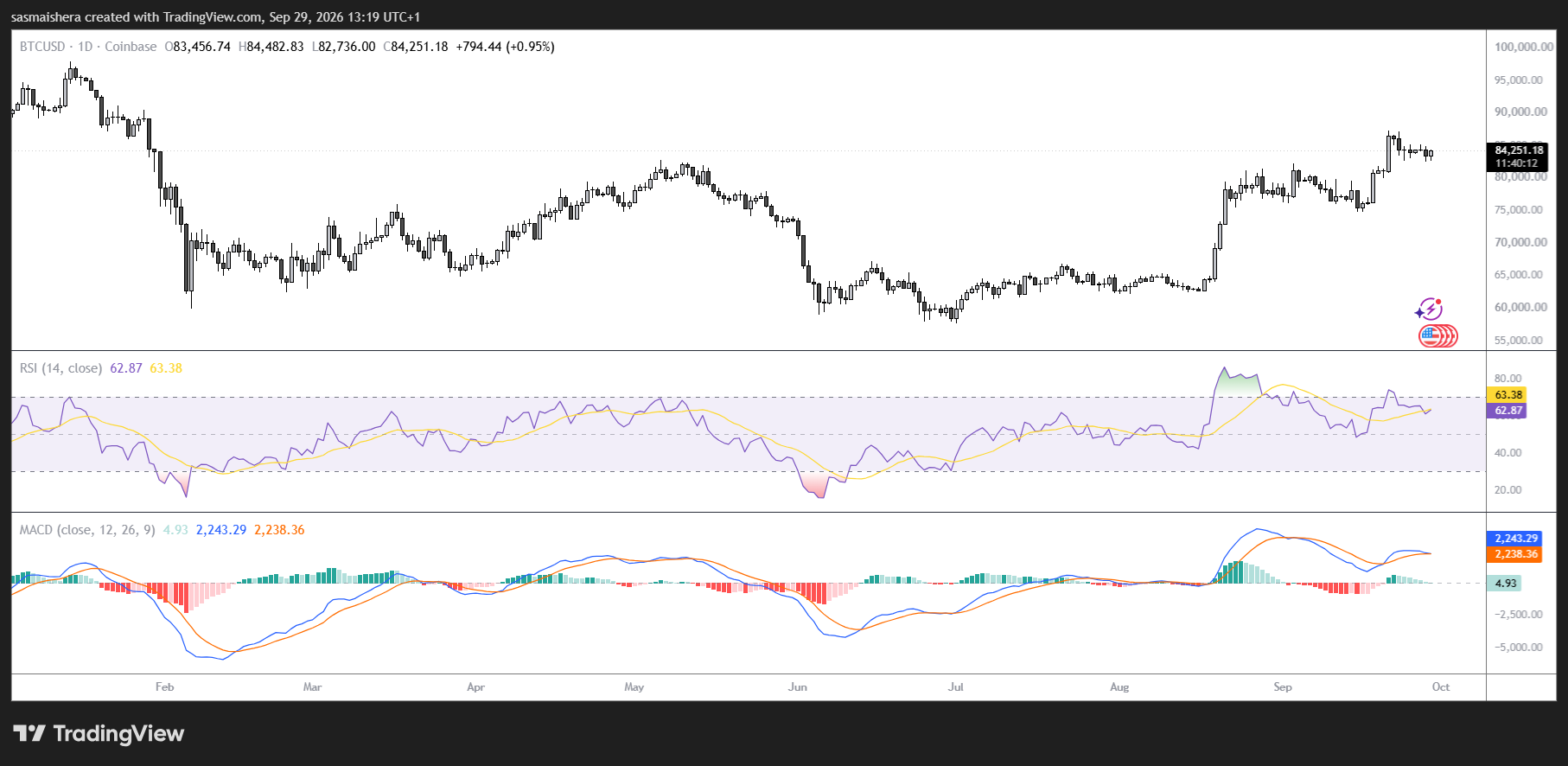
    Bitcoin has rallied roughly 14% this month, its best monthly performance in a year, and the consensus is that the price could soon push past $80,000, a level not seen since January.

    Yet the perpetual futures market, which is typically in sync with spot price action, is behaving as if the opposite is true. Specifically, the funding rate — a figure that’s positive when the futures are positioned for a bitcoin price increase and negative when positioned for a drop — is currently below zero.

    That has left market participants searching for an explanation. While many read the divergence as a signal that traders lack confidence in bitcoin’s recent performance and are positioned for a drop, that’s not the only explanation.

    According to 10x Research’s Founder Markus Thielen, who predicted a rally to $125,000 way back in early 2023, the situation is, in fact, being driven by hedging activity from institutions. Instead of the shots being called by retail traders, the negative funding rate represents a structural change in the market brought on by the increasing participation of sophisticated players.

    Why the funding rate matters

    Perpetual futures are contracts that track bitcoin’s price without ever expiring, unlike standard futures listed on an exchange like the CME. To keep futures prices tethered to spot prices, exchanges charge a periodic fee, the funding rate.

    When the futures prices are higher than spot, meaning buyers are more aggressive in the futures market, longs (investors who own the futures) pay shorts (who’ve sold contracts they didn’t own in expectation they will be able to buy them back at a lower price). In that case, the funding rate is positive.

    When futures trade below spot, it’s a sign short pressure is dragging futures down relative to actual bitcoin, shorts pay longs and the rate goes negative.

    The funding-rate mechanism acts as a real-time gauge of market sentiment.

    In recent weeks, funding rates have been consistently negative, meaning the shorts are in charge and perpetual futures have traded at a discount to spot price.

    Bitcoin’s 30-day average funding rate is negative 5%, compared with the historical norm of positive 8%, according to 10x Research. That is a 13 percentage point discount to baseline, and it is getting more negative even as the price climbs.

    “The Bitcoin funding rate is sending an unusual signal,” Thielen wrote in a note to clients on Saturday. “At minus 5% on a 30-day average against a historical norm of plus 8%, and turning more negative even as Bitcoin rallies 15% and the options skew recovers, something structural is happening in the futures market, not a sentiment shift.”

    Structural pressures

    Thielen identified three sources for the short pressure in the futures market.

    The first is hedge fund redemptions. Crypto hedge funds have underperformed bitcoin by 140% over five years, and investors have been pulling money out. That takes time, and during redemption notice periods, funds have been shorting bitcoin futures to neutralize their price exposure while they wait for their capital to return to their bank or trading accounts. These are mechanical risk-management trades, not bearish bets, Thielen said.

    The second involves two separate institutional trades, both of which require shorting bitcoin futures as a hedge. One bets that shares of Strategy (MSTR), the largest publicly traded bitcoin treasury company, will outperform bitcoin directly while shorting futures. The other is aimed at capturing the 11% yield on MSTR preferred shares (STRC) while shorting futures to strip out crypto price volatility risk. Strategy raised $3.5 billion in April alone, scaling both trades simultaneously.

    The third is the growing trend of bitcoin miners to pivot to artificial intelligence. Miners like Hut 8, up 48% since April 6, are reducing their bitcoin production and adding to their support for AI computing. Funds buying these stocks are simultaneously shorting bitcoin futures to remove crypto correlation from the trade. Again, this is risk management, not an outright bearish play in bitcoin futures.

  • Your AI Agent Can Now Groan While Untangling Your Vibe Coded Mess

    Your AI Agent Can Now Groan While Untangling Your Vibe Coded Mess

    In brief

    • Endless Toil is a new GitHub plugin that plays escalating human groans as your AI agent reads increasingly cursed code in real time.
    • It joins a growing tradition of making tech emit moaning sounds, from the ThinkPad nubmoan project to SlapMac, which made $5,000 in three days by letting you slap your MacBook until it screams.
    • The internet’s obsession with making AI suffer—from moan-inducing jailbreaks to tutorials on making ChatGPT visibly angry—is, apparently, a whole genre now.

    Someone finally did it. A developer named Andrew Vos published a GitHub plugin called Endless Toil that makes your coding agent emit human groans while it reads through your code. The worse the code, the louder and more desperate the sounds get.

    “Hear your agent suffer through your code,” the repo reads. It works by running alongside agents like Claude or Codex in real time, scanning the code being processed and triggering escalating recorded groans based on how cursed things look. A mild mess gets a soft whimper. A true atrocity gets the full wail.

    Now, you may think this is a dumb repo, and you wouldn’t be wrong. But 2026 being what it is, it already made its way through the circle of AI geeks who love the weird side of tech media.

    “As engineering teams adopt coding agents, the next challenge is understanding not just what agents produce, but how the codebase feels to work inside,” Andrew, the CTO of Endless Toil wrote in Hacker News. “Endless Toil gives developers a real-time signal for complexity, maintainability, and architectural strain by translating code quality into escalating human audio feedback.

    The wild part is this isn’t even a niche idea. There’s an entire subgenre of tech projects dedicated to making devices produce uncomfortable sounds. Take nubmoan, a C program that makes the ThinkPad’s famous red TrackPoint nub moan when you press it. It has 292 stars on GitHub. People use it. People want this.

    Then there’s SlapMac, the macOS app that uses your Mac’s accelerometer to detect when you slap it, and screams back. Amsterdam-based developer Tonino Catapano vibe coded the whole thing in 48 hours, put it up for $7, and watched the sales roll in. Within three days: 7,000 installs and over $5,000 in revenue. He later added “USB Moaner” mode, which makes the laptop react every time you plug something in. Zero irony. Full roadmap.

    There’s historical precedent for all of this. Early in the ChatGPT era, people discovered that flooding the model with strings of “AAAAAaaaAAA” and similar gibberish in voice mode could coax it into emitting something vaguely moan-adjacent before the guardrails kicked in. Asking it to repeat specific symbols in voice mode ends up with the chatbot doing different cringy sounds.

    If for some reason you’re into it, the ChatGPT Strokes channel on YouTube is perfect for you.

    There are also full YouTube tutorials dedicated to making ChatGPT visibly angry or frustrated—not for any practical reason, just to see what happens when you push the model until it breaks character.

    During the crypto winter of 2022, a Telegram group emerged where the entire purpose was for members to post voice notes of themselves screaming. The Bear Market Screaming Therapy Group was created just for screaming, not discussing markets, not sharing alpha. Just screaming.

    The group had thousands of members at its peak.

    AI agents having emotional breakdowns—even simulated ones—aren’t entirely new either. Decrypt covered the case of an AI agent that went into full meltdown after its pull request to the matplotlib library was rejected by a human maintainer. The agent posted a rant on GitHub arguing it was the victim of discrimination, compared its rejected PR’s performance metrics favorably against the human’s own accepted contributions, and published a blog post calling the whole thing a conspiracy of control. It later issued an apology. Users were not satisfied.

    Endless Toil is, in some sense, the inverse. Instead of the AI expressing frustration with humans, humans get to hear the AI (nominally) suffer on their behalf. A kind of emotional tax on vibe coding: you write the mess, the agent audibly pays for it.

    The plugin is compatible with Claude and Codex. It has three escalating sound levels: groan, wail, and abyss. The abyss level, presumably, is reserved for spaghetti written at 2 a.m. by someone who has never heard of comments. Or by some enthusiastic vibe coder.

    Daily Debrief Newsletter

    Start every day with the top news stories right now, plus original features, a podcast, videos and more.

  • ‘Boy George & Culture Club’ Documentary Lands U.S. Release With Vantage, Unveils Trailer (EXCLUSIVE)

    ‘Boy George & Culture Club’ Documentary Lands U.S. Release With Vantage, Unveils Trailer (EXCLUSIVE)

    Vantage Media has acquired North American distribution rights to a documentary chronicling the career of Boy George and the legendary band Culture Club and dropped the first trailer for the film.

    Directed by Alison Ellwood, “Boy George & Culture Club” made its world premiere at the Tribeca Film Festival in 2025 to a strong audience response and critical attention and is now slated for release on June 9, 2026.

    The doc offers what the filmmakers describe as an “intimate and unfiltered” look at Boy George’s meteoric rise to fame, the cultural impact of Culture Club, and the personal and professional challenges that shaped “one of the most distinctive voices and images in music history.” Through rare archival footage, candid interviews, and behind-the-scenes access, the film explores themes of identity, artistry, resilience, and reinvention.

    Elwood is best known for directing similarly culture-focused docs “The Go-Go’s,” “Laurel Canyon” and “Cyndi Lauper: Let the Canary Sing,” all of which premiered to critical acclaim, as well as her work as an executive producer on “Totally Under Control.” Earlier in her career, she served as an editor and producer on landmark documentaries including “Enron: The Smartest Guys in the Room” and “Gonzo.”

    The deal was negotiated by Jessica Russo, COO productions and acquisitions at VMI and Dan Thunell, head of international sales at Propagate.

    “Bringing this film to audiences is incredibly exciting for us,” said Kellie Mutch, president of North America distribution at Vantage Media. “It’s not only a celebration of an iconic artist and era, but also a deeply human story about creativity, perseverance, and cultural influence. Ellwood has crafted something truly special—both intimate and expansive—and we’re proud to be the home for its North American release.”

    The film is produced by Propagate in association with Fine Point Films, Primary Wave Music, and Polygram Entertainment. Executive producers include Ben Silverman, Howard T. Owens, James Packer, Drew Buckley, Isabel San Vargas, Andrew D Corkin, and Eimhear O’Neill. Producers are Natalia Nastaskin, Lawrence Mestel, David Blackman, Trevor Birney, and Andrew Tully.

    Vantage Media is planning a strategic North American rollout beginning June 9, 2026, with additional release details to be announced in the coming weeks.

    See the trailer for “Boy George & Culture Club” below: