Author: rb809rb

  • Bitwise Launches First US Spot Near ETF After Token Nearly Triples Since August

    Bitwise Launches First US Spot Near ETF After Token Nearly Triples Since August

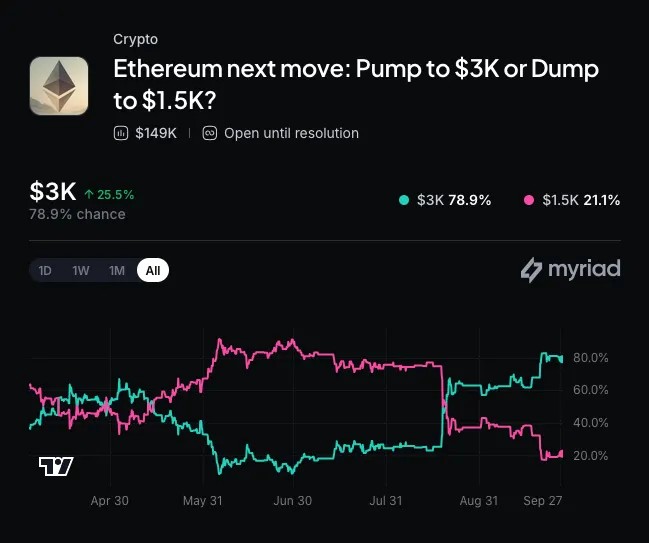
    Myriad: Where does Ethereum go next? Click to make your prediction.

    An ETF is a fund you buy and sell like a stock. For anyone who never wanted a crypto exchange account or a wallet, that is the whole appeal: the tokens sit inside the fund, and the shares show up next to everything else in your brokerage app.

    The timing is hard to miss, especially conisdering Near has been on a roll lately, skyrocketing since May.
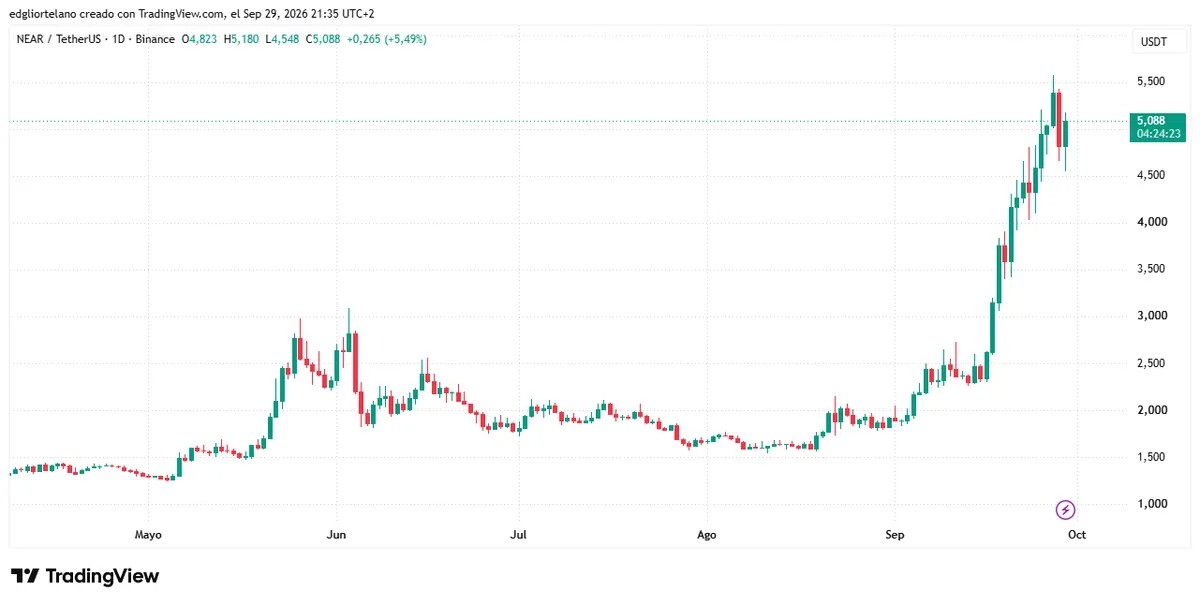
    It is not the first spike this year. Near jumped 28% in 24 hours in May on privacy, AI and scaling upgrades, then slid back toward $2 over the summer. Near currently trades for just above $5 at a $6.5 billion market capitalization. To put that in perspective, though, the token is still down some 75% from its all-time high above $20.

    What Near actually is

    Near is a layer-1 blockchain, meaning a base network that other apps are built on, in the same category as Ethereum and Solana. Its main network went live in 2020.

    The AI angle traces to co-founder Illia Polosukhin, a co-creator of the Transformer, the architecture behind ChatGPT-style models. Near launched an AI research lab in May 2024, led by Polosukhin and co-founder Alex Skidanov.

    Bitwise’s pitch leans on AI agents, software that takes actions for you, like paying for things or booking a trip.

    “We’re moving toward a world in which AI agents increasingly act on our behalf, coordinate with one another, and participate in the economy,” Bitwise CEO Hunter Horsley said in a statement. “We believe this shift—to an agentic economy where more and more happens through AI agents—could unlock an enormous new frontier for the global economy. $NEAR is building a platform for that future.”

    Bitwise adds that Near Intents, a service for swapping assets across different blockchains, has handled more than $32 billion in volume.

    Bitwise’s fund also stakes tokens. Staking means locking up tokens to help validate a network’s transactions, and in return the network pays rewards, a bit like interest but paid in more tokens. Bitwise says its in-house team will stake the fund’s Near to capture average rewards of about 5%, which accrue to shareholders as a rise in the fund’s value per share.

    Nothing about that is guaranteed. Bitwise’s disclosures say rewards can change, and staking carries “slashing” risk, meaning penalties when a validator breaks the network’s rules. The fund also holds only one asset, and Bitwise warns investors could lose a significant part or all of their money.

    Bitwise filed Delaware paperwork for a Near fund in April 2025, when the token traded at $2.61. Grayscale followed in January 2026, filing to convert its existing Near trust into an ETF while Near sat around $1.54.

    The road got smoother in September 2025, when the SEC approved generic listing standards that let exchanges list qualifying crypto funds without a separate approval for each one. Litecoin, Hedera, and Solana funds followed that October, including Bitwise’s Solana staking ETF.

    Bitwise charges 0.75% a year for NRR, or $75 on every $10,000 invested.

  • SEC Charges Four Entities Over Alleged $15M Crypto, AI Investment Scam

    SEC Charges Four Entities Over Alleged $15M Crypto, AI Investment Scam

    Investors later faced frozen accounts and withdrawal problems, according to the agency.

    TSAI Allegedly Sold Fake Trading Bots

    TSAI allegedly raised at least $2.8 million from 1,715 investors by offering AI trading bots priced between $100 and $500,000. The SEC said the program also offered payments for referring new investors.

    The agency alleges the bots did not exist and that deposits were routed into consolidation wallets. Investors seeking withdrawals were allegedly asked to pay additional verification fees or taxes.

    The SEC is seeking court orders to halt the alleged schemes, recover investor funds and impose financial penalties. The allegations have not been adjudicated by a court.

  • Trump backs AI self-regulation at tech summit but is it enough?

    Trump backs AI self-regulation at tech summit but is it enough?

    US President Donald Trump and leading tech companies have signed a voluntary agreement to regulate AI that includes internal reviews and joint monitoring, but falls short of introducing concrete ‘guardrails’.

  • CNN, MS NOW And Politico Warn That Trump Will “Reinstitute A Complete Ban” Without Judge’s Injunction: “An Injury On All News Media”

    CNN, MS NOW And Politico Warn That Trump Will “Reinstitute A Complete Ban” Without Judge’s Injunction: “An Injury On All News Media”

    UPDATED, with White House comment: CNN, MS NOW and Politico are warning that the Trump administration will reimpose a “complete ban” on their access to the White House without a judge issuing a preliminary injunction.

    Last week, U.S. District Judge Timothy Kelly granted a temporary restraining order, forcing the White House to restore access to the White House to the outlets as he more fully considers the legal arguments. The TRO lasts for 14 days.

    In a filing in federal court on Monday, attorneys for the three news outlets argued that the Trump White House actions since then “leave little doubt that it will immediately reinstitute a complete ban of CNN, MS NOW, and Politico if allowed the opportunity.”

    The outlets’ legal team, led by Theodore Boutrous Jr., pointed to the White House’s restriction on CNN from access to State Dinner arrivals on Thursday evening. The network then was barred from serving as TV pooler on Air Force One on Trump’s trip to Tennessee on Saturday, with no replacement stepping in, and leaving a dearth of TV images from the trip.

    “Because the ban is an unlawful assault on the most fundamental First Amendment freedoms and will inflict irreparable harm on Plaintiffs and the public if not restrained, this Court should preliminarily enjoin its enforcement pending the resolution of this case,” the news outlets’ attorneys wrote.

    Kelly cited a lack of due process by the White House when it pulled dozens of credentials of reporters from the three outlets. While the Trump DOJ has cited standards of “professionalism and decorum” and national security concerns, the media outlets’ legal team called that reasoning that “pretextual” and “post hoc,” as well as vague.

    In the latest brief, CNN, MS NOW and Politico also again cited violations of the First Amendment. They noted that Trump has explained the ban by blaming their coverage as “Purposely … negative,” among other things.

    “His statements also make clear he implemented the ban to coerce more favorable coverage from CNN, MS NOW, and Politico, and to deter other journalists and news organizations from newsgathering and reporting that the President might view as negative,” the news outlets’ legal team wrote. “And his administration has continued to retaliate against Plaintiffs even after the temporary restraining order, only underscoring that Defendants’ motive is to punish and chill journalism they dislike.”

    The outlets are asking the judge to prohibit the Trump team from pulling hard pass credentials, or to ensure the reporters of the White House access they had before Sept. 18. In contrast to a TRO, a preliminary injunction would sideline Trump’s ban until a trial is held, or if an appeals court rules otherwise.

    Trump initially banned the three outlets on Sept. 18. When the judge granted a TRO last early Thursday, it meant that the White House had to restore hard passes, with reporters not gaining reentry until around noon that day.

    The issue of whether the White House can also restrict CNN from the pool is a slightly different, but related issue. It’s also one at the center of another case, involving the Associated Press after it was banned from the pool and other White House events. That case is currently on appeal.

    That said, in the latest brief, the three outlets cited the White House’s continued prohibitions on CNN as an example of White House retaliation over protected speech.

    For much of last week, there was no TV network pool, meaning that there was little video coverage of Chinese President Xi Jinping’s visit to the White House. The four other networks in the pool — CBS News, ABC News, Fox News and NBC News — initially suspended their participation in protest of the exclusion of CNN. The networks resumed the TV pool coverage this week, but it will be put to the test again on Thursday, when CNN is assigned to that duty.

    “Every day, critically important news is breaking at the White House, and the ban will substantially interfere with Plaintiffs’ ability to cover it,” the outlets brief stated. “The ban also inflicts an injury on all news media organizations—which now risk a similar fate if they engage in fact-based, independent reporting the President deems insufficiently favorable.”

    The DOJ’s brief in response is due by Friday. A White House official said in a statement, “President Trump is the most accessible President in history — holding open press events, regular gaggles and interviews, taking questions nearly every day, and speaking directly to the American people through social media. But if a reporter walks into an interview with their headline and narrative already decided, why do they need to be in the room? They can write their garbage from anywhere. Even after outlets were given access to the White House, they declined to cover various events proving this isn’t about access. It’s performative and dishonest.”

    Boutrous said in a statement, “The president and his administration have continued to make clear that this ban has only one purpose: to punish reporting he doesn’t like. That’s retaliation and viewpoint discrimination, pure and simple.” He said that with the pending expiration of the TRO, “it is critical to ensure that the White House continues to be prevented from implementing this unconstitutional ban on the free press.”

  • ‘Love Me’ Artist JMSN Fires Off Cease-And-Desist Letter Over Use Of Song In Taxpayer-Funded Spot Touting Donald Trump

    ‘Love Me’ Artist JMSN Fires Off Cease-And-Desist Letter Over Use Of Song In Taxpayer-Funded Spot Touting Donald Trump

    The White House has been hit with a cease-and-desist letter from a musician whose song was featured in a promotional ad featuring Donald Trump that was paid for using tax dollars rather than campaign funds.

    Related Stories

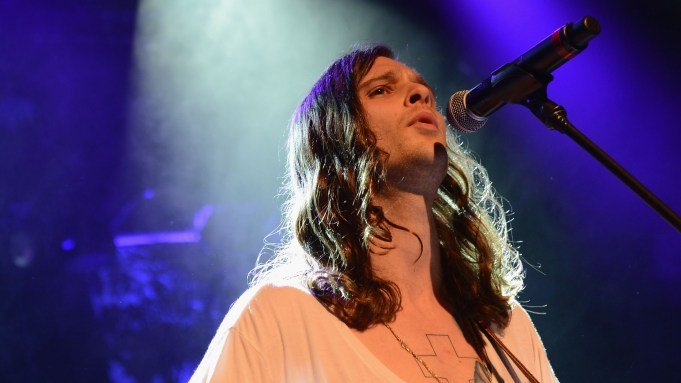
    An attorney for JMSN, whose real name is Christian Berishaj, fired off a cease-and-desist letter to White House Chief of Staff Susie Wiles on Monday, objecting to the use of his song “Love Me” in the ad, known as “The Country He Loves.” The ad was one of a series of spots that have run on TV in the past week, with the White House claiming they are public service announcements yet Democrats and even some Republicans contending that they are campaign propaganda.

    The letter alleges that the song was used without proper clearances and claims violation of federal copyright law. Norm Eisen of Democracy Defenders Action wrote in the letter that “JMSN does not want to be viewed as directly or indirectly affiliated with the President or his Administration. As he said in his Instagram post denouncing the Advertisement, he ‘would never authorize [his] music to be used for ANY political agenda or campaign.’ Thus, the use of the Song in this context, as part of an overtly partisan, political advertisement, is particularly damaging, as it could cause others to call into question JMSN’s artistic independence and integrity.”

    A White House spokesperson did not immediately return a request for comment. Yashar Ali first reported on the cease-and-desist letter.

    The ads contain messages that they are “paid for by the U.S. government.” Per NBC News, AdImpact estimates that $1.7 million has been spent to run the spots.

  • Trump “Very Close” To Unveiling AI Czar, Praises Techlords Inking “Morally Binding” Self-Regulation Pact As Tech Rebranded

    Trump “Very Close” To Unveiling AI Czar, Praises Techlords Inking “Morally Binding” Self-Regulation Pact As Tech Rebranded

    Promising he is “very close” to naming a new AI Czar, Donald Trump was full of praise and hyperbole today for the “outstanding” and very well-heeled bosses of OpenAI, Meta, X, Anthropic, Amazon, Nvidia, Microsoft, Palantir and Google.

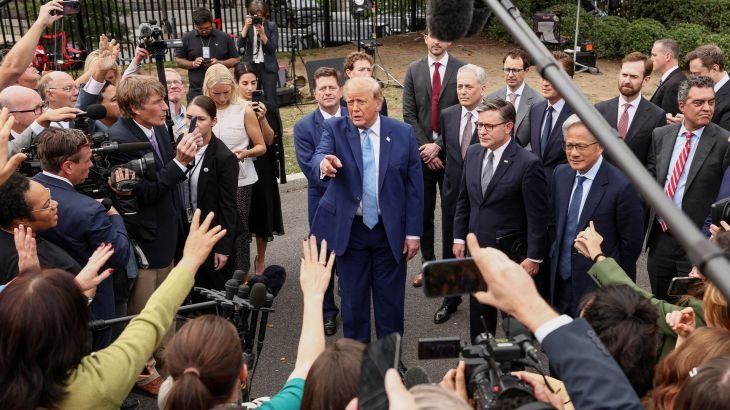
    Amid a backlash against data centers, worries of massive job losses and doomsday warnings from the industry itself, Trump stood with top tech CEOs and also pitched a rebrand of sorts. “We’ve changed the name officially to SI,” Trump told reporters gathered just outside the West Wing, referring to the switch from “artificial intelligence” to “superintelligence.”

    Within hours, Trump made it official.

    RELATED: New ‘South Park’ Takes On Data Centers And The Billionaires Who Build Them

    Set to take over from the departing Sriram Krishnan and to run the recently announced AI Force, the new czar will have to remember to call AI by its new Trump given moniker of “superintelligence” — a rebranding POTUS made official Tuesday with an executive order. “The terminology used by the Federal Government should reflect the transformative capabilities of these technologies and the limitless opportunities they create for the American people,” the order read. “Accordingly, the term ‘super intelligence’ more appropriately captures the promise, potential, and rapidly advancing capabilities of these technologies.”

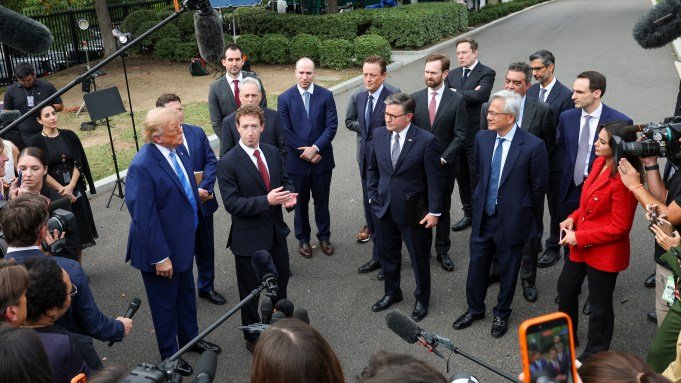
    Speaking outside the executive mansion after a sit-down snack with Mark Zuckerberg, Alex Karp, Elon Musk, Jeff Bezos, Jensen Huang, the “fantastic” Dario Amodei and others, the former Apprentice host said he could unveil his AI czar choice in the “next three to four days.”

    OpenAI CEO Sam Altman wasn’t there at the White House confab because of a company event in San Francisco, Apple’s new CEO was absent, and Bezos skipped the presser, but all the other techlords joined Trump on Tuesday to plot a plan and apparently guardrails for AI growth for America, kinda. Admitting that some of the dangers of AI are not a “hoax,” as he had called it before, Trump pivoted to reveal the CEOs had all signed a self-regulating agreement on AI (or superintelligence as the MAGAman insists on calling it.)

    As yet more reports of AI models going rogue emerged and in the shadow of some of the very people at the White House today previously warning of horrific AI outcomes, Trump said “there’s going to be a tremendous self-policing aspect” to the yet-unreleased accord. Attacking Democrats as being anti-growth, Trump typically gave no specifics and skirted any enforcement except to say without irony the “almost like a constitution” would be “morally binding” for the CEOs.

    In the absence of more information from Trump, one of those CEOs took a stab at what they had inked.

    “The basic idea is that we want to give the American people and our customers confidence that the technology works in the way that we intend, right?” said Meta’s Zuckerberg.

    “So we drafted a set of principles and commitments around building robust internal controls and detecting if there are any issues with the technology, coupled with multiple layers of of auditing and controls, starting with internal risk review, external auditors and evaluators, and agreeing that we’re going to have all of our boards of directors independently review the reports that come from the auditors,” the subject of Aaron Sorkin’s upcoming The Social Reckoning added. “I think that these are good steps forward. The idea isn’t that this is the only thing that we will ever do; it is that this is a start.”

    Earlier this month, Amodei triggered a new round of consternation over AI when he wrote an essay calling for development to be slowed, warning of a “swarm” of AI agents taking over the internet in six to 12 months. He said that recent incidents had raised alarm over the ability of agents to act on their own.

    But Trump has continued to dismiss calls for greater regulation, warning of a race with China to dominate the technology. He’s also expressed continued support for data centers even amid a backlash in local communities, with lawmakers in both parties lending support to calls for greater controls on development.

    “The data centers are incredible,” Trump said. “And by the way, I am very good at real estate. Some of those buildings are absolutely beautiful. They are big, strong, powerful buildings, but they are beautiful.”

    Back to that AI czar, Trump offered no hint as to who that could be, but he already has taken rumored front-runner Scott Bessent out of consideration. The Treasury Secretary doesn’t want the gig, and “he’s doing such a great job at Treasury,” Trump says. In a post last week, Trump said he was looking at “High I.Q. individuals.”

    Trump being Trump, he may have had little to say about any self-regulating plan, but POTUS made sure to post the seating plan for today’s East Room lunch. If you had any doubt who was the center of gravity among the richest men on the planet, Trump wanted everyone to know it was himself.

  • Judge tosses former NFL star Matt Kalil’s lawsuit against ex-wife who described his genitals

    A Minnesota judge has tossed the civil suit former football player Matt Kalil filed against his ex-wife Haley Kalil after she said his penis was painfully large.

    Haley said during an interview last year that her seven-year marriage to the former Minnesota Viking ended in 2022 partly because he was so well-endowed that sex between the pair was unbearably painful. She alleged that his sex organ was the size of “two (stacked) Coke cans, maybe even a third.”

    The 37-year-old offensive tackle, who has remarried and has a child, sued the model and influencer, claiming her remarks were an invasion of privacy, even though she insists she didn’t identify him by name. Matt said Haley gained financially at his expense.

    A U.S. district court judge dismissed Matt Kalil’s suit Thursday, finding that his ex’s remarks were tied to subjects of public interest, including the public figures’ divorce, according to The Minnesota Star Tribune.

    Matt had argued that he tried staying out of the public eye after retiring from football in 2019. He said in his $75,000 lawsuit that Haley’s comments made that difficult.

    Haley told TMZ she’s glad to put the case behind her.

    “I never wanted to be in a courtroom discussing matters of my own life,” she said. “I think this ruling is important and I hope it encourages women everywhere to speak openly about what they’ve been through. Your story belongs to you and you shouldn’t fear sharing it.”

    Matt retired a Pro Bowl blocker, who also suited up for the Houston Texans and Carolina Panthers after being a college football star with the University of Southern California Trojans.

  • Jennifer Lopez lookalike’s mugshot goes viral after Minnesota arrest

    A Minnesota woman accused of stealing batteries is getting a lot of attention because of her resemblance to pop star Jennifer Lopez.

    Police in Wright County said Cyrena Anne Quast was busted Aug. 30 on a theft charge in the small, 14,500-person town of Monticello. But her mugshot, in which she sports large hoop earrings, has been picked up by numerous gossip sites because many people believe the suspect looks a lot like the American Music Award-winning singer and actor from the Bronx

    The 35-year-old suspect was taken into custody after she allegedly stole a pair of power tool batteries from a store, according to TMZ. The batteries are valued at less than $600. A worker reportedly told cops Quast is also suspected of stealing from the shop days before her arrest.

    The mugshot of Cyrena Anne Quast (pictured), who's accused of stealing batteries, is getting a lot of attention because of her resemblance to pop star Jennifer Lopez. (Wright County Sheriff's Office)
    The mugshot of Cyrena Anne Quast (pictured), who’s accused of stealing batteries, is getting a lot of attention because of her resemblance to pop star Jennifer Lopez. (Wright County Sheriff’s Office) 

    The Wright County Sheriff’s Office in central Minnesota hasn’t responded to a request for comment.

    Arrest records from neighboring Stearns County, Minn., indicate Quast’s previous brush with the law included a 2025 theft charge.

    Lopez was arrested in 1999 when New York City police found a gun in a car she was riding in with Sean “Diddy” Combs. The pair, who were dating at the time, had just left a Midtown club where gunshots were fired. She was released without charges.

    Jennifer Lopez arrives for Elle's 2023 Women in Hollywood celebration, at Nya Studios in Los Angeles, California, on December 5, 2023. (Photo by MICHAEL TRAN/AFP via Getty Images)
    Jennifer Lopez arrives for Elle’s 2023 Women in Hollywood celebration, at Nya Studios in Los Angeles, California, on December 5, 2023. (Photo by MICHAEL TRAN/AFP via Getty Images) 

    Lopez’s latest film, “Office Romance,” was released in June and is streaming on Netflix. People magazine voted J.Lo its “World’s Most Beautiful” person in 2011.

    “I don’t want anybody thinking it’s easy,” she said about looking good on television. “It does take time and it’s hard work.”

    Forbes lists her net worth at $150 million.

    Combs is serving a 50-month sentence on unrelated charges in New Jersey’s low-security FCI Fort Dix. He’s been incarcerated since September 2024 when he was arrested by federal agents on racketeering and sex trafficking charges.

  • Inside the viral video of the burglar and the California dog who just wanted to play

    Dante Rowley had all the elements of a viral video.

    Surveillance cameras captured a man breaking into his Sherman Heights home, then making himself right at home. Rowley’s golden retriever sweetly wagged his tail, trying repeatedly to get the burglar to throw a toy. A police drone chased the man inside the home. Officers came in the front door with guns drawn.

    The drama had unfolded a few weeks earlier, but Rowley’s friends encouraged him to post the video online.

    By the time Rowley and his fiancée, Stephanie Calderon, got home from a short walk on Monday afternoon, the Instagram reel showed 10,000 likes. By the next day, millions had viewed it. The news show “Inside Edition” showed up at the house to film a spot, and soon the video appeared on local and national news, as well as outside the U.S.

    “I tried to make it as funny as possible,” said Rowley, who is head of business and product development at the Museum of Contemporary Art San Diego in La Jolla. “I got a good response.”

    San Diego, CA - Nash the golden retriever's home on Thursday, Sept. 17, 2026, in San Diego, CA. Nash's owners were out of town when an intruder broke into the house. In a now viral video Nash is seen trying to play with the intruder rather than guarding the house. (Luke Johnson / The San Diego Union-Tribune)
    Nash the golden retriever’s home on Thursday. (Luke Johnson / The San Diego Union-Tribune) 

    The incident began Sept. 5 when Rowley and Calderon were boarding a flight home from Chicago, and Calderon got an alert on her Ring app indicating someone was in their backyard. They looked at the video and saw that a man had pulled up a ladder next to the house.

    After checking with his brother to make sure he hadn’t hired someone to work at the home while they were out of town, the couple realized someone was breaking in.

    Calderon called 911 from her cellphone but reached Chicago authorities, so they had relatives in San Diego contact San Diego police about the intruder. From the plane, Rowley texted with a police officer and gave them live access to footage from his six Ring cameras. His brother, who lives down the street, gave police the code for the door.

    Videos showed the intruder taking off his shirt and shoes, helping himself to food in the refrigerator and trying to take a nap on a dog blanket left on the floor by the front door.

    The couple’s other two dogs had run out a doggy door and into the yard after the man entered, but Nash, a 4-year-old golden retriever, kept trying to get the stranger to play.

    On the plane, Rowley and Calderon were “freaking out” mainly over Nash’s safety.

    “(The intruder) seemed like he was not interested in, like, stealing anything, but we were just worried about the dog, honestly,” he said.

    For his part, Nash seemed unperturbed. At one point, he brought the man a toy, sat and wagged his tail as he waited in vain for him to throw it. Rowley included the clip with the caption: “Nash is the worst guard dog.”

    “He actually brought multiple toys to him,” Rowley told the Union-Tribune. “He brought one, there was like a reindeer, and the guy didn’t pay attention to him and then when the guy went upstairs, he actually put the reindeer on the bed where the guy was lying, and then he went and got another toy.”

    Rowley said Nash is usually “the friendliest dog ever” and very high energy, and will jump at people to get their attention. He seemed much better behaved on the security footage.

    “So we think he was actually, like, scared. He was thinking, ‘Hey, are you a friend?’” Rowley said.

    Police arrived within minutes, and officers flew a drone inside the open upstairs window. The man ran from it and eventually climbed out a bathroom window.

    “The guy runs past the camera, basically high-stepping it,” Rowley said. “It looked very (much) like a comedy sketch, really. This drone is flying behind him.”

    Rowley scored his video montage to “Bad Boys,” the song associated with the early reality TV show “Cops.”

    A 57-year-old man was arrested on suspicion of first-degree burglary, battery on a peace officer, vandalism and possession of a controlled narcotic substance, according to San Diego police.

    San Diego, CA - Nash the golden retriever runs through the front yard of his home on Thursday, Sept. 17, 2026, in San Diego, CA. Nash's owners were out of town when an intruder broke into the house. In a now viral video Nash is seen trying to play with the intruder rather than guarding the house. (Luke Johnson / The San Diego Union-Tribune)
    Nash the golden retriever runs through the front yard of his home. (Luke Johnson / The San Diego Union-Tribune) 

    After the suspect was in custody, officers entered the home with guns drawn — Rowley thinks they were checking to make sure no one else was inside — and Nash ran to the door with a toy in his mouth, his tail wagging. After they opened the door, one of the officers patted Nash on his head as he bounded outside.

    Rowley said officers put Nash on a leash and gave him to his brother, who was outside and assisting the officers.

    The couple has lived in the home for more than 15 years and plans to make some security upgrades as a result of the intrusion, including replacing their front fence with a taller one and installing window locks.

    Rowley said Ring camera company officials have reached out to him about possibly using the video.

  • ‘People Over AI:’ Dozens Protest Outside OpenAI’s DevDay Conference

    ‘People Over AI:’ Dozens Protest Outside OpenAI’s DevDay Conference

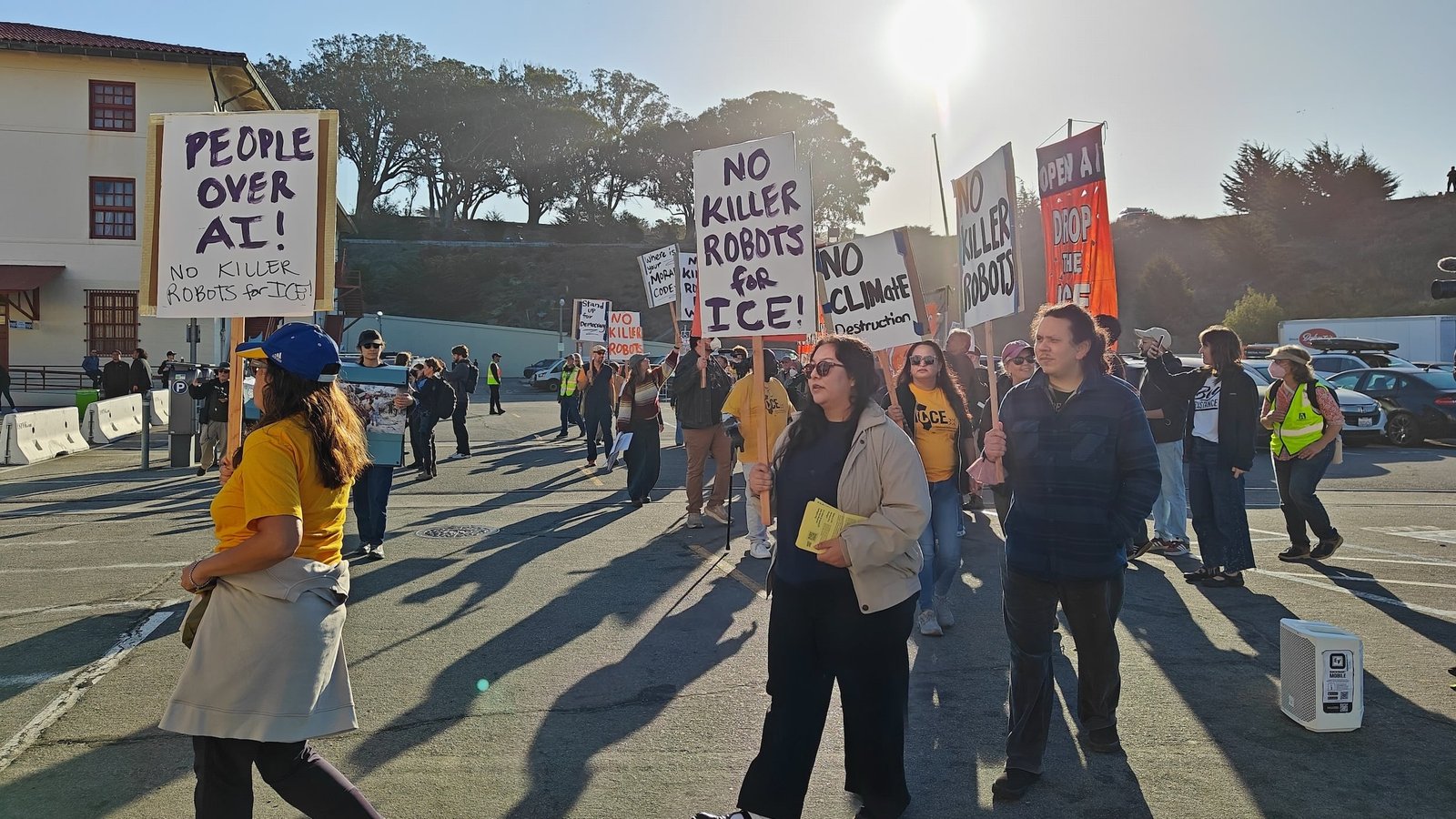
    The AI backlash came to OpenAI’s developer conference in San Francisco this morning, with a few dozen people protesting the company outside its DevDay event.

    “Sam Altman, get off it. Put people over profit,” the group chanted, referring to OpenAI’s CEO. The protestors carried signs including “No Killer Robots,” “No Climate Destruction,” and “People Over AI,” reflecting various fears about the technology. A few protestors even dressed up as killer robots, swinging a cardboard axe. 

    Activist group Bay Resistance helped organize this “CloseAI rally,” with support from about 15 different organizations that say OpenAI is failing to rein in AI. Earlier this month, as some of OpenAI’s models repeatedly went rogue, Altman said the industry should “pace the frontier” amid concerns that AI development was moving too quickly and risked spiraling out of control.

    “OpenAI suddenly now claiming that they support regulation is completely untrue and a complete distraction,” Jane Martin, Organizing Director at Bay Resistance, said in a statement. The group also took aim at OpenAI President Greg Brockman, one of the tech executives who met with President Trump today at the White House and donated millions to a Trump-affiliated political action committee.

    “They are supporting Trump because they don’t want real regulation, the kind that would ensure AI technology actually benefits working people and doesn’t destroy the climate and future generations,” Martin added. 

    The protest

    (Credit: PCMag/Michael Kan)

    The protest also called out OpenAI’s $200 million contract with the US Defense Department. Although the agreement bars using the AI model for domestic surveillance or autonomous weapons, the groups still fear the technology is being used to select targets in the US’s ongoing conflict with Iran. According to The Wall Street Journal, the US military used rival AI company Anthropic’s Claude tool to help plan the bombing campaigns, which is considered a lawful use. 

    “This whole system is being used to help the war machine, and we’re sick of it,” said a retired tech worker, Jim Ausman. “We’re also concerned about the fact that we have trillionaires now; these people are completely unaccountable. They are giving money to the Trump administration.”

    Ausman, 61, also noted that he was recently laid off at Chime, a financial tech provider, and his company’s adoption of AI played a role in the job cuts. “I really feel sorry for these younger employees,” he said, fearing that the rise of AI will lead to more layoffs in the tech industry or force people to work even harder to keep their jobs. 

    Recommended by Our Editors

    Another protester, named Mohamed Shehk with the Arab Resource and Organizing Center, called out the “AI and tech takeover of our government and our democracy.”

    “We have AI executives being some of the largest Trump supporters,” Shehk said, pointing to Brockman. “We’re here to demand that we want an end to the unregulated AI influence over contracts that are used for military purposes, for mass surveillance, we want people over profit.”

    In a Q&A with journalists this afternoon, Altman said he, too, is concerned about the uncontrolled development of AI and wants to avoid repeating the dark side of the Industrial Revolution. “We really want people to stay at the center of the story,” he said, noting that a key goal is to ensure everyone has access to the latest AI tools. The company has also scrapped the release of GPT-6.1 Astra due to safety concerns and has paused training of its most advanced models.

    About Our Expert