Author: rb809rb

  • Metaplanet Sold 10,000 Bitcoin and Bought Back 11,000 to Prove a Point

    Metaplanet Sold 10,000 Bitcoin and Bought Back 11,000 to Prove a Point

    In brief

    • Metaplanet sold 10,000 BTC and repurchased 11,000 during the third quarter, a net gain of 1,000 that brings its holdings to 44,000 BTC.
    • It sold more than the full principal of its bonds and borrowings, held the cash, and left the debts outstanding.
    • The sale produced a U.S. capital loss, against which it estimates a deferred tax asset of about $97 million.

    Metaplanet sold 10,000 BTC and bought back 11,000 during the third quarter, the Tokyo-listed treasury company disclosed, in a round trip staged to prove to credit rating agencies that it is both able and willing to turn its Bitcoin into cash.

    The net effect was an increase of 1,000 BTC, taking the group’s holdings to 44,000 BTC as of September 30, per BitcoinTresauries.

    “Rating agencies and credit investors ask one question of a Bitcoin company: can that Bitcoin be turned into cash to meet obligations, and will it be?” chief executive Simon Gerovich tweeted. “We answered by doing it.”

    The reasoning in the filing is that while Bitcoin is liquid, what matters to rating agencies and bond investors is not only whether an asset can be sold but whether the issuer will actually sell it when obligations fall due. Rather than assert that, Metaplanet decided to demonstrate it with a real transaction.

    So it sold an amount of Bitcoin exceeding the entire outstanding principal of its bonds, borrowings and other interest-bearing liabilities, and held the proceeds in cash. The debts were not repaid and remain outstanding on their original terms. Its liabilities, net of cash and dollar stablecoins, stood at ¥122.4 billion at quarter end, against sale proceeds of ¥124.7 billion.
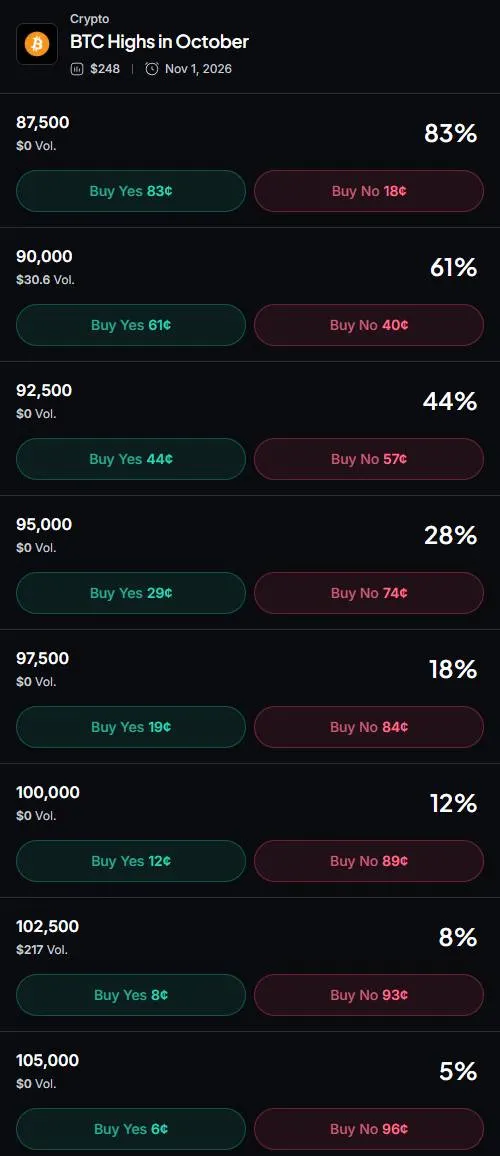
    Myriad: How high will Bitcoin go? Click to make your prediction.
    Myriad: How high will Bitcoin go? Click to make your prediction.

    Metaplanet points in the filing to “a previously published issuer credit rating of an overseas peer company” as the precedent, saying it showed that an issuer refusing or reluctant to sell its Bitcoin may find the asset given little weight in a credit assessment. It did not name the company. S&P assigned Strategy a B- issuer credit rating in October 2025, the first awarded to a Bitcoin treasury company, citing low dollar liquidity among its concerns and warning that a downturn could force sales at depressed prices.

    Strategy has since moved further than that. It approved a Digital Credit Capital Framework in June permitting sales of up to $1.25 billion to fund its cash reserve, dividends and buybacks, and had sold 6,948 BTC for about $432.5 million by August. The firm’s Chair, Michael Saylor, has recast his position as never being “a net seller” of Bitcoin rather than never selling. It has since resumed Bitcoin purchases, surpassing its previous record holdings late last month.

    The intent differs, with Strategy selling Bitcoin to meet obligations, while Metaplanet sold to prove it could, held the cash, then bought back more than it had sold. It came at a cost, with Metaplanet selling at an average of ¥12.47 million per BTC and buying back at ¥13.63 million, roughly 9% higher, so the net 1,000 BTC cost ¥25.2 billion against repurchases priced near ¥13.6 million each.

    BitcoinBTC · USD

    $85,649+1.91%

    Sep 28Sep 30Oct 2Oct 4Oct 5

    $86.8k$85.5k$84.2k$83.0k

    24h HighHigh$86,949

    24h LowLow$85,010

    VolVol$1.5B

    Market projectionsOdds by Myriad

    →

    Because the coins sold had been bought above the sale price, the disposal produced a capital loss for U.S. purposes, and the company estimates a deferred tax asset of about $97 million at subsidiaries of its U.S. holding company. The figure is preliminary and unaudited, and may not be recognized at all. Since Metaplanet carries Bitcoin at fair value, the loss does not create a new accounting loss.

    The company says it now intends to pursue a credit rating, and that its Bitcoin Income Generation business has booked revenue for eight consecutive quarters. Gerovich said the holdings make Metaplanet the second-largest listed Bitcoin treasury company in the world, and that the strategy “was never simply to accumulate Bitcoin.”

    He also announced a Net Interest Income Strategy, which he said is “designed to create recurring income streams and lower our effective cost of capital.” It sits alongside a pending Superplanet transaction and the build-out of Metaplanet Securities, in what he described as a unified push toward a Bitcoin-based financial institution.

    The quarter also marks a further slowdown in accumulation. Metaplanet added 2,823 BTC in the second quarter, itself a cooling from earlier in the year; the third quarter’s net addition was roughly a third of that.

    Daily Debrief Newsletter

    Start every day with the top news stories right now, plus original features, a podcast, videos and more.

  • Hollywood Unions Warn of 25-Year Decline in U.S. Production Market Share

    Hollywood Unions Warn of 25-Year Decline in U.S. Production Market Share

    A coalition of Hollywood unions issued a report on Monday warning that the U.S. has lost significant market share in film and TV production over the last 25 years.

    The report found that studios spent 74% of their film production budgets in the U.S. 25 years ago, but that the figure has since declined to 42%. On the TV side, the figure has fallen from 94% to 64%.

    The unions — including IATSE, the Directors Guild of America and SAG-AFTRA — published the report as Congress is considering whether to offer a 20%-30% production incentive to revive the domestic film and TV industry. Supporters have argued that the U.S. needs to counter generous incentives offered by Canada, the U.K., and other countries, and that state-based subsidies are inadequate.

    Members of Congress have focused on the sharp downturn in domestic production jobs since the end of Peak TV in 2022. But the union report, prepared by EY, takes a longer-term view, showing that the globalization of production has been underway since the turn of the millennium.

    The report acknowledges that production has grown considerably over that period — so the U.S. is taking a smaller piece of a much larger pie.

    The study looks only at films with budgets of $5 million or more, in 2025 dollars, and TV episodes costing at least $1 million, for those 40 minutes or shorter, and at least $1.7 million for episodes longer than 40 minutes.

    In film, the report found that overall production spending by major studios rose from $3 billion to $7 billion annually in the last 25 years. And in TV, spending exploded from $933 million to $8.4 billion over the same span. The report acknowledges that the TV landscape has changed so dramatically over the past two decades that it is hard to draw clear comparisons.

    “The rise of streaming fundamentally altered production scale, budgets, season lengths, and release models, creating discontinuities in what constitutes a comparable television series across periods,” the authors wrote.

    The report is also limited in that it does not attempt to explain why production has shifted overseas — only to quantify the shift.

    The report finds that big-budget films account for much of the exodus. For the 25 most expensive films, the U.S. market share declined from 74% to 34% over the 25-year span. Those 25 films represented a quarter of all films produced by the major studios, but half of the crew and two-thirds of the budgets.

    “This highlights that production budgets are heavily concentrated within a small subset of films,” the report notes. “Patterns observed within this group generally reflect the broader analysis trends, albeit with a somewhat larger decline.”

    The report argues that if U.S. market share had held constant over the last 25 years, an additional $4 billion would be spent each year on TV and film production in the U.S.

    The Motion Picture Association issued its own report last month, arguing that a federal incentive would generate an additional $22 billion in annual domestic production spending by 2035. The MPA report did not attempt to measure the historical trend in market share, but did warn that market share will decline in the future if Congress does not act.

    The unions are set to hold a rally with Sen. Adam Schiff and many Democratic members of the California Congressional delegation on Tuesday in Glendale. Schiff and others last month introduced a federal credit that would combine with state-based subsidies to create the world’s most generous incentive regime.

    With support from President Trump, who came out in favor of the idea in August, backers are hoping to pass the incentive into law by the end of the year.

  • Solana ETF inflows collapsed 99% but SOL holds firm: what are bulls seeing

    ETF inflows drop nearly 99%

    Solana-focused ETFs recorded $2.43 million in net inflows last week, according to CoinGlass data.

    That compares with $188.22 million the previous week—a decline of approximately 98.7%. Although the funds extended their positive streak to 14 consecutive weeks, the latest total shows a substantial reduction in fresh allocations.

    The distinction is important: demand slowed sharply, but the funds did not experience a net weekly withdrawal.

    The figures suggest ETF buying offered much less support than during the preceding week. Whether that represents a temporary pause or a more persistent slowdown will depend on subsequent flows.

    ETF activity also captures only one channel of $SOL investment. It does not provide a complete measure of buying and selling across exchanges, decentralized markets, and other investment vehicles.

    Solana’s network continued showing signs of active usage despite softer ETF inflows.

    According to SolanaFloor, the network’s decentralized exchange volume on Sunday exceeded the combined volume of Ethereum mainnet, Ethereum Layer-2 networks and Hyperliquid.

    The comparison highlights strong activity during that session, although one day’s performance does not establish a lasting lead.

    The platform also cites more than $4.4 billion in tokenized-stock trading volume on Solana. That points to growing activity around blockchain-based exposure to traditional equities.

    The supplied figures do not specify the measurement period for that total. It should therefore be distinguished from the Sunday DEX comparison rather than treated as a daily reading.

    Together, the reports support a picture of continued ecosystem participation, even as investment through ETFs moderates.

    Solana technical forecast: Triangle pattern keeps breakout levels in focus

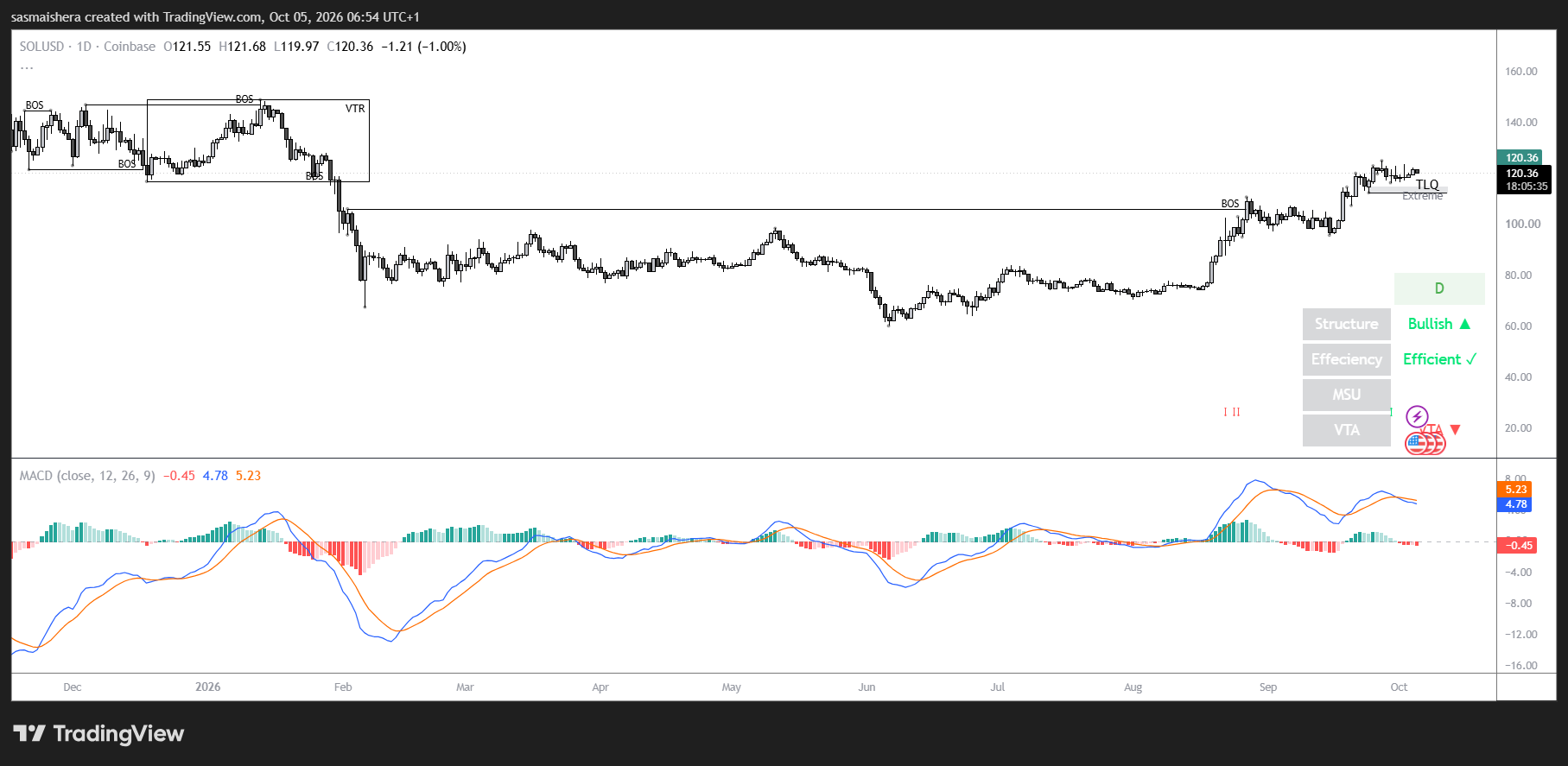
    On the four-hour and daily charts, $SOL remains above its 50-, 100-, and 200-period exponential moving averages, positioned around $119.24, $116.43, and $110.44.

    A rising support trendline near $119.16 and overhead resistance around $123 form the triangle. This narrowing structure suggests price is consolidating between nearby buying and selling levels.

    The pattern alone does not determine which direction the eventual breakout will take.

    Daily momentum remains constructive. The Relative Strength Index is near 54, while the Moving Average Convergence Divergence indicator is mildly positive.

    Those readings favor a modest bullish bias rather than an especially strong momentum surge.

    The immediate upside hurdle is the resistance trendline around $123, followed by September’s high at $124.95.

    A confirmed move above both levels would strengthen the case for extending the recovery. The Fibonacci projection places the next potential target at $132.87.

    That target remains conditional on a successful breakout. A brief move above resistance followed by a reversal would provide weaker confirmation than sustained trading above the cluster.

    Initial support is concentrated between approximately $118.71 and $119.25.

    That area combines a Fibonacci level, the rising trendline, and the 50-period EMA. Holding it would help preserve the short-term recovery structure.

    A decisive break below the cluster would bring the 100-period EMA near $116.43 into focus. The 200-period EMA around $110.44 sits further below.

    For now, $SOL’s technical bias remains mildly bullish, but its next move depends on whether buyers defend nearby support and generate enough demand to overcome resistance.

  • “What the Hell Else Can I Do?”—Cardano Founder Defends ADA Progress

    “What the Hell Else Can I Do?”—Cardano Founder Defends ADA Progress

    Hoskinson rejected that argument, noting that $NIGHT itself was issued on Cardano and asking why a project built from the Cardano ecosystem should be viewed as harmful to it.

    The stupidity is strong here. Apparently, launching a project on Cardano is bad for Cardano. Tell me where is night the issued. What was the first CNA to be listed on Binance? What wallets do people use to manage their night?

    If this is how Cardano treats the people building on… https://t.co/j2x0TvJl63

    — Charles Hoskinson (@IOHK_Charles) October 3, 2026

    Another critic went further, comparing Hoskinson to a “used car salesman” and pointing to what he described as weak liquidity, stablecoins, and DEX volume.

    He also accused Hoskinson of blaming $ADA holders rather than developers when the ecosystem struggles.

    Charles starting to sound like a used car salesman. If the cars broken, it’s your problem. Low liquidity, no stablecoins, no DEX volume. $ADA holders are aways the issue with him never the DEVs. We’ve been taken for a ride full circle. Most people just want their money back.

    — Kash_the_Kreator (@Nikkash4) October 4, 2026

    Hoskinson Points to RealFi, Midnight and New Integrations

    Hoskinson responded with a list of projects that have moved forward this year.

    Explain what I should do differently. We just launched RealFI; Pogun is on the way; we launched Midnight; and now we have Midnight. city. We did the Pentad that brought LayerZero, Fireblock, Pyth, Circle, and other integrations to Cardano. We have Draper and Alphagrowth. All…

    — Charles Hoskinson (@IOHK_Charles) October 4, 2026

    RealFi went live on Cardano mainnet on Oct. 1, following months of public testing. Midnight, meanwhile, launched its network in March, while $NIGHT had already launched as a Cardano Native Asset in December 2025.

    Midnight.city is also operating in open beta as an AI-focused application tied to the wider Midnight ecosystem.

    He also mentioned Pogun, a Bitcoin-focused DeFi project covering credit, yield and bridging. Its 12.29 million $ADA treasury request failed to secure enough support in September, although Hoskinson has continued to say the project is moving ahead.

    Then there is the Pentad’s infrastructure push. USDCx and Pyth have gone live, LayerZero is being rolled out in phases, and Fireblocks announced plans to add full support for Cardano Native Tokens.

    Cardano Now Has to Turn Development Into Usage

    This is where the criticism becomes measurable.

    Cardano currently has about $68.3 million in DeFi TVL and $67.2 million in stablecoins, so the claim that it has “no stablecoins” or DEX activity is not literally accurate. DEXs processed about $4.05 million over 24 hours and $41 million over seven days, with weekly volume up 133%. The network also recorded roughly 18,964 active addresses and 34,905 transactions over 24 hours.

    Those numbers show activity, but they also provide the benchmark against which Hoskinson’s recent launches can now be judged.

    The Crypto Basic previously reported that Hoskinson believes RealFi could become a major driver of Cardano TVL and eventually help push it toward $1 billion. With RealFi only reaching mainnet this week, that thesis has now moved from development promises to something that can be measured against actual deposits and usage.

  • Standard Chartered Draws Attention to Four Altcoins! Price Targets Revealed! Here Are the Details

    Standard Chartered Draws Attention to Four Altcoins! Price Targets Revealed! Here Are the Details

    Speaking to Milk Road Crypto, Geoffrey Kendrick stated that he believes a new era will begin in the crypto market as traditional finance moves onto blockchain networks.

    Kendrick stated that the tokenization trend is not a temporary phenomenon and has now become permanent, adding that four altcoins in particular could significantly benefit from this transformation: $UNI, $MORPHO, $AAVE, and $ARB.

    According to Kendrick’s assessment, institutional investors moving their real-world assets onto the blockchain could accelerate the growth of the DeFi ecosystem.

    At this point, the bank had previously predicted that the total value of tokenized assets on-chain could reach $4 trillion by the end of 2028. Of this, $2 trillion is expected to come from stablecoins and $2 trillion from real-world assets.

    Uniswap Has a $100 Target!

    The bank had previously stated a $100 target for $UNI in its analyses. However, Kendrick believes that even the previously announced $100 target for Uniswap by 2030 may be too low. According to the analyst, the platform’s strong liquidity network and the redirection of transaction fees to the token buyback and burning mechanism could support $UNI’s appreciation in value.

    Aave and Morpho Take Center Stage!

    Kendrick considers Aave one of the leaders in the on-chain banking system and projects a target of $3,500 for $AAVE by the end of 2030. For Morpho, he set a target of $60. According to the analyst, unlike Aave, Morpho has growth potential, particularly in the on-chain asset management sector.

    Arbitrum May Be the Biggest Bet!

    Among the four projects, one of Kendrick’s most ambitious predictions came for Arbitrum. The analyst believes $ARB could reach $10 by 2030. He bases this prediction on Robinhood Chain’s use of Arbitrum technology and the revenue it generates for Arbitrum.

    *This is not investment advice.

  • The mental health of young men is declining. Experts warn it could get worse

    On the surface, Nick Cholmsky looked like a thriving teenager. 

    Growing up in Ottawa, he says he was athletic and heavily involved in basketball, had friends and a close relationship with his family. 

    But underneath all that he says he was deeply depressed. The symptoms began in middle school and became much worse by Grade 11.

    At 16, he had begun entertaining suicidal thoughts.

    A young man in a red shirt.
    Nick Cholmsky, who grew up in Ottawa, experienced depression as a teen. He says online messaging encourages boys and men to stay silent about their psychological struggles. (CBC)

    Even as his depression and anxiety grew stronger, Cholmsky believed he couldn’t say anything, because “being a man” meant pushing negative thoughts down, and that any sign of weakness would cause him shame. 

    “Looking back, so much of that [congenial attitude] was for sure just a performance, me acting the way I thought I was supposed to act as a man,” said Cholmsky, now 21. 

    There’s a common problem everywhere and it’s how men and boys are feeling. And they are not feeling great.– Federal Health Minister Marjorie Michel 

    Earlier this year, the federal government reported on a wide range of data showing that the mental health of young men has deteriorated since 2012. Between 2012 and 2022, the number of men aged 15 to 24 who self-reported mood disorders increased from 11 per cent to 16 per cent, while self-reported generalized anxiety disorders increased from four per cent to 10 per cent.

    Those who reported their mental health as “very good” or  “excellent” plummeted from 70 per cent to 52 per cent in that same time period.

    A separate report shows that men are three times as likely as women to commit suicide and that it’s the second-leading cause of death in boys aged 15 to 34 (after unintentional injuries).

    “There’s a common problem everywhere and it’s how men and boys are feeling. And they are not feeling great,” federal Health Minister Marjorie Michel told CBC News. 

    “There is a lot of anxiety [about] their role as men and boys.”

    Social media use, gambling major issues

    Research implicates a variety of factors in men’s depression, most prominently social isolation, social media use and online sports betting.

    Data from the Canadian Medical Association Journal shows a huge rise in young men calling helplines with gambling addictions. (Health Canada reports men are three times more likely than women to have a gambling problem.)

    Canada legalized single-event sports betting in 2021. In 2022, Ontario became the first province to allow private companies to operate alongside government-regulated industry.

    A separate report released this month by the Institute for Clinical Evaluation Sciences (ICES) showed that since 2022, emergency room visits for gambling disorders had doubled — largely with young men showing up in a psychological crisis, such as suicidal ideation or psychosis, as a result of gambling losses. 

    “The gambling stats didn’t surprise me at all when I heard them,” said Cholmsky. “I saw kids in middle school gambling.”

    WATCH | Investor and podcast Scott Galloway on male potential:

    Scott Galloway on male potential

    U.S. investor and podcaster Scott Galloway talks to CBC News about the impacts of the manosphere and the loss of ‘off-ramps to the middle class,’ and how young men are being impacted.

    Whether the stress is the result of gambling or something else, Cholmsky says online messaging encourages boys and men to stay silent.

    “When I was going through some of my worst mental health times, I was online a lot and it was really the height of Andrew Tate,” Cholmsky said.

    The U.S.-born Tate is one of the best-known influencers in the manosphere, famous for espousing strict rules for being an alpha male, such as maximizing fitness, maintaining control over relationships and emotions and making as much money as possible.

    He retains a large following despite being in U.S. detention on multiple criminal charges, including sex trafficking.

    “[Tate’s] message, and a lot of that manosphere messaging for boys, is ‘be a man, be tough, make lots of money,’” Cholmsky said.

    There are also trends like “looksmaxxing.” Influencer Braden Peters, also known as Clavicular, has amassed a huge following telling young boys sometimes to smash their own faces with hammers to be more conventionally beautiful. His content has more than 40 million likes. Peters was charged with rape last month.

    Experts warn dangerous role models like this can have real-world impacts. 

    “The manosphere is radicalizing young boys who don’t know where they fit  — and that should concern us all,” said John Oliffe, Canada research chair in men’s health promotion at the University of British Columbia. 

    Oliffe says this was “amplified” by the earliest parts of the COVID-19 pandemic when global lockdowns increased isolation and the loss of social connection. Vulnerable teenagers often found themselves lost online. 

    “There continues to be a whole world of pain in some of that unregulated content,” Oliffe said. 

    A man with grey hair in a button-down shirt.
    John Oliffe, Canada research chair in men’s health promotion at the University of British Columbia, says the radicalizing effects of the manosphere should worry us all. (Nav Rahi/CBC)

    Adam Kunder, a 33-year-old former firefighter who lives in Toronto, says he also felt he needed to keep his problems quiet. He suffered mental health issues and hit “rock bottom” before beginning to find help in the summer of 2024.

    “As a man, you think you are supposed to be strong, push any bad feelings down, suppress depression or sadness or fear,” he said.

    Kunder says he has lost multiple friends to suicide and says you never would have known they were suffering.

    Gender roles and ‘toxic masculinity’

    Kunder said the world is changing in ways that are becoming confusing for many men.

    The emphasis on women’s parity in the labour force and society, as well as a greater acceptance of non-traditional gender identities, has upended expectations.

    “At one point we knew we were supposed to be the provider and protector, and the idea of ‘toxic masculinity’ wasn’t a thing,” he said. “I think men are really trying to figure out what it means to be a man in today’s world.”

    WATCH | Why manosphere influencers appeal to young men:

    Why ‘manosphere’ influencers are appealing to young men

    Critic Amil Niazi joins Commotion with Elamin Abdelmahmoud to discuss Louis Theroux: Inside the Manosphere, a documentary about the online world of toxic masculinity, and examine the rising popularity of “manosphere” influencers among young men.

    Oliffe pointed to other troubling patterns for young men. 

    “There are increasing lower rates of boys heading to universities, and very serious challenges in male-dominated industries such as construction, that as a society, we should not ignore.”

    Oliffe said that while the trades offer good careers, they often see high rates of substance use and mental health issues, as the necessary physical labour and harsh working environments can “heighten these risks.” 

    Oliffe said that in the last decade, there has been “low government investment in men’s mental health.” 

    “I think the theme of silence is a very regrettable period in history, where on one side we talked about equity and inclusion, and then in effect ostracized 50 per cent of the population,” Oliffe said.

    Health Minister Michel said that when she brought this issue to the federal cabinet, she was met with some resistance. Some colleagues told her it took “courage” to broach the mental health of boys and men, given it could even be politically risky to talk publicly about the issue. 

    “I said ‘courage’? This is not courage. We are ministers of health, it is our job to take care of the entire population,” she said. 

    “Men don’t know how to ask for help. And when they are struggling, they don’t know how to express it.” 

    Government strategy to come by early 2027

    The federal government will soon launch its first-ever mental health strategy for boys and men.

    The agency told CBC that some of what they hope to invest in will be “mentorship, peer support, sport and recreation,” while “promoting healthy relationships, positive social norms and safer online environments.”

    A young man in a green shirt.
    Toronto resident Adam Kunder says he feels it’s his duty ‘to show up for men who are suffering and to hear them out and just let them know it’s all OK.’ (CBC)

    For Robert Whitley, a men’s health expert and professor of psychiatry at McGill University in Montreal, part of the problem is the way society now views masculinity. 

    “Traditional masculinity has been denigrated in the popular mind whether it’s through the media, through influencers, through commentators,” he said. “The problem sometimes is a lack of masculinity.” 

    He says there’s a need for positive male role models.

    “I’ve said many times before, it’s not a crisis of masculinity, there’s a crisis of mentorship,” said Whitley.

    For example, data from Statistics Canada shows only 25 per cent of teachers across elementary and high school systems in Canada are men. And at the organizations that step in to fill the mentorship gap — like the Big Brothers and Big Sisters of Canada — 70 per cent of volunteers are women. 

    “We’re getting young men who are getting to the age of 18, 19, 20, who have never had a male role model in their lives,” Whitley said.

    Kunder and Cholmsky both say their mental health began to recover after they started asking for help, and they’re now working to be role models for other young men. 

    “I feel like it’s my duty in a way to show up for men who are suffering and to hear them out and just let them know it’s all OK,” said Kunder, who coaches and works with other men.

    Last month in Ottawa, Cholmsky was awarded top 21 under 21 for his work in mental health advocacy and challenging “harmful stereotypes around masculinity and mental health.” 

    “We all need to be doing our part to talk about this stuff,” he said.

  • How to Watch the Chicago White Sox vs. Cleveland Guardians Division Series Game 2 (Even for Free)

    How to Watch the Chicago White Sox vs. Cleveland Guardians Division Series Game 2 (Even for Free)

    As summer comes to a close and the air turns crisp, you know what’s coming: the MLB Playoffs. The NFL season is already underway, and if you’re also a baseball lover, this next month is essential viewing. The MLB has been through a number of changes in recent years. From the universal DH and the pitch clock to video replay and an automated strike zone, baseball may look very different if you haven’t been paying attention.

    This week, all Division Series matchups continue with the White Sox vs. Guardians, Braves vs. Dodgers, Yankees vs. Rays, and Padres vs. Brewers. American League games continue tonight, while National League matchups will pick up tomorrow. Don’t want to miss a minute of the action? Here’s how you can watch live.


    What Time Is the White Sox vs. Guardians Game 2?

    Today’s game between the Chicago White Sox and Cleveland Guardians will take place on Monday, October 5 at 5 p.m. ET.


    What Time Is the Yankees vs. Rays Game 2?

    Today’s game between the New York Yankees and Tampa Bay Rays will take place on Monday, October 5 at 8:00 p.m. ET.


    What Time Is the Braves vs. Dodgers Game 3?

    Tomorrow’s game between the Atlanta Braves and Los Angeles Dodgers will take place on Tuesday, October 6 at 6 p.m. ET.


    What Time Is the Padres vs. Brewers Game 3?

    Tomorrow’s game between the San Diego Padres and Milwaukee Brewers will take place on Tuesday, October 6 at 9:30 p.m. ET.


    How to Watch the MLB Division Series Games

    American League Division Series games will be broadcast on TBS, while National League games will be on Fox and FS1. You can also watch them with a live TV or sports streaming subscription from DirecTV, Fox One, Fubo, HBO Max, Hulu, Sling, Sportsnet+ (if you’re in Canada), or YouTube TV.


    How to Watch the Games For Free

    If you don’t want to subscribe to any of the above platforms, you may be able to sign up for a few free trials to gain access to this weekend’s games. Fox One and Hulu offer three-day trials, DirecTV and Fubo offer five days, and YouTube TV gives you 10 days for free.

    Unlock Your Streaming Service’s Full Catalog

    PCMag Logo

    Unlock Your Streaming Service’s Full Catalog


    2026 MLB Playoffs Game Schedule

    MLB’s expanded postseason means more teams on the playoff schedule. Things started off with the best-of-three Wild Card Series, where the Braves, Padres, White Sox, and Yankees advanced. Now, the best-of-five Division Series starts October 3. The Cleveland Guardians, Tampa Bay Rays, Los Angeles Dodgers, and Milwaukee Brewers will meet them.

    After this round, the Championship Series extends to seven games to determine the best team in each league, who then advance to a best-of-seven World Series. Who will make it all the way?

    Chicago White Sox vs. Cleveland Guardians – CWS lead 1-0:

    • Game 2 on October 5 @ 5:00 p.m. ET – TBS/HBO Max

    • Game 3 on October 7 @ 4:00 p.m. ET – TBS/HBO Max

    • Game 4 on October 8 @ 5:00 p.m. ET – TBS/HBO Max

    • Game 5 on October 10 @ 5:00 p.m. ET – TBS/HBO Max

    Atlanta Braves vs. Los Angeles Dodgers – Series tied 1-1:

    • Game 3 on October 6 @ 6:00 p.m. ET – FS1/Fox One

    • Game 4 on October 7 @ 6:00 p.m. ET – FS1/Fox One

    • Game 5 on October 9 @ 8:00 p.m. ET – Fox/Fox One

    New York Yankees vs. Tampa Bay Rays – TBR lead 1-0:

    • Game 2 on October 5 @ 8:00 p.m. ET – TBS/HBO Max

    • Game 3 on October 7 @ 8:00 p.m. ET – TBS/HBO Max

    • Game 4 on October 8 @ 8:00 p.m. ET – TBS/HBO Max

    • Game 5 on October 10 @ 8:00 p.m. ET – TBS/HBO Max

    San Diego Padres vs. Milwaukee Brewers – MIL lead 2-0:

    • Game 3 on October 6 @ 9:30 p.m. ET – FS1/Fox One

    • Game 4 on October 7 @ 10:00 p.m. ET – FS1/Fox One

    • Game 5 on October 9 @ 4:30 p.m. ET – FS1/Fox One

    2026 MLB postseason brackets

    (Credit: MLB)


    How to Stream the 2026 MLB Playoffs

    This year’s MLB postseason is stretched across multiple networks and streaming services. All Wild Card Series games for the American League and National League were broadcast on NBC, NBCSN, and Peacock. Additional rounds will be on other networks. ALDS and ALCS games are on TBS/TruTV and HBO Max, while NLDS and NLCS games are on Fox/FS1. For the World Series, all games will be broadcast on Fox and the Fox One streaming service.

    Recommended by Our Editors

    • DirecTV: DirecTV’s MySports base pack costs $45 per month for the first six months to see every game on Fox, FS1, NBC, and TBS/TruTV.

    • Fox One: Fox’s own streaming app lets you watch the NLDS, NLCS, and World Series on Fox and FS1 for $20 per month.

    • Fubo: Fubo’s Sports plan costs $45.99 for the first month to watch the Wild Card Series, NLDS, NLCS, and World Series on Fox, FS1, and NBC/NBCSN.

    • HBO Max: If you pay for the $18.49-per-month HBO Max Standard, you’ll be able to watch the ALDS and ALCS games on TBS/TruTV.

    • Hulu: For $90 per month, you can watch every game on Fox, FS1, NBC, TBS, and TruTV.

    • Peacock: Instead of a live TV service, you’d need to pay $10.99 per month for Peacock Premium to see the Wild Card Series games.

    • Sling: The $60.99-per-month Sling Orange & Blue bundle will let you watch the ALDS and ALCS on TBS/TruTV and the NLDS and NLCS on FS1. Day Passes are also available for Sling Orange, allowing you to watch games on TBS for up to seven days.

    • Sportsnet+ (Canada only): The $30-per-month Standard tier lets you watch every postseason game.

    • YouTube TV: Though the standard plan for YouTube TV costs $83 per month, you can actually now pay for the cheaper $65 Sports package to see all games on Fox, FS1, NBC/NBCSN, and TBS/TruTV.

    Can I Watch Postseason Games on MLB.TV?

    Are you already an MLB.TV subscriber? You can watch the Division Series, Championship Series, and World Series games through MLB’s own streaming service—but there’s a catch. To watch on MLB.TV, you’ll first need to authenticate through a participating pay TV provider. It’s such a sticking point that it makes the entire question moot. If you already have a TV provider, then you wouldn’t need to use a streaming service. If you don’t already have an MLB.TV subscription, don’t pay for one now.

    How can I listen to the 2026 postseason?

    You can also listen to the games via ESPN Radio.


    Which Teams Are In the Playoffs?

    Since MLB expanded its postseason picture in 2022, a total of 12 teams make the playoffs each year. That includes six teams per league, including the three division winners and three Wild Card teams.

    • American League Division Winners: Tampa Bay Rays (1), Cleveland Guardians (2), Houston Astros (3)

    • American League Wild Card: New York Yankees (4), Boston Red Sox (5), Chicago White Sox (6)

    • National League Division Winners: Milwaukee Brewers (1), Los Angeles Dodgers (2), Atlanta Braves (3)

    • National League Wild Card: Chicago Cubs (4), Philadelphia Phillies (5), San Diego Padres (6)


    Upgrade Your Streaming Experience

    If you decide to watch the MLB postseason, there’s still time to get a big-screen television for viewing this beautiful game. Pro tip: Turn on your TV’s motion-smoothing option for the best picture while watching sports. Just remember to turn it off before watching other TV shows and movies to avoid the awful “soap opera” effect.

    About Our Expert

  • How to Watch the Liberty vs. Dream,  Aces vs. Valkyries WNBA Semifinals Games Live, Even for Free

    How to Watch the Liberty vs. Dream, Aces vs. Valkyries WNBA Semifinals Games Live, Even for Free

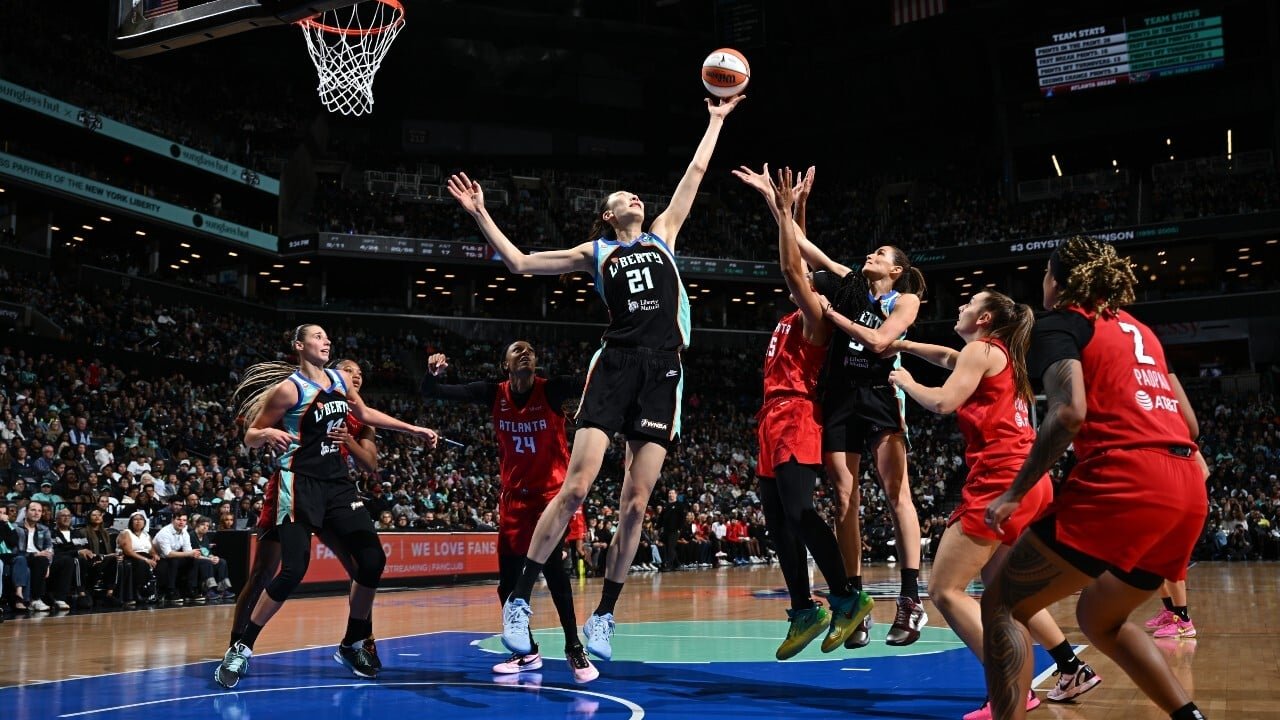
    The NBA playoffs ended in June with the New York Knicks winning the championship for the first time in more than 50 years. Now it’s time for the WNBA to make history as the Las Vegas Aces continue their active postseason appearance streak. The Minnesota Lynx, meanwhile, had the chance to become the winningest team in league history, but they were eliminated by the New York Liberty.

    If you’re fresh off the FIBA Women’s Basketball World Cup, Caitlin Clark’s Indiana Fever have been eliminated, but there are still plenty of faces you’ll recognize from the US Women’s Basketball Team. Here’s what you need to know before tuning in.


    2026 WNBA Playoffs Game Schedule

    The WNBA playoffs run from September 27 to October 31. While every matchup in the NBA is a best-of-7 series, the WNBA holds a best-of-3 series in the first round, a best-of-5 series in the semifinals, and a best-of-7 series—for just the second year—in the finals, giving teams a lot less room to maneuver and recover. One bad night could mean the end of everything for your favorite team.

    The first round will continue through October 2, with the New York Liberty, Atlanta Dream, and Las Vegas Aces advancing. Only one more team can make it to the semifinals, which begin on October 4. The WBNA Finals start on October 17.

    New York Liberty vs. Atlanta Dream – ATL leads 1-0

    • Game 2: Wednesday, October 7 @ 7:30 p.m. ET – ESPN

    • Game 3: Friday, October 9 @ 7:30 p.m. ET – ESPN 2

    • Game 4: Sunday, October 11 @ TBD – ABC

    • Game 5: Wednesday, October 14 @ TBD – ESPN

    Las Vegas Aces vs. Golden State Valkyries – GSV leads 1-0

    • Game 2: Wednesday, October 7 @ 9:30 p.m. ET – NBCSN/Peacock

    • Game 3: Friday, October 9 @ 9:30 p.m. ET – NBCSN/Peacock

    • Game 4: Sunday, October 11 @ TBD – NBC/Peacock

    • Game 5: Wednesday, October 14 @ TBD – NBCSN/Peacock

    WNBA Finals

    • Game 1: Saturday, October 17 @ 3:30 p.m. ET – NBCSN/Peacock

    • Game 2: Monday, October 19 @ 8:00 p.m. ET – USA/Peacock

    • Game 3: Thursday, October 22 @ 8:00 p.m. ET – USA/Peacock

    • Game 4: Saturday, October 24 @ 3:30 p.m. ET – NBC/Peacock

    • Game 5: Monday, October 26 @ 8:00 p.m. ET – USA/Peacock

    • Game 6: Thursday, October 29 @ 8:00 p.m. ET – USA/Peacock

    • Game 7: Saturday, October 31 @ 8:00 p.m. ET – USA/Peacock


    How to Watch the Golden State Valkyrie vs. Dallas Wings Playoff Game

    This year’s playoff schedule is tricky. It will be split across multiple networks and streaming services, even within the same series. ABC, ESPN, Prime Video, and USA carried the first round. ABC, NBC, NBCSN, Peacock, and ESPN will have the semifinals. NBC, USA, and Peacock will be options for the Finals. This means a single cable subscription or Live TV streamer might not be enough to watch everything.

    • DirecTV: DirecTV’s MySports base pack costs $45 per month for the first six months and offers ABC, ESPN, NBC, and USA.

    • Fubo: Fubo’s Sports plan costs $45.99 for the first month to watch games broadcast on ABC, ESPN, NBC, and NBCSN.

    • Hulu: For $90 per month, Hulu + Live TV lets you watch games on ABC, ESPN, NBC, and USA.

    • Peacock: Instead of a live TV service, you’d need to pay $10.99 per month for Peacock Premium to see the Wild Card Series games.

    • Prime Video: Prime’s $14.99 monthly or $139 annual cost grants subscribers access to the three first-round games on Amazon’s platform.

    • Sling: Sling’s $45.99-per-month Sling Orange plan will let you watch games on ESPN. Day Passes are also available for up to seven days. You’ll need the Orange $ Blue bundle for $60.99 to also watch games on USA.

    • YouTube TV: Though the standard plan for YouTube TV costs $83 per month, you can actually now pay for the cheaper $65 Sports package to see all games on ABC, ESPN, NBC, NBCSN, and USA.


    How to Watch New York Liberty vs. Atlanta Dream For Free

    If you don’t have a streaming subscription, you may be able to catch some of the action without spending a dime by signing up for a free video streaming trial. Here are your options:

    Recommended by Our Editors

    Unlock Your Streaming Service’s Full Catalog

    PCMag Logo

    Unlock Your Streaming Service’s Full Catalog


    Which Teams Are In the Playoffs?

    Unlike other sports leagues, the WNBA doesn’t care about conferences. Out of 15 teams, eight squads make it to the playoffs, regardless of where they come from. This year, there are an even four teams from the Eastern Conference and four from the Western Conference. Here they are, listed in order of seeding:

    1. Minnesota Lynx

    2. Golden State Valkyries

    3. Las Vegas Aces

    4. Atlanta Dream

    5. Indiana Fever

    6. Washington Mystics

    7. Dallas Wings

    8. New York Liberty


    Upgrade Your Streaming Experience

    If you decide to watch the WNBA Playoffs, there’s still time to get a big-screen television for viewing this beautiful game. Pro tip: Turn on your TV’s motion-smoothing option for the best picture while watching sports. Just remember to turn it off before watching other TV shows and movies to avoid the awful “soap opera” effect.

    About Our Expert

  • Iran says Hormuz to remain closed until US meets conditions

    Iran says Hormuz to remain closed until US meets conditions

    Iran’s Foreign Ministry says reopening the strait has been its main goal, while the US continues to focus on nuclear talks.

    The Strait of Hormuz is going to remain closed until the United States accepts Tehran’s seven-day plan to reopen the waterway, Iran’s top negotiator and parliament speaker has said.

    Iranian state-linked news agency Nournews, quoting ⁠Mohammad Bagher Ghalibaf, reported on Sunday that Washington made “some proposals through a mediator” days after the US replied ⁠to Iran’s diplomatic proposal.

    Recommended Stories

    list of 4 itemsend of list

    The US should know “that the era of wasting time and dictating unilateral demands is over”, Ghalibaf said, adding Iran’s position remains “clear and definite”.

    He emphasised that “the Strait of Hormuz will not open until our seven conditions based on the Islamabad memorandum are met”, and that Iran is “present on the military battlefield and will confront them with new surprises”.

    He added that Iran was neither “excited” nor “intimidated” by the latest US proposals and would “both fight and negotiate”.

    US President Donald Trump ruled out an Iranian proposal to reopen the Strait of Hormuz last week, hours after Iran put forward a roadmap to reopening the strait, through which one-fifth of global oil and natural gas is shipped during peacetime.

    Last month, Trump threatened to “annihilate” Iran in his speech on the floor of the United Nations General Assembly (UNGA).

    On Sunday, Iranian Foreign ⁠Minister Abbas Araghchi also said Iran is “serious about finding diplomatic solutions just as we are serious about defending ourselves”.

    Speaking to foreign ambassadors and diplomats in Tehran, Araghchi said Iran had clearly explained ⁠its conditions for reopening the strait and ⁠that Tehran hoped Washington would choose diplomacy and accept its proposal.

    However, Araghchi warned that if the US takes military action again, Iran is “more prepared than before and will take whatever action is necessary to defend ourselves”.

    Iranian Ministry of Foreign Affairs spokesman Esmaeil Baghaei added that Tehran used the UNGA platform last month to provide world leaders with its position on ending the US-Israel war on Iran.

    He said the US has continued to focus on nuclear talks, while reopening the strait has been Iran’s main goal.

    “We are at this stage mainly focusing on the strait, and our principal concern is to reach a solution and to have peace and stability restored within this waterway,” Baghaei said.

    The Strait of Hormuz has been largely blocked and disrupted for more than seven months, since the US and Israel launched strikes on Iran on February 28, driving one of the worst maritime shipping disruptions in decades.

    About one-fifth of global oil and natural gas is shipped through the Strait of Hormuz during peacetime, as the US-Israel war on Iran has created several trade chokepoints
    About one-fifth of global oil and natural gas is shipped through the Strait of Hormuz during peacetime, as the US-Israel war on Iran has created several trade chokepoints [File: Al Jazeera]
  • Man City’s Cavan Sullivan becomes youngest US international goalscorer

    Man City’s Cavan Sullivan becomes youngest US international goalscorer

    Sullivan’s goal beat fellow teenager Julian Hall’s record for United States which was only set against Chile on Tuesday.

    Cavan Sullivan became the youngest US international goalscorer in history as the United States defeated archrivals Mexico 3-0 in a friendly international in Arizona on Saturday.

    Sullivan, who is poised to join English Premier League side Manchester City next year, netted a superbly taken goal in the 62nd minute to double the USA lead at the State Farm Stadium in Glendale.

    Recommended Stories

    list of 4 itemsend of list

    At 17 years and five days, Sullivan beat Mathis Albert’s five-day-old record as the youngest US goalscorer.

    Albert, aged 17 and 31 days, scored during Tuesday’s 4-2 defeat of Chile.

    “These are the moments you dream of when you’re three, four, five or six-years-old,” Sullivan said.

    “I manifested this moment, not just these past couple of hours when I found out I was starting, but my whole life,” he added.

    Sullivan’s strike came after another teenager — 18-year-old Julian Hall — had given Mauricio Pochettino’s side the lead in the 28th minute.

    Hall’s goal was his third in as many games since being handed his international debut by US coach Pochettino in last week’s defeat of Peru. Hall also scored in the victory over Chile.

    The loss puts more pressure on Mexico coach Rafael Marquez, who is still seeking his first win since taking over following the World Cup.

    Mexico dominated possession and territory early on but were unable to find a way through a well-organised United States defence.

    Instead, it was the hosts who took the lead just before the half-hour mark with a superbly worked goal from Hall.

    Gio Reyna surged into the penalty area to collect a pass from Alex Freeman and ghosted past Mexico midfielder Erik Lira to reach the byline.

    Reyna’s low cross was parried away by Mexico goalkeeper Raul Rangel, but only as far as Hall, who lashed in from close range to make it 1-0.

    Mexico’s best chance came early in the second half when Roberto Alvarado’s rasping shot from the edge of the area was tipped over the bar by US goalkeeper Diego Kochen.

    Pochettino’s side doubled their lead on 62 minutes when Sullivan’s persistence in chasing down a long ball was rewarded after Rangel mishit a pass to the American outside his area.

    Sullivan coolly took his time and chipped home from long range to make it 2-0.

    “I just remember chipping the ball, hoping it didn’t hit the crossbar or go over,” Sullivan said of his strike. “I was getting nervous when it was in the air and then everything was a blur.”

    A miserable night for Mexico got worse shortly afterwards when substitute Luis Chavez was shown a red card for shoving a hand into the face of Sebastian Berhalter in the 68th minute.

    The United States completed the scoring in the 84th minute when Malik Tillman latched onto a poor Mexico backpass and smashed a shot into the top corner for 3-0.