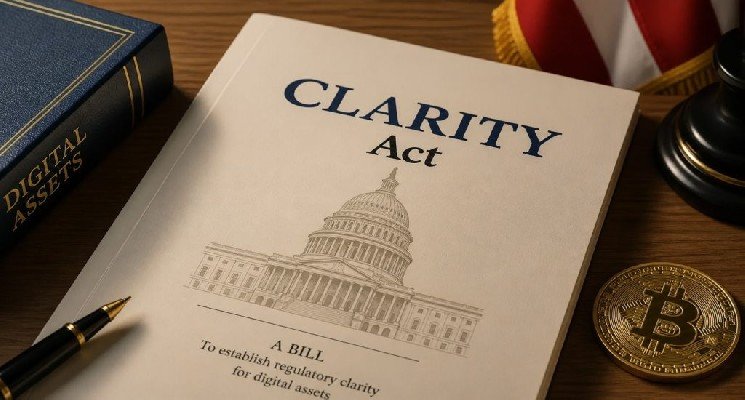
No agreement was reached between the parties on ethical regulations, one of the obstacles to the vote in the Senate on the Clarity Act, a bill aimed at creating a regulatory framework for crypto assets in the US. Yesterday’s closed-door meeting between senators and White House representatives yielded no agreement.
The meeting was attended by Democratic Senators Kirsten Gillibrand and Ruben Gallego, Republican Senators Bernie Moreno and Cynthia Lummis, as well as Patrick Witt, Executive Director of the White House Crypto Council. The parties reviewed the ethical provisions they had agreed upon in principle prior to Senate Banking Committee hearings in May.
According to sources, a provision in the draft agreement that would have authorized state attorneys general to sue the U.S. Department of Justice if it failed to enforce ethics rules regarding President Donald Trump was withdrawn by Republicans and the White House. The reason given for this change was concern that such authority could be used in the future by either party to target members of Congress.
Related News Another Nasdaq-Listed Company Has Announced the Sale of a Large Amount of Bitcoin (BTC)
The proposal also sparked constitutional debate. J.W. Verret, a professor at George Mason University’s Antonin Scalia School of Law, stated that while it is normal for states to sue the federal government for constitutional violations, it is constitutionally problematic for state attorneys general to compel the Department of Justice to take specific action.
As part of a compromise effort, Republicans proposed that the power to impose sanctions remain solely with the U.S. Attorney General and that impeachment be considered as a possible remedy for ethics violations. However, Democrats found these proposals insufficient and considered them a step back from a previous preliminary agreement. Sources involved in the talks described the state of the negotiations as “turbulent.”
The parties are expected to meet again on Thursday to try to resolve the dispute.
Ethical regulations are seen as one of the two major obstacles to the Clarity Act reaching the Senate floor. Some Democrats, including Senators Ruben Gallego and Angela Alsobrooks, have stated that their support for the bill is contingent upon the inclusion of strong ethical protections for Trump’s cryptocurrency initiatives.
*This is not investment advice.
Leave a Reply