Starlink customers can now log in to their accounts using passkeys, a faster and more secure alternative to traditional passwords.
SpaceX’s satellite internet system published a new support page with instructions on how subscribers can set up a passkey to access their account. “As of October 2026, passkeys are now available,” the page says.
Passkey adoption has been growing across online platforms as a better way to both protect and sign into user accounts. The security technology ditches the old-school password, which can easily be stolen or guessed. Instead, passkeys use a private cryptographic key that’s stored in your PC or phone. When you log in, the device uses the stored key to sign the challenge process from the website, proving you hold the key without sending it.
Completing passkey authentication only requires you to enter a PIN or complete a fingerprint or facial scan. Hence, a user doesn’t need to remember and type in a long password to log back in. Starlink’s support page goes on to explain that “a passkey is a faster, easier, phishing-resistant way to sign in than a password. Instead of a password, passkeys use Face ID, a fingerprint, a PIN, or a hardware security key to prove your identity.”
“Passkeys are optional. Setting one up does not replace your password. You can keep using both,” the page adds. “Starlink does not see your fingerprint, face, or device PIN. Those stay on your device.”
This also means that the conventional password system still appears to be in place, allowing a hacker to break into an account through the traditional login method or by abusing the Starlink account recovery process. (In 2024, the satellite internet system added support for two-factor authentication to help prevent account hijackings, following reports of account compromises.)

(Credit: PCMag/Brian Westover)
Although the traditional password system still seems to remain, using a passkey can nevertheless make logging in much more convenient.
Recommended by Our Editors
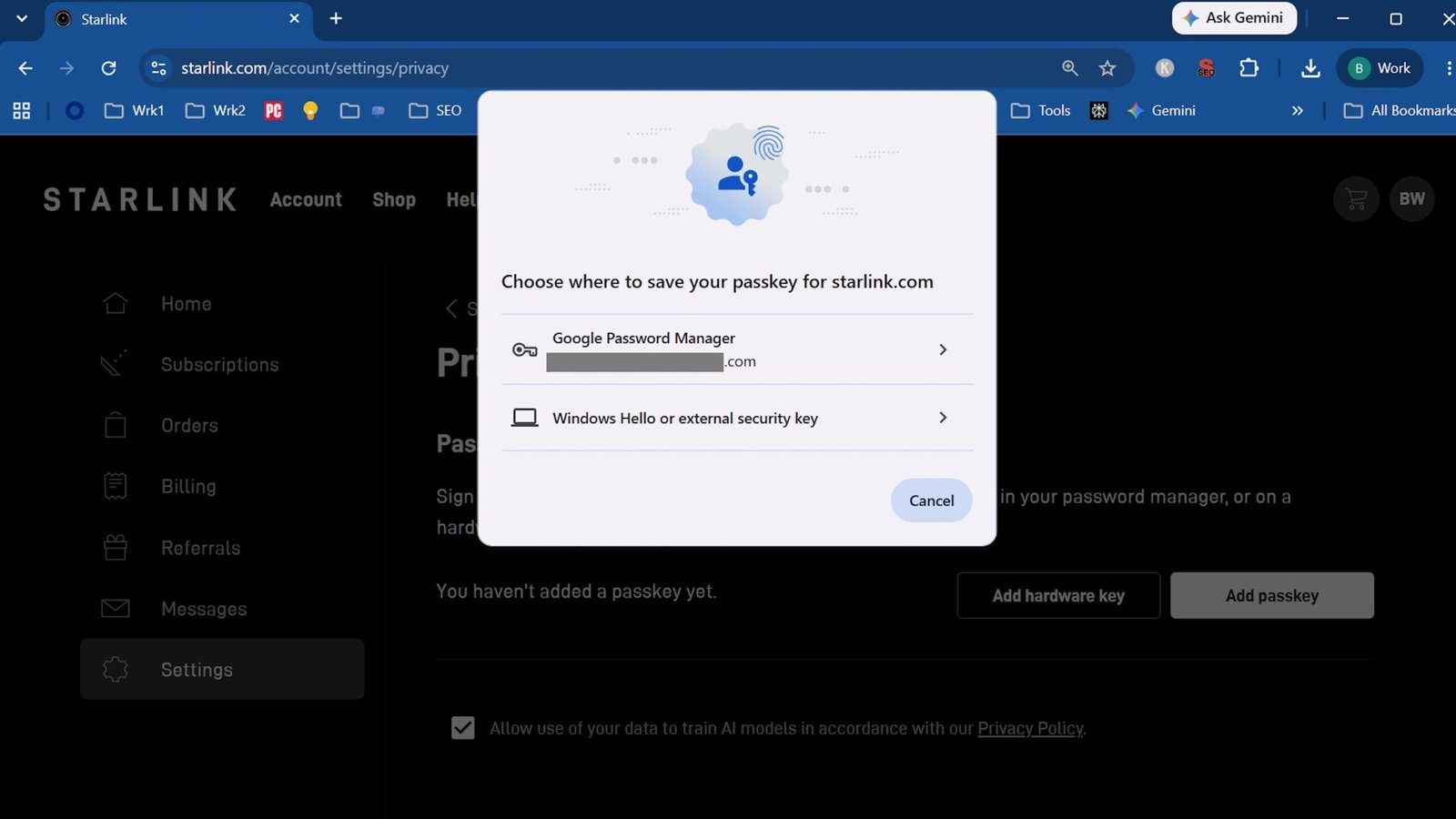
Interested customers can set up a passkey by going to Starlink.com, signing in, and then heading to Settings > Privacy & Security, and then looking under Passkey. You can then add a passkey to the account, which can be saved on the device or in a supported password manager, including iCloud Keychain, Google Password Manager, 1Password, or Bitwarden. Logging in with a passkey is also straightforward.

(Credit: PCMag/Brian Westover)
“You can add up to 10 passkeys. If you reach the limit, remove one before adding another,” the page adds. Users can also remove keys from their account. Another option is to save the passkey on a hardware-based security key if you own one. Last week, a new Starlink site revealed that SpaceX itself has been using hardware security keys to protect internal access to the satellite internet system.
About Our Experts

Brian Westover
Principal Writer, Hardware
Experience
From the laptops on your desk to satellites in space and AI that seems to be everywhere, I cover many topics at PCMag. I’ve covered PCs and technology products for over 15 years at PCMag and other publications, among them Tom’s Guide, Laptop Mag, and TWICE. As a hardware reviewer, I’ve handled dozens of MacBooks, 2-in-1 laptops, Chromebooks, and the latest AI PCs. As the resident Starlink expert, I’ve done years of hands-on testing with the satellite service. I also explore the most valuable ways to use the latest AI tools and features in our Try AI column.

Michael Kan
Principal Reporter
Experience
I’ve been a journalist for over 15 years. I got my start as a schools and cities reporter in Kansas City and joined PCMag in 2017, where I cover satellite internet services, cybersecurity, PC hardware, and more. I’m currently based in San Francisco, but previously spent over five years in China, covering the country’s technology sector.
Since 2020, I’ve covered the launch and explosive growth of SpaceX’s Starlink satellite internet service, writing 600+ stories on availability and feature launches, but also the regulatory battles over the expansion of satellite constellations, fights with rival providers like AST SpaceMobile and Amazon, and the effort to expand into satellite-based mobile service. I’ve combed through FCC filings for the latest news and driven to remote corners of California to test Starlink’s cellular service.
I also cover cyber threats, from ransomware gangs to the emergence of AI-based malware. In 2024 and 2025, the FTC forced Avast to pay consumers $16.5 million for secretly harvesting and selling their personal information to third-party clients, as revealed in my joint investigation with Motherboard.
I also cover the PC graphics card market. Pandemic-era shortages led me to camp out in front of a Best Buy to get an RTX 3000. I’m now following how the AI-driven memory shortage is impacting the entire consumer electronics market. I’m always eager to learn more, so please jump in the comments with feedback and send me tips.
Leave a Reply