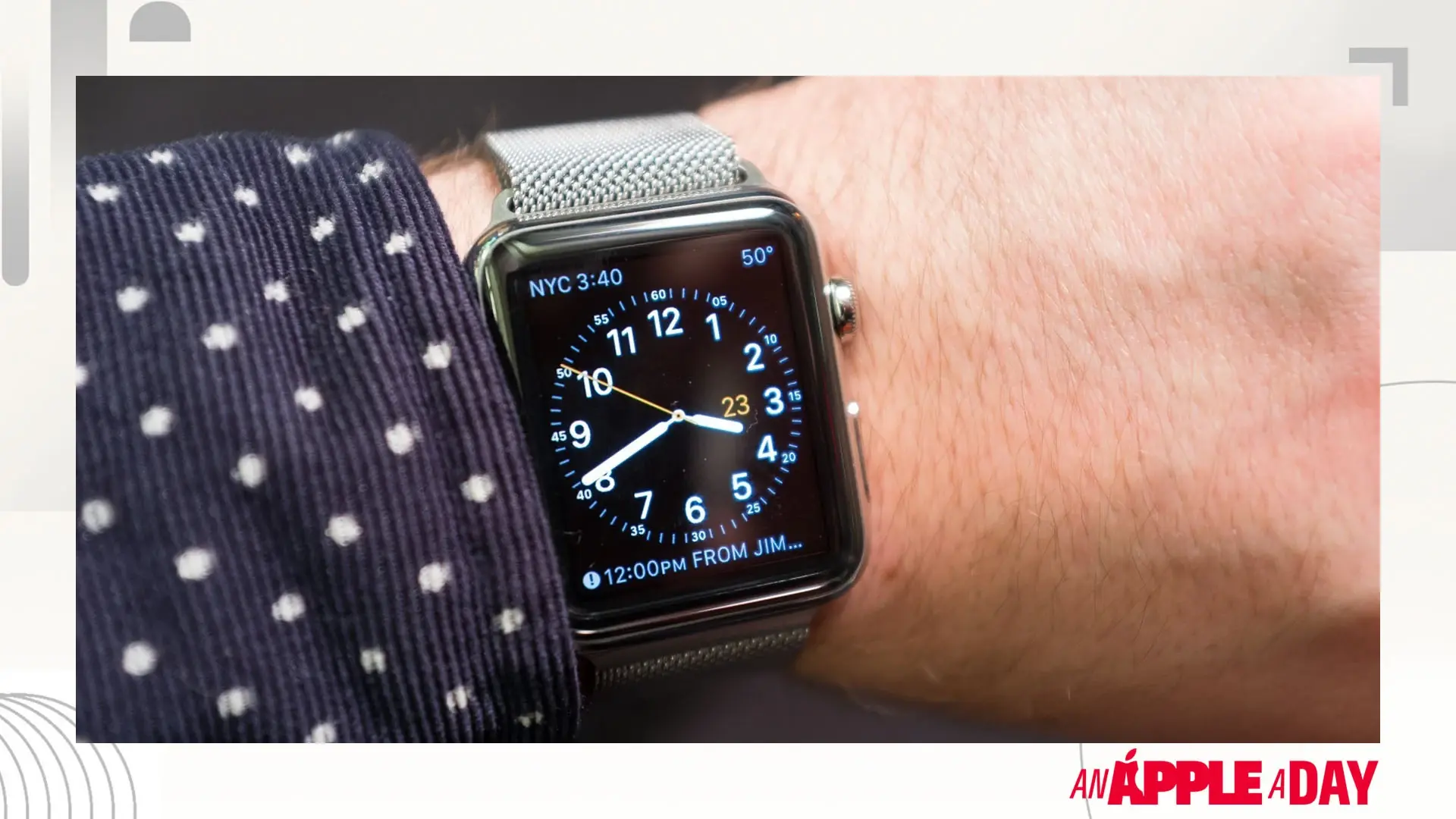
Editors’ Note: Welcome to an ongoing series called An Apple a Day, where we’ll share pieces of Apple content from our archives daily from now through late September. In addition to PCMag, this series will include pieces from our sibling sites CNET, Lifehacker, Mashable, and Popular Science.
When the original Apple Watch came out in April 2015, it was far from the first smartwatch to hit the market, but it was still early enough in the category’s history that I was the first writer at PCMag with the word “wearables” in their job description.
Getting an Apple Watch wasn’t easy back then—they weren’t available at every Apple store, and you had to schedule an appointment to try one on. So I remember feeling pretty cool sitting at a bar in Greenpoint, Brooklyn, the day after it was released, with multiple strangers stopping by to admire the device on my wrist and ask how I had gotten one so soon.

I gave the original Apple Watch four out of five stars (Credit: PCMag)
“You must be a tech writer,” a friend of a friend surmised. “I work at Bloomberg, and the only other Apple Watch I’ve seen belongs to our technology reviewer.” Bingo!
By that point, we had already seen early Pebble models, Android Wear watches from LG and Samsung, and a sea of forgettable start-ups. Smartwatches were clearly the next big thing, but none had proven themselves essential—or, in some cases, even remotely useful.
This is the exact arena where Apple tends to excel. The original iPhone wasn’t the first smartphone, for instance, but it redefined the category by pairing pocket-friendly internet access with a revolutionary touch screen. It gave us a clear, undeniable reason to buy a smartphone, even if it meant switching carriers for AT&T exclusivity.

Wearing the original Apple Watch (I’m second from the left) the day after it was released (Credit: Alex Colon)
I expected Apple to work that same magic on my wrist. Here’s how I opened my 2015 review: “Do you really need a smartwatch? Up until seven months ago, that’s a question I was fully expecting Apple to answer. After all, the company is best at coming into a fairly nascent category and showing users exactly why they need to have something.”
Looking back on that review 11 years later, it’s clear the original device didn’t quite deliver on that grand promise—even though I still gave it an “excellent” four-star rating. “While I was expecting Apple to deliver the world’s first must-have smartwatch, the truth is, you don’t need the Apple Watch,” I noted at the time. “Yes, you’ll still probably want to have it, and you’ll likely be happy if you buy it. For a first-generation device from one of the largest companies in the world, that’s a good start.”
Recommended by Our Editors

(Credit: Paul Maljak)
And it was a good start. After all, Apple did eventually figure out why we needed a smartwatch—it just wasn’t through wrist-based apps or the ability to send your heartbeat to friends, features that were highly touted on the original model. Instead, it turned out to be the health, safety, and seamless fitness-tracking features introduced in later models, eventually cemented by life-saving capabilities such as heart-rate alerts, ECG monitoring, fall detection, and sleep apnea tracking.
The original 2015 Apple Watch was a stylish status symbol in search of a core purpose; today’s model is an essential health monitor that also happens to tell time. It took a few iterations for Apple to pivot from high-fashion accessory to practical life-saver, but my initial hunch wasn’t wrong. Apple just needed a little more time to pull off the magic—and I needed a decade of hindsight to see the bigger picture.
Now, as we near the announcement of the new Apple Watch, the question is: What’s the next big pivot? If its first decade was defined by transforming a wrist accessory into a vital lifesaver, the next era is likely about predictive, proactive intelligence, shifting from reactive alerts to early preventive health tracking, seamlessly incorporating on-device AI coaching, and finally delivering multi-day battery life to make continuous health monitoring truly effortless. I look forward to seeing how things unfold over the next 10-plus years.
About Our Expert

Alex Colon
Executive Editor, Reviews
Experience
I’m PCMag’s executive editor of reviews, steering our coverage to make sure we’re testing the products you’re interested in buying and telling you whether they’re worth it. I’ve been here for more than 10 years. I previously managed the consumer electronics reviews team, and before that, I covered mobile, smart home, and wearable technology for PCMag and Gigaom.
I’ve written hundreds of reviews of cell phones, fitness trackers, robot vacuums, smartwatches, and various other products.
I’ve also edited thousands of reviews and articles on consumer electronics technologies and products.
I’m writing this bio on my 24-inch blue iMac, which I initially bought for personal use, but quickly decided to use for work instead of my tiny, company-issued ThinkPad (sorry, IT team). The screen is big, bright, and sharp, and the speakers are surprisingly good considering how thin the machine is.
The other big screen in my life is a 65-inch LG C9 OLED TV. If you’re wondering whether OLED is worth the premium over LCD, I’m here to tell you that it is.
I’d be doing my beloved LG C9 a disservice if I didn’t have it hooked up to a capable sound system, so I have a Sonos Beam sitting on a media console underneath the TV, and two Sonos Ones set up as rear channels for surround sound. If you’re a Sonos user, I highly recommend adding the Sonos Sub to your setup. It’s definitely a little more expensive than it should be, but it’s truly money well spent.
Of course, as an editor, I also do plenty of reading that isn’t related to work, and I love to sit down with a good, old-fashioned, paper-and-ink book. But when carrying a book isn’t convenient, I break out my first-generation Kindle Paperwhite, which is still working just fine nearly 10 years in.
Leave a Reply