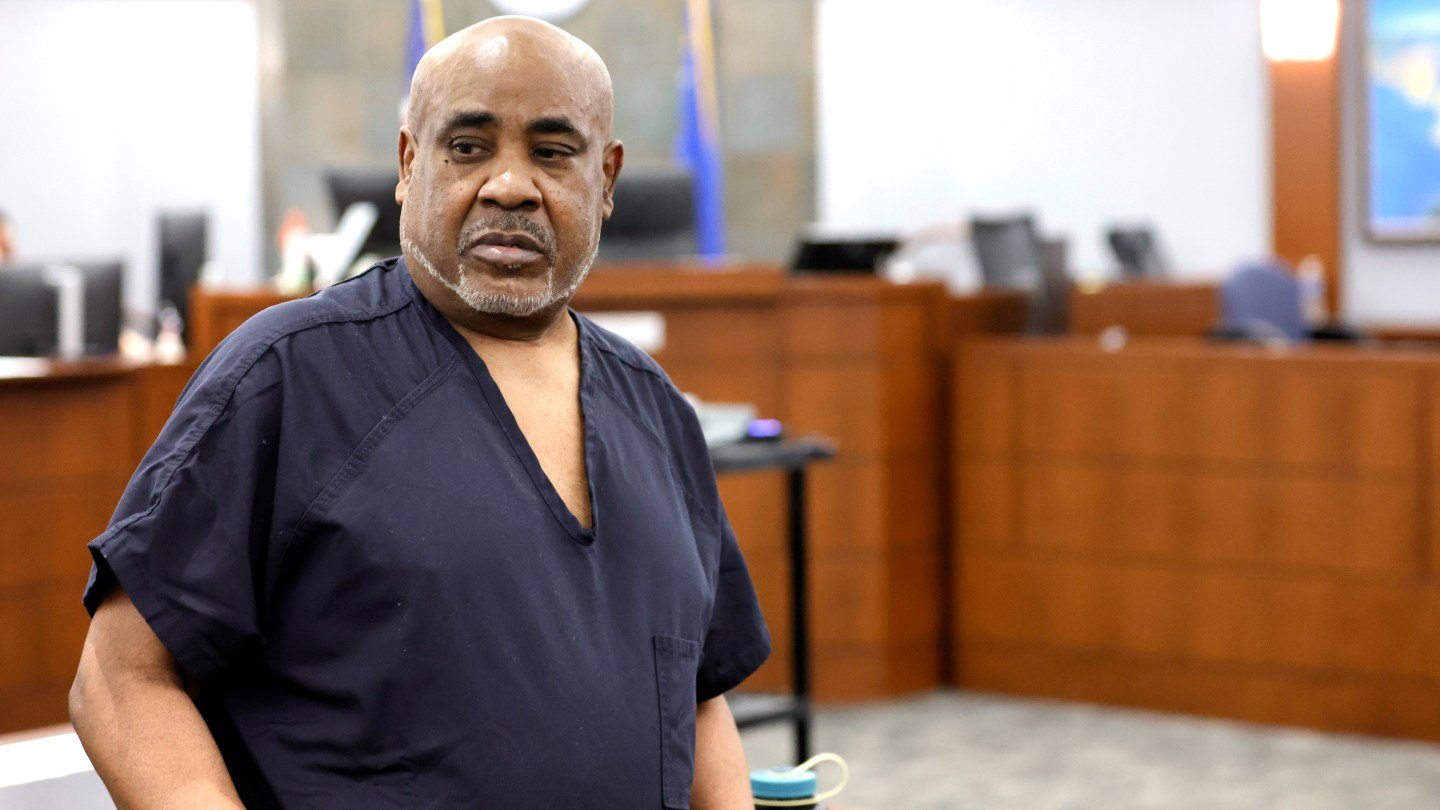
The trial of the former L.A. gang leader accused of orchestrating the shocking 1996 murder of rapper Tupac Shakur in a drive-by shooting in Las Vegas ended its first week on Friday with major evidence shown to the jury, including secret audio of the defendant’s admission to police decades ago of his involvement and the reemergence of the theory that imprisoned mogul Sean “Diddy” Combs ordered the hit.
Duane “Keffe D” Davis is facing one count of murder with the use of a deadly weapon in a Las Vegas court for his alleged involvement in the murder of rap icon Shakur and attempted murder of Death Row Records honcho Suge Knight. Prosecutors claim Davis orchestrated the attack that killed Shakur on Sept. 7, 1996, and that his nephew, Orlando “Baby Lane” Anderson — who Tupac’s crew had roughed up earlier that day — was in a rented Cadillac when it pulled up alongside the record label owner’s BMW off the Vegas Strip. Gunshots were exchanged, leaving Knight injured and Shakur mortally wounded; Shakur died days later from his injuries.
Audio from a conversation between Davis and investigators — which prosecutors say amounts to a full confession from the former Compton Crips capo — was played for the jury on Thursday. In it, Davis laments the state of life as a street gangster in Los Angeles and complains about the younger generation coming up in that world, before telling LAPD detectives about the 1996 shooting in an apparent bid to avoid prosecution on unrelated drug charges that would have carried a hefty sentence. He describes renting the car that pulled up to Knight’s vehicle and says his nephew fired the fatal shot.
“He leaned over on the window. He rolled down the window, popped ’em,” Davis said, according to the recording. “If they drove on my side, I would have popped ’em, know what I’m saying. But they was on the other side.”
LAPD Detective Daryn Dupree testified that when he was assigned to investigate the 1997 murder of rapper Christopher “Biggie Smalls” Wallace in Los Angeles, he interviewed Davis, who told him Bad Boy Records founder Combs had offered $1 million to whoever killed Shakur and Knight. To pursue Combs’ alleged involvement, Davis was brought in as a confidential informant and flown to New York to meet a man who was supposed to deliver the payment.
Dupree told the court Davis said he could “rekindle that relationship with [a contact named] Zip Martin and [discuss] the money that was given from Sean ‘Puffy’ Combs to Mr. Martin that never got to Mr. Davis.” But the meeting fell through — Davis was instead connected with the contact’s nephew, and the lead went nowhere.
Combs has repeatedly denied the allegation and has never been charged in connection with Shakur’s death.
Still, it’s a persistent alternative narrative that has resurfaced many times in the decades since the killing devastated the rap community. The theory first gained substantial traction from a 2008 interview in which, according to former LAPD detective Greg Kading, Davis described Combs approaching him about eliminating two prominent Death Row figures, with his gang allegedly promised $1 million for the double hit.
There was no hard evidence, and Combs has categorically denied the claim — but the theory resonated because it came from someone who was actually in the Cadillac during the shooting and was relayed by a law enforcement investigator. It was published in Kading’s 2011 book Murder Rap: Inside the Biggie and Tupac Murders. Combs called the theory “ridiculous,” but it was his book that pushed the idea deep into public consciousness. Notably, from 2011 on, the claim that Combs ordered Tupac’s murder was an allegation advanced by Kading based primarily on Davis’ statements — not a fact of any investigation.
In 2016, Kading’s theory became the centerpiece of a documentary also titled Murder Rap: Inside the Biggie and Tupac Murders, which again presented Combs as having commissioned the hit and named Anderson as the triggerman. Combs again denied involvement.
In 2019, Davis released a memoir, Compton Street Legend, offering a more detailed account of the shooting — one that reportedly contradicted his earlier narrative and is part of why he’s since been viewed as an unreliable witness and shaky defendant at trial.
Davis was arrested in 2023, nearly three decades after the murder, when Las Vegas authorities charged him with murder with a deadly weapon in connection with Shakur’s death. Prosecutors allege he obtained the gun and organized the men in the Cadillac after Anderson was beaten in a fight at the MGM Grand earlier that night.
Davis pleaded not guilty. Combs was not charged. The case drew renewed attention in 2024 when reports emerged that members of Shakur’s family had hired attorney Alex Spiro and a team of investigators to examine a possible Combs connection to the murder. Also that year, Ashley Parham filed a civil suit against Combs alleging that after she suggested in 2018 that he was involved in Tupac’s death, Combs threatened and assaulted her.
As Combs entered federal prison last year following convictions in his Mann Act/RICO trial, the Emmy-nominated docuseries Sean Combs: The Reckoning introduced the theory of his involvement to a new audience, featuring Kading and others connected to the case. The film received strong reviews for its scope but more mixed reactions to its evidence-to-speculation ratio.
Davis’s trial resumes Monday in Las Vegas.
Leave a Reply