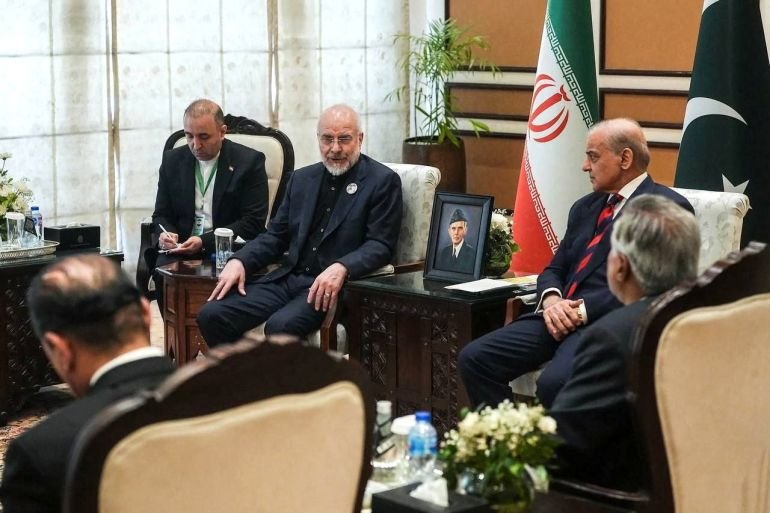
The recent statements by US President Donald Trump and the shuttle diplomacy carried out by senior Pakistani military and government leaders in regional capitals have raised hopes of ending the US-Israel war with Iran through negotiations. This could initially take the form of a “framework agreement” between the United States and Iran to lay the groundwork for a final deal.
Speaking to reporters at the White House on Thursday, Trump struck an optimistic tone, saying the war was “about to end”, as “almost all” issues had been resolved. The remaining differences would be addressed in talks that he said would resume soon. He also said he might travel to Islamabad if a final agreement were signed there.
Despite Trump’s tendency to make exaggerated statements, his remarks this time appeared to be backed by a series of intensive diplomatic activities in the region. The surprise visit by Pakistan’s army chief, Field Marshal Asim Munir, to Tehran for talks with Iranian officials—apparently to convey messages from Washington—suggested that the ground was being prepared for another round of negotiations between the US and Iran.
The messages conveyed were intended to address differences between the two sides over the remaining issues, as well as to discuss efforts aimed at securing a ceasefire in Lebanon.
At the same time, Pakistan’s Prime Minister Shehbaz Sharif embarked on a three-country tour—Saudi Arabia, Qatar, and Turkiye—to brief their leaders on the latest developments in the talks aimed at ending the war.
This also indicates that diplomatic activity was in full swing in preparation for another round of direct talks between Washington and Tehran.
With the ceasefire among the US, Israel, and Iran holding since April 8, the announcement of a 10-day truce between Lebanon and Israel has boosted optimism and was widely seen as a step towards a peace agreement between Washington and Tehran.
Iran welcomed the truce, which received global backing. Iranian Foreign Ministry spokesperson Esmaeil Baghaei said Tehran views the truce as part of a broader understanding with Washington reached during talks mediated by Pakistan.
In fact, controversy arose shortly after the ceasefire between the US and Iran was announced, when Iran and Pakistan said it included a truce in Lebanon as part of a broader regional ceasefire, but Trump denied that.
This required talks among Israel, the US, and Lebanon, which culminated in the ceasefire in Lebanon. In response, Iran announced it would allow all commercial ships to pass through the Strait of Hormuz for the remainder of the temporary truce period—before matters became somewhat complicated.
All of this came after negotiations held between the US and Iran in Islamabad on April 12.
These were the highest-level direct talks between them in more than four decades, during which there were no diplomatic relations between the two countries. The dispatch by both sides of high-level delegations indicated their seriousness about finding a way out of the conflict.
Many international media outlets rushed to declare that the talks were inconclusive and ended in failure, as if an agreement on such thorny issues could be reached within just a few hours.
In reality, the Islamabad talks were neither a major achievement nor a failure; the two delegations returned to their capitals to consult with their leaderships in a generally positive atmosphere, and neither side said the talks had collapsed.
The diplomatic option remained on the table for both sides, keeping the door open to the possibility of continuing negotiations. Diplomatic engagement continued through Pakistan, which stepped up its efforts to persuade the two parties to show flexibility and maintain back-channel communications in order to narrow the gaps in their positions.
The Islamabad talks revealed how far apart the two sides’ positions were, as reflected in the 15-point plan put forward by the US and the 10-point proposal presented by Iran.
Tehran’s core demands included guarantees that there would be no future American or Israeli attacks on Iran and its regional allies, the lifting of sanctions, the unfreezing of assets, international recognition of its right to uranium enrichment, and the continuation of its control over the Strait of Hormuz.
The US’s demands included strict Iranian commitments not to pursue nuclear weapons, insistence that Tehran carry out no enrichment, removing Iran’s stockpile of highly enriched uranium from the country, and the reopening of the Strait of Hormuz.
When the talks ended, the US side claimed that Iran had not responded to its nuclear concerns, while Iran asserted that the American negotiators had made unrealistic demands.
But both sides acknowledged that progress had been made, despite key issues remaining unresolved, including the future status of the Strait of Hormuz. The US proposed sharing the revenue from customs fees for the strait, but Iran rejected the idea.
Subsequent indirect contacts sought to address contentious points on the nuclear issue and the strategic waterway, as Pakistani mediators urged both sides to be more flexible.
These issues are expected to dominate the talks in a second round if it is held, as Pakistani mediators have privately said they made progress on the “contentious issues”, although Iranian officials have expressed a more cautious stance.
The main difference that must be resolved concerns the nuclear issue: the US proposes that Iran carry out no uranium enrichment for 20 years, which it believes would ensure that Tehran does not pursue a nuclear weapons programme.
Iran has repeatedly stressed that it will not build a nuclear bomb, but that it has the right to enrichment for peaceful purposes under the Nuclear Non-Proliferation Treaty, to which it is a party. Mohammad Eslami, head of the Atomic Energy Organization of Iran, has stated that the talks must recognise Iran’s rights, interests, and dignity if they are to bear fruit.
The question is whether the US would agree to enrichment at less than three percent —far below weapons-grade levels—for five years, as Iran reportedly offered.
As for the other issue related to removing nuclear material, it can likely be addressed through Tehran’s offer to dilute the concentration of its 400kg stockpile of highly enriched uranium to the lowest possible level inside Iran, while granting the International Atomic Energy Agency full access to verify it.
Iran wants all sanctions lifted, but it will not agree to take its stockpiles out of the country. When Trump recently claimed that Iran had accepted the US demand, Iran’s Foreign Ministry spokesperson quickly denied it, saying: “Enriched uranium will not be transferred anywhere.”
The question remains open as to whether the next round of talks will be able to break the deadlock over the nuclear issues and the Strait of Hormuz. The stakes are high for both sides, which appear to want a way out of the war, but obstacles remain, and Israel could still play a spoiling role and stand in the way of any achievement that might be made. These are difficult hours casting a shadow over the world.
A version of this article was originally published in Arabic by Al Jazeera Arabic.
The views expressed in this article are the author’s own and do not necessarily reflect Al Jazeera’s editorial stance.
Leave a Reply