Islamabad, Pakistan – Pakistan is gearing up to host the second round of talks between the United States and Iran aimed at ending their war, but rising tensions in recent hours have cast uncertainty over Tehran’s participation, as the deadline nears for the end of the two-week ceasefire.
Unlike the first round of talks held in Islamabad on April 11, the upcoming negotiations could last for multiple days until a temporary deal – mediators are calling it a memorandum of understanding – is signed, effectively extending the ceasefire, sources close to these efforts have told Al Jazeera. If the MoU is agreed, it would give negotiators a longer window – even up to 60 days – to secure a longer peace deal.
Recommended Stories
list of 4 itemsend of list
But all of that hinges on the participation of Iran, which – as of Monday morning – has not confirmed that it will be sending its negotiators to Islamabad. That follows a rapid escalation in tensions over the past 24 hours.
US President Donald Trump announced on Sunday that his representatives were heading to Pakistan for a second round of negotiations with Iran, as a fragile ceasefire, due to expire on Wednesday, edges towards its deadline. But Trump accompanied his announcement with a revival of earlier pre-ceasefire threats to bomb Iran’s energy and power facilities.
“My Representatives are going to Islamabad, Pakistan. They will be there tomorrow evening, for Negotiations,” Trump wrote on Truth Social. He accused Iran of a “Total Violation of our Ceasefire Agreement” after Iranian gunboats fired on vessels in the Strait of Hormuz on Saturday, hitting ships including a French vessel and a British freighter.
“We’re offering a very fair and reasonable DEAL, and I hope they take it because, if they don’t, the United States is going to knock out every single Power Plant, and every single Bridge, in Iran,” Trump wrote. “NO MORE MR. NICE GUY!”
The tensions did not ease overnight. In the early hours of Monday, Trump announced on Truth Social that the US Navy guided missile destroyer USS Spruance had intercepted an Iranian-flagged cargo ship, the Touska, nearly 900 feet (274 metres) long, in the Gulf of Oman after its crew refused to heed warnings to stop.
“Our Navy ship stopped them right in their tracks by blowing a hole in the engine room,” Trump wrote. US Marines have now taken charge of the vessel, which Trump alleged was under US Treasury sanctions for prior illegal activity.
Iran has described the seizure of the ship as “piracy”.

Pakistan’s preparations
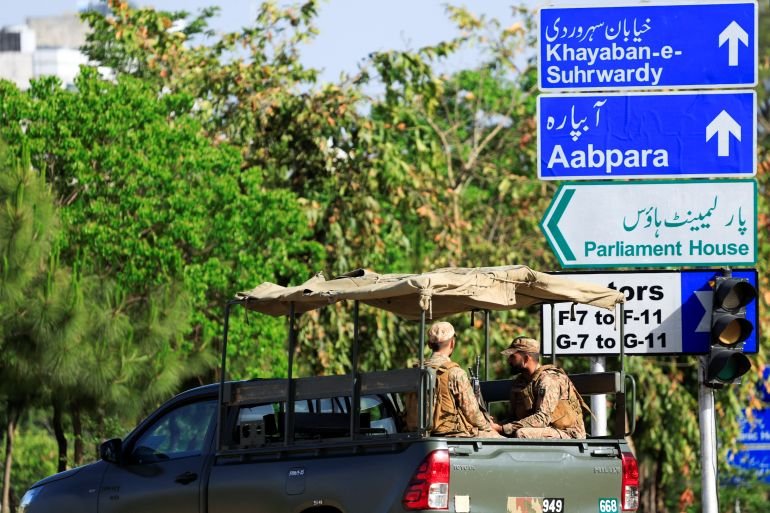
Amid those military and social media exchanges between Iran and the United States, Pakistan has been busy getting ready to host talks that it – as the principal mediator between Washington and Tehran – hopes will yield a deal to end the war, now into its eighth week.
Islamabad’s Marriott Hotel asked guests to vacate by Sunday afternoon. The Serena Hotel, just a few kilometres away and the venue for the first round of talks a week earlier, soon issued the same order and stopped taking reservations.
Roads into the Red Zone, the capital’s most heavily fortified area, were sealed. The district houses key government buildings, including the National Assembly, foreign embassies and both five-star hotels. Thousands of additional police and paramilitary personnel arrived from across the country.
Barbed wire and barricades lined the streets, and most access routes were shut.
But even before Trump’s latest threat to blow up Iranian energy and power facilities, and the subsequent hijacking of the Iranian ship, Tehran was unclear about whether it would join the talks.
Minutes before Trump’s Truth Social message, Iran’s ambassador to Pakistan, Reza Amiri Moghadam wrote on his social media that violations of international law, the continuation of the US naval blockade of the Strait of Hormuz, threats of further strikes, and what he described as unreasonable demands could not be reconciled with a genuine pursuit of peace.
“As long as the naval blockade remains, faultlines remain,” he added.
The negotiators: The US and Iranian teams
Trump first said on Sunday that Vice President JD Vance, who had led the US team in the first round of Islamabad talks, would not visit the Pakistani capital this time around, because of security concerns.
But White House Press Secretary Karoline Leavitt later said that Vance would join the US delegation, alongside special envoy Steve Witkoff and Trump’s son-in-law, Jared Kushner, the same team that led the first round.
Flight tracking data showed at least four US government aircraft carrying communications equipment and motorcade support landed on Sunday at PAF Base Nur Khan in Rawalpindi, the primary VIP entry point for Islamabad.
However, by late night, sources close to mediators told Al Jazeera that it was once again unclear whether Vance would travel to Islamabad on Monday. They said that the US might now send Witkoff and Kushner to Islamabad first, and if the talks actually happen, Vance might join them.
Amid Iranian hesitation over whether to join the Islamabad talks, Pakistani Prime Minister Shehbaz Sharif spoke with Iranian President Masoud Pezeshkian. The call lasted about 45 minutes, the Pakistan PM’s office said.
Sharif briefed Pezeshkian on his recent visits to Saudi Arabia, Qatar and Turkiye, where he met with their leaders, describing those engagements as helpful in “building consensus in support of a sustained process of dialogue and diplomacy”.
But by early Monday morning, Trump’s revived threats and the capture of the Iranian cargo ship have left the prospects of talks in Islamabad even more on edge than before.
Iran pushes back
Tehran pushed back sharply against Trump’s flurry of social media posts on Sunday.
Iran’s state news agency IRNA said reports of a second round of talks in Islamabad were “not correct”, and blamed the lack of progress on what it described as American “greed”, unreasonable demands, shifting positions and “continuous contradictions”.
According to IRNA, the naval blockade – imposed by Trump last Monday, two days after the first round of Islamabad talks – violated the ceasefire understanding and had “so far prevented progress in negotiations”.
It added that “no clear prospect for productive negotiations is foreseen” under current conditions and dismissed US statements on talks as “a media game”, aimed at pressuring Iran through a “blame game”.

In a post on X, foreign ministry spokesman Esmaeil Baghaei went further, describing the US naval blockade as “unlawful and criminal” and saying it amounted to “war crime and crime against humanity”.
Despite the public denials, Iranian sources earlier on Sunday indicated a delegation was expected in Pakistan on Tuesday. It could include Parliamentary Speaker Mohammad Bagher Ghalibaf, who led Tehran’s team in the first round, and Foreign Minister Abbas Araghchi, who had joined him then.
Pakistan’s foreign ministry said Araghchi and his Pakistani counterpart Ishaq Dar spoke by phone on Sunday and discussed “the need for continued dialogue and engagement as essential to resolving the current issues as soon as possible”.
Analysts say the gap between Iran’s public stance and private signalling reflects a deliberate strategy.
“This gap reflects a dual-track negotiation strategy,” Seyed Mojtaba Jalalzadeh, an international relations analyst based in Tehran, told Al Jazeera. “At the public level, Iran maintains a hardline position to preserve domestic legitimacy and increase its leverage; at the non-public level, by dispatching a team to Islamabad, it signals that it has not abandoned diplomacy but is instead testing its conditions.”
Fahd Humayun, an assistant professor of political science at Tufts University, agreed.
“When warring parties come to the table to negotiate, they come with the understanding that there is occasionally a gap between public posturing and private positions,” he told Al Jazeera. “My sense is that they will pick up from where they left off, rather than getting too caught up in the rhetoric that has emerged since”.
That divergence extends to the pace of negotiations.
Washington has pushed for a rapid resolution, with Trump repeatedly declaring the war “close to over” even as fighting continues. Tehran, by contrast, has shown little inclination to be rushed.
A diplomat in Islamabad, who has followed the talks closely, described the contrast.
“The previous round of talks is a great example. It appeared as if the Americans brought a stop-watch, whereas the Iranians came armed with a calendar,” the diplomat said on condition of anonymity.
What is achievable?
Officials do not expect a final deal this week.
The immediate goal is likely to be a ceasefire extension, with both sides in Islamabad working towards a limited understanding.
Pakistani officials expressed cautious optimism, saying the process was moving in a positive direction while stressing that a final agreement would require sustained engagement and compromise.
Unlike the first round, talks could run for several days, with the aim of agreeing on a framework for broader negotiations in the coming weeks and months.

Humayun cautioned against viewing the first round as a failure.
“I wouldn’t characterise the first round as having failed, that assumes expectations of resolving the most difficult issues early on, which is unlikely in talks of this nature where the issues are so complex,” he said.
For this round, a ceasefire extension would be “a meaningful outcome in itself”, while both sides would likely be “probing for any shifts or flexibility in positions since they last spoke”.
It is that movement, he added, that would allow both sides to “politically sanction an extension of the ceasefire”.
“A ceasefire extension could represent the most minimal form of agreement achievable in this round,” Jalalzadeh said, adding that the deal Washington seeks is “far broader in scope and is rooted in a history stretching back 47 years”.
Iran’s Deputy Foreign Minister Saeed Khatibzadeh, speaking on the sidelines of the Antalya Diplomacy Forum in Turkiye over the weekend, said “significant progress” had been made in the previous round but stressed that a framework must be agreed upon before talks could advance.
He described US demands on Iran’s nuclear programme as “maximalist”.
Ghalibaf was more direct. “There are many gaps and some fundamental points remain,” he said in televised remarks on Saturday night. “We are still far from the final discussion”.
The core sticking points, Iran’s nuclear programme and control of the Strait of Hormuz, remain unresolved since the first round, held on April 11, which lasted 21 hours and ended without agreement.
A separate Israel-Lebanon ceasefire is now in place, removing one of Tehran’s stated conditions for talks.
But Jalalzadeh said the ceasefire fell well short of satisfying Iran’s demands. “The current Israel-Lebanon ceasefire is temporary, fragile, and incomplete,” he told Al Jazeera, noting that Hezbollah – Tehran’s most powerful regional ally – was absent from the agreement, which the Lebanese government negotiated with Israel.
“This ceasefire is a tactical palliative, not a substitute for Iran’s strategic demand,” he said, adding that Tehran’s insistence on Lebanon being part of any broader deal, rather than handled through a separate arrangement, remained unchanged.
Humayun said Iran would want the Israel-Lebanon truce to hold and ideally include “some form of assurance against violations”.

The broader question, he said, is “whether Iran can secure at least some degree of US pressure on Israel to adhere to the ceasefire and to refrain from further escalation”.
The Sharif-Pezeshkian call capped an intensive week of Pakistani diplomacy.
Field Marshal Asim Munir travelled to Tehran last Wednesday, carrying what officials described as a new message from Washington.
Iranian Ambassador Reza Amiri Moghadam said last week in Islamabad that Tehran would “do talks in Pakistan and nowhere else, because we trust Pakistan”.
Analysts say Pakistan’s value as a mediator lies in the rare credibility it holds with both sides.
Humayun said that even if this round produces no breakthrough, it would not necessarily erode trust in Islamabad.
“All parties understand how difficult these issues are and that, without Pakistan’s facilitation, they may not have reached this point at all,” he said.
Jalalzadeh offered a more cautious assessment, saying Pakistan’s role ultimately depends on results.
“If this round also fails, its standing as an effective mediator will be weakened, even if it continues to function as a minimal communication channel,” he said.
Still, he noted, Islamabad has already distinguished itself among countries that have attempted mediation, filling a gap left by others and establishing itself as a credible host.
Trump, however, insisted a deal would come regardless.
“It will happen. One way or another. The nice way or the hard way,” he told ABC News. “You can quote me.”
Leave a Reply