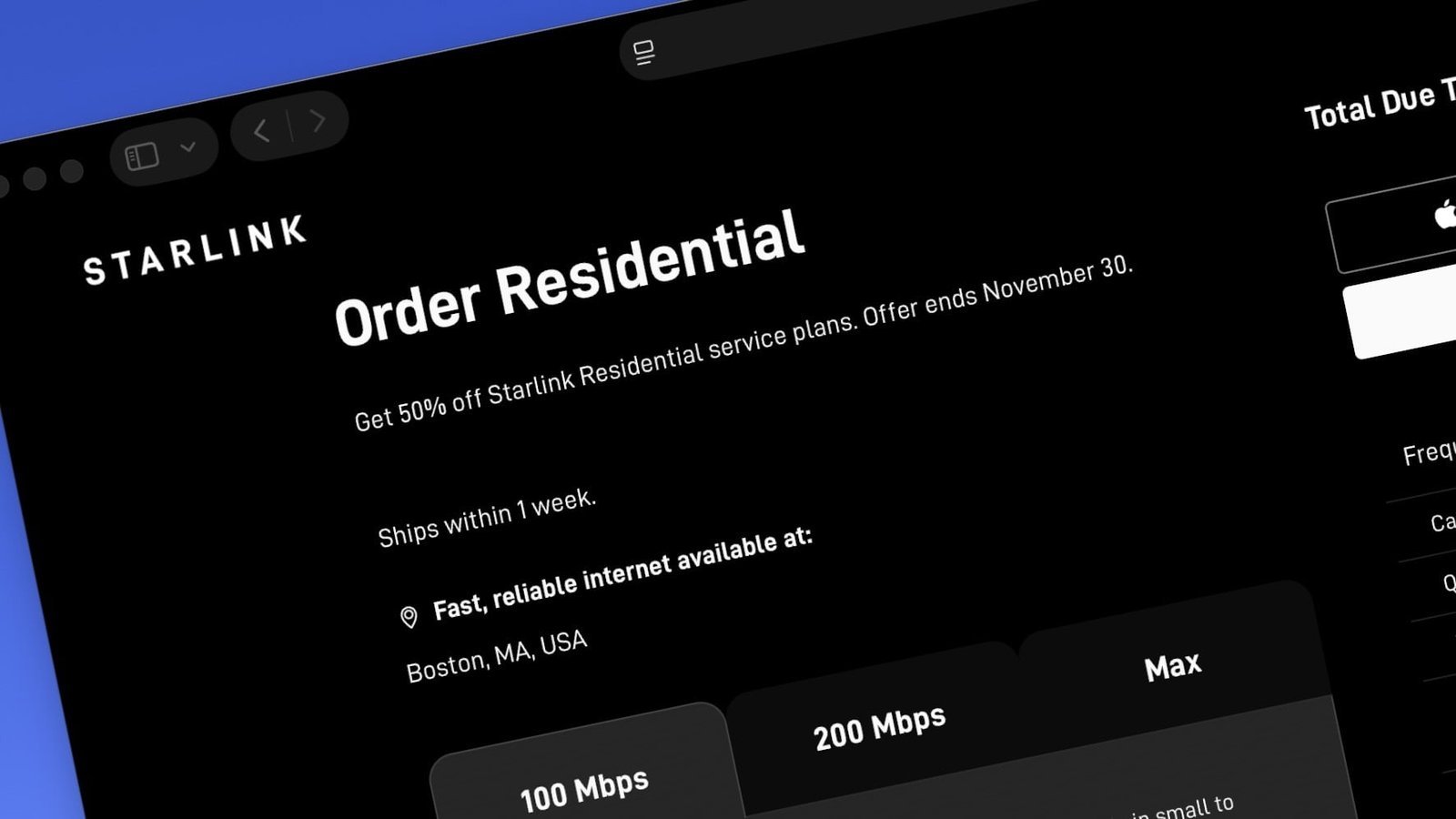
SpaceX’s Starlink appears to be making an aggressive push to attract new customers by offering deep discounts of 30% to 50% off in select areas.
The deals are appearing on Starlink.com for Residential and Roam plans. In locations such as San Francisco, Albuquerque, Milwaukee, and Denver, new customers can receive a 30% discount on the Residential plans, bringing the monthly fee down to $38.50 (100 Mbps), $59.50 (200 Mbps), and $91 (Max).

(Credit: Starlink.com)
The Residential discount drops to 50% off in locations such as Boston, Fargo, ND, Concord, NH, and Providence, RI. There, new customers pay $27.50 (100 Mbps), $42.50 (200 Mbps), or $65 (Max), a major bargain that could appeal to those looking to trim their broadband bills.

(Credit: Starlink.com)
The 30% discount also applies to the Roam plans and seems to be available across the US. However, Starlink.com says the rare deal will only be offered until Nov. 30. One Reddit user also spotted the discount appearing in New Zealand.
Starlink.com doesn’t say how long the prices will remain in effect for those who sign up, though a promotional email notes: “Pricing applies for as long as your subscription remains active.” A human Starlink customer representative also told us the discount has “no end date.”

(Credit: Starlink)
That said, Starlink could stop offering the discount in a specific area before Nov. 30 if a flood of customers subscribe, filling up network capacity, the representative added.
We suspect Starlink is offering the discount in areas where it has excess network capacity. In high-demand areas, the company has typically refrained from offering discounts and even imposed a “demand surcharge.”
We’re also skeptical the discount will remain indefinitely. Starlink has a history of making sudden changes to its policies, including controversial price hikes. A separate support page also notes: “In select areas, new Starlink customers can receive discounted service pricing for a fixed period of time (e.g., 6 or 12 months) when signing up for Residential or Roam service.”
SpaceX didn’t immediately respond to a request for comment. But the discounts suggest the company is using the holiday sales period to promote Starlink. In SpaceX’s most recent earnings call, CFO Bret Johnsen also signaled that Starlink has been building up its product inventory for a subscriber-growth push in Q4.
Recommended by Our Editors
Although Starlink has been known to be pricey, the new deals seem poised to make it competitive with traditional internet service providers that offer fiber and fixed wireless access. Globally, Starlink had 13.6 million consumer subscribers in Q3. But the average revenue per user reached only $69 per month, down from $83 a year ago.
On the flip side, it doesn’t look like the discounts do much to help existing customers, as some have been complaining about the recent price hikes. Last week, Starlink began testing dynamic pricing in Missouri and Kansas, which can raise or lower the monthly bill by 10% to 20%, depending on supply and demand. Some subscribers were pleasantly surprised to see a price reduction. But others, particularly in Missouri, have been concerned and angered to see that their bills will soon go up, the second price hike for this year.
“It’s completely unfair,” one affected user told us. “I signed up only because I live rurally and it was currently the best option, both for the price and the reliability. If it goes up again, I’m switching to another provider, as it will no longer be the best option price-wise.”
Dynamic pricing still seems to be in effect in parts of Missouri, Kansas, and Nebraska, despite the new round of discounts. Broadband experts also told PCMag they’ve never seen an ISP implement dynamic pricing on a quarterly basis. That said, Starlink has long had to manage limited network capacity. In an email to affected users about the dynamic pricing, the company suggested it could lower the rate once it expands capacity through future satellite launches.
About Our Expert

Michael Kan
Principal Reporter
Experience
I’ve been a journalist for over 15 years. I got my start as a schools and cities reporter in Kansas City and joined PCMag in 2017, where I cover satellite internet services, cybersecurity, PC hardware, and more. I’m currently based in San Francisco, but previously spent over five years in China, covering the country’s technology sector.
Since 2020, I’ve covered the launch and explosive growth of SpaceX’s Starlink satellite internet service, writing 600+ stories on availability and feature launches, but also the regulatory battles over the expansion of satellite constellations, fights with rival providers like AST SpaceMobile and Amazon, and the effort to expand into satellite-based mobile service. I’ve combed through FCC filings for the latest news and driven to remote corners of California to test Starlink’s cellular service.
I also cover cyber threats, from ransomware gangs to the emergence of AI-based malware. In 2024 and 2025, the FTC forced Avast to pay consumers $16.5 million for secretly harvesting and selling their personal information to third-party clients, as revealed in my joint investigation with Motherboard.
I also cover the PC graphics card market. Pandemic-era shortages led me to camp out in front of a Best Buy to get an RTX 3000. I’m now following how the AI-driven memory shortage is impacting the entire consumer electronics market. I’m always eager to learn more, so please jump in the comments with feedback and send me tips.
Leave a Reply