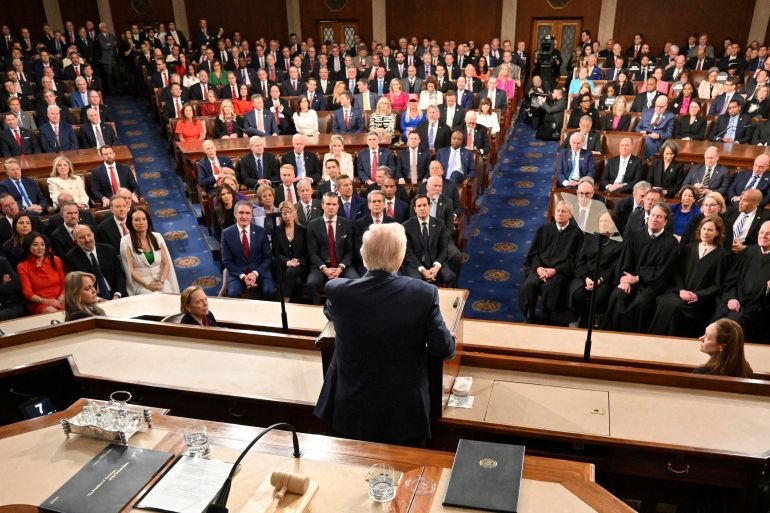
To understand the coming collision between President Donald Trump and a Democratic Congress, one must first discard the textbook formulas of US governance. The United States is about to witness a political experiment for which there is no modern precedent: a purely transactional populist, entirely unmoored from traditional ideological orthodoxy, forced to share power with a legislative branch unified in partisan hostility.
The conventional wisdom predicts immediate, paralysing gridlock. That is a misreading of the terrain. Trump does not view politics through the lens of conservative dogma or constitutional restraint; he views it through the lens of the deal. Consequently, his governance will not be characterised by passive stagnation, but by an aggressive, volatile mix of transactional bipartisanship and raw executive unilateralism.
Domestically, the ideological lines will blur. For decades, the Republican Party was defined by its commitment to limited government and free markets. Trump has spent a decade dismantling that consensus. Confronted with a Democratic House of Representatives and a Democratic Senate, he will feel no tribal loyalty to standard conservative policy. Instead, expect him to seek out areas of populist overlap.
When it comes to massive infrastructure spending, protectionist trade policy and aggressive state intervention to protect domestic manufacturing, Trump is often closer to the Democratic centre-left than to the ghost of former President Ronald Reagan. He will dare the opposition majorities to vote against legislation that pours millions of dollars into their districts or levies tariffs that protect their blue-collar constituents. It will be an unholy, ad hoc alliance — issue-by-issue, fleeting, and transactional — designed to deliver the optics of victory for both a populist president and a vulnerable congressional majority.
Where such transactions fail, however, the venue will shift from the legislative chamber to the administrative state controlled by the executive. Trump will not accept the traditional boundaries of a divided government. If necessary, he will govern by decree. Executive orders, emergency declarations and expansive interpretations of federal statutes will be deployed to bypass a stubborn Capitol Hill. The administration will dare the Democratic leadership to tie up the government in the federal courts, turning the slow wheels of the judiciary into a political weapon.
Yet, the true test of this fragile constitutional architecture will not occur on the domestic stage. It will happen abroad, specifically in the volatile expanses of the Middle East, where the executive branch enjoys its greatest constitutional latitude.
The immediate flashpoint is Iran. The Trump doctrine rests on a foundation of maximum economic pressure backed by highly unpredictable, asymmetric tactical deterrence. It is a posture designed to keep adversaries off balance. But a Democratic Congress, historically wedded to the framework of multilateral diplomacy and deeply wary of congressionally unauthorised foreign entanglements, will view this unpredictability not as a strategic asset but as an existential danger.
The US is likely headed for a historic constitutional showdown over the War Powers Resolution of 1973. Democratic majorities will also aggressively use the power of the purse to place statutory fences around the commander-in-chief, attempting to defund military manoeuvres or explicitly prohibit unilateral escalations against Tehran. Trump will treat these attempts at legislative constraints with open contempt. Asserting an absolute, almost unrestrained reading of the Constitution’s Article II executive authority, the president will argue that modern geopolitical threats require executive agility, not governance by congressional committee. When the rockets fly, the president will act unilaterally, leaving Congress to meaningless academic debates.
Hanging over this entire drama is the ultimate constitutional weapon: the threat of impeachment by Congress. In a Washington where both the House and the Senate are controlled by the president’s opponents, oversight will cease to be an instrument of governance and become an engine of partisan political destruction.
Democratic congressional committee chairs will launch a relentless, multifront campaign of subpoenas and investigations. Every member of Trump’s cabinet will live in a permanent state of interrogation; every foreign policy decision will be audited for high crimes and misdemeanours. The House will almost certainly draft articles of impeachment, not as an extraordinary remedy for rare misconduct, but as a routine penalty for political nonconformity.
Yet, this strategy carries severe risks for the opposition. Trump does not fear institutional warfare; he thrives on it. He will transform the spectacle of congressional investigations into the theatre of public grievance. To his base, a hostile Congress will be framed not as a coequal branch of government performing its constitutional duty, but as an illegitimate, obstructionist cabal subverting the will of the forgotten American voter.
Because the structural math of the Senate requires a two-thirds majority for removal of the president, actual eviction from the Oval Office remains a statistical fantasy. Impeachment will therefore achieve not displacement, but a permanent state of institutional friction.
What the US is about to enter is not two years of legislative inactivity, but a phase of perpetual brinkmanship. It will be an era in which governance occurs only in the narrow, volatile intervals between constitutional crises. The US system was built to withstand institutional tension, but it also requires a basic reverence for institutional boundaries to function. With a transactional populist president in the White House and an adversarial army on Capitol Hill, those boundaries will be tested as never before. The architecture will hold, but the foundation will shake.
The views expressed in this article are the author’s own and do not necessarily reflect Al Jazeera’s editorial stance.
Leave a Reply