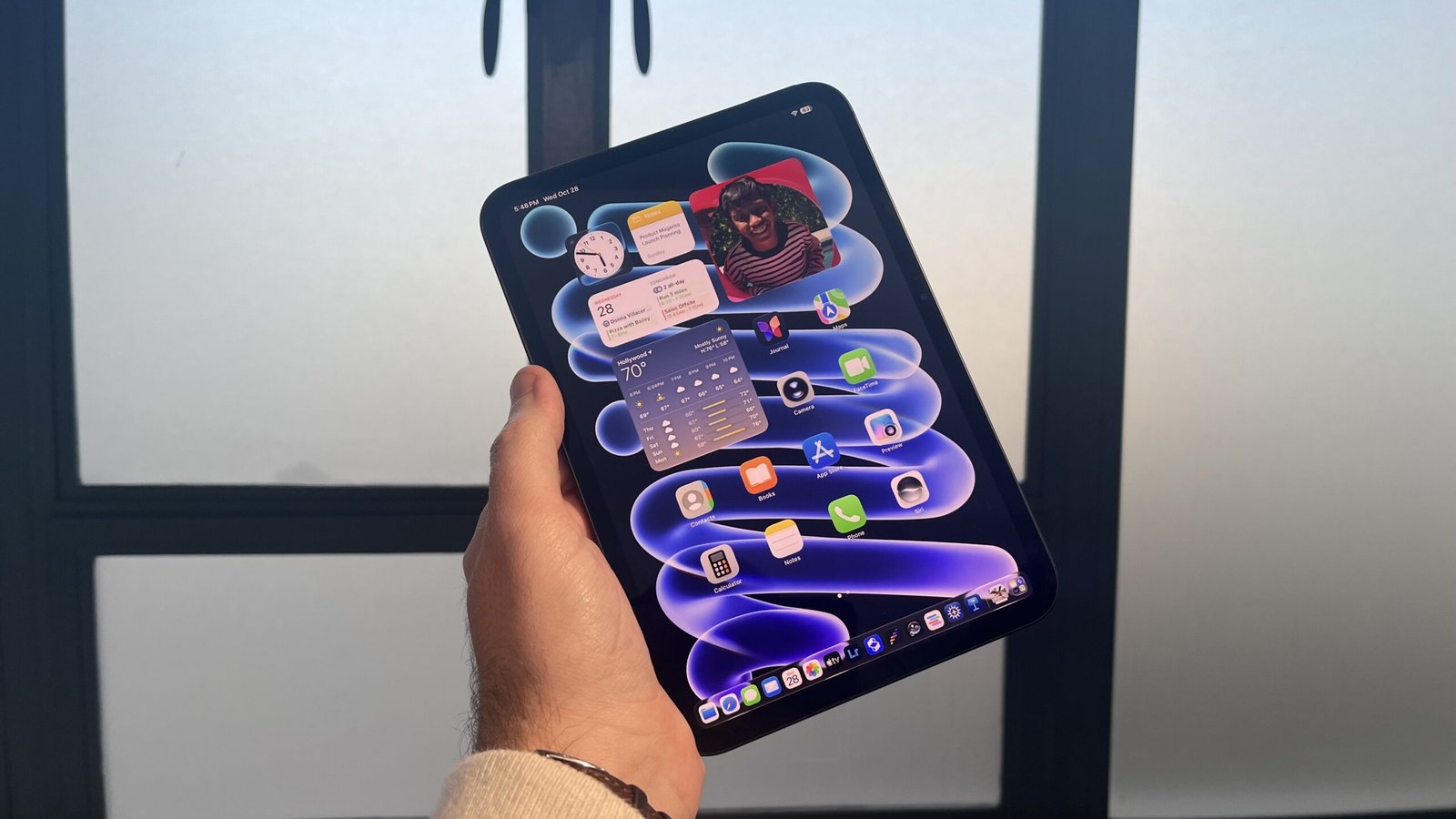
LOS ANGELES—In LA, I didn’t expect to meet one of the toughest iPads ever: the 2026 iPad mini. It’s an unlikely candidate to be the first Apple tablet to resist water and dust. (It now has an IP67 rating.) But that’s not Apple’s marquee update for its smallest tablet. For that, all you need to look at is the display.
The new iPad mini also gets numerous other worthy upgrades, but will it be enough to offset an unwelcome increase in starting price to $699 (from $599), and an uncertain value proposition versus the more basic, cheaper iPads? (The iPad mini has, for a while, been something of an odd “tweener” model with a cloudier target audience than most.) Here’s how it all feels, based on the time I spent with the tablet during Apple’s “Pro and Tell” showcase in LA.
Preorder Your 2026 Apple iPad mini Here

Apple iPad mini (2026)
8.5-inch OLED touch screen, A20 Pro processor, Acoustic Display, IP67
Design: The First iPad You Can Drop in a Puddle
This newest iPad mini is an adaptation of the previous design, retaining the same width and height footprint. The screen, which I’ll talk about more later, is now larger at 8.5 inches and fits within the same basic chassis dimensions. That’s thanks to thinner bezels and a new speaker system.
The tablet is thinner and lighter than the previous 2024 model, by 14% and 13%, respectively. In terms of absolute dimensions, the 2026 mini measures 0.21 inches thick and weighs just 0.56 pounds for the Wi-Fi model. (A version with a wireless cellular modem weighs just two-hundredths of a pound more.)
In my hands, the iPad mini feels super lightweight and portable. Having recently played with an iPhone Duo, the device feels surprisingly similar in shape and size.

(Credit: Joe Osborne)
Apple also made some major adjustments to the layout of certain key components. The 12MP FaceTime camera (which still supports Apple’s Center Stage automated adjustment) has been moved from one of the tablet’s narrow edges (for use in portrait orientation) to a landscape one (now positioned over the broad side of the screen). This is in line with Apple’s other iPads at this point, and it’s about time. The rear camera is also rated at 12MP resolution with a five-element lens, 5x digital zoom, and automatic image stabilization.
Apple also updated how the tablet delivers audio, but via a major change to the screen: The panel is what Apple now calls an Acoustic Display. This comprises a set of tweeters along the display’s sides and woofers positioned beneath the panel rather than along the outer edges. It relies on vibrations rather than the usual speaker ports to emit sound.

(Credit: Joe Osborne)
Fewer outlets mean fewer openings, and that helps enable the IP67 water and dust protection feature. It’s a first not just for the iPad mini, but for any iPad to date. According to Apple, the iPad mini can withstand submersion up to 1 meter for up to 30 minutes.
How do these vent-free speakers sound? While it was difficult to gauge the exact quality at Apple’s demo venue, pulsing with the oomph-oomph of house music, I could clearly hear the audio emanating from within the Acoustic Display. More on that when we can get the iPad mini to a quiet place.

(Credit: Joe Osborne)
As for wired connectivity, the iPad mini has just a single 10Gbps USB-C port. You’ll have to share it between recharge duties and whatever peripheral connections you want. For biometric login, the iPad mini still relies on a Touch ID sensor built into the power button.
Finally, Apple considerably reduced the iPad mini’s color options. Your choice is now down to Midnight (black) and Starlight (gold). This shift toward more sober colors is interesting, considering how many parents buy iPad minis for their kids.
Display: Deep Color and Contrast, But It Needs to Be Faster
Here’s probably the most divisive point regarding the iPad mini: its 8.5-inch OLED display. Yes, you’ve read that correctly. The iPad mini has finally moved on from standard IPS LCD to a superior OLED.
OLED (short for organic light-emitting diode) uses pixels that each emit light (rather than relying on backlighting to illuminate the entire screen, as IPS panels do). This results in superior color coverage and deeper black levels than traditionally lit IPS or LED panels can achieve.

(Credit: Joe Osborne)
Apple’s iPad mini OLED screen supports a resolution of 2,316 by 1,512 pixels, which works out to 326 pixels per inch. OLED also enables the screen to support the P3 wide color gamut. Apple covered the screen with an anti-reflective coating that you can further enhance with a nano-texture display option (a $100 upgrade).
The touch screen has some interesting brightness-related features. It’s rated to reach up to 1,200 nits of brightness when displaying HDR content, while it can dial down to just 1 nit for low-light use. Also, as an OLED panel, it offers a sky-high, hard-to-fathom rated contrast ratio typical of those panels: 2,000,000:1.

(Credit: Joe Osborne)
Given all these upgrades (plus the addition of the latest A-series processor, which I’ll dive into below), the iPad mini screen still refreshes at a pedestrian 60Hz. Apple neglected to update the iPad mini display with its 120Hz ProMotion refresh rate, which seemed like a layup for this new model. It would have made the display upgrade feature-complete, bringing it all full circle.
How does all of this look and feel in practice? The panel looks downright gorgeous, to be sure, with inky, deep blacks and vibrant colors. While the lack of a bump to the ProMotion refresh rate is a bummer given the price increase (not to mention the relative mismatch with the new super-powered processor), I didn’t notice the lower refresh rate during my brief few minutes swiping around the tablet. It looks and feels like any earlier iPhone or iPad I’ve used, in terms of response time and scrolling smoothness.
Recommended by Our Editors
To the untrained eye, it’s likely to pass unnoticed. Eagle-eyed enthusiasts who have used a faster ProMotion screen, however, are likely to see and feel the difference.
Specs Check: As Powerful As the Most Potent iPhones
Touching briefly on what’s inside this new iPad, Apple updated it from the A17 Pro chip to the latest A20 Pro. However, the exact flavor of A20 you’ll receive depends, curiously, on the storage configuration you opt for.
The starting iPad mini ($699 before any other upgrades) has a 128GB solid-state drive and an A20 Pro processor with a five-core CPU (two super cores and three efficiency cores) and a seven-core GPU. The 256GB option, which starts at $799, also includes this same version of the A20 Pro. If you want the best possible version of the chip (which includes an additional GPU core), though, you’ll need to jump to the 512GB option ($999 starting price). At first glance, the upgraded chip is only a marginal improvement, packing just an additional efficiency core and offering no advantage in GPU cores.
What the upgraded A20 Pro chip does have over the base-level silicon is a 32-core Dual Neural Engine, versus the standard 16-core AI coprocessor in the basic A20 Pro. This will certainly play into use with Apple Intelligence and Siri AI, but otherwise, you probably won’t notice much, if any, performance difference between the two in day-to-day iPad use.
Again, since you are getting Apple’s most advanced mobile chip yet, that sets an expectation for additional top-shelf tablet features, like a ProMotion screen. Without that, it’s a bit of an incomplete package for spec-savvy, enthusiast buyers, such as mobile gamers and content creators (especially digital illustrators).
Early Verdict? Upgrade Only for the OLED
Anyone buying an iPad mini for the first time will be pleasantly surprised by this version, for everything it brings to the platform. While I’m far from this product’s target audience, I can see the appeal of a juiced-up iPad that fits better in a bag or backpack and feels like nothing is there.

(Credit: Joe Osborne)
However, the iPad mini targets a hard-to-define audience—even more so now, given the higher price for everything new it brings. That’s why the 60Hz refresh rate stings so much. While I wasn’t miffed by it in my very limited time with the new iPad mini, Apple regulars who have enjoyed 120Hz Apple screens for some time now will certainly notice. For some, it’s just a spec argument, but it will likely bum out Apple observers and the mix of deep-pocketed shoppers who flock to Apple’s smallest tablet. And…they’ll need to dig even deeper into those pockets.
You can preorder the iPad mini starting at $699, and it will hit virtual and actual Apple Store shelves on Nov. 6. Be sure to check back here for our review and full tests in short order.
About Our Expert

Joe Osborne
Deputy Managing Editor, Hardware
Experience
After starting my career at PCMag as an intern 16 years ago, I’m back as one of its editors, focused on managing laptops, desktops, and components coverage. With more than 15 years of experience, I have been on staff and published in technology review publications, including PCMag (of course!), Laptop Magazine, Tom’s Guide, TechRadar, and IGN. Along the way, I’ve tested and reviewed hundreds of laptops and helped develop testing protocols. I have expertise in testing all forms of laptops and desktops using the latest tools. I’m also well-versed in video game hardware and software coverage.
Leave a Reply