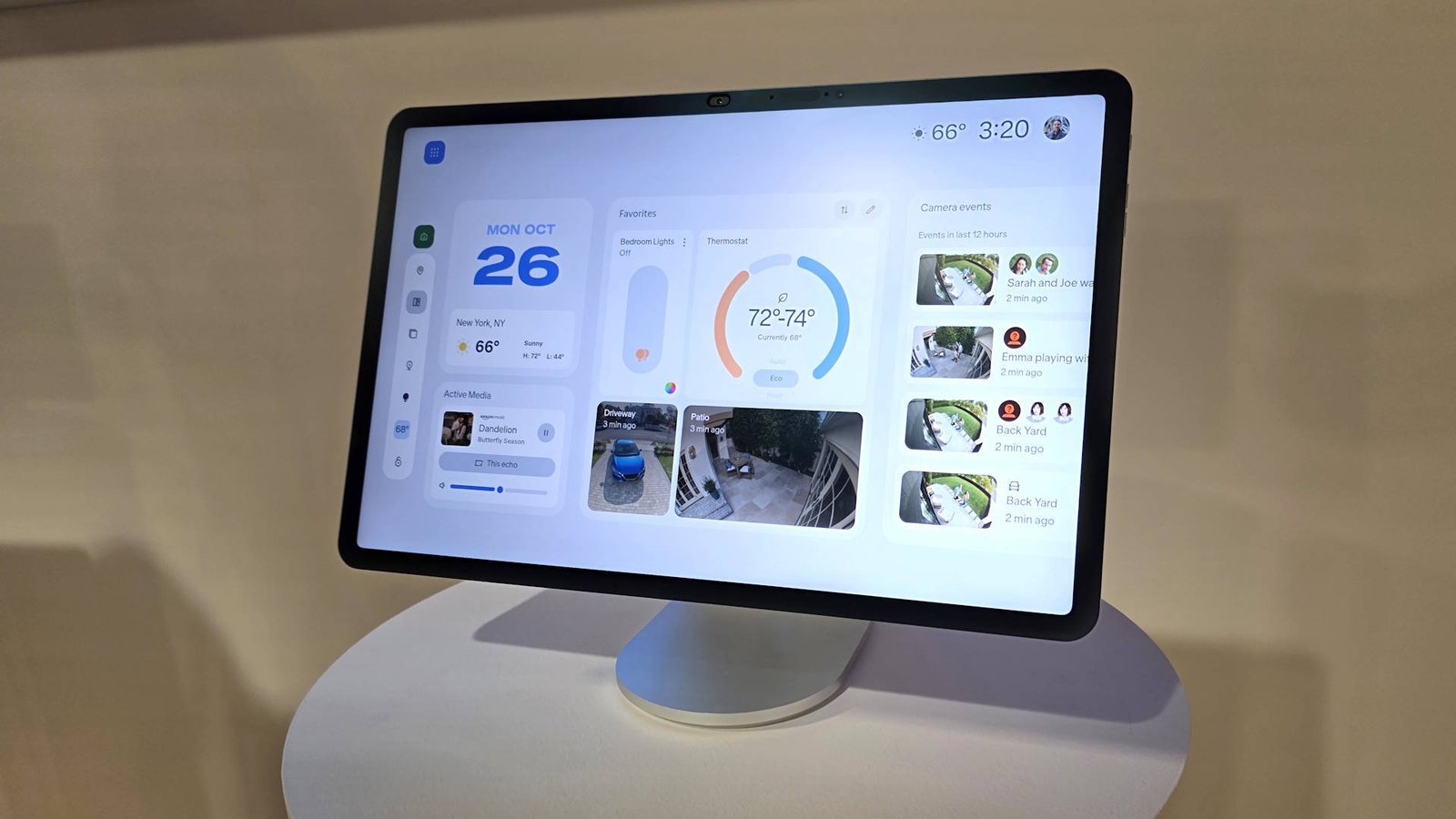
Amazon’s smart home strategy just took a sudden, fascinating turn. At a hands-on media demo in New York, the company unveiled its most ambitious piece of ambient hardware yet: the Echo Show 16, a massive, iPad-like smart display engineered to act as an all-seeing command center for your entire property. Its centerpiece is Alexa Home Map, a feature that uses Ring camera feeds and real-time AI to track every person and vehicle moving outside your home—a technical marvel that feels just as unsettling as it is capable.
But while the 16-inch flagship steals the spotlight with raw power and ambient surveillance, Amazon also showed off a surprisingly restrained counterweight: single-purpose devices like the Alexa Photo Frame and Echo Time that intentionally strip away the bloat. Rounded out by a refreshed Echo Dot and a camera-equipped Echo Studio, Amazon is clearly rethinking how much of your home Alexa should occupy.
Echo Show 16: A 16-Inch Command Center With an iPad Complex

The flat Echo Studio 16 can be easily mounted on a wall. (Credit: Will Greenwald)
The Echo Show 16 was definitely the headliner of the event. It’s a 16-inch smart display with a remarkably thin metal chassis that looks like an oversized Alexa Tablet or iPad. Like the Apple HomeView, it can sit on a table or mount on a wall. It’s also the first device to get Amazon’s newest Echo Show interface, which sorts its many tricks into automatically organized views built around each main function. A view for talking to Alexa, for instance, saves each conversation as a card so you can revisit the information later, while a home calendar view keeps track of family schedules and appointments.
The Echo Show 16 also offers the full Fire TV experience for streaming, but that’s nothing new; the Echo Show 15 and 21 already do. And while the Echo Show 16’s name slots it between those two displays, its design sets it apart. The 15 and 21 look like picture frames, while the 16 is a slim metal tablet. The older models will also get Alexa Home Map, a new smart home view that turns a scan of your home into an interactive map of all your connected devices (more on that below). The feature starts rolling out in early access later this year to the Echo Show 15, 16, and 21, as well as Alexa Tablets, the Ember Artline Fire TV, and the Alexa and Ring apps for Android and iOS. It will also get its own dedicated iOS app.
I poked around the Echo Show 16’s views and features, and the interface felt much cleaner and more touch-friendly than I’ve seen on an Amazon smart display. I could reach a number of functions without a single voice command, and the menus looked simple and intuitive. The hardware impressed me just as much; it has the look and feel of a premium tablet.
That big screen comes with a high price. The Echo Show 16 starts at $499.99, $200 more than the Apple HomeView. For $569.99, you can get a version with an anti-glare Nanomatte display, the same screen treatment found on the Alexa Tablet 12 Pro ($679.99). If you’d rather set it on a flat surface than mount it, a basic stand costs another $69.99, and a swivel-and-tilt stand costs $124.99.
Alexa Home Map: Technically Incredible, Deeply Ominous

Alexa Home Map is amazing—and kind of scary. (Credit: Will Greenwald)
Then there’s the new smart home view, called Alexa Home Map. You can scan the inside and outside of your home in the Alexa app and generate a map that shows up on the screen, with each individual smart home device appearing as an icon. Tap any device to control it, or if it’s a home security camera, bring up a video feed. Even more impressive, it can use AI to analyze the feeds of all of your outdoor Ring cameras and display any people or vehicles around your home.
Alexa Home Map, especially the AI-powered people-tracking, is technically incredible. It’s also honestly frightening. There are already plenty of concerns about privacy and security with Ring cameras and how their data can be shared, and feeding all of that data into a system that can track foot traffic feels ominous. Knowing about the foot traffic around your house is nice, but the possibility of that data being shared and aggregated, even if it’s totally separate from video footage, feels like a pretty big privacy invasion. Though to be fair, I’ve been leery of these cameras ever since I saw an earlier Ring demonstration using AI to summarize benign family activities in your home. Even so, it’s extremely impressive from a technical standpoint.
Alexa Photo Frame: The ‘Anti-Smart Display’ Stripped Down to the Basics

The Alexa Photo Frame isn’t a smart display; it’s a digital picture frame that happens to include Alexa. (Credit: Will Greenwald)
It’s clear that Amazon wants its Echo Show smart displays to do just about everything, which is what makes its other two new screen-equipped devices, the Alexa Photo Frame and the Echo Time, so interesting. Both have LCDs and hands-free Alexa, but each is built for one specific purpose. They’re deliberately limited, and they aren’t the smart displays we usually think of.
The Alexa Photo Frame is Amazon’s first official digital picture frame. It has a 10-inch anti-glare touch screen, a traditional frame-style bezel available in real wood, and, of course, Alexa. I’ve long thought of the Echo Show 15 and 21 as digital photo frames, but they’re really multipurpose smart displays that double as control panels, calendars, bulletin boards, and TVs.
The Alexa Photo Frame shows photos from your Amazon Photos library and nothing else. There are no smart home controls, no calendar, and no videos. It’s just for pictures. You can still talk to Alexa, but answers like weather reports and sports scores come only through Alexa’s voice and never appear on the screen. In other words, it’s not a smart display with a photo mode; it’s a picture frame that happens to have Alexa.
You can ask Alexa to show specific photos or search your library for particular people, places, or things. AI comes into play again here, with Alexa analyzing every photo to identify who and what appears in each shot. In the demo I saw, voice commands for multiple family members brought up group shots with exactly the right people in them. Alexa can also find thematic photo pairs; one demo placed a picture of the Amazon representative’s daughter at age 6 beside a picture of her at 16.
Pairing Alexa with a dedicated photo frame that does nothing else is a clever idea. It’s obviously more limited than, say, the Echo Show 11 ($249.99), but that’s a feature, not a flaw. There are no ads, no control panels, and no video, just photos you can summon with your voice. And since Alexa’s responses are almost entirely audio, they never clutter the screen.
The Alexa Photo Frame is available today for $199.99 in black or $229 in birch or walnut wood.
Echo Time: An Alarm Clock That Watches How You Sleep (Without a Camera)

The Echo Time is a clock first and a smart speaker second, designed to help you sleep better and wake up easier. (Credit: Will Greenwald)
The Echo Time is an alarm clock with Alexa built in. It’s a friendly, round little device that looks like an Echo Dot with a 3.2-inch touch screen devoted almost entirely to telling time. It works like a standard clock with hundreds of customizable faces, most of which offer only minimal controls for individual smart home devices. There’s no calendar or full control panel, and as with the Photo Frame, Alexa answers your questions by voice only, with nothing on the screen. It’s nearly as pure a clock as the sadly discontinued Echo Dot With Clock, which was literally just an Echo Dot with an LED clock on its side.
The Echo Time also has a few tricks no other Echo device offers, all focused on sleep. It doesn’t have a camera, but it uses Amazon’s Omnisense sensor bundle to track your sleep and adjust how it wakes you. If it senses you’re sleeping lightly in the morning, it wakes you sooner and more abruptly so you feel refreshed; if you’re in a deep sleep, it eases you awake more gradually. The clock face adapts, too, dimming to as little as 0.3 lumens and shifting to warmer colors so you can check the time at night without getting blasted with light. A Kids Echo Time adds a Sleep Studio feature with curated bedtime stories and music to help kids wind down, and it comes with a year of Amazon Kids+ ($7.99 per month with Prime, $8.99 without).
Recommended by Our Editors
I obviously couldn’t test the sleep features at the demo, but the device itself looks pleasantly simple. It reminds me a bit of the Echo Spot ($109.99), only friendlier-looking and with a bigger, better screen. Its focus is what really appeals to me. Like the Photo Frame, it doesn’t try to be a smart display; it strips away almost everything that isn’t essential to being a great alarm clock, with Alexa mostly out of sight.
The Echo Time is available today for $199.99, and the Kids Echo Time costs $209.99.
Echo Dot: Amazon’s Little Smart Speaker Adds More Bass and Matter

The latest Echo Dot doesn’t look very different, but it has some new smarts inside. (Credit: Will Greenwald)
The other two devices Amazon showed off were updated Echo smart speakers without screens. The new Echo Dot packs Amazon’s AZ3 chip, a fourth microphone, and Omnisense sensors into its little speaker ball, all to make Alexa more responsive and capable. It also doubles as a smart home hub for Matter, Thread, and Zigbee devices, and like its predecessor, it can act as an Eero mesh Wi-Fi extender. Amazon claims it delivers 50% more bass than the previous-generation Echo Dot, but given its tiny size, temper your expectations there.
The Echo Dot starts shipping today for $99.99, and a Kids Echo Dot with a year of Amazon Kids+ is available for $209.99.
Echo Studio With Home Camera: A Hi-Fi Speaker That Watches the Room

The Echo Studio with Home Camera let you check in our home using Live View. (Credit: Will Greenwald)
Finally, the Echo Studio ($219.99) gets a new variant, the Echo Studio with Home Camera. It’s exactly what it sounds like: an Echo Studio with a camera. The audio hardware is identical to the standard model, but the camera adds a few new abilities. You can check in on your home remotely with Live View, hold up an object and ask Alexa to identify it using machine vision, and make video calls when it’s paired with a Fire TV media streamer. If you don’t think your smart speaker needs a camera (and I don’t), the regular Echo Studio is still available.
The Echo Studio with Home Camera costs $249.99, $30 more than the standard Echo Studio.
The Real Test Comes at Home
Between the do-everything Echo Show 16 and the refreshingly focused Photo Frame and Echo Time, Amazon has given me a lot to dig into. A brief demo can only tell you so much, and I’m eager to see how these devices hold up in everyday use, especially the Echo Time’s sleep features and Home Map’s people tracking. Stay tuned for full reviews.
About Our Expert

Will Greenwald
Principal Writer, Consumer Electronics
Experience
I’m PCMag’s home theater and AR/VR expert, and your go-to source of information and recommendations for game consoles and accessories, smart displays, smart glasses, smart speakers, soundbars, TVs, and VR headsets. I’m an ISF-certified TV calibrator and THX-certified home theater technician, I’ve served as a CES Innovation Awards judge, and while Bandai hasn’t officially certified me, I’m also proficient at building Gundam plastic models up to MG-class. I also enjoy genre fiction writing, and my urban fantasy novel, Alex Norton, Paranormal Technical Support, is currently available on Amazon.
Leave a Reply