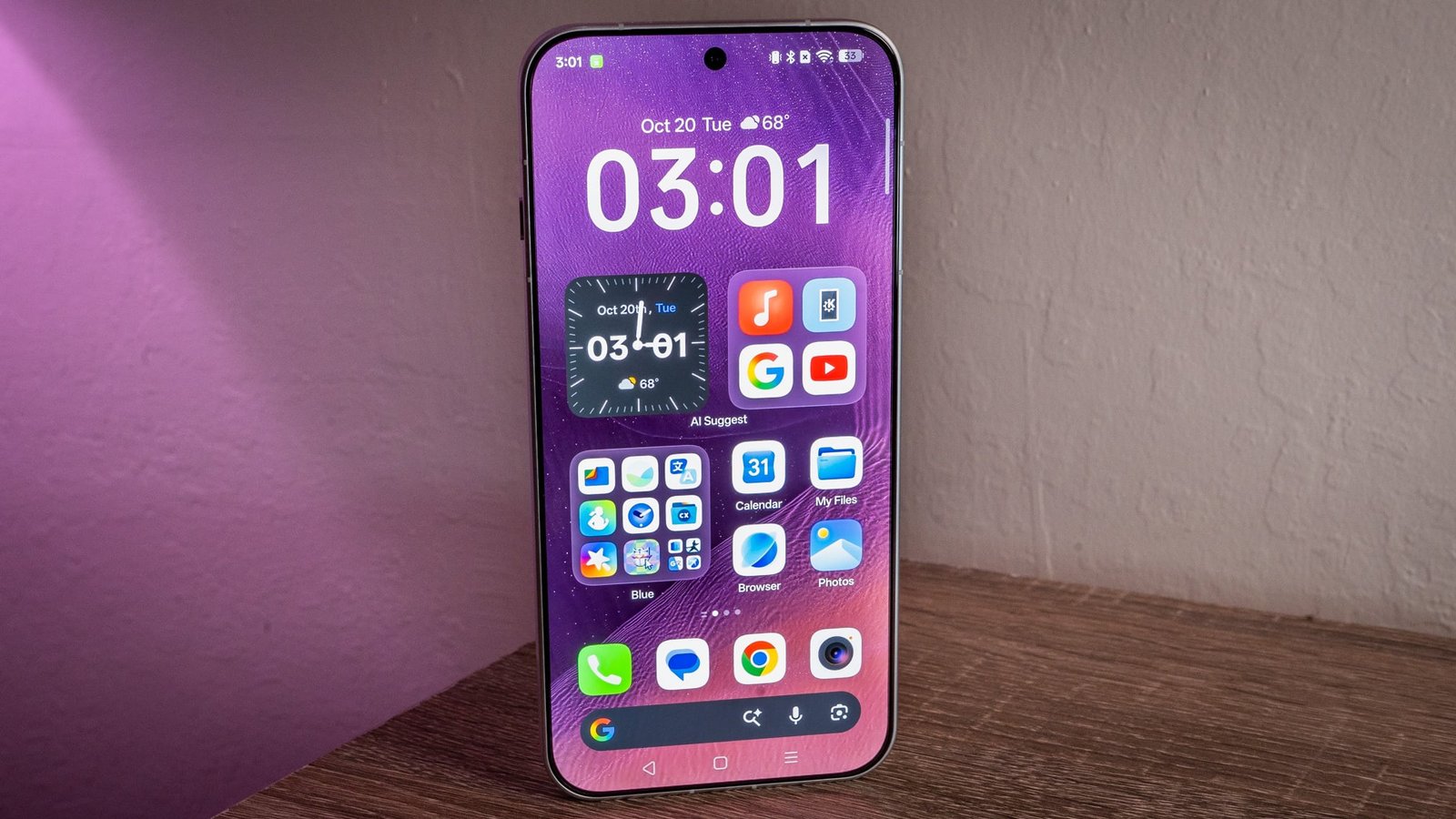
The biggest bummer about smartphone maker Oppo is that you can’t buy its phones in the States, at least not outright. Oppo recently launched its Find X10 flagship series, including the base Find X10 and the Find X10 Pro Max, in markets including China, India, and across Europe. The phones are drawing buzz for their high-resolution cameras and massive battery packs.
Oppo, if you recall, is the parent company of the brand OnePlus, which closed its US operations earlier this year. Over the past few generations, the two brands have shared DNA between flagships, and the Find X10 is similar to the OnePlus 16, which also won’t be sold here.
Oppo sent over both the Find X10 and X10 Pro Max models for us to paw at. The X10 starts at around $820 (converted from Chinese Yuan), while the Pro Max starts at roughly $1,015. They’re both available with up to 512GB of storage. The smaller Find X10 features a 6.59-inch display, 200MP primary camera, and a massive 8,000mAh silicon-carbon battery. The Find X10 Pro Max is the real powerhouse, with its 6.7-inch display, triple 200MP camera system, and the 2nm MediaTek Dimensity 9600 Pro processor. It’s the one I’d label “worth the import.”
Let’s look at what the Find X10 series will offer in other markets when it goes on sale next month, and what we’re missing.
Hearty Phones With Slim Bezels
As my husband said in the car the other day, looking at my Pixel 10 Pro on the dash: “Everything looks like the iPhone now.” That includes the Oppo Find X10 and X10 Pro Max, with their rounded corners and trim bezels. To Oppo’s credit, the bezels are thinner than on the latest iPhone. They measure 0.99mm on the Find X10 and 1.15mm on the Pro Max, compared with 1.4mm on the iPhone 18 Pro.

Left to right: Find X10 Pro Max in Luna White, Find X10 in Mist Grey (Credit: Florence Ion)
The Pro Max measures 6.35 by 3.01 by 0.33 inches (HWD), or roughly the size of the Google Pixel 11 Pro XL (6.40 by 3.0 by 0.30 inches) despite its smaller display. The regular Find X10 measures 6.16 by 2.92 by 0.33 inches; it’s slightly smaller than the Google Pixel 11/11 Pro (6.0 by 2.80 by 0.30 inches).
The Find X10 weighs 7.6 ounces, while the Pro Max weighs 8.29 ounces. They’re heavier than both the Pixel 11 Pro and Pro XL (7.2 ounces and 7.9 ounces, respectively). The Pro Max is especially dense in order to accommodate three 200MP camera sensors.
Both are covered in a mix of aluminum and matte finishes, with similar flat sides and contoured edges. The X10 comes in Glacier Blue, Glow Coral, and Mist Grey, while the Pro Max comes in Luna White and Titanium Grey.

Find X10 right edge (Credit: Florence Ion)
One thing Oppo brought to the Find X10 series that we loved about the last few OnePlus phones is its durability. Both devices feature IP66, IP68, and IP69 ratings. The devices are not only dust- and water-resistant, but also protected against high-temperature water jets and intense pressure. OnePlus’s favorite trick used to be advertising that you could throw the smartphone in the dishwasher and it would come out unscathed. If it weren’t already an Oppo creation, this would feel like a callback to OnePlus.
The Snap Key on the Pro Max (Credit: Florence Ion)
Other fake OnePlus callbacks—because, technically, Oppo invented it—include the Snap Key on the phones’ left side. Earlier OnePlus models had an alert slider, which eventually evolved into a user-programmable button. Some would say that’s too many buttons for a smartphone, but the latest iPhone has five buttons to fiddle with.

(Credit: Florence Ion)
The Batteries and Processors Sure Pack a Punch

(Credit: Florence Ion)
One of the best things about the OnePlus 15 was the long-lasting battery life. The Oppo Find X10 series should outlast it. Both phones have an 8,000mAh battery. Oppo advertises up to two days of full use on both devices, though the Find X10 promises at least an hour of streaming more than the Pro Max. I could not run the battery down even after five days of using the phone.
The phones share identical charging capabilities. They support Oppo’s proprietary 80W SuperVOOC wired charging and up to 55W fast charging with third-party compatible power bricks. Wireless charging is available up to 50W with Oppo’s proprietary magnetic charging gear. It’s a crapshoot to find third-party chargers that meet Oppo’s advertised speeds.
Perhaps the most surprising part of using the Oppo Find X10 is that the MediaTek chips pack a competitive punch. We are used to seeing MediaTek processors power low-budget phones and things like Lenovo tablets. The Find X10 features the 3nm MediaTek Dimensity 9600M processor with 12GB of RAM, while the Find X10 Pro Max runs on the 2nm MediaTek Dimensity 9600 Pro paired with either 12GB or 16GB of RAM. I was especially struck by the Pro Max’s benchmark results with 16GB of RAM.

(Credit: Florence Ion/Geekbench/3DMark)
I ran benchmarks once after freshly charging the Pro Max. It posted a single-core score of 2,823 and a multi-core score of 7,556 in Geekbench 6, placing it between the iPhone 18 Pro, which runs the Apple-made A20 Pro, and the Samsung Galaxy S26 Ultra, powered by the Qualcomm Snapdragon 8 Gen Elite 5 chip. In graphics processing, the Find X10 Pro Max lags in 3DMark. It ran 6,978 frames at 41fps, trailing the Galaxy S26 Ultra, which scored 7,847 frames at 46.99fps.
There’s Magic In the Megapixels

Find X10 Pro Max (Credit: Florence Ion )
Both the Find X10 and X10 Pro Max feature 200MP primary cameras. But only the Pro Max uses the upgraded custom Samsung-manufactured ISOCELL HPC sensor with DeepPix for the main camera. The regular Find X10 uses a 200MP main wide-angle camera, a 50MP ultrawide, and a 200MP telephoto, while the Pro Max uses 200MP sensors across the board. The Pro Max’s primary camera has the largest sensor at 1/1.3 inches, compared with 1/1.4 inches on the Find X10’s. If what you want is Oppo’s full stack of photography chops, backed by its Lumo processing engine and Hasselblad-branded glass, the Pro Max is it.
They can shoot in up to 8K video at 30fps and 4K video from 60fps to 120fps for slow-motion playback. The difference is that the Pro Max can do this on all three cameras, while the base model can do it only on the main camera.
Recommended by Our Editors

Find X10 Pro Max sample photo (Credit: Florence Ion)
Both devices use the same 50MP autofocus sensor for the front-facing camera. The built-in facial retouching on OnePlus and Oppo phones, which is more common in overseas camera apps, is why I liked taking all my selfies with them. It’s present in both Find X10 phones with new-to-me tools like face elongation and jaw tightening.
The camera app is more crowded than on many Android phones, but that’s just a quirk of Oppo’s ColorOS. You can adjust the face retouching features, turn on the four-thirds grid, and switch camera filters on demand from the viewfinder window. My favorite little gimmick is the automatic document processing, which works well for snapping shots of LCD and other screens. I like to archive my handwritten notes and the different breeds of Tamagotchi I’m raising across virtual pet devices. Oppo’s camera app uses a nifty AI-enhanced perspective correction feature to automatically crop, de-skew, and flatten what it detects as a photo of a screen or document.

(Credit: Florence Ion)
I Tried the Big Lens

The Hasseblad Teleconverter Kit, as mounted on the Oppo Find X10 Pro Max. (Credit: Florence Ion)
I want to show you this gigantic telescopic lens by Hasselblad relative to a smartphone. The $210 Hasselblad Teleconverter Kit includes a case and a mounting kit. It fits only the Find X10 Pro Max. The lens features 13 all-glass elements with various coatings to help reduce chromatic aberration. It helps the Pro Max’s 200MP 3x periscope telephoto camera achieve up to 10x true optical zoom. The camera app has a Hasselblad mode that calibrates the camera to this appendage. Then, you can only shoot beyond 3x, since the apparatus itself blocks out the other two cameras. Oppo says the accessory can help the Pro Max reach up to 20x zoom when combined with digital cropping.
I like the photos I took with the periscopic lens, and I think I could capture some cool, dreamy shots of sunsets or distant scenes. The lens makes the Find X10 Pro Max comically hard to maneuver. It’s way easier with the phone on a tripod, especially if you’re trying to follow along with moving objects like birds and planes. I also found that even with the elongated zoom, Oppo’s camera algorithms aggressively try to relay what they see far ahead. It isn’t exclusive to Oppo phones (we’ve seen it on the latest Pixel series), but it raises the caveat of bundling such extreme zoom capability into a small package.

Photo samples (Credit: Florence Ion)
Is the Curiosity Worth the Import?
There’s plenty more to like about the Find X10 series. Did I mention the Pro Max display’s 3,600-nit maximum brightness, 144Hz refresh rate, or its wide color gamut? Or the optimized Blackmagic Camera app with native Dolby Vision support? ColorOS also has some decidedly iOS-like elements designed to attract iPhone users in markets where Oppo phones are sold, such as Fluid Cloud notification bubbles, a Dynamic Island equivalent, and Lock Screen customization.
Of course, for all that “yin,” there’s also a “yang” to keep in mind if you do decide to go out of your way to find Oppo’s latest flagships. For instance, Oppo’s ColorOS has some curious features, like organizing icons by color. That works for some people, but it sent me into sensory overdrive. Since Oppo doesn’t officially release phones in the US, you will face connection limitations. The Find X10 series lacks mmWave 5G entirely and Band 71, which is crucial for T-Mobile in rural areas. And then there are account quirks, like Oppo’s account services not supporting US account registration. I pretended I was from Canada to complete device onboarding.
If anything, the Find X10 series reminds me of what OnePlus could have been. The Find X10 Pro Max shares a lot with the OnePlus 16, and US consumers don’t have easy access to either. If you’re a fan of Oppo’s efforts and don’t mind buying online from overseas markets, the Find X10 Pro Max could be a lot of fun.
About Our Expert

Florence Ion
Senior Writer, Mobile
Experience
I’m PCMag’s Senior Mobile Writer. I write about Android, iOS, and the myriad intricacies in between. I’ve been covering these worlds for more than 15 years. Before joining PCMag, I was a staff reporter for Gizmodo, PCWorld, and Ars Technica.
Leave a Reply