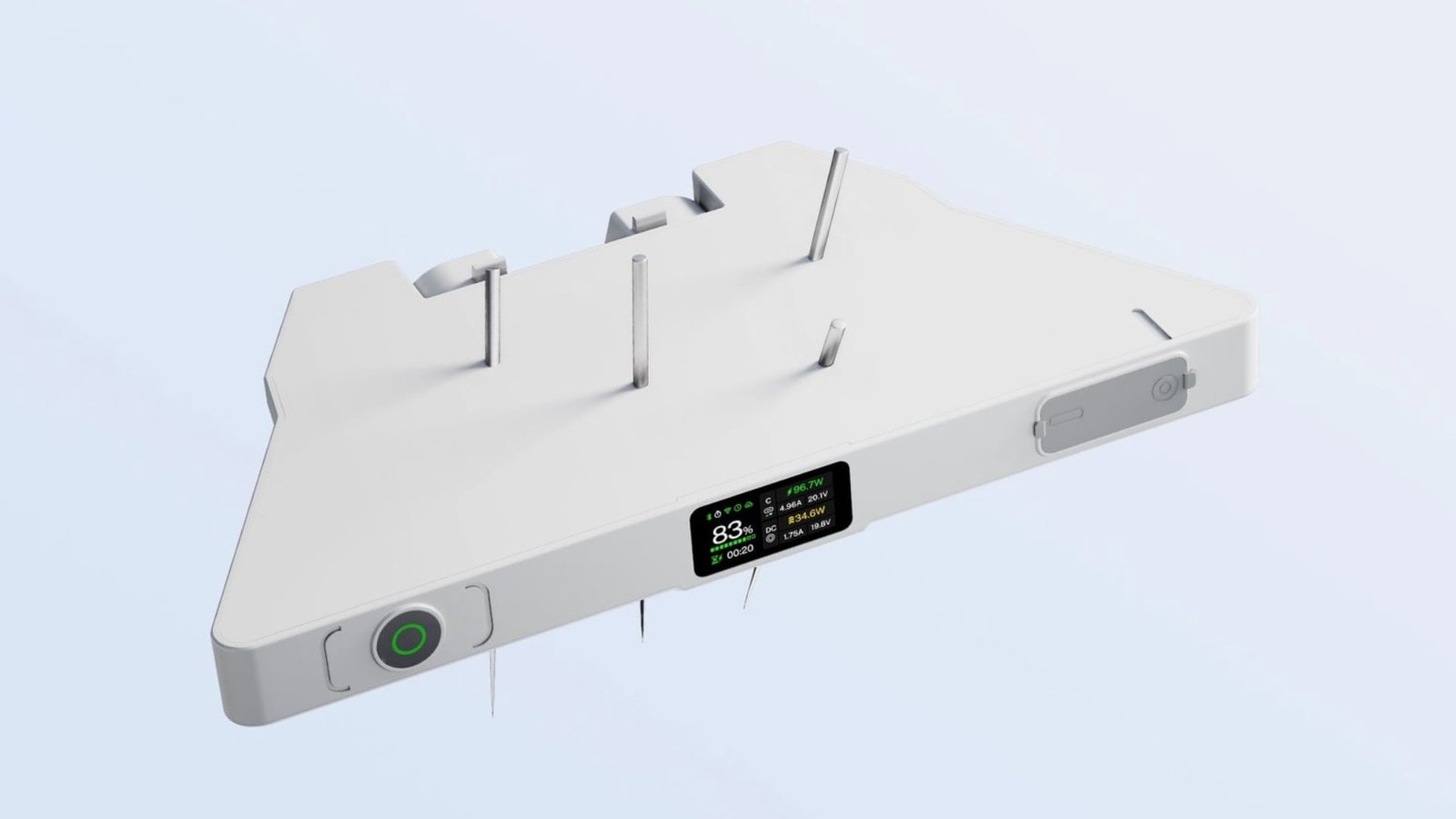
PeakDo, which makes battery accessories for the portable Starlink Mini dish, has a new “Ultra” tier model with a built-in fan to keep the battery bank cool.
The Chinese company today announced the LinkPower Ultra battery bank, which snaps onto the back of the Starlink Mini, giving owners a way to use the satellite internet service on the go.

(Credit: PeakDo)
This is the fourth entry in the LinkPower series. One of the main enhancements to the Ultra is the “active cooling” on the battery, which seems to address user complaints about earlier LinkPower models overheating, especially on hot, sunny days outdoors.
“The upgraded active cooling system automatically activates at 52°C (25 degrees Fahrenheit) and stops at 45°C,” the company adds. “Active airflow efficiently dissipates internal heat, helping manage temperature rise during extended high-load operation and maintain stable, reliable performance.”

(Credit: PeakDo)
Another improvement is the use of “semi-solid-state” battery cells, which LeakDo says make the product safer to use if it is punctured or operates at higher temperatures. Typically, a puncture can trigger a dangerous chain reaction in a lithium-ion battery, leading it to catch fire or explode. But in PeakDo’s case, the company says its semi-solid-state technology “enhances cell stability and thermal safety while reducing the risk of electrolyte leakage. Even if the cell is punctured under extreme conditions, it helps reduce the risk of thermal runaway, providing greater safety and reliability for outdoor use.”
The battery’s higher density also enabled PeakDo to create a slightly thinner design for the Ultra model. The device is 22 millimeters (0.866 inches) thick, down from 27mm on other models.

(Credit: PeakDo)
Despite its smaller size, the Ultra can still run for up to 5.5 hours on a single charge from its 27,000mAh battery, matching the performance of the LinkPower 3, which has a 27,500mAh battery. The Ultra’s battery also packs 99.9Wh, just under the 100Wh limit that FAA rules impose on lithium-ion batteries allowed in passenger luggage.
Recommended by Our Editors
Like the LinkPower 3, the Ultra model also includes a Wi-Fi remote-monitoring feature, allowing an owner to check their device’s battery status online. But at $329, it’s not cheap, especially since the Mini dish currently goes for $149 on Starlink.com and $249 at third-party retailers.
That said, PeakDo is offering a $30 discount over the next 10 days. The company also told PCMag: “The initial batch of inventory will be shipped from China, with an estimated transit time of 7 to 15 days to the United States. We plan to submit the product for listing on Amazon in early November. Please note that the actual launch date may be slightly later, as Amazon requires time to complete its review process and process the incoming inventory.”
Although PeakDo and other vendors have been filling a void with their third-party battery accessories for the Mini, there are signs that SpaceX is working on a second-gen model that’ll feature its own official battery capability. The company is also preparing a holiday sales push for Starlink, suggesting the new Mini could launch soon.
About Our Expert

Michael Kan
Principal Reporter
Experience
I’ve been a journalist for over 15 years. I got my start as a schools and cities reporter in Kansas City and joined PCMag in 2017, where I cover satellite internet services, cybersecurity, PC hardware, and more. I’m currently based in San Francisco, but previously spent over five years in China, covering the country’s technology sector.
Since 2020, I’ve covered the launch and explosive growth of SpaceX’s Starlink satellite internet service, writing 600+ stories on availability and feature launches, but also the regulatory battles over the expansion of satellite constellations, fights with rival providers like AST SpaceMobile and Amazon, and the effort to expand into satellite-based mobile service. I’ve combed through FCC filings for the latest news and driven to remote corners of California to test Starlink’s cellular service.
I also cover cyber threats, from ransomware gangs to the emergence of AI-based malware. In 2024 and 2025, the FTC forced Avast to pay consumers $16.5 million for secretly harvesting and selling their personal information to third-party clients, as revealed in my joint investigation with Motherboard.
I also cover the PC graphics card market. Pandemic-era shortages led me to camp out in front of a Best Buy to get an RTX 3000. I’m now following how the AI-driven memory shortage is impacting the entire consumer electronics market. I’m always eager to learn more, so please jump in the comments with feedback and send me tips.
Leave a Reply