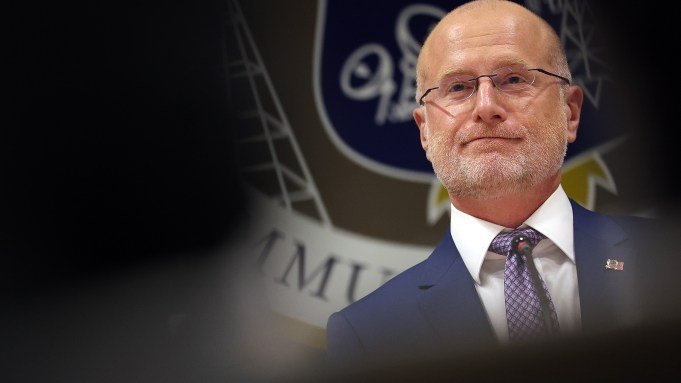
FCC Chairman Brendan Carr warned broadcasters on Wednesday about airing “fake polls” or “suppression polls,” once again threatening regulatory action for news content.
Carr has talked previously about the media’s reliance on poll information, as President Donald Trump, who appointed him to the top FCC post, has often dismissed survey results that are unfavorable to him as “fake.”
Carr wrote, “Many journalists and broadcasters have been amplifying or airing these Polls without regard to basic journalistic ethics and without informing the public that those Polls lack a scientific, accurate, or even real basis.”
He added, “The FCC takes these issues seriously. Broadcasters are prohibited by the terms of their federal licenses from engaging in News Distortion or promoting Broadcast Hoaxes. It is important that broadcasters comply with their public interest obligations. After all, the country benefits greatly when Americans can trust and rely on the media to report the news fairly and accurately.”
He did not cite specific examples. But on Tuesday, Wedgewood Polls released a statement admitting that it had fabricated results, even though its data had been used in polling averages by a number of outlets.
“Wedgewood Polling was never intended to sway an election or permanently mislead the public; it was designed as a wake-up call,” the company said in a statement. “If a fictional entity run by a small group of industry veterans can be integrated into major polling averages and cited by major news organizations, the standards for how polling data is vetted, aggregated and reported must change.”
Wedgewood released the statement after the site FiftyPlusOne contacted them about a story that questioned the authenticity of its polls.
The New York Times said that it included 15 polls released by Wedgewood from June to October.
The Times said in an editor’s note, “Before adding polls to its database, The New York Times seeks to confirm the validity of all new pollsters. In this case, the group answered a series of questions regarding the identities of the pollsters; the methods they were using to draw their sample, contact respondents and weight their polls; and the source of their funding. The group also responded to similar vetting questions from FiftyPlusOne and VoteHub, both of which subsequently included Wedgewood’s releases in their trackers.”
The FCC does not regulate print or digital media, and has limited authority over cable and streaming. It also was unclear which broadcasters featured Wedgewood polling. Carr wrote, “If broadcasters believe they should provide their viewers with additional context and information about Polls they have covered, they can now take those actions consistent with FCC regulations.”
In explaining its news distortion policy, the FCC states that its authority over news content is “narrow,” given the First Amendment. The FCC states that when it comes to news distortion, broadcasters “are only subject to enforcement if it can be proven that they have deliberately distorted a factual news report. Expressions of opinion or errors stemming from mistakes are not actionable.” The agency’s broadcast hoax policy prohibits stations from broadcasting false information about a crime or catastrophe. The licensee had to have known that the information was false.
Anna Gomez, the sole Democrat on the FCC, wrote on X following Carr’s comment, “Pollsters who intentionally mislead the public should answer for it, but broadcasters who report publicly available polling data should never be punished when a poll is wrong. FCC rules on news distortion or hoaxes do not apply to a station that reports this data in good faith.”
Leave a Reply