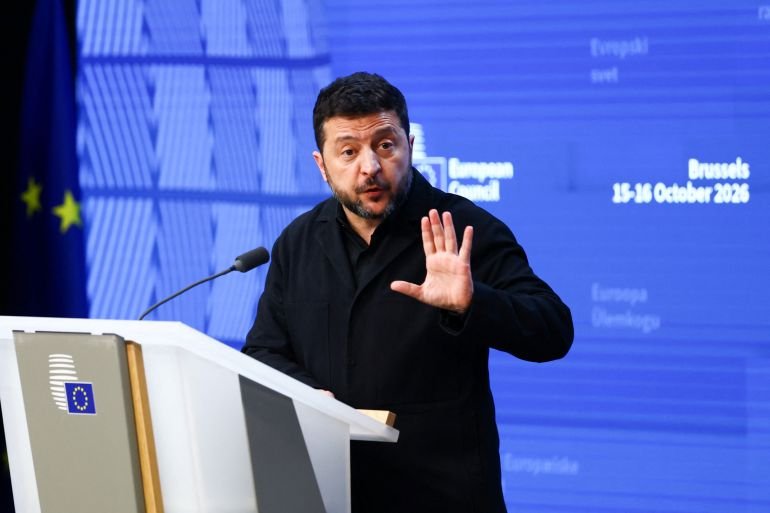
Ukraine’s President Volodymyr Zelenskyy has said that the war with Russia “must be brought to an end” and that his country is preparing for the “next steps” of diplomacy to end the conflict.
The Ukrainian leader’s comments come amid a significant diplomatic fallout with US President Donald Trump, who on Friday night waived sanctions targeting Russia’s energy economy.
Recommended Stories
list of 3 itemsend of list
In a Sunday social media post, Zelenskyy wrote that he had a “conversation with the American president’s envoys, Steve Witkoff and Jared Kushner”.
He added that “a lot depends” on the US position, but it’s clear there are “many things that matter to all of us”.
The Trump administration had already eased restrictions on Russian fuel imports on October 9, when it announced a deal for Russia to supply more than 300,000 metric tonnes of diesel to US and global markets in an effort to tackle soaring fuel prices
The US Treasury temporarily authorised the imports despite existing sanctions, prompting criticism that the move could provide Moscow with revenue to sustain its war in Ukraine.
Trump has also criticised recent Ukrainian strikes on Russian energy infrastructure as “a disgrace”.
Nonetheless, Zelenskyy said his team is in “virtually nonstop communication” with their US counterparts and said a focus of dialogue is on the results of the talks in Florida and further steps.
US wavers on Ukraine’s access to tech
Zelenskyy also said he was “thankful” that the US had resumed intelligence sharing with Ukraine after a pause left the country particularly vulnerable to Russia’s regular ballistic missile attacks.
“It was blocked for some period of time. And then it was deblocked by the American side,” Zelenskyy told NBC, adding: “Only [the] United States has this unique intelligence to tell our side when Russia uses ballistic missiles. And we didn’t get it during ballistic attacks during three days.”
Kyiv has also reported restrictions on the speed of satellite service Starshield, a military-grade version of Elon Musk’s Starlink satellite connectivity network, provided to Ukraine by Musk’s company SpaceX.
Ukraine said its relays were experiencing a limit on how fast receivers could travel while maintaining connectivity, making it almost impossible to intercept Russia’s upgraded jet-powered long-range drones.
Musk had said any restrictions imposed on Starshield connectivity were the responsibility of the US government. The White House quickly rebuked that and in an NBC interview on Sunday, Treasury Secretary Scott Bessent called Zelenskyy “very reckless” for accusing the US of throttling connectivity.
US Secretary of State Marco Rubio said on Sunday that Ukraine is currently blocked from Starshield, and that a request from Kyiv to access the system for attacks deep inside Russia is “under discussion”.
US officials defend Russia waiver as Trump orders 60-day review
Meanwhile, in the US, Trump has faced bipartisan pushback for his executive order on Friday night, waiving parts of the Lindsey Graham Sanctioning Russia and Iran Act of 2026.
Trump had signed the act into law in September, in honour of the late Senator Graham, a close Republican ally.
But his decision to ease sanctions and tariffs against Russia has prompted backlash even from within his own party. The penalties act was scheduled to take effect on Sunday.
Over the weekend, Trump signalled he has yet to make a final decision on easing the sanctions against Russia.
“My decision on Russia is a very simple one. I am in the process of negotiating Peace in the war between Russia and Ukraine, and don’t want to do anything that will drive, foolishly, Russia away from the bargaining table,” he wrote on Truth Social.
He concluded his post with further criticism directed at Zelenskyy. “He doesn’t want to end this war, and probably never did,” Trump said of the Ukrainian leader.
Secretary of State Marco Rubio said Saturday that Trump wanted up to 60 days to assess the economic consequences of imposing the sanctions and tariffs that were waived on Friday.
Zelenskyy has warned, however, that the waiver could embolden Russian President Vladimir Putin and prolong the war.
Rubio also defended the latest deal to import Russian diesel, saying “that diesel is going to be sold one way or the other”. He argued that the fundamental question was how much the US would secure for itself.
In a series of Sunday morning media appearances, US Energy Secretary Chris Wright also backed the arrangement.
Speaking to ABC, he called the deal a “carrot to try to end the war, not an economic lifeline” for Russia.
“If Russia can bring additional diesel to the market and export it, it would benefit American consumers,” Wright told CNN. “He’s putting pressure that would both benefit American consumers and be a step forward for peace in the Russia-Ukraine war.”
Long-range attacks continue
Also on Sunday, Ukrainian media reported that Russian strikes killed two people in the western Volyn region, near the border with Poland, and injured at least five others across the country. Overnight attacks by Russia killed a woman and injured a six-year-old in the Zaporizhzhia region.
On Saturday night and in the early hours of Sunday, Ukraine hit Russia’s second-largest city, St Petersburg, with a significant drone attack. It targeted a key oil refinery and depot, a warehouse of Russian online retailer Ozon and a data centre run by Russian social media company, VKontakte.
At least one person was killed in the attack, which Russian state media said was the largest on the city since the start of the war in 2022.

Leave a Reply