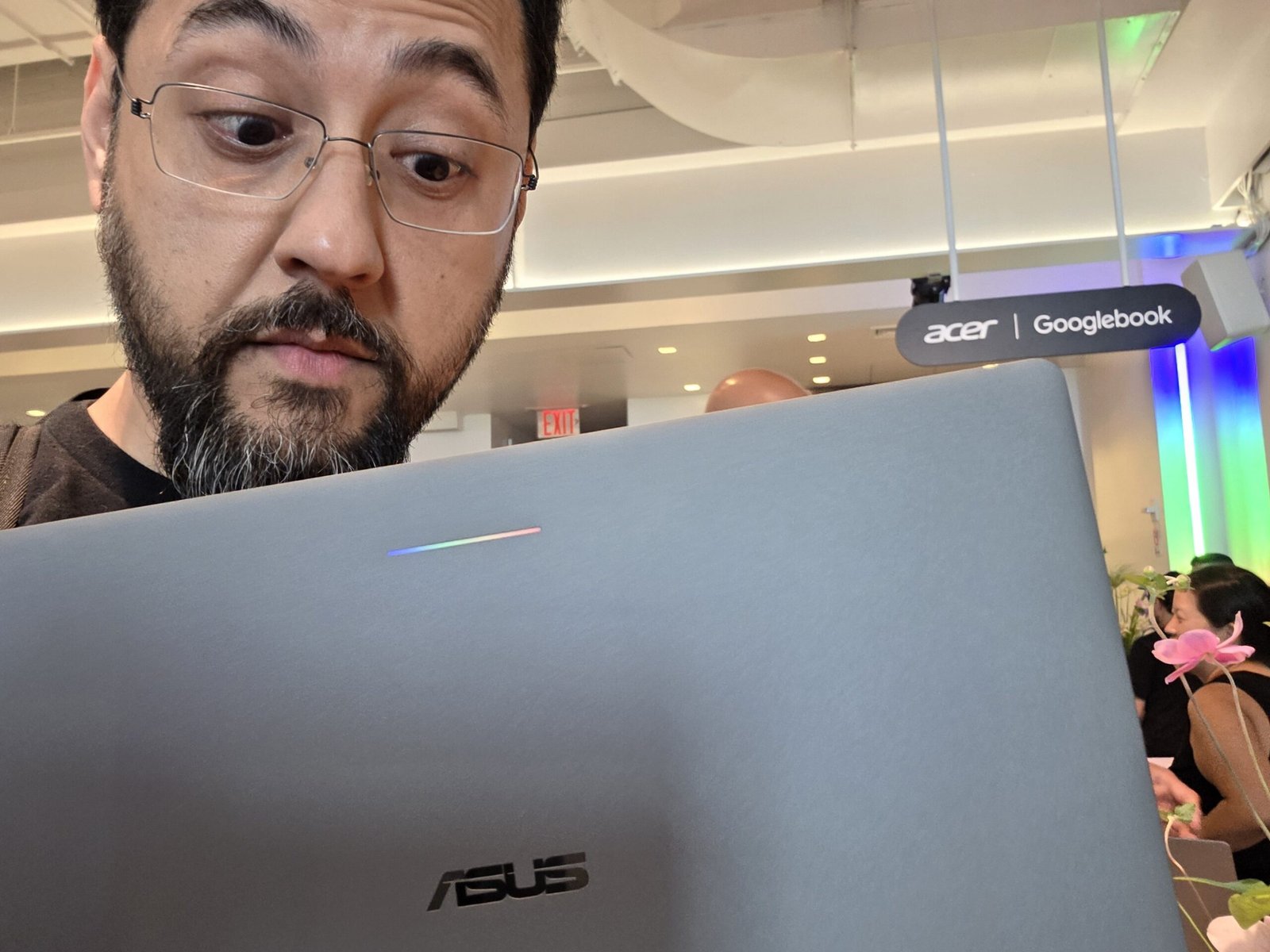
With its reveal, I was incredibly excited for Googlebooks, the new Android-based laptop class running Googlebook OS. I hoped Google would release a PC that understands that people use more than one device, and that your Android phone and notebook should essentially share the same brain for the best experience. After all, modern operating systems are the product of refinement, and Google had a chance to change how we use laptops by combining desktop and mobile, and bolstering it with a deep Gemini integration. Googlebooks are marketed as Android’s “perfect partner,” but it’s quite clear that Google’s definition of perfect dramatically differs from mine.
The Experience Eroded My Excitement
I received an Asus Googlebook 14, an Intel-powered machine with a 14-inch touch screen running Googlebook OS. Setting it up was simple, and I was excited to see how an Android phone would link up with its so-called perfect partner.
You see, Googlebooks support app casting, a way to wirelessly connect your phone to the laptop and run apps directly from the phone. For example, if you were in a flow state while working on a Googlebook, but needed to leave the office for an appointment, you could use app casting to access your phone’s rideshare app on the laptop.
Buy the Asus Googlebook 14

Asus Googlebook 14 (Intel Core Ultra 5 325, 16GB RAM, 512GB SSD)
Things did not go well from the start. Tapping the new G key (not to be confused with the regular g key) brought up a menu. I decided to search for something basic: the Gmail app. Curiously, typing “mail” returned web results rather than app suggestions. The answer was to type “Gmail,” which surfaced the email app. Hey Google, do you remember how to search?

A reasonable person could assume that typing “mail” would surface Gmail. (Credit: John Schwartz)
Opening the Googlebook’s version of Gmail was no different than using a web browser. I had direct access to my personal account, but did not see my work emails. I had to switch accounts to access other email addresses. I expected an option for “All inboxes” like the one in the Gmail phone and tablet apps, but no such luck. For some reason, Google’s approach to its mobile and desktop apps differs.
I wanted to access the Samsung Notes app on my Samsung Galaxy S25 Ultra, so I tried pairing the phone with the Asus Googlebook 14. That did not work because, at launch, Googlebooks did not support Samsung phones. Then I tried installing Samsung Notes through the Play Store, but the app was unavailable. As a result, I created a Samsung Notes APK for sideloading the app. The Asus Googlebook 14 ran through the process before telling me, “App not installed.” The good news is that the issue has since been fixed, but it was not a good first impression.

Samsung Notes sideloading failed. (Credit: Asus/PCMag)
However, the Googlebook successfully enabled app-casting on the Google Pixel 11 Pro. I launched Airbnb, and I could scroll on the Asus Googlebook 14 to find a getaway. Several other apps worked, too, but some (including my authenticator) were blocked on the laptop for security reasons. So I had to grab the phone. At that point, I should’ve just used the phone rather than the Asus Googlebook 14. My optimistic excitement started to dwindle.
Not a Chromebook, But You Must Use Chrome
I no longer use Chrome as my default web browser on my phone, tablet, or computer; instead, I switched to Brave. The Googlebook version of Brave is severely hampered, as it doesn’t support extensions or vertical tabs—and it stopped working on the Asus Googlebook 14 after half a day. So I tried firing up Microsoft Edge on the system, but I couldn’t get past the splash screen.

Chrome supports extensions and vertical tabs. (Credit: John Schwartz)
Fortunately, Google Chrome supports extensions and vertical tabs. However, I couldn’t access my well-curated, post-Chrome bookmarks and browsing history. But I had access to the web!
With Chrome, I could view my work Gmail alongside my personal email on the laptop by keeping one account in a browser and the other in the app. Perhaps, in the future, other developers will build Googlebook OS-optimized browsers.
My next task? Move 30GB of data from my Google Drive to the Asus Googlebook 14 using the Files app. The transfer failed several times before I gave up and used Solid Explorer, a third-party file manager. It transferred the 30GB without issue.

Solid Explorer on GooglebookOS (Credit: Asus/PCMag)
I enjoy picking default apps for tasks, and Android lets you do that. However, I expect more from Google apps running on a Googlebook OS-powered Googlebook.
Gemini to the Rescue?
Gemini worked well for random questions and project planning. In a few instances, I used Google’s Magic Pointer, which lets you select an item on screen and get AI-powered help. It worked as advertised. A keyboard shortcut, G+Spacebar, calls up Gemini for whatever request you have.
Recommended by Our Editors

There are no words. (Credit: Asus/PCMag)
I attempted to use Gemini to accomplish tasks directly…
-
I tried renaming files using Gemini. No luck.
-
I asked it to “Install Fantastical Calendar from the Google Play Store.” Gemini gave me the app’s Play Store direct link. I had to install it myself.
-
“Find my screenshots” opened Google Photos.
-
“Turn on dark mode” brought up the Settings app to the Dark Theme pane. I had to toggle the option myself.
-
“Can you find my files?” yielded “I cannot browse or search your local storage directly from this chat. However, your Googlebook has built-in search tools…”
I expected Gemini to actually get things done on the Googlebook, but the OS repeatedly dodged with “Your Googlebook has built-in search tools.” I know, but I want them to work.
A lot more went wrong. Check out the video to learn more…

Using a Googlebook Is Frustrating
The Best Is Yet to Come…Hopefully
I’ve figured out workarounds and stayed current on system updates, chasing new features (like broader Samsung support). Googlebook OS is fine, but it doesn’t rival macOS or Windows. You still must bend to the system’s way of doing things, and Gemini certainly doesn’t define the experience.

Another Googlebook I tried early on, from Lenovo. (Credit: Joseph Maldonado)
Perhaps this setup is meant for someone else. I’ve been using computers since MS-DOS, watching desktop operating systems slowly mature over decades. The Googlebook feels built for someone whose first computer was a smartphone.
Either way, Googlebook OS needs more time in the oven before it matures into a truly perfect partner for Android phones.
About Our Expert

Iyaz Akhtar
Mobile Writer
Experience
I’ve been into technology for as long as I can remember. As a PCMag mobile writer, I get to test the newest phones and tablets. Since you rely on our buying advice, I make sure you get everything a manufacturer claims, which means lots of testing. This is your phone we’re talking about; it’s like a part of you. I’ve covered technology as a career for around two decades (yikes, I had to think about that). You’ve seen my work at The Apple Blog, PCMag (from my first go around), This Week in Tech, and CNET. I also occasionally produce independent video projects, including This Old Nerd, a how-to series that shows practical ways to get the most from your tech.
Leave a Reply