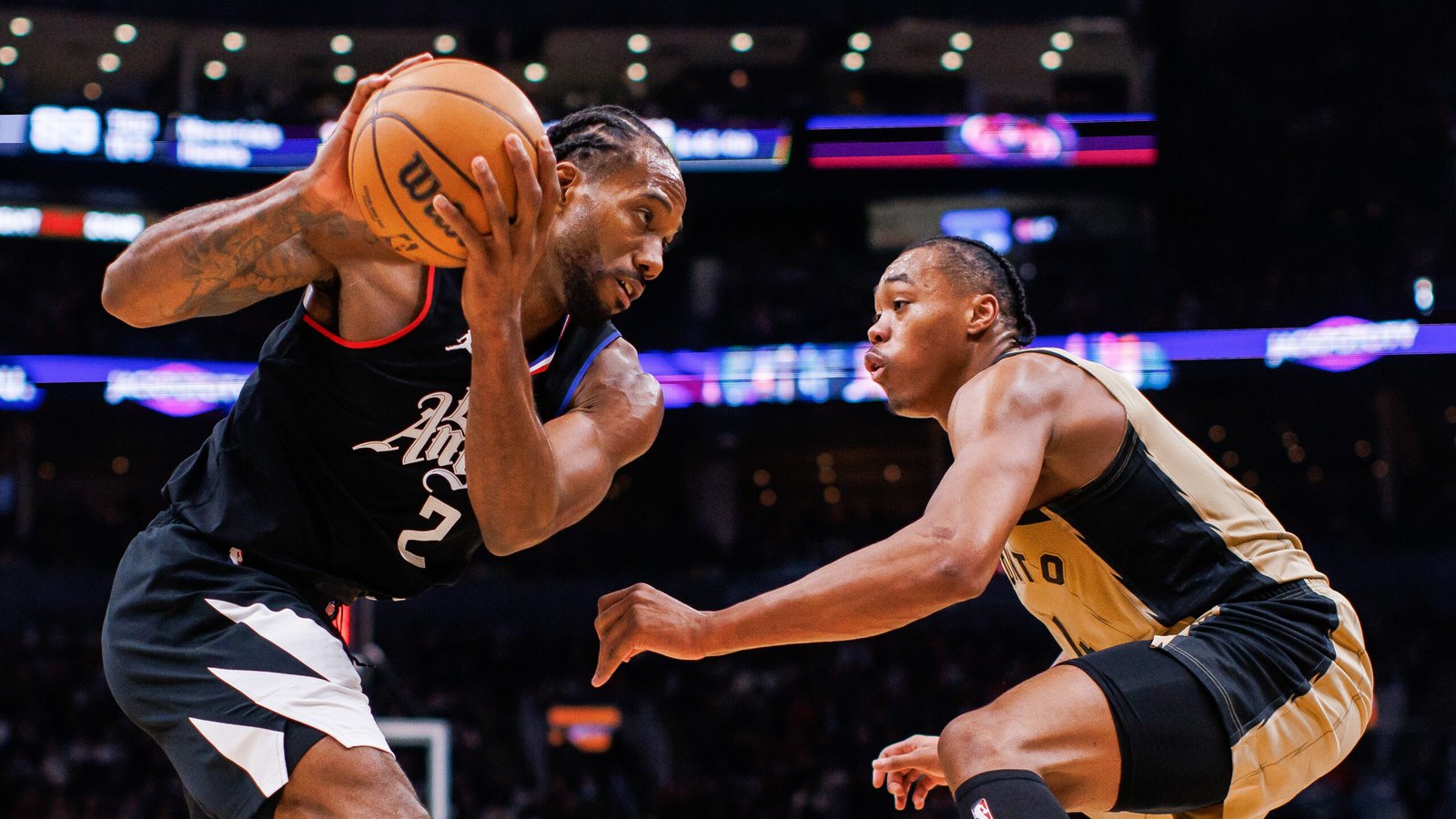
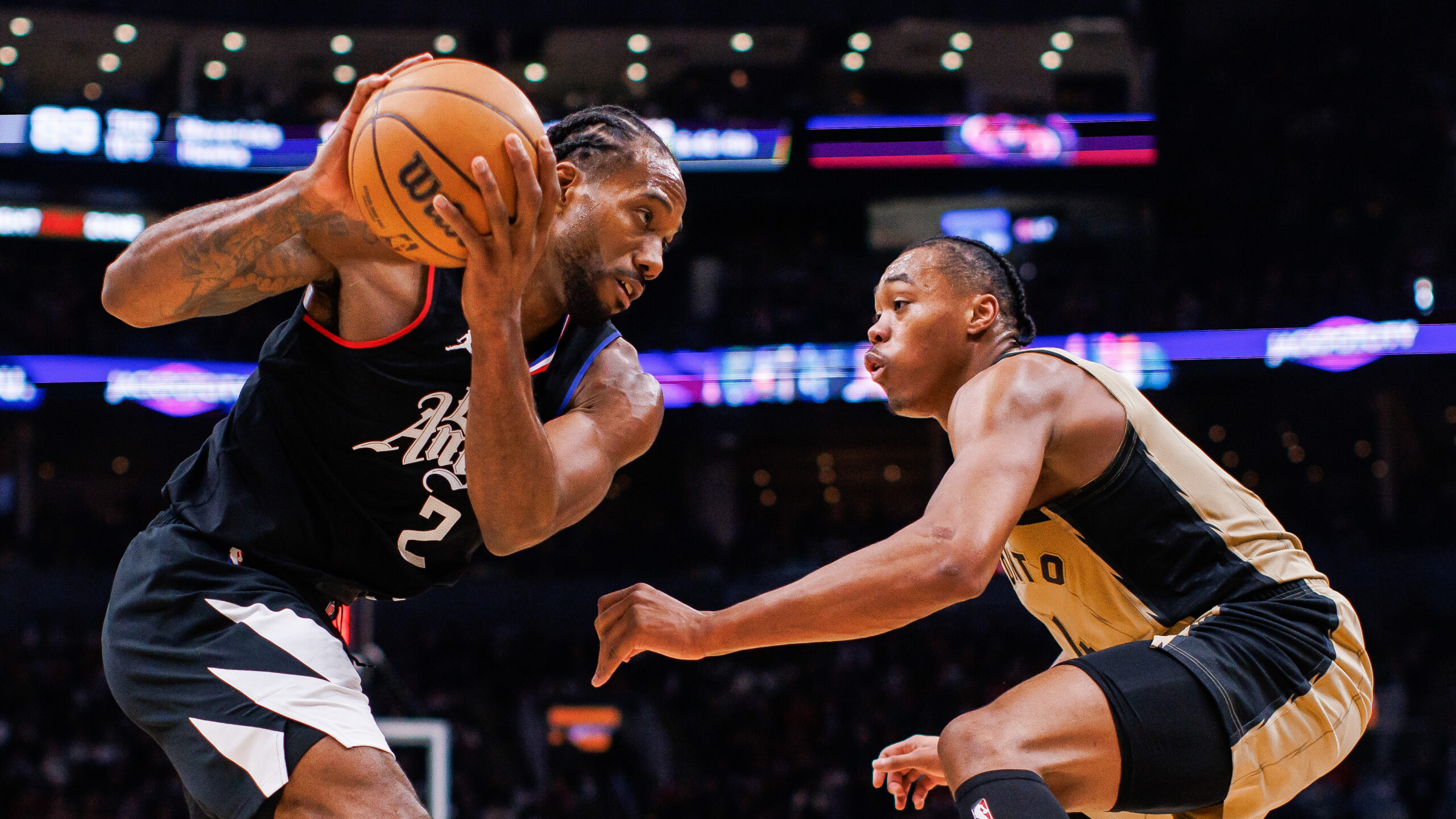
Kawhi Leonard (left) and Scottie Barnes (right) could provide the Raptors with a dynamic 1-2 punch next season.
Seven years after leading the Toronto Raptors to a championship and immediately leaving in free agency, Kawhi Leonard is coming back.
In a deal reported on Tuesday, the Raptors are re-acquiring their Finals MVP from the LA Clippers in exchange for:
- Gradey Dick and Brandon Ingram
- Two unprotected first-round picks
The Raptors were one of the most improved teams in the league this past season, winning 16 more games than they did in 2024-25. Statistically, it was their best season (plus-2.9 points per 100 possessions) in the last six years. With this deal, they’re clearly hoping to take another step forward and compete with the best teams in the Eastern Conference.
For the Clippers, this trade seemingly represents the final step of a five-month process to turn over the roster and start building a younger core. They had the league’s fourth best regular-season record over Leonard’s tenure in LA, but that just means that they had the best record among teams that didn’t win a championship over those seven years.
Here some notes and numbers regarding Leonard, the team he’s leaving, and the franchise with which he’s reuniting:
1. A great defense gets better
The Raptors ranked fifth defensively this past season, allowing 112.1 points per 100 possessions. Theirs was an aggressive defense that forced a lot of turnovers and defended the 3-point line relatively well.
There’s still room for improvement. While they ranked fifth overall, the Raptors ranked just 12th defensively (117.3 allowed per 100) against the league’s top 10 offenses. They also had the 12th-ranked defense in the first round of the playoffs.
One issue with the Raptors’ top-five defense was fouls. They ranked 23rd in opponent free throw rate (27.9 attempts per 100 shots from the field), and that rate was much higher (31.8 per 100) in the postseason.
Leonard isn’t quite the defender he was five or six years ago, but he remains a plus on that end of the floor … and he doesn’t foul often. This past season, Leonard had 122 steals, 27 blocks and just 78 personal fouls, with his ratio of blocks and steal per foul being the highest (by a wide margin) among 378 players who played at least 500 minutes:
Highest ratio, (steals + blocks) / personal fouls, 2025-26
| Player | MIN | STL | BLK | PF | (STL+BLK)/PF |
|---|---|---|---|---|---|
| Kawhi Leonard | 2,085 | 122 | 27 | 78 | 1.91 |
| Victor Wembanyama | 1,866 | 66 | 197 | 156 | 1.69 |
| Robert Williams III | 1,008 | 35 | 87 | 74 | 1.65 |
| Al Horford | 969 | 30 | 51 | 51 | 1.59 |
| Derrick White | 2,625 | 88 | 98 | 119 | 1.56 |
Minimum 500 minutes (378 players)
Jakob Poeltl has been a plus defender in the past, but he’s really struggled to defend in space the last couple of years and he just recorded the worst rim-protection mark of his career, with opponents shooting 63.9% at the rim when he was there to protect it this past season. While Poeltl started all seven of the Raptors’ playoff games, rookie Collin Murray-Boyles (191) played a lot more minutes than Poeltl (134) in the series.
A frontline of Leonard, Scottie Barnes and Murray-Boyles would be small, but very switchable and pretty fierce defensively. Upgrading from Ingram to Leonard gives the Raptors a great chance to have another top-five defense and be stronger on that end of the floor against the best teams in the league.
2. In need of a closer
A stout defense that forces turnovers will lead to transition opportunities, and the Raptors ranked third this past season with 28.6 transition points per game.
But no matter how good their defense is, teams need to be able to score late in the shot clock. And that’s where the Raptors have really struggled. According to tracking data, only the Indiana Pacers had a lower effective field goal percentage in the last six seconds of the shot clock than the Raptors (43.3%).
Leonard should help in that regard. Over the last three seasons, he has an effective field-goal percentage of 53.0% in the last six seconds of the shot clock. That mark ranks ninth among 131 players with at least 250 late-clock field goal attempts over those three years.
Leonard and Ingram are two of the 28 players who’ve isolated at least 1,000 times over the last three seasons. The Clippers scored 1.07 points per chance on Leonard’s isolations, a rate which ranked sixth among those 28 guys. The Pelicans and Raptors scored just 0.99 points per chance when Ingram isolated, a rate which ranked 24th.
Overall, the Raptors have had the league’s sixth-worst offense over the last three years. If they can continue to flourish in transition while leaning on Leonard late in the clock, they have a chance to have their best offensive season since his one year in Toronto.
3. All-time playoff performer
His 2019 championship run with the Raptors was not Leonard’s only great postseason. He is, in total, one of the best playoff performers of all time.
There are 89 players in NBA history who’ve averaged at least 20 points per game over 10 or more playoff games in their career. Leonard (21.5 points per game in 146 playoff games) has the second highest true shooting percentage among them, and his 62.1% is just a tick below that of Anthony Davis (62.2%), who’s played in less than half as many games (60).
On May 12, 2019, Kawhi Leonard gets an incredible bounce to knock down a game-winning shot in Game 7 sending the Raptors to the Eastern Conference Finals.
Since 2017, Leonard has averaged 28.6 points on a true shooting percentage of 63.2% over 71 playoff games. He’s one of five players in NBA history with at least three postseasons (2017, 2019 and 2021) where he averaged at least 25 points with a true shooting percentage of 60% or better in 10 games or more.
The Raptors scored a little more efficiently (111.9 points per 100 possessions) than the first-round average as they lost to the Cleveland Cavaliers in seven games. But they can obviously benefit from Leonard’s ability to score efficiently and at a high volume in a primary role.
4. A reset for the Clippers
A year ago, the Clippers added Bradley Beal, John Collins, Brook Lopez and Chris Paul to a core of Leonard, James Harden and Ivica Zubac.
Now, Lopez is the only one of those seven guys that’s still on the roster. Paul’s return to LA was short-lived, Harden and Zubac were traded at the deadline, Leonard is going back to Toronto, and Beal and Collins (both unrestricted free agents) seem unlikely to return.
As of Tuesday night (and with Kobe Sanders set to return), players under contract (plus those who’ve agreed to new deals) for 2026-27 account for just 42% of the Clippers’ minutes from 2025-26. That is, by far, the lowest continuity rate for any team in the league.
It would climb up to 52% if restricted free agents Bennedict Mathurin and Jordan Miller are re-signed, but that would still be the league’s second lowest rate (a tick above that of the Lakers) as things currently stand.
Just five months ago, the Clippers were trying to compete with a veteran group. They ranked 24th in ’25-26 in the percentage of their minutes (12%) that came from rookies or second-year players.
But they’ve overhauled the roster since Feb. 1 and, going forward, it will seemingly be built around Darius Garland and rookie guard Keaton Wagler.
* * *
John Schuhmann has covered the NBA for more than 20 years. You can e-mail him here, find his archive here and follow him on Bluesky.
Leave a Reply