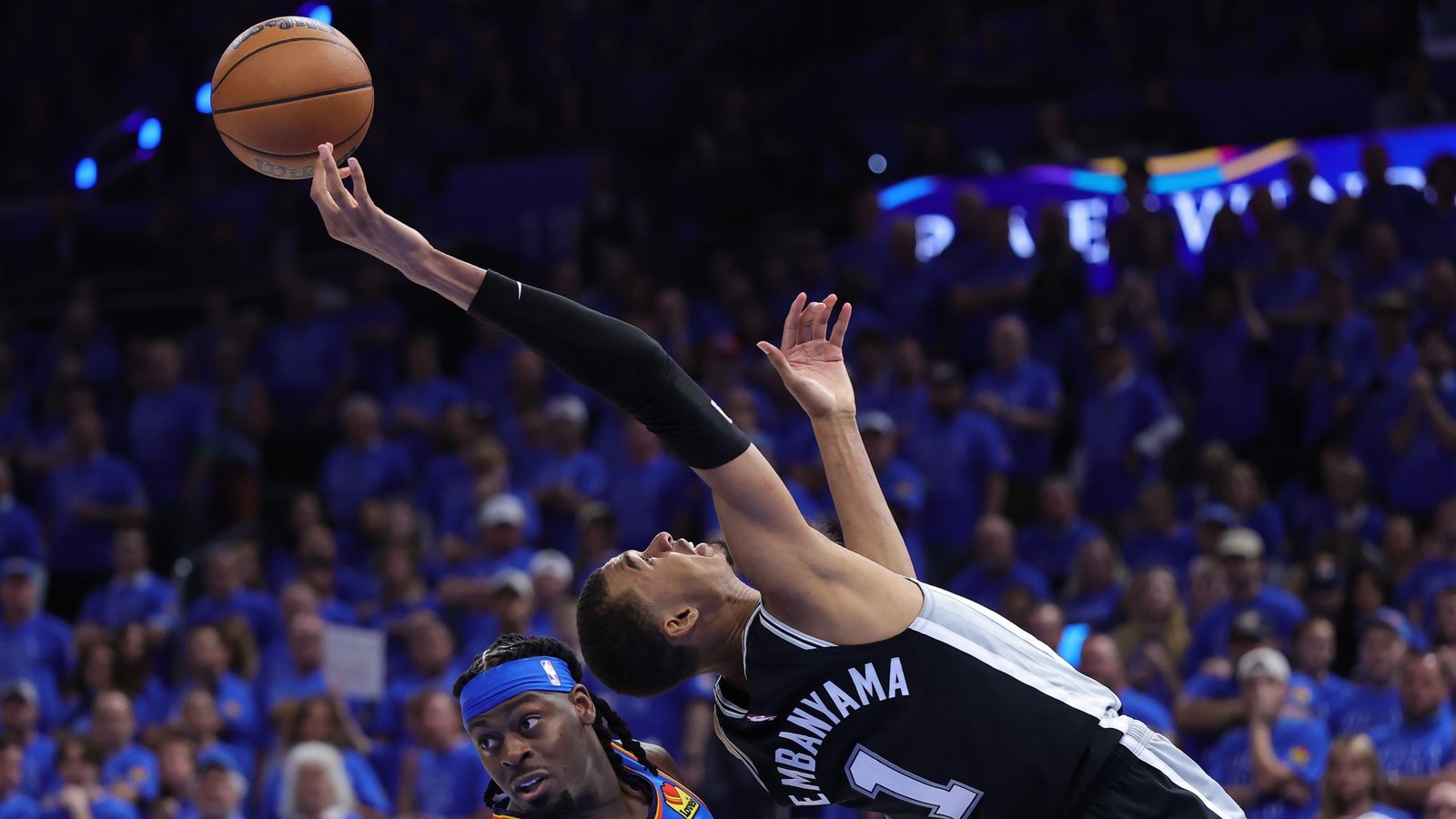
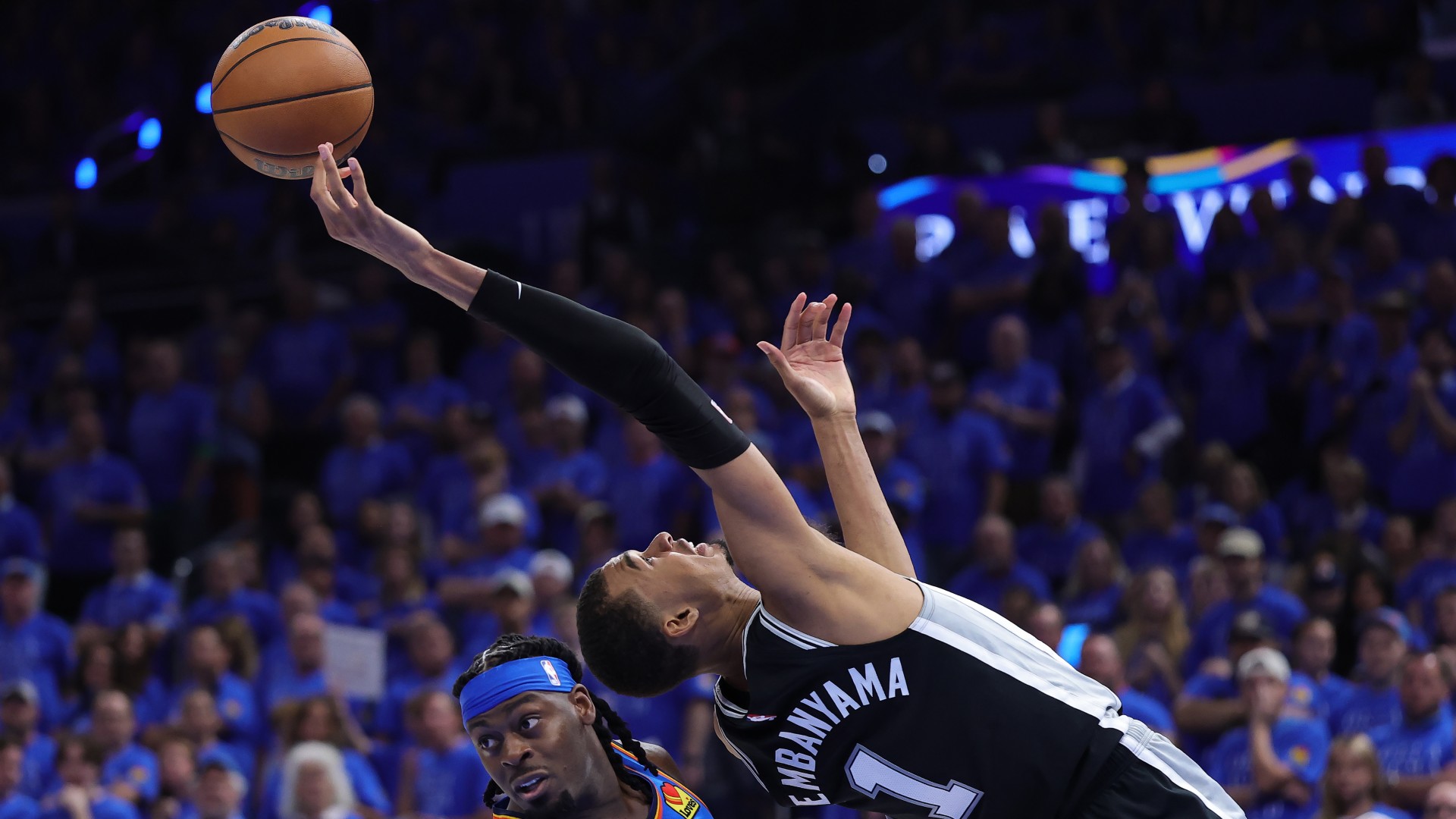
The Thunder need to find a way to limit Victor Wembanyama’s reach.
OKLAHOMA CITY – The Oklahoma City Thunder have been in this position before – down 1-0 in the playoffs – and responded with series victories.
It happened twice last year as the Thunder won the championship. They lost Game 1 to the Denver Nuggets in the Western Conference Semifinals and Game 1 to the Indiana Pacers in the NBA Finals. They needed seven games to win both series.
That experience allows the Thunder to act with poise and confidence and an understanding that they have found answers in the past and can figure out how to beat the San Antonio Spurs after Monday’s 122-115 Game 1 double-overtime loss.
“The cumulative experience just teaches you that it’s a series,” Thunder coach Mark Daigneault said. “Game 1’s a starting point, not an end point. We’ve lost a playoff series that we’ve won Game 1 pretty convincingly, and we’ve also won a series that we’ve won Game 1.
“So every series is different. It’s the first to four. They’re 25% of the way there, and we’re at zero right now, but there’s a lot of basketball left to be played. This team understands the length of a series, the length of a playoff run, the length of the playoff game. That’s the value of the experiences that we’ve had.”
Here are three things to watch in Game 2 Wednesday (8:30 ET, NBC/Peacock).
1. Can the Thunder limit Victor Wembanyama?
It was no secret entering the series that Wembanyama would be a handful for the Thunder. But that much of a handful? If that’s the Wembanyama the Thunder are going to get, maybe there’s not a game plan that can save them.
He was 13-for-21 on shots in in the paint, and the Thunder had undersized Alex Caruso defend Wembanyama for long stretches in an attempt to be more physical with him.
But it could also require more size with Chet Holmgren, Isaiah Hartenstein, Jalen Williams and Jaylin Williams.
Wembanyama’s 48 minutes, 42 seconds were a career high, and the Spurs have been careful with Wembanyama’s minutes. He played 29.2 minutes per game in the regular season and 28.8 per game during the first two rounds of the playoffs. This season, he didn’t log one game with more than 40 minutes played.
And that could be part of the long game for the Thunder – wear down Wembanyama with heavy minutes. In a series that is played every other day, can Wembanyama play big minutes and still be as effective as the series progresses?
Let’s see if the Thunder have solutions.
“Everything’s on the table,” Daigneault said. “In these series, you can’t just throw one pitch throughout the whole series. We have reasons why we approached the game why we did last night. Some of that was the regular-season matchup. Some of that was the stuff that we saw in the first couple rounds from ourselves and from them.
“But in these series, one of the things you got to do is you got to figure out what the problems are, and you got to put the fires out pretty quickly. And so that’s our challenge and we got to work on that with the team. We’ll continue to work on it and then we’ll throw our best pitch (Wednesday) night.”
2. Gilgeous-Alexander’s response to Game 1
If Wembanyama played with a chip on his shoulder in Game 1 because he didn’t win Kia MVP and Shai Gilgeous-Alexander did, then Gilgeous-Alexander likely will play with a similar chip because of his Game 1 performance.
In the aggregate, it wasn’t horrible: 24 points, 12 assists, five steals, one block, four turnovers. But it wasn’t efficient (7-for-23 shooting), and he was just 1-for-5 from the field with four points in the first half.
That’s from a player who was a 55.3% shooter during the regular season.
He had a better second half and found success with an aggressive approach when the Thunder needed points.
But don’t forget: the Thunder had a 108-105 lead in the first overtime and had a chance to extend it to 110-105. The Spurs know it could’ve gone either way and expect a better Gilgeous-Alexander in Game 2.
“That game was in the balance multiple times for both teams,” Spurs coach Mitch Johnson said, adding, “He missed some shots that he’ll make. That’s unfortunately the control you give up when you play a player who’s that good. You just hope that they’ll miss, and you have to make sure it’s a little harder than the one before it.”
3. What can the Thunder get from Holmgren?
Through Oklahoma City’s first two playoff series, Chet Holmgren averaged 18.6 points, 9.1 rebounds, 1.8 blocks and 1.4 steals and shot 60% from the field.
He was perhaps the team’s best player in the Western Conference Semifinals against the Los Angeles Lakers.
In Game 1, Holmgren had a quiet eight points and eight rebounds. He attempted just seven shots, and his first attempt didn’t come until 42.4 seconds remained in the second quarter.
He had a great block on Wembanyama at the rim on the final shot of the fourth quarter that ensured overtime at 101-101.
Daigneault said better team offense will lead to more opportunities for Holmgren.
“It’s running better stuff, but also just collectively having a better intentionality and approach that’s going to give us more advantages (and) put the defense in more dilemmas,” Daigneault said. “He’s 7-1 and skilled, and when we do that, he’s going to show up in a big way. But it’s more of a reflection of our offense collectively. We’re going against a great defense that’s, like I said, an acquired taste.
“So we have to improve as the series goes on on both ends of the floor. I thought we did some good things on offense, especially in the second half. We’ve got to be collectively better, and everybody will benefit from that, including him.”
* * *
Jeff Zillgitt has covered the NBA since 2008. You can email him at jzillgitt@nba.com, find his archive here and follow him on X.
Leave a Reply