For decades, Ali Larijani was the calm, pragmatic face of the Iranian establishment – a man who wrote books on the 18th-century German philosopher Immanuel Kant and negotiated nuclear deals with the West.
But on March 1, the 67-year-old secretary of the Supreme National Security Council’s tone changed irrevocably.
Recommended Stories
list of 3 itemsend of list
Appearing on state television just 24 hours after US-Israeli air strikes killed Supreme Leader Ayatollah Ali Khamenei and the Iranian Revolutionary Guard Corps (IRGC) commander, Mohammad Pakpour, Larijani delivered a message of fire.
“America and the Zionist regime [Israel] have set the heart of the Iranian nation ablaze,” he wrote on social media. “We will burn their hearts. We will make the Zionist criminals and the shameless Americans regret their actions.”
“The brave soldiers and the great nation of Iran will deliver an unforgettable lesson to the hellish international oppressors,” he added.
Larijani, who accused US President Donald Trump of falling into an “Israeli trap”, is now at the centre of Tehran’s response to its biggest crisis since 1979.
He is expected to have an important role alongside the three-man transitional council running Iran after Khamenei’s death.
So, who is the man tasked with steering Iran’s security strategy as its war with Israel and the US continues?
The ‘Kennedys’ of Iran
Born on June 3, 1958, in Najaf, Iraq, to a wealthy family from Amol, Larijani belongs to a dynasty so influential that Time magazine described them, in 2009, as the “Kennedys of Iran”.
His father, Mirza Hashem Amoli, was a prominent religious scholar. And like Larijani, his brothers have held some of the most powerful positions in Iran, including in the judiciary and the Assembly of Experts, a clerical council empowered with choosing and overseeing the supreme leader.
Larijani’s ties to Iran’s post-1979 revolutionary elite are also personal. At age 20, he married Farideh Motahari, the daughter of Morteza Motahhari, a close confidant of the Islamic Republic of Iran’s founder, Ruhollah Khomeini.
Despite his family’s conservative religious roots, his children have had a diverse trajectory. His daughter, Fatemeh, a medical graduate from the University of Tehran, completed her specialisation at Cleveland State University in Ohio, US.
The mathematician philosopher
Unlike many of his peers who came solely from religious seminaries, Larijani also has a secular academic background.
In 1979, he earned a bachelor’s degree in Mathematics and Computer Science from the Sharif University of Technology. He later completed master’s and doctorate degrees in Western philosophy from the University of Tehran, writing his thesis on Kant.
But it is his political positions that have been the centrepiece of his career.
After the 1979 revolution, he joined the IRGC in the early 1980s, before transitioning to government, serving as culture minister under President Akbar Hashemi Rafsanjani between 1994 and 1997, and then as the head of the state broadcaster (IRIB) from 1994 until 2004. During his time at the IRIB, he faced criticism from reformists who accused his restrictive policies of driving Iranian youth towards foreign media.
Between 2008 and 2020, he served as the Parliament (Majlis) speaker for three consecutive terms, playing a major role in shaping domestic and foreign policy.
Return to the security fold
Larijani ran for the presidency in 2005 as a conservative candidate, but did not make it to the second round. In the same year, he was appointed the secretary of Iran’s Supreme National Security Council, and the country’s chief nuclear negotiator.
He resigned from those posts in 2007, after growing distant from then-President Mahmoud Ahmadinejad’s nuclear policies.
Larijani entered parliament in 2008, winning a seat to represent the religious centre of Qom, and became the speaker. This allowed Larijani to grow in influence, and he maintained his connection to the nuclear file, securing parliamentary approval for the 2015 nuclear deal between Iran and world powers, known as the Joint Comprehensive Plan of Action (JCPOA).
After leaving his position as parliamentary speaker and member of parliament in 2020, Larijani attempted to run for president for a second time in the 2021 election. But this time, he was disqualified by the Guardian Council, which vets candidates. He was disqualified again when he attempted to run in the 2024 presidential election.
The Guardian Council gave no reason for the disqualifications, but analysts viewed the 2021 move as a way for the establishment to clear the field for hardliner Ebrahim Raisi, who won the election. Larijani criticised the 2024 disqualification as “non-transparent”.
But he did return to an influential position in August 2025, when he was reappointed as secretary of the Supreme National Security Council by President Masoud Pezeshkian.
Since taking the post, his stance has hardened. In October 2025, reports emerged that Larijani had cancelled a cooperation agreement with the International Atomic Energy Agency (IAEA), declaring that the agency’s reports were “no longer effective”.
Diplomacy amid war
Despite that tough stance, Larijani is often regarded as pragmatic and someone inside the Iranian system who may be willing to compromise, in part due to his past role in backing the 2015 nuclear deal.
Just weeks before the current escalation, Larijani was reportedly engaged in indirect negotiations with the US.
In February, during talks mediated by Oman, he stated that Tehran had not received a specific proposal from Washington, and accused Israel of trying to sabotage the diplomatic track to “ignite a war”.
In an interview with Al Jazeera prior to the US and Israel’s attacks on Iran, Larijani described his country’s position on talks as “positive,” noting that the US had realised that the military option was not viable. “Resorting to negotiation is a rational path,” he said at the time.
However, the air strikes, which began on February 28, have shattered the diplomatic window.
In his latest address, Larijani assured the nation that plans were in place to arrange the leadership succession according to the Constitution. He warned the US that it was delusional to think killing leaders would destabilise Iran.
“We are not intending to attack regional countries”, he clarified, “but we are targeting any bases used by the United States”.
The more pragmatic tone appears to have disappeared – for now. Larijani has rejected media reports that he wanted new talks with the US, saying on Monday that Iran would “not negotiate” with Washington.
Instead, with Khamenei gone and the region on the brink, Larijani has promised a response to the US and Israel with “a force that they have never experienced before”.
As its joint attack with the United States on Iran continues, Israel sees its task as the culmination of a longstanding policy on: ushering in regime change from within.
Taking to the airwaves in the wake of the killing of Iranian Supreme Leader Ayatollah Ali Khamenei on Saturday, Israeli Prime Minister Benjamin Netanyahu addressed the Iranian people directly, calling on them in Farsi to “come to the streets, come out in your millions, to finish the job, to overthrow the regime of fear that has made your lives bitter”.
Recommended Stories
list of 4 itemsend of list
“Your suffering and sacrifices will not be in vain. The help you wished for – that help has now arrived,” he said of the US-Israeli air strikes, which have already killed more than 555 people in Iran, including 180 at a girls’ school in the country’s south.
“The Israeli authorities don’t spell it out, but it is clear that what they want to see is a regime change in Iran,” said Ahron Bregman, a senior teaching fellow at the Department for War Studies at King’s College London, who had returned to Israel to research a book before the latest round of strikes took place.
“I’m stuck in Tel Aviv and spend many hours with Israelis in a local shelter. I’m taken aback by the strong support among these – mainly liberal – Israelis of the war,” he said. “They, like their leaders, believe that if you only topple the Iranian regime, the Middle East will totally transform for the better, which is, of course, nonsense.”
But there is a question of how invested Netanyahu and his allies are in ensuring that regime change in Iran is smooth.
Israeli officials know that Iran, including its opposition, has a diverse array of views and backgrounds.
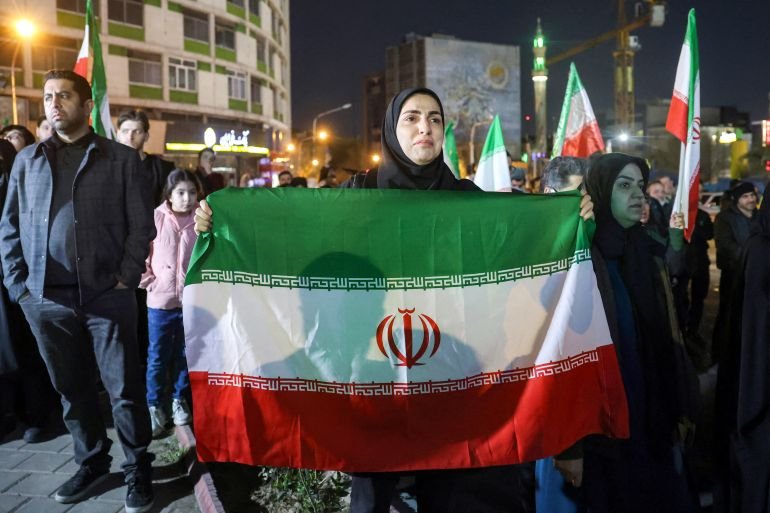
Many Iranians who have taken to the streets, including in the large protests that took place in January, are united only in their hostility to the government, with various factions calling for everything from the restoration of the monarchy to a full democracy. Others, however, are rallying on the government’s side after the attacks on their country and Khamenei’s killing.
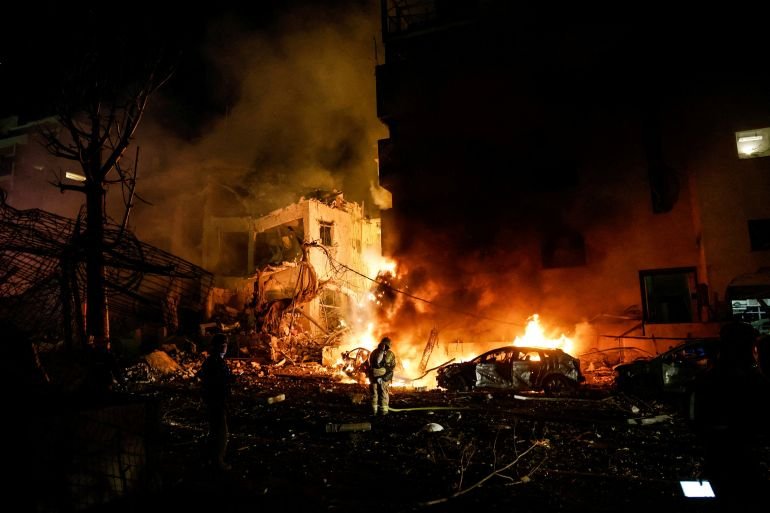
A plume of smoke ascends to the sky in Tehran after a strike on March 2, 2026 [Atta Kenare/AFP]
Questions remain
“I think there’s a public opacity to Israel’s war aims,” former Israeli government adviser Daniel Levy told Al Jazeera. “My sense is that Israel has no real interest in smooth regime change. I think most [Israeli leaders] regard that as a kind of fairytale, though that’s not something Netanyahu and allies might be ready to admit publicly.”
“Israel’s more interested in regime and state collapse,” Levy noted. “They want Iran to implode, and if the spillover from that takes in Iraq, the Gulf and much of the region, so much the better.”
“They’ll have removed a significant regional counter to their freedom to act, leaving Israel and its allies free to remake the regions and, critically, to continue both killing Palestinians, and possibly even move against Turkiye, which is the next logical step,” he said, reflecting a recent rise in anti-Turkiye rhetoric in Israel, with politicians even characterising the country as the “new Iran”.
However, while public appetite for the war may be high, there is an understanding that the duration of that war might not be of Israel’s choosing.
The bulk of Israel’s military spending is underwritten by the US, where the attack on Iran is proving less than popular. Equally, in a world where many states had belatedly grown critical of Israel’s genocidal actions towards Palestinians – in particular in Gaza – US diplomatic heft has been vital in protecting its ally from criticism, and even wider sanctions.
How long the US’s allies in the Gulf are ready to withstand Iranian assaults on their territory in response to a war they had repeatedly cautioned against is far from clear. Equally, how long it might be before regional diplomatic pressure on US President Donald Trump begins to have an impact is also hard to predict, Levy warned.
“It’s fitting that this is the holiday of Purim, which also marks the survival of the Jewish people over a threat from Persia 2,500 years ago, and we still celebrate it today. People understand that,” Barak said.
“Israel going to war in tandem with our greatest ally and the world’s greatest power is unprecedented,” Barak continued. “It’s hard to make any predictions, but Trump has his own priorities and his own endgame, which might not be the same as ours. It could be that Trump pulls out and leaves Israel holding the bag. What happens then, I don’t know.”
Public backing
Iranian missiles may be hitting Israel, but analysts there say the general sentiment among the public is supportive of active hostilities against Iran, with the backing of the US.
It stems from years – if not decades – of messaging that Iran and its allies are the main threats to Israel.
From Netanyahu’s repeated warnings that Iran is on the brink of acquiring nuclear weapons, to the predictions from politicians of all stripes that Israel’s destruction at the hands of Iran is imminent, the outbreak of a conflict that many Israelis see as the final showdown with their enemy has almost been welcomed.
Politicians from the right to the centre-left have backed the US and Israeli decision to attack Iran.
Yair Golan, the leader of the centre-left Democrats, who, in May last year, outraged many Israelis by saying that the endless killing of Palestinians risked reducing Israel to a “pariah state”, welcomed the war, saying the Israeli military had his “full backing” in “removing the Iranian threat”.
Other opposition politicians, such as the centrist Yair Lapid and the right-wing Naftali Bennett, have all fallen into line behind Netanyahu in his confrontation with Iran.
“People here know Iran is a threat. They know it because Iran keeps telling us,” said Mitchell Barak, a political pollster who was an aide to Netanyahu in the early 1990s. “They [Iran] have the weapons, the will, and we know they’re ready to attack. Everyone is happy that the war is under way, and this time, it will be finished.
“It gives Israelis a great sense of pride that it is a fully joint operation with the United States,” Barak, who spoke from a shelter in West Jerusalem, said. “The aim is regime change and protecting Israelis. They understand that. Israelis are hunkering down and resolved to see this through.”
Iranian Foreign Minister Abbas Araghchi holds calls with China’s Wang Yi amid Israeli-US attacks on Iran.
Published On 3 Mar 20263 Mar 2026
Share
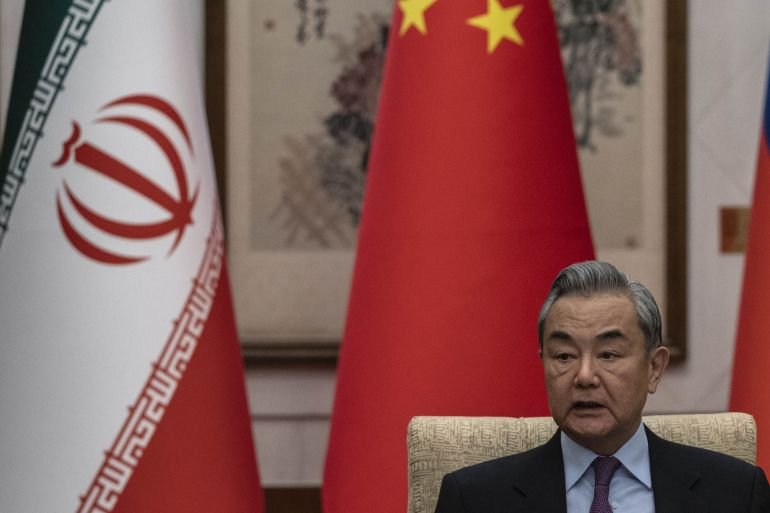
The Iranian minister of foreign affairs has briefed senior members of China’s central committee and his counterpart, Wang Yi, promising to do everything to ensure the safety of Chinese citizens in the country amid the war launched by the US and Israel.
Foreign Minister Abbas Araghchi made the comment in a call on Monday with Wang, which focused on the situation in Iran as Tehran defended “itself at all costs”, the Ministry of Foreign Affairs in Beijing said in a statement.
Recommended Stories
list of 4 itemsend of list
“Seyed Abbas Araghchi noted that the Iranian side will do its utmost to guarantee the safety and security of Chinese personnel and institutions,” the Foreign Ministry said in a statement.
Araghchi told Wang that Washington had “launched war against Iran for the second time during their ongoing negotiations”, despite the two sides having made “positive progress in the latest round of negotiations”.
The US and Israel launched their surprise attack on Iran on Saturday, just after Oman’s foreign minister – who had mediated the last round of indirect talks between Washington and Tehran – said a peace deal was closer than ever.
“A peace deal is within our reach,” Badr al-Busaidi said in an interview with CBS News just hours before the attack on Iran started.
Tehran had “no choice but to defend itself”, Araghchi told his Chinese counterpart, adding that he hoped Beijing would play a role in preventing further escalation of the conflict in the region.
“China values the traditional friendship between China and Iran and supports Iran in safeguarding its sovereignty, security, territorial integrity and national dignity and in upholding its legitimate and lawful rights and interests,” Wang told Araghchi, according to the ministry.
“China has urged the US and Israel to immediately cease military actions to avoid further escalation of tensions and prevent the conflict from expanding and spreading to the entire Middle East region,” Wang said.
The call between the ministers comes as China continues to maintain close relations with Iran and has worked in the past to end Tehran’s isolation on the world stage, including by granting Iran membership in BRICS+ – a bloc representing top emerging economies aiming to challenge the Western-led system – and the Shanghai Cooperation Organisation, according to the London-based think tank Chatham House.
Ahmed Aboudouh, an associate fellow at Chatham House, said Beijing and Tehran are comprehensive strategic partners, having signed a 25-year strategic agreement in 2021.
“China remains a lifeline for the Iranian economy” amid crushing sanctions, Aboudouh added.
More than 80 percent of Iran’s shipped oil in 2025 went to China, making up about 13.5 percent of all the oil China imported by sea, Aboudouh wrote in a recent briefing paper.
Dubai’s airport authority says it authorised a limited number of flights as hundreds of thousands remain stranded.
Published On 3 Mar 20263 Mar 2026
Share
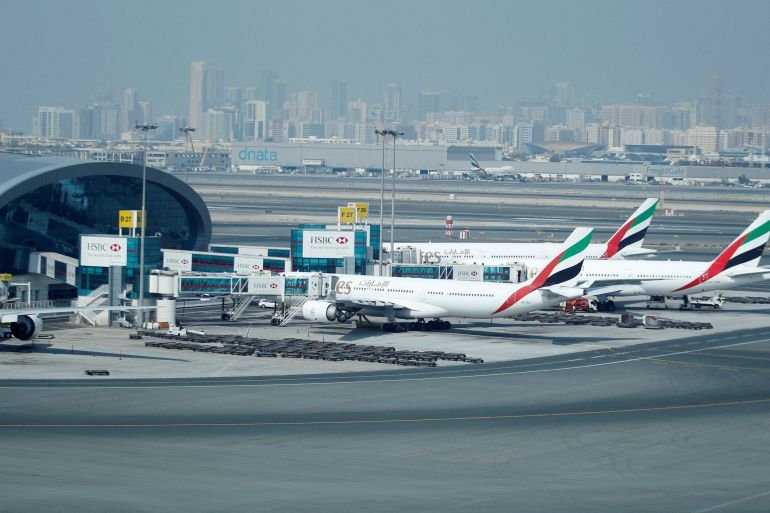
The United Arab Emirates has resumed a limited number of flights amid ongoing travel chaos across the region, prompted by the joint war by the United States and Israel on Iran.
Dubai’s airport authority said on Monday that it had authorised a “small number” of flights to operate from Dubai International airport, the world’s busiest gateway for international passengers, and Dubai World Central airport.
Recommended Stories
list of 4 itemsend of list
The authority said that passengers should not make travel plans unless they had been contacted directly by their airline with a confirmed departure time.
Dubai-based Emirates announced the resumption of a “limited” number of flights on Monday evening, and said that customers with earlier bookings would take priority.
Etihad Airways, based in Abu Dhabi, said that commercial flights would remain suspended until Wednesday, but that some “repositioning, cargo and repatriation flights” could take place subject to operational and safety approvals.
At least 16 Etihad Airways flights departed from Abu Dhabi on Monday to destinations including London, Amsterdam, Moscow and Riyadh, according to the flight tracking website Flightradar24.
At least two Emirates flights that departed from Dubai landed in India’s Mumbai and Chennai early on Tuesday morning, according to Flightradar24.
Later on Tuesday morning, two Etihad flights bound for Abu Dhabi were diverted to Muscat, Oman, and an Emirates flight headed for Dubai turned back towards Mumbai, according to the flight tracker.
“An Iran-conflict-driven disruption is typically more geographically concentrated, but it can still be severe, because it affects some of the world’s most important east-west corridors and creates rapid knock-on effects,” Tony Stanton, consultant director of Strategic Air in Australia, told Al Jazeera.
Countries including Iraq, Jordan, Qatar and Bahrain have closed their airspace amid US-Israeli attacks on Iran, and Tehran’s retaliatory strikes on US allies in the region, bringing travel across the Middle East to a shuddering halt.
More than 11,000 flights in and out of the region have been cancelled since the start of the conflict on Saturday, according to aviation data firm Cirium, prompting governments to consider plans for repatriating their citizens.
On Monday, German Federal Minister for Foreign Affairs Johann Wadephul said that Berlin would send chartered planes to Saudi Arabia and Oman to evacuate “particularly vulnerable” people who are unable to get home.
Stanton, the aviation analyst, said that the airline sector could face a lasting impact if the conflict drags beyond a few weeks, particularly if key routes become unviable and insurers and regulators raise the costs of operating.
“At that point, you can see route maps ‘reset’ – some services suspended indefinitely, hubs losing connection banks, and traffic shifting to alternative routings, or alternative hubs, that are perceived as lower-risk and more reliable,” he said.
Spanish Prime Minister Pedro Sanchez has condemned US and Israeli strikes on Iran.
Published On 2 Mar 20262 Mar 2026
Share
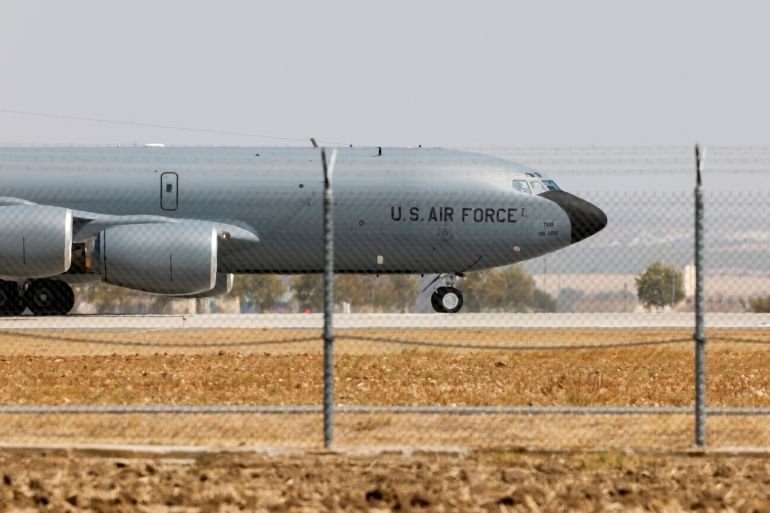
Spain says the United States is not using – and will not be using – joint military bases on its territory for operations against Iran, a mission condemned by Madrid.
“Based on all the information I have, the bases are not being used for this military operation,” Foreign Minister Jose Manuel Albares told Spanish public television on Monday.
Recommended Stories
list of 4 itemsend of list
Prime Minister Pedro Sanchez has condemned US and Israeli strikes on Iran that began on Saturday as an “unjustified” and “dangerous military intervention” outside the realm of international law, in another break from US policy.
“The Spanish government will not authorise the use of the bases for anything beyond the agreement or inconsistent with the United Nations,” Albares said, referring to the Rota naval base and the Moron airbase.
The US operates at the bases under a joint-use arrangement, but they remain under Spanish sovereignty.
Defence Minister Margarita Robles said the bases “will not provide support, except if, in a given case, it were necessary from a humanitarian perspective”.
Spain also condemned the retaliatory attacks by Iran on Gulf countries.
According to maps by flight-tracking website FlightRadar24 on Monday, 15 US aircraft have left bases in southern Spain since the US and Israel launched attacks on Iran. At least seven of the aircraft were shown on FlightRadar24 as having landed at Ramstein airbase in Germany.
The Spanish position is an outlier among the major European countries.
Britain had also initially refused to allow the use of its bases for an attack on Iran, but on Sunday, Prime Minister Keir Starmer authorised their use for “collective self-defence”, amid Iranian counterattacks targeting US assets across the Middle East and energy infrastructure in the Gulf region.
France and Germany, meanwhile, are prepared to do the same.
The three countries’ leaders were “appalled by the indiscriminate and disproportionate missile attacks launched by Iran against countries in the region, including those who were not involved in initial US and Israeli military operations”, read a joint statement on Sunday.
“We have agreed to work together with the US and allies in the region on this matter,” they stated.
The US secretary of state says he hopes Iranian people will overthrow the regime, as US military says six service members killed.
Published On 2 Mar 20262 Mar 2026
Share
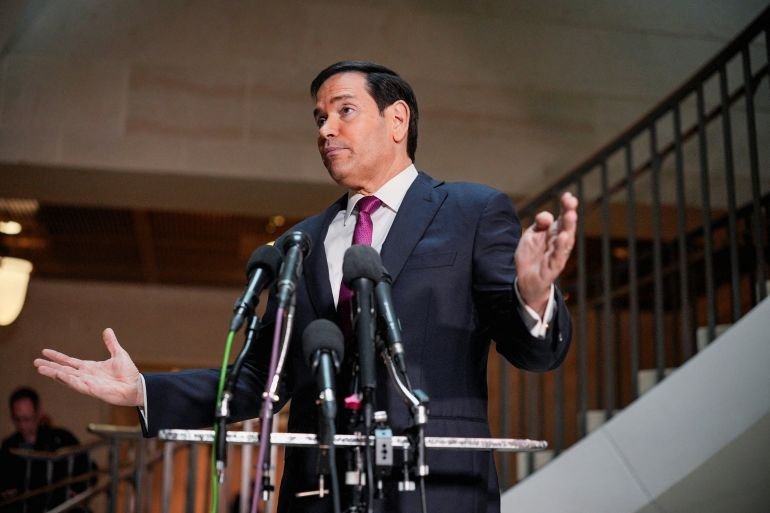
US Secretary of State Marco Rubio has suggested that a planned Israeli attack on Iran determined the timing of Washington’s assault on the government in Tehran.
The top diplomat told reporters on Monday that Washington was aware Israel was going to attack Iran, and that Tehran would retaliate against US interests in the region, so US forces struck pre-emptively.
Recommended Stories
list of 3 itemsend of list
“We knew that there was going to be an Israeli action,” Rubio said after a briefing with congressional leaders.
“We knew that that would precipitate an attack against American forces, and we knew that if we didn’t pre-emptively go after them before they launched those attacks, we would suffer higher casualties.”
The state secretary’s comments came minutes before the US military confirmed that its death toll from the conflict has risen to six, after two bodies were recovered from a regional facility struck by Iran.
Tehran retaliated against the joint US-Israeli attacks that killed its supreme leader, Ayatollah Ali Khamenei, several top officials and hundreds of civilians, with drone and missile launches across the region, including against US bases and assets in the Gulf.
Rubio argued on Monday that although the US and Israel jointly attacked first, Washington was acting to thwart an immediate threat because Israel was going to strike Iran on its own, anyway.
Israel is a close US ally and has received at least $21bn in military aid from Washington since 2023.
“There absolutely was an imminent threat,” Rubio said. “And the imminent threat was that we knew that if Iran was attacked – and we believed they would be attacked – that they would immediately come after us.”
The assertion highlights the Israeli role in bringing about the war with Iran, which Israeli Prime Minister Benjamin Netanyahu has been seeking for years.
On Sunday, Netanyahu said the attacks on Iran are happening with the assistance of his “friend”, US President Donald Trump.
“This coalition of forces allows us to do what I have yearned to do for 40 years,” the Israeli prime minister said in a video message.
Rubio told reporters on Monday that an attack on Iran had to happen because Tehran was amassing missiles and drones that it would have used to protect its nuclear programme and acquire a nuclear bomb.
Israel and the US launched the war less than 48 hours after a round of talks between American and Iranian officials over Tehran’s nuclear programme.
Rubio said the goal of the war is to destroy Iran’s missile and drone programmes, but stressed the US would welcome ending the governing system in Tehran.
“We would not be heartbroken, and we hope that the Iranian people can overthrow this government and establish a new future for that country. We would love for that to be possible,” he said.
Later on Monday, Washington urged US citizens across more than a dozen countries in the Middle East – including Gulf Cooperation Council nations, Lebanon, Syria, Egypt, Israel and the occupied Palestinian territories – to “depart now”.
The advisory reflects the growing turmoil and threats in the region.
The State Department “urges Americans to DEPART NOW from the countries below using available commercial transportation, due to serious safety risks”, US official Mora Namdar said on X.
Early on Monday, a suspected Iranian drone crashed into the runway at the United Kingdom’s RAF Akrotiri base in southern Cyprus. British and Cypriot officials said the damage was limited. There were no casualties.
Hours later, two drones headed for the base were “dealt with in a timely manner”, according to the Cypriot government.
Recommended Stories
list of 4 itemsend of list
The incidents came as Prime Minister Keir Starmer signalled on Sunday that the UK was prepared to support the United States in its confrontation with Iran – raising the prospect that it could be drawn deeper into a war it did not choose by its closest ally.
In a joint statement with the leaders of France and Germany, Starmer said the European group was ready to take “proportionate defensive action” to destroy threats “at their source”.
Later, in a televised address, he confirmed that Westminster approved a US request to use British bases for the “defensive purpose” of destroying Iranian missiles “at source in their storage depots, or the launches which are used to fire the missiles”.
But his agreement did little to placate US President Donald Trump, who said the decision came too late.
UK-based military analyst Sean Bell cautioned against reading too much into the Akrotiri incident.
“I understand the projectile that hit Cyprus was not armed, it hit a hangar [with] no casualties, and appears to have been fired from Lebanon,” he said, citing sources.
Al Jazeera was not able to independently verify the claim.
The broader context, he argued, is more consequential.
The US has taken the action “and everybody else is having to deal with the fallout”, he said.
Iran’s military strength lies in its extensive ballistic missile programme, he said, adding that while some have the range to threaten the UK, they do not extend far enough to strike the US.
“I don’t think [US] President Trump has yet made the legal case for attacking Iran, and … international law makes no discrimination between a nation carrying out the act of war and a nation supporting that act of war, so you’re both equally complicit,” he said.
Bell said that Washington likely reframed the issue, communicating to London that, whatever triggered the escalation, US forces were now effectively defending British personnel in the region.
That shift, he suggested, provided a legal basis to “not to attack Iran, but to protect our people”, allowing the UK to approve US operations from its bases under a “very, very clear set of instructions” tied strictly to national interest and defence.
UK officials ‘tying themselves in knots’
However, concerns of complicity had reportedly shaped earlier decisions, according to Tim Ripley, editor of the Defence Eye news service, who said the British government initially concluded that US and Israeli strikes on Iran did not meet the legal definition of self-defence under the United Nations Charter.
When Washington requested the use of bases such as RAF Fairford in Gloucestershire, UK, and Diego Garcia in the Indian Ocean, Starmer is understood to have consulted government lawyers, who advised against participation.
Up until Starmer’s televised address, in which he approved the US request, the UK had not considered the campaign a war of self-defence, said Ripley. While Washington’s legal reasoning has not changed, the war’s trajectory has.
Iranian retaliatory strikes – which have seen drones and missiles targeting Gulf states – have placed British expatriates and treaty partners under direct threat.
“The basis of our decision is the collective self-defence of longstanding friends and allies, and protecting British lives. This is in line with international law,” Starmer said.
According to Ripley, several Gulf governments, which maintain defence relationships with the UK, sought protection, allowing London to focus on protecting British personnel and partners rather than endorsing a broader campaign. However, with memories of the Iraq War hanging over Westminster, British ministers have stopped short of explicitly backing the US bombing campaign.
British officials are “tying themselves in knots” trying to describe a position that is neither fully participatory nor detached, he said.
US-UK: A strained relationship
Starmer on Monday told Parliament that the UK does not believe in “regime change from the skies” but supports the idea of defensive action.
But Ripley warned that any arrangement allowing US warplanes to operate from British air bases carries significant risks.
Iran’s missile systems are mobile and launchers mounted on trucks, he said. From RAF Fairford or Diego Garcia, US aircraft face flight times of seven to nine hours to reach Iranian airspace, necessitating patrol-based missions.
Once airborne, pilots may have only minutes to act. The idea that a US crew would pause mid-mission to seek fresh British legal approval is unrealistic, he said.
London must rely on Washington’s assurance that only agreed categories of “defensive” targets will be struck. If an opportunity arose to eliminate a senior Iranian commander in the same operational zone, the temptation could be strong. Yet such a strike might fall outside Britain’s stated defensive mandate. The aircraft would have departed from British soil, and any escalation could implicate the UK, Ripley said.
Bell highlighted another weakness: Britain has no domestic ballistic missile defence system.
If a ballistic missile were fired at London, he said, “We would not be able to shoot it down.”
Intercepting such weapons after launch is notoriously difficult, reinforcing the argument that the only reliable defence is to strike before launch.
The UK, therefore, occupies a grey zone: legally cautious, operationally exposed and strategically dependent on US decisions, it does not fully control.
Beyond the legal and military dilemmas, Starmer must also contend with a sceptical public.
A YouGov poll conducted on February 20 found that 58 percent of Britons oppose allowing the US to launch air strikes on Iran from UK bases, including 38 percent who strongly oppose.
Just 21 percent support such a move, underscoring limited domestic backing for deeper involvement.
Iran appeared determined to avenge the killing of Supreme Leader Ayatollah Ali Khamenei and other senior Iranian officials following the start of the US-Israeli assault on Saturday, as Tehran continued to strike back at Israel and United States military assets across the Gulf on Monday.
After Khamenei’s death was confirmed by Iranian state media on Sunday, the Islamic Revolutionary Guard Corps (IRGC) vowed revenge and launched what it called “the heaviest offensive operations in the history of the armed forces of the Islamic Republic against occupied lands [a reference to Israel] and the bases of American terrorists”.
Recommended Stories
list of 3 itemsend of list
Iran’s army chief, Amir Hatami, also pledged to continue defending the country, as the army claimed its fighter jets had bombed US bases across the Gulf region on Sunday.
This is not the first time Iran has targeted Israel and US military bases in the Gulf region in retaliatory strikes. Last June, during Iran’s 12-day war with Israel, Tehran launched a wave of ballistic missiles targeting Israel and the Al Udeid airbase in Qatar, which hosts US troops. Most of these missiles were intercepted and destroyed, and the strike on Al Udeid was pre-warned and largely seen as a face-saving exercise.
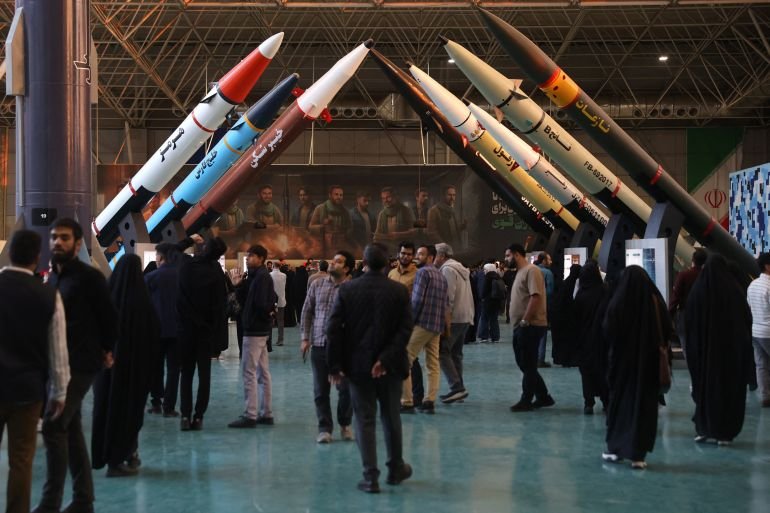
This year, defence analysts say Iran has revised its military strategy to a more aggressive one focused on the Islamic Republic’s survival.
The nation operates parallel armies, multiple intelligence services and layered command structures, all of which answer directly to the supreme leader, who serves as the commander in chief of all the armed forces.
The parallel armies comprise the Artesh – or Iran’s regular army, which is responsible for territorial defence, airspace and conventional warfare – and the IRGC, whose role goes beyond defence and includes protecting Iran’s political structure.
The IRGC also controls Iran’s airspace and drone arsenal, which has become the backbone of Iran’s deterrence strategy against attacks from Israel and the US.
Defence analysts told Al Jazeera that such a complex military structure is a deliberate strategy to safeguard the country from both external and internal threats, such as coups.
“Iran’s military strategy is derived from its political structure. Their political aim is to safeguard their own territorial integrity and stop foreign intervention targeted at overthrowing their rule,” a military specialist and former military official, who requested anonymity, told Al Jazeera.
(Al Jazeera)
How has Iran responded to strikes?
Following the US and Israel’s coordinated strikes on Iran on Saturday, Tehran has retaliated against Israel and US military bases across the Gulf region, using Shahed drones – Iranian unmanned combat aerial vehicles (UCAVs) – and high-speed ballistic missiles.
While Israel, the US and Gulf countries have intercepted most of these missiles, some have struck military assets and civilian infrastructure. Debris from those intercepted has also fallen on some civilian areas.
On Saturday, Iran fired 137 missiles and 209 drones across the United Arab Emirates (the UAE, where US military bases are present), its Ministry of Defence said, with fires and smoke reaching the Dubai landmarks of Palm Jumeirah and Burj Al Arab.
At Abu Dhabi’s airport, at least one person was killed and seven wounded during what the facility’s authority called an “incident”. Dubai’s airport, the world’s busiest for international traffic, and Kuwait’s airport were also hit.
At least nine people were also killed and more than 20 injured in Iran’s missile strike on the Israeli town of Beit Shemesh on Sunday.
(Al Jazeera)
What is Iran’s strategy here?
John Phillips, a British safety, security and risk adviser and a former military chief instructor, told Al Jazeera that Iran’s current military strategy is to survive intense Israeli‑US pressure, rebuild its core capabilities, and restore deterrence by calibrated asymmetric escalation through missiles, drones and proxies.
He said the military strategy firstly focuses on “asymmetric endurance, which is a case of hardening ‘missile cities’, dispersing command structures, and accepting initial damage in order to preserve a second‑strike capability rather than trying to prevent all strikes”. Missile cities are defensive infrastructure used by Iran to safeguard its ballistic and cruise missiles from any aerial attacks
Phillips explained that regional saturation and proxy warfare are also part of the strategy whereby Iran is using “large salvos of ballistic missiles and loitering munitions, alongside actions by Hezbollah and remaining partner militias across the Middle East, to stretch Israeli and US missile defences and impose costs region‑wide”.
Early on Monday, Hezbollah fired a barrage of rockets at northern Israel, to avenge the killing of Khamenei.
Phillips added that Iran has also threatened to close the Strait of Hormuz as part of its military strategy to raise the global economic stakes of the war and pressure Western and Gulf governments.
About 20-30 percent of global oil and gas supplies are shipped through the Strait of Hormuz. Instability in this important maritime route could rattle economic stability worldwide. So far, Iran has not officially closed the strait. But shipping data from Sunday showed that at least 150 tankers, including crude oil and liquified natural gas vessels, had dropped anchor in open Gulf waters beyond the strait.
(Al Jazeera)
How is this strategy different from last June?
In June last year, Iran and Israel, which was supported by the US, engaged in a 12-day war.
It erupted on June 13, 2025, when Israel launched air strikes on Iranian military and nuclear sites, killing key nuclear scientists and military commanders.
Iran retaliated with hundreds of ballistic missiles targeting Israeli cities. In the days that followed, Israel and Iran traded missiles as casualties mounted on both sides. While casualties were high in Iran, they were minimal in Israel. However, some missiles did breach Israel’s much-lauded Iron Dome.
The US entered the military clash on June 22 with bunker-buster strikes on Iran’s Natanz, Fordow and Isfahan nuclear facilities. Afterwards, US President Donald Trump claimed that Iran’s nuclear capabilities had been neutralised.
A fragile ceasefire was eventually brokered by the US on June 24, hours after Iran had fired missiles at the largest airbase hosting US troops in the Middle East – Al Udeid in Qatar.
Phillips said that since then, Tehran has shifted its military doctrine from a primarily defensive containment to an explicitly offensive asymmetric posture.
“The June 2025 war marked a major inflection from largely proxy‑based confrontation to direct, high‑intensity exchanges between Iran and Israel, with US involvement,” he said.
“Compared to June 2025, Iran today appears more structurally aggressive in doctrine where it is formally embracing earlier and more extensive use of regional missiles, drones, cyberattacks and energy coercion (when energy resources and infrastructure are targeted or cut off), but is operationally constrained by battle damage, sanctions and internal instability,” he added.
Phillips also noted that Iran has become more risk‑accepting and escalatory in nature since June last year.
“But its degraded capabilities and fear of triggering an outright regime‑ending campaign push it toward calibrated, episodic bursts of aggression rather than permanent high‑intensity warfare,” he said.
“Their immediate response is likely to be similar to that post the killing of [Qassem] Soleimani,” he said.
In January 2020, after Trump’s administration killed IRGC military commander Qassem Soleimani, along with six others in an air raid on Baghdad’s international airport in Iraq, Iran fired more than a dozen missiles at two Iraqi bases hosting US forces. There were no casualties.
Phillips added that Iran will likely resort to “excessive proxy attacks … for the period of mourning to avenge the killing of the ayatollah. There is highly likely to be another large-scale ICBM [intercontinental ballistic missile] attack on Israel to prove a point and to fight back.”
Is Iran’s current military strategy working?
Defence analysts say it is too early to tell whether the recalibrated strategy is working.
“Iran has a strong army, but there are currently no boots on the ground, and it is an aerial war. Iran is in a disadvantageous position with its air defence compared to the US and Israel. Tehran has increased its stockpile of aerial missiles, but only time will tell if it can hold its own,” the military expert and former official said.
Phillips compared Iran to a “wounded animal” and said that in narrow deterrence terms, Tehran’s military strategy is working to the extent that it has demonstrated it can still launch meaningful missile and drone attacks after the 2025 strikes. It has also forced Israel and the US into a “sustained, resource‑intensive defensive and offensive campaign rather than a clean, one‑off disarmament”, he added.
“However, Iran’s nuclear and missile infrastructure has been heavily damaged, its economy further weakened, and it lost Ayatollah Khamenei in the strike on Tehran, leaving the regime more vulnerable and internally strained, which indicates that its strategy has not prevented severe strategic setbacks,” he said.
How long can Iran hold out?
Even before the Israeli and US attacks on Iran on Saturday, Iranian officials had warned that any attack from Washington or Tel Aviv on Iran would be treated as the start of a wider war, not a contained operation.
After Khamenei’s killing, this stance by Iranian officials has continued.
“You have crossed our red line and must pay the price,” Iran’s parliamentary speaker, Mohammad Bagher Ghalibaf, said in a televised address, referring to the US and Israel.
“We will deliver such devastating blows that you yourselves will be driven to beg.”
While Iran, the US and Israel have traded air strikes since Saturday, it remains unclear how long the conflict will continue.
Phillips said that militarily, Iran can likely sustain “intermittent missile, drone, proxy, and cyber operations for years because these systems are relatively cheap and can be produced and deployed from dispersed, hardened facilities, even under sanctions”.
“Politically and economically, however, prolonged high‑intensity conflict that invites repeated large US‑Israeli strikes risks severe economic contraction, internal unrest, and further erosion of regime legitimacy,” he said.
“So Tehran has strong incentives to oscillate between escalation and tacit pauses rather than sustain continuous full‑scale war,” Phillips added.
How long can the US and Israel hold out?
US President Trump has repeatedly warned Iran against retaliation and threatened that the US could strike Iran “with a force that has never been seen before” in the face of retaliation. But he has also sent mixed messages about how long the war could continue.
Since early February, the US has amassed a vast array of military assets in the Middle East, amid escalating tensions with Iran.
According to open-source intelligence analysts and military flight-tracking data, since early February, the US appears to have deployed more than 120 aircraft to the region – the largest surge in US airpower in the Middle East since the 2003 Iraq war.
The reported deployments include E-3 Sentry Airborne Warning and Control System (AWACS) aircraft, F-35 stealth strike fighters and F-22 air superiority jets, alongside F-15s and F-16s. Flight-tracking data shows many departing bases in the US and Europe, supported by cargo aircraft and aerial refuelling tankers, a sign of sustained operational planning rather than routine rotations.
But after attacking Iran, Trump has been unclear about how long the conflict could last.
On March 1, he told the New York Times that the war could last for four to five weeks. He told ABC News that after the killing of Khamenei, the US was not thinking of targeting anyone else. He also told The Atlantic magazine that Iran’s new leadership had agreed to talk to him, signalling a potential end to the ongoing conflict.
Christopher Featherstone, associate lecturer in the department of politics at the University of York, said that for the US and Israel, international condemnation and domestic opposition could be a limiting factor.
“The US can continue to deploy assets in the region, but any increase in attack would require a huge political effort and significant resources. Trump ran on being an ‘at home’ president, but is increasingly aggressive abroad. However, he is still wary of sustained foreign engagement,” Featherstone told Al Jazeera.
Phillips said that militarily, Israel retains qualitative superiority, an active missile‑defence network, and robust US security support, allowing it to sustain repeated air and missile campaigns and defensive operations for an extended period.
“Its main constraints are domestic resilience (civilian disruption, reserve mobilisation fatigue) and the cumulative diplomatic and economic costs of prolonged regional conflict, which suggest it can sustain a grinding campaign for years, in military terms, but will come under growing pressure – internal and external – to stabilise the situation well before that,” Phillips said, adding that support from European and United Kingdom defence contractors could also dictate, to a degree, how long Israel can sustain this conflict.
‘The US can sustain the current tempo of strikes, air and naval deployments, and missile‑defence support far longer than either regional actor in purely material terms, given its global force posture and industrial base,” he said.
“The binding constraint is domestic political will and strategic prioritisation,” he noted.
“The Iran-Israel theatre is testing Washington’s ability to align its National Defense Strategy with limited public appetite for another open‑ended Middle Eastern conflict,” Phillips said. “So the US is likely to aim for a contained, deterrence‑focused campaign rather than an indefinite high‑intensity war. Their catalyst for stopping will be the political will of allies and how much sway they can hold over the next supreme leader.”
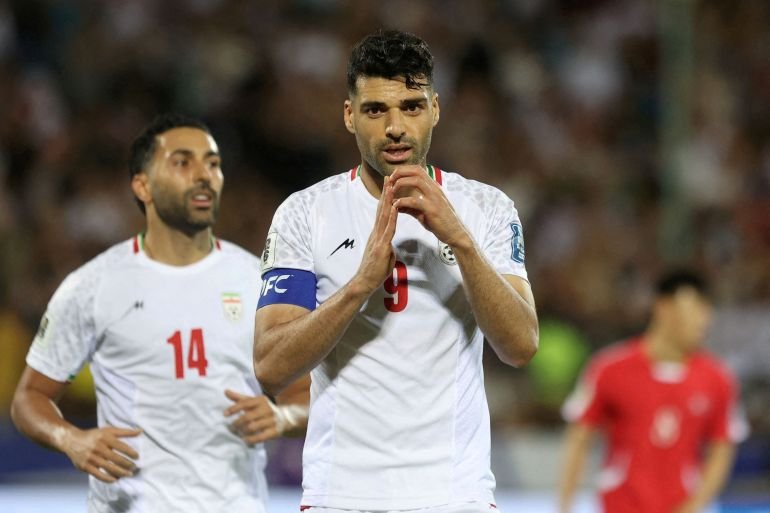
United States and Israeli attacks on Iran have cast doubt over the Iranian football team’s participation in the upcoming FIFA World Cup.
Iran has responded to the attacks, which began on Saturday, by striking Israeli and US military bases in the Middle East with missiles and drones.
Recommended Stories
list of 3 itemsend of list
As of Monday morning, at least 555 people had been killed across Iran and 10 in Israel. Three US soldiers had been killed in action while 38 people had been killed in other nations across the region.
The World Cup will be cohosted by Canada, Mexico and the US – where Iran is scheduled to play all its group games. But if there is no letup in the conflict, the tournament’s logistics and Iran’s role in it have come under question.
Here’s what we know so far:
When is the FIFA World Cup, and what’s Iran’s schedule in the tournament?
The World Cup will begin on June 11 in Mexico while Canada and the US will host their first match the following day. The final will be played on July 19 in East Rutherford, New Jersey, near New York.
Iran is in Group G of the tournament with Belgium, Egypt and New Zealand and is scheduled to play all of its games on the US West Coast.
Here’s Team Melli’s group-stage schedule:
June 15: Iran vs New Zealand at 9pm (05:00 GMT on June 16) at Los Angeles Stadium
June 21: Belgium vs Iran at 3pm (23:00 GMT) at Los Angeles Stadium
June 26: Egypt vs Iran at 11pm (07:00 GMT on June 27) at Seattle Stadium
Will Iran play in the FIFA World Cup?
While Iran has not officially pulled out of the tournament, a top Iranian football official has admitted the team’s participation has been thrown into question.
“What is certain is that after this attack, we cannot be expected to look forward to the World Cup with hope,” Mehdi Taj, president of the Football Federation of the Islamic Republic of Iran (FFIRI), told local sports portal Varzesh3 on Sunday.
“It’s not possible to say exactly, but there will certainly be a response,” Taj added when asked whether the FFIRI or the Iranian government would reconsider the country’s participation in the tournament.
“This will surely be studied by the country’s high-ranking sports officials, and there will be a decision on what’s going to happen.”
FIFA Secretary-General Mattias Grafstrom has said the world football governing body is monitoring the conflict and the situation emerging from it.
“I read the news [about Iran] this morning the same way you did,” Grafstrom said at the International Football Association Board’s annual general meeting in Wales on Saturday, according to a report by ESPN.
“We had a meeting today, and it is premature to comment in detail, but we will monitor developments around all issues around the world.”
With the tournament a little more than three months away, FIFA said it will “continue to communicate with the host governments”.
Will the Iranian team and fans be allowed in the US for the World Cup?
While Iran’s games are scheduled at venues on the US West Coast, which is home to a sizeable Iranian community, Team Melli’s fans hoping to travel to the tournament from Iran and support their team will find it difficult.
Iran was among the 12 countries that were included in US President Donald Trump’s travel ban imposed in June.
The ban was met with criticism from Iran, which called it “racist” and a sign of deep-rooted hostility towards Iranians and Muslims.
What happens if Iran does not participate in the World Cup?
There is no precedent for a team withdrawing from the FIFA World Cup, which is deemed the biggest sporting event in the world.
Teams that have been sanctioned and banned by global and regional football bodies have been excluded from the tournament with Russia’s ban the most recent.
Should Iran pull out of the tournament, it would likely be replaced by another nation to ensure the smooth operation of the tournament.
Because Iran is part of the Asian Football Confederation and qualified for one of the region’s berths for the World Cup, the replacement would likely come from Asia although organisers have not confirmed whether that would be the case.
Based on their position at the end of the qualifying process, the United Arab Emirates could be the nation next in line. However, if Iraq, who are aiming to qualify via an intercontinental playoff, fail to book a place, they could pip the UAE as Iran’s replacement.
What’s Iran’s record at the FIFA World Cup?
Iran are currently ranked 20th in the world and second in Asia.
They have appeared in the World Cup on seven occasions with consecutive appearances in the past three editions but have failed to move past the group stage.
A favourite tactic of war is to try to decapitate the enemy leadership. While such strategies might work in certain contexts, in the Middle East, they have proven to be a disastrous choice.
For sure, the assassination of an enemy leader might give a quick boost of popularity amid war. Certainly, United States President Donald Trump and Israeli Prime Minister Benjamin Netanyahu are basking in the limelight of their perceived “success” in assassinating Iranian Supreme Leader Ali Khamenei.
But killing an 86-year-old man who had already been planning his succession due to his ill health is not that much of a feat considering the overwhelming firepower that the US and Israel together possess. More importantly, eliminating him does not necessarily mean that what follows would be a leadership or a regime that would accommodate Israeli and US interests.
That is because leadership assassinations do not lead to peaceful outcomes in the Middle East. They can open the door for much more radical successors or for chaos that leads to violence and upheaval.
A brief glance at recent history shows that whenever Israel and the US have tried the idea of leadership “decapitation” in various conflicts in the region, the results have been disastrous. In the case of Iraq, its leader Saddam Hussein was captured by US forces and handed over to allied Iraqi forces who executed him. This ended a regime that was openly antagonistic to Israel, but it also opened the doors for pro-Iranian forces to take power.
As a result, in the following two decades, Iraq served as a launching pad for Iran’s regional proxy strategy, which saw it build a powerful network of nonstate actors that threatened US and Israeli interests.
The security vacuum created by the US invasion triggered various insurgencies, the most devastating of which was the rise of ISIL (ISIS), which swept through the Middle East, killing thousands of innocent people, including US citizens, and triggering a massive refugee wave towards US and Israeli allies in Europe.
Another case in point is Hamas. Since the early 2000s, Israel has repeatedly tried to assassinate its leaders. In 2004, it succeeded in killing its founder Sheikh Ahmed Yassin and then his successor Abdel Aziz Rantisi, who was considered a moderate. A few assassinations later, Yahya Sinwar was elected head of Hamas in Gaza and went on to plan the October 7, 2023, attack.
Hezbollah has a similar history. Its late leader Hassan Nasrallah, who successfully led the expansion of the group to a formidable nonstate power, ascended to its leadership after Israel assassinated his predecessor Abbas al-Musawi.
Two and half years of war and mass killing of leadership may now have devastated both armed groups, but Israel has failed to assassinate the idea behind them: resistance to occupation. The current lull in fighting may be the quiet before another storm.
In the Iranian case, it is highly unlikely that whoever replaces Khamenei would be as open to negotiations as he was. The statements by the Omani interlocutors during the talks in Muscat and Geneva pointed to major concessions on the nuclear issue that Iran under Khamenei was prepared to make. It is unlikely that his replacement would have the political space to follow suit.
If Israel and the US continue their campaign and really push for state collapse in Iran, what comes out of that ensuing chaos could be anyone’s guess. But if we are to go by recent experiences in Iraq and Libya, a security vacuum in Iran would have devastating consequences for US allies in the region and in Europe.
That raises the pertinent question of what Israel and the US stand to gain from their “decapitation” strategy in Iran.
For Netanyahu, the assassination of Khamenei is a major success. Facing crucial elections that could mean the possible end of his political life and maybe his imprisonment over four corruption charges, the short-term gain in popularity and votes is worth it. Israeli leaders do little thinking and planning on the mid- to long term and do not have to bear the consequences of military adventurism abroad. After all, Israeli society is very much in favour of it.
But for Trump, the gains are not as apparent. He gets to brag about killing an 86-year-old ailing leader of a faraway country to a public that has no appetite for war. At a time of a continuing cost-of-living crisis in the US, he is spending billions of taxpayer dollars to fight a war against a country that posed no imminent threat, a war that many Americans are increasingly identifying as “Israel’s war”.
Instead of projecting power, Trump risks showing weakness and being seen as a US president fooled into starting a costly war to ensure the political survival of the prime minister of a foreign country.
It is clear for now that the US president has drawn a line at putting US boots on the ground. At some point, he will have to end the bombardment campaign and pull US troops. He will leave behind a disaster that US allies in the region will have to bear the brunt of. US regional alliances are sure to suffer. Domestic audiences are sure to ask questions.
This will be yet another US military adventure in the region that will cost US taxpayers’ money, US soldiers’ lives and foreign policy clout and offer no return. The hope is that Washington may finally learn its lesson that assassinations and decapitation strategies don’t work.
The views expressed in this article are the author’s own and do not necessarily reflect Al Jazeera’s editorial stance.