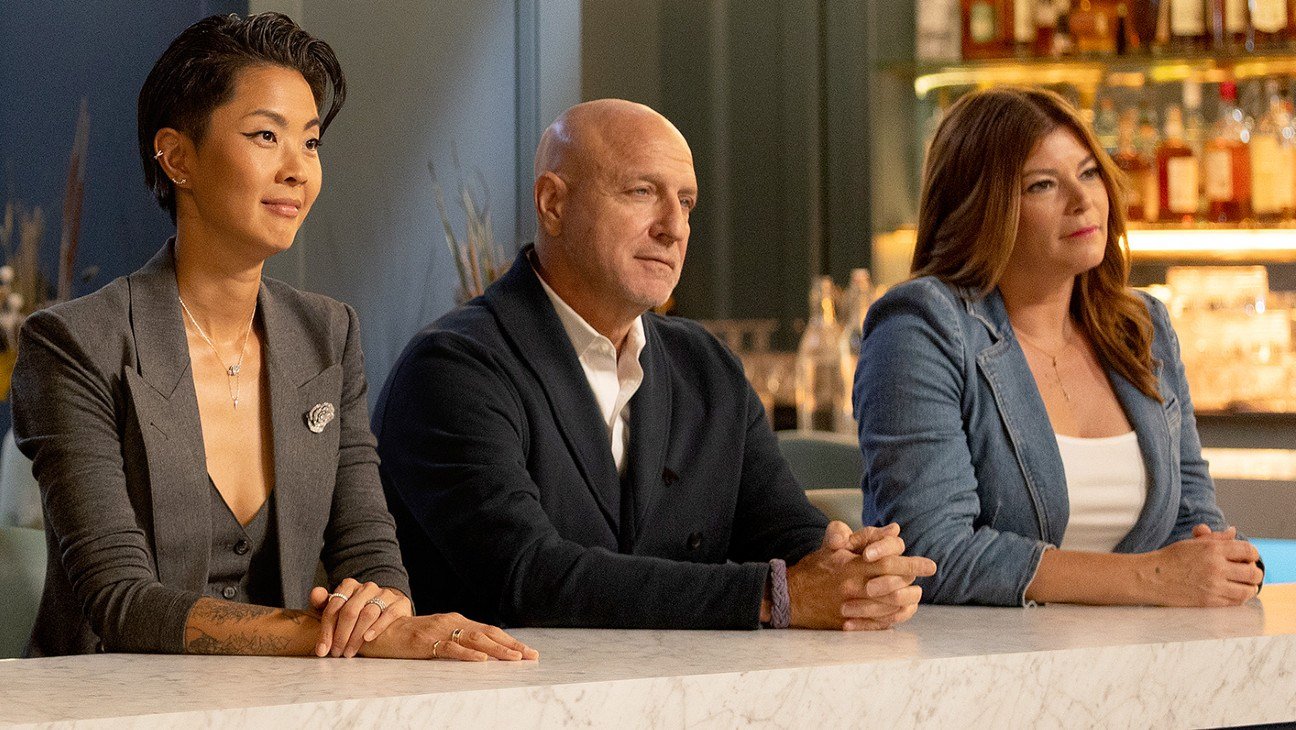
Top Chef, which has been nominated for 57 Emmys over its 23 seasons, last won in 2010, taking home the top prize of best reality competition program.
The long-running Bravo cooking-competition series is nominated in that category again this year as well as being up for best reality host (past Top Chef winner Kristen Kish in her third season as host), best casting and directing for a reality series.
But longtime judges Tom Colicchio and Gail Simmons think Top Chef deserves to win in part because it’s far “more complicated” than some of the other reality competition nominees.
“Our show is not done in a studio. It’s much easier to shoot a show in the studio. We shoot maybe one or two episodes when we stay in the studio. But we’re out on location. We’ve got to pick up and build a kitchen, move 150 people on a crew, trucks, and it’s hard to do,” Colicchio recently told The Hollywood Reporter. “Some of the other shows, you’re in a castle. You’re on a set. It’s good show, but still, it’s a set.”
Simmons echoes this as she talks about the challenges of making the “on location” series, which for its Emmy-nominated season 23, filmed in North Carolina and Greenville, South Carolina.
“It’s a more complicated show to shoot than a lot of other shows in the category, if I may say, and we’re on location in a different place every season,” she told THR ahead of season 23 winner Rhoda Magbitang’s dinner at the James Beard House in New York earlier this month, part of this season’s prize package. “This is not a studio show, and we’re dealing with perishables and knives and fire at all times. And I think sometimes that gets forgotten.”
Beyond that, Simmons recalls how this season in particular, which saw one contestant leave midway through for medical reasons after aggravating an injury, was particularly difficult.
“It wasn’t an easy season to shoot, not just for us but for our cast. There were casualties along the way, not just eliminations,” she said. “It was hard. It was hard for for a lot of reasons, but I think our producers do a really incredible job piecing the jigsaw puzzle together.”
Beyond that, though Colicchio and Simmons highlight the “human story” and “humanity” that came through this season, which also featured a memorable moment early on when the empathetic Kish comforted contestant Nana Araba who was visibly frustrated and emotional after not plating all of the elements of her dish.
The moment reflects part of what Kish brings to the show as she feels more comfortable showing more of herself. “I liken it to a muscle being exercised,” she said of her comfort level as host. “It’s not that I get stronger in one particular place. The thing that I get stronger in is feeling confident of being fully myself in all the different ways, because every season is different, every challenge is different, every batch of chefs brings a new kind of energy that I have to react to. It is reality television at its finest. It’s happening in real time. I don’t go and spit out a line and then I do the same thing over and over and over again. I react and I feel whatever is happening in the room at the time.”
Unlike some other reality competition shows, even ones that involve cooking, Top Chef often features strong levels of camaraderie among the competing chefs, who are facing off with different dishes but help each other with emotional support and feedback.
“I think [the culinary] industry’s changed a little bit. It’s a lot less cutthroat than it used to be,” Colicchio said of seeing this change. “But also I think that a lot of these chefs have watched Top Chef now or they grew up watching, and they think, ‘I’m not going to be that person. They don’t want to be that person, and I think they realize that you don’t have to be backstabbing to win this. It’s not like a lot of other reality shows. This is about food that you put on a plate. Backstabbing someone is not going to help you make your dish better. That’s what you have to focus on. Make your dish better. Forget what everybody else is doing. And it’s been the last five or six seasons where you get a real sense that they’re treating it like more like a kitchen because in a kitchen everybody works together. If you don’t work together, you’re going to have terrible service. And I think they all are realizing that it’s going to be a much better experience if they support each other than if they’re fighting each other. Ultimately, they want to win. I think they want to win on their own terms, making the best food.”
Indeed, Colicchio says that’s all it took for Magbitang to win the most recent season.
“We don’t judge on personality; we don’t judge on looks. We judge on food. Her food was consistently the best food,” he says of Magbitang. “At the end she came on really strong, put up some great dishes and her finale meal was the best meal.”
Simmons elaborated more on what made Magbitang stand out.
“She was always incredibly articulate about her food and how she came to be cooking the way she is, her story, her childhood, her family, and she always just had a great sort of confidence about her cooking style and her abilities, and I really appreciated that,” she said. “Her food? I think she has a knack for putting together beautiful flavors. They’re spicy and complex and interesting, and they rely on a lot of deep techniques, some of which I’m not even familiar with. I think the most successful chefs on our show, the winners certainly, really internalize the food that they grew up on, make it personal and then differentiate the way they cook it from anyone else who’s also trying to cook the same food.”
Both Simmons and Colicchio have been judging Top Chef for its entire 23-season run, and looking ahead they just want to keep going. For Colicchio, he sees the series as a valuable institution up there with prestigious culinary awards.
“[Top Chef has] become culturally really important to the culinary industry,” Colicchio told THR. “And so we want to keep it going because it’s that important. It’s as important as a [James] Beard Award or a Food & Wine best new chef award. You win Top Chef; that’s a big feather you’re putting in your cap. And you know what it does for the chefs; it gives them a real showcase. And what happens afterwards is makes it easier to raise money, especially the demographics that have always had a hard time raising money in the industry, and open your own restaurant, and that’s usually the goal: They want to open their own restaurant and do their thing. My goal is to just keep doing this for our industry. I think if we ever go away, that’s one less thing. It’s like the Beard Award. If all of a sudden they stop doing it, what am I shooting for now?”
Simmons had a broader approach to her goals with future seasons of the series. “I think what I want to keep doing, what Top Chef does so well, and I give that credit to our producers and to Bravo, is to evolve people’s perceptions of what good food is, and to evolve people’s perceptions of diversity and expand people’s ideas of travel and compassion, and also just highlight an industry where there’s a lot of people working really hard behind the scenes that most of us take for granted when we eat every day. There’s endless locations. There’s endless great young chefs in this world, and I want to see them all succeed.”
While Kish, Colicchio and Simmons are all returning for season 24, which Bravo announced at NBCUniversal’s May upfront, the location and production schedule for the upcoming season have yet to be announced.
The upcoming season will be filming later than usual, Simmons said. “Usually, we start shooting right around now, and this year we’re pushing it back a couple months, which is great,” she said. “It has nothing to do with us. It’s programming scheduling at the higher level, which means I get a full summer to myself, which is really nice for the first time. I will be at the first day of school for my kids for the first time in many years. But that’s about all I know. We know there will be a season 24 in 2027, and I can’t wait to make it.”
Kish seemed to know more but was sworn to secrecy but teased she was “so excited.” “All I can say is that it’s just it’s going to be incredible not only for us to to live through, but also I can’t wait for people to watch,” she said, adding that she thinks the delay will make sense when people find out the location.
And if producers need suggestions for where to go for future seasons, Simmons has a list.
“If I really have my druthers, I want to go to Tokyo. We’re not going to Tokyo. We’re going to stay domestic, I believe, but there’s a lot of great cities that we’ve never been to yet: Atlanta, Philadelphia. I think it’s high time we went back to Chicago. We were there season four, and that was like 18, 17 years ago. I’d love to go to Nashville. There’s so many places in the Midwest I’ve never been to that I know know how to create food. We’ve never really done the Southwest. We did Tucson. We’ve never done New Mexico. There’s just so many unique cultural locations across the U.S. that I think lend themselves to great storytelling and great food that we all could benefit from knowing more about.”