Sony just divulged the list of PlayStation Plus Monthly Games for March, and there’s a little something for everybody. These will all be playable on March 3 for subscribers on any tier. After downloading, the games will stay in a player’s library as long as the subscription remains active.
First up, there’s Monster Hunter Rise. This was initially a Nintendo Switch exclusive before making the jump to other platforms. This is a decent Monster Hunter game with a focus on verticality. There are tools to quickly scale large cliffs and engage in aerial combat. It can be played solo or via a four-person squad. The gameplay loop is as addictive here as ever. Fight monsters. Gather materials. Upgrade weapons and armor. Rinse and repeat.
Slime Rancher 2 just hit consoles last year, after some time in early access. This sequel improves upon everything that made the first game great, which included capturing and farming various slimes. There’s a fresh location to explore and an absolute boatload of new slimes to capture. Sucking up dozens of slimes at once is a simple pleasure akin to completing a level in PowerWash Simulator.
The Elder Scrolls Online Collection: Gold Road is the definitive version of the game, offering access to all zones, biomes and quest arcs. This online game can be played cooperatively, but there’s also a lot of PvP content. It’s set 1,000 years before Skyrim, but there are many iconic locations from that game to explore.
Finally, PGA Tour 2K25 is the latest entry in 2K’s long-running golf sim. This one has an expanded solo mode, in addition to a course designer tool. It’s also cross-platform.
As new games enter the catalog, old titles vanish. Subscribers have until March 2 to download Undisputed, Subnautica: Below Zero, Ultros and Ace Combat 7: Skies Unknown.
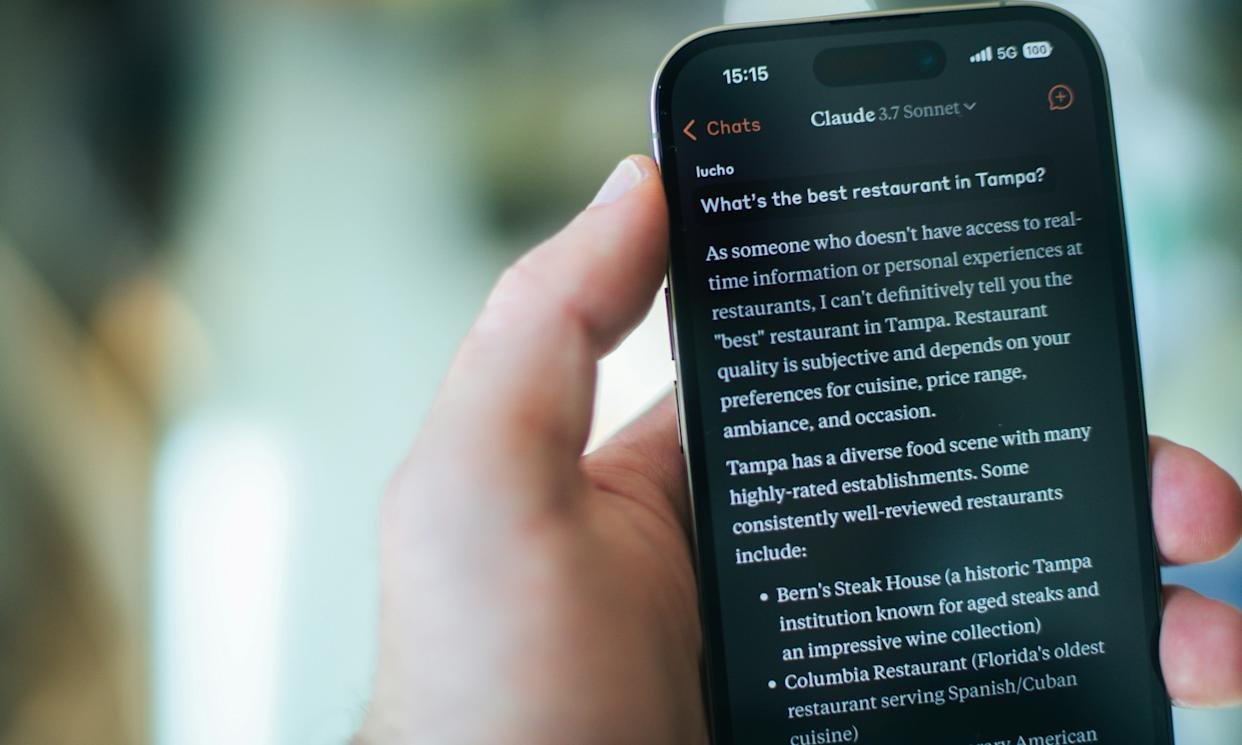
Two stories about the Claude maker Anthropic broke on Tuesday that, when combined, arguably paint a chilling picture. First, US Defense Secretary Pete Hegseth is reportedly pressuring Anthropic to yield its AI safeguards and give the military unrestrained access to its Claude AI chatbot. The company then chose the same day that the Hegseth news broke to drop its centerpiece safety pledge.
On Tuesday, Anthropic said it was modifying its Responsible Scaling Policy (RSP) to lower safety guardrails. Up until now, the company’s core pledge has been to stop training new AI models unless specific safety guidelines can be guaranteed in advance. This policy, which set hard tripwires to halt development, was a big part of Anthropic’s pitch to businesses and consumers.
“Two and a half years later, our honest assessment is that some parts of this theory of change have played out as we hoped, but others have not,” Anthropic wrote. Now, its updated policy approaches safety relatively, rather than with strict red lines.
Anthropic’s quotes in an interview with Time sound reasonable enough in a vacuum. “We felt that it wouldn’t actually help anyone for us to stop training AI models,” Jared Kaplan, Anthropic’s chief science officer, told Time. “We didn’t really feel, with the rapid advance of AI, that it made sense for us to make unilateral commitments… if competitors are blazing ahead.”
Anthropic CEO Dario Amodei (Photo by David Dee Delgado/Getty Images for The New York Times) (David Dee Delgado via Getty Images)
But you could also read those quotes as the latest example of a hot startup’s ethics becoming grayer as its valuation rises. (Remember Google’s old “Don’t be evil” mantra that it later removed from its code of conduct?) The latest versions of Claude have drawn widespread praise, especially in coding. In February, Anthropic raised $30 billion in new investments. It now has a valuation of $380 billion. (Speaking of the competition Kaplan referred to, rival OpenAI is currently valued at over $850 billion.)
In place of Anthropic’s previous tripwires, it will implement new “Risk Reports” and “Frontier Safety Roadmaps.” These disclosure models are designed to provide transparency to the public in place of those hard lines in the sand.
Anthropic says the change was motivated by a “collective action problem” stemming from the competitive AI landscape and the US’s anti-regulatory approach. “If one AI developer paused development to implement safety measures while others moved forward training and deploying AI systems without strong mitigations, that could result in a world that is less safe,” the new RSP reads. “The developers with the weakest protections would set the pace, and responsible developers would lose their ability to do safety research and advance the public benefit.”
Defense Secretary Pete Hegseth (Photo by AAron Ontiveroz/The Denver Post) (AAron Ontiveroz via Getty Images)
Neither Anthropic’s announcement nor the Time exclusive mentions the elephant in the room: the Pentagon’s pressure campaign. On Tuesday, Axiosreported that Hegseth told Anthropic CEO Dario Amodei that the company has until Friday to give the military unfettered access to its AI model or face penalties. The company has reportedly offered to adopt its usage policies for the Pentagon. However, it wouldn’t allow its model to be used for the mass surveillance of Americans or weapons that fire without human involvement.
If Anthropic doesn’t relent, experts say its best bet would be legal action. But will the Pentagon’s proposed penalties be enough to scare a profit-driven startup into compliance? Hegseths’ threats reportedly include invoking the Defense Production Act, which gives the president authority to direct private companies prioritize certain contracts in the name of national defense. The military could also sever its contract with Anthropic and designate it as a supply chain risk. That would force other companies working with the Pentagon to certify that Claude isn’t included in their workflows.
Claude is the only AI model currently used for the military’s most sensitive work. “The only reason we’re still talking to these people is we need them and we need them now,” a defense official told Axios. “The problem for these guys is they are that good.” Claude was reportedly used in the Maduro raid in Venezuela, a topic Amodei is said to have raised with its partner Palantir.
Time‘s story about the new RSP included reactions from a nonprofit director focused on AI risks. Chris Painter, director of METR, described the changes as both understandable and perhaps an ill omen. “I like the emphasis on transparent risk reporting and publicly verifiable safety roadmaps,” he said. However, he also raised concerns that the more flexible RSP could lead to a “frog-boiling” effect. In other words, when safety becomes a gray area, a seemingly never-ending series of rationalizations could take the company down the very dark path it once condemned.
Painter said the new RSP shows that Anthropic “believes it needs to shift into triage mode with its safety plans, because methods to assess and mitigate risk are not keeping up with the pace of capabilities. This is more evidence that society is not prepared for the potential catastrophic risks posed by AI.”
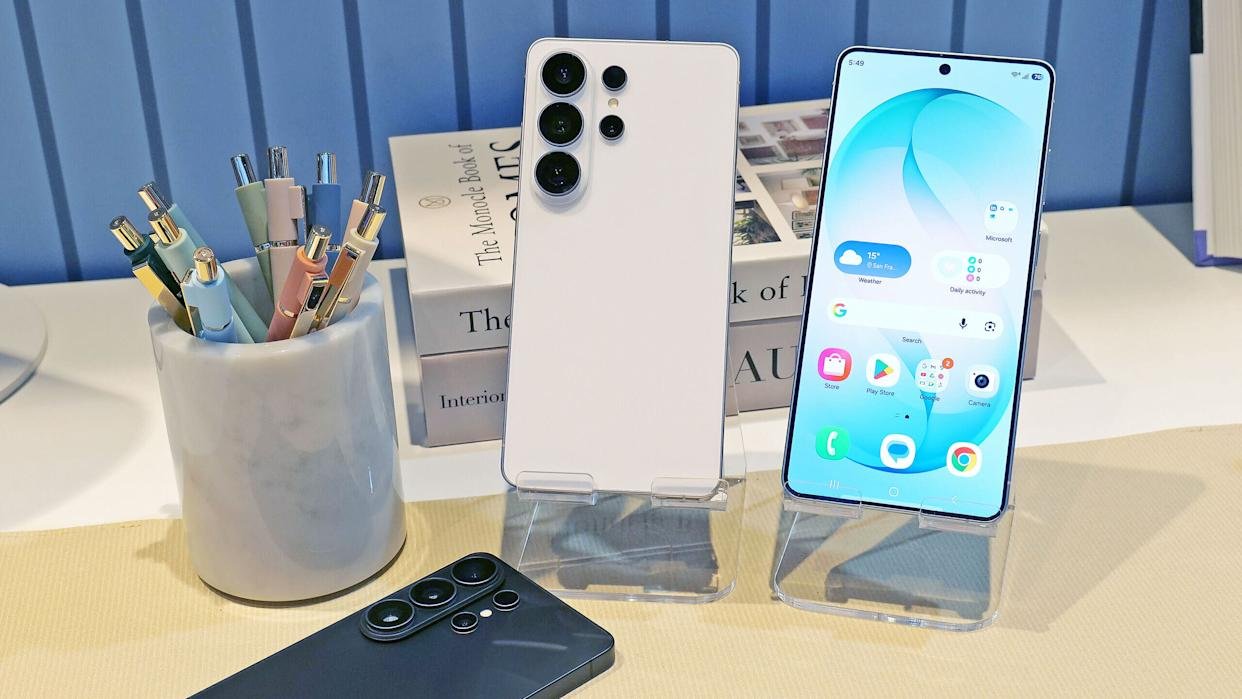
Last year, it felt like Samsung relied a bit too much on AI when trying to convince people to upgrade to its flagship phone. And while there’s no shortage of features that utilize machine learning on the new Galaxy S26 Ultra, it feels like Samsung has done a much better job of filling out the rest of the phone’s kit with fresh hardware, faster charging and a more cohesive design. It’s still rather expensive, but its price has stayed flat year-over-year at $1,300, which when combined with everything else makes it a much more attractive package than its predecessor.
Design and display
Samsung’s Ultra phones are always going to be somewhat boxy and that’s OK. However, for the Galaxy S26 Ultra, the company’s top-of-the-line handset is getting a slightly curvier appearance thanks to rounder corners. There’s also a very (and I do mean very) small reduction in size that technically makes this version the thinnest and lightest Ultra to date (214 grams and 7.9mm thick). That said, considering the previous model weighed 218 grams and measured 8.2mm, it’s incredibly hard to feel a difference even when you know what you’re looking for.
The two biggest changes to the S26 Ultra’s exterior design are more rounded corners and an aluminum chassis instead of titanium like we got on the S25U. (Sam Rutherford for Engadget)
In reality, the biggest exterior change is that Samsung has ditched the titanium frame from last year’s phone in favor of an Armor Aluminum chassis with Corning Gorilla Armor 2 panels in front and back. Samsung says this new design is meant to make the Ultra fit in better with its less expensive siblings while also making it easier to do things like color match the phone’s body to the rest of the device. Also, for anyone who keeps track of Samsung’s palette, the hero color for the S26 Ultra is a rather fetching shade of purple called cobalt violet, with sky blue, white and black available as well (plus silver shadow and pink gold being Samsung’s online exclusive hues).
If you look closely at the top of the phone, you can see where a notification has been blacked out by the S26 Ultra’s Privacy Display. (Sam Rutherford for Engadget)
However, my favorite new thing on the S26 Ultra is its Privacy Display. When activated, it functions a lot like HP’s Sure View tech, which prevents people from peeking at your screen from acute angles. It works both when viewed from the side or up and down and has a surprising amount of customization. Not only can you set it to turn on automatically when the phone asks you for a password or PIN, it can also be triggered by specific apps or whenever you receive a notification. But perhaps the most impressive thing is that there’s almost no impact on image quality. When Privacy Display is active, there is a minor reduction in overall brightness, but aside from that, it’s really hard to tell when it’s on (at least from the front). Furthermore, the S26 Ultra’s 6.9-inch AMOLED screen has the same underlying specs as last year, including its 120Hz variable refresh rate and 2,600 nit peak brightness, so there are pretty much no trade-offs for the added functionality.
Performance and charging
The S26 Ultra still comes with an included S-Pen and a built-in storage slot, but it still doesn’t have Bluetooth connectivity like on some of Samsung’s older models. (Sam Rutherford for Engadget)
Inside, the S26 Ultra features a Qualcomm Snapdragon 8 Elite Gen 5 for Galaxy chip along with either 12GB or 16GB of RAM and up to 1TB of storage. Compared to its predecessor, Samsung claims the NPU’s performance has made the biggest leap with it being 39 percent more powerful year-over-year with respectable increases for its CPU (19 percent faster) and GPU (24 percent faster) as well.
As for charging, both wired and wireless speeds have gotten a big boost with the former now rated at up to 60 watts (up from 45 watts) or 25 watts (up from 15) for the latter when using compatible Qi2 pads. Samsung says buyers will even get a three amp cable in the box, so all you need to do to get those peak wired speeds is to hook it up to the right adapter.
A small quirk with the S26 Ultra’s S-Pen is that because the end of the stylus is curved to match the corner of the phone, if you put it in “wrong,” it’ll stick out a bit. (Sam Rutherford for Engadget)
Unfortunately, we’re still not getting a magnetic ring inside the phone, which means if you want to use the S26 Ultra with magnetic accessories, you’ll need to pair the phone with a case that supports that functionality. This is super frustrating because Samsung says this decision was made in part to keep the handset as thin as possible, but when you consider the difference between the S26 Ultra and the S25 Ultra is 0.3mm, that choice feels rather misguided.
Cameras
One of my biggest complaints about last year’s S25 Ultra is that the only new hardware was an updated 50MP sensor for its ultra-wide lens, which is the camera I (and probably most people) use the least. Thankfully, it seems Samsung took note of that because while the resolution of its 200MP main cam, 10MP 3x telephoto and 50MP 5X telephoto are the same as before, the S26 Ultra’s main and 5x zoom lenses now have significantly wider apertures (from f/1.7 to f/1.4 and f/3.4 to f/2.9, respectively). This results in as much as 47 percent more light reaching the phone’s primary sensor (or 37 percent for the 5x telephoto), which should result in some major gains in photo quality and low light sensitivity. That said, I wasn’t able to properly test this during my hands-on session, so I’m going to reserve final judgement for a proper review.
The S26 Ultra’s 200MP main and 50MP 5x zoon lenses feature significantly larger apertures, which should deliver much improved image quality in low light conditions. (Sam Rutherford for Engadget)
Meanwhile, for video capture, Samsung is adding support for the APV codec at up to 8K/30 fps to the S26 Ultra along with a new horizon lock feature that will keep your footage level no matter how much you rotate the phone. Now I will admit that the latter didn’t impress me much when I first heard about it, but after testing it out and spinning the phone a full 360-degrees while recording a clip, I was shocked when the resulting video showed no hint of being whirled around. Samsung also says the handset’s improved Nightography processing uses AI to recognize noise patterns in low light to improve image quality. But similar to the wider apertures bringing in more light, I’ll believe it when I see it.
Finally, there’s a new AI-powered Photo Assist tool that lets you edit or adjust images using natural language prompts. From what I experienced, it’s effective and works as you’d expect. However, with the proliferation of services and devices offering similar functionality over the past year, this feature feels more like Samsung’s attempt to keep up with the Joneses.
AI features
When it comes to AI, the S26 Ultra is getting the same batch of new and improved features as the rest of the S26 family. So if you’re big into machine learning, there’s no need to pay extra for this model. Furthermore, many of the updates for 2026 are tweaks or refinements of existing things like the Gallery app, which now uses AI to automatically sort screenshots into eight different categories so they’re easier to find later. There’s also what Samsung is calling Now Nudge, which functions a lot like Google’s Magic Cue. It’s built into the Samsung keyboard and it can do things like suggest relevant photos based on your conversations.
One of the S26’s most powerful new AI features is Automated App Actions, which allows the phone to do things like book a car ride via Uber while you continue to use other apps in the foreground. (Sam Rutherford for Engadget)
To me, the most impressive of the bunch is the S26’s Automated App Actions, which allow you to ask the phone to do slightly more complicated tasks like ordering an Uber to a specific location. After your initial prompt, Gemini can even complete the task in the background while you go back to doomscrolling or watching videos. When it’s done, you’ll get a notification so you can manually review and confirm the command. Unfortunately, Uber will be the only supported app at launch, though Samsung says it’s working on expanding the feature to others like Instacart.
Early thoughts
The Galaxy S26 Ultra will be available in four main colors: sky blue, black, cobalt violet and white, along with two more online exclusive hues in silver shadow and pink gold. (Sam Rutherford for Engadget)
Look, there’s no getting around it: $1,300 is a lot to spend on a phone. That said, considering the RAM shortage that’s going on right now, keeping the S26 Ultra’s price the same as last year’s phone feels like a small blessing. And when you get that on a handset with a more refined design, a beefier chip, a fancy Privacy Display, faster charging and an updated generation of AI-powered tools, Samsung’s latest flagship feels like a much better deal than its predecessor. Really, the only thing that hasn’t been improved is the Ultra’s S-Pen, which as time goes on, is starting to feel more and more like a consolation prize for people who are still nostalgic about the Note line than a true tentpole feature.
Now this doesn’t mean that people with an S25 Ultra or even an S24 Ultra should run out and upgrade. But for anyone with something older than that who’s in the market for a true do-everything phone, the S26 Ultra has quite a bit to offer.
To coincide with the release of Samsung’s new Galaxy S26 family of phones, Google is pushing out a small but meaningful update to Circle to Search. As a reminder, Circle to Search allows you to carry out a Google Search from almost anywhere on your phone. Just tap and hold your device’s home button, and then circle the passage or image you want to know more about.
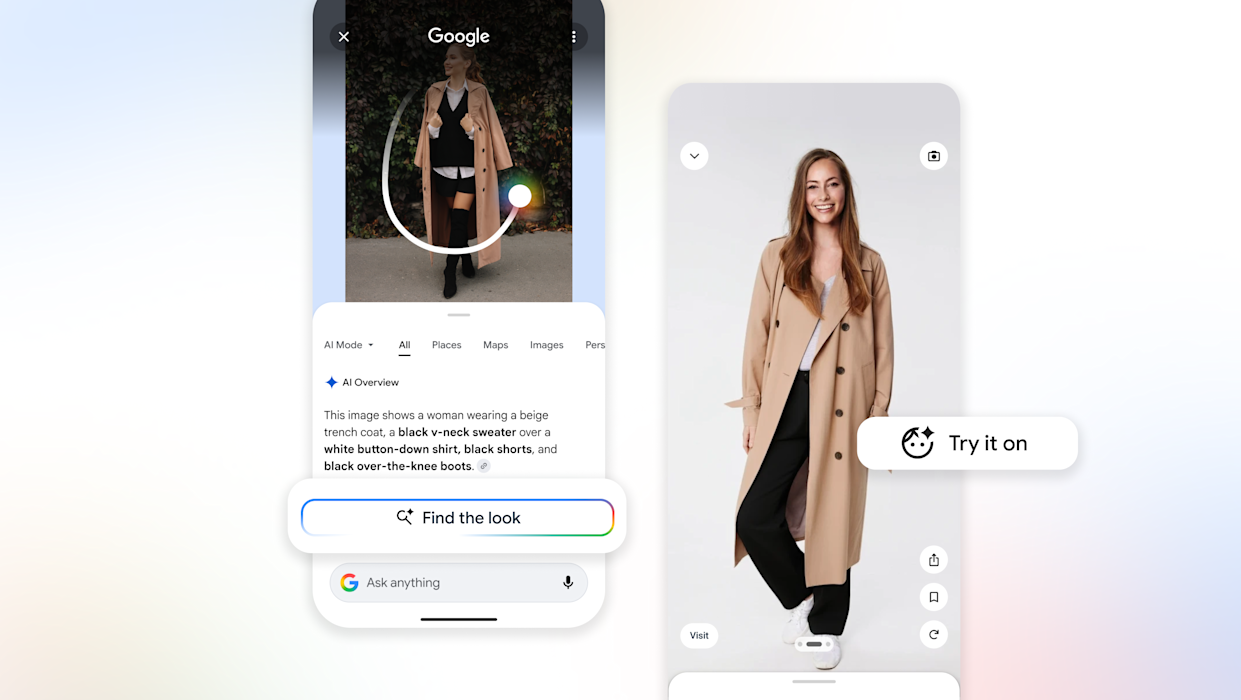
With previous iterations of Circle to Search, the tool’s underlying AI system was limited to searching against a single object in an image. Now, thanks to Gemini 3, it can scan and identify multiple objects at the same time. Naturally, Google is quick to point out the boon this represents for shopaholics. If you see a fit you like on Instagram, you can circle an entire person and the tool will attempt to find a match for each item they’re wearing, including any shoes and accessories. At the same time, Google has made it easier to see how those clothes might look on you by bringing its virtual try on feature directly inside of Circle to Search.
The benefits of the new model aren’t only limited to shopping queries. Building on a search technique Google debuted with AI Mode, Circle to Search can now also reason through the relationship between different objects in an image. So say you see a photo of a coral reef and want to know how all the different pictured fish live together, Circle to Search will not only be able to identify the different species shown but also explain how they coexist with one another.
Google is bringing the new and improved Circle to Search to Galaxy S26 and Pixel 10 phones first before rolling it out to more Android devices soon.
Mobile World Congress is right around the corner, but Samsung got out ahead of many rivals that will be showing off new handsets at that event by running the latest edition of Unpacked on Wednesday. The company took the opportunity to reveal the Galaxy S26 lineup, which includes the base S26, the S26+ and the S26 Ultra. We’ve got some hands-on impressions of all three handsets as well.
In addition to those, Samsung announced the Galaxy Buds 4 along with (you guessed it) some AI updates. Here’s a look at everything Samsung announced at the latest Unpacked:
Galaxy S26 and S26+
Sam Rutherford for Engadget
New-ish year, new Samsung phones. Let’s deal with the out-and-out bad news first. The S26 and S26+ are each $100 more expensive than their predecessors (the RAM shortage isn’t exactly helping to keep prices down). They start at $900 and $1,100, respectively, for variants with 256GB of storage.
Samsung has tweaked the design a bit this time by rounding the corners to align them more with the S26 Ultra’s look. The base model has a slightly larger display than the S25 at 6.3 inches, though the S26+ still has a 6.7-inch screen (albeit with a higher resolution than the S26 can handle). The S26 has a larger battery capacity than the S25 too at 4,300mAh.
In North America, China and Japan, Samsung is sticking with Qualcomm chips rather than using its own Exynos 2600. If you pick up an S26 or S26+ in those markets, it will run on the Snapdragon 8 Elite Gen 5 chipset.
The camera modules are the same as last year, but Samsung is aiming to supercharge them with upgrades elsewhere, such as ProScaler image upscaling and an MDNIe chip that’s said to greatly improve color precision. There’s also a video stabilization feature that tries to keep the horizon level while you’re following a moving person or pet, which sounds useful for action shots. The new Object Aware Engine is said to better render skin tones and hair textures to make your selfies look better. Samsung has reworked some AI features too, such as making Now Brief and Auto Eraser compatible with more apps.
Pre-orders for the S26 and S26+ are open today, and they’ll be available on March 11. The phones will be available in purple, blue, black, white, silver and rose gold, though the latter two are online exclusives. We’ve already had a chance to try the Galaxy S26 and S26+, so be sure to check out our hands-on story for our first impressions.
Galaxy S26 Ultra
The four main colors of the Galaxy S26 Ultra: Sky Blue, Black, Cobalt Violet and White. (Sam Rutherford for Engadget)
The Galaxy S26 Ultra will be available in the same colorways and on the same date as its smaller siblings. It starts at $1,300, so there’s no price increase from the S25 Ultra. Preorders open today.
The S26 Ultra has a 6.9-inch AMOLED display with a QHD+ resolution of 3120 x 1440 and a 120Hz refresh rate. That’s all well and good, but the display is hiding (that being the key word) what’s perhaps the Galaxy S26 Ultra’s most interesting feature.
The device has a Privacy Display that’s said to be the first of its kind on a smartphone. The idea here is to prevent people around from seeing what’s on the screen from acute angles. There’s a small decrease in brightness when Privacy Display is active, and there are lots of customization options. You can set up Privacy Display to activate when you’re asked for a password or PIN, or when you get a notification or open certain apps. So if (for instance) you tend to look at your banking apps when you’re on public transit and don’t want other passengers to see how much moolah you have, Privacy Display seems like a very handy feature.
Elsewhere, the S26 Ultra runs on the same chipset as its smaller siblings. It comes with 12 or 16GB of RAM and 256GB, 512GB or 1TB of storage. The battery is larger than the ones in the other S26 models, as the Ultra has a 5,000 mAh capacity. There’s support for Super Fast Charging 3.0 as well. Alas, Samsung still hasn’t seen fit to offer built-in Qi2 charging magnets in the S26 lineup, which seems like a wild oversight in the year 2026.
The selfie camera is the same as on the S26 and S26+. The S26 Ultra has 50MP ultrawide and 200MP wide lenses, along with dual 10MP 3x and 50MP 5x telephoto sensors. The resolutions of those cameras are the same as on the S25 Ultra, but the main 200M and 5x telephoto sensors now have wider apertures to let in more light. The S26 Ultra of course has the camera software features (and other AI features) found in the S26 and S26+.
Samsung Galaxy Buds 4 and Galaxy Buds 4 Pro (Billy Steele for Engadget)
While the S26 phones are more iterative updates this year, Samsung has given its Galaxy Buds a proper refresh. It revamped the design and shape of the Galaxy Buds 4 and Galaxy Buds 4 Pro to do away with the angular look of the stems and remove the lights from them.
The earbuds have a “more refined, computationally designed fit” too, according to Samsung. The company claims the latest earbuds have smaller earbud heads that allow for a better, more secure fit and a more “comfortable experience during all-day wear.” The Galaxy Buds 4 remain in an open-fit format while the Buds Pro 4 have a canal-fit design.
The latest earbuds are said to offer improved audio quality and active noise cancellation (ANC), with an ambient sound mode, adaptive EQ and adaptive ANC. On Buds 4 Pro, there’s a siren detection feature that enables ambient sound to let you hear things like alarms or emergency vehicle warnings.
The Buds 4 Pro have a wide woofer that increases the effective speaker area by nearly 20 percent compared with the previous gen earbuds, Samsung said. They support 24-bit/96kHz audio.
If you’re using Galaxy Buds 4 or Buds 4 Pro with a Galaxy device, you’ll be able to use Bixby, Google Gemini and Perplexity with hands-free voice controls (though the “hey, Plex” command for the latter might be a tad confusing for folks who use a certain media server app). The Buds 4 Pro support head gesture controls for managing calls and Bixby interactions as well.
As with the S26 phones, pre-orders for the earbuds open today and they’ll hit shelves on March 11. The Galaxy Buds 4 cost $180 and Galaxy Buds 4 Pro will run you $250. Both models are available in white and black with a matte finish. There’s an online-exclusive pink option for Buds 4 Pro as well.
Android AI features
Ahead of Unpacked, Samsung confirmed that it would offer Perplexity as an AI agent option in Galaxy AI on the S26 lineup. It also recently updated Bixby to make its own virtual assistant more conversational.
On top of that news, Google had announcements of its own to make at Unpacked regarding new Android AI features, which will of course be available on S26 devices. On those handsets and the Pixel 10 lineup, the Gemini app will soon have a feature (in beta) that enables you to offload multi-step tasks, such as booking a ride or putting a grocery order together, to AI. It sounds like an attempt to build out agentic AI features on mobile devices.
Starting this week on Pixel 10 devices (and soon on S26 phones), Circle to Search will offer the ability to find details about multiple objects at once, such as entire outfits instead of single pieces. Moreover, Gemini-powered, on-device Scam Detection for phone calls will be available for S26 devices in English in the US.
The wait is over. At its Unpacked event today, Samsung took the wraps off its new S26 family of phones. Unlike the S26 Ultra, the S26 and S26+ represent mostly iterative updates. Samsung has tweaked the design of the two devices, making it so they share the same rounded corners of their more expensive sibling. Additionally, the S26 has a slightly larger 6.3-inch AMOLED display and a higher capacity 4,300mAh battery inside. As for the S26+, it still has a 6.7-inch screen and 4,900mAh battery.
Like in years past, Samsung is depending on new and expanded software capabilities rather than updated hardware to give the S26 and S26+’s cameras an edge over the competition. As before, both phones feature a 50-megapixel main camera, a 12MP ultra-wide and a 10MP telephoto with 3x optical zoom. For selfies, they’re equipped a 12MP front-facing camera.
The company says its new Object Aware Engine will allow the front-facing cameras to deliver more pleasing portrait mode shots, with better rendering of skin tones and hair textures. For videos, Samsung has updated its Super Steady tech, making it capable of maintaining a 360-degree horizontal lock. The upgraded feature should make it easier to maintain a consistent level horizon while trying to record a video of a moving child or pet. A new feature named Auto Framing uses a machine learning algorithm to automatically tighten the frame while filming 4K and 8K clips.
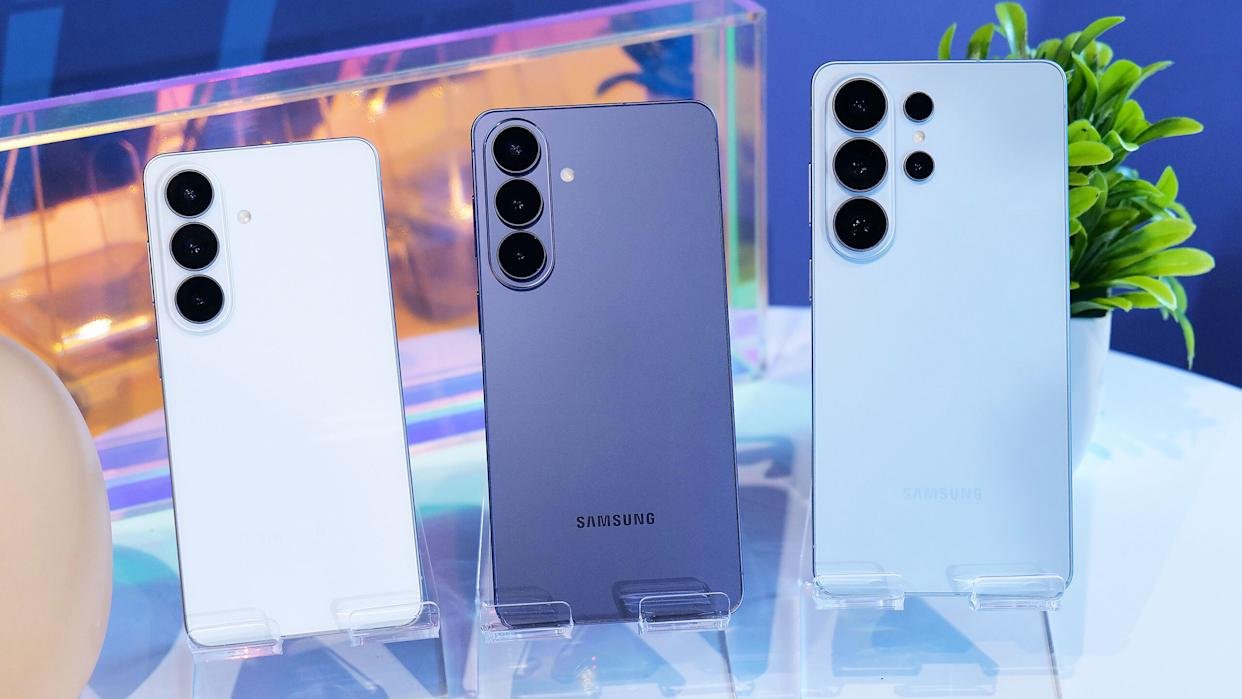
The S26 will be available in six different colorways, with the four pictured here available in store. (Sam Rutherford for Engadget)
And if you’re a Snapdragon fan, you can rest easy. While some pre-release reports suggested Samsung was planning to use its new flagship Exynos chipset across the entire S26 line, North American and Japanese variants of the S26 and S26+ will once again ship with Qualcomm silicon instead. Specifically, the two phones come specced with the speedy Snapdragon 8 Elite Gen 5, which debuted alongside the OnePlus 15 in November 2025. It will be interesting to see how the new Exynos 2600 compares with its Snapdragon counterpart; the former is the world’s first 2nm chipset.
Over on the software front, Samsung has upgraded its suite of AI features. For instance, the company has made Now Brief capable of pulling from a wider variety of apps to generate more comprehensive daily summaries. Similarly, the company’s handy Auto Eraser feature now works across streaming services like Netflix, allowing you to make it easier to hear dialogue in a greater variety of videos.
The two phones will retail for $899 and $1,099, making them both $100 more expensive than their predecessors. They come standard with 12GB of RAM and 256GB of storage. Samsung will also offer 512GB variants, alongside six different colorways of each phone. In-store, you’ll find the S26 and S26+ in purple, blue, black and white, with silver and rose gold being online exclusives. Pre-orders open today, with general availability to follow on March 11.
Samsung has announced the latest version of its flagship smartphone, the Samsung Galaxy S26 Ultra, and just like last year, the high-end phone is where the company is making some of its biggest changes. The S26 Ultra includes a new processor, a new privacy-focused display technology, an improved camera system and like Samsung’s other phones, a crop of new AI-powered software features.
On first blush, the Galaxy S26 Ultra isn’t all that different from the Galaxy S25 Ultra. Samsung is still using a 6.9-inch QHD+ AMOLED screen, with an 120Hz refresh rate and support for an S Pen stylus. The S26 Ultra also features the same flat sides, utter lack of Qi2-compatible magnets and pronounced camera bump. Despite those similarities, the new flagship does have some differences: for one, it’s ever so slightly thinner at 0.31-inches than the S25 Ultra was at 0.32-inches. It also comes with an aluminum frame rather than the titanium frame of the previous generation. For stylus fans, the new S Pen has a curved top that lets it better match the curves of the S26 Ultra. Biggest of all, Samsung’s new phone includes “Privacy Display,” a new technology that lets the phone limit how much of its screen is visible when you’re not looking directly at it.
Sam Rutherford for Engadget
Inside, the Galaxy S26 Ultra uses Qualcomm’s new Snapdragon 8 Elite Gen 5 for Galaxy chip, a modified version of the flagship mobile chip it debuted last year, and either 12 or 16GB of RAM. In terms of storage, the Galaxy S26 Ultra can come with either 256GB, 512GB or 1TB of memory. Regardless of which version you pick, you’ll get a 5,000mAh battery with support for Samsung’s wired and wireless fast charging, and Wireless PowerShare for topping up accessories like wireless earbuds.
The Galaxy S26 Ultra, just like the S25 Ultra before it, includes an array of four cameras on the back and one selfie camera on the front. The phone features a 200MP f/1.4 wide, 50MP f/1.9 ultra-wide, 10MP f/2.4 3x telephoto, 50MP f/2.9 periscope telephoto and 12MP f/2.2 selfie camera. If you were to just look at just the megapixel counts of the phone, they’re identical to last year’s model. Samsung’s major tweaks are to the aperture of both the wide and periscope cameras, which should let them capture more light.
Sam Rutherford for Engadget
Of course, plenty of the flashiest parts of Samsung’s new smartphone are software features. The improved photo and video performances of the Galaxy S26 Ultra’s cameras is partially driven by software tweaks. Samsung is also adopting Perplexity as a second, system-level AI assistant. The AI can be called with a button press or “Hey Plex,” powers improvements to Bixby and can act inside Samsung apps. That doesn’t mean Gemini isn’t still available, though. Google’s AI will gain the ability to handle things like booking a rideshare or filling an online grocery cart in the background on the Galaxy S26 Ultra.
The Galaxy S26 Ultra starts at $1,300 and is available to pre-order today in a purple-ish “Cobalt Violet,” light blue “Sky Blue,” black, white and exclusively through Samsung’s online store, “Silver Shadow” and “Pink Gold.” The phone will become generally available on March 11.
Samsung isn’t waiting a full year to reveal its latest Galaxy Buds. The company debuted the Galaxy Buds 4 and Galaxy Buds 4 Pro at its Galaxy S26 Unpacked event where the hot topic was three new phones. When it comes to Samsung’s earbuds, the company has overhauled the shape and design while improving sound quality, active noise cancellation (ANC) and adding new features. As always, the best of what the Galaxy Buds 4 lineup has to offer will be reserved for people with a recent Samsung phone.
While the company is keeping it’s AirPods-esque “blade” design, it retooled that element to ditch the angular shape and the gimmicky lights. It’s now a flat, metal panel and the area that allows for pinch controls has been engraved so that your fingers find it easily. In terms of shape, Samsung says it analyzed data from hundreds of millions of ear data points and ran over 10,000 simulations to improve overall fit with smaller earbuds. The Galaxy Buds 4 remain an open-fit design while the Pro version has a tip that seals off your ears. Like before, the company kept the transparent lids for the charging cases, although this time the earbuds lay flat in those rather than standing up.
Inside of the Galaxy Buds 4 Pro, Samsung is using a wider woofer as part of its two-way driver setup for cleaner bass. That configuration’s dedicated tweeter should also deliver natural, rich treble, according to the company. Both Galaxy Buds 4 models support high quality audio up to 24bit/96kHz (from a recent Samsung device) and direct multi-channel 360 audio is available as well.
Samsung Galaxy Buds 4 and Galaxy Buds 4 Pro (Billy Steele for Engadget)
Although the Galaxy Buds Pro 4 got the bulk of the ANC upgrades, Samsung says it improved noise-canceling performance for both models. The company promises effective noise blocking for transit sounds — engine noise from buses, trains or planes — in addition to “everyday background noise.” What’s more, both of the Galaxy Buds 4 devices feature ambient sound mode, adaptive EQ and adaptive ANC, with the latter two applying adjustments automatically as needed.
The Pro model can also detect the user’s voice and increase ambient sound for conversations — a feature that’s held over from the Galaxy Buds 3 Pro. When you stop talking, the earbuds will automatically resume ANC. The Galaxy Buds 4 Pro also has a Siren Detect feature that activates ambient sound so that you can hear safety alerts like alarms or emergency vehicles.
The new item that pushes the Galaxy Buds 4 Pro closer to the AirPods Pro 3 is head gestures. Samsung will now let users manage calls and interact with Bixby by nodding or shaking their head side to side. As before, the Galaxy Buds remain a conduit to Bixby, but they’re also a gateway to Gemini and Perplexity — all of which can be accessed hands-free via voice controls.
The Galaxy Buds 4 ($180) and Galaxy Buds 4 Pro ($250) are available for pre-order today before hitting shelves on March 11. Both models will be available in black, white and pink gold, although that third color is a Samsung online exclusive.
As we prepare to leave the winter months, Samsung announced another family of Galaxy S flagships for those looking to upgrade. As usual, the company put its best components and features into the Galaxy S26 Ultra, but it also added more to the base S26 and S26+. The company has hit its groove with its smaller (and cheaper) flagships, delivering solid devices with increasingly better cameras, occasionally even offering feature parity with its most expensive smartphone.
In 2026, that’s what we’re getting, with the 6.3-inch S26 ($899) and 6.7-inch S26+ ($1,099). Both phones are more expensive than last year, and it’s often a game of spot-the-difference when it comes to showing what’s new.
Fortunately, the best parts have been retained, too. Samsung has unified the design style across the entire S26 series, with the same corner ratios, curved edges and other design touches. While I tested both phones, I’ll focus on the S26. Barring screen differences and battery size, they’re identically specced.
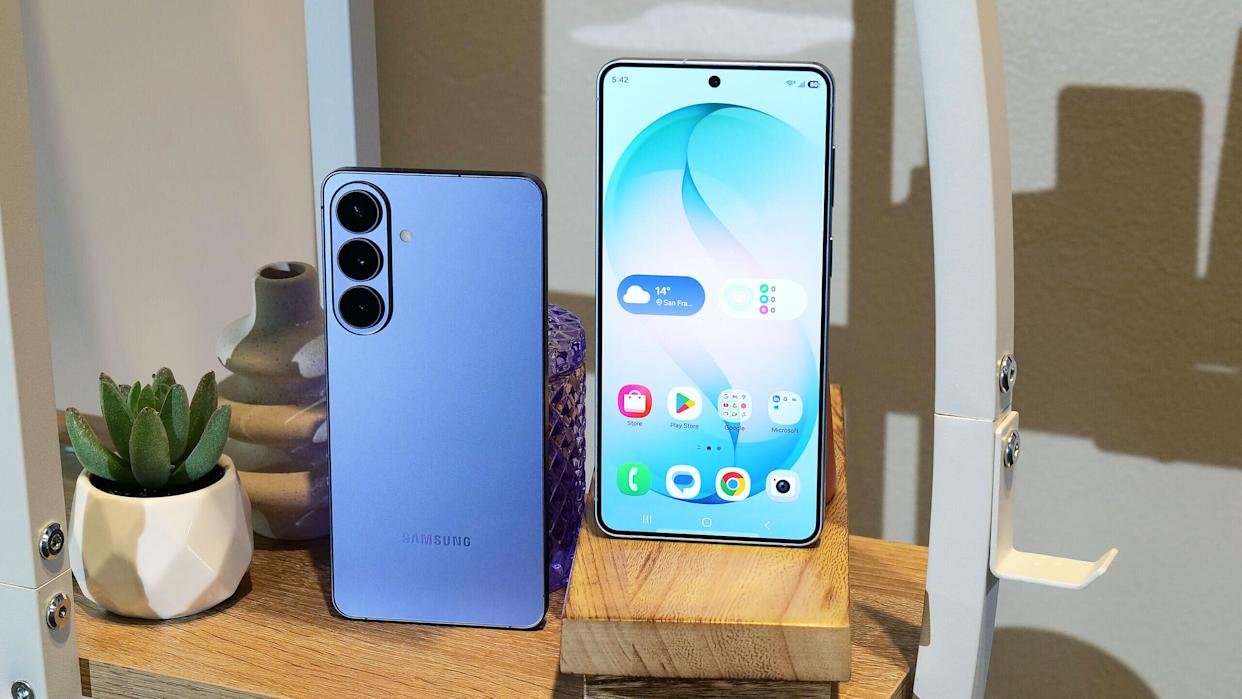
This year’s S26 color selection has a premium Samsung ‘mood’ to it that I can’t quite explain. Does purple mean Samsung to my brain? Maybe. Cobalt Violet is the particular shade I’m talking about, but there are also blue, black and white colors. Additional silver and pink-gold options will be available as online exclusives. There’s not much else to say about the design: it’s another Galaxy S flagship, and if it ain’t broke…
Mat Smith for Engadget
Samsung has increased the battery capacity to 4,300 mAh on the S26, while somehow maintaining the same thickness as last year’s S25. However, the S26+ has the same 4,900mAH battery as its predecessor. All S26 devices will launch with 256GB of storage and 12GB of RAM, with bigger storage options available. With the S26, Samsung has slightly increased the screen size to 6.3 inches, up from last year’s 6.2-inch S25.
The S26 comes with a familiar camera trio: a 50-megapixel main sensor, 12MP ultrawide, and 10MP telephoto with up to 3x optical zoom. On paper, that’s identical to last year’s base S25. However, Samsung has improved performance with its ProScaler technology for upscaling images and an MDNIe chip, which the company says provides four times the color precision compared to previous devices.
There are software improvements too, with video features being the most tangible upgrade, among more AI-assisted photo editing tools. Super Steady video has been upgraded to a 360-degree horizontal lock. This camera mode uses the S26’s gyroscopes to maintain a consistent horizon even as you rush to chase a pet or family member while recording, or to capture snowboarding buddies. (There’s always a snowboarding example when a company mentions horizontal lock.) It’s nice to see a feature we’re used to finding on gimbals and action cams built into an unashamedly mainstream phone like the S26.
Auto Framing is another new feature coming to both 4K and 8K video capture. It uses AI to lock onto subjects and automatically tighten framing to what you want to capture. Even during brief testing, I was intrigued and liked the dramatic punch-in effect as I recorded nearby people. It creates a faux-panning effect as it tracks moving subjects, something you might have experienced with Center Stage on Apple devices.
Samsung has also upgraded image processing on its front-facing cameras with a new Object Aware Engine for improved portrait mode shots, hair textures and more accurate skin tones. Based on my early testing, images seemed sharper than on my older Samsung devices, even though this is (again) largely the same 12MP camera as last year.
With processors, it’s getting a little more complicated. In the US, Samsung’s entire S26 series will use the Snapdragon 8 Elite Gen 5 for Galaxy, but in Europe, both the S26 and S26+ will be powered by the company’s own Exynos 2600, apparently the world’s first 2nm chipset. Comparing it to Snapdragon’s top mobile processor, however, will have to wait until review time.
With more power for AI functions, Samsung has continued to evolve and expand its AI software, although it seems less of a priority this year. Only one AI feature stood out during my briefing: Audio Eraser. While this launched on the S25, it only worked on audio and video you captured yourself. Now, Samsung expanded it to most major video platforms, including Netflix, Instagram and YouTube, adding the ability to strip out noise and distractions and amplify the volume of voices. It was especially effective with a rowdy replay of an Arsenal football soccer match, and sounded like I was listening to a dedicated commentary channel. Interestingly, unlike many sound editing apps and features, it will work on downloaded videos on those platforms without an internet connection.
Elsewhere, Now Nudge will attempt to suggest actions based on what’s happening onscreen, such as sharing contact numbers with someone or suggesting calendar times while dealing with work emails. Samsung’s Now Brief can pull information and notifications from a wider array of apps and sources to deliver in its daily briefings. However, again, that’s hard to assess at this early stage.
There are several more quality–of-life software updates, too, like the ability to sift through all those screenshots after they’ve been automatically categorized into sections like barcodes, events and more. If you can’t get enough AI image generation, you can now use Photo Assist to edit your photos using descriptive prompts. Elsewhere, Circle-to-Search now supports multiple, well, circles, if you’re looking to tag and search for multiple objects at once.
Mat Smith for Engadget
It’s not the most exciting year for Samsung’s smaller flagship phones. While the S26 Ultra can boast a new Privacy Display that’s the first of its kind, the rest of the S26 family have a little too much in common with their predecessors. The new video features seem useful and intuitive, so there’s more to explore there. We’ll have more to say in our full reviews soon.
Both the Galaxy S26 and S26+ launch on March 11th and are available to preorder now.
Google unveiled a new batch of Android updates, including more Gemini-powered tools and improved scam detection features at Samsung’s Galaxy S26 launch on Wednesday.
A new feature in the Gemini app will let users hand off multi-step tasks, like ordering a rideshare or building a grocery cart. The feature, which will first arrive in beta, runs in the background while users perform other tasks. Gemini’s progress can be monitored live via notifications, so users can see what it’s doing and jump in at any time.
Google
Google says this feature will initially be limited to certain food, grocery or rideshare apps. It will be available first on select devices, including the Galaxy S26 and Pixel 10, in the US and Korea.
Android is also getting an upgrade for Circle to Search, enabling it to search for multiple objects seen on screen at once. One implementation of this is full-outfit searches using “find the look.” Once the app has found all the individual pieces of the circled outfit, users can try them on virtually. This will be available on Galaxy S26 and Pixel 10 devices. The beefed-up feature can also be used to gain insights into multiple objects in an image.
Google
The company is also using Gemini to bring on-device Scam Detection for calls to Samsung’s Phone app. The tool alerts users if someone on their call is using speech patterns commonly heard from scammers. Google says the feature is never used while on a call with someone in your contacts and is off by default.
Google
The same technology and approach will also be used to detect scams in Google Messages. For now, scam detection on phone calls is only available on the Galaxy S26 in English in the US, while detection in messages is supported across various markets.
All of these new features are available now on the Pixel 10 and Galaxy S26 lineups, with availability in select markets varying by feature.