Tag: CRYPTOS FoxBusiness.

  • Trump’s National Cyber Strategy pledges to support crypto and blockchain

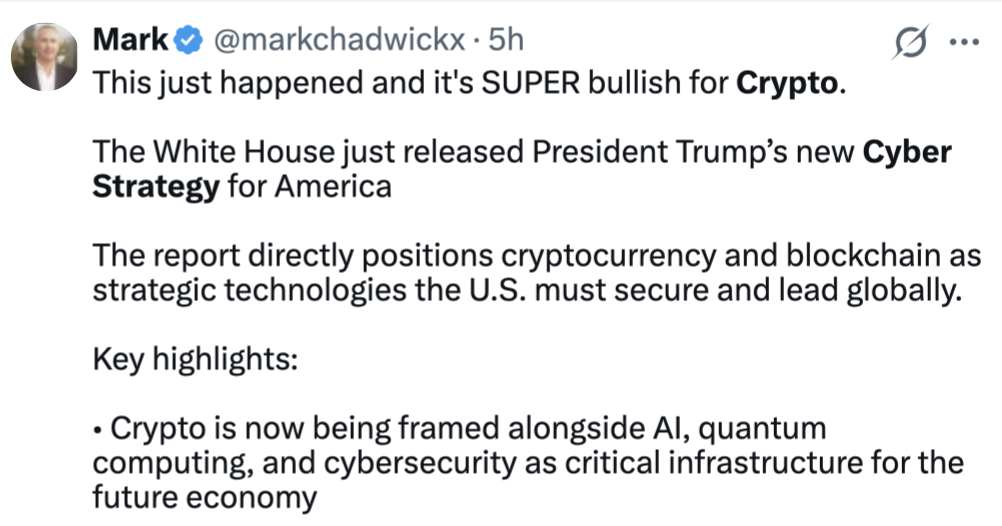
    Crypto industry executives are combing through US President Donald Trump’s National Cyber Strategy after it was released on Friday, searching for hints about what it could signal for government support of the crypto industry.

    “Crypto and blockchain are explicitly named as technologies to be ‘protected and secured.’ This is a first for any US cybersecurity strategy,” Galaxy Digital’s head of firmwide research Alex Thorn said in an X post on Friday.

    Crypto and blockchain were mentioned once in the six-page report:

    “We will build secure technologies and supply chains that protect user privacy from design to deployment, including supporting the security of cryptocurrencies and blockchain technologies.”

    However, industry executives have also been interpreting other parts of the document to see how they relate to crypto.

    Cryptocurrencies, United States, AI, Donald Trump, Quantum Computing

    Source: Mark Chadwick

    Thorn pointed to a section pledging to “uproot criminal infrastructure and deny financial exit and safe haven.” “This language could easily justify crackdowns on mixers, privacy coins, and unregulated off-ramps,” he said.

    Bitcoin VC points out that quantum has been taken “seriously”

    Castle Island Ventures founder Nic Carter, who has been vocal about the threat of quantum computing to Bitcoin (BTC) in recent times, pointed to the section saying the government “will accelerate the modernization, defensibility, and resilience of federal information systems by implementing cybersecurity best practices, post-quantum cryptography, zero-trust architecture, and cloud transition.”

    “Sure seems like they’re taking quantum seriously. Nothing to worry about, I’m sure,” Carter said in an X post.

    It comes as the crypto industry continues to debate about how close quantum computing is to being a serious threat to Bitcoin. On Feb. 15, Carter said that major Bitcoin-holding institutions may eventually lose patience with Bitcoin developers for not addressing quantum computing concerns quickly enough.

    Trump points to the next generation as a priority

    Trump said that the National Cyber Security outlines his priorities for “ensuring that America remains unrivaled in cyberspace.” Artificial intelligence was a key focus of the report.

    “We will secure the AI technology stack—including our data centers—and promote innovation in AI security,” it said.

    Trump also emphasized the importance of recruiting the next generation of workers in the cyber workforce to “design and deploy exquisite cyber technologies and solutions.”

    The US typically releases a national cybersecurity strategy every administration, outlining the government’s priorities for emerging technologies.

  • BlackRock private credit fund is latest to crack, hitting crypto prices and DeFi markets

    BlackRock private credit fund is latest to crack, hitting crypto prices and DeFi markets

    Cracks in the global private credit market are rattling investors, raising concerns the stress could spill into crypto markets.

    Bloomberg reported Friday that BlackRock’s $26 billion private credit fund has begun limiting withdrawals amid rising redemption requests. The move follows similar stress at Blue Owl, which sold $1.4 billion in loans last month to meet withdrawals and reportedly has exposure to a collapsed U.K. property lender.

    Shares of major asset managers including BlackRock (BLK), Apollo Global Management (APO), Ares Management (ARES) and KKR slid 4%-6% Friday, extending their 2026 rout.

    Read more: Blue Owl liquidity crisis has investors bracing for 2008-style fallout

    If redemption pressure forces private credit funds to unwind positions, it could trigger broader deleveraging across asset classes that could ripple through digital assets including bitcoin BTC$67,962.60, Andreja Cobeljic, head of derivatives trading at Swiss crypto bank AMINA Bank warned in an emailed note.

    Credit stress meets energy shock

    U.S. banks extended nearly $300 billion in loans to private credit providers as of mid-2025 and another $285 billion to private equity funds, Cobeljic wrote, carrying risks that credit woes could extend to the banking sector

    “In isolation this would be manageable,” he said. “But emerging in the middle of a broader global deleveraging event, alongside an energy shock and collapsing rate-cut expectations, it is a different conversation.”

    “For risk assets, including crypto, a disorderly unwind here would represent a significant second-order shock that current pricing does not reflect,” he said.

    Contagion to tokenized asset markets

    A second channel of credit risk could surface directly on blockchain rails.

    Tokenized private credit products — loans and funds packaged and issued on public blockchains as tokens — have grown quickly as part of the broader real-world asset (RWA) trend. According to data from rwa.xyz, the on-chain private credit market now stands at just under $5 billion. That remains tiny compared with the roughly $3.5 trillion global private credit market in 2025, estimated by the Alternative Credit Council.

    But the growing presence of these assets inside decentralized finance (DeFi) means stress in the underlying loans could ripple directly to crypto markets.

    “Institutions are entering crypto, but often with products that even degens and DeFi natives don’t fully grasp,” said Teddy Pornprinya, co-founder of real-world asset protocol Plume.

    Real-world credit products can carry complex risks that are not always obvious to crypto investors, he said, including volatile net asset value swings and headline yields that don’t fully reflect fees or credit risk.

    A recent episode shows how off-chain credit stress can spill into DeFi.

    According to a report by risk advisory firm Chaos Labs, the 2025 bankruptcy of auto-parts supplier First Brands Group affected a private credit strategy run by Fasanara Capital. A tokenized version of the strategy, mF-ONE, had been issued on the Midas RWA platform and used as collateral for borrowing on the Morpho protocol.

    When the underlying fund marked down exposure tied to the bankruptcy, the token’s net asset value slipped about 2%, pushing highly leveraged borrowers close to liquidation and tightening liquidity on the platform. Lenders ultimately avoided losses, but the episode highlighted how tokenized private credit used as DeFi collateral can transmit traditional credit stress into on-chain markets.

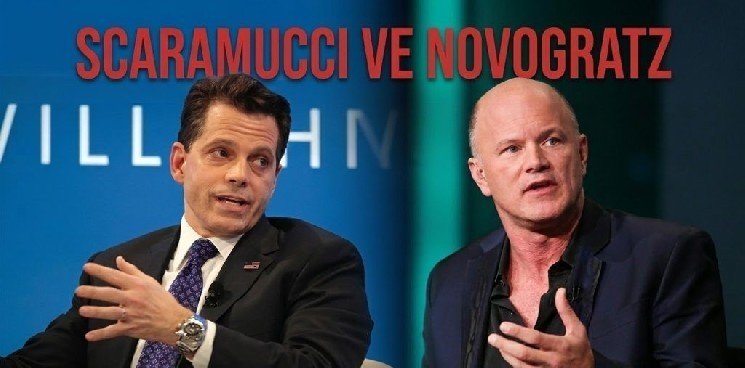
  • Anthony Scaramucci and Mike Novogratz Discuss Bitcoin and Ethereum: “The Worst May Be Behind Us”

    Anthony Scaramucci and Mike Novogratz Discuss Bitcoin and Ethereum: “The Worst May Be Behind Us”

    Renowned macro investors Anthony Scaramucci and Galaxy Digital CEO Mike Novogratz discussed the current state of the cryptocurrency market, allegations of manipulation, and future expectations in their latest broadcast.

    Amidst geopolitical tensions in the Middle East, markets are giving signals that “the worst may be over” for Bitcoin.

    Mike Novogratz displayed cautious optimism when evaluating Bitcoin’s recent price movements. Novogratz stated that he views the $60,000 level as a “tradable bottom.” He noted that sellers are showing signs of fatigue in the market and argued that after testing this level several times, Bitcoin is beginning to encounter upward resistance. However, he emphasized that for a real sense of relief in the market, the price needs to break above the $80,000 barrier.

    One of the most striking points in the news article was the “Jane Street” case, which caused a major stir in the crypto community. According to claims circulating on the crypto Twitter (X) world, Jane Street allegedly implemented a systematic selling program during the 2022 Terra (LUNA) crash, thereby driving down the price of Bitcoin.

    While Novogratz acknowledged that such giant financial institutions surpass even traditional giants like Goldman Sachs in terms of speed and resources, he noted that attributing the decline in Bitcoin entirely to such “scapegoats” might not be accurate. He stated that liquidity providers in the market are making enormous profits, but this isn’t always positive for society or market health.

    Novogratz noted that there is a strong stance against Ethereum falling below the $1,800 level, and reminded that crypto hedge funds are currently in a short position. He predicts that if the price of BTC suddenly rises to $80,000 or $100,000, these funds may be forced to buy again due to fear of missing out (FOMO), which could create upward momentum.

    *This is not investment advice.

  • Aave Labs Proposes Dedicated Bug Bounty Program for Aave V4 With Sherlock

    Aave Labs Proposes Dedicated Bug Bounty Program for Aave V4 With Sherlock

    • Aave Labs has published a proposal for a dedicated bug bounty program for a 24/7 channel to report security issues.
    • High-priority submissions require participants to stake at least 250 $USDC, which is forfeited if the report is invalid or deemed spam.

    Aave Labs has published a proposal to launch a new dedicated bug bounty program for its v4 on Sherlock’s security platform for DeFi protocols.

    The proposal aims to establish a channel to report any security concerns on the DeFi platform as it transitions to the fourth version (v4) of its protocol. The Labs says that Sherlock has been working with the community to audit the current v3 protocol and was used for early v4 testing. This translates to shared reporting standards and escalation paths for all parties.

    Founder Stani Kulechov noted that bug bounties have been an important part of the network’s security strategy. He also praised the Sherlock team for its expertise in managing previous bug bounty programs and security contests.

    We propose launching the Aave V4 bug bounty program with Sherlock. Bug bounties have long been an important part of Aave’s security strategy, and the Sherlock team has demonstrated strong expertise in managing both security contests and bug bounty programs. https://t.co/azjjaV7fIZ

    — Stani.eth (@StaniKulechov) March 5, 2026

    On its part, Sherlock expressed support for the proposed program, adding, “Always-on coverage, structured triage, and clear escalation for high-severity reports as V4 ships and scales. Aave’s commitment to security stays constant.”

    Aave’s 250 $USDC Stake to Prevent Spam

    The bug bounty program will be limited to the Aave v4 repositories and deployed contracts. Any expansion or migration of other programs would need a separate governance poll.

    Participants can hand in medium- or low-priority submissions at will. However, they cannot upgrade these to upper-tier submissions even if they expand in scope to ensure they pay enough attention to the original classification.

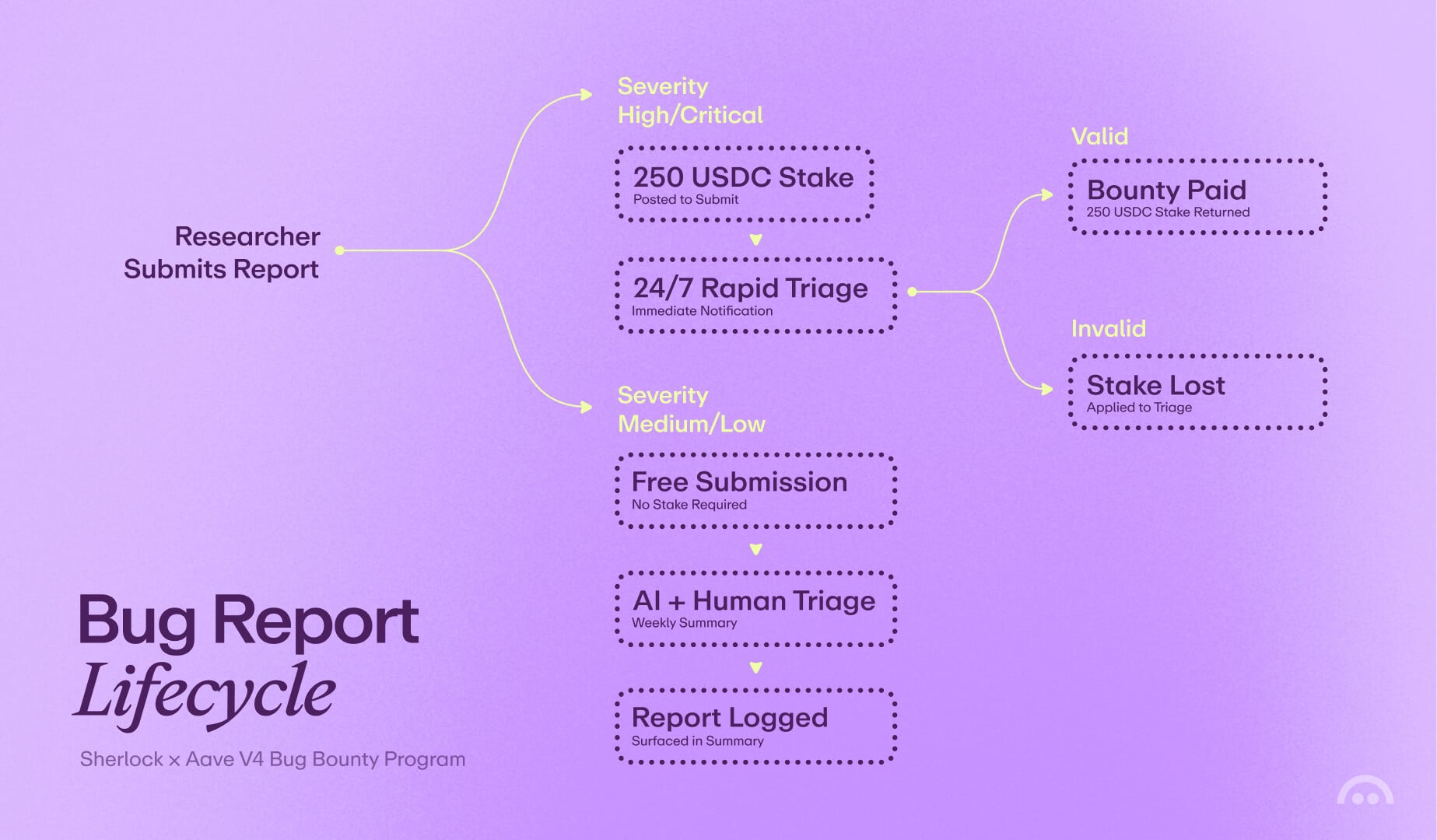
    The high-priority and critical submissions, which receive heftier payouts, will be limited to users who stake 250 $USDC. If the submission is valid, the stake is returned together with the payout. If invalid, the stake is forfeited to pay for triage costs. This is intended to prevent spam where participants classify all submissions as high-priority to take a shot at the higher payout.

    For high-priority submissions, Aave’s designated security team members are instantly notified via Telegram and Slack to respond immediately. The lower-priority submissions are assessed by an AI program working alongside human reviewers. Only the reports deemed higher-quality will be submitted for review.

    Image courtesy of Aave Labs.

    Aave Labs conceded that while the 250 $USDC staking will reduce spam, it could put off some genuine researchers from submitting high-priority security concerns. To mitigate, it intends to keep the medium-priority tier free and to prioritize experienced researchers using this tier.

    It also acknowledged that by barring the re-classification of medium submissions to high-priority, it would punish misclassified submissions. It intends to publish an extensive guide as part of the program launch materials.

    The proposal comes weeks after a dispute between Aave Labs and BGD Labs imploded, with the latter announcing its departure at the end of this month. BGD, which was contracted by the Aave DAO to cater to security and technical issues, says the Labs has frustrated its efforts to advance the protocol.

  • Binance Responds to Inquiry Letter from the U.S. Senate

    Binance Responds to Inquiry Letter from the U.S. Senate

    Binance, one of the world’s largest cryptocurrency exchanges, has officially responded to an inquiry letter sent by US Senator Richard Blumenthal, denying recent allegations of sanctions violations.

    The company argued that the media reports were based on misunderstandings and that its compliance processes were among the strongest in the industry.

    In its response to a Senate hearing on February 24, Binance stated that the allegations, first raised by The Wall Street Journal, were “defamatory.” The company said that the claims of sanctions non-compliance in the news reports were untrue and that its operations were misinterpreted.

    Binance stated, “We take these allegations seriously. However, they misrepresent both our daily operations and the significant progress we’ve made in building one of the strongest compliance programs in the industry.”

    The exchange claimed that strict KYC (Know Your Customer) and sanctions controls are implemented on the platform. According to Binance, users from Iran are banned from accessing the platform, and accounts deemed risky during investigations conducted by security forces are removed from the platform.

    The company also stated that accounts are reviewed when credible risk information emerges, closed when necessary, and shared with relevant authorities. Binance argued that its compliance mechanism “worked effectively” in the incidents mentioned in the Senate letter.

    Binance stated that its compliance program is constantly being strengthened and that the platform’s security standards are high, adding that more than 300 million users worldwide trust the platform.

    Binance also stated that its response to the Senate was prepared based on the information available and that it could provide additional information if necessary.

    *This is not investment advice.

  • CoinDesk 20 performance update: Aave drops 4.3% as all index constituents trade lower

    CoinDesk 20 performance update: Aave drops 4.3% as all index constituents trade lower

    CoinDesk Indices presents its daily market update, highlighting the performance of leaders and laggards in the CoinDesk 20 Index.

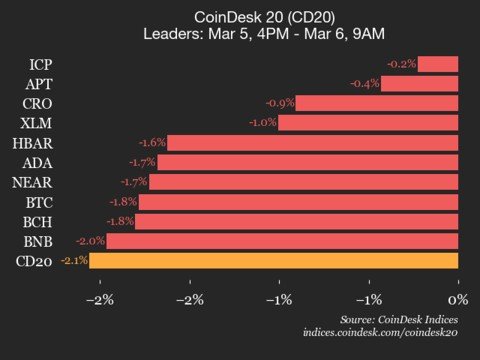
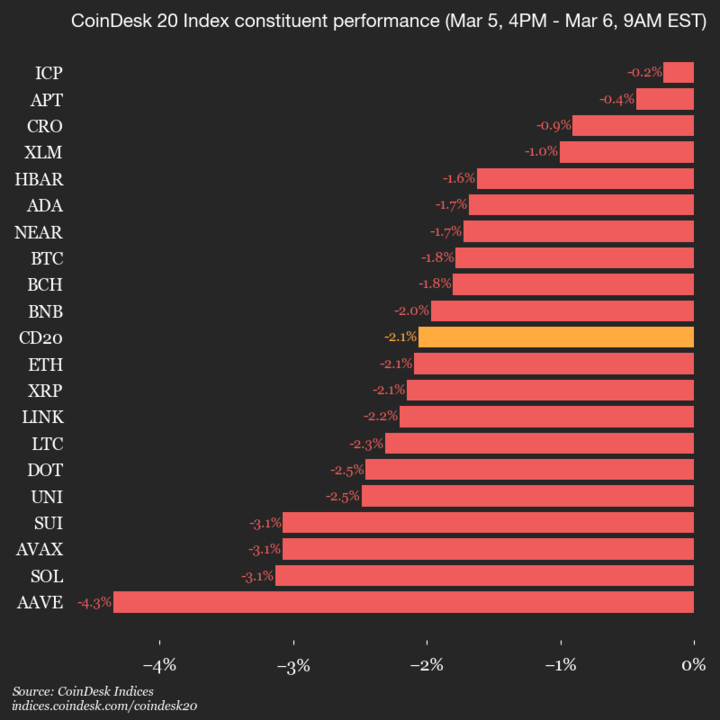
    The CoinDesk 20 is currently trading at 1991.98, down 2.1% (-41.93) since 4 p.m. ET on Thursday.

    None of the 20 assets are trading higher.

    Leaders: ICP (-0.2%) and APT (-0.4%).

    Laggards: AAVE (-4.3%) and SOL (-3.1%).

    The CoinDesk 20 is a broad-based index traded on multiple platforms in several regions globally.

  • Vitalik Buterin Makes Important Appeal to the Ethereum Community: “If We Do This, We Will Regain Momentum!”

    Vitalik Buterin Makes Important Appeal to the Ethereum Community: “If We Do This, We Will Regain Momentum!”

    Ethereum founder Vitalik Buterin called on the ETH community to embrace a bolder vision, specifically stating that the application layer needs to be “thought from scratch.”

    According to Buterin, the Ethereum ecosystem must break away from conventional thinking patterns to design next-generation applications without compromising its core principles.

    Buterin stated that the Ethereum community needs to reassess its relationship with the application layer and the rest of the world. He argued that Ethereum’s core features—censorship resistance, open-source nature, privacy, and security (CROPS)—must be preserved, and that a radical questioning of current approaches, particularly at the application layer, is crucial.

    The Ethereum founder stated last year that privacy has become one of the primary priorities for the ecosystem, signifying a radical shift in the application stack. According to Buterin, since Ethereum’s application infrastructure has not been developed with privacy in mind until now, it may be necessary to create a completely different application stack in this new era.

    Buterin also noted that one of the key topics of discussion this year was the reassessment of the role of Layer 2 (L2) solutions. He stated that it was necessary to rethink “from scratch” which L2 models could create the strongest synergy with Ethereum, adding that this process required both a technical and a cultural transformation.

    Buterin stated that the Ethereum ecosystem has long operated with a “how do we improve the existing system?” approach, arguing instead that a new mindset is needed. According to this new model, developers should reassess which applications truly create the greatest value on a robust Layer-1 infrastructure and an ever-growing toolset.

    Buterin suggested that developers assume Ethereum is a completely empty network as a thought experiment. He asked them to consider how they would design initial applications in areas such as DeFi, decentralized social networks, and authentication, arguing that setting aside existing dependencies and outdated assumptions would foster creativity.

    According to the Ethereum founder, this approach could be one of the keys to the ecosystem regaining momentum.

    *This is not investment advice.

  • Crypto Market Review: XRP is Blocked Between Two Levels, Bitcoin’s (BTC) First Key Resistance Updated, Did Shiba Inu (SHIB) Finally Bottom?

    Crypto Market Review: XRP is Blocked Between Two Levels, Bitcoin’s (BTC) First Key Resistance Updated, Did Shiba Inu (SHIB) Finally Bottom?

    The crypto market is approaching several key technical turning points as major assets move within tightening structures that could soon trigger larger price swings. While some coins are struggling with resistance during recovery attempts, others appear to be stabilizing after prolonged declines, setting up potential breakout scenarios.

    $XRP haven’t locked in enough

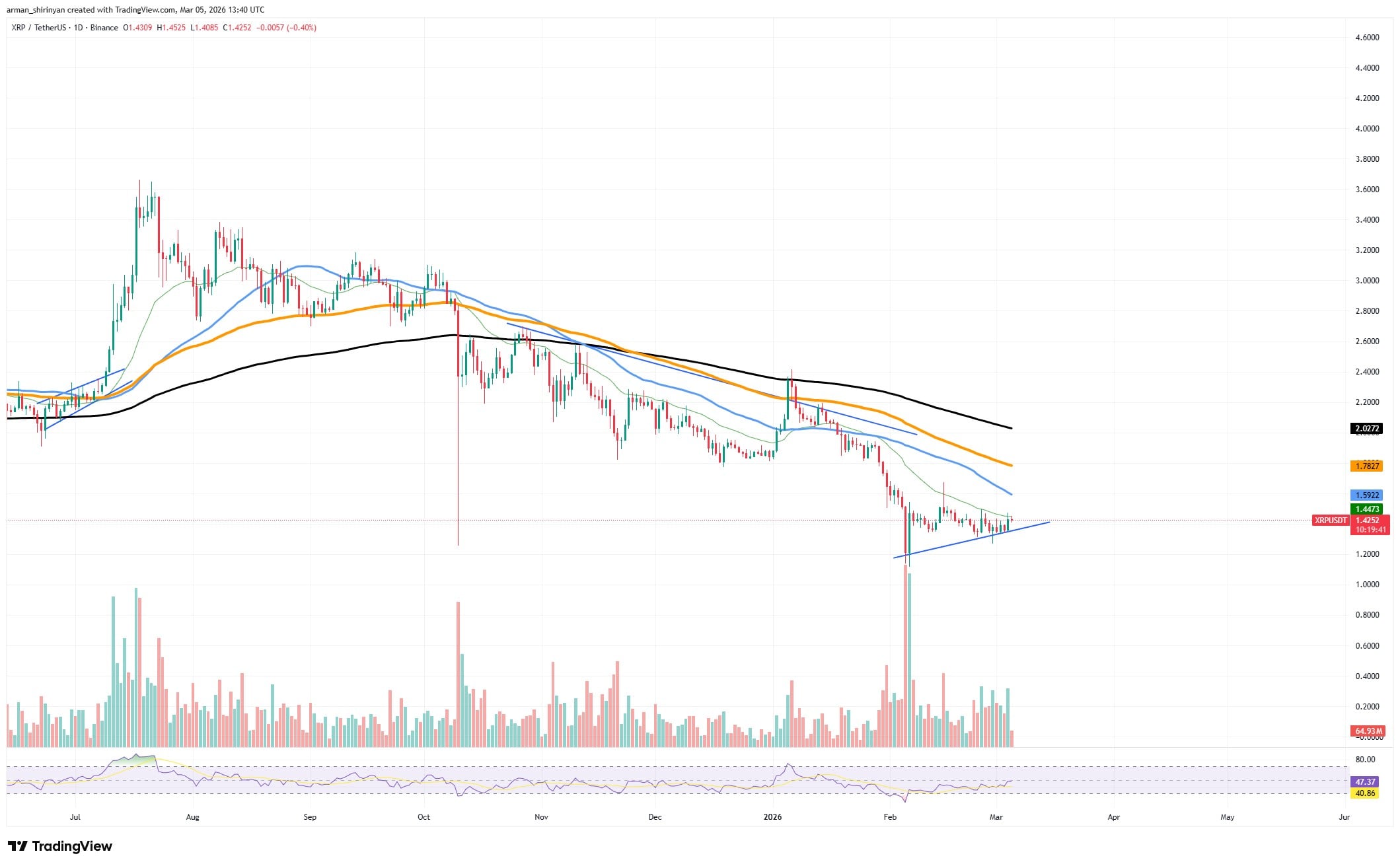
    At the moment, $XRP is stuck in a tightening range that restricts its price movement and makes it impossible for it to move in a clear direction. A rising support trendline from recent lows, and the declining 26-day exponential moving average serving as resistance, are two crucial levels that the asset is consolidating between.

    The next breakout could decide the market’s short-term course, because this compression has essentially locked $XRP into a small range.

    Article image

    After recovering from a steep decline earlier in February that brought the price close to the $1.25-$1.30 range, $XRP is currently trading around $1.40. Buyers reacted strongly to that selloff, creating a sequence of higher lows and the ascending trendline that is currently visible on the chart.

    Key trendline invalidated

    Since then, despite the overall bearish structure, this trendline has served as a short-term support level, keeping the price from falling further.

    The upside is still limited, though. $XRP’s attempts to move higher have been repeatedly rejected by the 26 EMA, which is still sloping downward. Sellers intervene each time the asset gets close to this moving average, driving the price back toward support. Bulls must get past this dynamic’s obvious technical barrier in order to start a recovery.

    This structure effectively squeezes $XRP between these two levels. The available trading range shrinks as the trendline rises and the moving average progressively falls.

    When one side of the structure eventually breaks, these compression patterns usually end abruptly with an increase in volatility.

    Reclaiming and holding above the 26 EMA is crucial for $XRP to start a significant recovery. The price may move toward the next resistance zones, which are located around $1.45 and possibly $1.60, where more moving averages and earlier price clusters are found, if a breakout is successful.

    Bitcoin finally tried itself

    One of the strongest recovery moves since the market recovered from the February lows near $63,000, Bitcoin recently attempted a significant breakout that momentarily lifted the asset above the $74,000 mark.

    The rally was short-lived, though. Sellers are still actively defending the upper boundary of the current recovery structure, as evidenced by Bitcoin’s swift retreat back toward the $72,000 zone after reaching the higher range.

    At first, the move above $74,000 appeared to be the start of a stronger bullish breakout. Bitcoin developed a tightening consolidation pattern that indicated an impending volatility expansion after weeks of pressure and a sharp decline earlier in the year. Eventually, buyers forced the price through that structure’s upper boundary, creating a surge of short-term momentum and a rise in trading volume.

    Article image

    The market was unable to sustain the higher levels in spite of the breakout attempt. The $74,000-$75,000 range is currently functioning as the first significant resistance barrier during the current recovery phase, according to the swift rejection.

    This level is crucial from both a technical and psychological standpoint, because traders typically lock in profits close to significant round-number zones.

    Bitcoin is currently maintaining a higher low structure in comparison to the February bottom, while holding just below that resistance area. This indicates that even though the market has not yet confirmed a sustained breakout, the larger recovery effort is still ongoing.

    Bitcoin may enter a new momentum phase that drives the price toward higher resistance clusters in the mid-$70,000 region if buyers are able to recover and hold above the upper range on significant volume.

    However, the market may enter another period of consolidation, or briefly retreat toward the mid-$60,000 range, if repeated attempts to break this level are unsuccessful.

    Shiba Inu’s turning point in close

    After months of relentless selling pressure, Shiba Inu may finally be nearing a turning point.

    For the majority of the past year, the meme asset has been in a consistent downward trend, breaking through several consolidation structures and continuously printing lower highs. On the other hand, recent price activity indicates that $SHIB might be stabilizing close to a possible bottoming zone.

    $SHIB is currently trading at $0.0000056, which is slightly above the most recent local support area. Due to its ability to absorb several waves of selling over the previous few sessions, this region has grown in importance. After the protracted decline, buyers may be gradually stepping in, as each attempt to drive the price lower has been met with a swift recovery.

    Technically speaking, $SHIB previously broke away from a number of descending triangle patterns that emerged during the decline. The asset declined steadily as a result of those breakdowns, but the most recent move seems to be losing steam. Rather than another violent collapse, the recent price action indicates a tight consolidation forming close to the current support zone.

    $SHIB‘s dynamic is unstable

    Additionally, volume dynamics lend credence to the stabilization possibility. The sharp spikes that accompanied previous breakdowns are starting to fade, even though selling activity is still present. This frequently happens close to the conclusion of protracted bearish cycles, when longer-term players start building positions and weaker holders leave the market.

    The separation between $SHIB and its key moving averages is another crucial component. The asset is still below important trend indicators like the 50 and 200-day averages, but as the downward momentum slows, the difference between the price and those levels has begun to close. The beginning of a reversal structure may be indicated if the market starts making higher lows.

    $SHIB needs to maintain the $0.0000055–$0.0000050 support range in order for a recovery scenario to emerge. By staying in this region, the asset would be able to establish a foundation before trying to recover adjacent resistance levels at $0.0000062 and $0.0000067.

  • Analyst Predicts 1,500% XRP Price Increase To $15 If This Is A Wave 2

    Analyst Predicts 1,500% XRP Price Increase To $15 If This Is A Wave 2

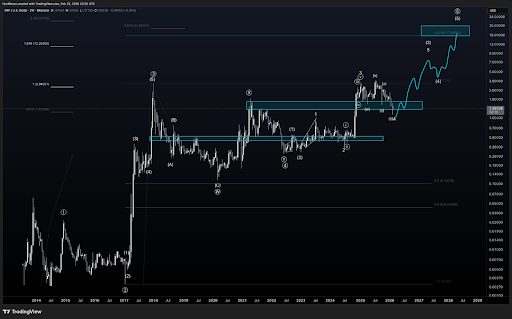
    A crypto analyst’s Elliott Wave chart suggests $XRP could be on the verge of one of its most explosive moves yet, but the real fireworks depend on where exactly we are in the cycle.

    In a post on X, crypto analyst HovWaves said his macro primary expectation is still the same, adding that he has been looking for a $15-$20 price target for $XRP and that the destination does not change even if the current structure turns out to be a different corrective leg than first assumed.

    The $15-$20 Target That Hasn’t Changed

    $XRP’s price action since the start of the year has hardly resembled that of an asset preparing for an explosive move into double-digit territory. Even so, the lack of strong upward price momentum has not discouraged many bullish proponents from maintaining extremely optimistic projections based on technical and fundamental analyses.

    One such analyst is HovWaves, who has been consistent in his projections. In a recent post on X, the analyst wrote: “Macro primary expectation remains the same for $XRP. Been looking for that 15-20 macro target.”

    The basis of HovWaves’ prediction is that the Elliott Wave label on the $XRP price chart can change, but the larger price objective of double digits stays on the table. He looked at the current $XRP structure as a choice between a smaller-degree pullback and a deeper corrective phase, stating that the price action could either be a 4th on the immediate degree or a deeper Wave 2.

    That matters because Wave 2 and Wave 4 corrections can look similar in real time, but they usually imply different upsides once the correction ends. HovWaves also added a key condition: if the market is actually carving a Wave 2, then the final target will likely be much higher. This is interesting because it means that the $15 to $20 bracket could be a waypoint if the bigger impulse thesis plays out.

    Bi-Weekly Elliott Wave Count Points To Final Impulse

    The chart features an Elliott Wave count stretching all the way back to 2013. In it, HovWaves shows a completed five-wave impulse structure from $XRP’s earliest days through its 2018 peak at $3.4, followed by a lengthy corrective phase. This was a sprawling ABC correction that bottomed out in 2020 before a new impulse began taking shape.

    The wave structure currently in focus is a five-wave advance from that 2020 low. Waves 1 and 2 look complete, and Wave 3 culminated in the July 2025 all-time high at $3.65. According to the chart, $XRP is now working through a Wave 4 consolidation with a downtrend and intermediate choppy phases before what would be the final fifth wave launch to a peak between $15 and $20.

    At the time of writing, $XRP is trading at $1.43, and traders are anticipating a break above $1.50.

    Featured image from Adobe Stock, chart from Tradingview.com