Tag: CRYPTOS FoxBusiness.

  • Zcash (ZEC) Price Soars above $221, Drops after Correction

    Zcash (ZEC) Price Soars above $221, Drops after Correction

    Key Highlights

    • Zcash has witnessed a spike of 2.88% and is trading at around $214 following the spike in BTC price
    • This upward momentum in the privacy coin was seen after receiving $25 million in the latest seed funding round
    • Shielded transaction volume rising, new U.S.-based compliant mining pool coming from Foundry Digital in April

    On March 13, Zcash ($ZEC), one of the leading privacy cryptocurrencies, witnessed an upward momentum, where it soared above $221; however, it quickly faced a correction and plunged below $214.

    While publishing this, the Zcash price is revolving around $213.66 after soaring by 1.6% on a daily chart with a market capitalization of $3.5 billion, according to CoinMarketCap.

    Why Is Zcash Price Soaring?

    There are many developments behind the spike in Zcash ($ZEC), including fresh funding in the recent seed funding round.

    On March 9, the Zcash Open Development Lab (ZODL), a new company formed by the core developers who left Electric Coin Company after a governance shake-up, announced it had raised over $25 million in seed funding. Major companies like Paradigm, a16z crypto, Coinbase Ventures, Winklevoss Capital, and others jumped in.

    The fresh capital will boost the development of the Zcash protocol and the user-friendly Zodl wallet (formerly Zashi), which makes private transactions easier for its users.

    The Relative Strength Index (RSI) is currently sitting around 42 to 55 on the 14-day chart. According to this indicator, below 30 means oversold, or potentially too cheap, while above 70 means oversought, or getting too hot. At around 45, $ZEC is nicely balanced, not exhausted. It has plenty of room to run higher without a big pullback.

    Looking at moving averages, the short-term 50-day moving average is revolving near $210 and $212. This is acting as a safety net that buyers are defending.

    The longer 200-day moving average is higher and trending up, which shows that the overall direction is still positive after last year’s massive gains. Recent price movement has bounced off support around $200, which is a classic bullish signal.

    According to other technical indicators, Fibonacci levels are like natural pause exports that the price often respects. From the recent low near $200, $ZEC is now testing the 23.6% Fibonacci retracement.

    It breaks through the next level at $220 to $230, which is the 38.2% Fib level. Analysts say that the next stop could be $250 to $278. This would show a quick 15% to 20% gain from current levels.

    This news sparked instant excitement, and investors are seeing ZODL as a fresh start for Zcash’s privacy tools at a time when people are increasingly worried about surveillance and regulations.

    On-chain data is showing healthy inflows, which have been growing steadily. Additionally, major institutions are joining the party. Foundry Digital is launching a U.S.-based Zcash mining pool in April 2026, which is aimed at companies that want compliant privacy mining.

    Popular analysts are bullish on the short-term momentum. The ZODL funded “a fresh wave of capital” that is already attracting new buyers. MEXC analysts noted that social activity and engagement are up sharply. CoinCodex sees neutral-to-bullish shows and predicts $ZEC could push toward $230 and beyond soon if resistance breaks.

    According to some experts, there are some predictions that say it could see a breakout of $300 to $600 if privacy demand continues to rise.

  • Analyst Flags Rare XRP Signal Amid Market Turbulence

    Something unusual is happening with $XRP, according to an analyst. The coin has dropped over 60% since its 2025 peak, and online chatter shows sentiments are turning bearish. Arthur, CIO of RoyalPeakCap, claims his personal indicator has just crossed a critical threshold.

    $RED ALERT: Something unusual is happening on $XRP. My personal indicator just crossed above the black line. Historically, every time this happens, it is followed by an immediate explosive bullish move. But this time… price is still ranging,” he noted.

    🚨$RED ALERT: Something unusual is happening on $XRP.

    My personal indicator just crossed above the black line. Historically, every time this happens, it is followed by an immediate explosive bullish move.
    But this time… price is still ranging. And paradoxically, that’s the worst… pic.twitter.com/7BnFXVvCq6

    — Arthur (@XrpArthur) March 13, 2026

    Arthur warns that the current sideways movement could be the worst possible scenario for this signal. If the price continues consolidating while the indicator cools toward neutral levels, momentum could reset and open the door to a sharp downward move.

    Price Behavior Signals Potential Shift

    $XRP has been falling for several weeks, with each bounce quickly pushed down by sellers. Lately, the price started to level out around $1.40, gathering just below a key resistance point, showing the market is pausing for now.

    The Relative Strength Index (RSI) is slowly climbing even though $XRP’s price is staying flat. This could mean selling pressure is easing, and bigger players might be quietly buying.

    $XRP also recently tested and briefly broke its downward trendline. While it didn’t spark a full rally, it suggests the selling momentum may be weakening. The analyst is keeping a close eye on the $1.45–$1.50 zone.

    Hitting this level repeatedly could either push the price higher or give big traders a chance to sell into small gains. According to Arthur, the latter seems more likely, which could mean the price might face more weakness soon.

    Market Outlook and Scenarios

    If $XRP can’t push past its resistance, this sideways movement might just be a pause before another dip. The price could wobble up and down for a while before sliding lower. Analysts call this a “liquidity trap,” where things look calm enough to lure buyers, but a bigger drop could still be on the way

    Right now, the $XRP market is at a crucial point, and traders and investors need to watch it closely. As of writing, according to CoinMarketCap, the token is trading at $1.44, having gone up 5% in the past day.

    Disclaimer: The information presented in this article is for informational and educational purposes only. The article does not constitute financial advice or advice of any kind. Coin Edition is not responsible for any losses incurred as a result of the utilization of content, products, or services mentioned. Readers are advised to exercise caution before taking any action related to the company.

  • Santiment Reveals the Six Most Popular Altcoins Right Now! Some Altcoins Were Surprising!

    Santiment Reveals the Six Most Popular Altcoins Right Now! Some Altcoins Were Surprising!

    Bitcoin (BTC) and altcoins continue to recover amid the ongoing US-Iran conflict. Bitcoin has climbed back above $71,000, while Ethereum ($ETH) has surpassed $2,100.

    While altcoins are also seeing significant upward movements, cryptocurrency analytics company Santiment recently revealed the most popular altcoins in the cryptocurrency world.

    According to Santiment, investors showed strong interest in altcoins such as Tether ($USDT), $AAVE, Ethereum ($ETH), Solana ($SOL), Ripple ($XRP), and Avalanche ($AVAX).

    Tether led the trending cryptocurrencies in the last 24 hours, surprisingly followed by $AAVE, $ETH, $SOL, $XRP, and $AVAX.

    The most popular cryptocurrencies in the crypto sector and the reasons why are listed below:

    “Tether: Trending due to approximately $50.4 million worth of $USDT being exchanged for around 324 $AAVE on Ethereum. According to the data, a cryptocurrency investor lost approximately $50 million in a transaction where they exchanged interest-bearing aEthUSDT for aEthAAVE via the CoW Protocol.”

    $AAVE: Trending due to the exchange of approximately $50.4 million worth of $USDT for around 324 $AAVE on Ethereum. The $AAVE CEO announced a refund of approximately $600,000 in relation to the incident.

    Ethereum: Trending due to BlackRock’s staking ETF. BlackRock’s iShares Staked Ethereum Trust (ETHB) began trading on Nasdaq yesterday.

    Solana: Reports of intermittent network outages and slow confirmations are trending due to a high-profile NFT launch. Twitter is buzzing about Solana’s growing stablecoin market share and trading volume.

    $XRP: It’s trending due to news of Ripple’s share buyback announcement, which increased the company’s valuation to approximately $50 billion, and ongoing Reddit discussions about Ripple financing its operations through $XRP sales.

    Avalanche: Trending due to Grayscale’s $AVAX ETF. Grayscale launched Avalanche staking ETF (GAVA), which began trading on Nasdaq and offers institutional investors exposure to $AVAX, combined with on-chain staking rewards.

    *This is not investment advice.

  • JPMorgan’s Report Will Disappoint Gold Investors! “There’s a Sharp Difference Between Bitcoin and Gold!”

    JPMorgan’s Report Will Disappoint Gold Investors! “There’s a Sharp Difference Between Bitcoin and Gold!”

    Bitcoin ($BTC) and gold continue to move in opposite directions. In this context, JPMorgan has revealed the latest data between $BTC and gold and the sharp divergence between them.

    US banking giant JPMorgan stated that $BTC and gold ETFs have seen opposing flows since the US-Iran war.

    According to The Block, JPMorgan analysts have noted a significant contrast in Bitcoin and gold ETF flows since the start of the conflict in Iran.

    JPMorgan analysts led by Nikolaos Panigirtzoglou stated in their latest report that SPDR Gold Shares (GLD), the largest gold ETF, has experienced outflows equivalent to approximately 2.7% of its holdings since the war. In contrast, BlackRock iShares Bitcoin Trust (IBIT), the largest spot Bitcoin ETF, recorded inflows equivalent to approximately 1.5% of its holdings during the same period.

    Analysts noted that this significant divergence stemmed from investors shifting their positions between the two assets.

    “We are seeing investors rebalancing their positions between gold and Bitcoin.”

    Analysts also added that there are signs that Bitcoin’s volatility is gradually decreasing as institutional investment increases and market liquidity improves.

    *This is not investment advice.

  • Expert Analyst Reveals Bitcoin Outlook for 2026: “BTC Won’t Rise Without This Happening”

    Expert Analyst Reveals Bitcoin Outlook for 2026: “BTC Won’t Rise Without This Happening”

    Charles Edwards, founder of Capriole Investments, discussed the current state of Bitcoin (BTC), his predictions for 2026, and the biggest risks facing the market during a live broadcast.

    Edwards stated that Bitcoin is in a “zone of value” according to historical data, while warning investors about the quantum computing threat and institutional cash flows.

    Speaking about the overall market situation on the broadcast, Edwards said that investors constantly trying to find the “bottom” is a flawed strategy. Analyzing Bitcoin’s current price movements, the expert stated, “We can say that the price is closer to the bottom than the top. We are in a deep value zone, but this doesn’t mean the price will rise immediately.”

    Edwards, drawing attention to “Cost of Production” data based on mining costs, stated that the $50,000-$60,000 range represents a strong support and value area for Bitcoin.

    One of the most striking parts of the broadcast was the discussion of “quantum risk” regarding Bitcoin’s future. Edwards stated that Bitcoin core developers haven’t taken this issue seriously enough. He reminded viewers that individuals/institutions like Kevin O’Leary and VanEck have limited or withdrawn their Bitcoin allocations due to quantum uncertainty.

    Despite the Ethereum Foundation making quantum security its number one priority, he expressed surprise that Bitcoin wasn’t even among its top 100 priorities.

    He argued that until this risk is resolved, it may be difficult for Bitcoin to reach new all-time highs (ATH), but concrete steps towards a solution would quickly push the price upwards.

    Edwards pointed out that the correlation between gold and Bitcoin has recently broken down. Referring to ratios showing gold’s performance against the S&P 500, he stated that gold is still in its early stages and could perform much better against stocks in the coming years.

    Regarding global liquidity, he stated that Trump-era policies and potential Fed interest rate cuts created “a perfect backdrop” for risky assets, but that a rise in oil prices above $100 would signal danger for equity markets.

    Edwards argues that the nearly 200 “Bitcoin treasury companies” (publicly traded companies holding Bitcoin) in the market are unsustainable, predicting that these companies will eventually consolidate or go bankrupt. He notes that while companies like MicroStrategy’s strategy of buying Bitcoin through borrowing might create leverage in the short term, they will eventually have to evolve their business models towards “banking/lending” in the long run.

    *This is not investment advice.

  • SEC’s advisory group backs tokenized securities push, outlines how to keep it safe

    A committee that advises the U.S. Securities and Exchange Commission recommended the agency move forward on a tokenized-securities policy that would allow traders to cut out the kind of go-between settlement that Wall Street investment firms have relied on for decades.

    The SEC’s Investor Advisory Committee voted Thursday to recommend narrow exemptions for the blockchain-based innovation for the trading of stocks, as long as the activity comes with mandatory disclosures, routine outside supervision and “a requirement that the trading of tokenized equity securities seeks to ensure that all investors receive the best terms for their orders.”

    These crypto assets still meet the definition of securities under the law, as SEC Chairman Paul Atkins has regularly contended, which means the activity needs parallel safeguards to the traditional system. Atkins said his agency is working toward formal regulations on tokenization. Now this work has the backing of an official recommendation from the committee, whose members include veterans from major trading firms, institutional investors and academics.

    The traditional approach to stock trading features brokers, transfer agents and centralized settlement databases and can take a day or more to execute, but in placing that same stock on-chain, “the delivery of the tokenized security and the payment can happen as a single transaction, with ownership records embedded directly into a single blockchain.”

    The group told the commission that the newer approach doesn’t come without risks:

    “The most significant risk associated with the tokenization of equity securities is that these reforms or grants of exemptive relief could introduce new risks that investors do not understand and impose higher costs that outweigh the benefits of tokenization,” according to the recommendation document approved by the committee.

    In remarks on Thursday, Atkins praised the committee for its “recognition that tokenization can enhance settlement efficiency, reduce settlement risk, and eliminate unnecessary intermediaries.

    “I expect the Commission to soon consider an innovation exemption to facilitate limited trading of certain tokenized securities with an eye toward developing a long-term regulatory framework,” he said.

  • Attention: Binance Announces Delisting of 21 Altcoins from its Pre-Listing Pool! Listing Canceled!

    Attention: Binance Announces Delisting of 21 Altcoins from its Pre-Listing Pool! Listing Canceled!

    Binance, the world’s largest cryptocurrency exchange, announced its new platform, Binance Alpha, a year ago to introduce early-stage altcoin projects.

    Binance, which has added many altcoins for listing, has announced a delisting for its Binance Alpha platform.

    Accordingly, Binance Alpha announced that it has implemented a comprehensive altcoin review mechanism.

    At this point, Binance Alpha announced that it had delisted 21 altcoins following a comprehensive review that included factors such as liquidity and trading volume.

    “Based on recent reviews, the following token(s) do not meet Binance Alpha standards and will be removed from the featured list on March 12, 2026 at 12:00 (UTC):”

    MIRROR (Black Mirror Experience), SHARDS (WorldShards), FST (FreeStyle Classic), DGC (DecentralGPT), COA (Alliance Games), ULTI (Ultiverse), TGT (TOKYO GAMES TOKEN), AGON (AGON Agent), $BNB Card ($BNB Card), AFT (AIFlow), PFVS (Puffverse), SGC (SGC), RDO (Reddio), ELDE (Elderglade), MILK (MilkyWay), TAT (Tell A Tale), BOT (Hyperbot), SSS (Sparkle), SUBHUB (SubHub), PLANCK (Planck) and OOOO (oooo)”

    Binance stated that users can still sell these tokens even after they are delisted.

    Kullanıcılar bunu şu yollarla yapabilirler:
    – Binance Cüzdanı: [Pazar] sekmesine gidin > Ara > İşlem yap
    – Binance Alpha: [Varlık] sekmesine gidin > [Alpha] > Tokeni seçin > Sat”

    *This is not investment advice.

  • Fitch Ratings Announces How Many Interest Rate Cuts It Expects from the Fed and Its US Economic Forecasts!

    The leading cryptocurrency, Bitcoin (BTC), is struggling around $70,000 amid the uncertainty and tension created by the US-Iran conflict.

    The war between the two countries has driven up oil prices, indirectly increasing inflation concerns. Analysts worry that inflation, which the US Federal Reserve (FED) has long been trying to bring down to its 2 percent target, may come under renewed upward pressure with this increase in energy prices.

    While there is talk at this point that the Fed might even raise interest rates in the face of inflation risk, there are differing opinions and expectations regarding the Fed’s interest rate decisions.

    While it is even expected that the Fed will not cut interest rates at all in 2026, international credit rating agency Fitch has announced its expectations for the Fed.

    In its latest report, Fitch stated that the labor market has cooled and wage growth has slowed, which could lead the Fed to cut interest rates twice in 2026.

    In this context, Fitch forecasts that US consumption will slow in 2026. Weakness in the labor market will put pressure on household income. As a result, a cooling labor market and slowing wage growth will prompt the Fed to take action.

    *This is not investment advice.

  • Bitcoin slips below $69,500 as tanker attacks send oil back above $100

    Bitcoin slips below $69,500 as tanker attacks send oil back above $100

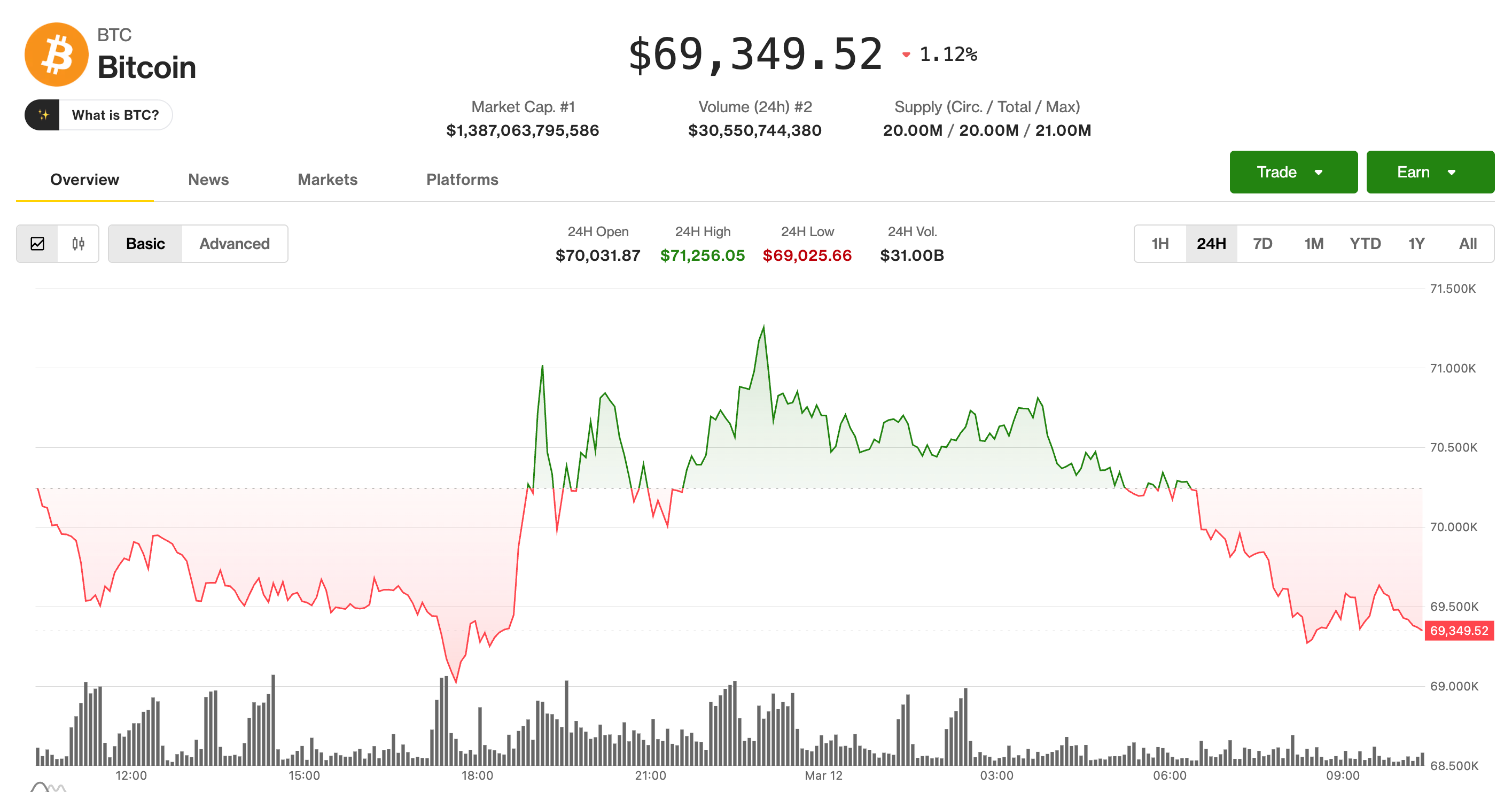
    The bitcoin $BTC$69,593.87 relief rally due to oil losing gains lasted about 36 hours.

    Bitcoin fell to $69,393 on Thursday morning, down 0.8% over the past 24 hours and 4.3% on the week, after attacks on two oil tankers in Iraqi waters sent Brent crude surging back above $100 a barrel.

    The move wiped out Wednesday’s optimism around the IEA’s proposed record reserve release and pushed risk sentiment back into retreat across Asian markets.

    The chart tells the story of a market that can’t catch a break. Bitcoin touched $71,230 late Wednesday evening before the tanker headlines hit, dropping nearly $2,000 in a matter of hours.

    That’s the third time in two weeks that bitcoin has pushed above $71,000 only to get knocked back by an escalation in the Middle East conflict.

    Brent surged as much as 10.5% on Thursday, driven by a combination of the tanker attacks, clearance of the Mina Al Fahal port in Oman, continued hostilities across the Persian Gulf, and growing doubt about whether the IEA reserve release will be large enough to offset the supply disruption.

    MSCI’s Asia Pacific index dropped 1.8% with energy the only sector in the green. The session extended losses as it went on, with no signs of stabilization.

    The broader crypto market followed bitcoin lower. Ether fell to $2,025, down 0.5% on the day and 4.5% on the week. Solana dropped 1.5% to $85 and is now down 5.7% over seven days, the worst-performing major. XRP lost 0.8% to $1.37.

    Dogecoin fell 0.8% to $0.092, giving back most of Tuesday’s Musk-driven gains. BNB was flat at $642.

    The pattern of the past two weeks has been consistent. Good headlines push bitcoin toward $71,000-$74,000. Bad headlines drag it back toward $66,000-$68,000. The net movement over the period is close to zero, which is exactly what the on-chain data has been suggesting.

    Apparent demand remains deeply negative at -30,800 $BTC on a 30-day basis. CryptoQuant’s bull-bear indicator is still in bear territory, while supply in loss continues to climb. Every bounce gets sold into by holders looking to exit.

    Trump said earlier this week the war would resolve “very soon” and that military objectives were “pretty well complete.”

    But the timeline remains unclear, Iran continues to strike targets across the region, and the Strait of Hormuz is still disrupted. Mixed messaging from Washington has left markets unable to price the conflict’s duration with any confidence.

    The Fed meeting on March 17-18 is now five days away, and oil back above $100 makes the stagflation case harder to dismiss and rate cuts even more distant.

  • Ripple Moves to Secure Australian Financial Services License for APAC Payments

    Ripple moves to secure an Australian financial services license, positioning its blockchain payments network for deeper expansion across Asia-Pacific while tightening regulatory footing in one of the region’s most active digital asset markets.

    Ripple Strengthens Global Compliance Network With Australian License Plan

    Ripple plans to secure an Australian Financial Services License (AFSL) to expand its regulated payments offering in Australia and across the Asia Pacific (APAC) region, the blockchain-based enterprise solutions provider stated on March 11. The initiative aims to support financial institutions, fintechs, and enterprises seeking faster cross-border value transfers within established regulatory frameworks.

    Fiona Murray, Managing Director for Asia Pacific at Ripple, stated the licensing effort supports the company’s global compliance strategy and regional growth plans. Murray explained:

    “Licensing is fundamental to Ripple’s strategy, ensuring we can deliver secure, compliant solutions to customers worldwide.”

    “Australia is a key market for Ripple, and an AFSL strengthens our ability to scale Ripple Payments across the region,” the executive continued. “By leveraging blockchain technology and digital assets, we enable customers to move value globally with greater speed, transparency, and reliability. We remain focused on working closely with regulators to support the next phase of growth for digital asset infrastructure.”

    The company outlined that it intends to obtain the license through the proposed acquisition of BC Payments Australia Pty Ltd. The announcement states:

    “Ripple will obtain its AFSL through the proposed acquisition of BC Payments Australia Pty Ltd, which is subject to finalizing the standard completion process. This will strengthen Ripple’s ability to offer a licensed, end-to-end platform for moving funds globally.”

    With the AFSL in place, the payments platform would manage the full lifecycle of transactions including onboarding, compliance, funding, foreign exchange, liquidity management, and final payout. The acquisition of BC Payments Australia is expected to provide Ripple with an existing AFSL rather than requiring a new license application, allowing faster entry into the regulated market once the transaction closes.

    Meanwhile, APAC payments volume nearly doubled year over year in 2025, reflecting increased regional demand for blockchain-based settlement infrastructure, Ripple noted. The network works with institutions including Hai Ha Money Transfer, Novatti Group, Stables, Caleb & Brown, Flash Payments, and Independent Reserve. The company holds more than 75 regulatory licenses globally and participates in initiatives such as Project Acacia led by the Reserve Bank of Australia and the Digital Finance Cooperative Research Centre.

    FAQ 🧭

    • Why is Ripple seeking an Australian Financial Services License?
      Ripple aims to expand regulated cross-border payment services across Australia and the broader Asia Pacific region.
    • How could the AFSL impact Ripple’s payments network?
      The license would allow Ripple to operate a fully regulated end-to-end payments platform in Australia.
    • What does Ripple’s acquisition of BC Payments Australia mean?
      The acquisition is expected to provide the regulatory pathway for Ripple to secure the AFSL.
    • Why is the Asia Pacific region important for Ripple?
      Rapid growth in APAC cross-border payments demand makes the region a major expansion opportunity for Ripple’s blockchain infrastructure.