Tag: CRYPTOS FoxBusiness

  • U.S. DOJ Moves to Seize $25 Million in Cryptocurrency Linked to International Fraud Ring

    U.S. DOJ Moves to Seize $25 Million in Cryptocurrency Linked to International Fraud Ring

    The U.S. Department of Justice has initiated forfeiture proceedings to seize more than $25 million in cryptocurrency tied to an international fraud investigation, according to a report by The Block. The action marks the latest effort by federal authorities to recover digital assets linked to cross-border financial crimes.

    DOJ Targets Digital Assets in Global Fraud Crackdown

    Prosecutors are pursuing a formal forfeiture action to transfer the seized cryptocurrency to the state, the DOJ confirmed. The assets were secured during a broader investigation into an international fraud scheme, though officials have not disclosed specific details about the alleged perpetrators or the nature of the fraudulent activity. The case underscores the growing role of cryptocurrency in illicit financial networks and the government’s increasing capacity to trace and recover digital funds.

    Broader Recovery Efforts Under the Scam Center Strike Force

    The DOJ’s Scam Center Strike Force, established to combat large-scale fraud, has recovered over $800 million in victim assets to date. This figure includes funds from various schemes, such as investment fraud, romance scams, and business email compromises, many of which involve cryptocurrency as a payment or laundering vehicle. The $25 million forfeiture action is part of this ongoing campaign, which leverages blockchain analytics and international cooperation to identify and freeze illicit assets.

    Implications for the Crypto Industry

    This case highlights the dual nature of cryptocurrency: while it enables financial innovation, it also presents new avenues for fraud. For legitimate investors and businesses, the DOJ’s actions signal a maturing regulatory environment that prioritizes consumer protection and asset recovery. However, the seizure also raises questions about due process for asset owners and the challenges of proving ownership in decentralized systems. The outcome of this forfeiture could set a precedent for how U.S. authorities handle similar cases involving digital assets.

    Conclusion

    The DOJ’s pursuit of $25 million in cryptocurrency tied to international fraud is a significant step in its broader mission to dismantle illicit financial networks. With over $800 million already recovered, the Scam Center Strike Force demonstrates the government’s commitment to using advanced tools to protect victims. As the case progresses, it will provide further clarity on the legal treatment of digital assets in fraud-related forfeiture proceedings.

    FAQs

    Q1: What is the DOJ’s Scam Center Strike Force?
    A: It is a specialized unit within the U.S. Department of Justice that focuses on investigating and recovering assets from large-scale fraud schemes, including those involving cryptocurrency.

    Q2: How does the DOJ trace cryptocurrency in fraud cases?
    A: Investigators use blockchain analytics tools to follow transaction trails on public ledgers, often collaborating with exchanges and international law enforcement to identify and freeze assets.

    Q3: What happens to seized cryptocurrency after forfeiture?
    A: Once forfeited, the assets are typically converted to fiat currency through a government-approved process, and the proceeds are used to compensate victims or fund law enforcement activities.

    Related Reading

    • South Korea Seizes $275 Million in Illicit Crypto and Financial Crime Proceeds
    • Crypto Tracing in Cross-Border Litigation: New York Bar Sets Framework
    • South Korea Customs Unearths 47 Illegal Crypto Money Exchangers in Targeted Crackdown
    • UK Government Cracks Down on Foreign Political Funds, Targeting Reform Party’s Crypto Backers
    • Chilean Regulator Revokes License of Crypto Exchange Linked to Venezuelan Crime Syndicate

  • Illinois crypto tax faces first legal challenge before it even takes effect

    Illinois crypto tax faces first legal challenge before it even takes effect

    The Digital Chamber sued Illinois on Tuesday to block the state’s new 0.2% tax on digital asset transactions, becoming the first trade group to challenge the law in court before it even takes effect.

    🧵1/ Today we filed suit in Sangamon County, IL, to stop the Digital Asset Tax Act. No one should be taxed differently because of how ownership of digital assets is recorded or transferred. pic.twitter.com/pv3J3FPybM

    — The Digital Chamber (@DigitalChamber) July 21, 2026

    The verified complaint, filed in Sangamon County Circuit Court against Illinois Department of Revenue Director David Harris and Attorney General Kwame Raoul, argues the state has not taxed a new kind of property, it has taxed an old kind of property recorded in a new way.

    Illinois tax could reach users outside the state

    The complaint’s clearest argument comes through a hypothetical: a man named Steve Doe splits time between Austin and Chicago and once registered his crypto accounts using a Chicago mailing address. He then buys coffee with a stablecoin debit card and moves governance tokens to vote in an online protocol, all while never setting foot in Illinois.

    The Act makes the old Chicago address sufficient to create a presumption that each of those transfers is an Illinois transaction, taxable individually, failure to comply with which constitutes a Class 3 felony.

    TDC’s six-count complaint argues this violates Illinois’ Uniformity Clause, due process protections in both the state and federal constitutions, and the Commerce Clause, and is preempted outright by the federal Internet Tax Freedom Act.

    The filing’s core argument is blunt: “it distinguishes only between traditional financial infrastructure and blockchain infrastructure.”

    Beyond a court order blocking the tax, TDC is also asking the state to cover its legal fees.

    Crypto levy was added through a rewritten farm bill

    Senate Bill 3019 did not start as a tax measure at all. It began as a narrow amendment to the Illinois Finance Authority Act covering agricultural financing, then a floor amendment gutted and replaced it with an entire omnibus budget bill carrying the tax provision, according to the complaint.

    That maneuver means the Digital Asset Tax Act was never introduced, heard, or debated as its own bill. As Cryptopolitan earlier reported, Kalshi already sued Illinois over a separate provision buried in the same SB 3019 package, that one requiring prediction market platforms to hold a state gambling license. This means there have been two lawsuits against the same bill in one month.

    Lawsuit warns blockchain tax could spread beyond crypto

    Buried in the complaint is a line that should worry more than just crypto brokers. As per TDC, if Illinois has the right to impose taxes on blockchain technology because it is a new method of recording, then the same logic would justify taxing AI-powered settlement or cloud-powered payments in other states.

    Michael Selig, Chairman of the CFTC, has separately referred to the fee as a “sin tax,” noting that it poses a threat to Chicago being a financial hub.

    The case is now going before a court in Springfield, which will determine whether or not Illinois can tax identical properties differently depending on which ledger the property is recorded in.

  • Robinhood Chain’s Early Boom Could Become Arbitrum’s Next Major Growth Driver

    Robinhood Chain’s Early Boom Could Become Arbitrum’s Next Major Growth Driver

    • Robinhood Chain recorded an average of 10 million daily transactions during the first three weeks following its official launch.
    • The protocol transfers 10% of its net fee revenue to the ArbitrumDAO treasury and the developer guild.
    • Total value locked in real-world assets (RWA) on the network reached $12.8 million by mid-July 2026.

    At least 10 million daily transactions were recorded by the Layer 2 networkRobinhood Chainduring the first three weeks following its launch. Built on Arbitrum’s technology stack, the platform directly connects its operational throughput to the treasury of Ethereum’s scaling ecosystem.

    Revenue mechanisms and operational metrics

    Token Terminal revealed data indicating that the daily transaction count consistently remained between 7 and 11 million since early July, while average block times dropped to 100 milliseconds. However, the analytics firm itself clarified that Robinhood will cover all user gas fees during the network’s first 90 days of operation.

    This temporary waiver reduces transaction costs to zero for participants. According to industry analysts, the measure acts as an incentive capable of temporarily boosting activity volume until the subsidies end in late September.

    At a financial level, the economic link between both platforms operates under the framework of the Arbitrum Expansion Program rules. Official ArbitrumDAO documentation indicates that the Layer 2 network allocates 10% of its net protocol revenue to the ecosystem, distributing 8% to the DAO treasury and 2% to the protocol’s developer guild.

    This structure strengthens the funds under governance management. Nevertheless, industry sources point out that the current model does not include automatic open-market purchases of the ARB token nor direct dividend distributions to holders of the cryptocurrency.

    During the subsidy phase, fees generated by the network averaged around $4,000 per day. According to estimates from FalconX, the network is projected to reach approximately $1.1 million in fees over a six-month operational period.

    By mid-July 2026, DefiLlama metrics showed that early activity was driven by stablecoin and memecoin trading, recording $12.8 million in tokenized real-world assets. The platform’s retention capacity will be formally evaluated in the fourth quarter of the year, when users assume regular payment of network fees.

  • Bitcoin miners cut OTC holdings 72% – Assessing BTC’s next move

    Bitcoin miners cut OTC holdings 72% – Assessing BTC’s next move

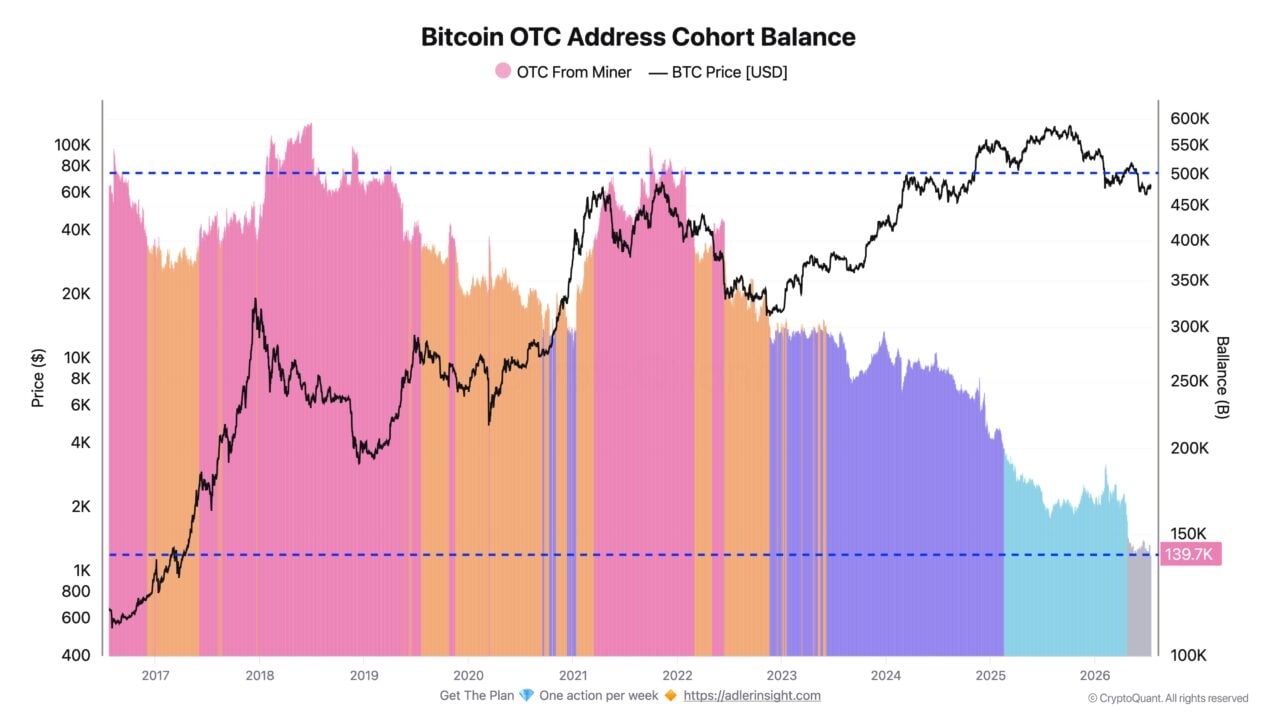
    Bitcoin’s miner-linked over-the-counter [OTC] balances continue shrinking. That means – fewer coins remain available for large private transactions.

    Since November 2021, holdings have dropped from 500,000 $BTC to 139,700 $BTC, a decline of nearly 72%. Miners drew down their inventory over time without meaningfully rebuilding it after the 2024 halving.

    Source: CryptoQuant

    As a result, OTC supply tightened while miner-to-exchange flows declined. Naturally, it suggested lower visible selling pressure on Bitcoin.

    Meanwhile, Bitcoin’s [$BTC] price has advanced despite declining OTC inventories, highlighting stronger demand against a shrinking pool of available supply. Yet, if institutions and whales continue accumulating under these conditions, tighter liquidity could amplify Bitcoin’s upside sensitivity in the coming quarters.

    Bitcoin supply tightens beyond miner OTC desks

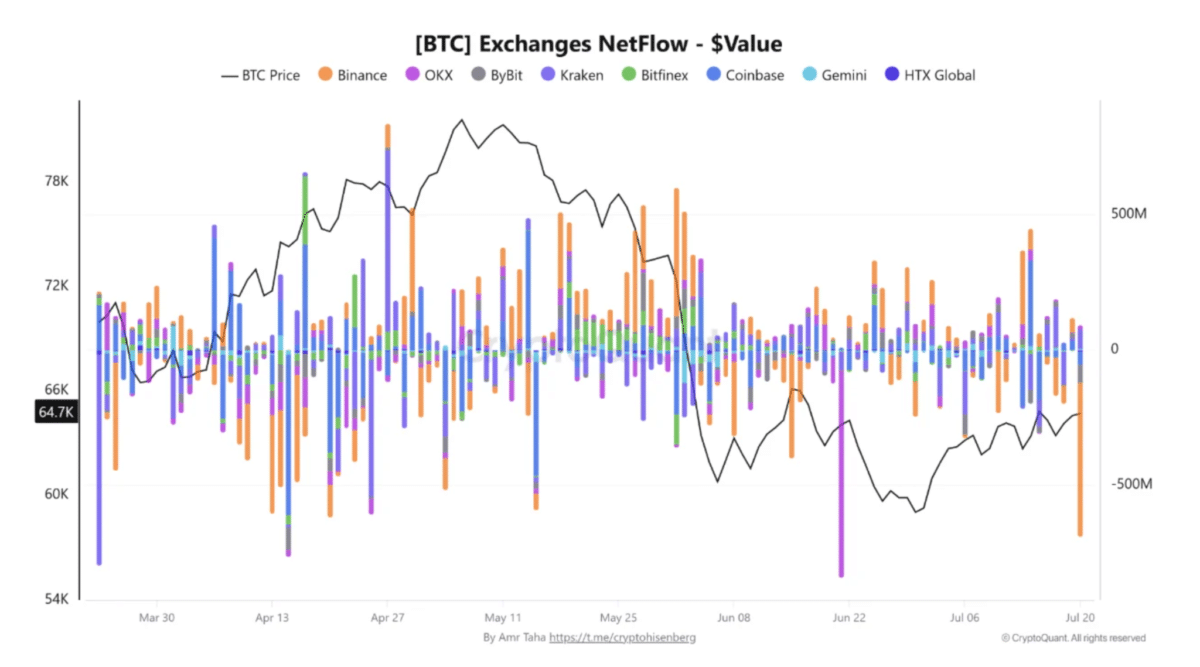
    The tightening supply picture extends beyond miner-linked OTC desks and is now visible across centralized exchanges.

    On the 20th of July, Bitcoin recorded $686 million in Exchange Netflows. By the way, Binance led with $570 million in net outflows, marking its largest withdrawal since April.

    Source: CryptoQuant

    Furthermore, Bybit contributed $65 million, Coinbase another $48 million, and HTX nearly $3 million.

    Ultimately, it meant there were coordinated withdrawals rather than isolated activity. As more $BTC leaves exchange wallets, the pool of coins readily available for spot-market selling continues to shrink.

    This trend complements declining OTC inventories, reinforcing a tighter market structure. If demand continues strengthening, reduced exchange liquidity could amplify Bitcoin’s upside sensitivity in the months ahead.

    Are long-term holders selling?

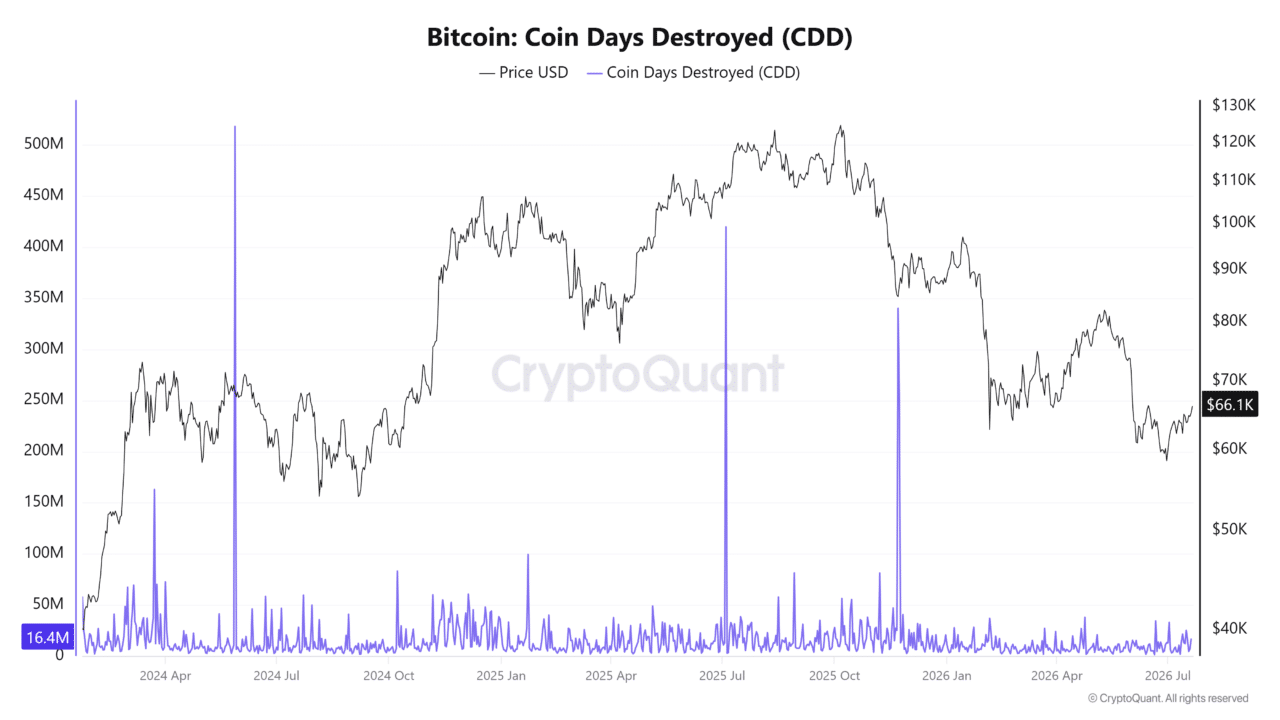
    Even as Bitcoin rebounded from recent lows, long-term holders showed little interest in distributing older coins into the market. The trend of Coin Days Destroyed (CDD), which measures the number of days old coins are sold into circulation, remains flat at 16.4 million.

    Source: CryptoQuant

    Those brief increases failed to develop into sustained selling, suggesting most dormant holdings remained untouched despite changing market conditions. Therefore, it is likely that most of the older coins continue to remain unliquidated regardless of changes in the markets.

    As older coins stay inactive, the burden of driving price discovery shifts toward fresh spot demand instead of recycled supply.

    Thus, the next price movement for Bitcoin could potentially be driven by whether or not sufficient capital is available in the market. That demand must absorb the majority of the coins remaining within the increasingly smaller tradable float.


    Final Summary

    • Bitcoin [$BTC] tradable supply continues shrinking as sell-side liquidity remains constrained.
    • Bitcoin needs stronger spot demand to unlock its tightening supply advantage.
  • Crypto Clarity Act still at mercy of ethics section as Democrats balk at Trump deal

    Crypto Clarity Act still at mercy of ethics section as Democrats balk at Trump deal

    August 7 — the fast-approaching final day before the Senate’s summer recess — is seen as a major deadline for finishing the Clarity Act this year. Crypto insiders are expecting the bill to get to the floor as soon as the beginning of next week, which would fit with what Senate Majority Leader John Thune had previously indicated. The legislation could require several days to get to a final vote.

    Earlier on Tuesday, CoinDesk had reported that a White House official said Trump agreed to “the most comprehensive and wide-ranging ethics provision in history,” though the actual language he’s accepted hadn’t yet been shared with Democrats. As of press time, it was still unclear if Democrats had seen the exact language. Still, the administration argued that it had “bent over backward” to satisfy Democrats, suggesting it would be their fault if the legislation doesn’t advance.

    Trump’s agreement to a crypto constraint of his own business ties raises significant questions about how his involvement would be made sufficiently remote to comply with the limit. The president and his family are deeply connected to several crypto business initiatives, including their ownership stake in World Liberty Financial. While Trump has insisted he’s not conflicted as his administration imposes crypto policies that affect his own businesses, Democratic lawmakers have openly accused him of corruption.

  • Flash Analysis of Four Altcoins: “Two Are Bullish, Two Are Bearish”

    Flash Analysis of Four Altcoins: “Two Are Bullish, Two Are Bearish”

    Cryptocurrency analytics company Santiment analyzed the exchange activity of four altcoins in the decentralized finance sector. According to the analysis, Uniswap ($UNI) and Curve ($CRV) recorded their highest exchange outflows of 2026 in the last 24 hours, while DeXe ($DEXE) and Injective ($INJ) saw high-volume exchange inflows.

    According to Santiment data, approximately 8.4 million $UNI and 9.8 million $CRV tokens were withdrawn from cryptocurrency exchanges in just 24 hours. The company stated that the withdrawal of tokens from exchanges could reduce the supply available for sale in the short term, easing selling pressure on prices.

    The developments on the Uniswap side coincided with expectations regarding protocol fees and the token burning mechanism, the launch of Robinhood Chain, support for tokenized assets, and Spark’s transfer of $150 million in liquidity to Uniswap v4. According to Santiment, these developments brought decentralized exchange infrastructure back to the market’s forefront.

    Related News Major Claim from a Famous Founder: “Bitcoin Is on Sale Right Now”

    Curve’s exchange exits were assessed as presenting a more positive outlook due to the recovery in the protocol’s core operations. Santiment highlighted the reduction in crvUSD printing costs, the rebuilding of PegKeeper reserves, the increase in veCRV distributions, and the momentum in Llamalend V2 as key developments.

    The analytics firm noted that the delisting of tokens from exchanges as usage rates and fee revenues rise could indicate that investors are holding onto their positions or accumulating rather than preparing to sell.

    In contrast, a more cautious outlook emerged for $DEXE and $INJ. The recent inflow of approximately 261,000 $DEXE and 1.8 million $INJ to exchanges resulted in the highest exchange inflows for both altcoins in 2026. Santiment warned that these movements could increase the risk of short-term selling.

    Injective is noted for its inclusion in Binance.US spot trading and for its futures products regulated by the US Commodity Futures Commission, supporting institutional access. DeXe, on the other hand, is said to offer a strong use case as a governance token. However, according to Santiment, the price outlook for both altcoins may remain fragile until the large amount of supply transferred to exchanges is absorbed.

    *This is not investment advice.

  • Crypto lobby group TDC sues Illinois to block digital asset tax

    Crypto lobby group TDC sues Illinois to block digital asset tax

    A crypto lobbying organization has sued the state of Illinois over a last-minute tax provision inserted into the state budget last month.

    TDC (otherwise known as The Digital Chamber) alleged that Illinois’ Digital Asset Tax Act violated both the U.S. and state constitutions and is preempted by a federal tax law. The lawsuit, filed Tuesday, asks a federal judge to block the Illinois state government from enforcing the tax.

    The tax violates the Illinois state constitution’s uniformity and due process clauses, the Commerce Clause of the U.S. Constitution and the Internet Tax Freedom Act by specifying digital asset transactions, the suit said.

    The Digital Asset Tax Act was passed and approved on short notice last month, right before the Illinois state government wrapped up its session for the year. The 0.2% tax applies to any entities that are based in Illinois or provide services with gross receipts of over $100,000. The tax takes effect in January.

    TDC’s lawsuit said the Internet Tax Freedom Act alone created a rule that “electronic commerce would not be subjected to discriminatory state and local taxation.”

  • Pump.fun launches BOOST mode to recycle dead liquidity through token burns

    Pump.fun launches BOOST mode to recycle dead liquidity through token burns

    Pump.fun has introduced BOOST mode, a new launch mechanism that automatically reinjects liquidity through token buybacks and burns after coins complete the platform’s bonding curve.

    Introducing BOOST mode – the new standard launch mechanism for EVERY new pump fun coin

    Over $100M in dead liquidity is lost every year when tokens migrate. Now, we’re reinjecting future liquidity into EVERY BONDED COIN.

    Learn more 👇 pic.twitter.com/FJEE0rSXiB

    — Pump.fun (@Pumpfun) July 21, 2026

    The Solana memecoin launchpad said more than $100 million in liquidity becomes permanently trapped each year when tokens migrate from their bonding curves. The platform refers to this capital as dead liquidity because it remains locked in liquidity pools even after traders sell their holdings.

    Under the previous migration structure, each token sacrificed roughly 20% of its liquidity, according to Pump.fun. BOOST mode redirects part of that capital into market purchases during the five minutes immediately following a migration.

    The mechanism reinjects 17.6 $SOL for $SOL trading pairs or $2,516 for USDC pairs. Purchases are executed gradually through a time weighted average price system, with the acquired tokens automatically burned after each transaction.

    Pump.fun said the feature does not require creators or traders to activate it. All eligible coins migrating after 10:23 a.m. Eastern Time on July 21 will automatically use the BOOST configuration.

    Tokens that migrated before the cutoff will not receive the feature. Coins launched through Pump.fun’s Mayhem system are also excluded.

    Pump.fun said the trading experience will remain unchanged, while the redirected liquidity is intended to create additional buying pressure and permanently reduce the circulating supply of migrated tokens.

    Pump.fun’s native PUMP token traded largely flat following the announcement, although it remained up more than 30% over the previous seven days.

  • XRP Jumps 4% as MiCA Approval and Bitcoin’s Rebound Fuel a Trendline Breakout

    XRP Jumps 4% as MiCA Approval and Bitcoin’s Rebound Fuel a Trendline Breakout

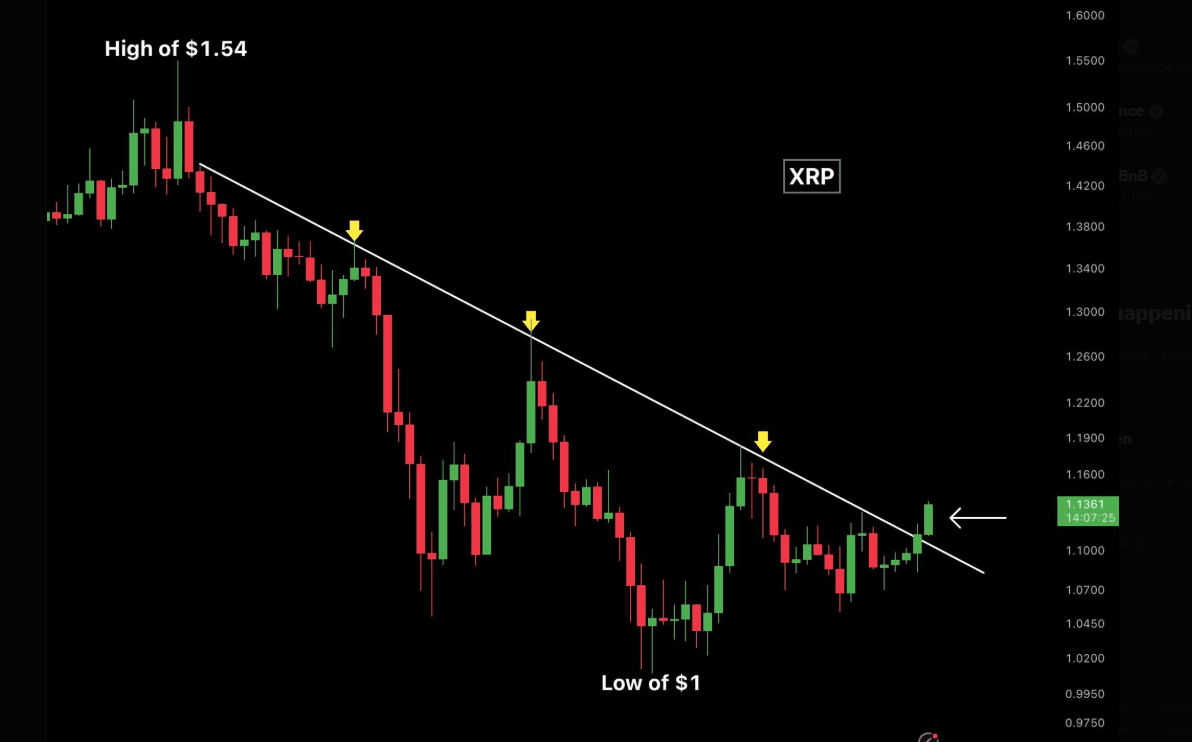
    $XRP is having a strong day. The Ripple-linked token climbed about 4% over the last 24 hours to trade near $1.13, and this time the move has real drivers behind it — a major regulatory win, widening institutional access, and a broader market lifted by a resurgent Bitcoin. The rally has also pushed $XRP above a descending trendline that has capped every attempt to recover since its $1.54 high.

    Let’s start with why it’s moving, then look at what the chart says.

    Why is $XRP Price up today?

    Three things are working in $XRP‘s favor at once.

    First, regulation. Ripple has secured full MiCA approval to operate across 30 European countries, which strengthens its appeal to banks and payment providers and removes a layer of uncertainty that had kept institutions cautious. Second, access is widening: investors can now buy 21Shares $XRP through most brokerages without needing to hold the coin in self-custody — a meaningful lowering of the barrier for traditional money. Third, momentum from the broader market: $XRP posted its fourth straight green daily close on Monday, with the move powered in large part by a rebounding Bitcoin dragging the majors higher.

    Put together, that’s a mix of structural and momentum drivers rather than a one-off spike.

    $XRP Price Analysis: Is $XRP UP?

    Now the technicals. From the $1.54 high, $XRP carved out a clean downtrend — a series of lower highs, each rejected right at the same descending line (the yellow arrows on the chart mark those failed attempts). Price bottomed near the $1 support zone, bounced, got rejected at the trendline again, and pulled back.

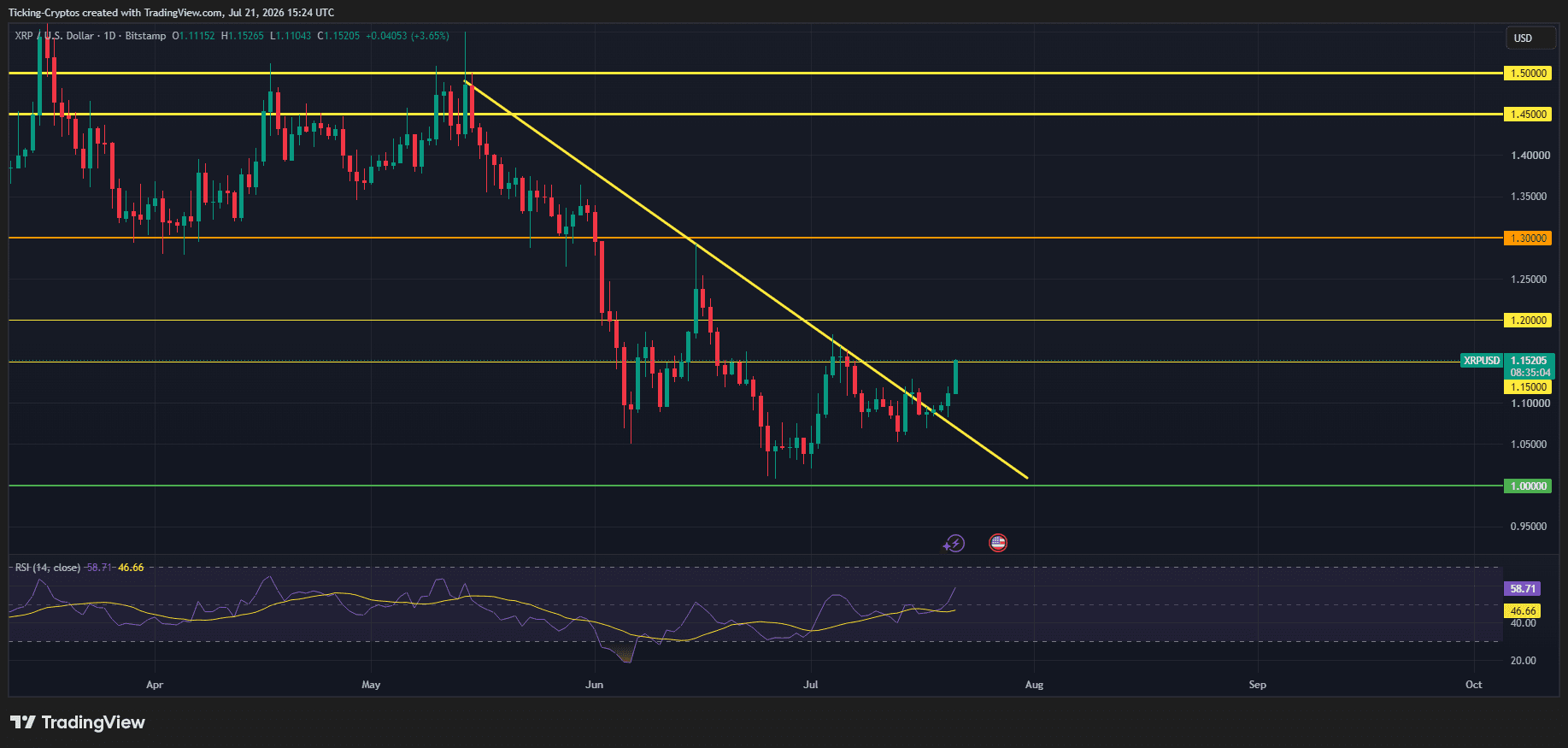
    Today breaks that pattern. The latest green candle has pushed through the descending line near $1.1361 instead of bouncing off it. That resistance has defined $XRP‘s price action for roughly two and a half months, so clearing it is the first genuine technical win the bulls have had in a while. Analysts note the move also lines up with a symmetrical-triangle breakout that traders had been watching, with $1.13 as the key trigger level.

    $XRP Prediction: Where does $XRP go from here?

    Breaking a trendline is a start, not a confirmation. On the daily chart, $XRP is still inside a larger descending channel, with the 100-day and 200-day moving averages sitting overhead around $1.12-$1.13 and again near $1.24. That makes the $1.24-$1.28 zone the real test — it lines up with both the channel’s upper boundary and the major moving averages. Clear it decisively, and analysts see $1.35 coming into focus.

    On the downside, support sits firmly around $1.02-$1.06, where buyers have repeatedly stepped in over recent weeks. A loss of that zone would undo the breakout and potentially expose the $0.88-$0.92 area.

    The takeaway: $XRP has fundamentals and momentum aligning with a technical breakout — but it needs to hold above $1.13 and eventually crack $1.24-$1.28 to turn today’s move from a breakout attempt into a real trend reversal.

  • White House pushes Senate Democrats to take ‘historic’ crypto Clarity Act ethics deal

    White House pushes Senate Democrats to take ‘historic’ crypto Clarity Act ethics deal

    “If Senate Democrats block this historic legislation after the administration has bent over backward to accommodate their concerns, stakeholders should make no mistake: It is the Democrats who are blocking this legislation because they were never serious about a legislative outcome,” the White House official said.

    Democratic negotiators such as Senators Kirsten Gillibrand, Ruben Gallego and Angela Alsobrooks reportedly haven’t received details of the agreement with Trump, who’d met personally with Republican senators last week. But many of the Democrats have drawn a line in the sand that the ethics provision — driven primarily by Trump’s own deep crypto connections — needs to be strong.

    The dispute was heightened recently by the president’s disclosures that he’d pocketed more than $1 billion last year from his crypto interests.

    The White House, Republicans and their crypto industry allies are already building their case against any Democrats who don’t accept the new answer to their ethics demands. It’s unclear when they’ll get to see it.

    The industry is expecting full circulation of the Clarity Act legislative language as soon as Tuesday night or Wednesday, though that expectation has been repeatedly delayed since last week.

    The Senate has fewer than three weeks to finish the bill, including the ethics piece, and get it through the political gauntlet of a floor vote before lawmakers leave town for their reelection campaigns. There’s technically enough time, but even without significant further debate, it would be tight.