The U.S. Senate’s Digital Asset Market Clarity Act draft is still open to changes on a number of big-ticket items that include its government-ethics section, Senator Cynthia Lummis, one of the lead negotiators on the bill, said about the effort that’s “finally” getting closer to passage with the release of the text.
The Senate’s Judiciary, Ethics and Intelligence Committees all had input into the bill, Lummis told CoinDesk on Wednesday, and while the process has “been very difficult,” the bill is ready for additional feedback.
“It’s time to show everyone the fully integrated bill that we will be voting on, and get the feedback from the industry that’s about to be regulated, as well as others,” Lummis said. “So I’m pleased we’ve reached this point.”
Lummis released an updated text of the Clarity Act earlier Wednesday that merged the bills passed by the Senate Banking and Agriculture Committees into one longer bill. The updated text is not likely to be the final version of the bill.
The bill’s proposed conflict-of-interest limits for government officials’ crypto involvement will continue to be discussed through the weekend, and some of the illicit finance provisions may also see further discussion, Lummis said.
Bitcoin prices fluctuated close to $65,000 on Wednesday, July 22, as analysts pointed out key technical levels that traders should monitor.
The world’s largest digital currency by total market value fell to as little as $65,484.00, according to Coinbase data from TradingView.
At this point, the cryptocurrency had fallen close to 50% from the all-time high of more than $125,000 it reached in October 2025, a price reported by Reuters.
As the digital asset traded near the $65,000 level, several analysts highlighted key technical levels that short-term traders should watch.
Maxime Seiler, cofounder and CEO of STS Digital, offered some input on this matter, stating via email that “$70.000 to $72,000 is the upside zone to watch into month end, which lines up with where the bullish structures are set, and $67,000 to $68,000 is the immediate resistance that has to give first.”
“On the downside, $60,000 is still the level the market cares about,” he added, shedding some light on where bitcoin has support in this market.
Seiler also highlighted some macro developments, clarifying that “The main catalyst is the Fed meeting on July 28 and 29, which the market is treating as the thing that resolves the range one way or the other.”
“In addition, it’s worth watching alongside whether the ETF inflow streak holds,” he stated, referring to the flows into bitcoin exchange-traded funds.
Julio Moreno, head of research for CryptoQuant, supplied a similar take on the matter.
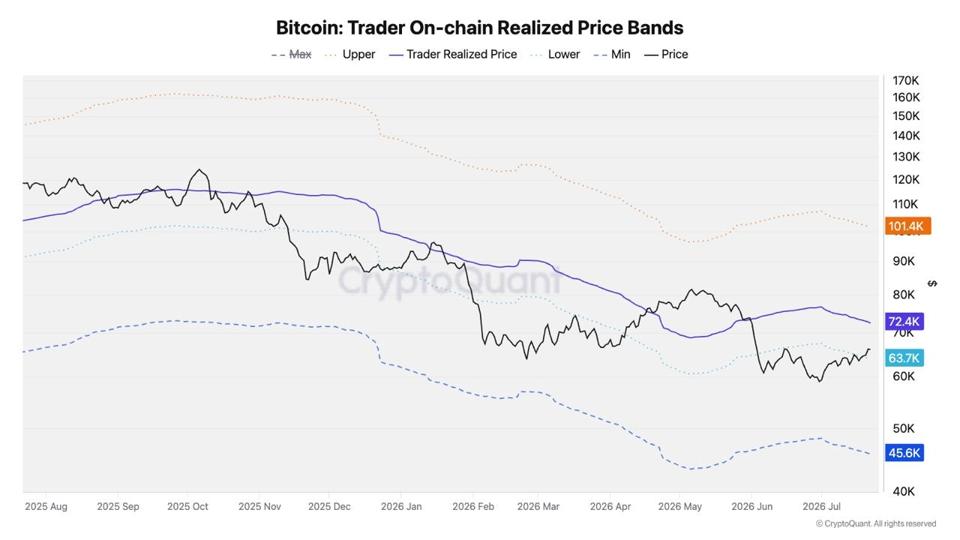
“From a traders’ perspective, I would watch the $64K price level as a support (dotted light blue line) and $72K as resistance (purple line) in the short term,” he said via email, referring to lines in a chart provided below.
“These levels are the lower band and traders’ on-chain realized price, and have been reliable support and resistance levels during this bear market,” noted Moreno.
Trader on-chain realized price bands
CryptoQuant
Tim Enneking, managing partner of Psalion, also chimed in.
“After months of indecision, it appears that $60k is finally a rather firm bottom for $BTC,” he said through emailed commentary.
“Since initially falling back to $60k in early February of this year (after breaking that level on the way up almost two years ago), $BTC has spent a full six months bouncing between $57k and $83k.”
“It’s spent the last almost two months between $57k and $67k, with $BTC today trying to push through the $67k ‘high’ set on June 15. Breaking that level is critical to continue putting in the higher lows and highs which began about one month ago.”
“My one fear is that this kind of looks like fall 2022, when $BTC also took its time putting in a bottom, and then completed one more leg down before moving up significantly beginning the following January.”
Ondo price has climbed 27% from $0.32 on July 15 to an intraday high near $0.42 as institutional tokenization deals and a decisive chart breakout have strengthened bullish sentiment around the RWA-focused token.
According to data from crypto.news, Ondo ($ONDO) price traded near $0.41 at press time, up about 2% on the day, with a market capitalization close to $2 billion. The token has outperformed Bitcoin and Ethereum over the past week as traders moved toward crypto projects tied to real-world financial infrastructure.
Recent interest followed Ondo Finance’s work with the Depository Trust & Clearing Corporation on a model for tokenizing securities held at the Depository Trust Company. Products linked to assets such as the SPDR S&P 500 ETF and Circle shares could use entitlements tied to securities held within existing custody systems, rather than stand-alone synthetic copies.
Ondo’s institutional case also includes a cross-border redemption completed with Mastercard, Kinexys by J.P. Morgan and Ripple. The transaction announced in May tested the redemption of tokenized U.S. Treasuries across two banking networks, giving investors another example of how regulated assets can move between blockchain and conventional payment systems.
Meanwhile, Ondo has expanded its tokenized-stock platform to more than 440 assets, while its website reports about $1.05 billion in value locked across those products. The company also introduced round-the-clock minting and redemption for tokenized stocks in June, reducing the dependence on U.S. market hours.
A separate agreement with Japan’s SBI Group added another source of demand for the RWA narrative. The companies plan to explore tokenized Japanese securities distributed through SBI’s network, with yen-based settlement through the JPYSC stablecoin.
Institutional deals have driven $ONDO’s breakout
Daily active addresses rose from 2,589 to around 3,300 on July 21 as the price approached $0.40, according to network data cited in the market analysis. The increase came alongside a sharp rise in trading volume, which helped $ONDO break from a descending channel that had controlled price action since May.
Spot buying also pushed cumulative volume delta back above zero, while derivatives open interest rebounded from its recent low. Those moves show that fresh capital entered both markets during the advance, although the speed of the recovery also forced traders holding short positions to close contracts as $ONDO crossed $0.39.
Investor sentiment has turned firmly positive after repeated failures below the same resistance. According to analyst Michaël van de Poppe, the token’s brief return to $0.34 created a successful retest before the latest push.
“I assume that, with this short retest at $0.34 and the fact that we’re having a test of this resistance so fast, it’s likely that we’ll continue to rally upwards.”
Van de Poppe placed $0.45 as the next likely objective and argued that strength in $ONDO could also pull other RWA tokens higher. His view matches the latest spot structure, though the token must first absorb sellers between $0.41 and $0.42.
Macro conditions have also favored assets with clear institutional links. Bitcoin traded near $66,000, and Ethereum hovered around $1,930 as both assets registered limited daily gains, while investors assessed commodity volatility and the next round of central-bank decisions. $ONDO’s 27% weekly advance has separated it from that subdued large-cap performance.
$ONDO price must secure $0.42 before targeting $0.47
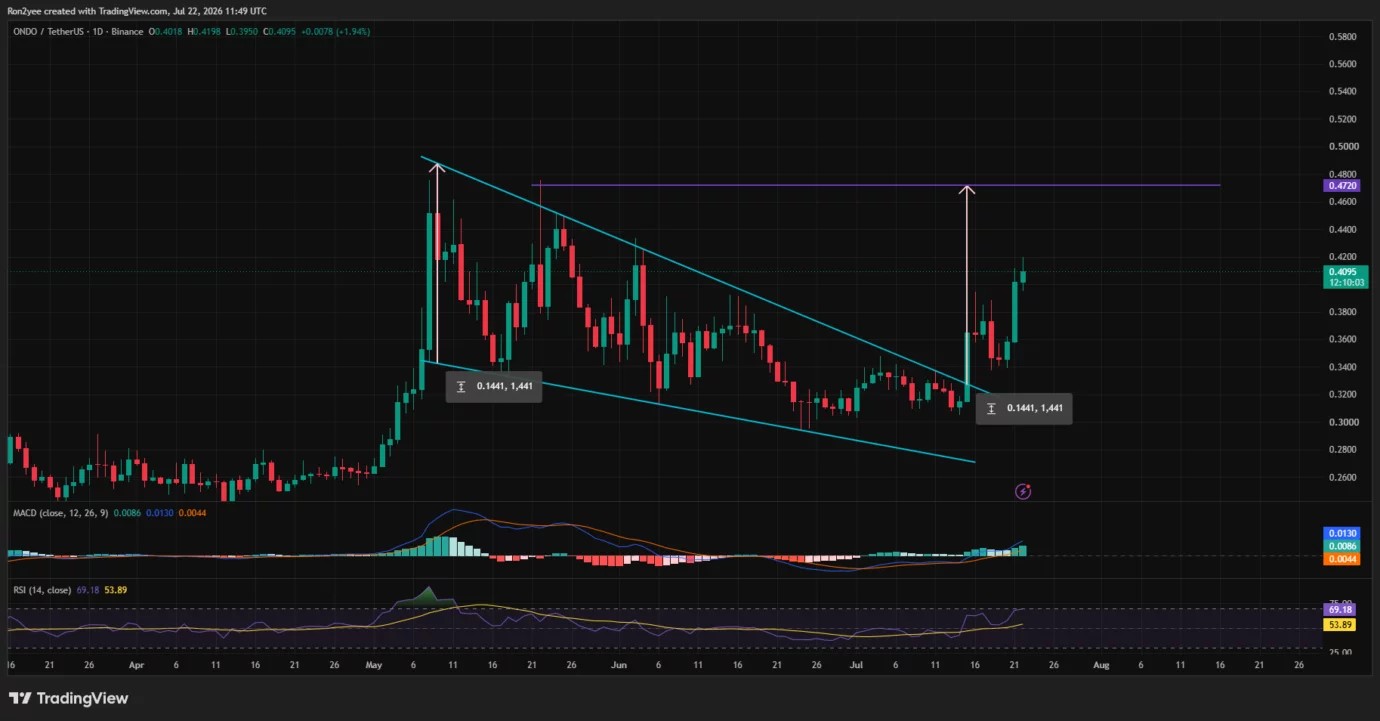
The daily chart shows $ONDO breaking above the upper boundary of its multimonth descending channel after several failed attempts. Based on the height of the channel, the measured move places the main bullish target near $0.472, an area that also served as resistance during May.
Ondo price daily chart has broken out of a descending channel pattern on the daily chart — July 22 | Source: crypto.news
Momentum supports the advance but leaves little room for a weak close. The daily relative strength index has reached 69.18, just below the conventional overbought threshold of 70, while its average remains at 53.89. The MACD line has risen to 0.0130 above the 0.0044 signal line, and the positive histogram has expanded to 0.0086.
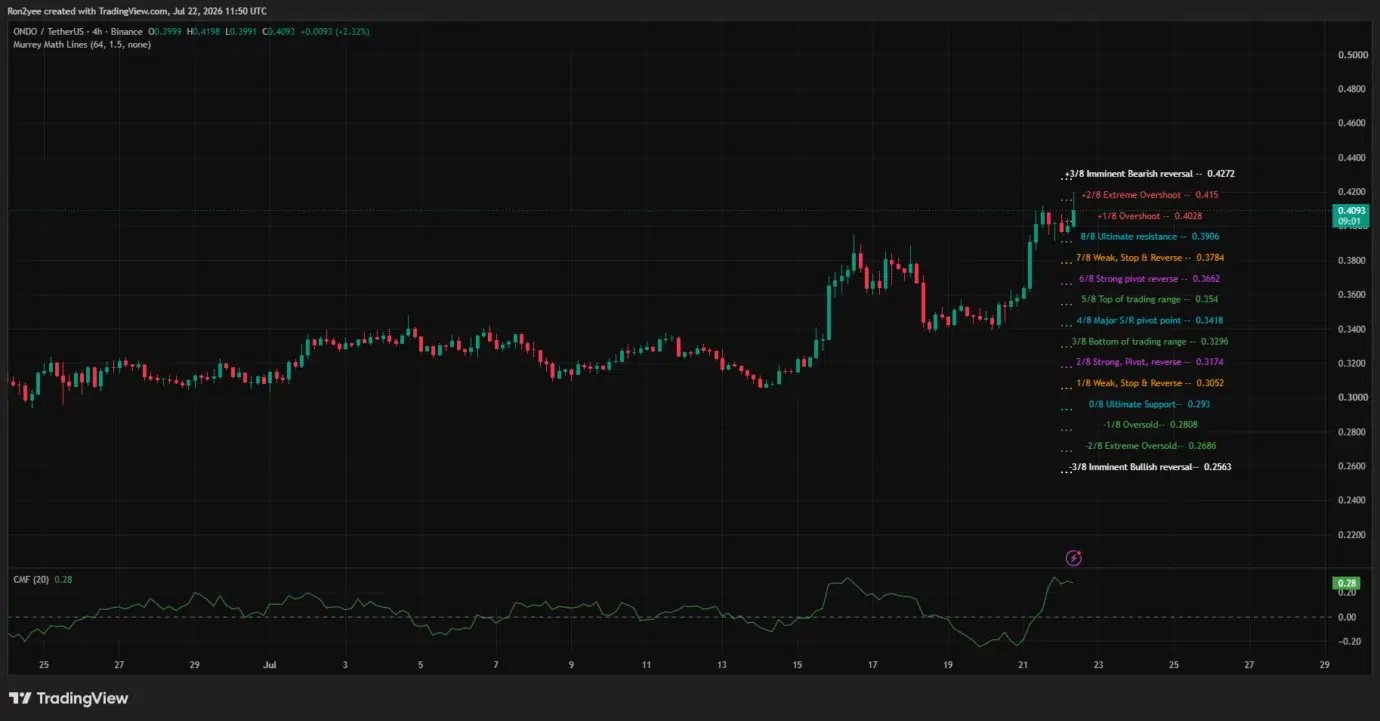
On the 4-hour chart, $ONDO has moved above the Murray Math ultimate resistance at $0.3906 and the $0.4028 overbought level. Price has now entered the band between $0.4028 and $0.4150, where traders may take profits after the rapid advance. The next extension sits at $0.4272 if buyers secure a 4-hour close above $0.415.
Ondo price 4-hour chart — July 22 | Source: crypto.news
Cash flow remains supportive, with the 4-hour Chaikin Money Flow reading at 0.28. A positive value of that size confirms that buying volume has outweighed selling volume during the breakout, though a drop below $0.3906 would weaken the immediate setup. Lower supports sit at $0.3784 and $0.3662.
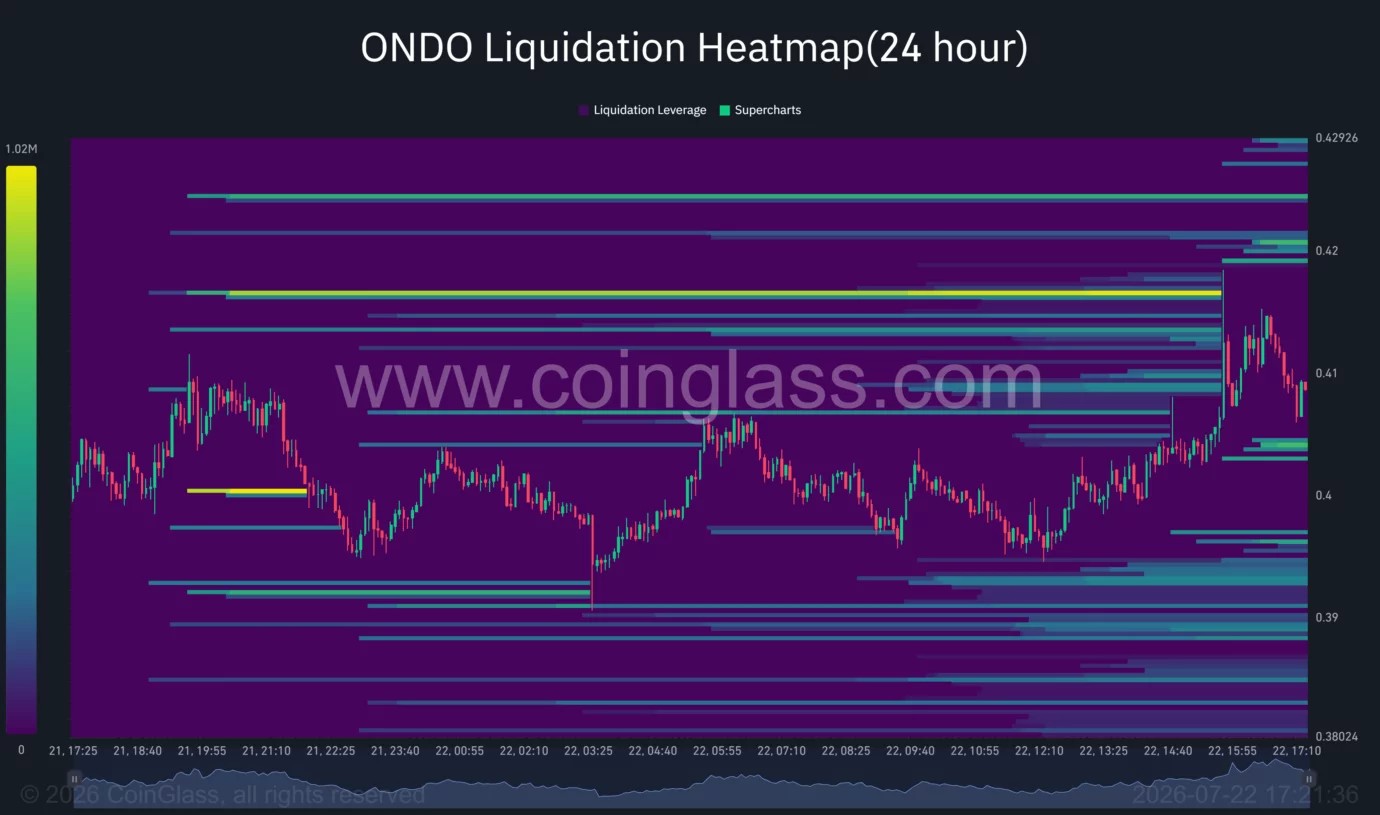
CoinGlass’ 24-hour liquidation heatmap places the largest nearby leverage pool around $0.416–$0.417, just above the current price. A push through that cluster could liquidate additional short positions and carry $ONDO toward $0.42. Below the market, leveraged positions are concentrated near $0.393–$0.390, with another dense pocket around $0.389.
Ondo liquidation heatmap | Source: CoinGlass
A daily close above $0.42 would open the route toward $0.45 and the channel target at $0.472. Rejection from the current resistance could send $ONDO back toward $0.39, while loss of that level would expose $0.378 and delay the bullish continuation.
The market for tokenized stocks reached a record $2.3 billion in market capitalization in mid-July, according to Token Terminal data, nearly doubling since March, when the sector first cleared $1 billion, and the growth is showing up across every major issuer at once.
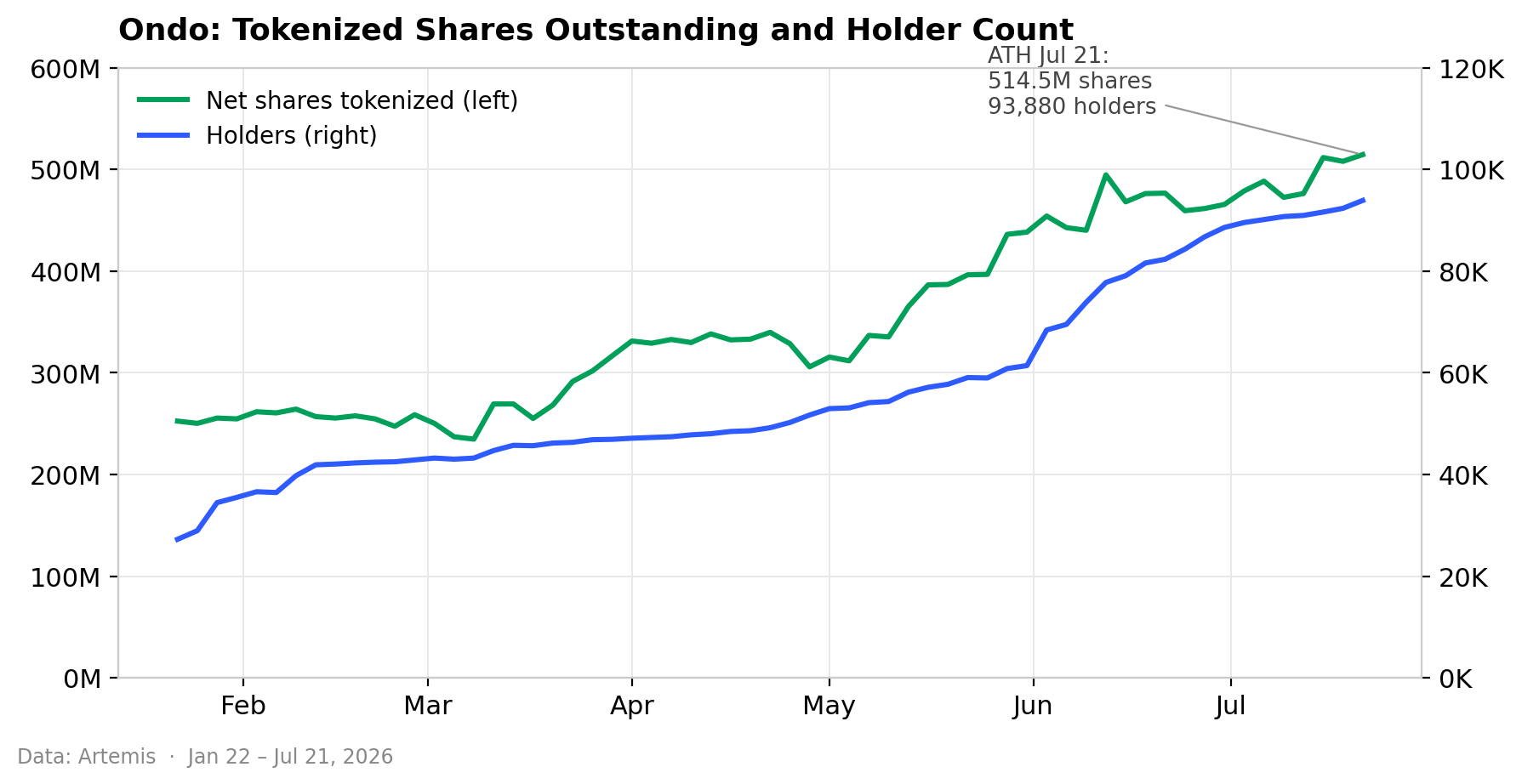
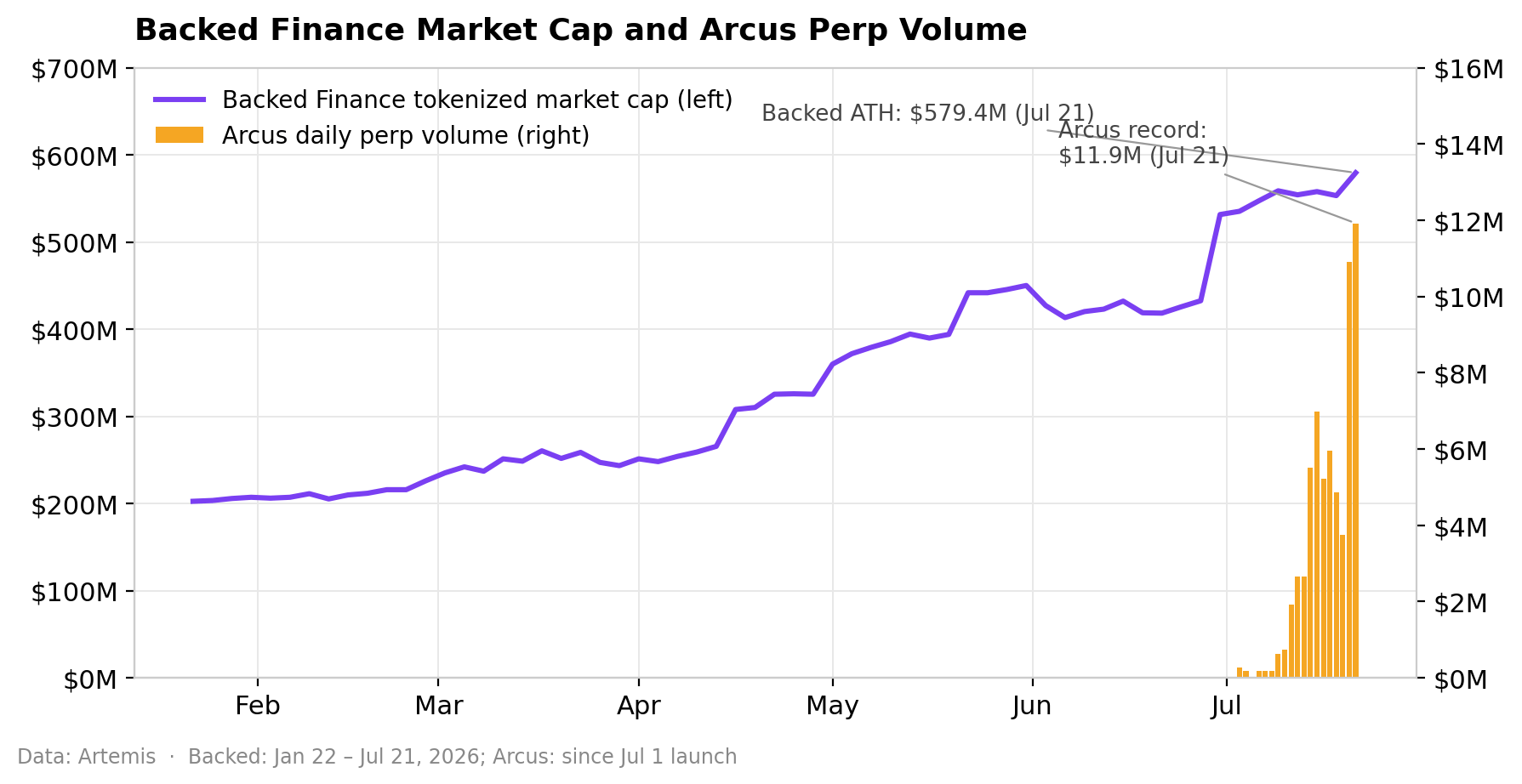
On July 21 alone, Artemis data recorded all-time highs for Ondo Finance’s tokenized shares outstanding (514.5 million) and holder count (93,880), Backed Finance’s tokenized market cap ($579.4 million), and Robinhood Chain’s tokenized shares (126,720) and equity holder count (36,170).
Arcus, the tokenized-stock exchange launched this month by the team behind dYdX, posted record daily perps volume of $11.9 million and record open interest of $6.8 million the same day.
Ethereum leads the sector with 34% of tokenized stock market share, followed by $BNB Chain at 30% and Solana at 23%, per Token Terminal. Tokenized stocks remain a small corner of the broader tokenized real-world asset market — roughly 5% by Token Terminal’s count, while DefiLlama tracks about $27.3 billion in active RWA market cap — but they have been the fastest-growing asset class on Ethereum this year.
Ondo Extends Its Lead
Ondo’s tokenized shares outstanding roughly doubled over six months to 514.5 million, while holder count more than tripled to 93,880 — both all-time highs on July 21. Data: Artemis.
Ondo Finance is the largest issuer with $955 million in onchain equities, per Token Terminal, and its July has been dense with catalysts. The firm partnered with Japan’s SBI Group on July 16 to tokenize Japanese stocks and explore settlement in JPYSC, SBI’s trust-backed yen stablecoin. It also switched on 24/7 minting and redemption for tokenized US stocks and ETFs, added voting rights to its tokenized stocks, and enabled tokenized stock collateral on OndoPerps, its perpetual futures venue — the product behind its record $39.8 million in open interest, per Artemis.
The firm’s catalog has passed 430 tokenized stocks and ETFs across Ethereum, Solana, and $BNB Chain, and its distribution now runs through MetaMask and Felix on Hyperliquid.
ONDO traded around $0.41 on July 22 with a market capitalization of $1.99 billion, near the top of its seven-day range of $0.32 to $0.41, per CoinGecko. The token jumped roughly 15% in the 24 hours after the SBI announcement.
Backed and the Exchange-Issued Wave
Backed Finance, the Swiss issuer behind the xStocks product distributed on Kraken, Bybit, and Solana DeFi, reached a record $579.4 million in tokenized market cap on July 21, per Artemis. Kraken said xStocks surpassed $25 billion in cumulative transaction volume within eight months of launch. Token Terminal puts xStocks’ onchain holdings at $507 million, with Binance’s bStocks third among issuers at $334 million — a sign exchange-issued products are becoming a distinct growth channel alongside DeFi-native issuers.
Backed Finance’s tokenized market cap nearly tripled since late January, jumping from about $430 million to over $530 million in a June 29 step-change before its July 21 record. Arcus perp volume, overlaid since its July 1 launch, hit $11.9 million the same day. Data: Artemis.
New Entrants: Robinhood Chain and Arcus
Robinhood’s Stock Tokens, issued on the company’s own Layer 2 that launched July 1, remain the smallest of the cohort at $19.3 million in tokenized market cap, but all three of the product’s Artemis metrics — market cap, shares tokenized, and holder count — hit records on July 21. The tokens are available in more than 120 countries and are already being used as collateral on Lighter, a derivatives protocol on the chain.
The speculative layer is arriving too. Arcus, launched July 1 by dYdX Labs with investment from Robinhood Crypto, offers 24/7 spot trading on 95 stock tokens with zero fees and is rolling out perpetual futures on equities, commodities, and indices with up to 50x leverage. The exchange is not available in the US, UK, or Canada. Its record $11.9 million in daily perps volume, while small against crypto-native perps venues, is an early data point for leveraged trading built on tokenized equities.
The Road to $3B
An Ondo executive said in May the company expects the tokenized equity market to reach between $2.5 billion and $3 billion by year-end, per TheStreet. At the current pace — the sector has nearly doubled in four months — that target implies slower growth than the market is delivering.
Holder counts remain the metric to watch. Ondo’s 93,880 and Robinhood Chain’s 36,170 tokenized-equity holders are records, per Artemis, but are small next to any retail brokerage’s user base. Whether 24/7 settlement, DeFi collateral use, and yen-settled Japanese stocks translate into sustained holder growth is what the next two quarters will show.
CertiK, a blockchain security firm, said on Wednesday that 52 confirmed physical attacks on crypto holders occurred in the first half of 2026. The amount of money at risk was ~$124.1 million, up from $10.5 million the previous year.
Nowadays, there is a much more common and much more expensive threat to anyone with a known identity who has real crypto.
There were 52 confirmed incidents, a 33.3% increase year over year from the 39 cases in H1 2025. CertiK defines a wrench attack as any form of violence, intimidation, or credible threat used to force someone to transfer digital assets, provide private keys, or unlock a wallet.
The tactic is an “established threat vector for cryptocurrency holders,” CertiK said. It works on even strong digital security because it attacks the person, not the software.
France drives Europe’s wrench attack wave
Of the 52 confirmed incidents, 39 were in Europe. France alone was home to 33 of them, according to CertiK. Europe was already highlighted as the riskiest region for crypto holders in CertiK’s 2025 wrench-attack report.
Increasingly, victims are being confronted in their own homes by attackers. CertiK reported that the number of crypto-related home invasions soared from one publicly reported case in H1 2025 to 20 in H1 2026. Kidnappings also increased, from 12 to 16.
Elsewhere, there was little movement. There were four cases of torture, as in the year before. Each period had one murder in association with a crypto coercion event.
The rise was attributed to home invasions. The attackers are now finding out where the targets live instead of waiting to catch them somewhere else.
$124 million exposure figure isn’t stolen crypto
The ~$124.1 million number is an estimated exposure, not a confirmed theft. It includes ransom demands, money victims paid, and assets later frozen by authorities or providers. Some of this money was never lost.
The average recorded exposure per incident rose from ~$270,000 in H1 2025 to ~$2.39 million in H1 2026. CertiK says its totals understate the true picture. Attack victims often don’t report them because they’re afraid of getting hurt, being taxed, or having their reputations hurt.
The half-year total obscures two different phases. The increase was led by Q1 2026, with 35 incidents compared to 22 in Q1 2025. January saw 15 cases compared to 9 a year ago, March had 13 compared to 7, and April shot up to 8 from 2. Then May and June were down below 2025. CertiK attributes that to a combination of better holder security, reporting delays, and law-enforcement pressure. Q2 2026 ended with 17 incidents, the same as Q2 2025.
Extrapolating the first half in a straight line would indicate about 100 incidents for the entire year. CertiK warns that this is not a prediction, especially given the differences between the two quarters.
Cryptopolitan reported this month that 63% of the 164,538 traders active in Robinhood Chain’s top memecoins were underwater. Wrench attacks target a different profile. Holders whose money and location are sufficiently obvious that it is worth the trouble to coerce.
CertiK’s advice is to break the link between a person’s public identity and their holdings. It proposes limiting data that links a name, location, or daily pattern of a holder to ownership of a crypto. Significant assets should be stored so that no one person can move them on demand.
Crypto holders should keep their wallets, signing tools, and recovery data separate. The company also says that people should make their homes secure, talk to their family about what to do in an emergency, and avoid using sensitive accounts on any devices they take with them when they travel.
New provisions limiting the ability of presidents and other federal officials to profit from digital assets have been added to the CLARITY Act, a bill under consideration in the US Senate that includes comprehensive regulations targeting the cryptocurrency market.
According to updated draft legislation obtained by CNBC, US presidents, federal officials, and certain public officials will not be able to issue cryptocurrencies or other digital assets, or sponsor such projects.
Senate Republicans, in an update to the CLARITY Act on Wednesday, included the first legal limits on how US presidents can earn income from the cryptocurrency sector.
Related NewsFlash Analysis of Four Altcoins: “Two Are Bullish, Two Are Bearish”
The CLARITY Act, which aims to comprehensively regulate the digital asset market, seeks to determine which institutions will oversee the cryptocurrency sector and under what rules. Newly added ethical provisions aim to prevent public officials from using their positions to profit personally from cryptocurrency or digital asset projects.
If the bill becomes law, U.S. presidents and other federal officials serving in office will face significant restrictions on issuing cryptocurrencies in their own names, sponsoring a digital asset project, or directly profiting from such ventures.
Previously, US President Donald Trump launched his own TRUMP token, which has recently experienced significant declines.
After Bitcoin surged above $66,000, reaching its highest level in the past month, analysts noted that the $68,000 level could be a critical resistance point. According to experts, Bitcoin testing this region for the first time could create significant selling pressure as investors nearing their cost basis begin to sell.
Spot Bitcoin ETFs traded in the US recorded net inflows of $203 million yesterday, extending their positive streak for the sixth consecutive trading day. This brings the total net inflow since July 13 to approximately $779 million. Spot Ethereum ETFs also saw inflows of $37.5 million on the same day, marking a third consecutive day of positive trading.
Bitfinex analysts stated that the next significant level for Bitcoin is $68,000. They noted that this region coincides with the average cost level for short-term investors and the opening price of the second quarter. According to the analysts, investors who bought Bitcoin in the last five months and are still at a loss may choose to sell as the price rises back to their cost levels. Therefore, a strong supply is likely to be encountered during the first test of $68,000.
Related NewsFlash Analysis of Four Altcoins: “Two Are Bullish, Two Are Bearish”
Vetle Lunde, Head of Research at K33, stated that Bitcoin trading volumes continue to remain seasonally low. According to Lunde’s data, as of July 19th, the 30-day spot trading volume was only 62.4% of the annual average.
Institutional investor activity in the futures market also remains weak. Bitcoin open interest on the CME stayed below 100,000 BTC throughout July, reaching its lowest level since October 2023. This indicates that institutional participation has not yet recovered strongly. While ETF inflows improved during the same period, flows were largely driven by BlackRock’s IBIT fund.
CapitalCom analyst Daniela Hathorn considers the $63,000 level a significant support point in the short term. According to Hathorn, if Bitcoin remains above this level and settles back above the $65,000-$66,000 range, it could strengthen the upward momentum. Conversely, a loss of the $63,000 support could lead to increased profit-taking by investors, creating renewed pressure on the price.
Cryptocurrency market maker Wintermute analyzed the rise in Bitcoin and Ethereum following the release of June inflation data in the US. The company stated that there are signs of recovery in the structure of the cryptocurrency market, but the upward trend is not yet confirmed.
The US consumer price index (CPI) fell 0.4% month-on-month in June, marking its largest monthly decline since April 2020. Annual inflation also dropped from 4.2% to 3.5%, below market expectations of 3.8%.
Following the inflation data, markets largely excluded the possibility of a Fed rate hike in July from their pricing. However, renewed tensions between the US and Iran and the renewed discussion of port blockades caused Brent oil to rise by 15.54 percent during the week.
Risky assets showed divergent performance. During the same period, Ethereum gained 3.64% and Bitcoin gained 1.46%, while the Nasdaq index fell by 4.16%.
Following the release of US inflation data, Bitcoin surged from approximately $62,000 to $64,900 in a short period. Ethereum also rose by up to 7%, reaching $1,884. As a result of the rapid market surge, approximately $134 million worth of short positions were liquidated within an hour.
Spot Bitcoin ETFs traded in the US recorded net inflows of approximately $191 million on Tuesday and Wednesday, ending a ten-day streak of outflows from ETFs.
Wintermute stated that the recent inflows were a positive development, but compared to the record net outflow of $4.5 billion recorded in June, the current magnitude was insufficient to confirm a new trend.
Related NewsExpert Analyst Argues Altcoin Bear Trend is Nearing Its End, Reveals His Favorite Altcoins!
According to the company, Bitcoin’s ability to maintain its gains following the inflation data release during the sell-off in chip stocks indicates an improvement in the structure of the cryptocurrency market. However, a definitive upward trend has not yet formed in the market.
Wintermute stated that the relative strength of the market could be confirmed if spot Bitcoin ETFs record uninterrupted net inflows for a week and the Bitcoin price remains above $66,000 for several trading days.
However, it was added that macroeconomic risks could intensify again if Brent oil rises above $90 or if the Strait of Hormuz is officially closed, and the positive assessment of the cryptocurrency market could lose its validity.
Ramp has made stablecoin accounts and payments available to all its customers, giving businesses one platform to hold, send, and receive both regular dollars and stablecoins like $USDC and USDT.
Until now, most finance teams treated stablecoin payments as a separate hassle, requiring a different wallet, no approval controls, and hours of manual reconciliation.
One Ramp beta customer found that stablecoin payments made up just 10% of vendor payments but consumed half of their accounts payable team’s time.
Ramp’s approach folds stablecoins directly into the same system businesses already use for cards, bills, and accounting, so a payment settling in $USDC follows the same approval chain as one settling in dollars.
“Businesses shouldn’t need a second financial system just because a payment settles on different rails,” said Andrew Chapello, Stablecoin Product Manager at Ramp.
How it actually works
Businesses can hold stablecoin balances, earn rewards on them, and pay vendors or employees directly from a stablecoin account, a checking account, or a linked bank account, without needing to pre-fund anything.
Every transaction syncs automatically into the company’s existing accounting system with the same categorization and audit trail as a regular payment.
Trending on TheStreet Roundtable:
White House official postpones military duty right before a major vote
Analyst reveals Bitcoin is massively undervalued at $65,000
Bernie Sanders rallies against crypto, AI in new campaign
Stablecoin deposits are supported across seven blockchain networks, including Solana, a high-performance blockchain known for its speed and low transaction costs.
Solana has increasingly become a preferred settlement layer for stablecoin activity, and its inclusion here reflects a broader trend of payment platforms building directly on top of it rather than treating it as one option among many.
More than 150 businesses adopted stablecoin accounts during Ramp’s public beta, spanning far beyond crypto-native companies, including a farming business and a church managing donations.
Ramp built the feature in partnership with Stripe, whose Bridge and Privy infrastructure powers the stablecoin issuance and wallets behind the scenes. Stablecoin accounts and payments are now available to all Ramp customers.
TRON has implemented a significant update to improve its technical infrastructure. According to a statement from TRON, GreatVoyage v4.8.2 (Pyrrho) is now officially available.
The new version enhances compatibility with the Ethereum ecosystem while also including various improvements in smart contract execution performance, node management, and network monitoring capabilities.
With the released update, the TRON Virtual Machine (TVM) has been made more compatible with Ethereum’s Pectra and Osaka upgrades. Additionally, the CLZ (Count Leading Zeros) command has been added for developers, and a new precompiled function for secp256r1 digital signature verification has been introduced. These improvements aim to facilitate the migration of Ethereum-based applications to the TRON network and enhance the developer experience.
Significant changes were also made to the infrastructure. With the new version, the JSON processing infrastructure was migrated from the Fastjson library to the Jackson platform. In addition, node monitoring and performance metrics were transferred from the InfluxDB system to the Prometheus infrastructure. This aims to make network monitoring, performance analysis, and operational management more efficient.
The TRON team emphasized that GreatVoyage v4.8.2 is a mandatory update. According to the announcement, node operators need to upgrade to the new version before 11:59 PM on August 16, 2026 (Singapore time). Failure to update by this date may result in node synchronization issues and loss of compatibility with the network.
On the other hand, TRON’s Event Plugin component has also been updated to version v3.0.0. Node operators using the official plugin are advised to update the Event Plugin first, then upgrade their main node software. Operators using their own custom plugins are recommended to complete compatibility work with the new version as soon as possible.
Experts believe this update will strengthen TRON’s technical integration with the Ethereum ecosystem, modernize developer tools, and significantly contribute to the network’s long-term scalability and operational efficiency. This is expected to enhance TRON’s competitiveness in decentralized applications and smart contract development.