Tag: CRYPTOS FoxBusiness

  • Strive’s SATA recovers most of June decline, trades within 3% of par

    Strive’s SATA recovers most of June decline, trades within 3% of par

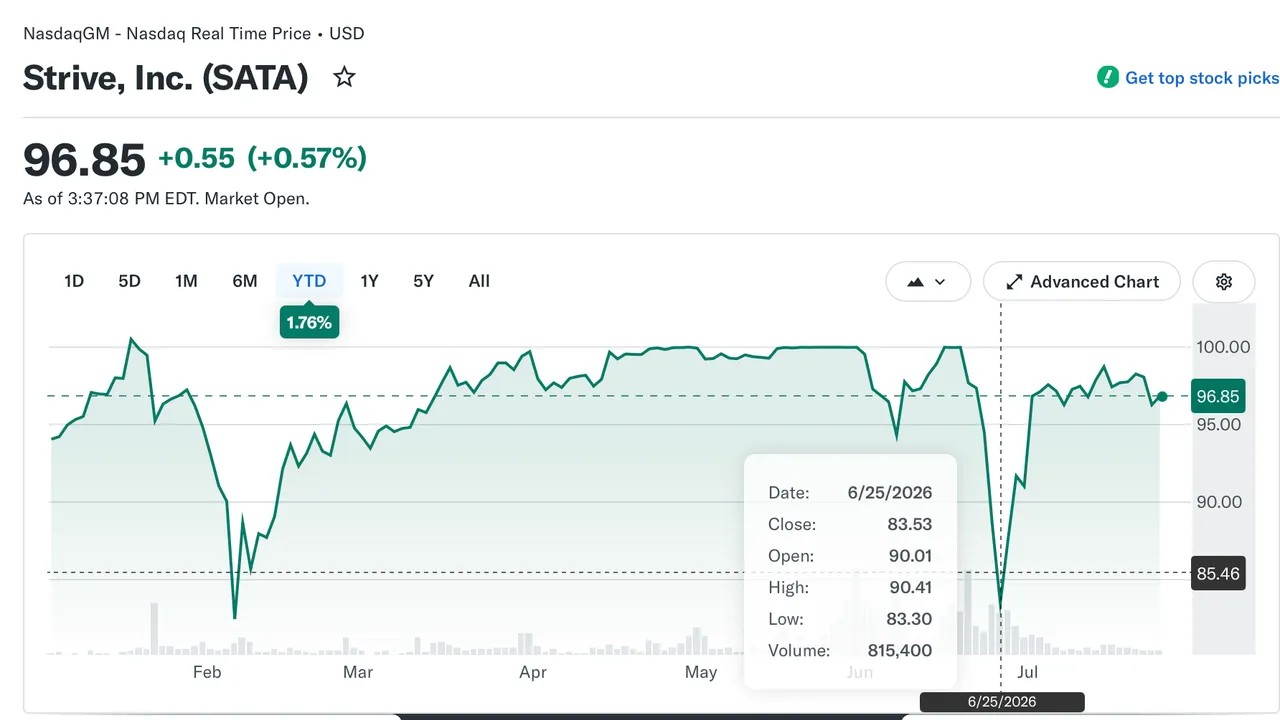
    Strive’s SATA preferred shares have rebounded from a June low of $83.30 to about $97, recovering most of the selloff and moving back within roughly 3% of their $100 par value, according to Yahoo Finance data.

    Strive introduced SATA in November 2025 as part of its strategy to finance the expansion of its Bitcoin treasury through preferred equity. The variable-rate perpetual preferred stock is intended to trade near its $100 par value by adjusting its dividend rate, allowing Strive to raise capital for its Bitcoin ($BTC) treasury without issuing additional common shares.

    SATA is one of a growing number of preferred-share products tied to Bitcoin treasury strategies, an emerging segment that companies such as Strategy describe as “digital credit.”

    Strategy’s STRC, launched in 2025 with a similar objective of maintaining a $100 share price through a variable dividend, also fell sharply during the late-June selloff before recovering, though it continues to trade below par at around $87.

    SATA year-to-date price chart. Source: Yahoo Finance

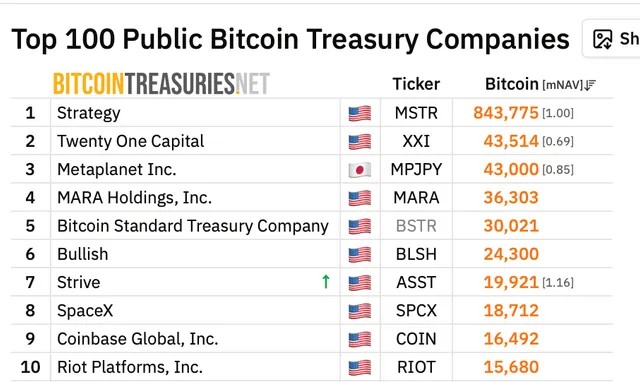
    While Strategy remains the world’s largest public corporate Bitcoin holder with 843,775 $BTC, Strive has climbed to seventh place with 19,921 $BTC, according to BitcoinTreasuries.NET.

    Top 10 Bitcoin treasury companies. Source: BitcoinTreasuries.NET

    SATA recovery could help lift Strategy’s STRC, says Mow

    Jan3 founder and CEO Samson Mow told Cointelegraph that recent adjustments by Bitcoin treasury companies are beginning to restore confidence in preferred-share products, supporting his view that Bitcoin has already found its bottom.

    “I think every action that Strategy has undertaken to strengthen their balance sheet and encourage STRC to go back to par is also working,” Mow said, adding:

    But everything sort of works in tandem. I think as SATA returns to par, you’re going to see STRC return to par too, because people say, ‘OK, this model’s not broken.’ Everyone is capitalized for three or more years of dividend payments… there was no reason to panic all along.

    Mow said the improving performance of preferred-share products is part of a broader shift in the Bitcoin treasury sector, where companies have continued refining their capital-raising strategies.

    He pointed to Lyn Alden’s Orange Juice treasury company, which launched on July 15 with plans to operate a Bitcoin treasury, as another example of firms entering the market with different approaches and a lower Bitcoin cost basis.

    Samson Mow interview with Cointelegraph. Source: Cointelegraph

  • Strategy Demands Corporate Bitcoin Transparency with MSTR-BTC Dashboard Revealing $54.88B in Holdings

    Strategy Demands Corporate Bitcoin Transparency with MSTR-BTC Dashboard Revealing $54.88B in Holdings

    Michael Saylor didn’t just announce a dashboard. He published a balance sheet with an address. Strategy’s new MSTR-$BTC interface, unveiled Thursday, is less a tool for shareholders and more a declaration: corporate Bitcoin holders no longer get to hide behind opaque treasury disclosures. The numbers, pulled straight from the blockchain, are unambiguous. The company holds 843,775 $BTC valued at $54.88 billion, priced at $65,035 per coin, according to the original report.

    This isn’t a marketing splash. It’s a structural shift in how public companies can verify digital asset reserves. The dashboard doesn’t rely on quarterly attestations or delayed SEC filings. It ties the treasury directly to on-chain data and capital structure metrics, displaying gross reserves of $58.1 billion, net reserves of $35.88 billion, and a market-based net asset value (mNAV) ratio of exactly 1.00x. For CFOs watching from the sidelines, that level of granularity changes the conversation.

    A Corporate Treasury Built on Public Verification

    Strategy’s move arrives at a moment when institutional Bitcoin adoption is accelerating, yet regulatory uncertainty still hangs over how companies account for digital assets. The dashboard’s numbers tell a specific story: year-to-date $BTC yield sits at 5.8%, representing a gain of 39,325 $BTC — roughly $2.56 billion in dollar terms since January. That’s not paper profit from a rising price; it’s net Bitcoin accumulation relative to diluted shares outstanding.

    Saylor has spent years framing Bitcoin as a superior treasury reserve asset. Now the company is proving the thesis with data that anyone can audit. The dashboard scrubs away the vagueness that once made corporate Bitcoin holdings a black box. If more firms follow this model, the market’s understanding of treasury risk shifts from trust-me filings to verifiable on-chain proof.

    But this transparency cuts both ways. A 1.00x mNAV tells investors the market values Strategy’s Bitcoin holdings at their spot price, with zero premium for the operating business or future acquisitions. That’s a signal the market is pricing the company purely as a levered Bitcoin play — not a software firm. For longtime bulls, that’s validating; for those waiting for a diversification narrative, it’s a reality check.

    The Transparency Standard Nobody Asked For

    Corporate Bitcoin treasuries are still a niche. Tesla, Block, and a handful of public miners hold significant positions, but none publish a live dashboard with this level of detail. Strategy is essentially setting the benchmark without any regulatory mandate, creating a market expectation that could pressure other firms to follow. If a company holds over $1 billion in Bitcoin and doesn’t provide comparable on-chain verification, that silence might start to look strategic.

    This dynamic parallels what happened with stablecoin reserves a few years ago. Transparency became a competitive advantage, then a baseline requirement. In the corporate treasury arena, Strategy is doing the same. The dashboard’s timing also matters. A recent push for clearer crypto accounting rules in the U.S. has been stalled by banking interests, a conflict detailed in our coverage of the biggest crypto bill facing Senate resistance. Until legislation resolves, voluntary transparency becomes the strongest signal.

    The dashboard doesn’t just list holdings; it connects debt structure to Bitcoin assets. Net reserves subtract obligations, giving bondholders and equity investors a clearer view of leverage. That’s especially relevant as tokenized real-world assets expand, with on-chain RWA markets crossing $20 billion and blurring the line between traditional finance and crypto collateral. When a corporate Bitcoin treasury is that transparent, using it as collateral becomes easier — and more dangerous if over-leveraged.

    The Parts the Dashboard Can’t Show

    What’s missing from the MSTR-$BTC interface is a volatility adjustment for the underlying asset. Bitcoin’s price at $65,035 gives a clean valuation, but anyone who watched the 2022 drawdown knows that $54.88 billion can quickly become $35 billion without any change in Strategy’s conduct. The dashboard’s elegance might obscure the fact that the reserve value is a moving target, not a stable number.

    There’s also a governance question. The dashboard assumes Bitcoin is a permanent treasury asset, but strategy shifts happen. If a future board decides to sell part of the stack, the real-time nature of the interface could amplify market panic. Transparency is a double-edged sword when the underlying asset is that volatile and that liquid.

    Still, for an asset class still fighting for legitimacy among corporate treasurers, Strategy’s move is aggressively normalizing. It’s borrowing the language of public company investor relations and applying it to an asset that many still dismiss. And it’s happening while institutions are quietly building out infrastructure — from institutional staking surges on networks like Sui to tier-one banks testing tokenized settlement. The dashboard fits into that larger picture, whether regulators are ready or not.

    Strategy didn’t invent corporate Bitcoin holding. But with one interface, it just made holding it quietly look like a decision not to be transparent. That might be the dashboard’s biggest impact: not the data it shows, but the standard it imposes on everyone else.
  • LMAX taps Morgan Stanley and KBW for potential $5 billion IPO

    LMAX taps Morgan Stanley and KBW for potential $5 billion IPO

    Institutional crypto trading platform LMAX Group is working with Morgan Stanley and KBW to evaluate strategic options that could include a sale or public listing, according to three people familiar with the matter.

    The London based company could seek a valuation of up to $5 billion. Options under consideration include a sale, SPAC merger, or IPO in the United States or Europe, with a Nasdaq listing currently the preferred route.

    LMAX is reportedly in no rush to complete a transaction as weak crypto markets weigh on the sector, while its foreign exchange business provides some protection from the downturn.

    LMAX operates institutional trading venues for foreign exchange and digital assets, providing execution, liquidity, and market infrastructure to banks, brokers, hedge funds, and asset managers.

    The company has expanded its digital asset operations over the past year. In February, it launched a 24 hour multi asset exchange for foreign exchange, digital assets, commodities, and tokenized securities.

    The launch followed a $150 million strategic investment from Ripple in January to support the adoption of its RLUSD stablecoin across LMAX trading and settlement infrastructure.

    A $5 billion valuation would represent a fivefold increase from 2021, when J.C. Flowers acquired a 30% stake for $300 million, valuing LMAX at approximately $1 billion.

    The potential transaction comes as crypto exchanges and financial infrastructure companies pursue deals to expand institutional trading, custody, settlement, tokenization, and stablecoin services.

  • Samsung Wallet to Support Stablecoins

    Samsung Wallet to Support Stablecoins

    Samsung has taken a significant step in the cryptocurrency world by adding stablecoin support to its mobile wallet, Samsung Wallet. At the recent Galaxy Unpacked event, it was announced that Samsung Wallet will support stablecoins like $USDC. This move brings digital dollars into the pockets of hundreds of millions of Galaxy device users.

    Innovations Announced by Samsung

    Stablecoin integration was introduced as part of an effort to make Samsung Wallet a unified hub for payments, rewards, and digital assets. Samsung framed this innovation as a “secure payments and rewards experience.” A definitive launch date for the stablecoin feature has not yet been announced, and it hasn’t been officially confirmed which stablecoins will be supported besides $USDC. However, there are strong indications that $USDC will be supported.

    This announcement came alongside Samsung’s introduction of the Galaxy Card, issued by Barclays and operating on the Visa network. This credit card offers various cashback rewards to US users. A partnership with Coinbase in 2025 provided millions of US Galaxy users with access to cryptocurrency services directly through their devices, laying a significant foundation for transforming Samsung Wallet into a more comprehensive digital asset platform.

    What it Means for Investors

    For Circle, the company behind $USDC, this partnership could strengthen its position ahead of a potential IPO or market activity. However, regulatory frameworks for stablecoins are still under development in many regions. Samsung will have to overcome varying compliance requirements in its global markets, which could initially lead to the feature being limited to certain regions. The Galaxy Card, in partnership with Barclays, is likely to launch in the US market as the first target.

    The partnership with Coinbase in 2025 provided Samsung with a foundation in crypto services, but stablecoin integration offers an entirely different proposition. It’s one thing to offer users the ability to buy Bitcoin through a partner app, but integrating the dollar equivalent of digital currency into the core wallet experience is quite another.

  • An Altcoin Has Formed a Partnership with a Major Company; It Will Acquire Its Tokens—Price Surges Suddenly

    An Altcoin Has Formed a Partnership with a Major Company; It Will Acquire Its Tokens—Price Surges Suddenly

    AGI3, a conglomerate of Kinetic Group and developer of the decentralized finance protocol Fluid, has submitted a governance proposal for a strategic ecosystem partnership focused on corporate finance and real-world assets.

    According to the proposal, Kinetic Group plans to acquire up to 10% of the total supply of $FLUID tokens through secondary market purchases and over-the-counter transactions. It was stated that the tokens to be purchased will not come from the Fluid DAO treasury or team allocation.

    The Fluid Foundation will also reserve 5% of the $FLUID supply for safekeeping in compliant private banks and institutional digital asset custodians in Switzerland, the European Union, Hong Kong, and Singapore. These tokens will remain locked for at least four years, until 2030.

    Related News Goldman Sachs CEO Makes a Surprise Bullish Statement on Cryptocurrencies

    As part of the partnership, AGI3 will also transfer 2% of its company shares to Fluid Foundation. A four-year lock-in period will apply to these shares.

    AGI3 Markets, the core product of AGI3, is designed as a permissioned DeFi platform for institutional investors. The platform will feature KYC and anti-money laundering controls and will support trading and lending of real-world assets such as tokenized private loans, government bonds, commodities, equities, and corporate bonds.

    According to the agreement between the parties, all protocol revenues and incentive budgets generated through AGI3 Markets will be shared 50/50 between Fluid and AGI3.

    *This is not investment advice.

  • Mirae plans to turn crypto exchange Korbit into something Korea hasn’t seen before

    Mirae plans to turn crypto exchange Korbit into something Korea hasn’t seen before

    Korbit currently holds less than 1% of South Korea’s domestic crypto market, far behind giants Upbit and Bithumb. When asked directly about its strategy to compete, Mirae Asset stressed that the goal is not to overtake any other company or exchange, but to promote sustainable growth of the digital assets industry in South Korea.

    “We intend to combine Mirae Asset’s extensive global investment expertise with Korbit’s digital asset capabilities to promote the sound and sustainable growth of the digital asset industry in Korea and globally.”

    In other words, Mirae Asset isn’t trying to outdo Upbit or Bithumb, but to offer a one-stop shop that brings together institutional investment capabilities, research, education, and digital asset infrastructure under one roof.

    The group also told CoinDesk it would strictly comply with AML, KYC, and fraud-detection standards across all areas, a signal that Digital X is being positioned for institutional clients as much as for retail traders.

    Mirae Asset’s affiliate Mirae Asset Consulting recently increased its stake in Korbit to 97.15%, completing the acquisition after receiving regulatory approval from South Korea’s Fair Trade Commission.

    “The acquisition was carried out through lawful procedures following a thorough review of the relevant laws and regulatory framework. Mirae Asset Consulting was selected as the acquiring entity after comprehensive consideration of each affiliate’s business purpose and role, as well as its potential synergies with the digital asset business,” the firm said.

  • Bitcoin Exchange Binance Announces Adding Three Altcoins to its Risky Asset List! Here Are Those Altcoins

    Bitcoin Exchange Binance Announces Adding Three Altcoins to its Risky Asset List! Here Are Those Altcoins

    Binance, one of the world’s largest cryptocurrency exchanges, has decided to expand its risk warning system for some digital assets listed on its platform. According to the exchange’s statement, as of July 24, 2026, Across Protocol (ACX), Lisk (LSK), and Stacks (STX) tokens will also be included in the Monitoring Tag system.

    Binance stated that the Monitoring Tag application is used to show investors tokens that are deemed to have higher volatility and risk compared to other listed assets. Projects with this tag are regularly reviewed and may face complete delisting from the platform if they fail to meet the exchange’s listing criteria.

    The exchange emphasized that adding the tag does not mean the tokens in question will be directly delisted, and stated that the performance of the projects will continue to be closely monitored. The Monitoring Tag may be removed as a result of periodic evaluations, and different tokens may be included in this scope if deemed necessary.

    Binance also shared the criteria it considered during the review process. These include the project team’s commitment to development activities, the level and quality of software development work, trading volume and liquidity, network security and resilience to attacks, the stability of smart contracts, and the level of communication with the public.

    The project teams’ responses to Binance’s periodic audit requests, significant changes in token supply, updates to the token economy, any activity suspected of being unethical or fraudulent, and the project’s contributions to the crypto ecosystem are also considered in the evaluation process.

    Users who wish to trade tokens covered by the Monitoring Tag are required to complete a risk awareness test and approve the relevant risk disclosures at regular intervals. Binance states that this practice aims to help investors make more informed decisions about high-risk assets.

    *This is not investment advice.

  • Ripple’s RLUSD gets two boosts as transfer volume drops 25%

    Ripple’s RLUSD gets two boosts as transfer volume drops 25%

    Fintech firm Ripple made two moves on Thursday aimed at growing its dollar-backed stablecoin, $RLUSD, in a month when transfer volume across the token has dropped by 25%.

    The first is Ripple Mint, a platform that lets institutional customers create, redeem, bridge and track $RLUSD through a web dashboard or direct integration.

    Until now, minting $RLUSD — the process of issuing new tokens when a customer deposits dollars — generally meant arranging it directly with Ripple and waiting on a manual issuance process. The APIs let a firm trigger minting and redemption automatically from its own systems and track each transaction from dollar transfer to onchain settlement.

    Ripple has also been extending $RLUSD beyond the $XRP Ledger and Ethereum onto the XRPL EVM sidechain, Base, Optimism, Ink and Unichain, widening the number of networks where the token can circulate.

    Separately, Ripple announced late Thursday a strategic investment in Notabene. This compliance network places $RLUSD inside its business-payments platform, putting the token in front of institutions positioned to send and receive it.

    So, while Mint is designed to make $RLUSD simple to create and manage, Notabene is built to get it moving through institutional payment rails.

  • Bears tighten grip on AVAX as open interest rises alongside falling prices

    Bears tighten grip on AVAX as open interest rises alongside falling prices

    Avalanche [$AVAX] token prices were down by 4.91% in the past 24 hours. This was among the biggest price drops for crypto assets in the top 35, by market capitalization, CoinMarketCap data showed.

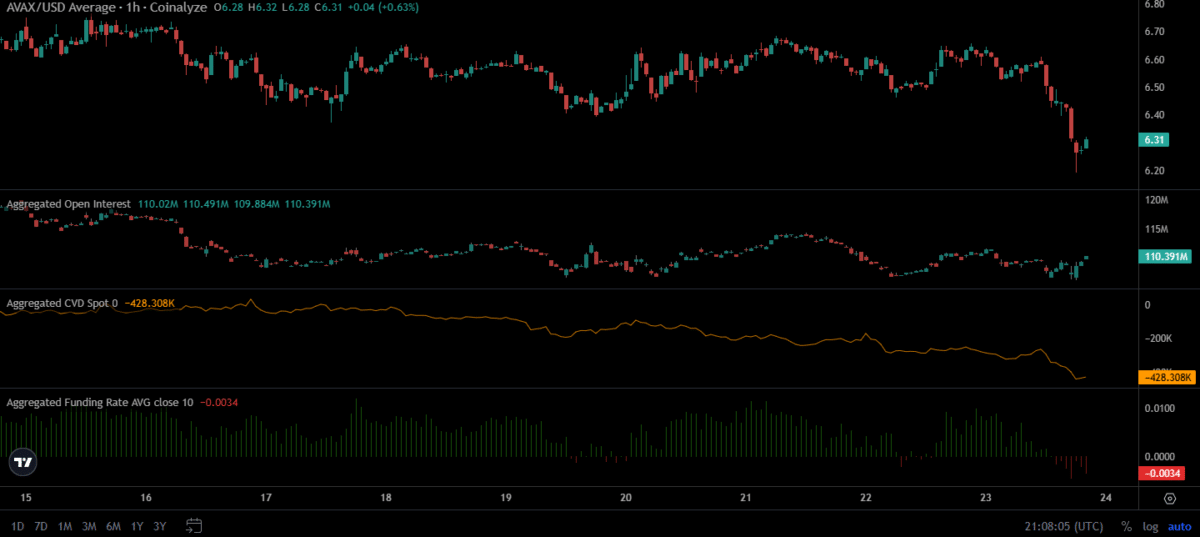
    Source: Coinalyze

    The price drop came alongside an uptick in Open Interest in the past few hours, even as prices fell below the $6.50 local support zone. The spot CVD declined noticeably, and the funding rates also slipped into negative territory.

    In other words, the short-term market expectations were firmly bearish. Let’s see what the price trends hold in store for $AVAX bulls.

    The Avalanche bulls’ struggles have centered around $7 recently

    In a recent report, AMBCrypto detailed how the altcoin’s price trends were stalling even after a 20x surge in daily transactions onchain. The long-term price trend of Avalanche was pointed downward.

    It did not help that in the past 24 hours Bitcoin [BTC] fell below the $65.5k local support zone and was trading below $65k too at the time of writing. If this selling persists, it could trigger a bearish market sentiment shift, dragging $AVAX further south.

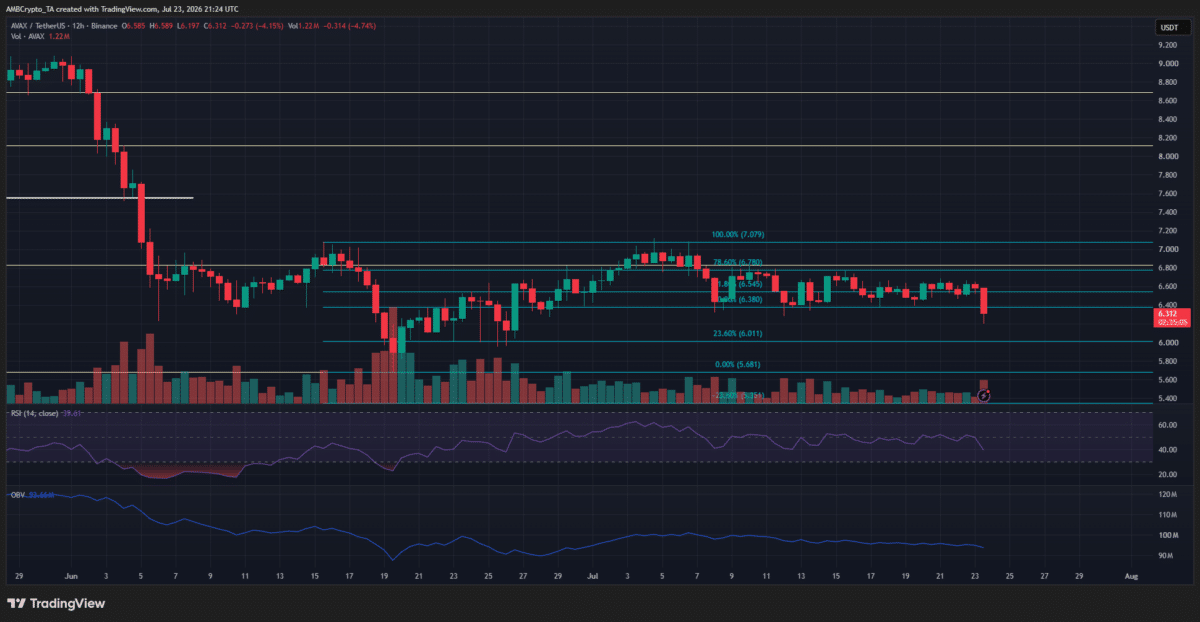
    Source: $AVAX/USDT on TradingView

    The longer-term downtrend saw a new swing low registered at $5.68. On the 12-hour timeframe price chart above, this has given rise to a bearish swing structure. A bullish structure would have come into play had the $7.08 swing high been broken.

    It was tested in early July, but not broken. The subsequent rejection has dragged prices lower. Over the past two weeks, $AVAX has traded between $6.38 and $6.78.

    At press time, the band of support around $6.40 appeared to have been breached. This could accelerate the downtrend and drive prices toward $6 and below in the coming days.

    Traders’ call to action- Maintain a bearish bias

    As the Coinalyze data showed, short-selling was becoming popular. As bearish conviction takes root in the derivatives market, it could lead to a short squeeze.

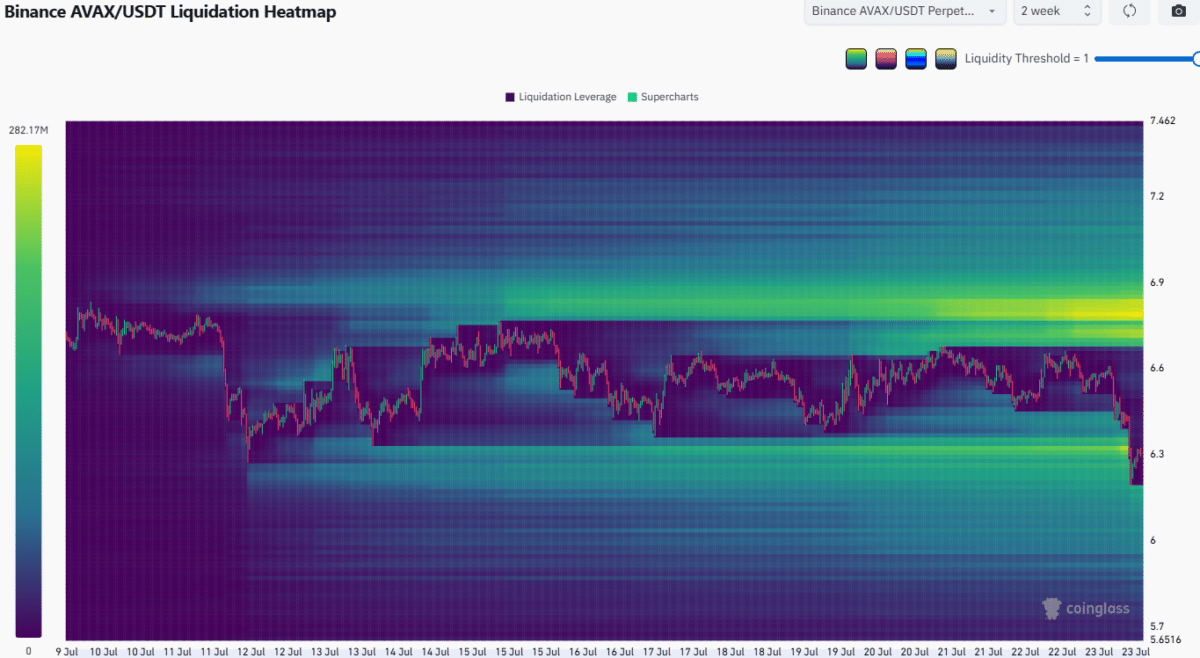
    Source: CoinGlass

    The 2-week $AVAX liquidation map underlined this threat precisely. To the north, the $6.70-$6.85 area had a dense cluster of short liquidations. This area can be a key magnetic zone that pulls prices upward briefly, before a continuation of the existing bearish trend.

    Therefore, traders can maintain a bearish bias but also be wary of a short squeeze.

    Final Summary

    • Avalanche witnessed steady spot selling, a slight uptick in Open Interest, and negative funding rates in recent trading hours- pointing to heightened short-selling.
    • The loss of the $6.50 support zone could push prices toward and below $6.0 next, but traders should beware of a potential short squeeze.
  • Cathie Wood Snaps Up $60M In Tesla, Circle, Securitize Shares As US Stock Market Crashes

    Cathie Wood Snaps Up $60M In Tesla, Circle, Securitize Shares As US Stock Market Crashes

    On Thursday, July 23, Cathie Wood’s ARK Invest purchased almost $60 million worth of Tesla, Circle Internet Group and Securitize Corp. stock. The purchases coincided with a dramatic sell-off in U.S. stocks. Inflation-driven higher oil prices, higher US Treasury yields and a strong dollar led to a bearish investor sentiment.