“As it uses existing rules, it’s going to be much less like a standalone framework,” Lightstone said. “A crypto firm will be treated like any normal traditional financial institution,” adding that “it will still be hard to get FCA authorization.”
For established banks and investment firms already operating under those rules, adapting to crypto may be relatively straightforward. For newer crypto businesses, however, the cost of building governance, capital and custody systems from scratch could prove considerably more burdensome.
That challenge is particularly evident in the FCA’s proposed client asset regime, applying the Clients Asset Sourcebook (CASS) framework, which would require firms to segregate customer crypto assets from company funds under trust arrangements while introducing crypto-specific operational safeguards around private keys and reconciliations.
“The CASS requirements are very onerous,” Lightstone said. “That could encourage those newcomers to merge [with], be acquired by, a traditional firm that’s already subject to CASS and has those controls in place.”
Banking adoption
The prospect of consolidation comes as banks themselves appear more willing to enter digital assets now that regulatory uncertainty is beginning to lift.
“As of today, there is less than 20% of all the banks in Europe [that] offer today any type of crypto services, so it’s heavily underserved,” said Simon Schneider, CEO of Sygnum Europe.
Developer activity keeps serving as a key factor to indicate the health of the blockchain network. This data still reflects innovation, long-term sustainability, and community engagement. Based on the data from Santiment, Ethereum, $BNB Chain, and Polygon are the leading blockchains in terms of developer activity. The other prominent players include Arbitrum, Optimism, Solana, Cosmos, Avalanche, Harmony, and Cardano.
Ethereum Continues to Dominate 30-Day Developer Activity
Ethereum is the top name on the list of key blockchains in line with developer activity. Over the past thirty days, the blockchain has recorded 263.3K developer activity events with a 40.29% decline. Additionally, these events witnessed 1.1K contributors, expressing a 13.23% drop. In addition to this, $BNB Chain has become the 2nd top player, witnessing 121.8K developer activity events with a 40.72% decrease. At the same time, the respective events had 603 contributors, highlighting a 17.62% dip.
Following that, Polygon has become the 3rd top blockchain ecosystem when it comes to developer activity over the past 30 days. In this respect, it saw 100.4K developer activity events, displaying a 40.85% plunge. Additionally, the 452 contributors of these events show a 16.14% decrease. Additionally, as the 4th top name on the list, Arbitrum accounted for 79K events with a 45.22% decline, while its 373 contributors expressed an 18.02% dip.
Solana, Avalanche, Harmony, and Cardano Bottom List
As per sanbase data, Optimism’s 78.4K monthly developer activity events indicated a 45.3% dip. Simultaneously, its 355 contributors signified an 18.01% drop. Then comes Solana with 77.4K developer activity events, showing a 32.14% decline. However, its 377 developer activity contributors show a 1.62% rise over the same period.
According to Santiment, Avalanche is the 8th top blockchain when it comes to 30-day developer activity. It thus recorded 73.4K events with a 43.93% dip alongside 320 contributors, reflecting a 15.34% decrease. Additionally, Harmony’s 62.9K monthly developer activity events show a 39.45% dip, while its 287 contributors present a 10.87% drop. Concluding the list, Cardano’s 62.6K events and 295 contributors account for 34.58% and 11.41% dips.
Shiba Inu has recently flipped negative and its key exchange activity shows that demand is on pause and traders are increasingly selling again.
Latest onchain data from crypto analytics platform CryptoQuant shows that the Shiba Inu exchange activity has retreated from its recent bullish position, flashing negative signals.
Shiba Inu price explodes
The data shows the Shiba Inu exchange netflow has increased to over 69 billion $SHIB as the amount of $SHIB currently available for sale across all supported exchanges has surged substantially.
With the $SHIB exchange flow sitting at a net balance of 69,237,400,000 $SHIB, it implies that the amount of $SHIB tokens being sent to exchanges for sale over the last day is substantially higher than the amount of tokens removed from the exchanges for buying purposes.
Despite the bearish trend in the Shiba Inu exchange activity, Shiba Inu has taken an unexpected turn with an explosive price move that has seen its price reclaim a previous high.
Unlike previous market situations when bearish netflows are met with extreme price volatility, Shiba Inu has defied the trend this time, resisting the pressure from sellers.
Although the $SHIB exchange activity shows that inflows are outpacing outflows, Shiba Inu has surged by over 10% over the last 24 hours, reclaiming its previous high of $0.000004566.
Nonetheless, the unexpected divergence between the $SHIB price move and exchange netflow suggests that buyers are aggressively absorbing the additional supply entering exchanges.
The company behind the cryptocurrency and stock trading app, Robinhood, is reportedly discussing plans to expand its existing prediction markets offering with crypto exchange Crypto.com.
According to a Friday Wall Street Journal report citing people familiar with the matter, Robinhood was in talks with Crypto.com to place yes-or-no event contracts supplied by the exchange. The trading company launched its prediction markets hub in March 2025, initially facilitated by Kalshi in order to comply with regulatory requirements from the US Commodity Futures Trading Commission (CFTC), and later using ForecastEx and Rotella.
The reported move came just days after Bernstein analysts raised the firm’s price target on Robinhood (HOOD) stock to $160 from $130 per share, based on the company’s outlook for prediction markets and tokenized equities. They predicted Robinhood’s revenue using prediction markets could reach $1.7 billion by 2028.
While Bernstein said in April that volumes in prediction markets could reach $1 trillion by 2030, many of the platforms face ongoing legal challenges in the United States between state and federal authorities. The CFTC has claimed to have “exclusive jurisdiction” over the companies’ event contracts, while gaming authorities in many states have filed lawsuits attempting to block or restrict their activities.
Sui [$SUI] faced a 5% price drawdown in the past 24 hours, with a 9.6% uptick in daily trading volume. This was worrisome as it suggested a short-term increase in selling pressure.
The rest of the crypto market has faced losses over the past day, too. Bitcoin [BTC] and Ethereum [ETH] were down 1.05% and 1.14%, respectively. Compared to these market leaders, Sui was underperforming in the short-term.
Why the Sui downturn is surprising
Coinbase announced that $SUI can be staked directly on the exchange. Staking rewards would directly accumulate to the user’s account. It offered an easy, effortless way of earning rewards.
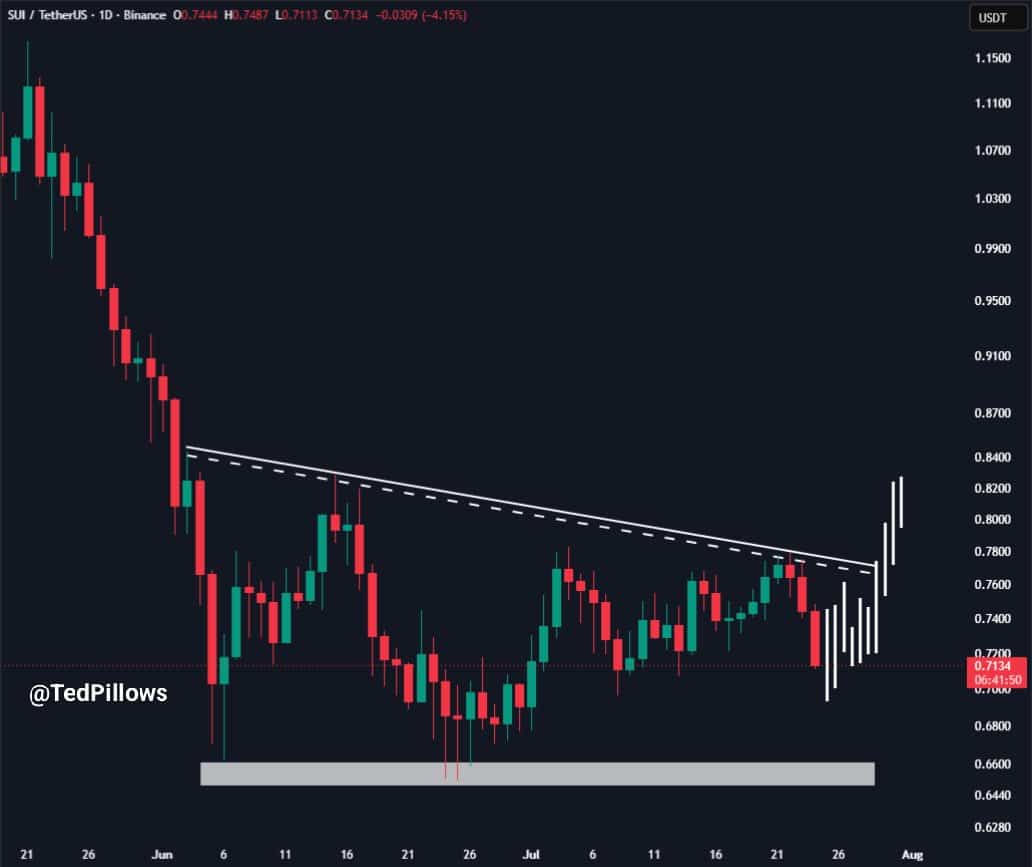
Source: Ted on X
Trader Ted noted that the bullish catalyst could help the altcoin break past the descending trendline resistance in place since early June. The token has defended the $0.66 support zone well so far.
Some more consolidation followed by a bullish breakout was a viable scenario, the trader wrote.
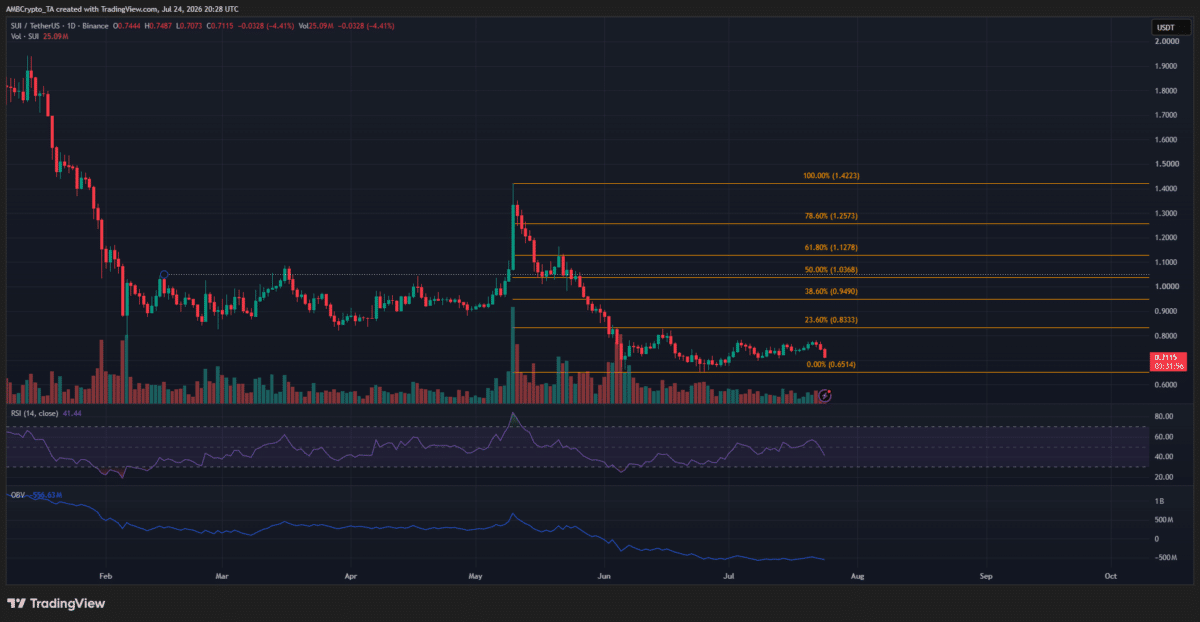
Source: $SUI/$USDT on TradingView
The swing low at $0.65, made in June, marked the swing structure’s low. The RSI on the 1-day timeframe recently climbed above neutral 50, but the losses of the past three days sent the momentum indicator tumbling once more.
The OBV was in a downtrend, although the selling pressure has eased in July.
A pullback, in the form of a rally toward $1.12-$1.25, the Fibonacci golden pocket, was technically possible. However, it was far from playing out in reality.
Traders’ call to action- Wait
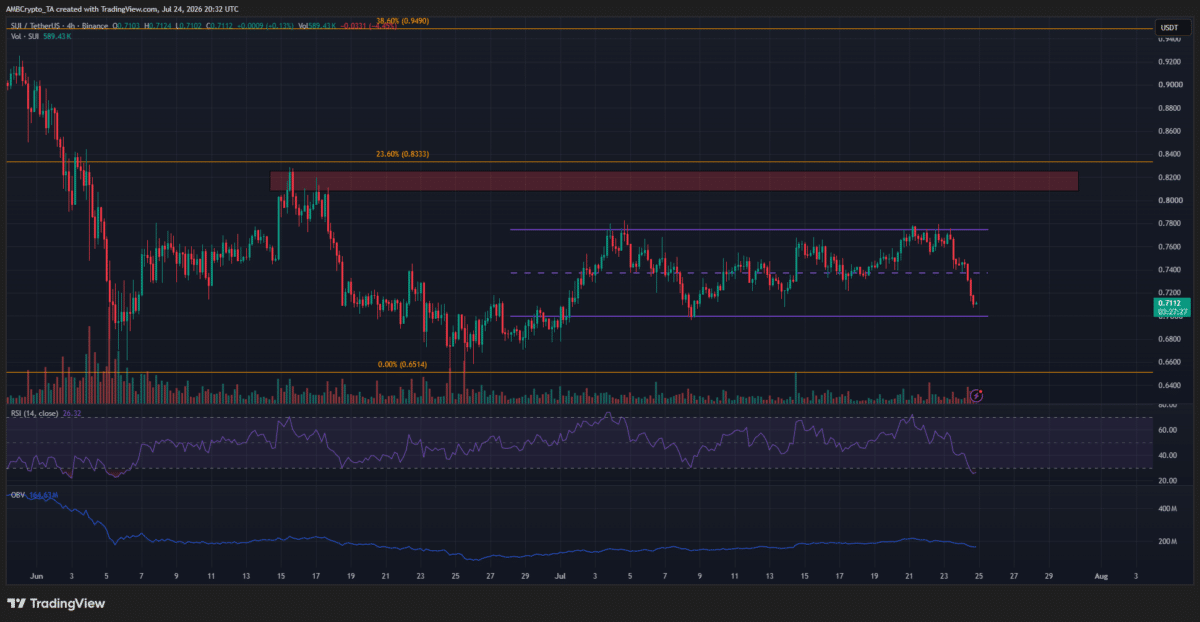
Source: $SUI/$USDT on TradingView
In July, $SUI has been trading within the $0.70-$0.77 range. Traders can look to trade the token within this range. The RSI on the 4-hour chart was in oversold territory as the token approached the range lows.
While this can be a buying opportunity, a breakout past the $0.82 local resistance zone would be a stronger buy signal for swing traders. Similarly, a breakdown below $0.65 would signal that the next impulse bearish price move was imminent.
Final Summary
The Coinbase staking news has served as a sell-the-news type event.
The short-term range between $0.70-$0.77 might provide trading opportunities, but the $0.82 supply zone is also one to keep an eye on.
Since the October 2025 peak, Bitcoin has failed to sustain an uptrend, falling 48% from its $ATH. Amid this extended market weakness, long-term holders, especially institutions, have seen their losses skyrocket.
The rising losses have pushed many of these firms to a breaking point, and they are not only capitulating but also walking away.
KULRTech dumps $9 million in Bitcoin
Treasuries that rushed to accumulate Bitcoin [$BTC] from late 2024 and 2025, fearing they would miss out, have found themselves operating at a loss.
Others were pushed to capitulate to avoid more losses, and one such Bitcoin treasury company is KULRTech.
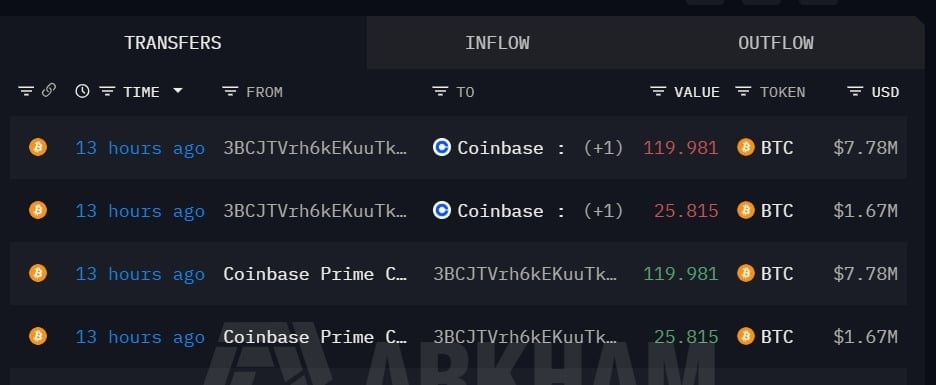
KULRTech has been aggressively dumping its $BTC over the past months. According to Arkham data, KULRTech transferred 145.8 $BTC worth $9.45 million to Coinbase Prime.
Source: Arkham
After multiple transfers, its holdings of 1,021 $BTC worth $101 million now have only 100 $BTC worth $6.47 million left.
In its selling spree, the company has mostly exited at a loss. AMBCrypto earlier reported that KULR Bitcoin holdings saw over $18 million in losses.
Now with only 100 $BTC left, it seems the company is on the verge of completely exiting its position. Thus, if weakness continues, the company is likely to sell and exit the market entirely.
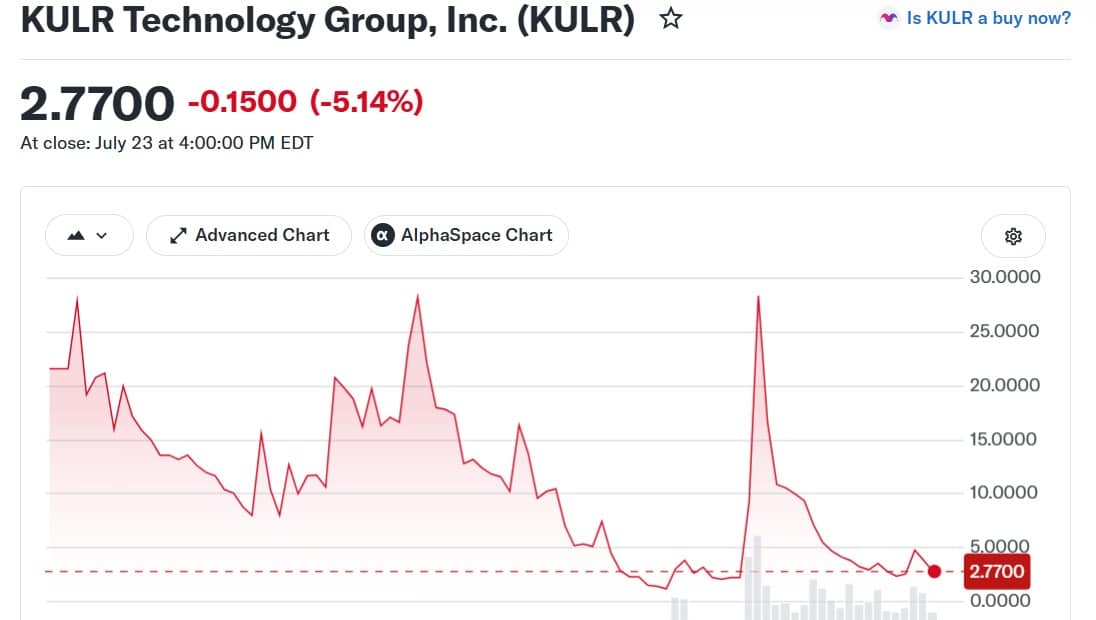
Source: Yahoo Finance
Even more impactful for KULRTech, the company’s stock value was hit the hardest by extended Bitcoin poor performance.
Yahoo Finance data showed that the company’s stock declined 78% from its $ATH of $43 recorded after it announced its $BTC investment. As of this writing, the firm’s stock value was around $2.7.
Treasuries holdings value plunges $47 billion from 2025 peak
KULR Technology Group, Inc is one of the many Bitcoin treasury companies operating at a loss. Also, it joins a long list of these firms aggressively selling.
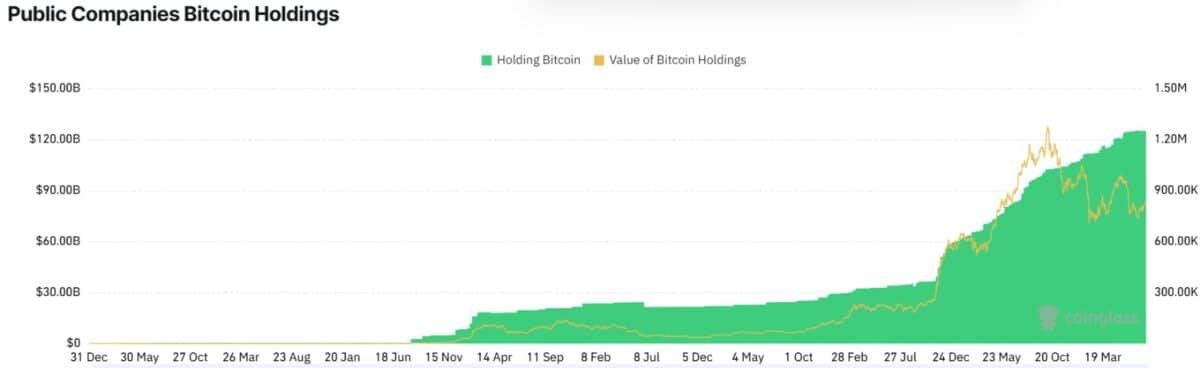
Interestingly, while Treasury companies have increased their holdings in 2026, they have yet to reclaim peak value.
Source: CoinGlass
In 2025, Bitcoin treasury companies held 1.02 million $BTC worth approximately $128.5 billion at the peak. Now, these firms hold 1.25 million $BTC worth $81.5 billion, marking a $47 billion drop from the 2025 peak.
Thus, although holdings have increased by 230k $BTC, the value remains extremely low, signaling rising losses. For example, Strategy is currently operating on $9 billion in losses.
With these major investors holding at a loss and continually selling, the Bitcoin market still remains at extreme risk. Thus, fear from treasuries could drive continued market weakness, further reducing the capital that $BTC relied on significantly for the 2024-2025 rally.
Final Summary
KULR Technology Group transferred 145.8 $BTC worth $9.45 million to Coinbase Prime, reducing total holdings to 100 Bitcoin.
Bitcoin treasuries have increased holdings by 230k $BTC since October 2025, but value dropped from $128 billion to $81 billion.
Nation’s Largest Police Labor Group Reverses Course
The National Fraternal Order of Police (FOP) has endorsed the latest version of the Digital Asset Market Clarity Act after lawmakers revised provisions that had raised concerns about cryptocurrency-related prosecutions.
Founded in 1915, the FOP describes itself as the largest law enforcement labor organization in the United States, representing more than 382,000 active and retired officers. Its size gives the group a prominent voice in federal debates affecting policing, criminal investigations, and officer resources.
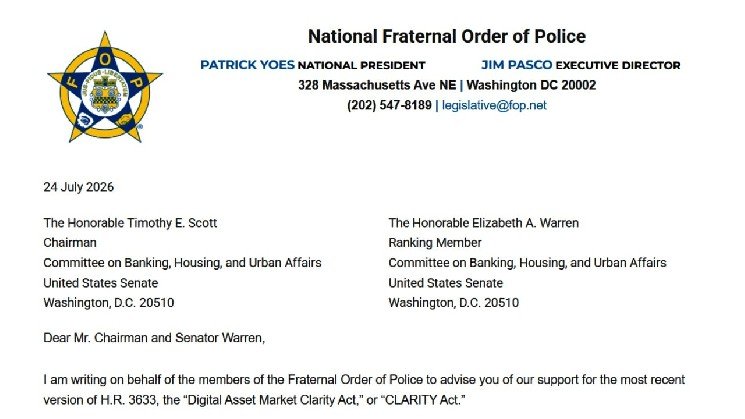
In a July 24 letter to Senate Banking Committee Chairman Tim Scott and ranking member Elizabeth Warren, FOP National President Patrick Yoes said the organization’s concerns had been “satisfactorily addressed.”
The endorsement reverses the FOP’s earlier position. In its April opposition letter, the organization warned that language involving noncontrolling blockchain developers could restrict prosecutors pursuing financial crimes involving cryptocurrency.
Revisions clarified that protections for certain noncontrolling software developers and decentralized technologies would not curtail investigations, prosecutions, or the application of established criminal statutes.
Law Enforcement Positions Shift
The FOP joins the National Organization of Black Law Enforcement Executives (NOBLE), which became the first major police organization to endorse the legislation. NOBLE said the bill would expand investigative capabilities while preserving established criminal authorities, marking an early law enforcement endorsement for the proposal.
Major County Sheriffs of America stopped short of endorsing the bill but withdrew its opposition after further discussions. The group’s move to a neutral position suggested that revisions had eased some concerns.
Opposition has not disappeared. A coalition representing more than 70,000 prosecutors, sheriffs, police chiefs, and other professionals previously called for changes to the CLARITY Act, arguing that broad exemptions could weaken oversight and investigative tools.
Revised Bill Expands Enforcement Tools
The revised bill would protect digital asset companies and stablecoin issuers from liability when they voluntarily delay suspicious transactions or act at law enforcement’s request. Temporary holds could give investigators time to prevent losses, trace stolen assets, and disrupt illicit transfers.
The legislation also addresses crypto ATM fraud and applies Bank Secrecy Act obligations to covered digital commodity exchanges, brokers and dealers. An official section-by-section summary says those businesses would face anti-money laundering, customer identification, and due diligence requirements.
Title IX would establish a grant program to strengthen state and local digital asset enforcement capabilities, create a law enforcement and national security training program, establish a digital asset cyber innovation center, and fund research into emerging technologies used in cryptocurrency-related crime. The provisions also include initiatives aimed at protecting older Americans from fraud and improving coordination among federal, state, and local agencies.
Democrats Reject Latest Senate Draft
U.S. Senator Cynthia Lummis (R-WY) released an updated CLARITY Act draft July 22 after Senate banking and agriculture lawmakers combined their market-structure proposals. The measure addresses securities oversight, commodities regulation, decentralized finance, illicit-finance controls, and federal ethics requirements involving digital assets.
Seven Democratic senators rejected the Republican text, contending that the proposal still falls short of an acceptable bipartisan agreement. Their joint statement opposing the current draft identified unresolved concerns involving elected officials’ ethics, consumer protections, illicit finance, conflicts of interest, and market integrity.
Although the seven lawmakers pledged to continue negotiations, Republicans are expected to need Democratic votes to reach the 60-vote threshold typically required to invoke cloture if the legislation faces a filibuster. The timing of a floor vote will depend on whether negotiators can resolve the remaining political and regulatory disputes.
On the 24th of July, a whale transferred 191,453,164 USD Coin [$USDC] into the Aave protocol.
Whale Alert valued the transaction at $191.42 million. The transfer confirmed sizable protocol activity, although its effect on $AAVE demand remained unclear.
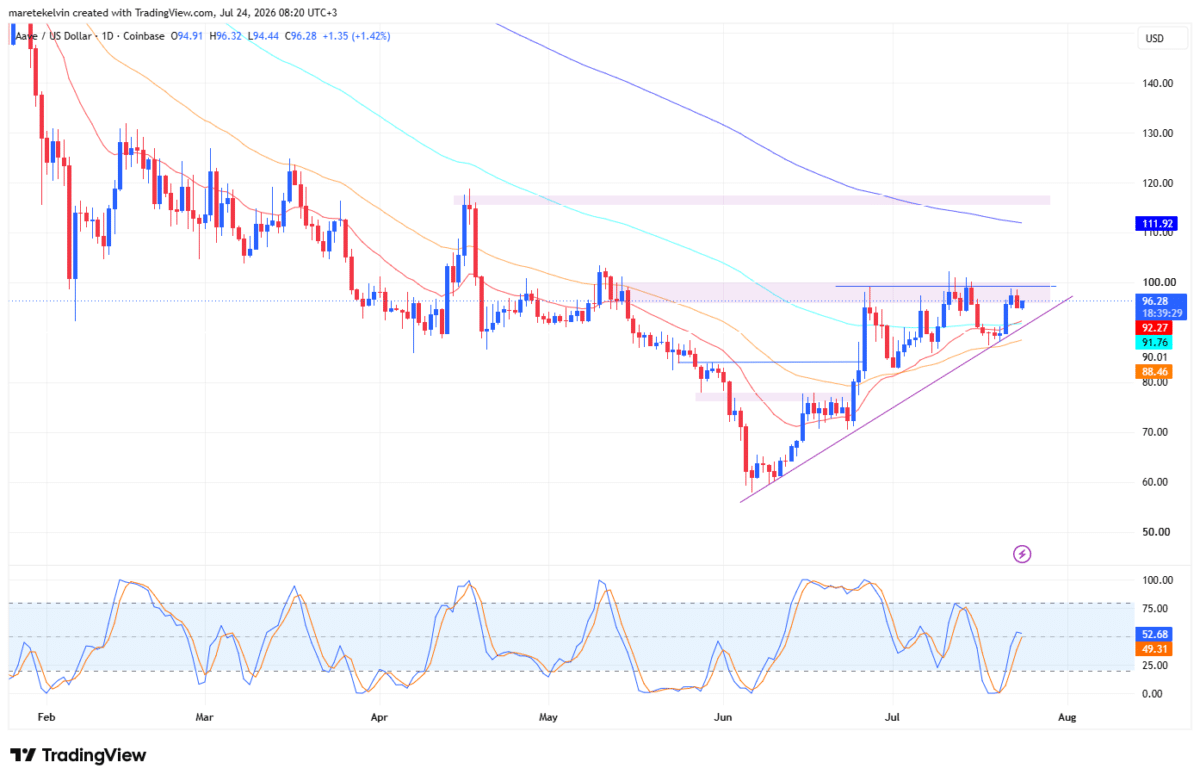
Meanwhile, Aave [$AAVE] traded at $96.28, just below the resistance around $99–$100. This zone had rejected several recovery attempts, making the whale’s timing particularly notable.
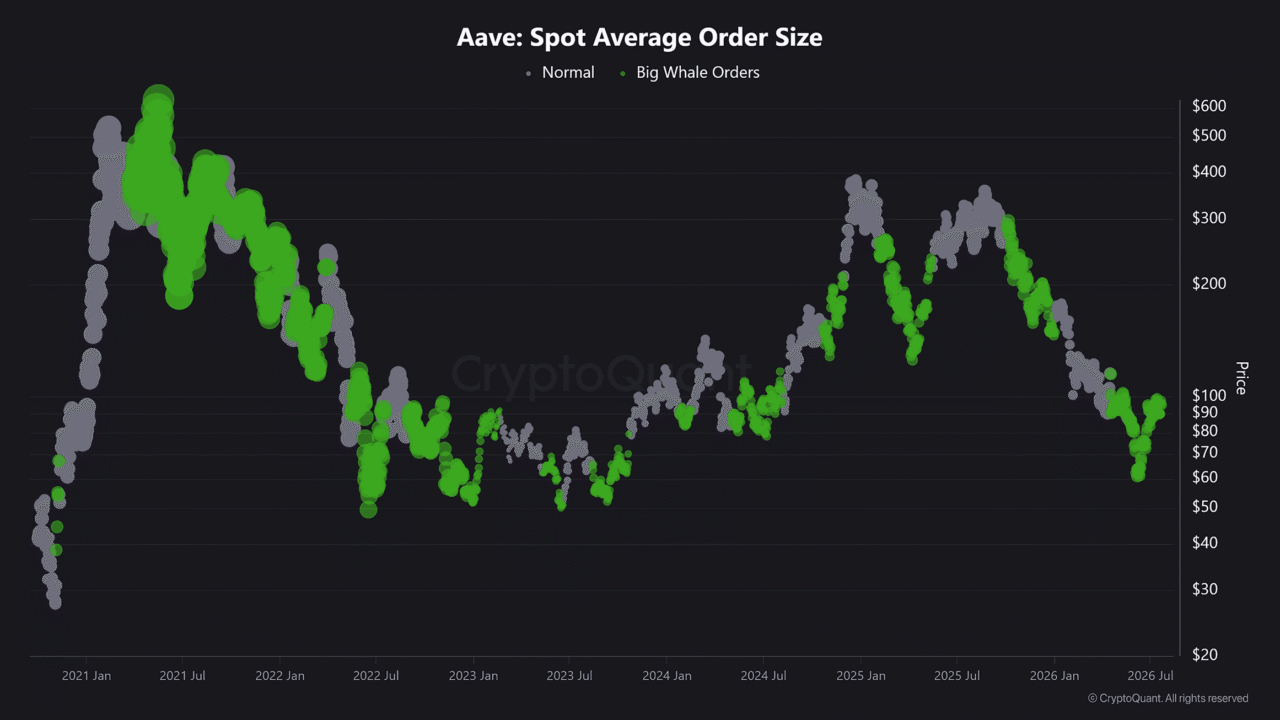
CryptoQuant’s Spot Average Order Size also recorded Big Whale Orders near $AAVE’s current price range. However, neither dataset confirmed that these whales bought $AAVE ahead of a breakout.
Source: CryptoQuant
Are whales positioning before $100?
The $USDC transfer was part of a broader increase in large transactions.
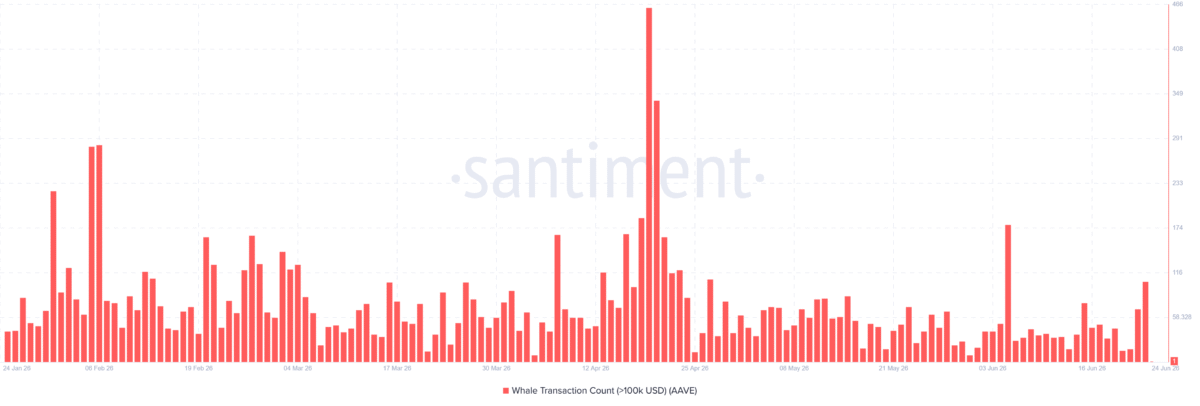
Santiment recorded a rise in Whale Transaction Count for transfers exceeding $100,000 before the latest partial reading. This activity suggested renewed interest from large holders. However, the metric included purchases, sales, and wallet transfers.
Consequently, a higher Whale Transaction Count could increase volatility without determining its direction.
Source: Santiment
Spot demand offered a clearer bullish signal.
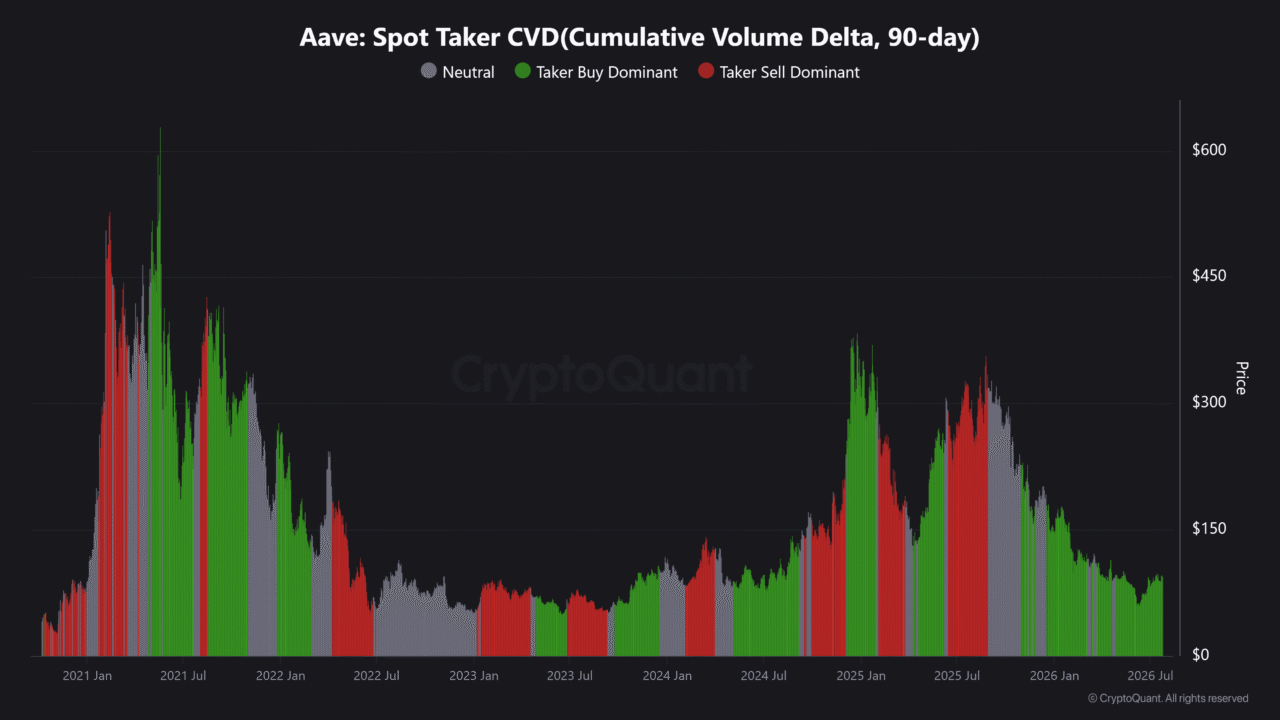
CryptoQuant’s 90-day Spot Taker CVD showed Taker Buy Dominant activity during $AAVE’s latest recovery. This indicated that aggressive spot buyers had increasingly crossed the spread to complete purchases.
Coinalyze data supported that positioning. Longs represented 56.09% of one-day positions, compared with 43.79% for shorts.
The one-day Long/Short Ratio stood at 1.28. Still, crowded long positioning could increase liquidation risk during a rejection.
Source: CryptoQuant
Can $AAVE break above $100?
$AAVE had consolidated beneath $100 after recovering from its June lows.
The daily chart formed an ascending triangle, with buyers defending a rising trendline beneath horizontal resistance.
$AAVE also traded above its 20-day, 50-day, and 100-day Exponential Moving Averages. Those averages stood near $92.27, $91.76, and $88.46, respectively.
Meanwhile, the Stochastic RSI recorded values of 52.68 and 49.31. These neutral readings left room for movement in either direction.
A confirmed daily close above $100 could strengthen the breakout case. Rejection may return attention to the moving averages below $92.
Source: TradingView
Final Summary
Whale activity increased as $AAVE consolidated beneath the psychologically important $100 resistance.
Buy-dominant spot flow strengthened $AAVE’s breakout case without confirming the move.
Binance barely needed a full quarter to seize control of a new product category that most rivals barely saw coming. The exchange’s ETF perpetual contracts have now cleared more than $116 billion in cumulative trading volume since their March 2026 debut, pushing Binance’s market share in the segment to 74%, according to the original report. The number is more than a growth metric—it marks a structural quickening in how traditional financial instruments get absorbed by crypto-native infrastructure.
When the product launched, Binance held just 18% of the ETF perpetual market. The rapid share grab reflects both execution and the sheer volume of latent demand among crypto traders for familiar capital-market exposure without leaving the perpetual swap rails. In July alone, ETF perpetuals made up 19% of Binance’s entire TradFi perpetual trading volume. The exchange now lists 146 such pairs, with 35 added over the past month, spanning contracts that track SPY, QQQ, semiconductor ETFs, country-focused funds, and leveraged and inverse products.
What’s happening is not simply a new listing category. It’s a convergence that has been building since tokenized RWAs crossed $20 billion on-chain and institutional players started settling Treasury trades directly with crypto-native rails. The broader tokenization trend has made the leap from niche experiment to top-of-mind allocation for a class of traders who want the leverage mechanics of perpetuals attached to non-crypto underlyings. The ETF wrapper, already familiar to retail and institutional money alike, reduces the cognitive distance.
Why the 74% share matters now
Market concentration above 70% in any derivatives category draws attention—both from competitors and from regulators. Binance captured share not because the field was empty, but because it moved quickly. Other major exchanges offer TradFi perpetuals, but few built the ETF-specific infrastructure, liquidity, and pair density that Binance rolled out across more than 140 contracts. In derivatives markets, the order-book depth and listing breadth often become self-reinforcing: liquidity begets liquidity. That dynamic makes it structurally difficult for challengers to claw back ground once a venue establishes early dominance.
That dominance will be watched closely as legislative pressure on hybrid crypto products intensifies. Mounting regulatory pressure on hybrid crypto products in Washington is already reshaping the conversation about what a compliant model looks like when exchanges start blending securities-like exposure with crypto-style margin and settlement. The ETF perpetual boom sits squarely in that gray zone.
What the volume shift says about user behavior
The 19% contribution of ETF perpetuals to Binance’s overall TradFi perpetual volume in July is a signal that demand is not a novelty blip. Traders are clearly reallocating from traditional perpetual categories—forex, commodities, equity indices—toward the ETF format, likely because it bundles exposure, provides lower tracking friction, and fits into existing risk systems that already understand ETFs. The fact that 35 new pairs were added in the past month suggests Binance sees the product as elastic: demand expands as the available menu grows.
Crypto-native users, accustomed to perpetual swaps on tokens, don’t need to learn a new venue or settlement process to trade QQQ or a leveraged semiconductor ETF. That familiarity lowers the switching cost that typically protects incumbent broker-dealers. Growing institutional staking demand elsewhere in the market has shown that mainstream capital is increasingly comfortable with crypto-native mechanics; the ETF perpetual product extends that comfort to a much wider asset universe.
What remains uncertain
The sustainability of a 74% market share is far from guaranteed. Competitors who misjudged the speed of adoption are now building out their own ETF perpetual suites, and if volume continues to grow, the pie will attract more aggressive market makers and possibly pressure on fees. Binance itself has not disclosed how much of the $116 billion volume is organic versus wash-trading or incentive-driven, and the report offers no breakdown of unique traders. In the absence of granular data, the headline number remains impressive but incomplete.
Regulatory risk adds another variable. The same framework debates that surround crypto ETFs and tokenized securities apply to the perpetual wrapper. Whether regulators eventually deem ETF perpetuals as security-based swaps or something else will determine the compliance burden, and any adverse classification could reshape the market structure overnight. For now, the numbers show that the appetite for bridging TradFi and crypto-native execution is deep and, at least for one exchange, highly concentrated.
Strategy’s STRC preferred stock has become the largest holding in three major U.S. preferred stock ETFs, which collectively own $756 million of the security even as its price remains about 13% below its $100 par value.
Michael Saylor, Strategy’s co-founder and executive chairman, disclosed that STRC now leads the portfolios of BlackRock’s iShares Preferred and Income Securities ETF (PFF), Virtus InfraCap’s U.S. Preferred Stock ETF (PFFA), and VanEck’s Preferred Securities ex Financials ETF (PFXF). In a July 24 X post, Saylor described the placements as evidence that Strategy’s “digital credit” products are entering institutional portfolios.
Digital Credit is entering the institutional mainstream. $STRC is now the largest holding in three leading U.S. preferred stock ETFs, with $756 million held across BlackRock’s $PFF, Virtus InfraCap’s $PFFA, and VanEck’s $PFXF. pic.twitter.com/IoYwl2D360
— Michael Saylor (@saylor) July 24, 2026
The three funds give investors indirect exposure to STRC alongside preferred securities issued by established U.S. companies. According to Saylor’s figures, their combined STRC position has reached $756 million, making the security the largest individual holding in each portfolio.
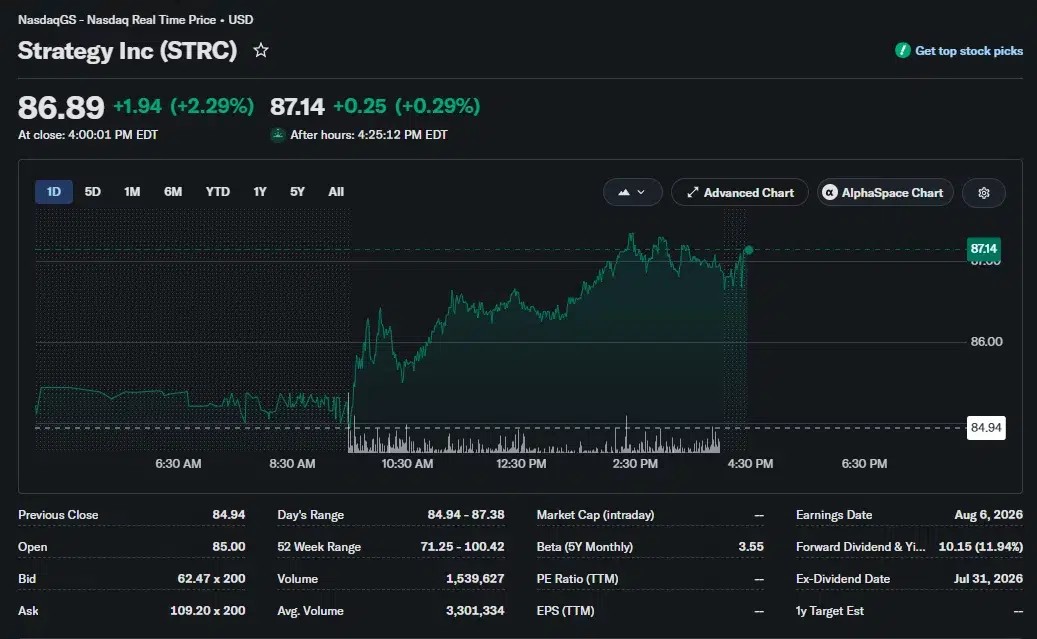
Although ETF demand has increased, STRC closed at $86.89 on July 24, gaining 2.29% during the session before rising to $87.14 in after-hours trading, according to market data shown by Yahoo Finance. Its closing price left the stock 13.11% below the $100 level Strategy designed it to track.
Source: Yahoo Finance
Trading below par has become an important constraint for Strategy because the company uses STRC sales to raise money for Bitcoin purchases. Strategy can issue additional preferred shares near or above $100 and direct the proceeds into Bitcoin, but selling new stock at a large discount would secure less capital per share and weaken the economics of the transaction.
ETF demand has lifted institutional ownership
Strategy CEO Phong Le reported that the average STRC position held by institutions climbed 105% to $3.5 million between March and July. Over the same period, retail investors’ share of ownership fell from 78% to 71%, according to figures Le published on X.
“The institutions are coming,” Le wrote.
Yes, but that means retail investors sold for a loss. My guess is the institutional buyers bought in for a short-term trade only. Or maybe they shorted MSTR and bought STRC as a spread trade. Maybe they bought STRC and shorted Bitcoin. None of those trades are bullish bets.
— Peter Schiff (@PeterSchiff) July 24, 2026
His figures correct reports describing the increase in average institutional holdings as 10%. Le’s post placed the increase at 105%, indicating that the average position more than doubled during the four-month period.
Institutional participation does not prove that every buyer expects either STRC or Bitcoin to rise, according to Bitcoin critic Peter Schiff. Responding to Le, Schiff argued that retail investors may have sold their positions at a loss while professional investors entered trades designed to profit from differences between Strategy’s securities.
Schiff suggested that some funds could have purchased STRC while shorting Strategy’s common stock, MSTR, as a spread trade. Other buyers may have paired long STRC positions with short Bitcoin exposure, he added.
“None of those trades are bullish bets,” Schiff wrote in his response.
Strategy currently pays STRC holders a 12% annual dividend in cash through two payments each month. The company’s STRC information page states that management adjusts the dividend rate monthly to encourage the stock to trade around its $100 par value and reduce price volatility.
The preferred stock’s high payout has not yet closed the discount. STRC’s 52-week range spans $71.25 to $100.42, while its July 24 closing price remained closer to the lower end of that range than to par.
The $100 level controls Strategy’s Bitcoin funding
Le has directly linked further STRC issuance and Bitcoin purchases to a recovery in the preferred stock. During a July interview, the Strategy CEO said the company would resume issuing more STRC once it returned to par.
“We’ll continue to build that. And yeah, when Stretch gets back to par, we’ll issue more. We’ll buy more Bitcoin,” Le said.
Under this funding model, a return to $100 would allow Strategy to sell new STRC shares on more favorable terms and use the proceeds to add Bitcoin. Until the discount closes, Le’s comments indicate that the company has less incentive to expand the program.
Strategy has already demonstrated how pressure on its preferred securities can affect its Bitcoin treasury. A July 6 filing showed that the company sold 3,588 $BTC for $216 million to fund dividends on its digital-credit securities and maintain liquidity. Following the sale, Saylor reported that Strategy held 843,775 $BTC and had increased its U.S. dollar reserves to $2.55 billion.
Also on July 6, Binance Stocks added STRC for spot trading, according to the exchange’s announcement reported by crypto.news. The listing followed the introduction of STRC-linked perpetual futures and gave Binance users another route to trade the preferred security.
Binance stated that fully paid securities lending would become available after stock transactions had settled completely. While the listing added another distribution channel for STRC, the stock’s continued discount shows that ETF accumulation and additional trading access have not yet restored the $100 level needed to restart Strategy’s preferred-share-funded Bitcoin purchases.