Tag: CRYPTOS FoxBusiness

  • Market Experts: “85 Percent of the Bear Market in Bitcoin and Altcoins Is Over”

    Market Experts: “85 Percent of the Bear Market in Bitcoin and Altcoins Is Over”

    The DeFi Report, a cryptocurrency and macroeconomics analysis company, announced in its latest assessment of Bitcoin and the overall cryptocurrency market that the bear market has now entered its final phase. The analysis stated that approximately 85% of the bear cycle is behind us, and the remaining 15%, which will determine the market’s fate, largely depends on global macroeconomic developments.

    According to the company’s on-chain cost base analysis, the leading cryptocurrency Bitcoin is exhibiting movements quite similar to previous cycle bases in terms of on-chain data. However, it was noted that spot and futures trading volumes have fallen to their lowest levels since the end of 2019, which was described as a clear indication of a “time-spread capitulation” process taking place on the chain. Furthermore, asset sales by miners, redirecting their energy capacity to AI firms, were also cited as factors increasing pressure on the market.

    The analysis stated that whether Bitcoin will fall to the “deep value” region of $55,000 and below will depend on macroeconomic liquidity conditions in the coming weeks. The fact that US 30-year Treasury yields have surpassed 5.2%, reaching a 20-year high, and the Fed’s move towards higher interest rates were highlighted as key factors putting pressure on risky assets.

    Another notable development in global markets was the covert liquidity measures implemented by the US Treasury Department and the Bank of Japan to strengthen the Yen. Analysts described this mechanism, which allows foreign institutions to provide liquidity by collateralizing US bonds instead of selling them, as “QE Light” (Quantitative Easing). The 15% increase in gold prices due to this covert liquidity injection and the impact of global risks suggests that investors are positioning themselves against inflationary pressures, and a similar liquidity flow could shift to Bitcoin in the future.

    Analysts evaluating technical levels and strategies consider the 200-week moving average, currently at $63,800, a critical threshold. If Bitcoin closes the month above the $68,700-$69,800 range, the scenario that the bottom has been reached will gain strength.

    *This is not investment advice.
  • 44 Billion SHIB in Hours: Shiba Inu May Head for Rebound

    44 Billion SHIB in Hours: Shiba Inu May Head for Rebound

    Shiba Inu has continued to trade on a downward trajectory amid prolonged broader market volatility. However, its exchange activity over the last 24 hours has provided a different signal.

    With its price still struggling to reclaim its recent high around the $0.000005 mark, the latest data from crypto analytics platform CryptoQuant has provided investors with a glimpse of hope for a possible price recovery soon.

    44 billion $SHIB in demand

    Per the data, the Shiba Inu exchange netflow has drawn attention amid the market downturn after projecting a negative balance of 44.1 billion $SHIB as of Thursday, August 13.

    While a netflow of 44 billion $SHIB may seem modest, its timing makes it significant as it shows a major divergence between the $SHIB trading price and its exchange activity.

    Notably, the metric shows that the amount of $SHIB tokens moved out of exchanges amid growing demand is significantly greater than the amount of $SHIB returned to exchanges for sell-off purposes over the last day.

    While the difference in both activities stands at -44 billion $SHIB, it means that the amount of $SHIB available for sale on exchanges has been reduced substantially, gradually cooling the intense sell pressure facing the Shiba Inu ecosystem.

    Where’s $SHIB headed?

    Although the Shiba Inu exchange flow provides a bullish outlook for $SHIB, the asset is still struggling to recover near its recent high, consistently trading in the red zone.

    However, analysts believe there is still a chance for a potential price reversal for $SHIB if investors remain resilient and it is able to sustain demand even amid such weak market conditions.

  • We found HTX’s reserves at Poloniex

    We found HTX’s reserves at Poloniex

    $HTX’s situation has appeared increasingly precarious as both the European Union Council and the United Kingdom’s Foreign, Commonwealth, & Development Office have chosen to sanction the exchange.

    Since then, it’s made some big changes to how it manages users’ reserves.

    Its June proof of reserves report was the first that acknowledged that it had moved huge swaths of its reserves to an undisclosed “ThirdParty.”

    $HTX moved $1.3 billion from reserves to undisclosed ‘ThirdParty’

    $HTX claims on its website that you can verify these balances by reaching out to the custodian; unfortunately, it doesn’t tell users who that custodian is. As a result, Protos has been unable to verify most of those balances.

    Further complicating this, TRM Labs, a blockchain intelligence firm, released a report in which it detailed how $HTX has begun churning through its wallets at a prodigious rate.

    Ari Redboard, the global head of policy for TRM, described this behavior as an attempt “to stay a step ahead of screening built on static lists.”

    TRM claims $HTX is rotating wallets to ‘stay ahead of screening’

    $HTX, for its part, previously claimed that this was totally normal cybersecurity behavior.

    Since then, Protos was able to track a substantial portion of $HTX’s staked ETH (stETH) through Poloniex addresses.

    Now, we can add that various other $HTX assets have also recently passed into Poloniex.

    Is Justin Sun mixing $HTX’s reserves with Poloniex?

    First, $HTX distributes a tool that used to enable people to gain greater insight into its reserves, even including which addresses the reserves were held in.

    We can use these past reports to determine where certain assets were claimed to be at a certain time and can use the blockchain transactions to follow some portion of the reserves as they move.

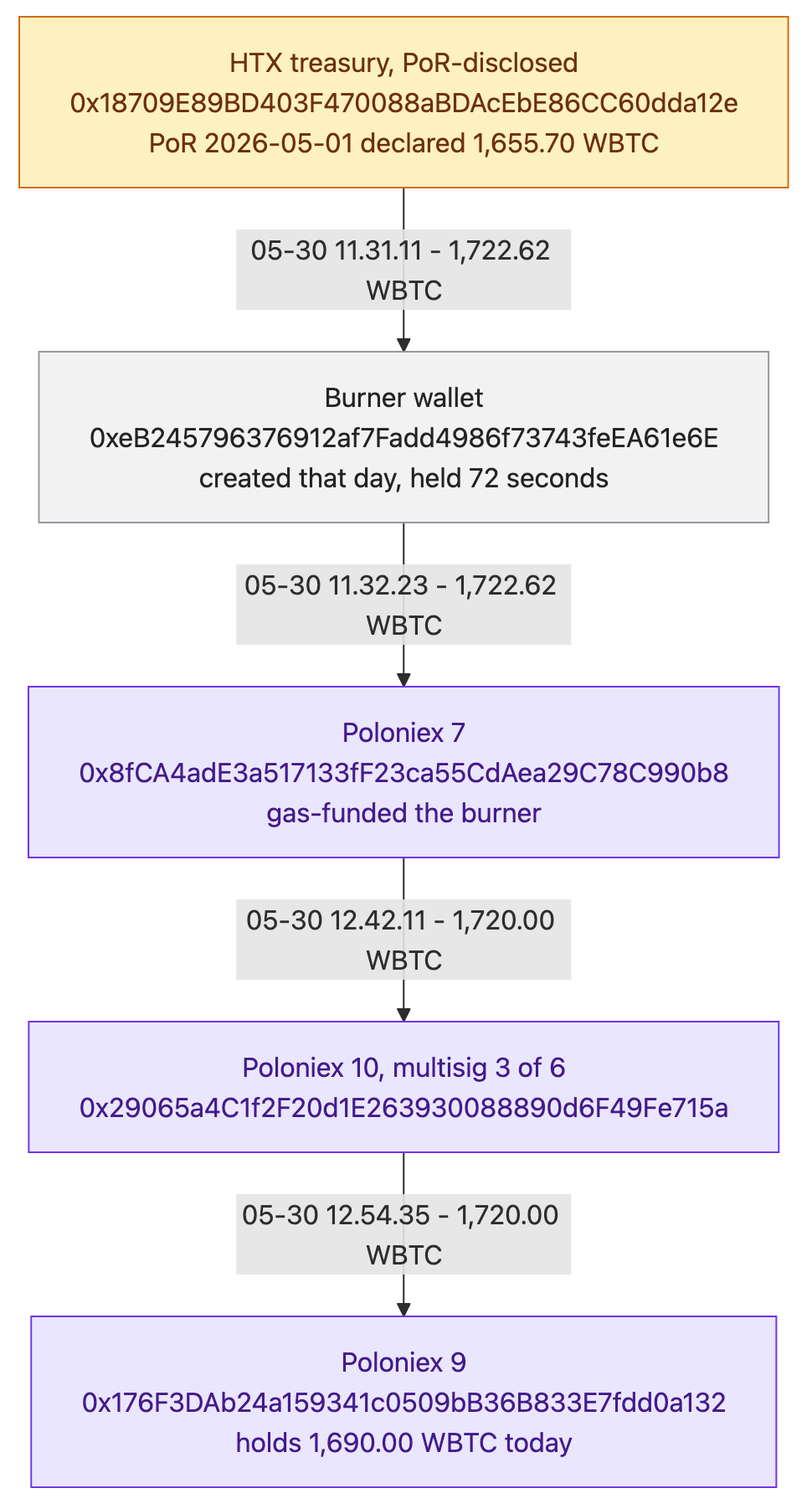
    Consider 0x18709e89bd403f470088abdacebe86cc60dda12e, which was an address that $HTX used to hold many of the Ethereum-based DeFi positions it maintained, for some reason.

    On May 30, immediately before we get the transition to ThirdParty, we can watch the Sun-advised wrapped BTC (WBTC) move from this $HTX address to 0xeB245796376912af7Fadd4986f73743feEA61e6E.

    These funds were then transferred to 0x8fCA4adE3a517133fF23ca55CdAea29C78C990b8, an address that Etherscan labels as Poloniex 7.

    These funds were then quickly sent to 0x29065a4C1f2F20d1E263930088890d6F49Fe715a, an address that Etherscan labels as Poloniex 10.

    Finally, this WBTC was sent to 0x176F3DAb24a159341c0509bB36B833E7fdd0a132, an address that Etherscan labels as Poloniex 9.

    This WBTC which came from $HTX, is still stored in this Poloniex address.

    The $HTX to Poloniex pattern repeats

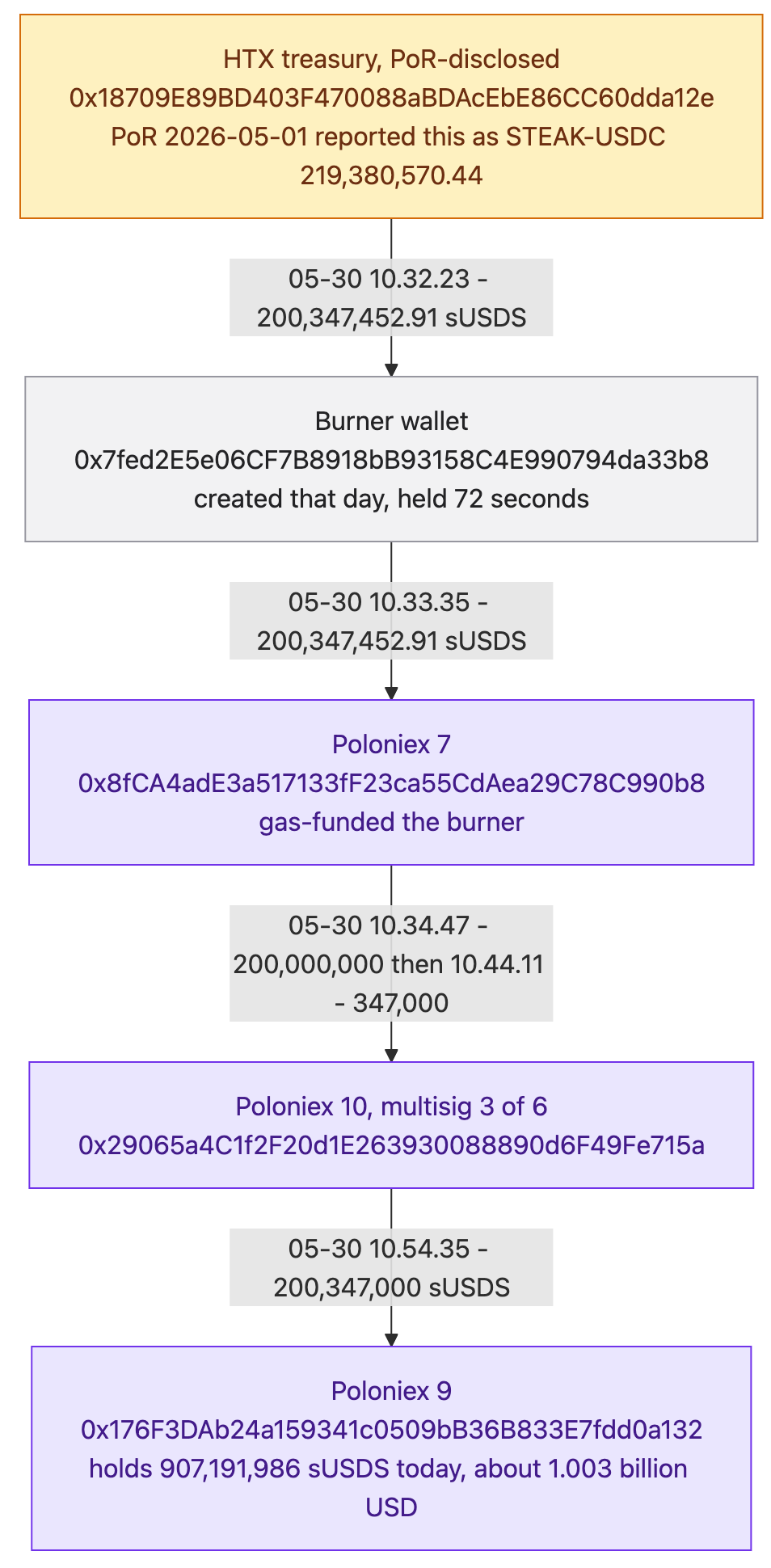
    The May PoR for $HTX had a problem. It claimed that it had a bunch of STEAK-$USDC, but it was wrong; there was no STEAK-$USDC in that address on that date.

    However, there was a matching amount of Sky Savings USDS (sUSDS) in that address, suggesting that while $HTX failed to accurately label its own reserves — troubling on its face — it did have another position that represented that value.

    We start with approximately $200 million worth of sUSDS moving to 0x7fed2E5e06CF7B8918bB93158C4E990794da33b8.

    These funds are then sent onward to Poloniex 7.

    These were then forwarded in three transactions to Poloniex 10.

    Finally, these funds were forwarded to Poloniex 9.

    Similar patterns can also be observed for various Spark positions, some of which may have been since redeemed.

    These related-party transactions, involving many hundreds of millions of dollars worth of value, raise serious questions about the internal controls and management of both of these Sun-owned exchanges.

    They furthermore raise questions about Poloniex’s role in interacting with this repeatedly sanctioned entity.

    Protos reached out to $HTX with questions about these transfers, but it didn’t respond before publication.

  • Barça Mobile Adds Digital Wallet on Stellar

    Barça Mobile Adds Digital Wallet on Stellar

    Barça Mobile, the telecom platform linked to FC Barcelona, is adding a digital wallet to its mobile app through partnerships with Wirex, Crossmint and the Stellar Development Foundation. New Era Visionary Group, the official telecom operator and partner of FC Barcelona, is working with the three companies to build the wallet infrastructure. The new feature will combine mobile services with payments, rewards, travel and other digital services for users worldwide.

    Wirex will provide payment and card infrastructure for the wallet. Crossmint will provide wallet infrastructure and onboarding technology. Stellar will serve as the blockchain layer for the wallet. Its network will support digital transactions and cross-border value transfers, allowing Barça Mobile to build services for users in different markets.

    The wallet will not operate as a separate product. Instead, it will become part of the existing Barça Mobile app. The initiative is part of Barça Mobile’s broader plan to develop a global connectivity platform. The company says the service is aimed at FC Barcelona fans, travelers, and mobile subscribers looking for access to telecom and digital services through a single interface.

    Image: Magnific

  • Chiba Institute Joins Theta Academic Network

    Chiba Institute Joins Theta Academic Network

    Chiba Institute of Technology has joined Theta Network’s global academic network through a partnership with Theta EdgeCloud. The collaboration will give the university’s Takagi Laboratory and its Web3 club (which has more than 250 student members) access to decentralized computing resources for AI research, simulations, and student projects.

    Theta Network is a decentralized computing network. Its EdgeCloud platform provides access to distributed GPU capacity through more than 30,000 edge nodes, offering an alternative to traditional cloud infrastructure.

    The partnership includes Professor Toru Takagi and his laboratory, which researches systems using mathematical models that can be processed and simulated by computers. The lab also works on game theory, AI-based automated proving, and the modeling of cellular activity.

    Image: Magnific

  • There’s Significant Whale Activity in Two Altcoins Today—Here Are Those Altcoins

    There’s Significant Whale Activity in Two Altcoins Today—Here Are Those Altcoins

    The cryptocurrency market has seen a surge in on-chain activity from large investors. Recent data indicates strong accumulation and selling activity in Hyperliquid’s native token, $HYPE, while also showing millions of dollars in transfers in Chainlink ($LINK)-connected wallets.

    According to on-chain data, a crypto whale bought another 40,000 $HYPE from Coinbase today, worth approximately $2.3 million.

    It was stated that the wallet in question increased its total $HYPE holdings to 260,000 tokens through purchases made from Coinbase, Bybit, and other sources over the past two months. At current prices, the whale’s $HYPE position is worth approximately $15.1 million.

    Another Hype Whale Goes on Sale

    Another major investor reportedly invested 60,000 $HYPE in Hyperliquid and has begun selling.

    The whale has so far earned approximately $1.77 million in exchange for 31,560 $HYPE. Additionally, it’s noted that two TWAP orders for selling $HYPE are still active in the wallet.

    It was reported that one of the active orders is worth approximately 40,000 $HYPE, or $2.1 million, and has about 15 hours left to be completed.

    The same wallet also sent approximately 1.67 million USDC to Coinbase.

    On the Chainlink side, a different whale movement was observed. A large investor transferred approximately 213,810 $LINK, worth $1.87 million, to their Gnosis Safe wallet.

    The whale withdrew the aforementioned amount of $LINK from Binance approximately two weeks ago. The transfer of the tokens from the centralized exchange to a self-custody platform like Gnosis Safe could be interpreted as an indication that the assets are not being held for short-term sale on the exchange. However, wallet transfers alone do not provide a definitive signal regarding an investor’s future transactions.

    *This is not investment advice.

  • SushiSwap-Backed Pools.fun Announces Protocol Token Launch with Buyback and Airdrop Plans

    SushiSwap-Backed Pools.fun Announces Protocol Token Launch with Buyback and Airdrop Plans

    Pools.fun, the token issuance platform developed jointly by decentralized exchange SushiSwap and automated trading agent Bankr, is preparing to launch its own protocol token. Bankr founder 0xDeployer revealed the plans on X, outlining a structure that includes token buybacks, burns, an airdrop, and a points program.

    Tokenomics and Fee Allocation

    According to 0xDeployer, 30% of protocol fees generated by Pools.fun will be allocated to token buybacks and burns. This mechanism is designed to reduce circulating supply over time, potentially benefiting long-term holders. The founder also confirmed that fees intended for buybacks are already being accumulated ahead of the token’s official launch.

    The announcement detailed a points program that rewards user activity. Trading volume on the platform and the trading volume of tokens issued by users will both factor into the points system. While the exact conversion rate between points and token allocations has not been disclosed, the program is expected to play a role in the upcoming airdrop.

    Context and Platform Background

    Pools.fun emerged from a collaboration between SushiSwap, one of the oldest decentralized exchanges in the DeFi space, and Bankr, an automated trading agent focused on on-chain strategies. The platform aims to simplify token issuance, allowing users to create and trade tokens with built-in liquidity mechanisms. Its positioning draws comparisons to other issuance platforms like pump.fun, but with a distinct emphasis on automated trading integration.

    The decision to launch a protocol token follows a broader trend in DeFi where platforms introduce native tokens to incentivize usage and align stakeholder interests. However, such launches also carry risks, including regulatory scrutiny and market volatility.

    Implications for Users and the DeFi Ecosystem

    For active users of Pools.fun, the points program and airdrop could provide tangible rewards for early participation. The buyback-and-burn mechanism may also create a deflationary pressure on the token’s supply, which some investors view positively. Yet, the success of such initiatives depends on sustained platform activity and market conditions.

    Industry observers note that token launches of this nature often generate short-term speculation. Long-term value will hinge on the platform’s ability to attract and retain users beyond initial incentives. The integration with Bankr’s automated trading tools could offer a unique utility, potentially distinguishing Pools.fun from competitors.

    Conclusion

    Pools.fun’s protocol token launch represents a significant step for the SushiSwap-Bankr collaboration. With a clear fee allocation strategy and user-centric incentives, the platform is positioning itself to reward early adopters. However, as with any emerging DeFi project, potential participants should conduct thorough research and remain mindful of market risks.

  • GSR raises Solana to 43.6%, cuts Bitcoin to 16.9%

    GSR raises Solana to 43.6%, cuts Bitcoin to 16.9%

    GSR shifted its Core3 model toward Solana on Aug. 12, raising $SOL to 43.6% of the portfolio and making it the model’s largest allocation.

    Ether fell to 39.5%, while Bitcoin dropped to 16.9%, the smallest weight among the three assets.The firm said the change reflected a move in its relative alpha signals toward Solana as $SOL showed stronger near term price momentum. GSR’s written commentary lists the Solana weight at 43.7%, while the accompanying allocation table shows 43.6%. This article uses the table figure.

    Solana allocation jumps 7.1 points in one week

    The latest allocation marks a sharp reversal from the prior week. On Aug. 5, GSR assigned 36.5% to Solana, 44.1% to Ether and 19.3% to Bitcoin. Solana therefore gained 7.1 percentage points in the model within seven days, while Ether lost 4.6 points and Bitcoin lost 2.4 points.

    As crypto.news previously reported, the prior weekly allocation tilted toward Bitcoin as trading activity weakened and volatility eased. The Aug. 12 update reversed part of that move. GSR said its latest positioning reflected proprietary relative signals rather than a simple ranking of recent returns.

    The distinction matters because Core3 is not presented as a live investment recommendation. GSR says the weekly publication is a model framework intended for professional investors and does not constitute advice or a recommendation to allocate to the three assets.

    Solana leads weekly returns while Ether leads the month

    Solana delivered the strongest seven day return in GSR’s latest table, gaining 2.98%. Bitcoin declined 1.02% over the same period, while Ether slipped 0.20%. Over 30 days, however, Ether remained ahead with a 7.88% gain, compared with 3.19% for Bitcoin and 2.44% for Solana.

    The Core3 model itself returned 0.85% over one week and 5.30% over one month, ahead of the equal weight basket at 0.59% and 4.68%, respectively. Longer periods remain weaker. Core3 was down 35.58% year to date and 70.28% over one year, compared with losses of 32.22% and 63.44% for the equal weight basket.

    Volatility also remained relatively subdued. GSR put 30 day volatility at 26.82% for Bitcoin, 39.75% for Ether and 35.26% for Solana. The firm said Solana trading volume had softened over both seven and 30 day periods, meaning its larger model weight did not coincide with stronger volume across those windows.

    U.S. Solana access expands as GSR favors $SOL

    The model shift comes as U.S. investors gain more exchange traded routes to Solana exposure. Morgan Stanley Investment Management announced on July 28 that it had launched the Morgan Stanley Solana Trust, MSOL, on NYSE Arca alongside an Ether product. The release said MSOL carries a 0.14% expense ratio and seeks to track $SOL while staking a portion of its holdings.

    Morgan Stanley expanded its crypto ETP lineup after launching a Bitcoin product earlier in 2026. An SEC prospectus says the Solana trust may stake up to 100% of its $SOL under normal market circumstances, subject to liquidity needs and legal or regulatory considerations. The filing also details risks tied to staking, custody and concentration in one digital asset.

    Competition among U.S. products has also increased. A 21Shares filing dated July 27 said the issuer would waive TSOL’s 0.21% sponsor fee for one year beginning July 28. The company said the product can capture staking rewards, while warning that rewards can fluctuate and staking creates operational and liquidity risks.

    Those product developments do not prove that U.S. investors share GSR’s preference for Solana. They do show that regulated U.S. exchange traded access to $SOL has broadened and become more competitive while the Core3 model has shifted exposure away from Bitcoin and Ether.

    What traders will watch next

    GSR publishes the Core3 model weekly, making the next allocation an immediate test of whether the Solana overweight persists or reverses. Recent updates show how quickly the weights can move. Bitcoin rose from 9.2% on July 15 to 19.3% on Aug. 5 before falling back to 16.9% in the Aug. 12 model.

    Volume, relative momentum and volatility will therefore remain useful measures to watch alongside the next model update. GSR has already cautioned that its opinions and estimates can change without notice as market conditions change.

    The firm also warns against treating Core3 results as returns available from a live strategy. Its published figures are hypothetical, gross of transaction and management fees and exclude staking rewards. GSR further states that it may trade the assets for its own account and may hold positions that differ from the views expressed in its commentary.

  • Metaplanet CEO shuts down Bitcoin sale speculation after $322M transfer

    Metaplanet CEO Simon Gerovich has shut down speculation that the Japanese Bitcoin treasury company was selling its holdings.

    “This was a routine custody operation. No bitcoin was sold, and our holdings remain 43,000 $BTC,” Gerovich said Thursday.

    The company transferred 5,014 $BTC ($322 million) over a 24-hour span starting Wednesday. Gerovich said the network fees to move the trove cost Metaplanet about $8.

    Metaplanet is the third-largest publicly traded Bitcoin treasury company and the largest in Asia. According to Arkham data, it is sitting on an unrealized loss of about $1.4 billion.

    Metaplanet has continued to expand its Bitcoin strategy beyond accumulation. In March, the company established Metaplanet Ventures, pledging 4 billion yen ($25 million) over two to three years to invest in Bitcoin and crypto infrastructure in Japan.

    The company is targeting holdings of 100,000 $BTC by the end of 2026 and 210,000 $BTC by the end of 2027.

  • Bank of England to test stablecoin, digital currency use in cross-border finance

    Bank of England to test stablecoin, digital currency use in cross-border finance

    “If these processes can become faster and more efficient, U.K. businesses could unlock working capital sooner and make it easier to finance international trade,” Jacobsson said in an interview over LinkedIn.

    The BOE named NOBO Finance, Dun & Bradstreet, a global provider of business decisioning data, analytics, and credit-rating services, and Polygon Labs, a software and blockchain company, as participants in its Digital Pound Lab.

    The project will be the first time the Digital Pound Lab tests how public stablecoins and central-bank money work in a single payment flow alongside a portable credit identity for small businesses. The lab uses no real customers or money and does not signal any decision to issue a digital pound.

    NOBO, a U.K.-based fintech building digital trade finance infrastructure that helps small and medium-sized enterprises (SMEs) become visible, verifiable, and bankable, was already involved in Phase 1. During the first phase, NOBO helped demonstrate conditional business-to-business escrow payments relevant to trade finance workflows.

    A first workstream will build an SME “bankable profile.” NOBO, Dun & Bradstreet and Polygon plan to combine wallet transaction data, open-finance information and business intelligence to create a reusable credit assessment. Polygon will provide smart contracts intended to record the verified outcome and manage consent.