Tag: CRYPTOS FoxBusiness

  • Michael Saylor Compared Bitcoin to Gold

    Michael Saylor Compared Bitcoin to Gold

    Strategy founder Michael Saylor said that Bitcoin is reshaping the way wealth is stored and transferred by converting digital scarcity into economic value.

    Saylor stated that Bitcoin combines computers, digital networks, and cryptography, describing this structure as “the first digitally designed monetary network in human history.”

    According to Saylor, Bitcoin digitizes monetary assets entirely, ensuring that supply is controlled by publicly available protocols rather than the decisions of individuals or institutions. Thus, economic value is transformed into information that can be securely transmitted over global communication networks.

    Comparing Bitcoin to gold, Saylor stated that increasing the supply of Bitcoin is more difficult, while integrating it with software and transferring it is easier. He noted that network participants are incentivized to protect the system’s security, arguing that the proof-of-work mechanism connects Bitcoin to the physical world.

    Saylor noted that this mechanism consumes real energy in exchange for ledger security, increasing the cost of altering past transactions. He stated that miners, energy companies, and investors have formed a common defense system around this structure, adding that while Bitcoin could be described as “digital gold,” the term “digital monetary energy” is more accurate.

    Saylor stated that the Bitcoin network is not merely fixed software; it is an adaptable system comprised of miners, nodes, developers, capital, and users. He explained that Bitcoin is deliberately kept simple at its core, and that its primary purpose is to create a secure and reliable ledger for scarce digital assets.

    Saylor stated that complex functions are left to applications at higher levels, arguing that this architecture makes Bitcoin a foundation upon which economic value can be transferred across time and space. According to Saylor, this structure also supports innovations in payment, credit, and financial services.

    Saylor stated that Bitcoin’s deeper impact lies in creating a new form of digital sovereignty, noting that private keys allow individuals to control their economic power without permission. He added that in this system, ownership is verified through mathematical methods rather than institutions.

    Saylor stated that companies, banks, trusts, and applications could build comprehensive economic systems around Bitcoin, and that social networks could also leverage this technology to add real costs and responsibilities to the digital environment.

    Saylor stated, “Gold’s physical scarcity translates into money, while Bitcoin’s digital scarcity does the same.” Arguing that Bitcoin is more than just a means of payment, Saylor likened money to energy, describing Bitcoin as the monetary energy of the digital age.

    *This is not investment advice.

  • Humanity eyes $0.33 as whale wallets grow – H rally at risk IF…

    Humanity eyes $0.33 as whale wallets grow – H rally at risk IF…

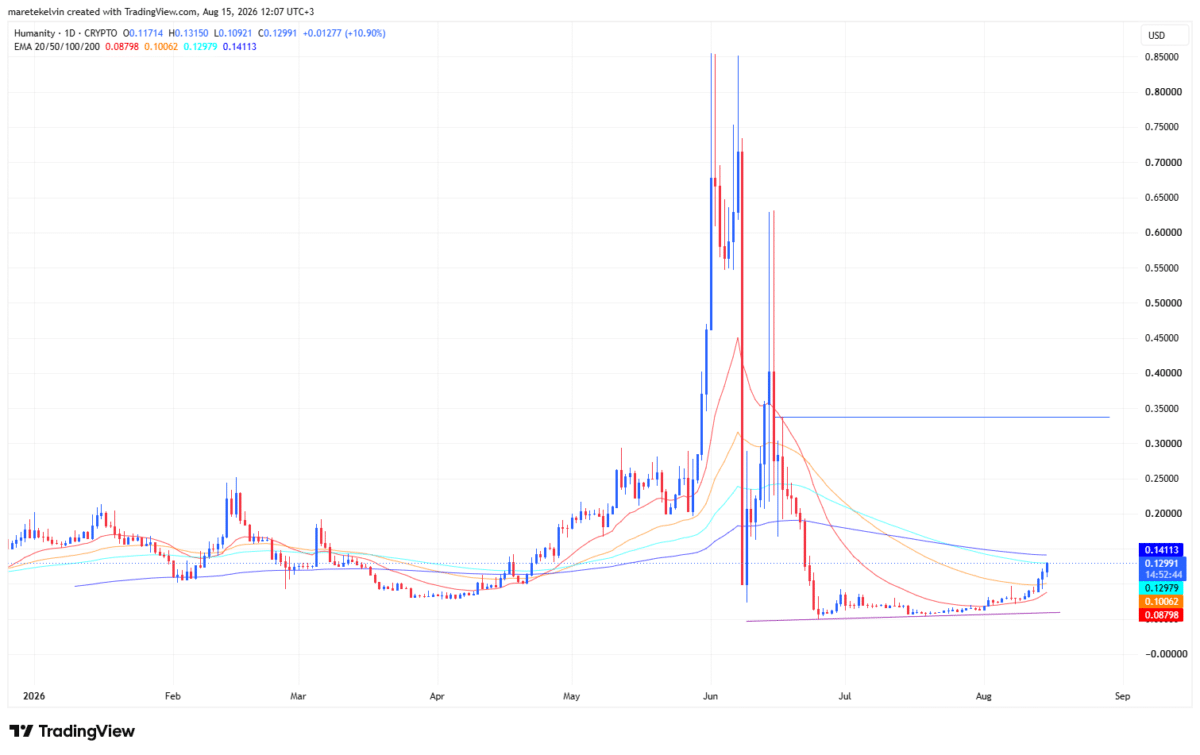
    Humanity [H] extended its weekly rally and moved above the 20-day and 50-day Exponential Moving Averages (EMAs).

    The technical improvement arrived as capital rotated toward altcoins. More large-holder wallets and bullish derivatives positioning supported H’s recovery. Could this momentum push Humanity toward the next resistance at $0.33?

    Can Humanity hold above its EMAs?

    Humanity advanced during the past week and traded above its 20-day and 50-day EMAs. This move suggested that buyers had gained momentum across the short and medium terms.

    Holding above both EMAs could help bulls extend the rally toward $0.33.

    However, losing these levels would weaken the bullish structure and increase the possibility of a deeper correction.

    Source: TradingView

    Are Humanity whales accumulating H?

    Notably, Humanity’s large-holder activity offered another bullish signal.

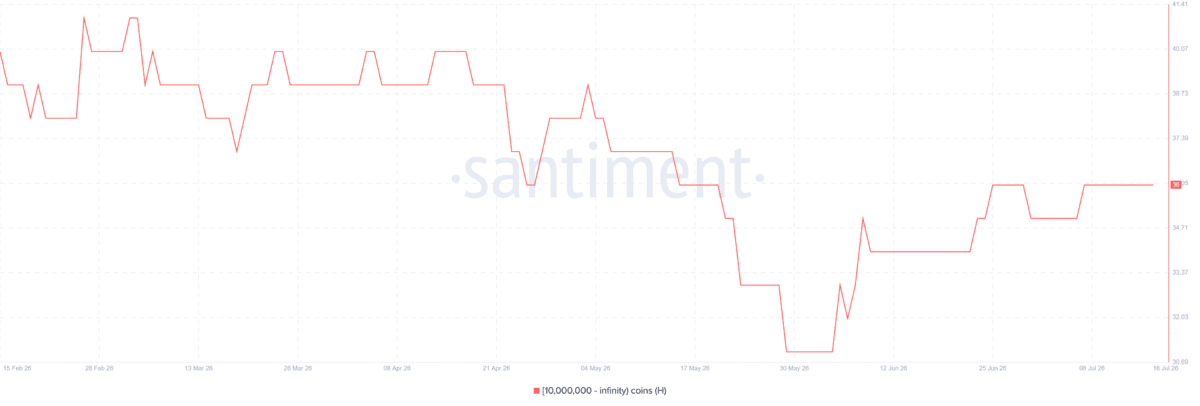
    The number of wallets holding over 10 million H reached 39, its highest level in several months. This increase suggested more wallets had entered that holding bracket. However, the metric alone could not confirm fresh whale purchases.

    Even so, continued growth in large-holder wallets could support H’s attempt to reach $0.33.

    Source: Santiment

    What does H’s 7% volatility mean?

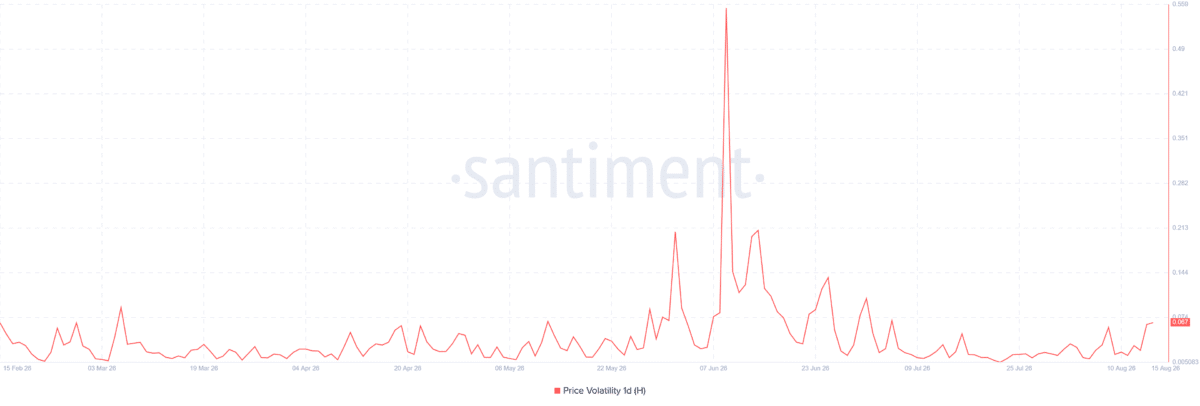
    At the same time, H’s Price Volatility climbed to approximately 7%, reaching its highest recent level. This increase indicated that H had begun experiencing wider price movements as its bullish trend continued.

    Elevated Price Volatility could amplify the rally if buying pressure holds. It could also accelerate losses during a sudden reversal.

    Therefore, the same metric supporting a faster move toward $0.33 also increased H’s pullback risk.

    Source: Santiment

    Are Humanity traders too bullish?

    On top of that, derivatives positioning remained strongly tilted toward buyers.

    Long positions represented approximately 66% of H’s tracked positioning, showing that traders expected further upside. This bullish positioning supported the continuation scenario.

    However, it also left leveraged longs exposed if momentum weakened. A price reversal could trigger Long Liquidations and deepen any resulting pullback.

    Source: Coinalyze

    Can Humanity reach $0.33?

    Humanity’s bullish structure rested on its EMAs, rising large-holder wallets, and strong long positioning.

    If buyers maintain control, H could extend its weekly advance and challenge the $0.33 resistance. For now, both EMAs remain the key support levels below H’s price.

    A sustained move above $0.33 could strengthen the bullish case. Losing EMA support may invalidate the near-term setup.


    Final Summary

    • Humanity traded above its 20-day and 50-day EMAs, strengthening its short-term bullish structure.
    • Wallets holding over 10 million H reached 39, their highest count in several months.
  • CLARITY Act Odds Decline as SEC and CFTC Build Interim Fixes

    CLARITY Act Odds Decline as SEC and CFTC Build Interim Fixes

    Congress and the regulators are no longer moving on the same timeline. The CLARITY Act, the U.S. crypto market structure bill meant to settle long-running questions over digital asset issuance and trading, now looks less likely to pass in 2026. Galaxy Research’s latest read, the original report, points to fading legislative momentum and a shift toward faster agency action.

    The banking sector’s resistance to sweeping market structure changes has already been visible in the Senate, where major crypto legislation faced a last-minute lobbying fight. That friction is now part of the broader backdrop for the CLARITY Act. As the calendar tightens, the practical question for exchanges, issuers, and compliance teams is not whether Congress will act, but which agency will fill the gap first.

    Agency action is accelerating

    The SEC and CFTC have responded to the uncertainty by pushing administrative measures: rulemaking, interpretive guidance, and regulatory exemptions. Galaxy says the goal is to clarify how digital assets should be issued, traded, and supervised while the legislative path remains blocked. A staff interpretation or an exemption can be more useful in the near term than a bill that may never get a floor vote.

    That speed has real value. A token project waiting on registration guidance or a trading platform trying to understand which regulator has jurisdiction can make operational decisions off an agency action far sooner than off a stalled congressional process. For institutional buyers and token issuers, the difference between a statute and an agency exemption is not academic. A statute binds the agency and survives a leadership change. An exemption is only as durable as the current line of thinking at the commission.

    The urgency is especially visible in tokenized real-world assets, where issuance and settlement structures are already scaling. Recent tokenization activity shows that market participants are not waiting for Washington to settle every definition before expanding products.

    Temporary clarity has a hard ceiling

    Galaxy’s caution is straightforward: administrative fixes lack legal durability. Rulemaking and guidance can be revised or reversed by a future administration, and they cannot replace a long-term framework established by Congress. That creates a different kind of uncertainty. Firms can build against an SEC staff position only to have a new chair unwind it after a political transition.

    The result is a two-tier regulatory reality. Congress may still deliver a durable statute, but for now the industry is operating on guidance that is faster to arrive and easier to reverse. That is not a stable foundation for capital-intensive infrastructure decisions.

    For legal and compliance leaders, the shift also changes the type of risk they have to manage. A legislative process carries one set of lobbying and timing risks. An administrative process carries another: the possibility that a guidance document disappears with a new administration, or that a court reads a rule more narrowly than staff intended. That distinction is now a planning cost, not a theoretical concern.

    Meanwhile, builder activity continues to concentrate in a few dominant ecosystems regardless of the legal noise. Developer activity this week remains clustered among major Layer 1 and Layer 2 networks, but the rules for the assets built on those chains still depend on whatever the agencies do next.

  • Ethereum and Solana may become scarcer – THESE Grayscale projections say…

    Ethereum and Solana may become scarcer – THESE Grayscale projections say…

    Ethereum [$ETH] was trading at $1,876.89 at press time, following a slight increase over the previous day but a 2.16% decline over the previous week. Meanwhile, Solana was trading at $75.16 at press time, following a slight increase over the previous week and a slight decline over the previous day.

    These contradictory price movements imply that there is no clear bullish or bearish momentum dominating the cryptocurrency market, which is extremely erratic.

    In fact, there were no clear indications of bulls or bears on the RSI for either $ETH or $SOL as well.

    Grayscale paints a concerning picture for $ETH and $SOL

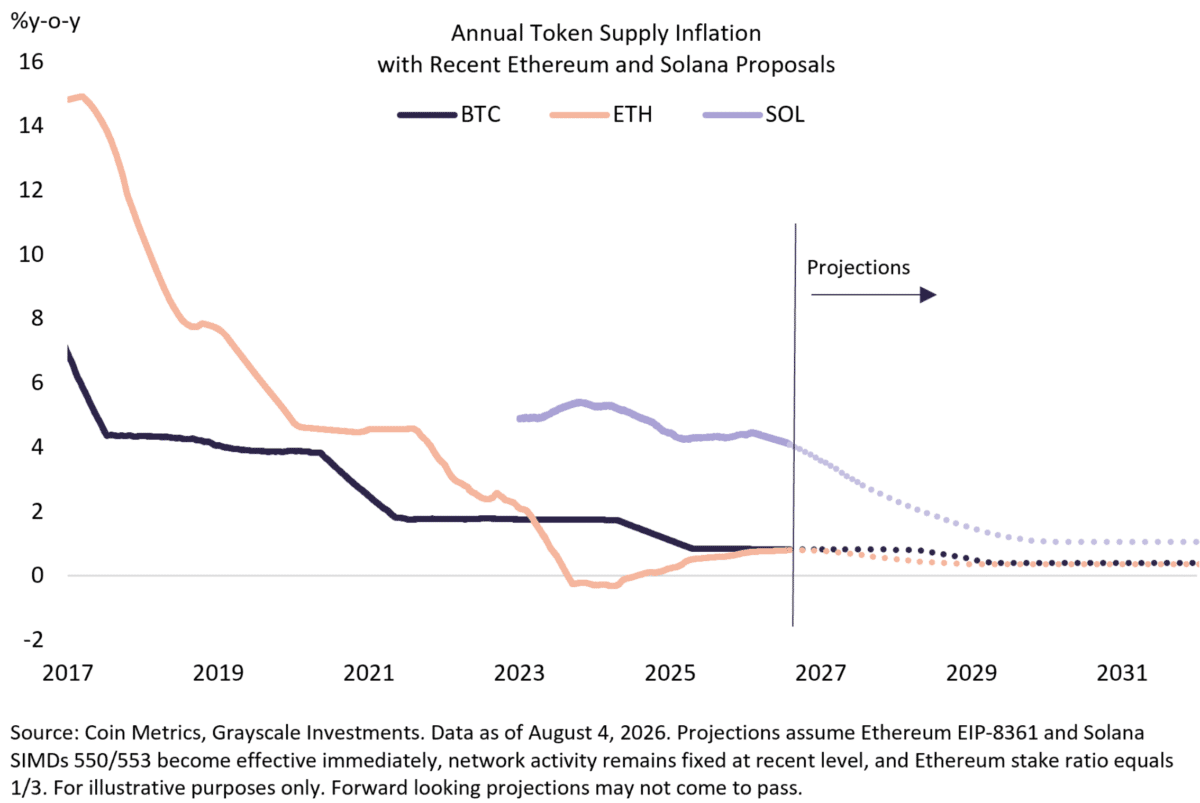
    At the same time, Zach Pandl, Head of Research at Grayscale, presented his analysis indicating that Ethereum and Solana may become more scarce assets due to their respective networks’ consideration of lowering the annual production of new tokens.

    Source: Grayscale

    Currently, issuing new $ETH and $SOL, which expands the total supply, helps to fund staking rewards on Ethereum and Solana.

    This inflation would be decreased by the suggested modifications. Comparable to lowering the production of a commodity, the value of the current tokens may rise if demand remains constant or rises and fewer new tokens are introduced to the market.

    According to Pandl, by 2031, the annual supply growth of $ETH and $SOL may drop to about 0.4% and 1.1%, respectively, bringing them closer to Bitcoin’s supply growth and below gold’s estimated 1.8% annual supply growth.

    What about stakers?

    For stakers, there is a trade-off, though. People who stake their tokens will get fewer tokens as rewards if there are fewer new $ETH and $SOL created.

    After a decrease in inflation, for instance, a staker who earns 5 $SOL might only receive 3 $SOL. Yet, the value of those three $SOL might still surpass the value of the initial five $SOL if the decreased supply makes $SOL more scarce and its price increases noticeably.

    Therefore, while stakers must weigh the potential for higher token prices against the possibility of lower token rewards, unstaked holders may directly profit from increased scarcity.

    s up for debate and do not guarantee changes.

    This was consistent with an earlier report from AMBCrypto that stated that Solana’s ecosystem provides more than just trading and DeFi, which is why it is drawing in more users and money.


    Final Summary

    • Both Ethereum’s and Solana’s price actions are not that strong, with RSI supporting this narrative.
    • Garyscale suggests that Ethereum and Solana may become more scarce assets due to their respective networks’ consideration.
  • Binance Ends Transactions With 16 Platforms, Warns of Wallet Reviews

    Binance Ends Transactions With 16 Platforms, Warns of Wallet Reviews

    Binance Sets Three Deadlines for Transaction Restrictions

    Transactions involving 16 crypto-asset service providers will no longer be processed through Binance under restrictions announced Aug. 14. The exchange instructed users not to send funds to, receive assets from, or otherwise engage directly or indirectly with the named entities after their respective effective dates.

    Restrictions took effect Aug. 7 for Shelbit, operated by Shelbit General Trading LLC, and Aban Tether Exchange. Binance applied a second deadline on Aug. 13 to A7 Nigeria, A7 Africa and Pilotfinance Ltd., followed by an Aug. 23 cutoff covering 11 more platforms, including HTX, EXMO, Rapira, Aifory Pro, ABCeX, and WhiteBird.

    The remaining Aug. 23 entities are Noonecrypto Inc., Tradex, Monease Ltd., Bitpapa and Exnode, including Exnode Pay. Binance cautioned:

    “Any transactions attempted on or after these dates, may be held and subject to a compliance review. Restrictions may be applied to the impacted wallet(s) while the review is ongoing and such activity may also constitute a breach of Binance Terms of Use.”

    Sanctions Target Iranian and Russian Crypto Networks

    U.S. authorities imposed sanctions on Shelbit and Aban Tether through an Office of Foreign Assets Control (OFAC) action on Aug. 7. The Treasury Department alleged that Shelbit addresses exchanged more than $3 million with Islamic Revolutionary Guard Corps addresses, while Aban Tether processed transactions involving previously designated Iranian exchanges.

    Earlier enforcement against Nobitex, Wallex, Bitpin and Ramzinex increased screening requirements surrounding Iranian exchange exposure. The June 2 sanctions action involving four Iranian platforms covered businesses that OFAC later identified among Aban Tether’s transaction counterparties, connecting the August restrictions to a broader campaign targeting Iran-linked digital asset flows.

    U.K. authorities separately targeted cryptocurrency exchanges and the Kremlin-backed A7 network through 18 sanctions designations announced May 26. Officials alleged that A7 supported sanctions evasion, military procurement and oil-related payments, while the network claimed it moved more than $90 billion during the previous year.

    The U.K. package included several entities appearing on Binance’s list, such as EXMO Exchange Ltd., Rapira Group LLC, Sooty Ltd., Bitpapa, Nueva Cryptologia and Huobi Global. The sanctions also reached exchanges and payment providers associated with Russia-facing settlement routes, stablecoin infrastructure and cross-border liquidity channels.

    A7 Expands Alternative Payments as Compliance Pressure Rises

    A7 has promoted alternative cross-border settlement systems as Western governments tighten access to established financial channels. A7 says it serves more than 10,000 trade partners and intermediates nearly one-fifth of Russia’s international settlements market. Its A7A5 ruble-backed stablecoin has reportedly surpassed $100 billion in aggregate transaction volume.

    Binance has expanded compliance operations while responding to scrutiny over transactions involving restricted parties. The company previously reported a 96.8% decline in sanctions-related transaction exposure between January 2024 and July 2025. Its compliance operation includes more than 1,500 workers, representing about 25% of its global workforce.

    Users remain responsible for confirming the destination, network, and counterparty before initiating an irreversible blockchain transfer. A small test transaction can expose address or network errors, although it would not eliminate the compliance risks associated with transferring assets to a restricted platform or wallet connected to one.

    Centralized exchanges retain custody over customer assets and can delay, review, or prevent withdrawals under applicable rules. A self-custodial wallet gives its owner control of the private keys, but it does not remove sanctions obligations or protect users who transact with restricted counterparties. Binance’s final group of platform restrictions takes effect Aug. 23.

  • Why the world’s second-largest Bitcoin mining power is shutting down rigs in its capital city

    Why the world’s second-largest Bitcoin mining power is shutting down rigs in its capital city

    Crypto mining was banned in Moscow, the surrounding Moscow Region and parts of Kursk, with the restrictions set to run through Dec. 31, 2032.

    The measure, established under government decree No. 936, also prohibits participation in crypto mining pools. The decree was signed on July 25 and published on July 31, local media reports.

    Russia as a whole accounted for an estimated 175 exahashes per second, or 16.4% of Bitcoin’s global computing power, in the first quarter, according to Luxor’s Hashrate Index. That placed it second behind the U.S., although it’s unclear what capacity was located in the newly restricted region.

    The country’s Energy Ministry said a year-round restriction was needed to reduce the risk of power-capacity shortages as energy-intensive mining facilities connect to regional grids. Mining currently consumes roughly 1 gigawatt in the Moscow power system, while the region’s target=”_blank” rel=”noopener noreferrer”>Interfax reported after the decree was first signed.

    Mining is also linked to the country’s Western sanctions.

    Russian companies had been using domestically mined bitcoin in international payments after legal changes designed to counter Western restrictions, Finance Minister Anton Siluanov said in December 2024.

  • Robot maker Unitree is going public. Hyperliquid traders see 4x upside from IPO price

    Robot maker Unitree is going public. Hyperliquid traders see 4x upside from IPO price

    Crypto traders are betting that Unitree Robotics will be worth more than four times its IPO valuation when the Chinese robot maker debuts on the public markets.

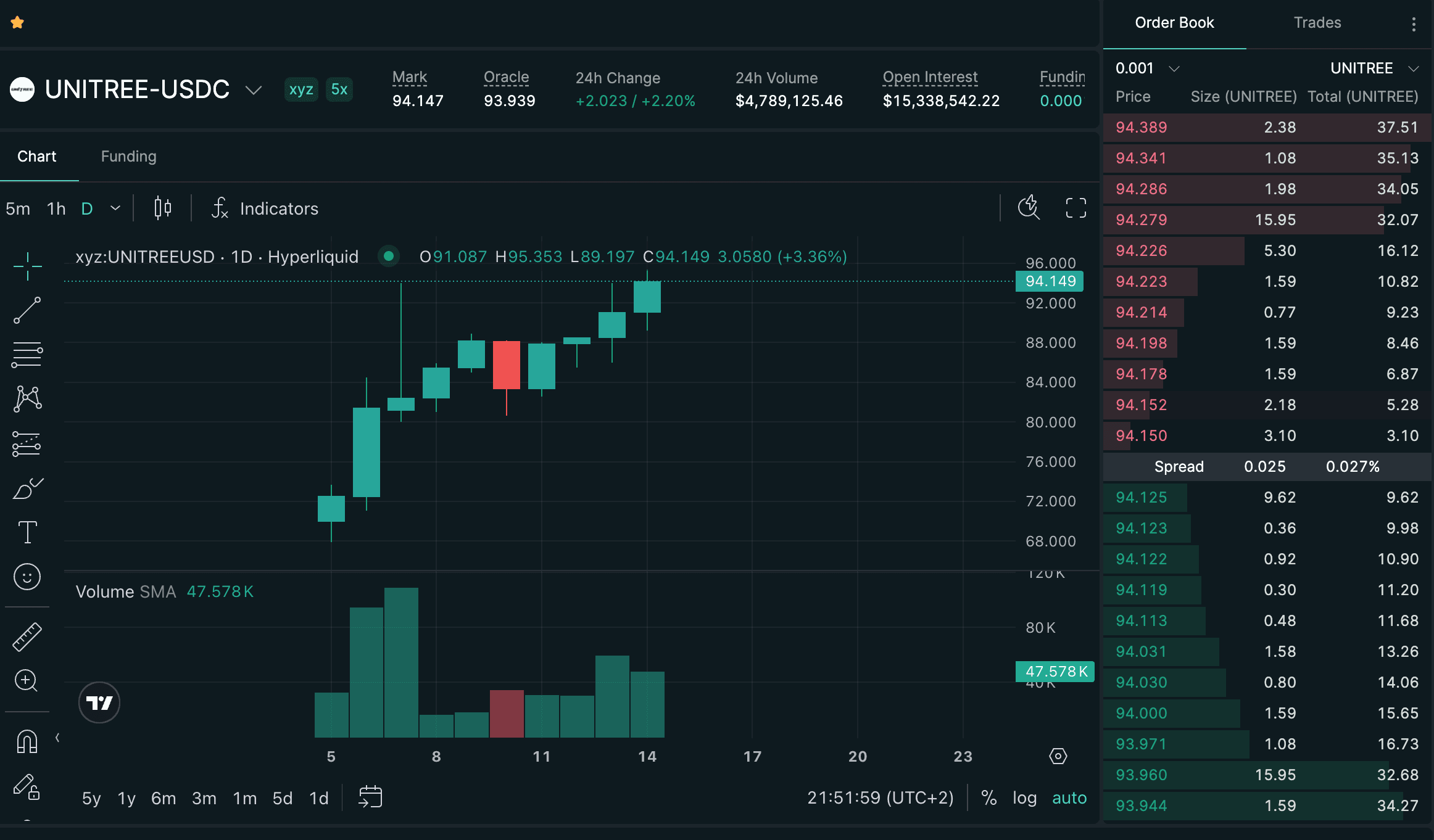
    Unitree priced its Shanghai STAR Market offering at 150.80 yuan ($22.37) per share, valuing the company at roughly $9 billion. Pre-IPO perpetual contracts trading through Hyperliquid, however, were between $92 and $94 on Friday, equivalent to a valuation of about $38 billion, blockchain analytics firm Allium said in a report.

    The premium reflects lofty expectations for one of China’s closely watched robotics companies. Founded in Hangzhou in 2016, Unitree makes four-legged and humanoid robots for research, industrial and consumer applications. Revenue reached $253 million last year, up 335%, while humanoid robot shipments topped 5,500, according to Allium’s report.

    The firm’s IPO was reportedly 8000 times oversubscribed by retail traders, with trading expected to begin between Aug. 17 and Aug. 21.

    Unitree pre-IPO market on Hyperliquid

    Pre-IPO perps

    Unitree’s public-market debut is also shaping up to be the latest in a corner of crypto derivatives that has recently expanded rapidly: pre-IPO perpetual futures.

  • Swiss mega-bank UBS ramps up its Bitcoin exposure with a massive 24-fold surge in ETF call options

    Swiss mega-bank UBS ramps up its Bitcoin exposure with a massive 24-fold surge in ETF call options

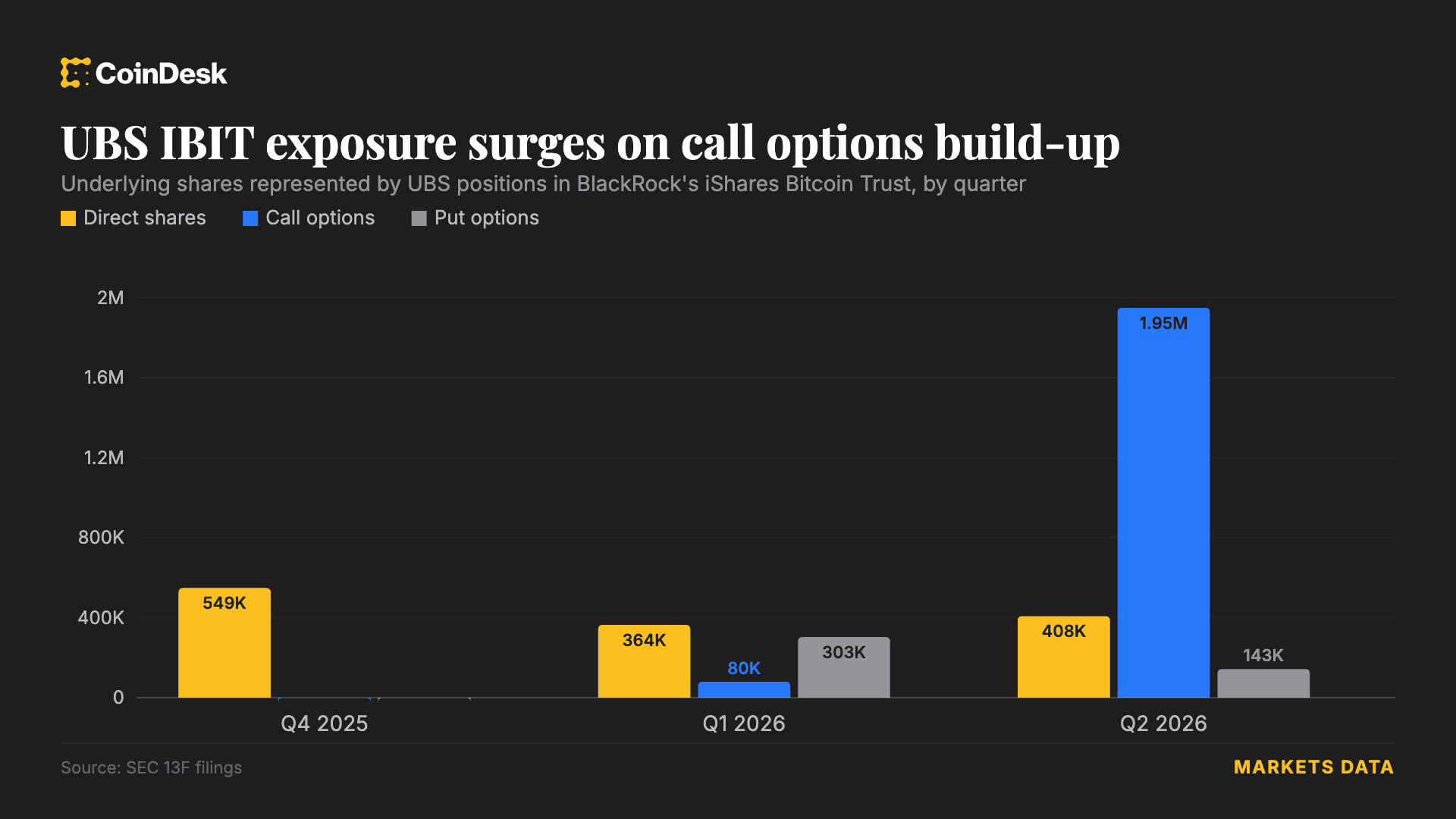
    Banking giant UBS, with over $7 trillion in assets under management, has reported a more than 24-fold quarterly increase in call option exposure tied to BlackRock’s iShares Bitcoin Trust (IBIT) in the second quarter.

    That increase, which gives it the right to acquire IBIT shares at a later date at a set price, came as its outright IBIT holdings rose about 12%, according to a regulatory filing this week.

    The Swiss banking group reported calls representing 1.95 million underlying IBIT shares as of June 30, up from 80,000 three months earlier. UBS separately held 407,890 IBIT shares worth about $13.6 million, compared with 364,371 shares at the end of the first quarter, according to its Q1 filing.

    Put option exposure, giving UBS the right but not the obligation to sell IBIT at a set date and price, moved in the opposite direction. UBS reported puts representing 143,300 underlying shares, down about 53% from 303,300 at the end of March.

    Its direct IBIT position also remained below the 548,614 shares reported at the end of 2025, according to its fourth-quarter filing.

    UBS 13-filing for IBIT. (CoinDesk)

    The disclosure also does not include strike prices or expirations, making it difficult to determine UBS’s net directional exposure from the filing alone.

  • Strategy: Index Providers Should Measure Markets, Not Dictate Corporate Assets

    Strategy: Index Providers Should Measure Markets, Not Dictate Corporate Assets

    For a company that runs a corporate treasury around bitcoin, the most important gatekeeper is no longer a bank or a securities regulator. It may be the committee that decides which public companies belong in benchmarks watched by trillions of dollars in passive capital. Strategy, the bitcoin treasury company, is now pressing that point in public: index providers should reflect markets, not police corporate balance sheets.

    According to the CoinDesk report, Strategy said index providers should measure markets rather than determine which assets public companies are allowed to own.

    The statement speaks to a structural tension that gets little attention in ordinary market coverage. MSCI and other index creators have become de facto regulators of corporate behavior. Inclusion decisions shape passive fund flows, cheap index-tracking capital, and sometimes access to certain investor bases. When that power extends into what a company can keep on its balance sheet, the index provider stops being a neutral yardstick and starts making allocative choices.

    The Benchmark Gatekeeper Problem

    Benchmark methodology is usually framed as a technical exercise. Sector classifications, liquidity screens, and investability rules determine whether a stock enters a major index. For corporate treasuries holding bitcoin, that framing creates a practical risk. A company could meet every conventional test but still face scrutiny because a committee views treasury assets as outside the normal course of a public company’s business.

    Strategy’s position is that this is backwards. The company has made bitcoin the central reserve asset on its balance sheet, a model that some investors treat as a leveraged bitcoin proxy and others view as a structural anomaly. From Strategy’s perspective, the market should price that choice. Index providers should then measure the resulting company, not validate or reject the treasury strategy.

    The distinction matters because passive investment has grown enough to make index inclusion a funding channel. When a decision about eligibility changes, it can alter demand for that stock before the company changes anything about its operations. That is exactly the kind of market impact that normally belongs to investors, not to a committee publishing a rulebook.

    The specific asset class matters less than the broader principle. If an index provider can label certain treasury holdings as disqualifying, it creates two classes of public companies: those whose assets are considered ordinary and those whose assets require special permission. That is a strange role for a company whose main product is a ranking system.

    Why This Flares Up Now

    The pushback arrives while institutional exposure to crypto has been migrating from private funds into more visible public markets. Tokenized real-world assets have moved past milestone levels on-chain, and even non-bitcoin sectors have been absorbing institutional flows, as recent tokenization data showed. In that environment, more public companies are likely to hold digital assets directly, making benchmark treatment a live question rather than a hypothetical one.

    There is also a Washington thread. Crypto market structure remains unsettled in the United States, and banking interests are already fighting landmark legislation before a Senate vote. If lawmakers and bank lobbyists are still negotiating what crypto participation looks like, it is not surprising that index providers are being watched as another layer of gatekeeping.

    Institutional demand has also broadened beyond a single asset. Some platforms are pulling in capital through institutional staking and payments integrations, suggesting that corporate and fund-level exposure will keep expanding. The more that expansion reaches public company treasuries, the more index methodology will affect actual issuance and balance sheet decisions.

    The Risk of a Quiet Precedent

    There is no public sign that MSCI has proposed a specific rule against bitcoin treasury companies. The danger is not necessarily an explicit ban, but a slow drift in which methodology language treats certain assets as abnormal, forcing companies to justify their reserves to a committee rather than to their shareholders.

    That drift would be hard to reverse. Benchmark rules are sticky by design. Investors want stable classification systems, but stability can turn into orthodoxy when committees become reluctant to adapt. Strategy’s complaint is essentially that market participants should own that adaptation, not subcontract it to a small group of index researchers.

    What remains uncertain is whether index providers signal any willingness to explicitly exclude or constrain companies with large crypto treasury positions. Without that signal, Strategy’s statement reads as an early warning rather than a response to an announced change. For investors, the key question is whether that warning becomes a broader corporate campaign or remains a single company defending its balance sheet.

  • Former Bybit CEO startup ABFinance cancels launch plans

    Former Bybit CEO startup ABFinance cancels launch plans

    ABFinance, the U.S. finance startup founded by former Bybit co-CEO Helen Liu, has announced that it will begin winding down.

    17 major crypto businesses and about 95 total projects have already closed so far in 2026.

    Why is ABFinance closing down?

    Helen Liu unveiled ABFinance in mid-March, days after Bybit confirmed her exit. Liu was building the platform in the United States with full U.S. licensing in place from day one. The idea behind the product was to create a single platform that would handle deposits, trading, earning, and payments while linking fiat currency to crypto.

    ABFinance announced on August 14, about four months after its initial unveiling, that it will not move forward with its launch and said it is “winding down in an orderly manner” on its X (formerly Twitter) account.

    The company thanked its community, partners, and people who “built” alongside it.

    No specific reason was given for the shutdown, and the company also did not say what would happen to its education program.

    The program, ABF Learn, was ABFinance’s only export, designed for students and people early in their careers to help them understand how banking, AI, and digital assets work together.

    How bad has 2026 been for crypto companies?

    ABFinance is just one of many crypto companies that closed in 2026. By late July, Cryptopolitan counted 17 major crypto ventures that had closed. In total, about 95 projects shut down during the year. Industry experts blame the shutdowns on a long bear market and on the fact that businesses are merging into fewer big platforms.

    Other companies that shut down this year include Bitmart, which said in July that it would close its worldwide operations. The exchange had been running for nine years.

    BitMEX ended its 11-year run around the same time while Bitwise cut about 14% of its staff in August. The company’s main index fund lost a lot of value. Its net assets fell 48.27% to $532.8 million in the first half of the year.

    In May, Syndicate Labs, Everclear and ZERO Network closed within hours of each other.