
Tag: Business – Decrypt

  • Trump DOJ Rejects Tornado Cash Developer’s Newest Argument for Dismissal

    Trump DOJ Rejects Tornado Cash Developer’s Newest Argument for Dismissal

    In brief

    • The DOJ rejected Roman Storm’s argument that a recent Supreme Court ruling should lead to his case’s dismissal.
    • Prosecutors told a judge the ruling shouldn’t apply, arguing it deals with a different situation and industry.
    • The case highlights tensions between the Trump administration’s pro-crypto stance and its continued prosecution of crypto developers.

    Attorneys for the Department of Justice poured cold water Tuesday on Ethereum developer Roman Storm’s latest plea for dismissal of his criminal case—which could now head to court for a second time. 

    In a letter sent today, federal prosecutors urged federal judge Katherine Polk Failla to disregard a recent Supreme Court ruling, which Storm’s attorneys said could have significant implications for the software developer’s current legal woes.

    Storm was arrested and charged in 2023 for operating Tornado Cash, a coin mixing service that allowed Ethereum users to keep their transactions, typically visible on the blockchain, private. Prosecutors alleged Storm was aware that bad actors were using Tornado Cash to launder money, even though the software ran autonomously without the developer’s direct involvement.

    Last summer, a Manhattan jury found Storm guilty of operating an illegal money transmitter, but failed to reach verdicts on two other money laundering and sanctions evasion charges. Storm appealed the verdict. Last month, the Trump DOJ filed to try the developer again for conspiracy to commit money laundering and conspiracy to commit sanctions evasion.

    But late last month, Storm’s attorneys thought they might have caught a break. On March 25, the Supreme Court unanimously ruled, in a seemingly unrelated music copyright case, that Cox—a major internet service provider—could not be held liable for the illegal actions of its customers.

    In a letter to Judge Failla sent last week, Storm’s lawyers argued the Supreme Court’s ruling—namely, that Cox’s awareness that some of its customers might illegally stream music did not amount to an intent on Cox’s part to infringe on music copyrights—had direct bearing on their case.

    They specifically highlighted how the Trump administration itself backed Cox’s position that the internet giant should not be considered supportive of the illegal actions of some of its users. The Supreme Court ultimately found that argument convincing.

    But today, in a blunt, three-page letter, U.S. attorneys for the Southern District of New York rejected the argument that the Cox decision should have any bearing on Storm’s case.

    Cox went out of its way to discourage users from engaging in copyright infringement with policies that ended the vast majority of identified misconduct, the DOJ said. Further, Cox’s internet services could be used by customers for a wide variety of purposes besides copyright infringement, prosecutors wrote.

    In contrast, they argued, Storm was personally aware of the misconduct of some Tornado Cash users and did not intervene to stop it.

    The Trump DOJ further alleged in Tuesday’s letter that there is no evidence a crypto privacy service like Tornado Cash was capable of “substantial or commercially significant” noncriminal uses. That claim is all but certain to irk crypto privacy champions, who contend all digital asset users have a right to keep their financial transactions private.

    “The defendant’s conduct simply is not comparable to the conduct at issue in Cox,” the DOJ said Tuesday. “In any event, a civil copyright case has no relevance here in the first place.”

    The DOJ’s push to retry Roman Storm is notable given the Trump administration’s aggressively pro-crypto agenda. Last year, on multiple occasions, the DOJ pledged to stop prosecuting crypto privacy software developers, to the crypto industry’s elation. Yet federal prosecutors have sent multiple such developers to prison in the interim, a state of affairs of great concern to leading privacy advocates.

    Daily Debrief Newsletter

    Start every day with the top news stories right now, plus original features, a podcast, videos and more.


  • Solana Exchange Stabble Warns Users to Pull Liquidity After North Korean Hacker Scare

    Solana Exchange Stabble Warns Users to Pull Liquidity After North Korean Hacker Scare

    In brief

    • Solana exchange Stabble urged users to pull liquidity after its former CTO was alleged to be a North Korean hacker.
    • The firm’s total value locked dropped 62% in the wake of the request, dropping from $1.75 million to less than $663,000.
    • North Korean hackers allegedly completed a sophisticated scheme to exploit Drift Protocol last week for $285 million.

    Solana decentralized exchange Stabble has urged users to pull liquidity from the platform, leading to a 62% drop in its total value locked (TVL) Tuesday after the firm learned its former chief technology officer was flagged as an alleged North Korean hacker. 

    The protocol, which was recently taken over by a new team, began the day with around $1.75 million in TVL, according to data from DeFiLlama. After publicly sounding the alarm to a potential emergency, that value is down to less than $663,000

    “EMERGENCY!” the new protocol team posted on X. “Guys, please temporarily withdraw your liquidity instantly! Better safe than sorry.”

    The alert hit social media around 9:34 a.m. ET on Tuesday, about seven hours after pseudonymous on-chain sleuth ZachXBT had identified an alleged North Korean hacker, Keisuke Watanabe, who reportedly worked as the CTO at Stabble last year.

    Despite there being no disclosed exploit on the platform, the firm said it was working on audits to ensure everything is fully secure. 

    “We received a message and are acting on it, our primary focus is the safety of our LPs,” the new Stabble team posted. “We’re not PR people, we’re quants and early DeFi degens. We hear you, and your feedback matters.”

    The platform’s hasty move to alert the public comes less than a week after leading Solana DeFi protocol Drift was exploited for more than $285 million by hackers linked to North Korea.

    In a complex, sophisticated scheme played out over six months, it is alleged that the attackers used fabricated professional identities and in-person conference meetings before deploying malicious developer tools to execute the drain.

    North Korea’s connection to DeFi and on-chain exploits is a long-standing issue. Last year, hackers from North Korea exploited crypto exchange Bybit for $1.4 billion, the largest crypto hack of all-time, and individuals believed to be from North Korea are trying to get hired at Binance every day, according to its chief security officer.

    On Monday, the Solana Foundation launched multiple new security efforts for the ecosystem, saying that it would help secure DeFi protocols with a total value locked of at least $10 million.

    Daily Debrief Newsletter

    Start every day with the top news stories right now, plus original features, a podcast, videos and more.

  • ‘Captive Audience’ Could Drive Demand for Morgan Stanley’s Bitcoin ETF: Bloomberg Analyst

    ‘Captive Audience’ Could Drive Demand for Morgan Stanley’s Bitcoin ETF: Bloomberg Analyst

    In brief

    • Morgan Stanley’s Bitcoin Trust is expected to debut as early as Wednesday after the SEC flashed a regulatory green light for the exchange-traded fund.
    • The product faces an entrenched titan in BlackRock’s spot Bitcoin ETF, but Morgan Stanley is making things more competitive with the industry’s lowest fees.
    • Meanwhile, one of the largest investment banks has an “army of advisors” that could bolster the product’s adoption, Bloomberg’s Eric Balchunas said.

    Morgan Stanley’s Bitcoin Trust is expected to face stiff competition when it debuts as early as Wednesday, but the exchange-traded fund is poised to enter a crowded field with distinct advantages, according to Bloomberg Senior ETF Analyst Eric Balchunas.

    Through a combination of low fees and in-house distribution, Balchunas told Decrypt on Tuesday that the product being offered by the firm with $9.3 trillion in assets has a decent shot at pulling momentum away from BlackRock’s industry-leading alternative.

    “It’s not going to knock off BlackRock and become the biggest, but I believe it will do well,” he said in reference to Morgan Stanley’s spot Bitcoin ETF. “What Morgan Stanley has going for it is a captive audience. It’s got its own army of advisors.”

    With approximately 16,000 financial advisors on Morgan Stanley’s payroll, MSBT’s adoption will be bolstered by recommendations to clients, Balchunas said. He pointed out that Fidelity has some advisors—but “Morgan Stanley is on another level.”

    Last year, Morgan Stanley’s Global Investment Committee recommended allocating up to 4% of investors’ portfolios to crypto for “opportunistic growth.” Among clients, those allocations could soon become further legitimized, with the SEC’s approval of MSBT’s debut on Tuesday.

    Balchunas noted that Morgan Stanley’s “brand is huge,” standing in contrast with a handful of crypto asset managers that debuted their products alongside BlackRock.

    As various issuers refined filings ahead of spot Bitcoin ETFs’ U.S. debut in 2024, Balchunas began using the term “Terrordome” to describe an intensely competitive environment for emerging issuers’ fees. He said Morgan Stanley hasn’t failed to show up.

    ETFs charge what is known as an expense ratio, deducting fees from the fund’s assets to cover management, administrative, and operating costs. Morgan Stanley’s spot Bitcoin ETF is set to debut with a 0.14% expense ratio, undercutting BlackRock’s 0.25% fee for its iShares Bitcoin Trust ETF (IBIT).

    Balchunas said Morgan Stanley’s target is lower than most legacy firms are willing to go, but the move likely has strategic elements when it comes to optics for advisors.

    “You’ve got this product that’s cheap enough where [allocations] won’t look like a conflict of interest,” he said. “They’re literally picking the most fiduciary product if you go by fees alone.”

    For a firm that’s “late to the party,” Balchunas noted that differentiation is crucial. He wagered that Morgan Stanley has done enough to separate its product from BlackRock’s, which has taken in $63.3 billion since its debut, according to CoinGlass.

    Balchunas compared IBIT to basketball legend Michael Jordan. At this point, he said that BlackRock’s ETF has become entrenched as the undeniable leader in its field through robust liquidity and a massive options market.

    Historically, the Grayscale Bitcoin Trust ETF’s fees have been the highest at 1.5%. Still, the asset manager debuted a “Mini” counterpart last year that has a 0.15% expense ratio, lower than almost every other alternative on the market.

    The VanEck Bitcoin Trust currently charges no fees to investors. But that’s because the asset manager has implemented what is known as a fee waiver. Its expense ratio is set to remain at 0% until the end of July, unless it crosses $2.5 billion in assets beforehand. 

    Decrypt has reached out to Morgan Stanley for comment.

    Daily Debrief Newsletter

    Start every day with the top news stories right now, plus original features, a podcast, videos and more.
  • Bitcoin Threatens to Break Support as Trump Threatens to Destroy Iran

    Bitcoin Threatens to Break Support as Trump Threatens to Destroy Iran

    In brief

    • Trump set an 8 p.m. ET deadline for Iran to reopen the Strait of Hormuz or face destruction.
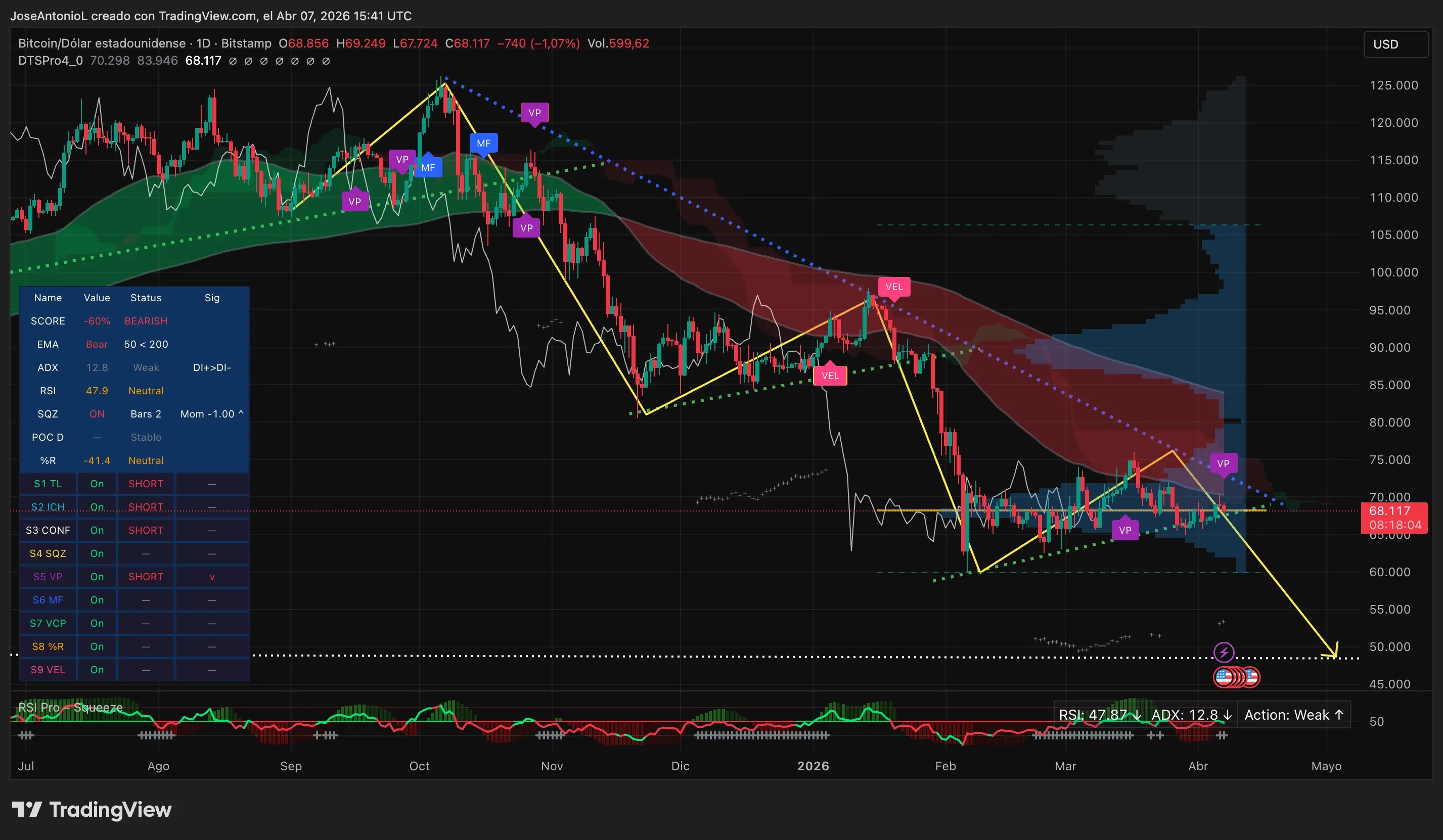
    • The move has rattled markets, with Bitcoin down 2% to $68,117 and a triple-pattern breakdown playing out on the daily chart.
    • Prediction market traders on Myriad give BTC a 57% chance of dumping to $55K.

    War is the macro today.

    President Donald Trump posted on Tuesday morning on Truth Social that “a whole civilization will die tonight, never to be brought back again” unless Iran gives in to U.S. demands. He set 8 p.m. ET as the hard deadline for Iran to reopen the Strait of Hormuz or face destruction.

    S&P 500 futures fell 0.4%, Nasdaq 100 futures dropped 0.6%, and Dow futures sank 142 points before the opening bell. Oil went the other direction: WTI crude is trading above $115 a barrel, Brent above $110—a more than 70% rise over the last 30 days—the direct result of a Strait of Hormuz closure that has been choking off roughly a fifth of the world’s oil supply since late February.

    Iran rejected a previous ceasefire proposal from the United States, and international groups such as the International Committee of the Red Cross have said Trump’s threats, if fulfilled, could amount to “war crimes.”

    The escalation in rhetoric has markets on edge, and crypto is no different. Bitcoin slipped to $68,557, dropping 2% on the day, and Ethereum slipped 2.7% as traders apparently brace for further turmoil. The logic appears to be that if bombs start falling on civilian infrastructure tonight, investors will flee to safety—and Bitcoin has increasingly shown to not function as a safe haven asset during a war panic.

    On Myriad, a prediction market built by Decrypt‘s parent company Dastan, traders are pricing in only a 24.1% chance that the Iranian regime falls before October. It suggests traders either expect yet another TACO move from Trump or believe the conflict will drag deep into the second half of the year, with no clean resolution in sight.

    The Bitcoin chart has seen this movie before

    With Bitcoin down around 2% today, the short-term movement doesn’t look catastrophic—but the long-term picture isn’t pretty.

    Price of Bitcoin over time. Image: Tradingview
    Image: Tradingview

    The daily charts show three separate attempts by buyers to recover losses after a major top, and three separate failures, since October of last year. Each recovery set a lower high. Each breakdown found a lower bottom. Bitcoin closed Q1 2026 with its worst quarter since 2018, down 22% as war, tariffs, and a hawkish Fed crushed risk appetite. The coin is now at the bottom of the third pattern, hovering above support near $65,000. If this plays out the way the previous two did, the next stop is $55,000 or worse.

    The overall indicators show a bearish mood among Bitcoin traders.

    The Exponential Moving Averages, or EMAs, show that the 50-day average is trading below the 200-day, which is the quintessential bearish indicator. It means the longer-term trend is still pointed down, and there’s no structural reversal in the moving averages yet. When EMAs are in this configuration, traders refer to it as a “death cross,” and rallies tend to get sold into.

    The 50-day EMA has marked a solid resistance since the death cross appeared late last year.

    The Average Directional Index, or ADX, is at 12.8—well below the 25 threshold that signals a real trend is forming. ADX measures trend strength regardless of direction. Below 20 means the market is choppy and directionless. The bears are in control on paper, but the trend hasn’t gone full force yet as can be seen by the sideways movement after the big drop in February.

    For Bitcoin bulls, the good news is that a low ADX could point to a trend reversal. The bad news is it needs confirmation from other indicators, and that’s not happening right now.

    The Relative Strength Index, or RSI, sits at 47.9—firmly neutral but slightly oversold. RSI measures buying and selling momentum; at this level, neither camp has the edge. Meanwhile, the Squeeze Momentum Indicator shows that compressed energy is building, and the current lean is negative. A squeeze release with downward momentum is a bearish setup.

    Moon or doom?

    The charts show Bitcoin is more likely to go down. Three identical yellow patterns. Three failed recoveries. BTC formed a lower high every single time, then broke through support and found a new floor. The descending blue trendline connecting the highs is still intact. The Ichimoku cloud above is deep red—a ceiling, not a floor.

    Close below $65,000, and it’s a major confirmation for this pattern. The path to $55,000 then opens with little structural support in between.

    On Myriad, traders are leaning that way too: traders say there’s a 57% chance BTC’s next major move is a dump to $55,000, compared to 43% odds on a pump to $84,000. A separate market asks whether there’s still a chance crypto will bloom this spring: 66% say no, with the market closing May 31.

    There’s a real argument for the other side. Bitcoin is down more than 45% from the $126K all-time high set last October. Some analysts—including Main Management’s Kim Arthur—have called this the “bottoming phase” of a classic four-year crypto winter.

    But bulls need to see real confirmation first: Bitcoin breaking past the $75,000 mark with conviction, ADX climbing above 20 to signal a genuine trend forming, and the 50-day EMA starting to curl back toward the 200-day. None of that is happening yet. Without it, any bounce seems like just another lower high in the making.

    Disclaimer

    The views and opinions expressed by the author are for informational purposes only and do not constitute financial, investment, or other advice.

    Daily Debrief Newsletter

    Start every day with the top news stories right now, plus original features, a podcast, videos and more.

  • Phone Logs Show Seven Calls Between Milei and LIBRA Backer on Launch Night: Report

    Phone Logs Show Seven Calls Between Milei and LIBRA Backer on Launch Night: Report

    In brief

    • Phone logs show seven calls between Milei and a backer of the LIBRA meme coin on its launch night, according to a New York Times report.
    • WhatsApp messages reference regular payments to Milei from when he was still a congressman.
    • Argentina’s federal criminal probe into the scandal remains open.

    Argentine President Javier Milei’s ties to the collapsed LIBRA meme coin may run deeper than he has acknowledged, with newly surfaced phone logs showing seven calls between Milei and a key figure behind the token on the night of its launch.

    Milei promoted the Solana-based token on X in February 2025, sending its market cap above $4 billion before it crashed over 90% within hours as insiders drained roughly $87 million in liquidity.

    The collapse cost investors an estimated $250 million and triggered fraud charges, a congressional investigation, and a federal criminal probe that remains open.

    By June 2025, Argentina’s anti-corruption office cleared Milei, ruling he acted in a personal capacity when he posted about the token.

    According to a New York Times report citing initial coverage from local cable news channel C5N, the calls in question took place before and after Milei’s now-deleted post endorsing the Solana-based token at the time.

    “The launch and promotion of LIBRA was not at all improvised or accidental on the part of the president,” Maximiliano Ferraro, an opposition lawmaker, told the paper. “It was a planned, coordinated and deliberately executed operation.”

    Behind the scenes

    The phone logs, obtained from the federal prosecutor’s investigation, show the calls took place on the night of February 14, 2025, between Milei and Mauricio Novelli, one of the entrepreneurs behind the token. Novelli also allegedly called two of Milei’s top advisers that evening, including the president’s sister Karina Milei, per the report.

    WhatsApp messages recovered from Novelli’s phone point to a financial relationship way before the token’s launch.

    In one 2023 audio message, Novelli told an assistant to budget “the usual 2,000 for Milei,” calling it a monthly salary, while in a separate April 2024 message he referenced “the 4,000 we need to give to Karina,” in an apparent reference to Milei’s sister, per the Times.

    Draft documents found on Novelli’s phone outlined a $1.5 million payment scheme tied to Milei publicly naming Hayden Davis as a presidential adviser, the report indicates.

    It’s worth noting, however, that no evidence has emerged showing Milei agreed to or received any of the payments. The Argentine president has not publicly commented on the phone logs or payment references, and has not been formally charged in relation to them.

    Novelli’s lawyer, meanwhile, told the Times his client “is entirely unconnected to any wrongdoing” and is seeking to have the phone evidence excluded, arguing the device may have been tampered with in custody.

    If Milei was already cleared, the new evidence could cause them to “go back and re-investigate,” Austin Campbell, founder of crypto risk and compliance advisory firm Zero Knowledge, told Decrypt, while pointing to the difficulties of doing so.

    “Crypto has a deep problem with undisclosed payments, promotions, and outright scams,” Campbell said. “What we badly need is a disclosure regime for such arrangements or payments, with significant civil and criminal penalties for failing to disclose.”

    Milei dissolved the government task force investigating the scandal in May last year. The federal criminal probe under prosecutor Eduardo Taiano remains open.

    Decrypt has reached out to Argentina’s presidential press office for comment and will update this piece should they respond.

    Daily Debrief Newsletter

    Start every day with the top news stories right now, plus original features, a podcast, videos and more.

  • Solana Foundation to Help Secure DeFi Protocols Following $285 Million Drift Hack

    Solana Foundation to Help Secure DeFi Protocols Following $285 Million Drift Hack

    In brief

    • The Solana Foundation launched the STRIDE security program with 24/7 threat monitoring for protocols exceeding $10M total value locked.
    • Protocols with over $100M TVL receive “formal verification” services funded by the Foundation.
    • On April 1, the Solana-based Drift Protocol saw $285 million swiped in an exploit that’s believed to have been planned for months by North Korean hackers.

    Nearly a week after a prominent Solana-based decentralized exchange was hit with a $285 million hack that’s been linked to North Korean hackers, the Solana Foundation has revealed plans to help secure the network’s largest DeFi protocols.

    The Solana Foundation and Asymmetric Research launched STRIDE, a tiered security program that provides 24/7 threat monitoring for DeFi protocols with over $10 million in total value locked (TVL). For protocols with over $100 million TVL, the Foundation will offer “formal verification”—described in a post as “a mathematical, proof-based method that guarantees smart contract correctness by exhaustively checking every possible state and execution path.”

    STRIDE—or Solana Trust, Resilience and Infrastructure for DeFi Enterprises—evaluates protocols against security standards before providing ongoing protection services. The initiative marks a significant escalation in blockchain security infrastructure as attackers target Solana’s growing billions in locked value with increasingly sophisticated methods.

    The program launched alongside the Solana Incident Response Network (SIRN), a membership-based collective of security firms dedicated to rapid ecosystem defense. Founding participants include Asymmetric Research along with OtterSec, Neodyme, Squads, and ZeroShadow. The framework will evolve based on real-world assessment feedback, with version 0.1 currently live.

    The timing underscores an urgent need—Drift Protocol suffered an exploit where attackers drained $285 million in under 12 minutes on April 1, demonstrating the speed and scale at which modern DeFi vulnerabilities can be exploited. Drift said on Sunday that it discovered that North Korean hackers had spent six months infiltrating its team and infrastructure before executing the attack.

    Such incidents highlight why major blockchain networks are taking more direct responsibility for ecosystem-wide security rather than leaving individual protocols to defend themselves.

    The tiered approach based on TVL thresholds reflects how layer-1 networks are institutionalizing security as decentralized finance matures. Rather than treating all protocols equally, STRIDE allocates resources proportionally to risk—acknowledging that protocols managing hundreds of millions of dollars’ worth of assets require different protection than smaller experiments.

    This shift recognizes that individual smart contract audits alone cannot match the innovation pace of adversaries targeting blockchain infrastructure. Rapidly advancing AI is also a key concern, as it can help attackers and developers alike find flaws.

    An upcoming Anthropic AI model codenamed Claude Mythos is being viewed as a particular threat to cybersecurity—so much so that top cybersecurity stock prices fell late last month when first details of the model were leaked. On the other hand, a recently fixed Zcash software exploit was discovered with the help of AI tooling.

    Daily Debrief Newsletter

    Start every day with the top news stories right now, plus original features, a podcast, videos and more.
  • Bitcoin ETFs Add $471M in Biggest One-Day Haul Since February

    Bitcoin ETFs Add $471M in Biggest One-Day Haul Since February

    In brief

    • Bitcoin ETFs recorded $471 million in inflows Monday, the largest since February.
    • Iran responded to America’s 15-point plan with its own 10-point plan including reopening the Strait of Hormuz with a $2 million per ship fee.
    • Prediction market users on Myriad have optimistically repriced a spike in traffic through the Strait before May, from 43% on April 3 to 68% today.

    Bitcoin ETFs posted their largest single-day inflow since late February as investors positioned ahead of President Trump’s Tuesday-night deadline on Iran.

    The funds added $471.3 million on Monday, led by BlackRock’s IBIT with $181.9 million, followed by Fidelity’s FBTC at $147.3 million and ARKB at $118.8 million, according to SoSoValue data. Every ETF recorded net inflows or held flat, with none seeing outflows.

    The inflows come as Bitcoin trades at around $69,200, down 1% over the past 24 hours and up 3.7% on the week, according to CoinGecko data.

    “Institutional positioning right now looks more like measured accumulation than a binary bet on geopolitics,” Wenny Cai, Founder and CEO of decentralized derivatives exchange SynFutures, told Decrypt.

    This move from institutional investors shows that they’re stepping back in, but through “structured allocation rather than chasing a near-term resolution of the Middle East conflict,” Cai explained.

    The flows follow a flurry of diplomatic activity in the U.S.-Iran conflict.

    Iran delivered a “10-point” response to the U.S. “15-point peace plan,” demanding a permanent end to the war, the lifting of all sanctions, and an end to Israeli strikes in Lebanon. In return, Iran would reopen the Strait of Hormuz but impose a $2 million fee per ship, splitting proceeds with Oman.

    However, negotiators are “pessimistic” Iran will bend to meet Trump’s demand to reopen the strait before his Tuesday-night deadline, The Wall Street Journal reported.

    A strategic adviser to Iran’s parliament speaker struck a defiant tone: “It is Trump who has about 20 hours to either surrender to Iran or his allies will return to the Stone Age,” according to The Kobeissi Letter’s post Tuesday.

    As a result, oil prices have extended gains to $115.50 per barrel, up 110% since December 2025 lows as the reopening of the Strait of Hormuz—a key variable—remains shrouded in uncertainty.

    Users on prediction market Myriad, owned by Decrypt’s parent company Dastan, see a 68% chance that average ships transiting the strait will rise above 15 before May—up from 43% on April 3, reflecting growing but cautious optimism. Nevertheless, Myriad users put an 84% chance on crude oil’s next move taking it to $120.

    For Bitcoin, the path forward hinges on whether diplomatic efforts succeed, Decrypt previously reported, with analysts suggesting a potential retest of $80,000 was possible if the ceasefire talks yield an end to hostilities.

    “If tensions ease, Bitcoin could be one of the first assets to reprice higher, but a sustained bull run will still depend more on global liquidity than geopolitics alone,” Cai said.

    However, Bitcoin’s resilience since the war began on February 29 underscores a shift in its narrative. That, combined with steady ETF demand and macro hedging, could keep Bitcoin supported near current levels, with $70,000 acting more as a test zone than a firm floor, Cai said, tempering optimistic expectations.

    Daily Debrief Newsletter

    Start every day with the top news stories right now, plus original features, a podcast, videos and more.

  • Bitcoin Whale Moves $20M to Binance Amid Broader Selling Pressure

    Bitcoin Whale Moves $20M to Binance Amid Broader Selling Pressure

    In brief

    • A Bitcoin whale moved 300 BTC worth more than $20 million to Binance Tuesday.
    • The transfer could represent a $15 million loss if sold at current prices, though alternative scenarios like OTC deals remain possible
    • Bitcoin currently trades at around $68,300, down 45% from its October 2025 all-time high of $126,080.

    A Bitcoin whale moved roughly 300 BTC worth more than $20 million to a Binance deposit address on Tuesday, according to on-chain data. The transfer marks the latest in a series of large holder movements as Bitcoin trades well below last year’s highs.

    Per Arkham data, the whale’s wallet accumulated just under 513.3 BTC between January and March 2025, during which time Bitcoin traded at an average purchase price of $97,500, according to CoinGecko historical data.

    With Bitcoin currently trading at around $68,300, the transfer represents a potential realized loss of around $15.02 million—though the movement could also indicate an over-the-counter deal, custody rebalancing, or other non-sale activity. The whale retains approximately 200 BTC worth around $13.65 million in their wallet.

    Tuesday’s transfer follows heightened whale activity in recent months. In November last year, a Bitcoin billionaire dumped their entire $1.3 billion stash after 14 years, while just two months later a Satoshi-era whale moved $180 million in BTC to Coinbase.

    Last month, a holder moved 2,100 BTC worth $147.7 million that had remained untouched for over 13 years, while another whale transferred $33 million worth of BTC to Binance during the same period, continuing an unwind of coins acquired in 2013. These movements have coincided with Bitcoin’s retreat from its all-time high of $126,080 recorded in October 2025.

    Bitcoin currently trades almost 46% below those record levels, facing sustained selling pressure as the cryptocurrency market navigates a broader downturn, with Q1 2026 marking the worst quarterly performance for the cryptocurrency since 2018. The accumulation period for Tuesday’s whale—between January and March 2025—coincided with Bitcoin trading around what was then an all-time high, making this holder representative of investors who entered positions during last year’s rally.

    Daily Debrief Newsletter

    Start every day with the top news stories right now, plus original features, a podcast, videos and more.
  • Solo Bitcoin Miner Beats the Odds, Scores $210K Block Reward

    Solo Bitcoin Miner Beats the Odds, Scores $210K Block Reward

    In brief

    • A solo Bitcoin miner successfully mined block 943,411 to earn 3.139 BTC worth approximately $210,000.
    • Operating with just 230 Terahash/s, the lucky miner overcame 1-in-28,000 daily odds to win the “lottery.”
    • Listed Bitcoin mining companies are shedding millions of dollars worth of BTC as they pivot to AI infrastructure.

    A solo Bitcoin miner operating with minimal computing power validated block 943,411 and earned 3.139 BTC on April 2. The reward, worth approximately $210,000 at current prices, included both the standard block subsidy and transaction fees.

    The miner was running roughly 230 Terahash/s per second of computing power, representing about 0.00002% of Bitcoin’s total estimated hashrate of around 1 Zhash/s.

    Bitcoin mining involves racing to solve cryptographic puzzles using computational power to secure block rewards. Once the preserve of individuals mining on CPUs, an “arms race” in computing power has seen miners switch first to GPUs and latterly to specialized ASIC mining rigs. Nowadays, mining is mostly the preserve of large mining pools with massive amounts of computational power at their disposal—but solo miners do occasionally win the “lottery.”

    In a tweet, CKpool developer Con Kolivas said the miner had roughly a 1-in-28,000 chance of finding a block on any given day. For perspective, major mining operations like Riot Platforms operate roughly 30 exahashes—approximately 130,000 times the hashrate of Thursday’s solo winner.

    The miner used solo.ckpool.org, an anonymous solo mining pool introduced in 2014 that lets operators keep their full block rewards minus a 2% fee.

    The solo miner’s windfall comes as industrial-scale operations are shedding their Bitcoin holdings. Last week, Riot Platforms sold some $250 million worth of BTC, while MARA Holdings sold $1.1 billion in Bitcoin late last month, as part of a pivot to AI infrastructure.

    While it’s a long shot for solo miners hoping to win block rewards, it happens surprisingly often. In December, a solo miner secured a $282,000 reward in just such a David-versus-Goliath scenario, swiftly followed by two separate miners who each won roughly $300,000 block rewards within days of each other in January, and another lucky miner who earned $200,000 after renting just $75 worth of hash power in February.

    Daily Debrief Newsletter

    Start every day with the top news stories right now, plus original features, a podcast, videos and more.
  • Altcoin Resilience Signals ‘Compelling Entry Points’ for Crypto Markets: Grayscale

    Altcoin Resilience Signals ‘Compelling Entry Points’ for Crypto Markets: Grayscale

    In brief

    • Grayscale’s Zach Pandl thinks a bottom could be forming for the crypto market’s leading altcoins, based on their recent resilience.
    • Despite macroeconomic uncertainties heightened by conflict in the Middle East, Ethereum and Chainlink have notched gains over the past month.
    • Pandl pointed to tokenization and stablecoins as factors that are driving the adoption of cryptocurrencies on Wall Street, potentially improving fundamentals.

    Crypto’s leading altcoins have fallen far from all-time highs notched last year, but their recent resilience indicates that downward pressure could be abating, according to Grayscale Head of Research Zach Pandl.

    In a blog post published on Thursday, Pandl wrote that the crypto asset manager “can’t be sure that crypto markets have bottomed.” In an interview with Decrypt on Monday, however, he expressed positive sentiment toward the performance of altcoins amid geopolitical turmoil.

    “Altcoins are trading remarkably well over the last month in the context of a challenging macro environment,” Pandl said, in reference to headwinds like the U.S.-Israel war with Iran and a significant drawdown in stocks. “The price action may be telling us that we found a more durable bottom. That remains to be seen, but I think [it’s still] very encouraging price action.”

    The crypto industry’s leading altcoins, from Ethereum to Avalanche, have been hammered since the value of all cryptocurrencies tracked by CoinGecko peaked around $4.37 trillion in October. The global cryptocurrency market cap stood at $2.47 trillion on Monday, or 43% lower. 

    Despite the drawdown, Ethereum has risen 9.2% to $2,160 over the past month. Solana has edged down 1.9% to $82 over the same period. Chainlink, meanwhile, has risen 3.8% to $9.08. Still, there is broad consensus that the crypto market is mired in a bear market at this point.

    Pandl wagered that some traders may want to wait for clearer catalysts for altcoin allocations. At the same time, he said investors with longer horizons may consider current levels. In recent months, industry onlookers have looked to the passage of the Clarity Act crypto market structure bill with hope.

    Experts say the bill could drive the adoption of crypto on Wall Street through regulatory clarity. After months of tension over stablecoin rewards, Coinbase Chief Legal Officer Paul Grewal signaled last week that a resolution among lawmakers could be coming soon.

    “If you have some patience for some further range-bound markets and choppiness over the short term, these are potentially very compelling entry points,” Pandl added.

    Slumping trading volumes for altcoins have tilted the market towards Bitcoin. Some analysts have attributed that shift to expectations of tighter monetary conditions and macro uncertainty.

    From Grayscale’s perspective, there’s a striking disconnect between the valuations of some altcoins and the ongoing improvement in fundamentals, from regulatory clarity to the growing adoption of stablecoins and tokenization. In particular, Pandl said that Ethereum and Solana “stand to benefit significantly from those trends,” despite their recent slides.

    “You’re getting a surprising opportunity, in my view,” Pandl added. “Bitcoin, in fact, will benefit less than many of these assets from regulatory clarity and adoption of tokenized assets.”

    Pandl may be bullish on leading altcoins’ prospects, but the sentiment stands in contrast with some expectations that more pain could be ahead. 

    Although Bitcoin has already dropped nearly 45% to under $70,000 from its October all-time high of $126,000, Bloomberg Intelligence strategist Mike McGlone reiterated on Sunday that $10,000 is in the cards this year. Other analysts have called for Bitcoin bottom marks of $55,000 or $50,000 in recent months.

    As for the top altcoin on the market, Ethereum, traders still appear to be bearish on its short-term prospects. On Myriad, a prediction market platform operated by Decrypt‘s parent company Dastan, traders penciled in a 58% chance that Ethereum’s next stop is a fall to $1,500 rather than a jump to $3,000.

    Daily Debrief Newsletter

    Start every day with the top news stories right now, plus original features, a podcast, videos and more.