Tag: Al Jazeera

  • California leads lawsuit against Trump fuel efficiency standards rollback

    California leads lawsuit against Trump fuel efficiency standards rollback

    Lawsuit alleges NHTSA contravenes its congressional mandate to set fuel-economy standards at ‘maximum feasible’ .

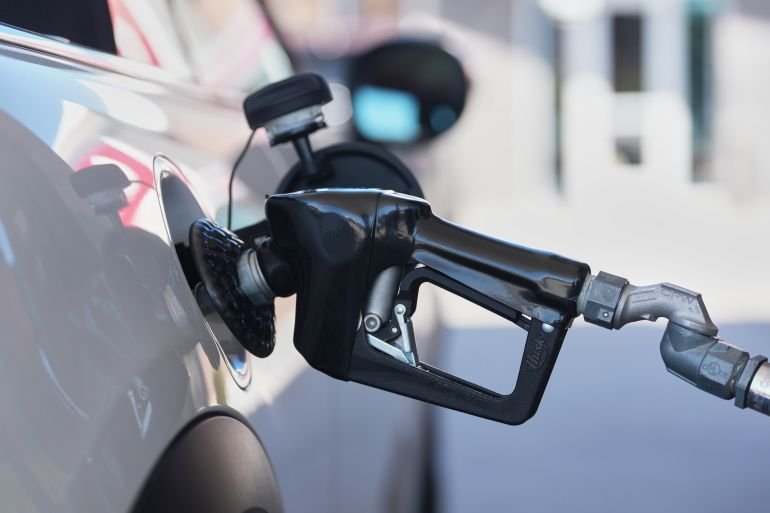
    Twenty-six states, including California and New York, have filed a lawsuit against United States President Donald Trump’s administration after the US Department of Transportation lowered fuel economy standards for petrol-powered vehicles.

    The lawsuit, filed on Friday, challenges the Department of Transportation’s rollback of fuel economy standards to a fleet average fuel economy of 34.9 miles (56km) per gallon (3.78 litres) by model year 2031. Under the administration of former President Joe Biden, fuel economy standards were set at 50.4 miles (81km) per gallon by model year 2031.

    Recommended Stories

    list of 4 itemsend of list

    California Attorney General Rob Bonta, who is leading the lawsuit, argued that the Trump administration improperly changed how federal regulators calculate fuel economy standards.

    The National Highway Traffic Safety Administration (NHTSA) bases standards on technological improvements that could make petrol-powered vehicles more efficient. To do that, it first models the current fleet’s performance and then considers what additional actions manufacturers could take to improve their fuel economy in future model years above that.

    In past standards, including during the first Trump administration, NHTSA’s baseline fleet included the millions of electric vehicles that already run on US roads.

    Bonta said the Transportation Department change ignores the existing slate of EVs, which makes it easier to justify weaker standards for petrol-powered vehicles, and called the approach “flawed” and “dramatically distorted”.

    The lawsuit also alleges that NHTSA’s new rule is contrary to law and that NHTSA contravenes its mandate from Congress to set fuel-economy standards at their “maximum feasible” level.

    The Transportation Department has said the change could save American taxpayers $138bn over the next five years.

    “The president started a war that has created volatility in oil markets, disrupted global energy supplies, and left families and businesses paying the price at the pump. Yet, the Trump administration is attempting to gut fuel economy standards and force Americans to spend billions more on gas while poisoning the air in our communities,” Attorney General Bonta said in a statement.

    The rollback was applauded by car makers.

    “We welcome the Administration’s efforts to reset the CAFE [Corporate Average Fuel Economy] regulations to more achievable targets that are better aligned with market realities,” said Shane Karr, senior vice president of public affairs at Stellantis North America.

    Second lawsuit

    The litigation by the states came in tandem with a second lawsuit filed on Friday by progressive and climate groups, including the Environmental Defense Fund and Public Citizen.

    “Trump’s lawless push to roll back key safeguards on fuel economy will pollute our air, and line the pockets of oil and auto CEOs. We are confident of stopping Trump’s CAFE standards rollback,” Robert Weissman, co-president of Public Citizen said in a statement announcing the lawsuit, which was filed in a federal court in Washington DC.

    Auto stocks were trending downward throughout the day, with Ford, General Motors and Toyota closing down around 1 percent. Stellantis fell more than 6 percent amid reports of slumping sales.

  • Iraq grants Iranian airlines 40 daily Najaf flights after US exemption

    Iraq grants Iranian airlines 40 daily Najaf flights after US exemption

    Mahan Air is excluded from the agreement as Baghdad says Washington granted its request for a waiver.

    Iraq has agreed to let Iranian airlines, except Mahan Air, operate up to 40 flights a day to and from Najaf International Airport, saying the United States granted an exemption from its sanctions.

    Prime Minister Ali al-Zaidi’s office announced the agreement on Friday, a day after Tehran urged Baghdad to lift restrictions that it said hurt pilgrims, patients, students and business.

    Recommended Stories

    list of 2 itemsend of list

    The deal eases the links between the two Shia-majority neighbours since Washington sanctioned Iran’s aviation sector last month.

    Al-Zaidi welcomed the “positive response shown by the US government to Iraq’s efforts and its cooperation in granting the necessary exemption”, the statement from his office said.

    “Air travel does not merely represent transportation between two airports, but rather a bridge of communication between peoples,” it added.

    Separately, Iraq’s Foreign Minister Fuad Hussein said the return of flights supports an Iraqi-US partnership premised on mutual respect.

    Hussein also welcomed what he described as US understanding of the importance of respecting religious freedom and facilitating access for visitors to holy sites.

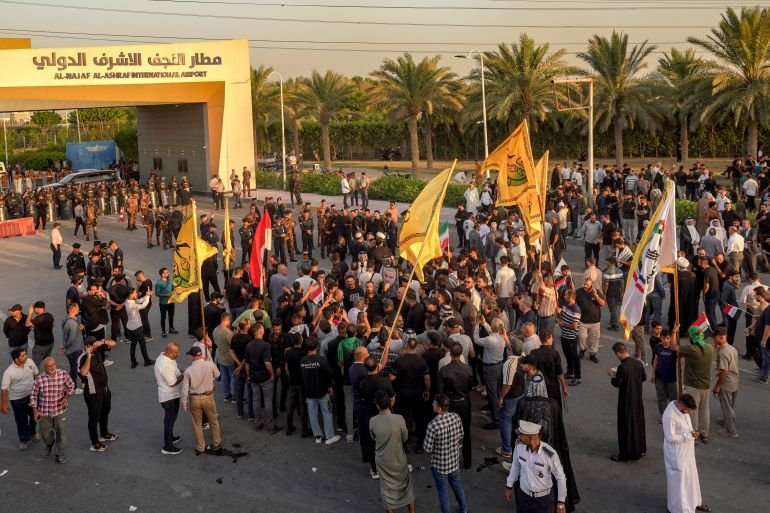
    Security personnel stand guard as demonstrators gather outside the Al-Najaf Al-Ashraf International Airport in Najaf on September 28, 2026, demanding the facility to be reopened for flights from Iran.
    Security personnel stand guard as demonstrators gather outside the Al-Najaf Al-Ashraf International Airport in Najaf, demanding the facility to be reopened for flights from Iran [AFP]

    Flights suspended

    The US Treasury announced sanctions on September 8 against 36 entities linked to Iran’s aviation sector.

    Foreign ground-handling companies then refused to service Iranian aircraft for fear of falling foul of US sanctions, and flights stopped at four Iraqi airports.

    Soon after, Iraq’s government held direct talks with Washington, seeking an exemption.

    Iraq’s ambassador to Tehran, Yasser al-Hajjaj, told Iran’s IRNA news agency that Baghdad had not ordered the halt in flights. The suspension also led to demonstrations outside Najaf airport and in Nasiriya, Karbala and Amarah, according to Iran’s Press TV.

    Najaf is the main destination for Iranian flights in Iraq. Flights to and from the city carry Iraqi Shia Muslim pilgrims to Iran’s holy cities or Iranians visiting sacred sites in Iraq.

    Iran’s ambassador to Baghdad, Mohammad Kazem al-Sadegh, told the Iranian news agency ISNA that there were “roughly 25 daily flights from Iran to Najaf and about 15 flights to Baghdad” before the ban.

    “Around 12,000 to 13,000 people travel between Iran and Iraq and vice versa on Iranian airlines, which is not a small number,” he added.

    In a statement shared on Thursday, Iran’s Foreign Ministry said that Washington’s “illegal and inhumane” extraterritorial enforcement of sanctions was disrupting Iran’s trade and air transport.

    Restrictions remain

    Flights between Najaf and Iran restarted late on Monday, according to the Iraqi News Agency.

    However, flights with Iran are still suspended at Baghdad, Erbil and Sulaimaniyah airports, forcing passengers into land journeys of at least 12 hours and disrupting pilgrim traffic.

    Al Jazeera has not verified the exemption with representatives in Washington.

  • US to send third aircraft carrier towards Iran: US official to Al Jazeera

    US to send third aircraft carrier towards Iran: US official to Al Jazeera

    Massive US military deployment in the Middle East includes 50,000 troops, F-35s and Marines to pressure Tehran.

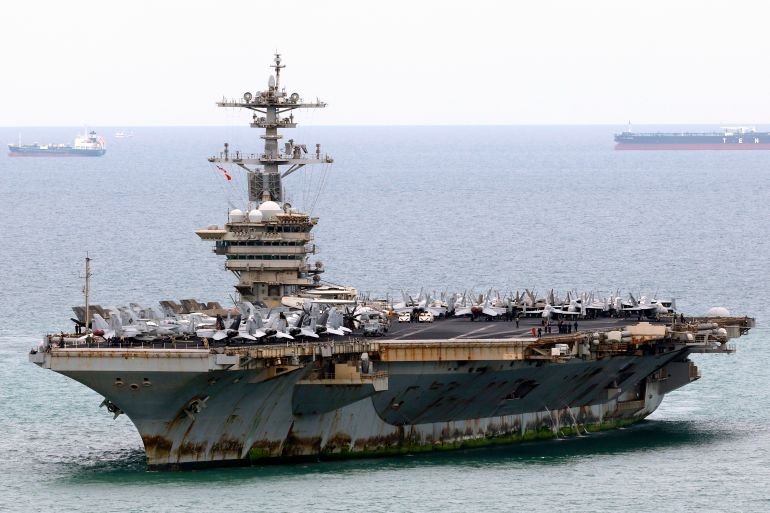
    The United States is deploying a third US aircraft carrier to the waters around Iran, a US official told Al Jazeera, as the war enters its eighth month and both sides weigh escalation and diplomatic engagement.

    The official told Al Jazeera that the USS Theodore Roosevelt carrier strike group left its San Diego base on Sunday, bound for the region, followed a day later by the Makin Island Marine Expeditionary Force, carrying more than 2,000 Marines.

    Recommended Stories

    list of 3 itemsend of list

    By the end of November, the official said, three aircraft carriers and two amphibious landing groups will be positioned around Iran.

    The official said the concentration of force would hand President Donald Trump a wider menu of options if he decides to act.

    Al Jazeera’s Tanya Noury, reporting from Washington, said the new deployment includes thousands of troops and extra air power, including F-35 fighter jets, layered on top of the roughly 50,000 US service members already stationed in the region.

    The goal, Noury said, citing sources inside the Pentagon and White House, is to keep military options “on the table” for Trump regardless of how diplomacy unfolds, with the Pentagon not planning to withdraw any assets even if an agreement with Iran is reached. Defense Secretary Pete Hegseth has said forces are “ready to go” should Trump order new strikes.

    Trump himself has kept the threat alive in public. He told Fox News he believes the US is “going to win the war” with Iran “very soon”, while suggesting in other remarks that a return to military action “is possible” but something he would rather not spell out before November’s midterm elections.

    Washington has paired the show of force with new economic pressure, sanctioning Iran’s rail and automotive conglomerates this week, as the Treasury Department called the new measures an effort to drain what remains of Tehran’s revenue.

    Diplomatic track

    Parallel to the military build-up, Iran has pushed a seven-day roadmap, conveyed through Qatar, that would see it reopen the Strait of Hormuz and resume nuclear talks in exchange for an end to the US naval blockade, sanctions relief and a regional ceasefire covering Lebanon and Yemen.

    The plan was then rejected by Trump.

    US Ambassador to the UN Mike Waltz told NBC the plan’s demand for frozen funds and sanctions relief was non-negotiable, noting “these aren’t just the United States’ sanctions … these are global sanctions”, and pointing to seven UN Security Council resolutions against an Iranian nuclear weapons programme.

    Iran’s response, in the meantime, has been similarly two-pronged.

    Foreign Minister Abbas Araghchi told NBC that Tehran was “fully prepared” to resume the war, before writing on X that “we did not come to New York to sell a war. We came to forge peace.”

    Analysts say the mixed signals are deliberate.

    Abas Aslani of the Center for Middle East Strategic Studies said the dispute has shifted from whether to negotiate to “who is going to abandon the primary leverage first”, while former US ambassador Richard Schmierer said Trump is caught between delaying past the midterms and the political cost of offering concessions that mirror a June deal he was already criticised for.

    Nearly 70 percent of Americans now say the war has not been worth fighting, according to a new AP-NORC poll, with Trump brushing off the slide in his approval ratings by insisting “the pollsters are corrupt”.

  • Miami judge rules federal noncitizen voting law violates US Constitution

    Miami judge rules federal noncitizen voting law violates US Constitution

    Judge Leibowitz’s decision underscores state jurisdiction over voter qualifications, limiting federal actions.

    A United States federal judge has ruled that a law criminalising voting by noncitizens is unconstitutional, dealing a setback for President Donald Trump’s administration as it cracks down on alleged election fraud ahead of November’s midterm elections.

    US District Judge David Leibowitz in Miami dismissed a federal case on Thursday against Chelsea Cox, a Florida resident originally from Jamaica who had been charged in October 2025 with illegally voting in the 2020 presidential election.

    Recommended Stories

    list of 3 itemsend of list

    Leibowitz, who was nominated to the bench by former Democratic President Joe Biden, found that under the US Constitution, only individual states, not the US Congress, have the authority to set voter qualifications.

    Since every state already requires US citizenship to vote, he wrote, it is up to Florida, not the Department of Justice, to prosecute Cox for breaking that rule. “Florida can and does,” he wrote, noting the state already has its own laws against the conduct Cox is accused of.

    The ruling applies only to Cox’s case and it does not bind judges elsewhere, though about 45 similar cases remain pending nationwide. At least four other defendants have raised the same constitutional challenge.

    Court filings show Cox entered the US as a tourist in 1999, overstayed her visa, and later used a fraudulent birth certificate from the US Virgin Islands, a US territory in the Caribbean, to obtain a Florida driver’s licence and register to vote in 2012.

    Trump has falsely claimed that noncitizen voting, which is already illegal and rare, cost him the 2020 election, and has cast it as part of a broader effort by Democrats to dilute Republican support.

    The Department of Justice has charged at least 60 people with the offence since Trump returned to office in January 2025.

    Among 129 people charged with “voting by an alien” since 2021, none was accused of conspiring to sway an election, backing a candidate, or being paid to vote, according to Reuters. Most were found to be lawful permanent residents who had registered by mistake or on the incorrect advice of an election worker or government clerk.

    Cox’s lawyer, Bruce Udolf, welcomed the ruling and said he hoped authorities would not now seek to deport her, citing her declining health conditions.

  • New aircraft carrier, 10,000 US troops: Is the Iran war about to escalate?

    New aircraft carrier, 10,000 US troops: Is the Iran war about to escalate?

    The United States is deploying a third aircraft carrier strike group to waters in the Middle East close to Iran, a US official has told Al Jazeera, as the war enters its eighth month and both sides weigh escalation and diplomatic engagement.

    Thousands more troops are also on their way to the region, just a month before November US midterm elections, which could see US President Donald Trump’s Republican Party hit hard by his handling of the war, which is deeply unpopular in the US.

    Recommended Stories

    list of 3 itemsend of list

    We look at what the latest troop deployment means and whether it signals a coming escalation in the war on Iran:

    What troops and military equipment have been deployed?

    A US official told Al Jazeera that the USS Theodore Roosevelt carrier strike group left its San Diego base on Sunday, bound for the region, followed a day later by the Makin Island Marine Expeditionary Unit (MEU), which is carrying more than 2,000 Marines.

    The Wall Street Journal reported that the strike group and naval deployments could involve an additional 9,000 to 10,000 US troops in total, including sailors and Marines assigned to the carrier strike group and other ships.

    By the end of November, the official said, three aircraft carriers and two amphibious landing groups will be positioned near Iran.

    The official said the concentration of force would hand President Donald Trump a wider menu of options if he decides to act.

    Al Jazeera’s Tanya Noury, reporting from Washington, said the new deployment, which includes F-35 fighter jets, will add to the roughly 50,000 US service members already stationed in the region.

    The goal, Noury said, quoting sources inside the Pentagon and White House, is to keep military options “on the table” for Trump regardless of how diplomacy unfolds. The Pentagon is not currently planning to withdraw any assets even if an agreement with Iran is reached.

    Defense Secretary Pete Hegseth has said forces are “ready to go” should Trump order new attacks.

    What forces does the US already have in the Middle East?

    The US has stationed troops and military assets at bases in the Middle East for decades.

    According to the Council on Foreign Relations, the US operates from a broad network of military sites, both permanent and temporary, across at least 19 locations in the region.

    Of these, eight are permanent bases, located in Bahrain, Egypt, Iraq, Jordan, Kuwait, Qatar, Saudi Arabia and the United Arab Emirates.

    The US’s first deployment of soldiers in the Middle East took place in July 1958, when combat troops were sent to Beirut during the Lebanon crisis. At its height, there were almost 15,000 Marines and soldiers in Lebanon.

    As of mid-2025, there were 40,000 to 50,000 US soldiers stationed around the Middle East, comprising personnel stationed in both large, permanent bases and smaller forward sites across the region.

    Trump has been beefing up the US military presence in the Middle East since the start of this year, initially sending warships, including the USS Abraham Lincoln aircraft carrier, to the Arabian Sea.

    INTERACTIVE - US Military presence in the Middle East June 2026 - JUL30, 2026-1785419231

    What military assets and troops did the US send ahead of the war?

    According to open source intelligence analysts and military flight-tracking data, the US has deployed more than 120 aircraft to the region since early February. This is the biggest surge in US airpower in the Middle East since the 2003 Iraq War.

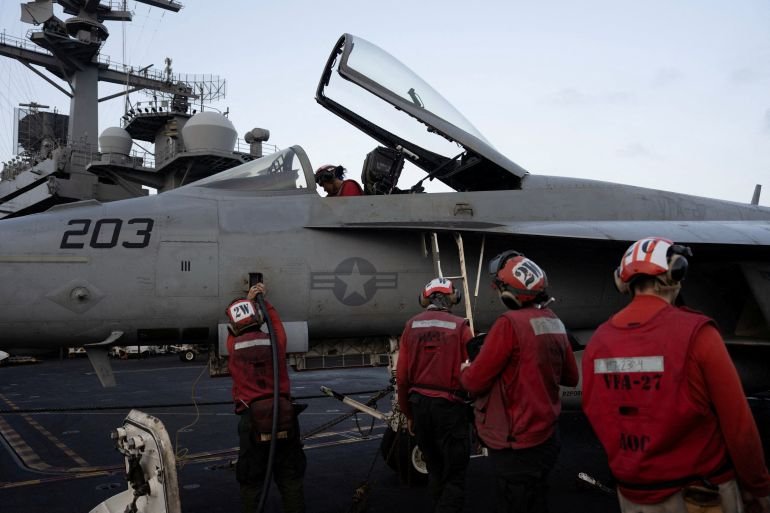
    Reported deployments include E-3 Sentry Airborne Warning and Control System (AWACS) aircraft, F-35 stealth strike fighters and F-22 air superiority jets alongside F-15 and F-16 fighter aircraft. Flight-tracking data showed many of these planes departing bases in the US and Europe, supported by cargo aircraft and aerial refuelling tankers, a sign of sustained operational planning rather than routine rotations, military analysts said.

    In March, the Pentagon also ordered additional US forces to the Gulf.

    The reinforcements consisted of three distinct formations, each with a different origin, route and timeline.

    The first was the Tripoli Amphibious Ready Group, centred around the America-class assault ship USS Tripoli and the 31st Marine Expeditionary Unit (MEU).

    The second was the Boxer Amphibious Ready Group, built around the Wasp-class assault ship USS Boxer and the 11th MEU, based in Southern California in the US.

    Together, these two Marine groups have added 4,500 Marines and sailors in the region.

    The third was a contingent of about 2,000 soldiers from the 82nd Airborne Division’s Immediate Response Force, based at Fort Bragg, North Carolina. The airborne infantry division is focused on parachute assaults.

    In total, nearly 7,000 additional soldiers have already been deployed to the Middle East since the war on Iran began.

    What does the latest deployment signal?

    While it is not clear if the new troop deployment signals an escalation in the war, in an interview with Time magazine published on Thursday, Trump suggested that it is “possible” he could ramp up bombing Iran after the midterm elections.

    When asked by Time for further details, Trump said: “I can’t tell you that because look, you know, you’re asking, where are you going to bomb?”

    Some analysts have suggested that sending more troops to the region could be Washington’s negotiating technique with Iran.

    Last week, Iran sent a new proposal to reopen the Strait of Hormuz within seven days, subject to certain conditions it wants the US to meet, including the lifting of sanctions, unfreezing Iranian assets and guaranteeing an end to strikes.

    However, the Trump administration rejected the proposal. Analysts say the US wants other issues, such as Iran’s nuclear programme, to be discussed before it agrees to any terms.

    In his Time interview, Trump said that he had rejected the latest ceasefire proposal from Iran because it included “things” he “wouldn’t have approved a year ago” and  “wouldn’t have today”.

    Washington has paired the show of force towards Iran with economic pressure, sanctioning Iran’s rail and automotive conglomerates this week, as the Treasury Department called the new measures an effort to drain what remains of Tehran’s revenue. Last month, the US unveiled sweeping new sanctions on Iran, as well as on other countries which trade with it.

    What stage are diplomatic efforts at?

    Indirect peace talks conducted between the US and Iran via mediators have been continuing without any breakthroughs.

    At talks held on the sidelines of the United National General Assembly (UNGA) in New York last month and mediated by Qatar, the opening of the Strait of Hormuz remained a sticky subject.

    At the talks, Iran pushed a seven-day roadmap, conveyed through Qatar, that would see it reopen the Strait of Hormuz and resume nuclear talks in exchange for an end to the US naval blockade, sanctions relief and a regional ceasefire covering Lebanon and Yemen.

    The plan was rejected by Trump.

    US ambassador to the UN Mike Waltz told NBC the plan’s demand for frozen funds and sanctions relief was non-negotiable, noting “these aren’t just the United States’ sanctions … these are global sanctions”, and pointing to seven UN Security Council resolutions against an Iranian nuclear weapons programme.

    In response, Iran’s Foreign Minister Abbas Araghchi told NBC that Tehran was “fully prepared” to resume the war, before writing on X that “we did not come to New York to sell a war. We came to forge peace.”

    Late on Thursday, Trump warned Iran that the current confrontation will end “very soon”, threatening severe consequences if Tehran fails to reach a deal with Washington.

    Speaking at a Peterbilt Motors plant in Denton, Texas, Trump said Iran will either “do something very proper and smart, or they won’t be around very long”.

    He also questioned whether Iran can be trusted to honour any agreement, saying: “When I make a deal with this company, you’re going to honour it. When you make a deal with them, it’s very possible that they won’t honour it.”
  • ICC ends contract with French insurer amid US sanctions threat

    ICC ends contract with French insurer amid US sanctions threat

    ICC and Axa terminate agreement amid mounting US criticism and looming financial restrictions on the court, FT reports.

    The International Criminal Court (ICC) has ended its contract with the French health and life insurer Axa effective immediately and will be moving to use another insurance provider.

    The change, which was first reported by the Financial Times on Thursday, comes as United States President Donald Trump ramps up attacks on the Hague-based court.

    Recommended Stories

    list of 4 itemsend of list

    Late last month, the Wall Street Journal reported that the White House was preparing sanctions against the ICC amid the court’s call to arrest Israeli Prime Minister Benjamin Netanyahu. The Trump administration has already sanctioned more than a dozen ICC judges and prosecutors, including the ICC president in August.

    At last week’s United Nations General Assembly, Trump referred to the ICC as an “evil” and “a rogue institution” and urged countries to leave it. The only country to follow suit is Naoero, a tiny Pacific island nation formerly known as Nauru.

    The Trump administration has said that the ICC oversteps its authority by claiming jurisdiction over citizens of countries, including the US and Israel, that have not ratified its founding treaty, known as the Rome Statute.

    The ICC said sanctions could prohibit it from conducting transactions involving the US dollar, the Wall Street Journal reported.

    Axa and the ICC expressed concern that the looming sanctions would force the Paris-based insurer to stop doing business with the court, the Financial Times reported. After months of talks, the two sides were unable to find a solution without using what is called a blocking statute — a legal mechanism designed to protect European firms from the impacts of sanctions imposed by third countries, the report said.

    “Axa and the Court have decided by mutual agreement to terminate the contractual relationship,” the ICC spokesperson told Reuters news agency in a statement.

    The ICC and Axa did not respond to Al Jazeera’s request for comment.

    The Financial Ttimes said that the court would use a new health insurance provider but didn’t specify the firm.

  • US Supreme Court agrees to take up Trump’s ICE detention policy

    US Supreme Court agrees to take up Trump’s ICE detention policy

    The case is the latest dispute over US President Donald Trump’s sweeping immigration crackdown.

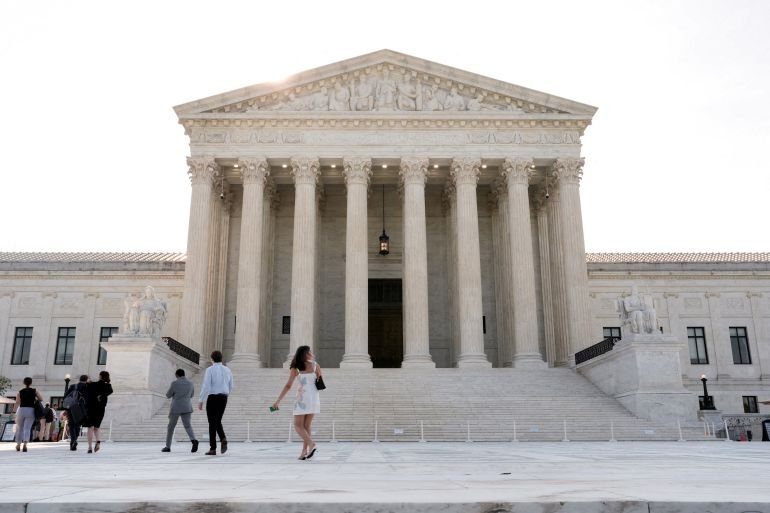
    The United States Supreme Court has agreed to hear a case focused on the Trump administration’s policy requiring millions of undocumented immigrants to remain in detention while they fight deportation.

    The case, accepted on Thursday by the justices, is the latest dispute over US President Donald Trump’s sweeping immigration crackdown to reach the nation’s highest court.

    Recommended Stories

    list of 3 itemsend of list

    At issue is whether migrants already living in the US have a legal right to a hearing where a judge can decide whether they should be released on bond from Immigration and Customs Enforcement (ICE) detention while their deportation cases are pending.

    In July 2025, the administration introduced new guidance directing federal immigration authorities to detain undocumented immigrants without a bond hearing for the duration of their deportation proceedings, which can last for years.

    The new policy, which has divided lower courts, reverses a decades-old interpretation that allowed some immigrants in the US to be released while their cases were pending in immigration court, according to Reuters news agency.

    Most US federal appeals courts have ruled that immigrants cannot be detained without a bond hearing. But the 5th and 8th US Circuit Courts of Appeals have found that immigrants accused of illegally entering and remaining in the country must remain detained while their deportation cases proceed.

    Trump administration attorneys told the Associated Press the split is “disrupting the orderly administration of immigration law”.

    “The result is an unworkable patchwork of inconsistent immigration enforcement, where aliens present without admission are subject to mandatory detention in some circuits but are entitled to bond hearings and often released in others,” the lawyers wrote.

    Millions could be affected

    The Supreme Court case stems from a 2nd US Circuit Court of Appeals ruling involving Ricardo Aparecido Barbosa da Cunha, a Brazilian national who entered the US around 2004 or 2005.

    Immigration officers arrested him in September 2025 while he was driving to work in the US state of Massachusetts. He was initially denied a bond hearing under the administration’s policy but was later released on bond, according to court documents cited by Reuters.

    The American Civil Liberties Union (ACLU), which is representing the plaintiffs, told the Associated Press the Trump administration is trying to deny bond hearings for immigrants apprehended within the US rather than limiting the restriction to noncitizens stopped at the border.

    “Millions of noncitizens could be affected by the government’s new interpretation,” ACLU attorneys wrote.

    The Supreme Court is expected to hear arguments on Monday, when its new term starts.

  • Canada to fast track oil pipeline meant to diversify economy away from US

    Canada to fast track oil pipeline meant to diversify economy away from US

    Carney declared the pipeline a project of national interest, smoothening its way to a single federal regulatory review process.

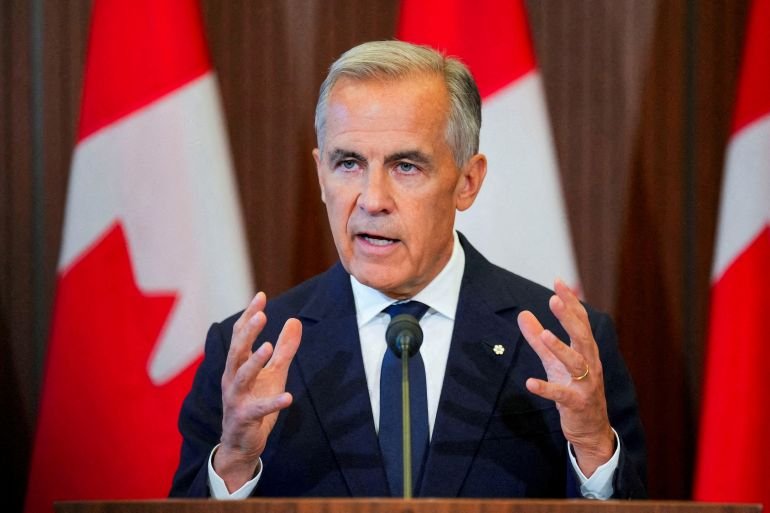
    Canada will fast track the approval process for a new proposed crude oil export pipeline to its west coast that could generate billions in revenue and boost economic growth, Prime Minister Mark Carney has said.

    Carney made the announcement on Thursday to fast-track the pipeline, which is a crucial part of his bid to diversify the economy away from the United States and help lessen the effect of US President Donald Trump’s tariffs.

    Recommended Stories

    list of 4 itemsend of list

    Carney said Ottawa is officially listing the Pacific Link pipeline, which had been announced in July, as a project of national interest. That will ensure it proceeds through a single federal regulatory review process. He said Ottawa aimed to complete the process by September 1, 2027.

    “A pipeline to the west coast is part of our mission to transform our economy, to double our non-US exports over the next decade … [and] to unlock our full potential as a global energy superpower,” he told reporters in Fort McMurray, hub of Alberta’s tar sands industry.

    Ottawa says the 1 million barrel a day project would create 140,000 jobs and generate more than 20 billion Canadian dollars ($14bn) in gross domestic product (GDP) per year and 100 billion Canadian dollars ($70bn) in government revenue by 2060.

    Canada currently has just one east-west oil export pipeline in Canada, the 890,000-barrel-per-day Trans Mountain pipeline. An expansion of that pipeline was completed in 2024, but it is already running at capacity.

    For years, Canada has sent more than 90 percent of its crude oil exports to the US via pipeline. A new oil export pipeline could make Canada a major global energy supplier, as Asia’s top importers seek oil from outside the Middle East in the wake of the Iran conflict.

    Filling the pipeline, however, would require new tar sands expansions of the type no company has undertaken in more than a decade.

    The pipeline will be built by government-owned Trans Mountain Corp in coordination with Pembina Pipeline Corp. Alberta estimates it could cost between 35.2 billion Canadian dollars and 43.7 billion Canadian dollars ($24.7bn – $30.7bn).

    The majority owners will be the federal government and the government of Alberta. Indigenous communities will be offered a minimum of 10 percent ownership interest.

    Previous oil pipeline projects in Canada have faced strong opposition from environmentalists and Indigenous groups, resulting in the cancellation of some projects and leading to cost overruns and construction delays with others.

    Alberta separatism

    Carney made the announcement alongside Alberta Premier Danielle Smith in Fort McMurray in the heart of Canada’s tar sands, a move meant to mend relations with oil-rich Alberta as separatists push for a referendum on leaving Canada.

    Alberta is holding a public vote on October 19 on whether to hold a referendum on leaving Canada. Smith has long complained that Carney’s predecessor, Justin Trudeau, hindered Alberta’s energy industry and fuelled separatist sentiment.

    Smith said she would vote to keep Alberta in Canada and called the roughly 22 percent support for separation in a recent poll “still too high for my liking”.

    “I don’t like the fact that many of our fellow citizens have given up on Canada,” Smith said, adding that the pipeline was an example of how “cooperative federalism can work in action”.

    Asked what message Albertans considering separation should take from the announcement, Carney said it demonstrated that “Canada is working” and showed what the country could achieve by acting together.

  • Renee Good’s family sues Trump administration over fatal ICE shooting

    Renee Good’s family sues Trump administration over fatal ICE shooting

    Lawsuits accuse Trump officials of recklessness and civil rights violations in Renee Good’s fatal Minneapolis shooting.

    The family of Renee Good, one of two US citizens fatally shot by federal immigration agents in the state of Minnesota, has sued the government over her killing during a sweeping immigrant deportation blitz in January.

    The two lawsuits – filed on Thursday by Good’s partner, Becca Good, and Renee’s brother, Brent Ganger – say officials from US President Donald Trump’s administration were reckless and violated the civil rights of Good and others in Minneapolis. The lawsuits are demanding a jury trial and financial damages.

    The lawsuits are the first major civil actions taken against the Trump administration over its unprecedented deportation crackdowns in Minneapolis last winter, dubbed Operation Metro Surge.

    The first lawsuit seeks damages for Good’s wrongful death under Minnesota law, citing claims of assault, battery, false imprisonment, negligence and intentional infliction of emotional distress.

    The second lawsuit alleges a civil rights conspiracy among numerous defendants including the immigration officer and shooter Jonathon Ross, who was named alongside high-ranking Trump administration officials, including White House Deputy Policy Chief Stephen Miller, former Homeland Security Secretary Kristi Noem, former Border Patrol commander Gregory Bovino and Trump’s longtime campaign adviser, Corey Lewandowski.

    Good, a mother of three, was shot and killed in her car by an Immigration and Customs Enforcement (ICE) agent in south Minneapolis when she and her wife joined one of the city’s daily demonstrations against masked and armed federal agents deployed to the city to arrest migrants for deportation.

    Widespread cellphone footage taken by eyewitnesses captured the moment in which Good was killed, after agent Ross fired into the windshield, shooting her in the head, arm and torso.

    Federal officials at the time said the officer acted in self-defence and that Good had engaged in “an act of domestic terrorism”.

    In a statement posted on Truth Social at the time, Trump defended the deadly ICE shooting, saying that the reason those “incidents” were happening was that “the Radical Left is threatening, assaulting, and targeting our Law Enforcement Officers and ICE Agents on a daily basis”.

    Days after the shooting, officials from the US Department of Justice, including then-Deputy Attorney Todd Blanche, blocked federal prosecutors from pursuing a criminal civil rights case against the agents involved in her killing, which prompted at least half a dozen of those prosecutors to resign in protest.

    Minnesota sued the Trump administration in March to gain access to the evidence it gathered at the shooting scenes, but investigations stalled after the Justice Department halted its routine cooperation and evidence-sharing with the Minneapolis Police Department.

    None of the agents involved in Good’s killing has faced any charges.

  • Despite praise and White House visits, Trump avoids endorsing Netanyahu

    Despite praise and White House visits, Trump avoids endorsing Netanyahu

    In a Time interview, Trump avoids directly endorsing Netanyahu but defends him over reports of warnings before October 7 attacks.

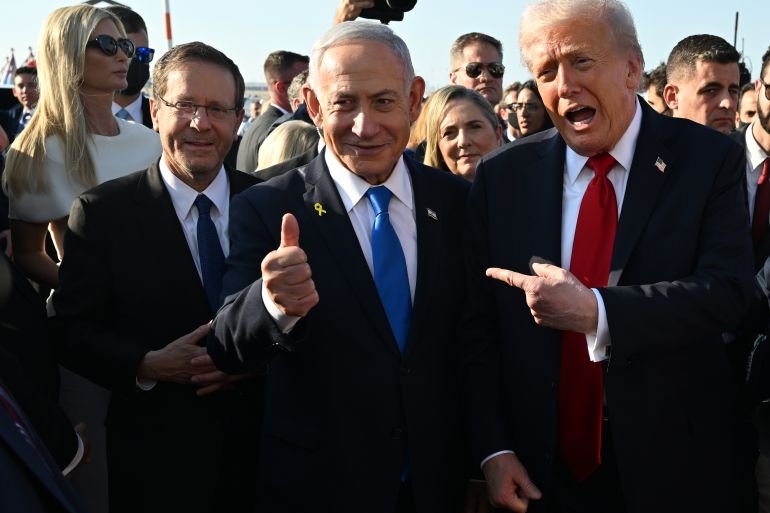
    United States President Donald Trump has avoided directly endorsing Benjamin Netanyahu in an interview ahead of Israel’s upcoming elections, despite repeatedly heaping praise – and White House visits – on the Israeli prime minister.

    Trump thrice avoided making an endorsement in an interview with Time magazine published on Thursday, instead pivoting to his own popularity in Israel and actions in support of Israel’s government.

    Recommended Stories

    list of 3 itemsend of list

    The US president was initially asked if the “Israeli people should give Netanyahu another term?”

    “Well, I can only say that I’m not involved in politics any more, except that we’re popular,” Trump said, claiming “99 percent” popularity in Israel.

    When pressed a second time on whether Netanyahu should have another term, Trump pointed to Washington’s continued security support for Israel and his decision to move the US embassy from Tel Aviv to Jerusalem during his first term.

    The interviewer responded: “It seems like you’re doing a lot of work for him. Should he have another term?”

    Trump replied: “No, my primary thing – I do want to help them defend Israel. My thing that I mention all the time is Iran cannot have a nuclear power because they are crazy and you can’t let crazy people have nuclear weapons.”

    Trump has repeatedly hailed his relationship with Netanyahu throughout his second term, even as government officials have leaked accounts of private discord between the two leaders.

    Trump has met with Netanyahu at least seven times since January 2025, more than any other leader, and has publicly pushed for a pardon in the Israeli leader’s ongoing corruption trial.

    Still, the latest statements come as Trump and his Republican Party have contended with growing discontent with his administration’s policy towards Israel, particularly amid perceptions that the Israeli government influenced Trump to launch the US-Israel war against Iran in February.

    The conflict, which has driven up petrol prices in the US, has become a key vulnerability ahead of the US midterm elections in November, which will determine whether Democrats or Republicans control the US Senate and House of Representatives for Trump’s final two years in office.

    Nevertheless, Trump hosted Netanyahu most recently at the White House in July, flouting concerns over Israeli obstructions to ending the conflict, as well as to achieving a more lasting peace in Israel’s genocidal war in Gaza.

    Speaking to Time magazine, Trump defended the war with Iran, saying he may still seek to “annihilate” Iran and could resume bombing after the midterm vote.

    Trump also came to Netanyahu’s defence, batting away reports that Egypt and the United Arab Emirates had warned Netanyahu of the impending Hamas-led attacks on southern Israel on October 7, 2023.

    “I think if he would have known, he would have done something about it,” he said.

    He later acknowledged that “people have written off Bibi many, many times, just like they’ve written off me many, many times”, using Netanyahu’s nickname.

    “I wouldn’t underestimate Bibi,” he added.

    Trump was also asked if US security support would change if Gadi Eisenkot, whose opposition bloc has been leading in  Israeli polls, were to win the October 27 vote.

    He replied: “Well, I don’t know. I don’t hear bad things about him.”