It’s quite common to see home security systems set up outside any house in the neighborhood. From floodlights to video doorbell systems, it seems like everyone has their bases covered when it comes to keeping their yard and front doors safely monitored.
But what about inside? Whether you have a pet at home you want to keep an eye on while you’re at work, or are headed out of the country for a week-long vacation, the inside of your house is just as important to keep tabs on. There’s never been a better time to add indoor monitoring to your home security setup, because a Ring Indoor Cam Plus two-pack just dropped to $59.98—that’s 50% off for peace of mind!
The Ring Indoor Cam Plus is the company’s newest model, and it can monitor the inside of your business just as easily as your home. With versatile mounting options, you can place it on a table, a wall, or even a ceiling as long as the cord reaches a power source. It captures everything in front of it with Retinal 2K video, letting you see even the tiniest details. And since you can zoom in up to 4x, you can even check whether you accidentally left the gas stove on low. Crisis averted!
But what about when the sun goes down? The Ring Indoor Cam Plus uses Low-Light Sight to capture every bit of ambient light in the room to give your video true-to-life color. When there isn’t enough light for a colorful picture, the camera switches to a crisper black-and-white image to preserve detail.
Let’s say your dog sitter can’t find the dog treats. You don’t have to sit there helplessly on the other side of your phone screen—you can use Two-Way Talk and Live View to interact with them in real time (and tell them they’re behind the food bag). But if you’re gone for a while, you might not want to check every single notification the camera system sends to your phone. And you don’t have to, thanks to AI-powered event descriptions that summarize what you missed. It also supports intelligent video searches if you can’t quite remember when a specific event took place!
Recommended by Our Editors
When we reviewed the Ring Indoor Cam Plus, PCMag expert John R. Delaney gave it an “Excellent” rating, praising the security camera for its strong 2K video, AI-powered alerts, and easy Alexa integration at a fair price. He didn’t love that its full potential was behind a monthly paywall, but this deal giving you two cameras for half off makes up for the qualm in spades.
If you purchase an independently reviewed product or service through a link on our website, The Hollywood Reporter may receive an affiliate commission.
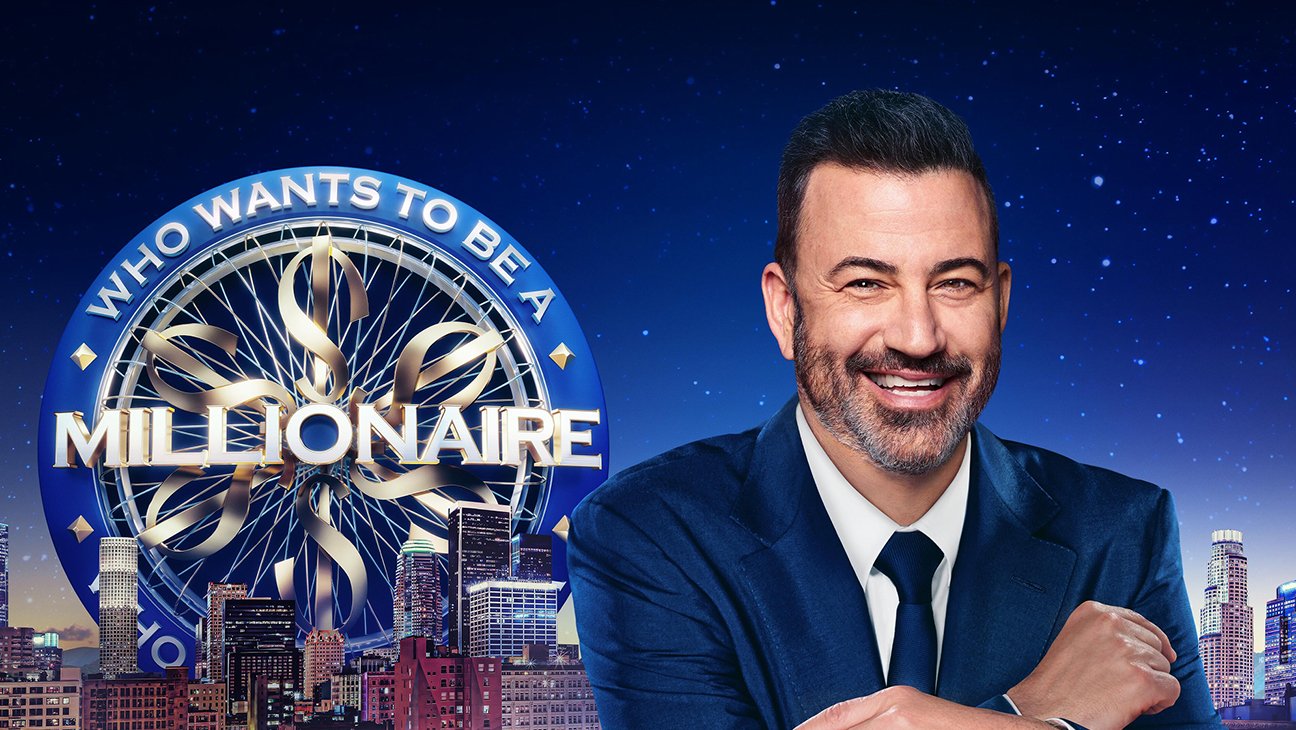
Jimmy Kimmel returns to host season five of Who Wants to Be a Millionaire‘s star-studded revival. With a stacked celebrity roster including Ben Affleck, Larry David, Michael Keaton, Awkwafina, Leslie Odom Jr. and Krysten Ritter, the new season of Millionaire premieres on Wednesday, July 22 at 8 p.m. PT/ET on ABC, which is available on any streaming service that carries said network, namely DirecTV (with a five-day free trial), Fubo, Sling and Hulu + Live TV. New Episodes will air weekly during the same time slot.
Weekly episodes will also be available to stream on-demand on a one-day delay (every Thursday) on Disney+/Hulu.
At a Glance: How to WatchWho Wants to Be a Millionaire Season Five
Where to Watch Who Wants to Be a Millionaire Season Five: Air Date, Time
The Kimmel-hosted competition show will be broadcast Wednesdays on ABC, at 8 p.m. PT/ET, starting with its July 22 premiere.
Where to Stream Who Wants to Be a Millionaire Season Five Online
Since Millionaire airs on ABC, it will also be available to watch live on any streaming service that carries the network, including DirecTV (with a five-day free trial), Fubo, Sling and Hulu + Live TV. Episodes will be available to stream the following day on Disney+/Hulu.
More on each live TV streaming option — and their new subscriber discounts — below.
DirecTV
Five-day free trial; packages from $19.99 per month
ABC is included in any of DirecTV’s signature packages: Entertainment, Choice, Ultimate or Premier. Plus, DirecTV offers a five-day free trial for its streaming service, meaning new subscribers can tune in at no cost for a limited time.
Learn more about each plan option, including how to build your own channel lineup (starting at just $19.99 per month), at directv.com.
Fubo
Fubo
Up to $30 off first month; packages from $64.99 per month ($54.99 for first month)
ABC is available to stream with a subscription to Fubo, which offers between $10 and $30 off for the first month. Plans start at $54.99 during the first month and $64.99 monthly thereafter.
Sling
Plans from $4.99 per day or $19.99 per month
ABC is included in Sling’s Blue Plan, from $45.99 per month, and Sling’s Orange & Blue plan, from $60.99 per month. That said, local channel availability depends on your TV market. Visit Sling.com to check station availability and package options, starting as low as $4.99 per day or $19.99 per month.
Hulu + Live TV
Three-day free trial; packages from $89.99 per month
Watch ABC for free with a three-day trial to Hulu + Live TV. Subscriptions come bundled with Disney+ and ESPN+, and start at $89.99 per month.
Who Wants to Be a Millionaire Season Five Contestants, Host
Jimmy Kimmel returns as host with a stacked lineup of players for the revival’s fifth season. Duos include Ben Affleck and Jeopardy! champion Jamie Ding, Larry David and Cazzie David, Jason Alexander and Wayne Knight, Tig Notaro and Pete Holmes, Brad Paisley and Clayton Kershaw, Michael Kosta and Wendi McLendon-Covey, Jesse Eisenberg and Paul Giamatti, Krysten Ritter and Sarah Shahi, Michael Keaton and Jon Lovett, Paul Scheer and Rob Huebel, Awkwafina and Paul Feig, Billy Porter and Leslie Odom Jr., Timothy Simons and Jackie Tohn, Sarah Jane Nader and Brooks Nader, Colin Jost and Michael Che, plus Taran Killam and Will Forte.
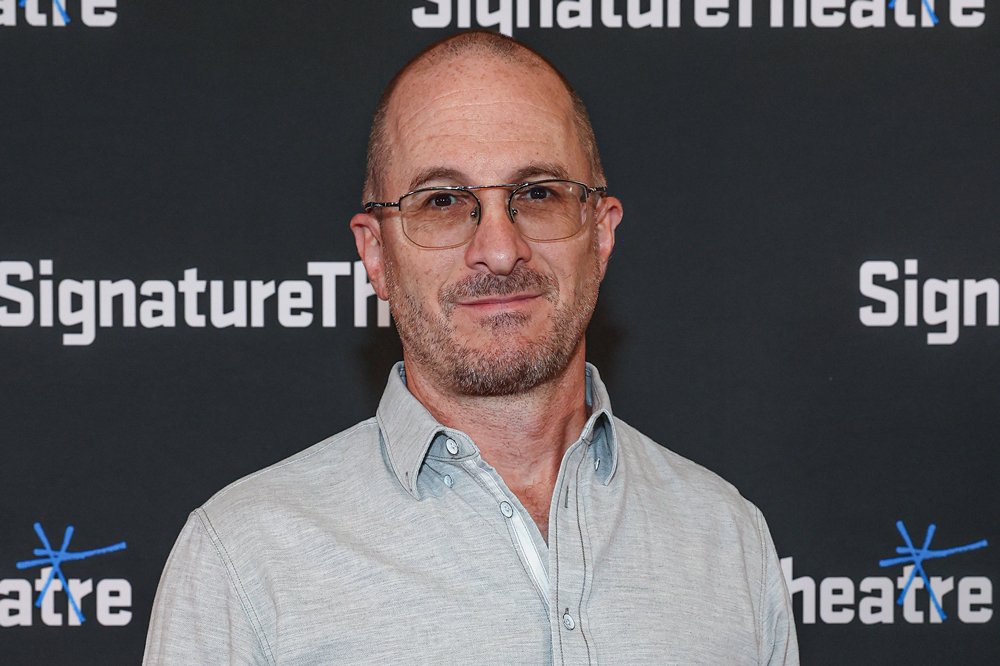
Primordial Soup, the AI Film and content studio launched by filmmaker Darren Aronofsky (The Whale, Black Swan, Requiem For a Dream) is raising cash as AI-first filmmaking continues to proliferate, The Hollywood Reporter has learned.
Earlier this month Primordial Soup Labs, Inc., which lists Aronofsky and his producing partner Dylan Golden as executive officers, filed with the Securities and Exchange Commission for a $15 million equity raise.
The document said that the company had sold just over $11 million of that total so far, with the first sale taking place July 1.
It is not clear what Primordial Soup will use the cash for, though the company’s website suggests that it is in the midst of something that amounts to a hiring spree, with open roles for “generative artists,” social media strategists, a chief of staff, and a “Head of Studio.”
The head of studio role underscores the scale of the endeavor, with the description noting that the person they hire will run content strategy and studio operations. “You’ll oversee the development, production and commercialization of our slate, including digital-first creator content, feature films, television series, and branded content,” the description states.
That suggests that Primordial Soup will supplement its film and TV projects with commercials and AI creator content.
Aronofsky and his spokesperson did not respond to a request for comment.
A growing number of Hollywood traditionalists are diving into AI. Martin Scorsese is using the tech for storyboarding, a veteran Doctor Who director is developing an animated AI film and studios including A24 and Lionsgate have forged creative partnerships with AI companies.
Aronofsky has been focused on cutting-edge tech for years, becoming an early pioneer in 2018 with a three-part VR project called Spheres he produced from filmmaker Eliza McNitt and then of course making Postcard from Earth for The Sphere in Las Vegas several years ago.
Primordial Soup launched just over a year ago with the tagline of “make soup not slop” and formed a non-exclusive filmmaking partnership with Google DeepMind that allowed him to experiment with the company’s tools.
As part of that partnership, he and McNitt produced Ancestra, a 45-minute featurette (and first in a planned trilogy) about a mother and memory. They debuted it at Tribeca in 2025, where Aronofsky took the stage with McNitt and a DeepMind exec to say that, “There are a lot of ways to use these models. I’m mostly interested in figuring out how to use these models to tell stories.”
The director took an even more public role on behalf of AI filmmaking — and plenty of backlash for it — when this winter he premiered On This Day, a set of American Revolution-themed live-action shorts that used AI generations of historical figures. Critics pilloried the project for uncanny-valley vibes, though the work did get more refined as it went. Last month he announced a pivot of sorts for the series, saying he was trying an animated approach — then dropped an anime-inspired episode in which Thomas Jefferson fights King George III in a boxing ring and says lines like “Kneel before this, bitch.”
While AI filmmaking is a lot cheaper than the traditional kind, the potential use of voice actors, consultation of department heads and, perhaps most important, time for writers and directors to shape a story all cost money, and it stands to reason the Soup capital-raise will be used to help produce even more content, pushing the envelope along the way.
McEntire credits her manager, Justin McIntosh, with the concept behind the EP releases, which began in April and will continue through December via her longtime label, MCA. Next up is “Ring, Ring,” which bows on July 24. As part of the release plan, McEntire has assembled special playlists for fans that dive deeper into her vast catalog.
“It’s genius to be able to bring a new song to the fans along with five songs that are in the catalog,” McEntire says. “I think it’s a genius idea because even when you are at a concert, you say, ‘OK, I’m gonna play you a new song. Everybody goes, oh yeah, but they want to hear familiarity. They want to hear songs where they can sing along and they know the words and it takes them back to a place the first time they heard it, or with their best friend or someone they love. So to prepare a brand new song with older songs that they already are familiar with and they love is genius. And I’m so glad to be a part of this project.”
McEntire has pulled off a rare feat these days with a multi-camera comedy that has found traction with a broadcast TV audience. Her NBC sitcom “Happy’s Place” returns for Season 3 on Oct. 23. The show reunited McEntire with the team that produced her previous WB Network series, “Reba,” from 2001-2007. This time around, she co-stars with her husband, actor Rex Linn.
“There is something about a four-camera TV show. It’s nostalgic. It takes you back. It takes me back to my childhood when I was watching four camera television shows and absolutely loving it. It’s funny. It’s family entertainment. It’s great writing, great actors. Rex and I love to be on the show together for one thing. And then getting to work again with [co-star[ Melissa Peterman and then my showrunners Kevin Abbott and our producers Mindy [Schultheis] and Michael [Hanel] — everybody on that whole team. They are family. And we treat them like family. And, everybody knows that when you walk on ‘Happy’s Place’ set, we’re going to have a good time and you’re going to be treated well.”
Another project close to McEntire’s heart in recent years has been her investment in a retail and entertainment center in Atoka, Oklahoma, near her hometown of Chockie. It’s housed in a refurbished, 15,000 square foot building from 1907, and the complex includes a diner dubbed Reba’s Place. It’s infused with memories for McEntire and her siblings and a tribute to their mother, Jacqueline McEntire, who died in 2020 at age 93.
“Reba’s Place is a restaurant that serves great family food. And then we also have a stage where we have live music. My brother and sister, Pake and Susie, have performed on the stage as I have also,” she says. “On the second floor is more dining and with a cutout of the floor where you can look down and see the stage. The third floor is the little store where you can buy all kind of goodies, t shirts to wooden spoons. And then we’ve got a little speakeasy in the back and then we’ve got a library. When Mama passed away March of 2020, she had so many books in her house, we didn’t know what to do with them. We all took a bunch, but then we decided to put them in the restaurant there in Atoka. And so that’s Jackie’s Library.”
Ondo price has climbed 27% from $0.32 on July 15 to an intraday high near $0.42 as institutional tokenization deals and a decisive chart breakout have strengthened bullish sentiment around the RWA-focused token.
According to data from crypto.news, Ondo ($ONDO) price traded near $0.41 at press time, up about 2% on the day, with a market capitalization close to $2 billion. The token has outperformed Bitcoin and Ethereum over the past week as traders moved toward crypto projects tied to real-world financial infrastructure.
Recent interest followed Ondo Finance’s work with the Depository Trust & Clearing Corporation on a model for tokenizing securities held at the Depository Trust Company. Products linked to assets such as the SPDR S&P 500 ETF and Circle shares could use entitlements tied to securities held within existing custody systems, rather than stand-alone synthetic copies.
Ondo’s institutional case also includes a cross-border redemption completed with Mastercard, Kinexys by J.P. Morgan and Ripple. The transaction announced in May tested the redemption of tokenized U.S. Treasuries across two banking networks, giving investors another example of how regulated assets can move between blockchain and conventional payment systems.
Meanwhile, Ondo has expanded its tokenized-stock platform to more than 440 assets, while its website reports about $1.05 billion in value locked across those products. The company also introduced round-the-clock minting and redemption for tokenized stocks in June, reducing the dependence on U.S. market hours.
A separate agreement with Japan’s SBI Group added another source of demand for the RWA narrative. The companies plan to explore tokenized Japanese securities distributed through SBI’s network, with yen-based settlement through the JPYSC stablecoin.
Institutional deals have driven $ONDO’s breakout
Daily active addresses rose from 2,589 to around 3,300 on July 21 as the price approached $0.40, according to network data cited in the market analysis. The increase came alongside a sharp rise in trading volume, which helped $ONDO break from a descending channel that had controlled price action since May.
Spot buying also pushed cumulative volume delta back above zero, while derivatives open interest rebounded from its recent low. Those moves show that fresh capital entered both markets during the advance, although the speed of the recovery also forced traders holding short positions to close contracts as $ONDO crossed $0.39.
Investor sentiment has turned firmly positive after repeated failures below the same resistance. According to analyst Michaël van de Poppe, the token’s brief return to $0.34 created a successful retest before the latest push.
“I assume that, with this short retest at $0.34 and the fact that we’re having a test of this resistance so fast, it’s likely that we’ll continue to rally upwards.”
Van de Poppe placed $0.45 as the next likely objective and argued that strength in $ONDO could also pull other RWA tokens higher. His view matches the latest spot structure, though the token must first absorb sellers between $0.41 and $0.42.
Macro conditions have also favored assets with clear institutional links. Bitcoin traded near $66,000, and Ethereum hovered around $1,930 as both assets registered limited daily gains, while investors assessed commodity volatility and the next round of central-bank decisions. $ONDO’s 27% weekly advance has separated it from that subdued large-cap performance.
$ONDO price must secure $0.42 before targeting $0.47
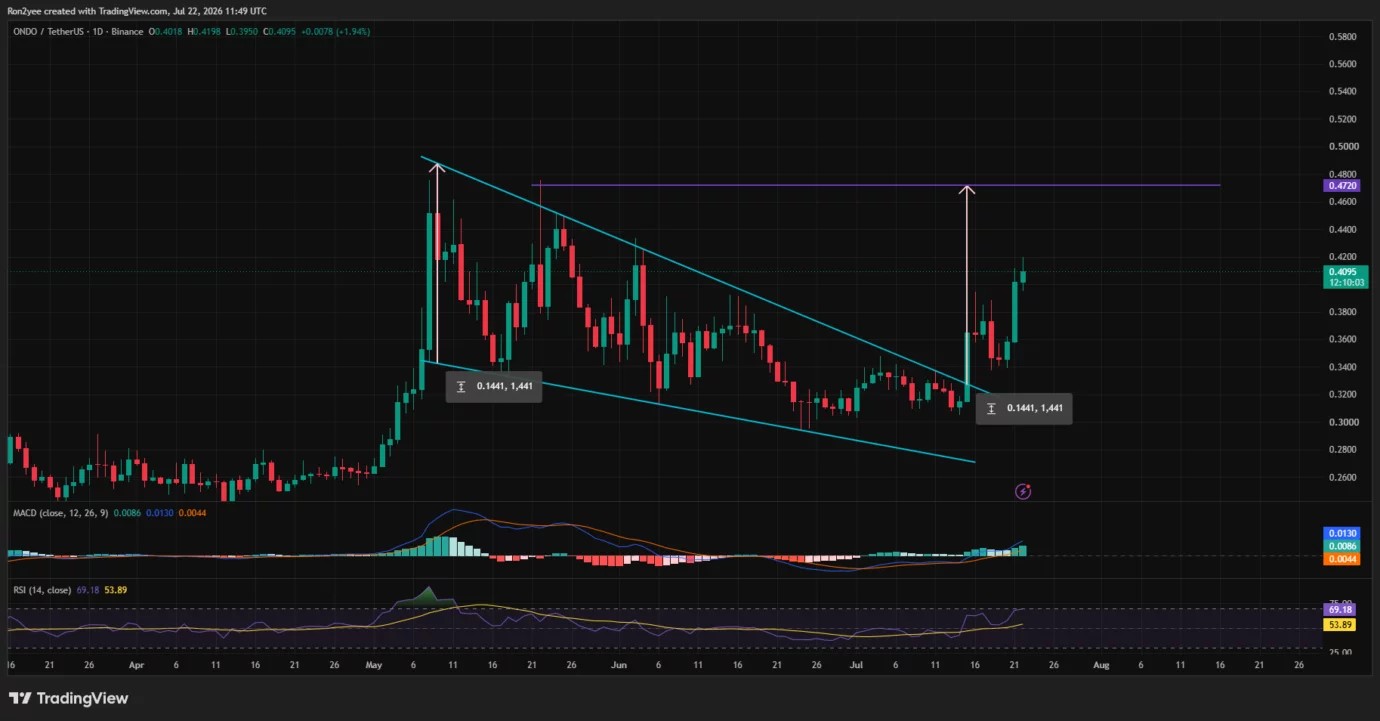
The daily chart shows $ONDO breaking above the upper boundary of its multimonth descending channel after several failed attempts. Based on the height of the channel, the measured move places the main bullish target near $0.472, an area that also served as resistance during May.
Ondo price daily chart has broken out of a descending channel pattern on the daily chart — July 22 | Source: crypto.news
Momentum supports the advance but leaves little room for a weak close. The daily relative strength index has reached 69.18, just below the conventional overbought threshold of 70, while its average remains at 53.89. The MACD line has risen to 0.0130 above the 0.0044 signal line, and the positive histogram has expanded to 0.0086.
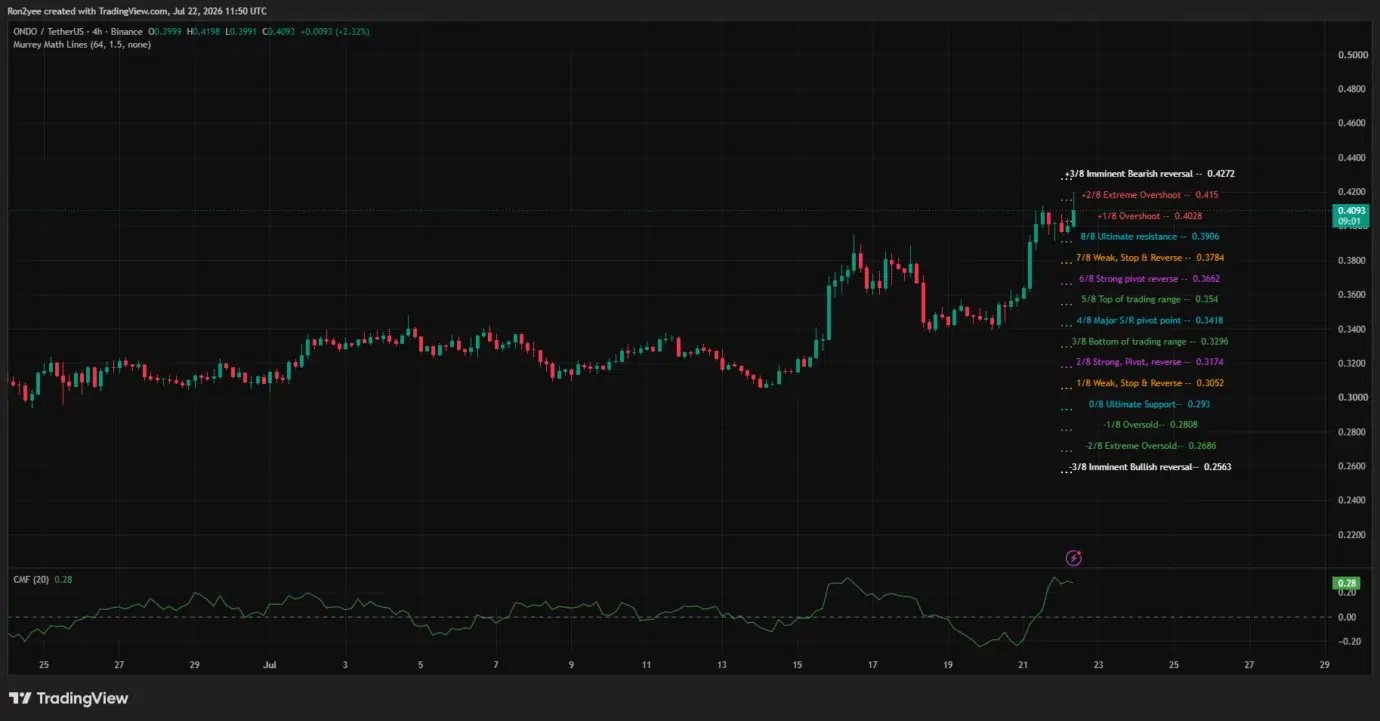
On the 4-hour chart, $ONDO has moved above the Murray Math ultimate resistance at $0.3906 and the $0.4028 overbought level. Price has now entered the band between $0.4028 and $0.4150, where traders may take profits after the rapid advance. The next extension sits at $0.4272 if buyers secure a 4-hour close above $0.415.
Ondo price 4-hour chart — July 22 | Source: crypto.news
Cash flow remains supportive, with the 4-hour Chaikin Money Flow reading at 0.28. A positive value of that size confirms that buying volume has outweighed selling volume during the breakout, though a drop below $0.3906 would weaken the immediate setup. Lower supports sit at $0.3784 and $0.3662.
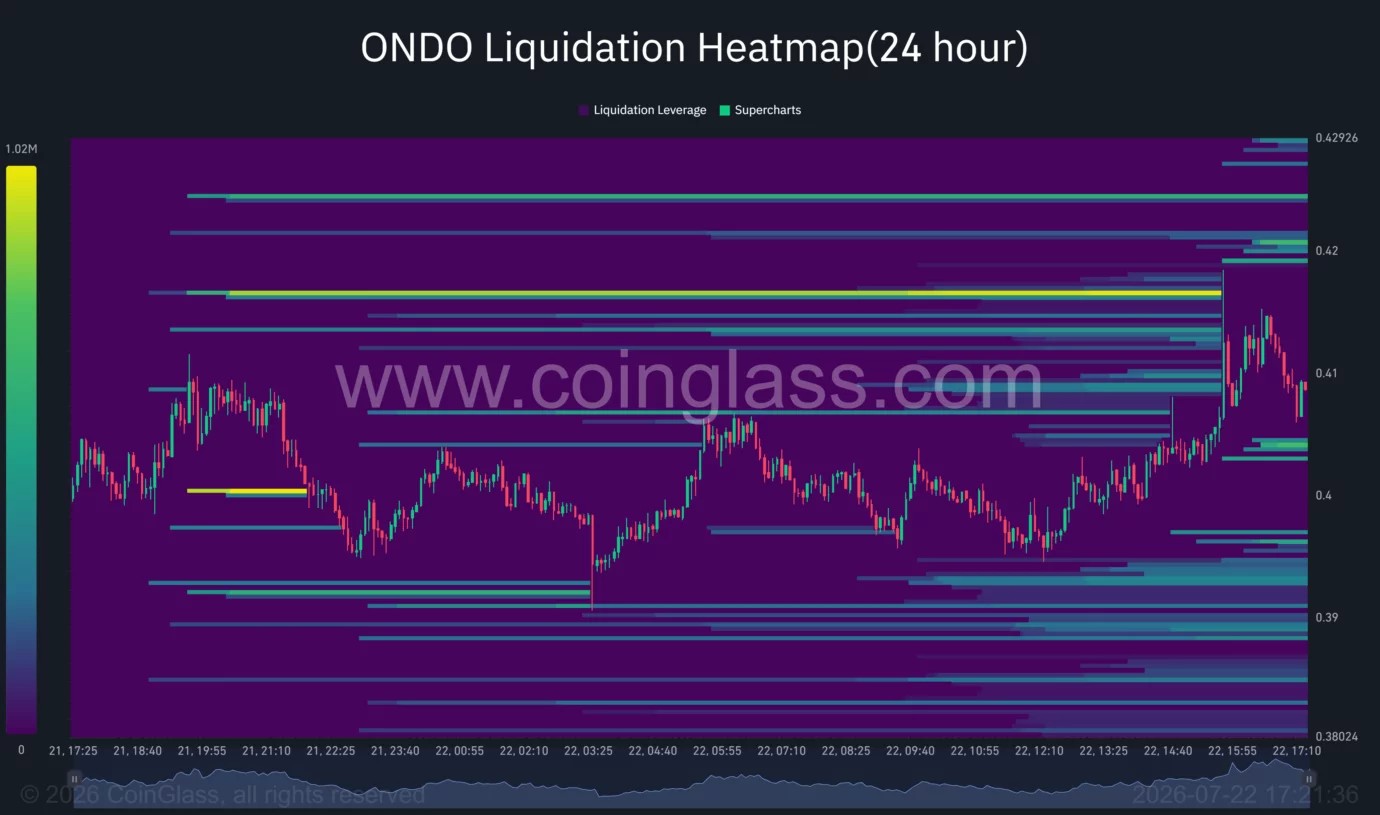
CoinGlass’ 24-hour liquidation heatmap places the largest nearby leverage pool around $0.416–$0.417, just above the current price. A push through that cluster could liquidate additional short positions and carry $ONDO toward $0.42. Below the market, leveraged positions are concentrated near $0.393–$0.390, with another dense pocket around $0.389.
Ondo liquidation heatmap | Source: CoinGlass
A daily close above $0.42 would open the route toward $0.45 and the channel target at $0.472. Rejection from the current resistance could send $ONDO back toward $0.39, while loss of that level would expose $0.378 and delay the bullish continuation.
Coinbase Canada CEO Eric Richmond confirmed the company is working to bring its “Everything Exchange” to Canadian users.
The idea is to offer a single app combining crypto, stocks, ETFs, and prediction markets—with no hard launch date announced.
Tokenized stocks—shares recorded on a blockchain that settle instantly and trade around the clock—are planned for non-U.S. users, including Canadians, this month, with full dividend rights included.
Coinbase has a new pitch for Canada: stop thinking of the company as just a crypto exchange, and start seeing it as the only financial app the country needs.
Eric Richmond, CEO of Coinbase Canada, told BNN Bloomberg this week that the company is pushing its “Everything Exchange” north of the border—a single platform where crypto, stocks, ETFs (funds that track a basket of assets like the S&P 500), and prediction markets (platforms where users bet real money on the outcome of real-world events, like elections or sports results) all trade from one account.
“I think chapter one of Coinbase in Canada was really about being a crypto exchange,” Richmond said. “But now phase two of that is the Everything Exchange. How do we create that one place for Canadians to have their entire financial experience in one app that’s underpinned by this technology that makes things frictionless, seamless, and 24/7?”
No hard launch date has been set for Canada. Coinbase says it is working closely with local regulators to get there—a relationship it has cultivated since becoming the first international crypto exchange registered in Canada in April 2024.
In the U.S., the build-out is already well underway. Coinbase opened stock and ETF trading to eligible American users in February 2026 and launched prediction markets in January through Kalshi, a federally regulated prediction market operator now valued at $22 billion. As Decrypt covered in June, the company’s roadmap for the Everything Exchange now includes nearly 10,000 stocks and ETFs on one platform.
Tokenized stocks—shares in real companies recorded on a blockchain instead of a traditional brokerage system, meaning trades settle instantly and the market never closes—are supposed to be coming to non-U.S. customers this month, according to a previous official blog. Richmond framed it as a matter of access.
On competition from Robinhood and traditional Canadian brokerages, Richmond wasn’t particularly worried. “I think people are starting to realize the fact that banks close at 4 p.m., or the markets close at 4 p.m., or that wires can take days to settle, or that access for high-net-worth individuals to certain products are gated for just those high-net-worth individuals,” he told BNN Bloomberg.
His five-word summary: “Rising tide lifts all boats.”
The Bank of Canada is expected to finalize stablecoin implementing regulations in 2027—the last major regulatory piece Coinbase needs before it can list a Canadian dollar stablecoin and fully roll out the Everything Exchange in the country.
Daily Debrief Newsletter
Start every day with the top news stories right now, plus original features, a podcast, videos and more.
The market for tokenized stocks reached a record $2.3 billion in market capitalization in mid-July, according to Token Terminal data, nearly doubling since March, when the sector first cleared $1 billion, and the growth is showing up across every major issuer at once.
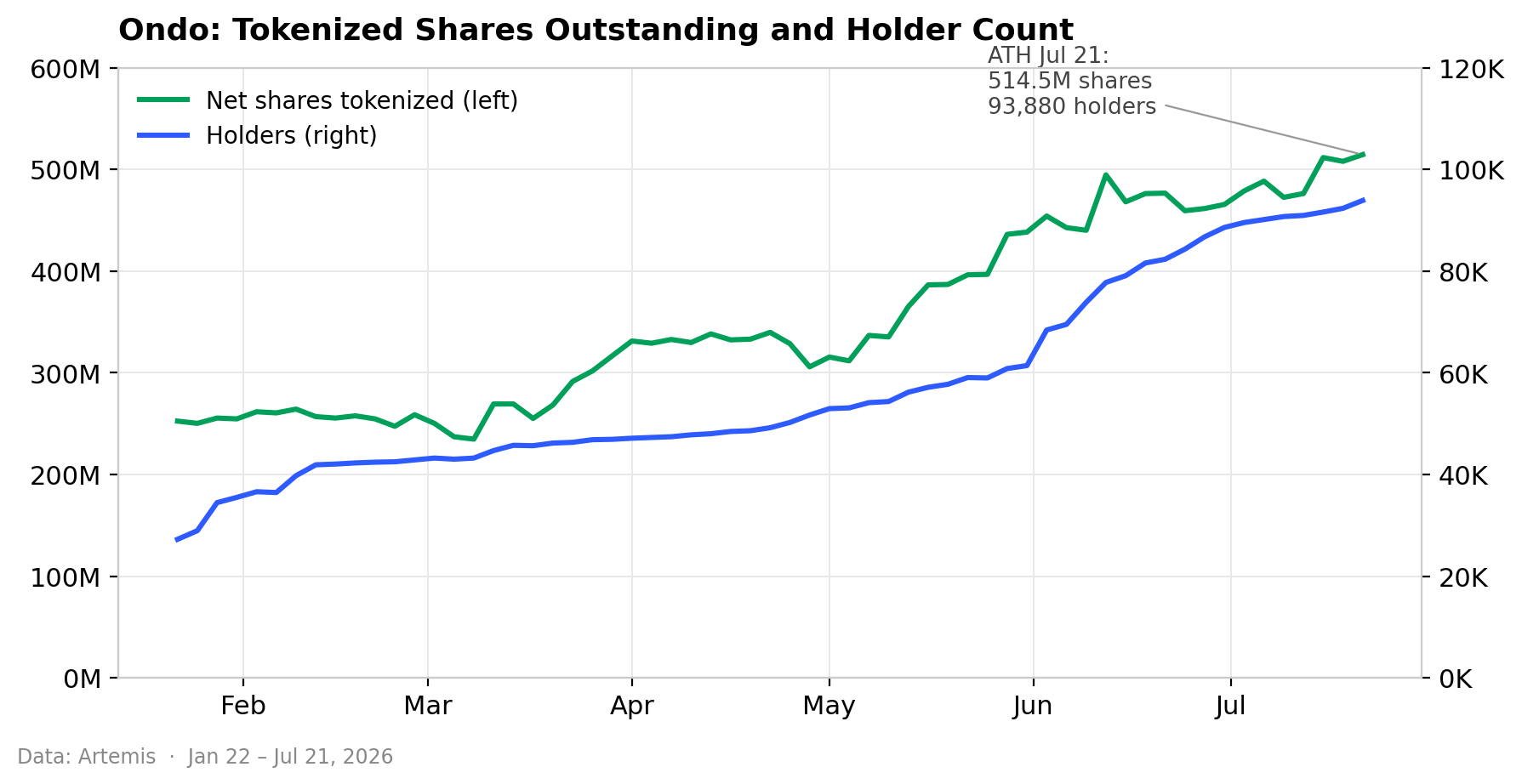
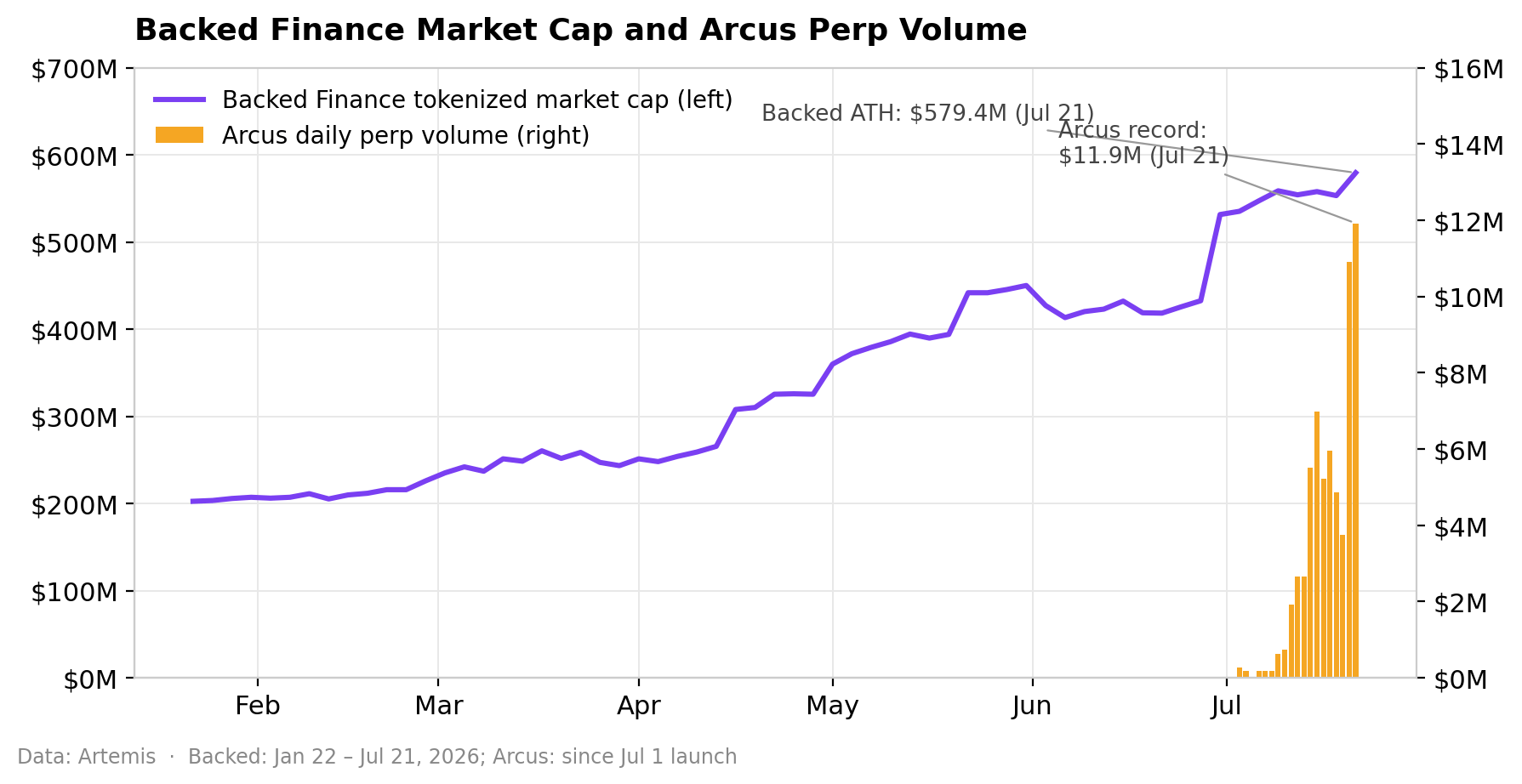
On July 21 alone, Artemis data recorded all-time highs for Ondo Finance’s tokenized shares outstanding (514.5 million) and holder count (93,880), Backed Finance’s tokenized market cap ($579.4 million), and Robinhood Chain’s tokenized shares (126,720) and equity holder count (36,170).
Arcus, the tokenized-stock exchange launched this month by the team behind dYdX, posted record daily perps volume of $11.9 million and record open interest of $6.8 million the same day.
Ethereum leads the sector with 34% of tokenized stock market share, followed by $BNB Chain at 30% and Solana at 23%, per Token Terminal. Tokenized stocks remain a small corner of the broader tokenized real-world asset market — roughly 5% by Token Terminal’s count, while DefiLlama tracks about $27.3 billion in active RWA market cap — but they have been the fastest-growing asset class on Ethereum this year.
Ondo Extends Its Lead
Ondo’s tokenized shares outstanding roughly doubled over six months to 514.5 million, while holder count more than tripled to 93,880 — both all-time highs on July 21. Data: Artemis.
Ondo Finance is the largest issuer with $955 million in onchain equities, per Token Terminal, and its July has been dense with catalysts. The firm partnered with Japan’s SBI Group on July 16 to tokenize Japanese stocks and explore settlement in JPYSC, SBI’s trust-backed yen stablecoin. It also switched on 24/7 minting and redemption for tokenized US stocks and ETFs, added voting rights to its tokenized stocks, and enabled tokenized stock collateral on OndoPerps, its perpetual futures venue — the product behind its record $39.8 million in open interest, per Artemis.
The firm’s catalog has passed 430 tokenized stocks and ETFs across Ethereum, Solana, and $BNB Chain, and its distribution now runs through MetaMask and Felix on Hyperliquid.
ONDO traded around $0.41 on July 22 with a market capitalization of $1.99 billion, near the top of its seven-day range of $0.32 to $0.41, per CoinGecko. The token jumped roughly 15% in the 24 hours after the SBI announcement.
Backed and the Exchange-Issued Wave
Backed Finance, the Swiss issuer behind the xStocks product distributed on Kraken, Bybit, and Solana DeFi, reached a record $579.4 million in tokenized market cap on July 21, per Artemis. Kraken said xStocks surpassed $25 billion in cumulative transaction volume within eight months of launch. Token Terminal puts xStocks’ onchain holdings at $507 million, with Binance’s bStocks third among issuers at $334 million — a sign exchange-issued products are becoming a distinct growth channel alongside DeFi-native issuers.
Backed Finance’s tokenized market cap nearly tripled since late January, jumping from about $430 million to over $530 million in a June 29 step-change before its July 21 record. Arcus perp volume, overlaid since its July 1 launch, hit $11.9 million the same day. Data: Artemis.
New Entrants: Robinhood Chain and Arcus
Robinhood’s Stock Tokens, issued on the company’s own Layer 2 that launched July 1, remain the smallest of the cohort at $19.3 million in tokenized market cap, but all three of the product’s Artemis metrics — market cap, shares tokenized, and holder count — hit records on July 21. The tokens are available in more than 120 countries and are already being used as collateral on Lighter, a derivatives protocol on the chain.
The speculative layer is arriving too. Arcus, launched July 1 by dYdX Labs with investment from Robinhood Crypto, offers 24/7 spot trading on 95 stock tokens with zero fees and is rolling out perpetual futures on equities, commodities, and indices with up to 50x leverage. The exchange is not available in the US, UK, or Canada. Its record $11.9 million in daily perps volume, while small against crypto-native perps venues, is an early data point for leveraged trading built on tokenized equities.
The Road to $3B
An Ondo executive said in May the company expects the tokenized equity market to reach between $2.5 billion and $3 billion by year-end, per TheStreet. At the current pace — the sector has nearly doubled in four months — that target implies slower growth than the market is delivering.
Holder counts remain the metric to watch. Ondo’s 93,880 and Robinhood Chain’s 36,170 tokenized-equity holders are records, per Artemis, but are small next to any retail brokerage’s user base. Whether 24/7 settlement, DeFi collateral use, and yen-settled Japanese stocks translate into sustained holder growth is what the next two quarters will show.
The company disclosed in a Securities and Exchange Commission filing last week that it was seeking to raise $15 million in cash in exchange for equity in the studio. The filing lists Aronofsky and his producing partner Dylan Golden as chief executives in the venture, and it stated that Primordial Soup has so far sold just over $11 million in equity this month.
A spokesperson for Aronofsky did not immediately respond to a request for comment.
The effort underscores Aronofsky’s ambitions in the space, with the “Requiem for a Dream” and “Black Swan” director’s studio hiring for a “Head of Studio” and multiple “Generative Artists” to work on AI-focused projects. Primordial Soup launched a year ago and partnered with Google’s DeepMind unit to produce multiple short films, with each filmmaker receiving mentorship by Aronofsky and the DeepMind team.
“Filmmaking has always been driven by technology,” Aronofsky said in a statement at the time. “After the Lumiere brothers and Edison’s ground-breaking invention, filmmakers unleashed the hidden storytelling power of cameras. Later technological breakthroughs — sound, color, VFX — allowed us to tell stories in ways that couldn’t be told before. Today is no different. Now is the moment to explore these new tools and shape them for the future of storytelling.”
Since the launch, Primordial Soup developed animated series “On This Day… 1776,” which used a hybrid model of AI tools and traditional filmmaking methods. to recreate moments throughout the year America was founded.
CertiK, a blockchain security firm, said on Wednesday that 52 confirmed physical attacks on crypto holders occurred in the first half of 2026. The amount of money at risk was ~$124.1 million, up from $10.5 million the previous year.
Nowadays, there is a much more common and much more expensive threat to anyone with a known identity who has real crypto.
There were 52 confirmed incidents, a 33.3% increase year over year from the 39 cases in H1 2025. CertiK defines a wrench attack as any form of violence, intimidation, or credible threat used to force someone to transfer digital assets, provide private keys, or unlock a wallet.
The tactic is an “established threat vector for cryptocurrency holders,” CertiK said. It works on even strong digital security because it attacks the person, not the software.
France drives Europe’s wrench attack wave
Of the 52 confirmed incidents, 39 were in Europe. France alone was home to 33 of them, according to CertiK. Europe was already highlighted as the riskiest region for crypto holders in CertiK’s 2025 wrench-attack report.
Increasingly, victims are being confronted in their own homes by attackers. CertiK reported that the number of crypto-related home invasions soared from one publicly reported case in H1 2025 to 20 in H1 2026. Kidnappings also increased, from 12 to 16.
Elsewhere, there was little movement. There were four cases of torture, as in the year before. Each period had one murder in association with a crypto coercion event.
The rise was attributed to home invasions. The attackers are now finding out where the targets live instead of waiting to catch them somewhere else.
$124 million exposure figure isn’t stolen crypto
The ~$124.1 million number is an estimated exposure, not a confirmed theft. It includes ransom demands, money victims paid, and assets later frozen by authorities or providers. Some of this money was never lost.
The average recorded exposure per incident rose from ~$270,000 in H1 2025 to ~$2.39 million in H1 2026. CertiK says its totals understate the true picture. Attack victims often don’t report them because they’re afraid of getting hurt, being taxed, or having their reputations hurt.
The half-year total obscures two different phases. The increase was led by Q1 2026, with 35 incidents compared to 22 in Q1 2025. January saw 15 cases compared to 9 a year ago, March had 13 compared to 7, and April shot up to 8 from 2. Then May and June were down below 2025. CertiK attributes that to a combination of better holder security, reporting delays, and law-enforcement pressure. Q2 2026 ended with 17 incidents, the same as Q2 2025.
Extrapolating the first half in a straight line would indicate about 100 incidents for the entire year. CertiK warns that this is not a prediction, especially given the differences between the two quarters.
Cryptopolitan reported this month that 63% of the 164,538 traders active in Robinhood Chain’s top memecoins were underwater. Wrench attacks target a different profile. Holders whose money and location are sufficiently obvious that it is worth the trouble to coerce.
CertiK’s advice is to break the link between a person’s public identity and their holdings. It proposes limiting data that links a name, location, or daily pattern of a holder to ownership of a crypto. Significant assets should be stored so that no one person can move them on demand.
Crypto holders should keep their wallets, signing tools, and recovery data separate. The company also says that people should make their homes secure, talk to their family about what to do in an emergency, and avoid using sensitive accounts on any devices they take with them when they travel.
A federal judge is being asked to clarify that Nexstar is prohibited from having its executives serve on the board of Tegna, as plaintiffs contend that it violates an injunction that has out a pause on the merger of the two broadcast station groups.
A coalition of state attorneys general, as well as DirecTV, filed a motion in federal court on Wednesday to clarify that the injunction “does not permit Nexstar to appoint its current or recent former employees, executives, consultants, or other personnel to Tegna’s Board.”
In April, U.S. District Judge Troy Nunley issued a preliminary injunction to halt the merger for the time being as the legal proceedings play out. But Nexstar had already closed the Tegna transaction, meaning that they were required to hold their operations separately.
In their filing, the plaintiffs, which include the states of California and New York, cited the judge’s order that Tegna had to operate as a “separate and distinct, independently managed business unit from Nexstar,” and that Nexstar “must place and maintain internal controls and procedures to prevent the sharing of competitively sensitive information.”
The plaintiffs pointedto the presence of Nexstar CEO Perry Sook and others on the board of Tegna.
“These Nexstar executives have already taken part in managing Tegna’s strategy: They have approved Tegna’s budget, which was developed from forecasts that surely contain Tegna’s competitively sensitive information and which would not have been shared with Nexstar is the two companies were independent competitors.” They also said that Sook has “openly touted” that Tegna operates as a “subsidiary of Nexstar,” which “In his view means that Tegna senior management must ‘report to the Board’ and can ‘have conversations’ with Nexstar executives.”
In response to the filing, Nexstar said in a statement that it “has scrupulously complied with the Court’s hold-separate order. Tegna continues to operate independently, and Nexstar has no involvement in Tegna’s retransmission consent negotiations, content decisions, staffing, or other day-to-day operations. Nexstar’s executives’ service on Tegna’s Board is consistent with the Court’s order and is critical to ensuring that Nexstar can continue to satisfy its financial reporting obligations while the hold-separate requirements are in place.”