Blog

  • Paramount Agrees To Not Close Warner Bros Discovery Transaction Until Next Year Or Until Lawsuit Merits Are Resolved

    Paramount Agrees To Not Close Warner Bros Discovery Transaction Until Next Year Or Until Lawsuit Merits Are Resolved

    Paramount has agreed not to close its proposed merger with Warner Bros. Discovery until June 1, 2027, or until shortly after the merits of lawsuits brought by state attorneys general and the Writers Guild of America are resolved.

    The agreement is an extraordinary new development in the merger transaction, which has won regulatory approval from the federal government and European regulators.

    After a court filing spelling out the agreement came during the last hour of trading on Wall Street, shares in Paramount added to what was already a lackluster day. They fell 3.3% on the day to finish at $8.21 after touching a 52-week low of $8.17. The stock slid another penny in after-hours trading.

    Click here to read Paramount’s agreement not to close the transaction as legal proceedings take place.

    U.S. District Judge Araceli Martinez-Olguin this week granted the states a temporary restraining order pausing the transaction for 14 days to hold a hearing on whether to grant a lengthier preliminary injunction. She later extended the TRO by another 14 days, through August 17. Now both sides have indicated that they want to schedule a trial.

    California Attorney General Rob Bonta, in a statement on social media, called the agreement “a major victory for a free and fair economy, for the entertainment industry, for workers, for consumers, and for affordability.” He planned to share additional thoughts with the media at a Friday afternoon press briefing.

    Hanging over the legal proceedings has been the prospect that Paramount would be on the hook to pay a $7 million-per-day “ticking fee” to Warner Bros Discovery for every day that the transaction does not close past September 30. The agreement opens the very real possibility that legal proceedings will extend well beyond that date. There is a $7 billion breakup fee if the deal falls apart.

    In their filing in federal court Friday, the attorneys for the parties wrote, “The transaction at issue in State of California and Writers Guild shall not close, be consummated, or otherwise be completed and Defendants will not take any steps, directly or indirectly, to integrate or consolidate their operations pursuant to the Transaction until the earlier of (1) five days after the merits determination in these matters, or (2) June 1, 2027. This stipulation and order extends to Defendants’ agents, officers, servants, employees, attorneys, and other persons who are in active concert or participation with Defendants.”

    A Paramount spokesperson said, “Today’s agreement is a significant win because the result is exactly what we have sought from the outset: a direct path to a trial based on the evidence. This is the fastest and clearest way to prove that this transaction is good for competition, good for consumers, and good for creators, a conclusion dozens of competition authorities around the world have already reached. Plaintiffs’ market definitions bear no relationship to the realities of today’s marketplace and cannot withstand scrutiny. We look forward to proving our case at trial.”

    The judge still has to sign off on the plan, but she had asked attorneys for the plaintiffs and defendants to meet to try to agree to a schedule.

    In a joint statement on the agreement, the WGA West and WGA East said, “Paramount and Warner Bros. Discovery today agreed to what the state Attorneys General and the WGA both sought from the court: the merger will be put on hold pending the outcome of the states’ and the WGA’s cases or until June 1, 2027, whichever comes first. It remains our view that this merger is unlawful, and we will continue the fight to block it.”

    New York Attorney General Letitia James, representing one of a dozen seeking to block the transaction, said in a statement, “From the workers and artists who bring stories to life to the families who buy tickets at the box office, Paramount’s illegal takeover of Warner Bros. is a bad deal for all those who count on a competitive entertainment industry. Halting this merger while our case proceeds is a critical victory in our efforts to uphold the law and protect the film and television industries. I look forward to continuing our case to stop this illegal merger.”

    The sides also agreed to scrap the current briefing schedule, as well as an August 3 hearing on the motion for a preliminary injunction. They also agreed to file a joint statement regarding the scheduling of a trial by July 31.

    The state attorneys general sued July 13 to block the transaction, claiming that it would stifle competition for wide release theatrical film distribution, anticipated big budget blockbusters, and basic cable television channel licensing. The WGA filed its own suit a day later, contending that the merger would illegally limit competition for writers services.

    Paramount called the state AGs lawsuit a “flawed application of the antitrust laws and is wrong on both the facts and the law. We will vigorously defend the transaction and demonstrate that this challenge is inconsistent with sound competition policy and the competitive realities of the media marketplace.”

  • Donald Trump Says LeBron James Is “Maybe A Racist” After 76ers Move & Prefers Michael Jordan: “I Only Like People Who Like Me”

    Donald Trump Says LeBron James Is “Maybe A Racist” After 76ers Move & Prefers Michael Jordan: “I Only Like People Who Like Me”

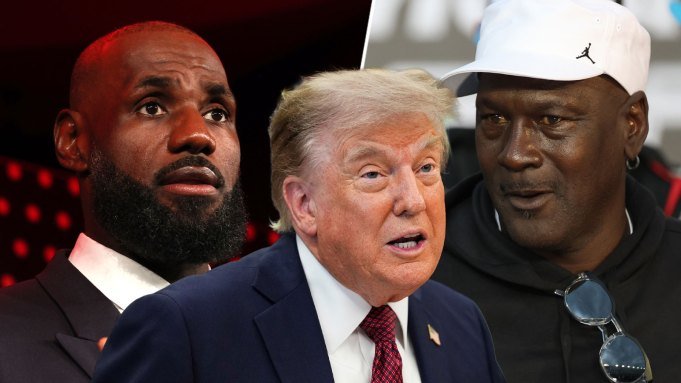
    Donald Trump is weighing in on LeBron James signing with the Philadelphia 76ers as he continues his NBA career after leaving the Los Angeles Lakers.

    During a press conference Friday at the White House, a reporter asked Trump where he stood on the James versus Michael Jordan debate.

    “Well, Michael Jordan is a guy who is a friend of mine — play golf with him. He’s a really good guy,” Trump said.

    He continued, “I think LeBron is… Maybe he’s a racist. Maybe he doesn’t like Trump. I don’t know, but I only like people that like me. So I would say Michael Jordan all the way.”

    James has been open about his political choices, voicing his support for Joe Biden and Kamala Harris in the 2020 election; for the 2024 election, James endorsed Harris in her presidential run. Claims that Jordan endorsed Trump for the last presidential election were debunked by his management team, who said “there is absolutely no truth” that the former NBA star publicly endorsed a candidate.

    James made news earlier in the day after he confirmed he was headed to the 76ers for “a chance at the feeling of winning another championship.”

    “I thought I was done when the season ended. I wasn’t ready to announce it, and I knew I needed some time to really decide, but I was pretty sure I played my last game,” James posted on X. “I was honest at that last press conference when I said I needed to look at myself and decide if I still love this game. I still truly love this game, and I have more to give.”

    ESPN reported that James signed an $8 million, two-year deal with the 76ers. The basketball star made almost $53 million playing with the Lakers last year.

    Watch Trump make the comments about James in the video below.

  • Malia Baker on Returning to ‘Descendants’ and Her Dream Roles

    Malia Baker on Returning to ‘Descendants’ and Her Dream Roles

    As Descendants enters a new chapter, so does Malia Baker.

    The 20-year-old Botswana-born actress returns as Chloe Charming in Descendants: Wicked Wonderland, stepping back into the Disney franchise, not as the newcomer who once idolized the original cast, but as one of the faces leading its next generation.

    “It’s like entering this world as camp counselors this time instead of these nervous campers that we were the first time around,” Baker tells The Hollywood Reporter on a recent Zoom.

    “We put so much pressure on ourselves just because we loved the movies so much. They were so integral, not just for my formative years, but my peers as well,” she continues. “You hold so much respect and love for them, so it was a really big deal. But it was still so much fun to film.”

    Returning for a second film also meant welcoming a new group of cast mates, who quickly turned into some of Baker’s closest friendships. She’s excited for the “world to fall in love” with her friends and the new characters.

    Malia Baker.

    Cibelle Levi

    Ahead of the film’s release, the Descendants and Zombies casts embarked on a tour, giving Baker the chance to witness fan excitement firsthand. “It’s so wild to be able to literally watch it unfold in front of you and have people be so excited and joyful around something that’s so close to your heart,” she says.

    The Descendants films are among the most beloved Disney movies in modern time. Baker feels that the films strike a necessary chord of timeless themes and represent young people well, which is why they’ve been able to remain relevant.

    For Baker, stepping into the character of Chloe meant embracing the legacy of Cinderella and Prince Charming, two of Disney’s most recognizable characters. While audiences were already familiar with Chloe’s parents, the young actress had the opportunity to help define a new character entirely her own.

    “I think we all put our hearts and souls into it,” she says. “Yes, these are iconic characters, but Chloe Charming has never been done before, which is a lot of trust to put into a person.”

    Malia Baker and Brandy in ‘Descendants: Wicked Wonderland.’

    Disney/David Astorga

    With Disney’s trust in Baker to represent the beloved character over the course of two films, she says she’s found herself growing alongside Chloe. “As things in your life start changing, you can find different levels and depths to whatever character you’re playing,” she says. “I think Chloe and I have been very fortunate to have been at very similar stages in our lives. It feels like we really are learning these lessons at the same time and inspired by one another’s growth.”

    The actress hopes that Wicked Wonderland viewers watch it and enjoy it. “It can seem like it’s your responsibility to not enjoy something, because it’s not as ‘serious,’” she says. “But I think there’s something really magical in being able to learn a great lesson while having fun.”

    While Chloe Charming may be the role she’s most known for today, sitting at the top of her acting bucket list is Starfire from Teen Titans. “I love the role of Starfire, I think she’s the coolest ever she is just such a baddie in her own right,” she says, laughing. “I would swap out the blue for some pink hair any time any place.”

    The actress says a role in a biopic would also be a dream for her. “I don’t know who, what or when, I keep joking with Brandy about playing her,” she says. “I told her I’ll start practicing for it.”

    Malia Baker.

    Cibelle Levi

    While Starfire, and maybe a Brandy biopic if she ever gives that call, remain on Baker’s manifestation board, she’s still wrapping her head around the fact that she’s become one of the faces of Disney’s newest generation with Descendants.

    “Sassy little me would’ve been shocked, flabbergasted, everything in between. It’s still a dream now,” Baker says of her younger self. “I have to have little reminders every now and then. I don’t think it’ll ever fully sink in, and honestly, I’m happy it won’t.”

  • Ralph W. Hemecker, Veteran TV Director of ‘Blue Bloods,’ ‘Once Upon a Time’ and More, Dies at 65

    Ralph W. Hemecker, Veteran TV Director of ‘Blue Bloods,’ ‘Once Upon a Time’ and More, Dies at 65

    Veteran TV director, writer, producer and showrunner Ralph W. Hemecker has died. He was 65.

    Hemecker, whose work spanned three decades and included directing 31 episodes of Blue Bloods and 28 episodes of Once Upon a Time, died July 10 at his home in Glendale.

    He also directed episodes of The X-Files, Millennium, Ghost Whisperer, Numb3rs, The Vampire Diaries, Nikita, V, Legends of Tomorrow, Quantico, Body of Proof, The Flash and Pacific Blue as well as the 2000 TNT TV movie Witchblade, going on to serve as showrunner, writer and executive producer of the Witchblade TV series across its two-season run from 2001 to 2002.

    And he directed the pilot for Roar, starring a then little-known Heath Ledger, as well as the pilots for Lawless and Dead at 21.

    Born on June 12, 1961, Ralph William Hemecker graduated from Bucknell University where he studied English, made short films and developed a passion for visual storytelling. He went on to take filmmaking courses at New York University and began his career in production and post-production.

    Some of his earliest directing work was on America’s Most Wanted, helming dramatic reenactments of real-life crimes, and he directed episodes of Silk Stalkings, on which he worked behind the scenes, as well as Renegade.

    “Some losses are impossible to put into words,” Once Upon a Time actress Lana Parrilla wrote in part on Instagram. “Ralph Hemecker was one of the kindest, most generous souls I’ve ever known. One of Once Upon a Time’s defining directors. A truly passionate, beautiful man and my dear friend. I was lucky enough to shadow Ralph as a director as he knew Once, behind the camera, best. He was always carrying a camera in hand, staying up all night in the director’s office putting his shots together, studying the scripts and endlessly visiting sets in preparation. His passion was infectious. We always knew if Ralph was directing, we were in good hands.”

    Hemecker is survived by his two stepdaughters as well as his father, sister and brother; two nephews; one niece and one great-nephew.

    Hemecker admired the Navy SEALs’ courage, discipline, resilience and commitment to service, and he was inspired by their leadership principles. As a result, in lieu of flowers, his family asks that memorial donations be made to the SEAL Future Foundation in Hemecker’s memory.

    A celebration of Hemecker’s life will be announced at a later date.

  • ‘Blue Bloods,’ ‘Once Upon a Time’ TV Director Ralph W. Hemecker Dies at 65

    Veteran TV director, writer and producer Ralph W. Hemecker, known for his work on shows including “The X-Files,” “Blue Bloods,” “Once Upon a Time” and “The Flash,” has died. He was 65.

    According to an obituary notice, Hemecker died July 10 at his home in Glendale, Calif. Hemecker’s credits over the years also include “Millennium,” “Ghost Whisperer,” “Numb3rs,” “The Vampire Diaries,” “Nikita,” “V,” and many more. He directed the Fox pilot “Roar,” starring a then-unknown Heath Ledger, as well as pilots for “Lawless” and “Dead at 21.”

    Ralph William Hemecker was born on June 12, 1961, and studied English at Bucknell University, where he was already making short films. He later took filmmaking classes at New York University.

    Hemecker started his career in production and post-production, and early on was a director on Fox’s “America’s Most Wanted.” He also got early experience on the syndicated series “Silk Stalkings,” which he later directed episodes for, as well as Stephen J. Cannell’s “Renegade.”

    Another big break came in 2000, when he directed the TNT TV movie adaptation of the comic “Witchblade,” executive produced by Dan Halsted and Oliver Stone. That turned into the “Witchblade” TV series, which he served as showrunner, executive producer and writer for two seasons, from 2001 to 2002.

    Among his busiest gigs were directing 31 episodes of “Blue Bloods” and 28 episodes of “Once Upon a Time.”

    “Some losses are impossible to put into words,” “Once Upon a Time” star Lana Parilla wrote on Instagram. “Ralph Hemecker was one of the kindest, most generous souls I’ve ever known. One of ‘Once Upon a Time’s’ defining directors. A truly passionate, beautiful man and my dear friend. I was lucky enough to shadow Ralph as a director as he knew ‘Once,’ behind the camera, best. He was always carrying a camera in hand, staying up all night in the director’s office putting his shots together, studying the scripts and endlessly visiting sets in preparation. His passion was infectious. We always knew if Ralph was directing, we were in good hands.”

    Wrote “Once” exec producers Adam Horowitz and Eddy Kitsis: “Ralph Hemecker was a great friend, partner, and a true artist. His contribution to ‘Once Upon a Time’ was immeasurable and he will be missed more than words can express.”

    Hemecker also directed feature films and television movies such as “Dead On,” “Blade Squad,” “Haunting Sarah,” “Fatal Desire,” “Nora Roberts’ Angels Fall,” “Nora Roberts’ Midnight Bayou” and “Skyrunners.” He launched Mythic Films in 2000.

    Hemecker is survived by two stepdaughters, as well as his father, sister, brother, three nephews, one niece and a great-nephew. Services will be announced at a later date.

  • Hollywood Royalty, Michelin-Starred Meal, Cartier Gift Bags: Inside Monaco’s Most Exclusive Event of the Year

    Hollywood Royalty, Michelin-Starred Meal, Cartier Gift Bags: Inside Monaco’s Most Exclusive Event of the Year

    If you purchase an independently reviewed product or service through a link on our website, The Hollywood Reporter may receive an affiliate commission.

    The Monaco Grand Prix, the Rose Ball and the Red Cross Gala: the Monégasque social calendar’s trifecta of prestige.

    Serving as the pinnacle of black tie elegance, Monaco‘s Red Cross Gala — or the Gala de la Croix-Rouge Monégasque, in French — is the yearly flagship fundraiser for the Monaco Red Cross, which, from 1958 to 1982, was presided over by none other than Grace Kelly, Princess of Monaco. Cut to the evening of July 18, 2026: Even without the Oscar-winning movie star’s physical presence, the Old Hollywood glamour at the 77th annual charity ball was palpable.

    Prince Rainier and Princess Grace of Monaco (aka Grace Kelly) arrive at Sporting Monte-Carlo for the annual Red Cross Gala on July 19, 1958 .

    Courtesy of AFP via Getty Images

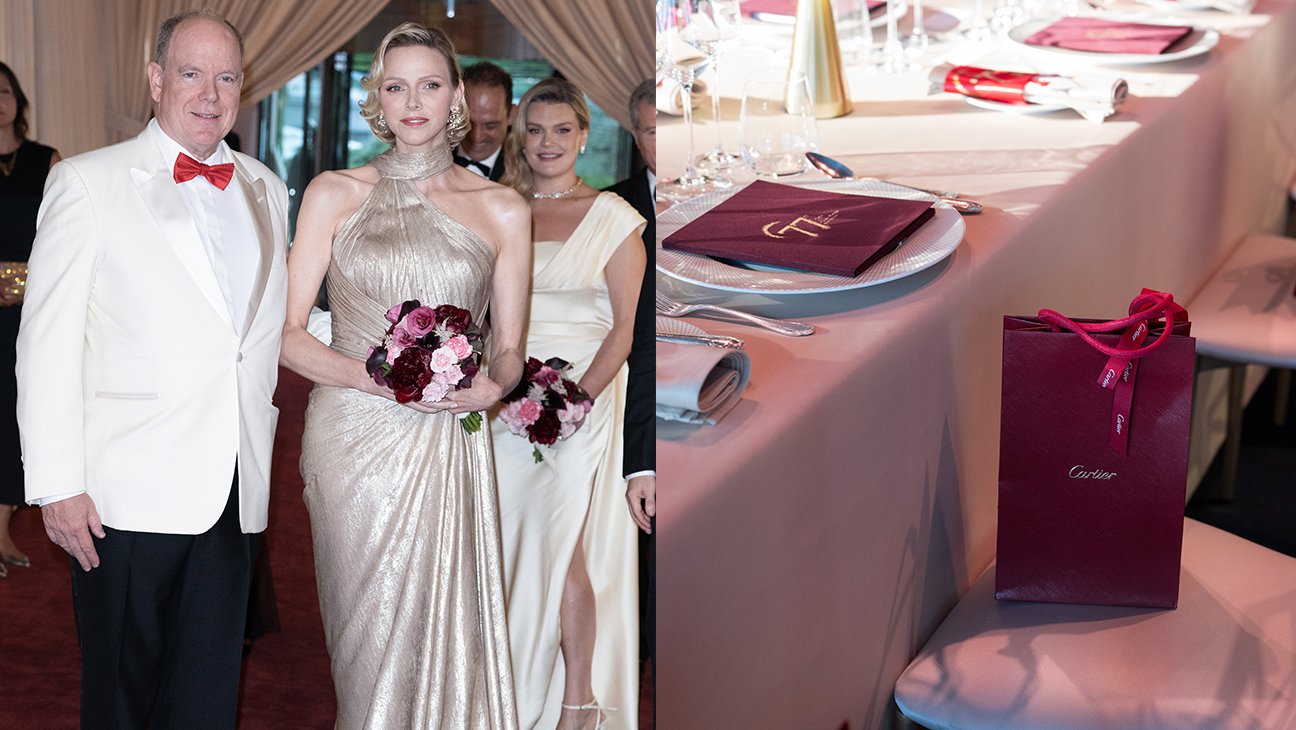
    Prince Albert II and Princess Charlene of Monaco arrive at Sporting Monte-Carlo for the annual Red Cross Gala on July 18, 2026.

    Courtesy of The Red Cross

    On Saturday night at the Sporting Monte-Carlo, esteemed guests eagerly awaited the arrival of Prince Albert II and Princess Charlene, son and daughter-in-law of Grace Kelly and respective President and Vice-President of the Red Cross Society’s Monaco branch. Charlene, Princess of Monaco, statuesque as ever, channeled the timeless style of her late mother-in-law in a custom-made Elie Saab golden draped gown. The couple was joined by niece Camille Gottlieb, one of Kelly’s 11 grandchildren, plus the evening’s hosting duo, actress and model Estelle Lefébure and actor and comedian Michel Boujenah.

    Following arrivals, guests glided through a sea of white tablecloths to dine on a multi-course meal imagined by three-Michelin-starred chef Marcel Ravin. And while only one lucky winner walked away with the gala’s grand prize, a Cartier Grain de Café jewelry set fit with 58 total diamonds, every guest in attendance went home with a generous parting gift from the luxury House, a supple leather cardholder stamped with the Double C emblem.

    The gala’s grand prize, a Cartier Grain de Café jewelry set, gifted by the luxury House.

    Courtesy of The Red Cross

    On the heels of an otherworldly fireworks show and ahead of the jazz-inspired after party, guests enjoyed the world premiere of SOUL! Where Legends Come Back. This dance-inducing live show, which traces the journey of African-American music, is the newest original production by Monte-Carlo Société des Bains de Mer (SBM), the luxury hospitality and entertainment company that doubles as the annual gala’s organizer and venue host. In many ways, SBM feels like — and, quite honestly, is — the brain behind much of Monaco’s social, cultural and hotel scene, with the sovereign city-state sitting at under one square mile.

    SBM’s crown jewel has to be the Hôtel de Paris Monte-Carlo, a palatial escape located at Place du Casino in Monte Carlo, smack dab in the heart of Monaco. Widely regarded as one of the world’s most luxurious properties, Hôtel de Paris is every bit as breathtakingly lavish as you’d hope and expect. It, therefore, only makes sense that a conveyor belt of black cars promptly escorted guests from their accommodations and pre-event drinks to the main festivities at the Sporting Monte-Carlo.

    So what’s next on the Principality of Monaco’s social calendar? Well, you’ll have to consult Monte-Carlo Société des Bains de Mer’s extensive annual agenda. But for now, a few more highlights from the 77th annual Monaco Red Cross Gala.

    Camille Gottlieb arrives at 77th annual Monaco Red Cross Gala on July 18, 2026.

    Courtesy of The Red Cross

    Princess Charlene and Prince Albert II dance alongside guests at 77th annual Monaco Red Cross Gala on July 18, 2026.

    Courtesy of The Red Cross

    Returning to Hôtel de Paris Monte-Carlo with the Cartier gift bag.

    Courtesy of Erin Lassner

  • Norwegian Zombie Comedy ‘Grandmonster’ Wins Big Laughs and Top Outpost Award at Fantasia’s Frontières Market

    Norwegian director Vegard Dahle’s zombie comedy “Grandmonster” has won the top Outpost Award, and a prize of post-production services, at the Fantasia Festival’s prestigious Frontières Co-Production Market, which handed out six awards at its closing cocktail, July 25.

    The film, about an American dropout who unintentionally triggers a zombie outbreak at a remote Norwegian nursing home while trying to save her grandmother from dementia, was presented with deadpan, self-deprecating humor by Dahle and producer Jon Vatne, who wore matching sweaters, at a day-long Frontières pitching event on July 22.

    The project, one of the 20 titles in Frontières official selection, received a boisterous, laugh-inducing response from the packed Frontières audience of fellow pitchers and buyer and industry delegates. 300 delegates from 24 countries attended the market, including team members of projects in its official selection, Genre Lab, Shorts To Features, and Music strands.

    Outpost Special Awards were presented to two titles in the Shorts to Features category. “Reset” is U.S. directors Celine Tien and Jerry Hsu’s sci-fi drama about a program that resets the elderly into children to remain economically useful; the short is screening in Fantasia’s official international short film competition. “Sea Spirits” is director Edson Jean’s Haiti-set gothic folk horror about a guilt-ridden mother haunted by her daughter, who is lost at sea and refuses to leave the country in search of her ghost.

    The PurpleDOG Award for an official selection project, which comes with a prize of post-production services, went to “Cher,” the first project out of Thailand participating in Frontières, a supernatural folk horror about a vengeance-seeking forest spirit who emerges near a remote mining camp that is trespassing on sacred forestland.

    The PurpleDOG Award for a project in the Gender Equity in Media Society (GEMS) section of the Genre Film Lab went to “Wifey,” Canadian director Cassidy Civiero’s horror thriller about an independent artist about to transition female-to-male who is is forced into a non-consensual marriage in which traditional gender norms are used as a violent weapon.

    The Sitges International Fantastic Film Festival Award, which comes with an invitation to pitch at the Sitges festival in October, went to “Eternal Valley,” U.K. director Jasmine De Silva’s dark comedy body horror, a feature project based on her proof-of-concept short film “Beauty Sleep,” which had its world premiere at Fantasia in 2025.

    “The feedback we’ve received from participants about the projects pitched last Wednesday has been overwhelmingly positive,” Frontières executive director Annick Mahnert told Variety shortly before the award ceremony.

    “People have praised not only the exceptional quality of the projects themselves, but also the filmmakers’ pitch presentations. Every year, the bar is raised even higher, and I believe that’s why decision-makers return year after year. They trust our curation.”

    One-on-one meetings and industry seminars conclude on July 25.

    Here is the full list of Frontières award winners and their prizes:

    Outpost Award of CAD$15,000 (US$10,637) in post-production services: “Grandmonster”
    Outpost Special Mention Award of CAD$5,000 (US$3545) in post-production services: “Reset”
    Outpost Special Mention: Award of CAD$5,000 (US$3545) in post-production services: “Sea Spirits”

    PurpleDOG award to Official Selection project, CAD$10,000 (US$7091) in post-production services: “Cher”
    PurpleDOG award to GEMS project, CAD$10,000 (US$7091) in post-production services: “Wifey”
    Sitges International Fantastic Film Festival: an invitation to pitch at the Sitges Festival next October, “Eternal Valley”

  • AAVE whales return as $100 nears – Will buyers break through?

    AAVE whales return as $100 nears – Will buyers break through?

    On the 24th of July, a whale transferred 191,453,164 USD Coin [$USDC] into the Aave protocol.

    Whale Alert valued the transaction at $191.42 million. The transfer confirmed sizable protocol activity, although its effect on $AAVE demand remained unclear.

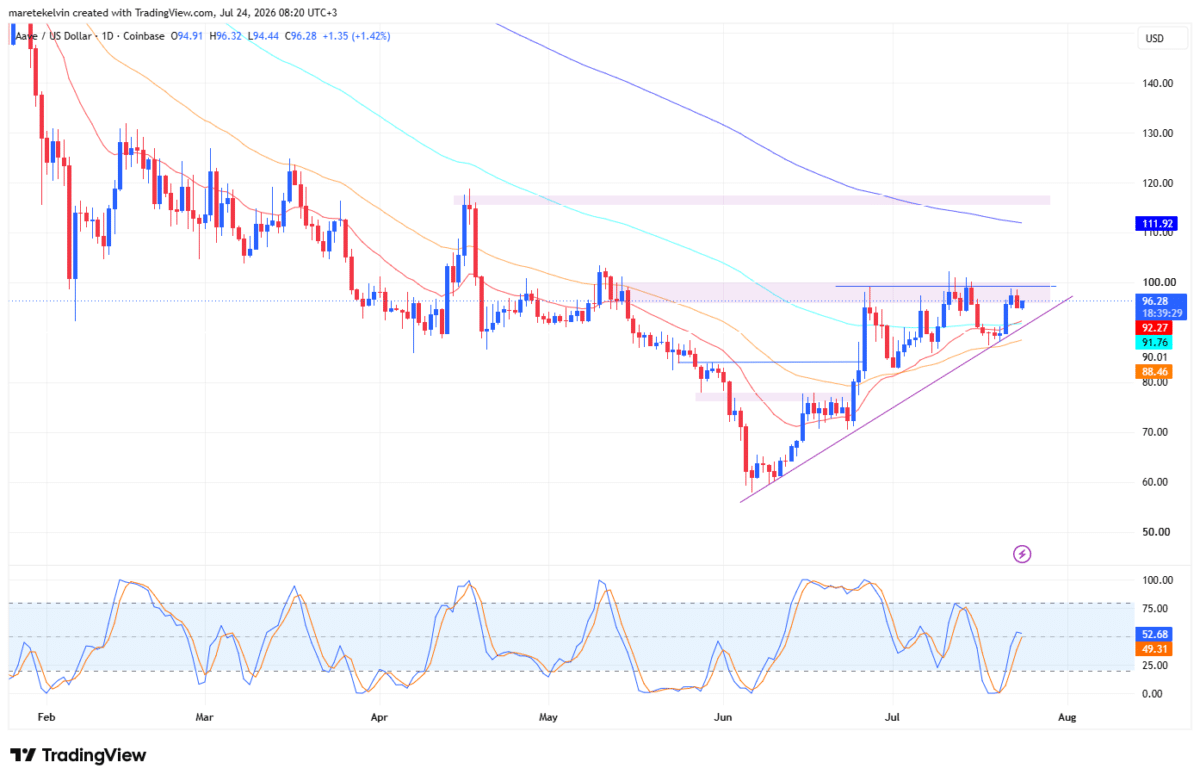
    Meanwhile, Aave [$AAVE] traded at $96.28, just below the resistance around $99–$100. This zone had rejected several recovery attempts, making the whale’s timing particularly notable.

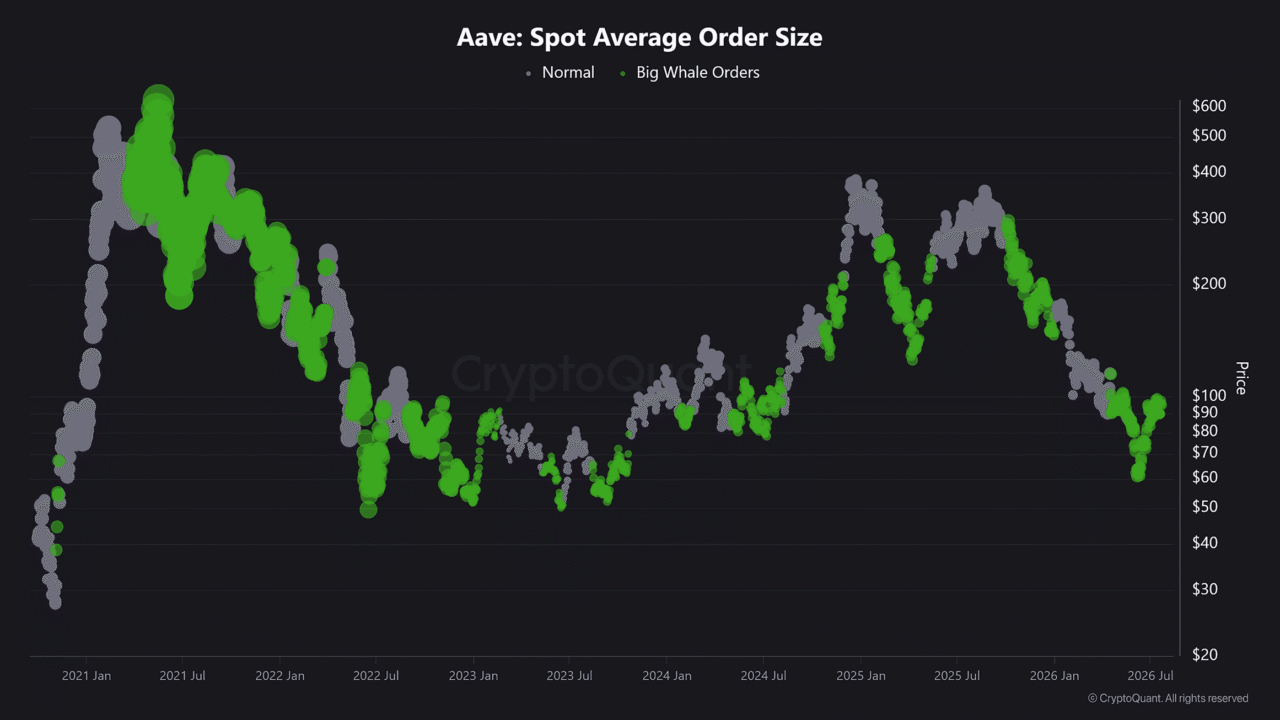
    CryptoQuant’s Spot Average Order Size also recorded Big Whale Orders near $AAVE’s current price range. However, neither dataset confirmed that these whales bought $AAVE ahead of a breakout.

    Source: CryptoQuant

    Are whales positioning before $100?

    The $USDC transfer was part of a broader increase in large transactions.

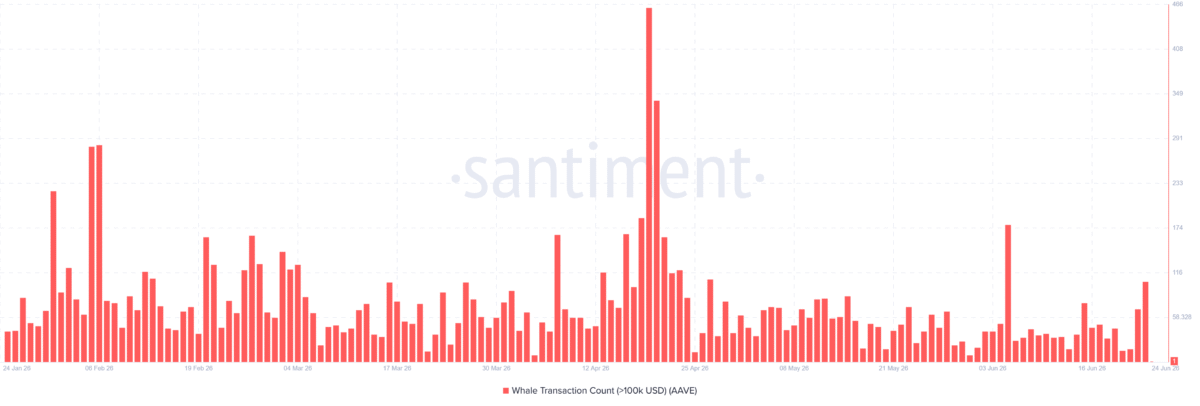
    Santiment recorded a rise in Whale Transaction Count for transfers exceeding $100,000 before the latest partial reading. This activity suggested renewed interest from large holders. However, the metric included purchases, sales, and wallet transfers.

    Consequently, a higher Whale Transaction Count could increase volatility without determining its direction.

    Source: Santiment

    Spot demand offered a clearer bullish signal.

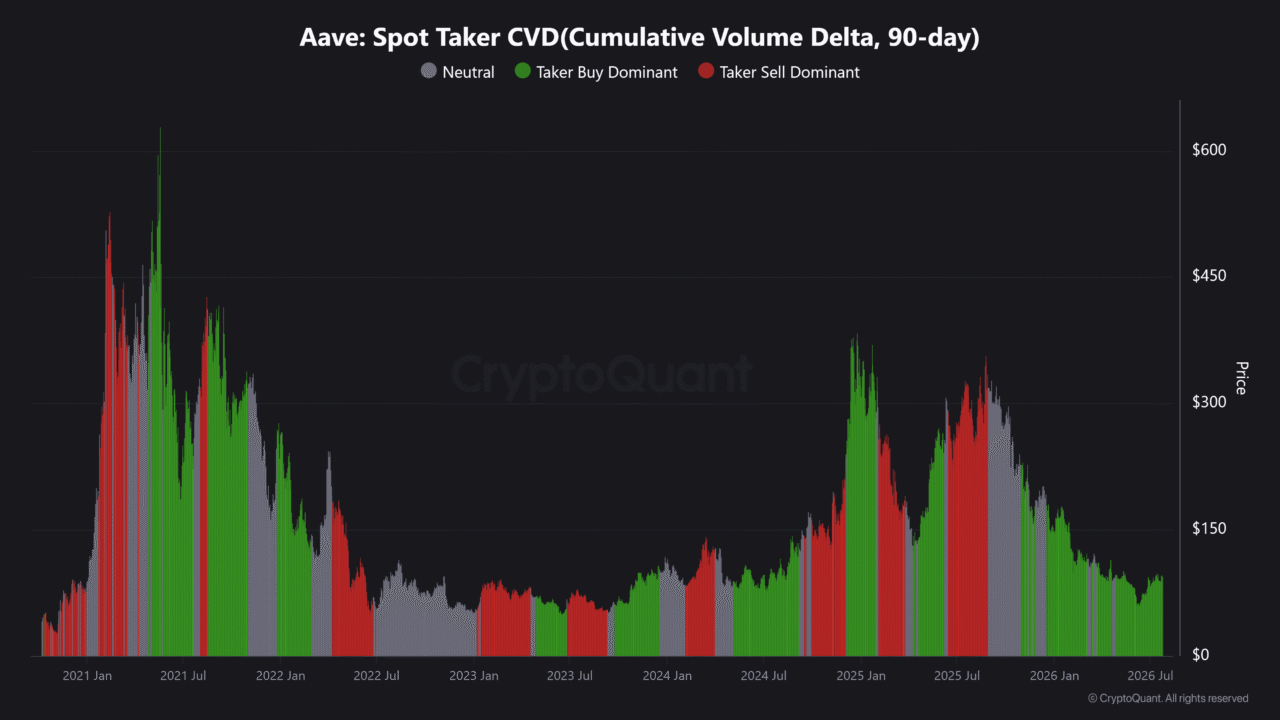
    CryptoQuant’s 90-day Spot Taker CVD showed Taker Buy Dominant activity during $AAVE’s latest recovery. This indicated that aggressive spot buyers had increasingly crossed the spread to complete purchases.

    Coinalyze data supported that positioning. Longs represented 56.09% of one-day positions, compared with 43.79% for shorts.

    The one-day Long/Short Ratio stood at 1.28. Still, crowded long positioning could increase liquidation risk during a rejection.

    Source: CryptoQuant

    Can $AAVE break above $100?

    $AAVE had consolidated beneath $100 after recovering from its June lows.

    The daily chart formed an ascending triangle, with buyers defending a rising trendline beneath horizontal resistance.

    $AAVE also traded above its 20-day, 50-day, and 100-day Exponential Moving Averages. Those averages stood near $92.27, $91.76, and $88.46, respectively.

    Meanwhile, the Stochastic RSI recorded values of 52.68 and 49.31. These neutral readings left room for movement in either direction.

    A confirmed daily close above $100 could strengthen the breakout case. Rejection may return attention to the moving averages below $92.

    Source: TradingView

    Final Summary

    • Whale activity increased as $AAVE consolidated beneath the psychologically important $100 resistance.
    • Buy-dominant spot flow strengthened $AAVE’s breakout case without confirming the move.
  • Paramount Faces Drawn-Out Battle With State AGs: ‘They Saw the Writing on the Wall’

    Only a few days ago, the states’ antitrust challenge to the Paramount-Warner Bros. merger still looked like a speed bump.

    Now, it looks more like siege warfare — as Paramount has agreed to put the $111 million deal on hold for at least several months. In doing so, Paramount’s lawyers have effectively conceded that they were not likely to prevail in an upcoming fight over an injunction and will instead try to beat the states at trial.

    “I think they saw the writing on the wall,” California Attorney General Rob Bonta told Variety on Friday. “They saw that the outcome of a motion for a preliminary injunction was a fait accompli. The die was cast. They were going to lose. Otherwise, why not challenge it?”

    David Ellison, Paramount Skydance‘s chairman and CEO, had hoped to win a ruling denying the injunction by mid-September — allowing him to close the deal in time to avoid paying Warner Bros. shareholders millions of dollars a day. His lawyers pushed for a three-day evidentiary hearing in late August, where they could confront the states’ expert economist and undermine the states’ argument that the deal will result in illegal market concentration.

    But in a ruling on Thursday, Judge Araceli Martinez-Olguin denied Paramount’s bid to speed up briefing on that request, signaling she was not inclined to go along with the multiday hearing. The judge had already granted a 28-day restraining order, finding that the states had made a “strong showing” that the merger was likely to harm competition, and the standard to get an injunction would be similar.

    Paramount could have opted to wait for the ruling and then immediately appeal to the 9th Circuit. But Nexstar tried to do that after its merger with Tegna was enjoined in April — and is still stuck in limbo with no assurance of resolution anytime soon. Paramount would have faced a similar delay, likely pushing any appellate relief into early 2027.

    So where does it go from here?

    To trial, where Paramount still believes it has the upper hand against what it terms “one of the weakest merger challenges in modern antitrust history.” The company hopes to get there as soon as possible, ideally before the end of 2026.

    Whenever a trial is held, it won’t come fast enough to avoid having to pay Warner Bros. Discovery shareholders $7 million per day, starting on Sept. 30. But that is a cost that Paramount will have to bear to get the deal done.

    The 12-state coalition will push for a later date, arguing that it needs additional time to prepare.

    “We do think 2027 is appropriate,” Bonta said. “If the judge said April 2027, we would not disagree with that.”

    Paramount has agreed not to close the transaction until five days after the trial ruling or June 1, 2027, whichever comes first. Bonta argued that Paramount is pushing for a speedy resolution due to “business factors” and not due process considerations.

    “I’m sure they want a fast trial,” he said. “That’s based on other reasons, not what’s appropriate for a case of this magnitude.”

    The states will want extra time to obtain extensive discovery, including documents and depositions they were unable to get during their investigation.

    “Paramount and Warner Bros. were dragging their feet. They didn’t give us everything we wanted,” Bonta said. “If they wanted to have a trial quicker, they could have given us the information we asked for in the pre-litigation discovery process.”

    The trial will be held in Martinez-Olguin’s courtroom in Oakland, Calif., and could last two to three weeks or more.

    In the meantime, Paramount could seek to reopen settlement talks with the states. So far, Bonta said, the company has not offered the sort of structural remedies — that is, divestitures of cable or film distribution assets — that would have to be part of a deal.

    Bonta has said repeatedly that he is not interested in “behavioral” remedies, such as a consent decree guaranteeing a minimum number of film releases or 45-day theatrical windows, saying that those have proven ineffective in the past.

    “We’ve never gotten anything that would come close to addressing the concerns we’ve raised,” Bonta said. “We’re focused on litigation. We’ve built momentum and we look forward to taking that momentum into trial.”

    In its statement, Paramount argued that the strategic retreat was the best way to get to a decision on the merits of the deal as soon as possible.

    “This is the fastest and clearest way to prove that this transaction is good for competition, good for consumers, and good for creators, a conclusion dozens of competition authorities around the world have already reached,” the company said.

    Bonta argued the opposite — and now it’s clear those arguments present more than a minor obstacle.

    “This merger, if it is able to go through, will hurt Americans, will hurt Californians,” he said. “It will raise their prices. It shouldn’t break the bank to enjoy your favorite show on the couch.”

  • Binance ETF Perpetual Volume Tops $116B, Market Share Hits 74%

    Binance ETF Perpetual Volume Tops $116B, Market Share Hits 74%

    Binance barely needed a full quarter to seize control of a new product category that most rivals barely saw coming. The exchange’s ETF perpetual contracts have now cleared more than $116 billion in cumulative trading volume since their March 2026 debut, pushing Binance’s market share in the segment to 74%, according to the original report. The number is more than a growth metric—it marks a structural quickening in how traditional financial instruments get absorbed by crypto-native infrastructure.

    When the product launched, Binance held just 18% of the ETF perpetual market. The rapid share grab reflects both execution and the sheer volume of latent demand among crypto traders for familiar capital-market exposure without leaving the perpetual swap rails. In July alone, ETF perpetuals made up 19% of Binance’s entire TradFi perpetual trading volume. The exchange now lists 146 such pairs, with 35 added over the past month, spanning contracts that track SPY, QQQ, semiconductor ETFs, country-focused funds, and leveraged and inverse products.

    What’s happening is not simply a new listing category. It’s a convergence that has been building since tokenized RWAs crossed $20 billion on-chain and institutional players started settling Treasury trades directly with crypto-native rails. The broader tokenization trend has made the leap from niche experiment to top-of-mind allocation for a class of traders who want the leverage mechanics of perpetuals attached to non-crypto underlyings. The ETF wrapper, already familiar to retail and institutional money alike, reduces the cognitive distance.

    Why the 74% share matters now

    Market concentration above 70% in any derivatives category draws attention—both from competitors and from regulators. Binance captured share not because the field was empty, but because it moved quickly. Other major exchanges offer TradFi perpetuals, but few built the ETF-specific infrastructure, liquidity, and pair density that Binance rolled out across more than 140 contracts. In derivatives markets, the order-book depth and listing breadth often become self-reinforcing: liquidity begets liquidity. That dynamic makes it structurally difficult for challengers to claw back ground once a venue establishes early dominance.

    That dominance will be watched closely as legislative pressure on hybrid crypto products intensifies. Mounting regulatory pressure on hybrid crypto products in Washington is already reshaping the conversation about what a compliant model looks like when exchanges start blending securities-like exposure with crypto-style margin and settlement. The ETF perpetual boom sits squarely in that gray zone.

    What the volume shift says about user behavior

    The 19% contribution of ETF perpetuals to Binance’s overall TradFi perpetual volume in July is a signal that demand is not a novelty blip. Traders are clearly reallocating from traditional perpetual categories—forex, commodities, equity indices—toward the ETF format, likely because it bundles exposure, provides lower tracking friction, and fits into existing risk systems that already understand ETFs. The fact that 35 new pairs were added in the past month suggests Binance sees the product as elastic: demand expands as the available menu grows.

    Crypto-native users, accustomed to perpetual swaps on tokens, don’t need to learn a new venue or settlement process to trade QQQ or a leveraged semiconductor ETF. That familiarity lowers the switching cost that typically protects incumbent broker-dealers. Growing institutional staking demand elsewhere in the market has shown that mainstream capital is increasingly comfortable with crypto-native mechanics; the ETF perpetual product extends that comfort to a much wider asset universe.

    What remains uncertain

    The sustainability of a 74% market share is far from guaranteed. Competitors who misjudged the speed of adoption are now building out their own ETF perpetual suites, and if volume continues to grow, the pie will attract more aggressive market makers and possibly pressure on fees. Binance itself has not disclosed how much of the $116 billion volume is organic versus wash-trading or incentive-driven, and the report offers no breakdown of unique traders. In the absence of granular data, the headline number remains impressive but incomplete.

    Regulatory risk adds another variable. The same framework debates that surround crypto ETFs and tokenized securities apply to the perpetual wrapper. Whether regulators eventually deem ETF perpetuals as security-based swaps or something else will determine the compliance burden, and any adverse classification could reshape the market structure overnight. For now, the numbers show that the appetite for bridging TradFi and crypto-native execution is deep and, at least for one exchange, highly concentrated.