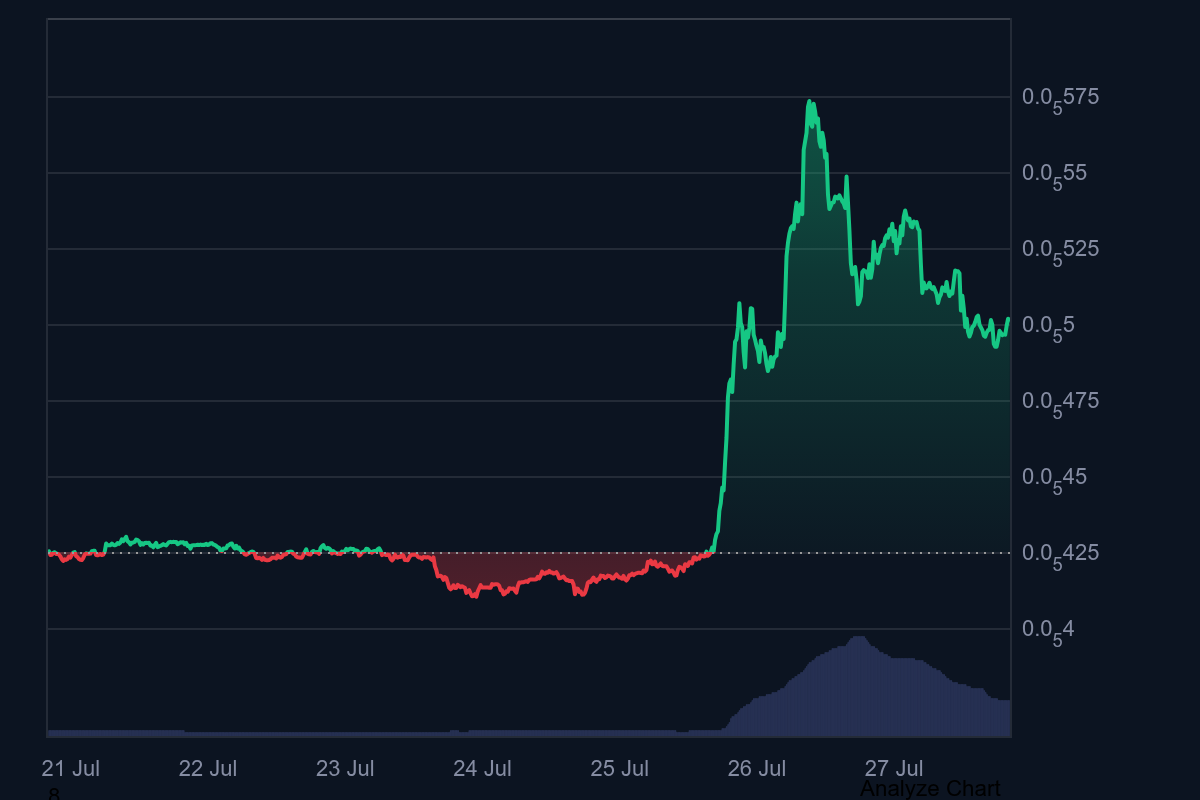
Cryptocurrency analytics company Santiment has analyzed Shiba Inu ($SHIB), which has seen a significant increase in volatility recently. According to the company’s data, the price of $SHIB rose by 37 percent in two days, but quickly gave back some of its gains.
Santiment reported that social media interest in Shiba Inu also increased significantly during the rally. $SHIB’s social dominance reached 0.084%, its highest level since April 2nd. However, the company noted that investor interest peaked during a period when price movement began to weaken.
The chart shows the increase in $SHIB price.
On-chain data also indicated that large investors may have viewed the rise as a selling opportunity. 52 whale transactions occurred in $SHIB in a single day, the highest daily level recorded since March 31st.
Related NewsAttention: We’re Entering a Critical Week – Numerous Economic Developments and Altcoin Events Ahead – Here’s a Day-by-Day, Hour-by-Hour List
According to Santiment, the increase in whale transactions suggests that large investors may have reduced their $SHIB positions by realizing profits as the price rose. In contrast, individual investors are believed to have entered the market later.
The company stated that the surge in social media interest following the sharp rise indicates that small investors bought under the FOMO (Fear of Missing Out) effect as the price approached its peak. This may have provided whales with the necessary liquidity to reduce their positions.
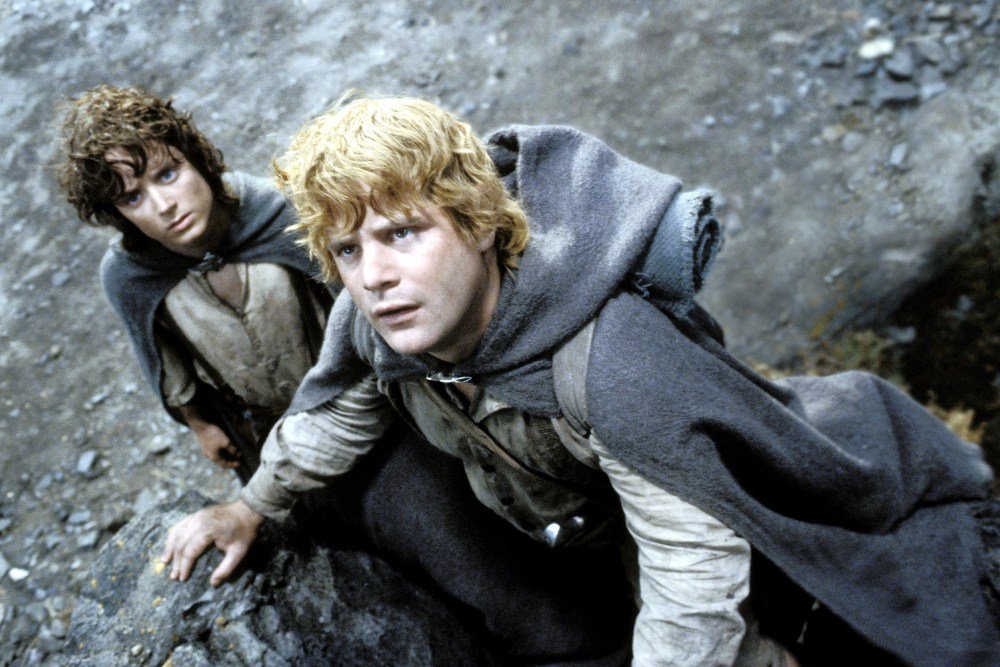
Sean Astin said in a new interview with The Guardian that he was forced to sell his house amid “The Lord of the Rings” fame in the early 2000s because he negotiated such a small salary to play Samwise Gamgee in Peter Jackson’s landmark movie trilogy. The reveal may come as a shock to fans considering the “Rings” movies were cultural phenomenons that grossed $2.9 billion at the worldwide box office between 2001 and 2003.
“I was not prepared for that level of visibility and access,” Astin told the publication. “And there was a disconnect between the attention that I was getting and how much money we had. It was not a lot of money! In fact, I had to sell my house because I negotiated such a small amount on the trilogy.”
Astin noted that he is “very comfortable financially now,” but that wasn’t the case when “The Lord of the Rings” was dominating box office charts. Peter Jackson and the team behind the “Rings” trilogy famously shot all three movies at once, meaning there was no opportunity for the cast to renegotiate their salaries based of the success of each installment.
“Because we weren’t making one movie and then renegotiating a contract for the next, it wasn’t the sort of lucrative scenario that you could sort of rest easy for the rest of your life,” Astin’s “Rings” co-star Elijah Wood told Business Insider last year. Wood noted that New Line Cinema took a “real gamble” filming all three movies at once. To mitigate financial risk, the ensemble cast was offered “not massive salaries,” the Frodo actor said.
“The benefit of that was that we were also signing up for something that was going to be a part of our lives forever,” Wood added at the time.
Astin previously revealed that he earned around “$75,000 a movie,” brining his total “Rings” salary to around $250,000. Co-star Orlando Bloom (who played Legolas) said in a 2019 interview on “The Howard Stern Show” that he was paid just $175,000 for the trilogy.
“The Lord of the Rings” franchise is currently developing its big screen return courtesy of “The Hunt for Gollum,” which Andy Serkis is currently directing, and a new movie co-written by Stephen Colbert. Astin is not confirmed yet to reprise his role in either project, but he will certainly fight for better pay if he is, telling The Guardian: “Goddamn right.”
A searchable database built from New York City’s public property records has sparked backlash.
Crypto executives say organizing public records into a searchable tool increases security risks.
Critics point to a rise in violent attacks targeting cryptocurrency holders.
A searchable database built from New York City’s public property assessment records is drawing backlash from prominent figures in the crypto industry, who argue that making the information easier to search effectively creates a directory of wealthy property owners and could expose them to physical danger.
The controversy centers on data published by the New York City Department of Finance, which annually releases assessed values used to calculate property taxes for every property in the city. The agency’s FY2027 assessment roll, supplemental market value data, and property tax guides are publicly available through the city’s Open Data portal.
Critics on X said the issue is not that the records are public, but that they have been aggregated and organized into a searchable database that makes identifying owners of expensive properties far easier.
Uniswap founder Hayden Adams called it “the worst mass doxxing I’ve ever seen,” saying the database listed nearly every unit in some luxury apartment buildings, including primary residences of people he knows. He argued the project cast too wide a net and called it “incredibly dangerous.”
“Not only were their units listed, but nearly every unit in the entire building was listed,” Adams wrote. “They clearly took an incredibly expansive view of ‘could be’ and just doxxed a huge percentage of all expensive apartments in New York City.”
Helius CEO Mert Mumtaz called the database “unsettling” and said it crossed a line by transforming scattered public records into a centralized resource that effectively singled out wealthy individuals.
“While this data was largely public prior to this in a messy way they have cleaned it, organized it, singled out ‘the rich,’ and mass distributed it only the 50th sign this year of privacy continuing to become scarcer,” he wrote.
Castle Island Ventures partner Nic Carter warned that an easily searchable database of affluent property owners could make potential victims easier to identify, pointing to recent crypto-related kidnappings and violent attacks in Europe.
“So this is a list of wealthy people and their addresses. As we’ve seen in France and Sweden this leads to crypto kidnappings, torturings and murders,” Carter wrote on X. “Yes real estate records are semi public but this is an easily searchable database and target list.”
The criticism comes as physical or “wrench” attacks targeting cryptocurrency holders continue to rise, with incidents including kidnappings, torture, home invasions, and sexual assaults.
In February, blockchain security firm CertiK reported 72 verified crypto “wrench attacks” worldwide in 2025, up 75% from the previous year and resulting in more than $40.9 million in losses.
In April, French authorities charged 88 suspects, including more than 10 minors, in a sweeping crackdown on violent crypto kidnappings. In May, U.S. prosecutors indicted three men accused of carrying out a series of armed home invasions across California that allegedly stole millions of dollars in cryptocurrency. In June, two Texas brothers pleaded guilty to kidnapping a Minnesota family and forcing the victims to transfer more than $8 million in crypto.
By July, CertiK said attackers had already carried out 52 verified crypto “wrench attacks” in the first half of 2026, with recorded financial exposure surging nearly twelvefold year over year to $124 million.
Daily Debrief Newsletter
Start every day with the top news stories right now, plus original features, a podcast, videos and more.
If you purchase an independently reviewed product or service through a link on our website, Variety may receive an affiliate commission.
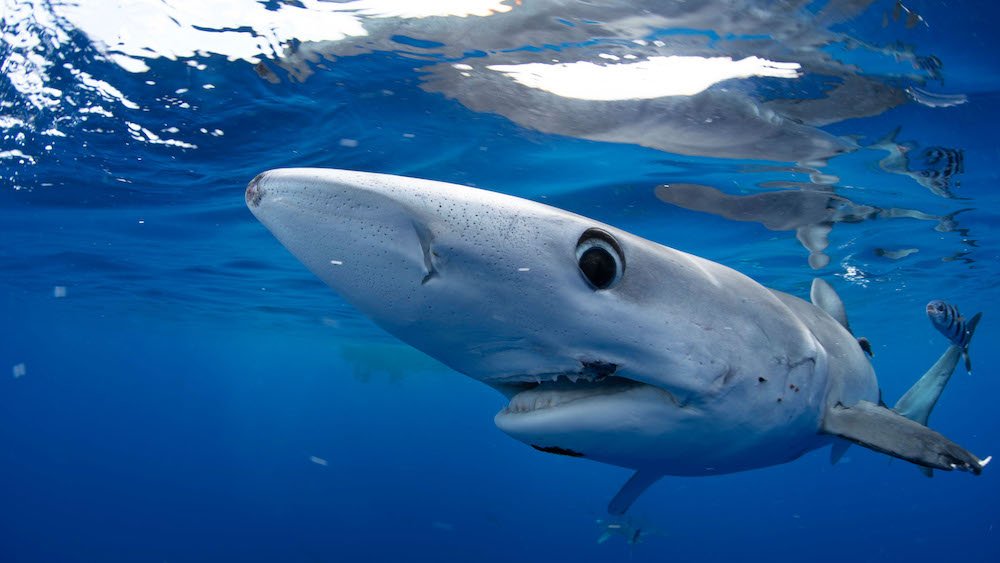
Shark Week has officially returned, bringing another frenzy of great whites, makos and other underwater predators to Discovery Channel.
The network’s annual programming event kicked off Sunday, July 26, and runs through Saturday, Aug. 1, with new specials airing nightly beginning at 8 p.m. ET. Cord-cutters can watch Shark Week live online through Sling TV, which carries Discovery Channel as part of its Sling Blue and Sling Orange + Blue packages.
Sling Blue includes more than 40 live channels and allows subscribers to stream on as many as three devices simultaneously. The service also comes with 50 hours of cloud DVR storage, making it possible to record Shark Week specials and watch them later.
Viewers who miss the live broadcasts can also add Discovery+ through Sling. Discovery+ is available in an ad-supported plan for $5.99 per month or an ad-free plan for $9.99 per month, with Shark Week programming available to watch on demand.
This year marks the 38th edition of Shark Week, with Discovery rolling out 20 new specials focused on shark behavior, attacks, conservation and ocean science. The lineup opened with “K-Pop Shark Heroes,” featuring comedian Ken Jeong and singer Rei Ami on a mission to challenge misconceptions about sharks across East Asia.
Other highlights include “Air Jaws: Red, White and Breach,” which investigates great white sharks breaching along the U.S. coastline, and “Invasion of the Mega Sharks,” following researchers as they search for a potentially record-breaking great white off Nova Scotia.
Later in the week, “Jurassic Sharks” uses CGI and real-world expeditions to examine prehistoric species, while “Jaws vs Orca” explores the growing evidence that killer whales are hunting great whites. “How to Train a Great White” tests whether the predators can learn and respond to cues, and “Ultimate Shark Dive” follows high diver Molly Carlson as she attempts a helicopter jump into a narrow shark cage.
The week concludes Aug. 1 with “Great White Highway,” about the increasing number of great whites traveling along the East Coast, followed by “Thresher Shark: Stun to Kill,” which examines how thresher sharks use their powerful tails to incapacitate prey.
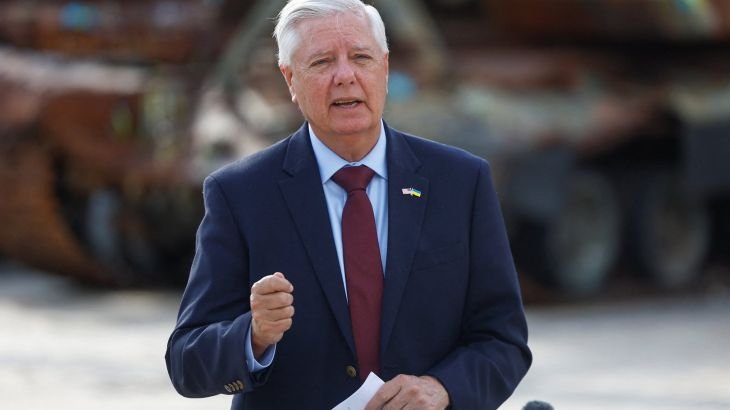
“Look what we’ve done here. I almost cried.” Unreleased documentary footage shows late US Senator Lindsey Graham celebrating the war on Iran, saying it was ‘the best thing’ he had ever done and revealing he had pushed for military action for years.
Senate Republicans are seeking Democratic support for the Clarity Act as lawmakers consider starting a floor process before the August recess.
Clarity Act faces a 60-vote Senate test
Crypto industry groups hope Thune will begin the floor process by filing cloture on a motion to proceed, according to a Crypto in America report.
A cloture filing would typically set up a vote two Senate session days later. At least 60 senators would need to support the motion before the chamber could begin debating whether to take up the bill.
If the Senate invokes cloture, lawmakers could spend as many as 30 hours debating the motion before voting on whether to proceed to the legislation itself. That process would not guarantee the Clarity Act’s passage but would move the bill closer to a full floor debate.
Republicans hold 53 Senate seats, leaving them dependent on Democratic votes even if nearly every GOP senator supports the measure. Senator Mitch McConnell is also expected to remain absent, while Republican Senators Josh Hawley and Rand Paul have not confirmed their positions.
Both senators voted against the GENIUS Act in 2025, adding uncertainty to the Republican vote count.
Democratic concerns threaten the floor push
Seven Democratic senators said the updated Clarity Act text released last week “fell short” of their expectations. Their concerns include political ethics, consumer protection, illicit finance, market integrity and the regulation of decentralized finance.
Senator Thom Tillis has been leading bipartisan negotiations over stronger ethics rules. The North Carolina Republican has called for provisions that go beyond the proposal agreed to by the White House and other GOP lawmakers.
The White House-backed language would restrict senior elected officials from issuing or sponsoring certain digital assets. However, some Democrats have questioned whether relying on the Department of Justice to enforce the restrictions would provide sufficient oversight.
Senators Catherine Cortez Masto and Mark Warner have also tied their potential support to stronger safeguards against crypto-related financial crime.
Without an agreement, Republicans are unlikely to secure the 60 votes required to move forward. The narrow GOP margin also means that any Republican defections would increase the number of Democratic votes needed.
Police endorsement removes one DeFi obstacle
The National Fraternal Order of Police endorsed the revised Clarity Act on Friday after lawmakers addressed its concerns about the Blockchain Regulatory Certainty Act.
The BRCA provisions would protect certain non-custodial software developers from having to register as money transmitters. Law enforcement groups had previously warned that broad protections could make it harder to prosecute crimes involving digital assets.
The police union now believes the revised language preserves investigators’ authority while providing legal protection for developers who do not control customer assets. Its endorsement could help ease concerns among Democrats focused on illicit finance and enforcement.
However, the support does not resolve broader disagreements over when a DeFi service should qualify as decentralized and when people controlling a protocol should face financial regulations.
SEC Commissioner Hester Peirce separately warned that moving a financial product onchain does not automatically place it outside federal securities law. She said actively managed crypto vaults could resemble investment funds when third parties decide how users’ assets are allocated.
“When you have a third party involved in deciding how different assets are being allocated and invested, that’s really a situation where you have to start asking: Do the securities laws apply?”
August recess leaves little time for a deal
Senators are scheduled to leave Washington on August 7, giving negotiators a limited window to settle the remaining disputes and start the floor process.
Thune said last week that he did not expect the Clarity Act to pass before the break. However, Senate leaders have reportedly discussed keeping lawmakers in Washington during the first few days of the recess if enough votes can be secured.
The bill would establish a federal market structure for digital assets and clarify the roles of the Securities and Exchange Commission and Commodity Futures Trading Commission. Failure to reach a bipartisan agreement before the recess could push further action into a more difficult election-year calendar.
US Crypto Regulations — Read the full US Regulation Hub for the latest on SEC enforcement, IRS crypto tax rules, and pending legislation.
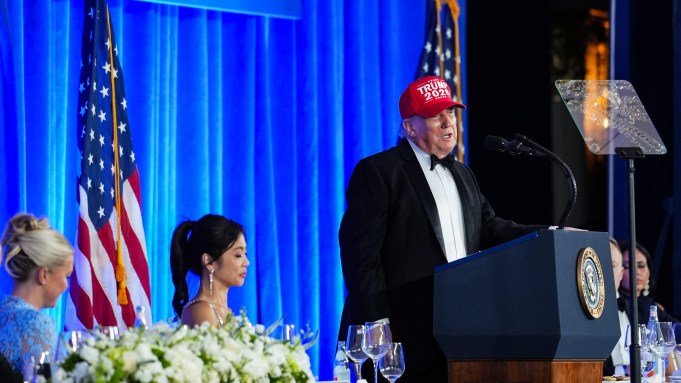
Inside the Waldorf Astoria on Friday evening, President Donald Trump took to the stage at the White House Correspondents’ Dinner and tried out some Don Rickles-like shtick, interspersed it with some of his greatest rally hits and fixated on some of his obsessions, including his plans for a White House ballroom.
What stood out during his one-hour-and-two minute remarks, though, was the silence in the crowd: many jokes didn’t land, he meandered into asides and veered into insider-ish attacks that likely went well over the heads of the TV audience. Much of what he said wasn’t humor, in contrast to the tightly scripted routines of his predecessors, but akin to a fever dream from someone who has spent a bit too much time watching right-wing TV.
At about 45 minutes in, guests were looking at their phones and fidgeting in their seats. I looked around and locked eyes with a man who gave a brief yawn. It was Howard Lutnick, the commerce secretary.
The length of Trump’s remarks were a reminder of one of Johnny Carson’s quips from the Oscars decades ago: “Welcome to two hours of sparkling entertainment spread over a four-hour show.” It should be noted that Trump’s weaving from topic to topic included a riff on the Academy Awards and how they have gotten too anti-Trump, but even that didn’t get much of a response.
The president did deliver some funny lines, including quips about Robert F. Kennedy Jr.: “I hope that everyone finally got to enjoy their entire, very delicious beef tenderloin, very special beef. And I want you all to know that Bobby Kennedy, who’s right here, personally ran over the cow in his car.”
Trump also revealed that he still counts how many front-page stories he gets in the New York Times, and gave some practical guidance for reporters who have his phone number and want to call him directly, and why he answers some of them. “I always find that when you don’t speak to the press, you always get a bad story. When you do speak to the press, you have a shot at a good story.”
Yet in a room full of journalists, Trump’s attacks on figures like CNN’s Kaitlan Collins were met with stone-faces from those who were well aware their reactions could be caught on C-SPAN cameras. His personal insults, ranging from Adam Schiff having a pencil neck to Chris Christie’s weight to Bruce Springsteen’s aged face, also were repeats of various Truth Social posts.
The event, in the Waldorf Astoria ballroom, was in a much smaller venue than the Washington Hilton, making it more intimate and putting many attendees face-to-face with Trump’s top advisers and members of his cabinet including Stephen Miller, Defense Secretary Pete Hegseth and Acting Attorney General Todd Blanche. With a much smaller crowd, and no pre-event receptions, the enhanced security generally moved briskly.
There were standout moments during other parts of the evening. This was the rescheduled dinner after April’s event was stopped by an apparent assassination attempt on the president, as a gunman breached security and the sounds of gunfire sent the thousands of attendees at the Washington Hilton to the floor. The WHCA paid tribute to the Secret Service officer, Victor Gonzales, who helped stop the gunman, as well as the Washington Hilton staff.
WHCA president Weijia Jiang, White House correspondent for CBS News, gave a very personal and heartfelt speech about her journey, having been born in China, raised in Appalachian coal country and, inspired by Connie Chung, landing in the “Oval Office to ask questions of the president of the United States.”
L-R: White House Press Secretary Karoline Leavitt, President Donald Trump and Weijia Jiang
Eric Lee/Getty Images
There was pressure on the WHCA to directly confront Trump for his attacks on the press. Jiang talked about the purpose of the First Amendment and the intent of the founders, while commenting more generally on the state of the situation rather than call out specific episodes. She said, “Criticism of the media can be unfair. It can also be legitimate. We get a lot right, but sometimes we get things wrong. We mistake proximity to power for understanding it, and at times we get trapped in our own bubbles. There is a difference, though, an existential difference, between criticizing the press and trying to undermine it.”
When it came to the defense of the press at a difficult moment, the approach of the WHCA appeared to be that of what is taught in J-school: Show, don’t tell. A video segment featured an AI-generated James Madison explaining the importance of the First Amendment, with clips of Trump’s predecessors, including Ronald Reagan to Barack Obama, acknowledging the essential role of the press corps. Comments from Dan Rather and Sam Donaldson reinforced how the adversarial nature of the relationship is nothing new.
The most direct face-to-face with Trump’s press attacks came when Wolf Blitzer presented an award to Wall Street Journal for its reporting on an alleged bawdy letter that Trump wrote to Jeffrey Epstein. As Blitzer noted that Trump sued the Journal for $20 billion, the president gave a smirk, to some laughter, then he shook hands with the reporters who received the prize. After it was over, he threw his hands up in the air, as if to say, whatever.
Toward the end of his winding remarks, Trump did say that he respected those in the room, but also that he planned to be back at the event next year.
Pres. Trump reacts to award to Wall Street Journal receiving @whca Katharine Graham Award for Courage and Accountability for investigative reporting detailing a birthday card and drawing sent to Jeffrey Epstein pic.twitter.com/AyFZjjx1Vj
What seemed to really wow the room came at the end, when mentalist Oz Pearlman performed a series of feats, made all the more notable when they involved UN Ambassador Mike Waltz and Blanche. The latter figure, awaiting Senate confirmation to take the DOJ post permanently, gamely played along as Pearlman asked him to lie about how much money he had in his wallet. Blanche said $130; Pearlman wrote down the correct figure, $85.
Later, Pearlman had Blanche sign one of his $20 bills.
“Hold it up and let everyone see the federal offense you have just committed,” Pearlman quipped. “He just clearly lost the Senate confirmation hearings on camera.” The interplay made sense a little later when Pearlman performed another feat, writing a figure on a whiteboard that matched the serial number to Blanche’s bill.
The moment was a bit incongruous to what is going on in D.C. and with Blanche himself, what with the DOJ recently issuing subpoenas to reporters from The New York Times, and then withdrawing them in the face of a judge’s criticisms. But for the WHCA dinner, a tradition that has traditionally mixed the serious with showbiz, Pearlman’s routine at least proved to be a bit of sparkling entertainment.
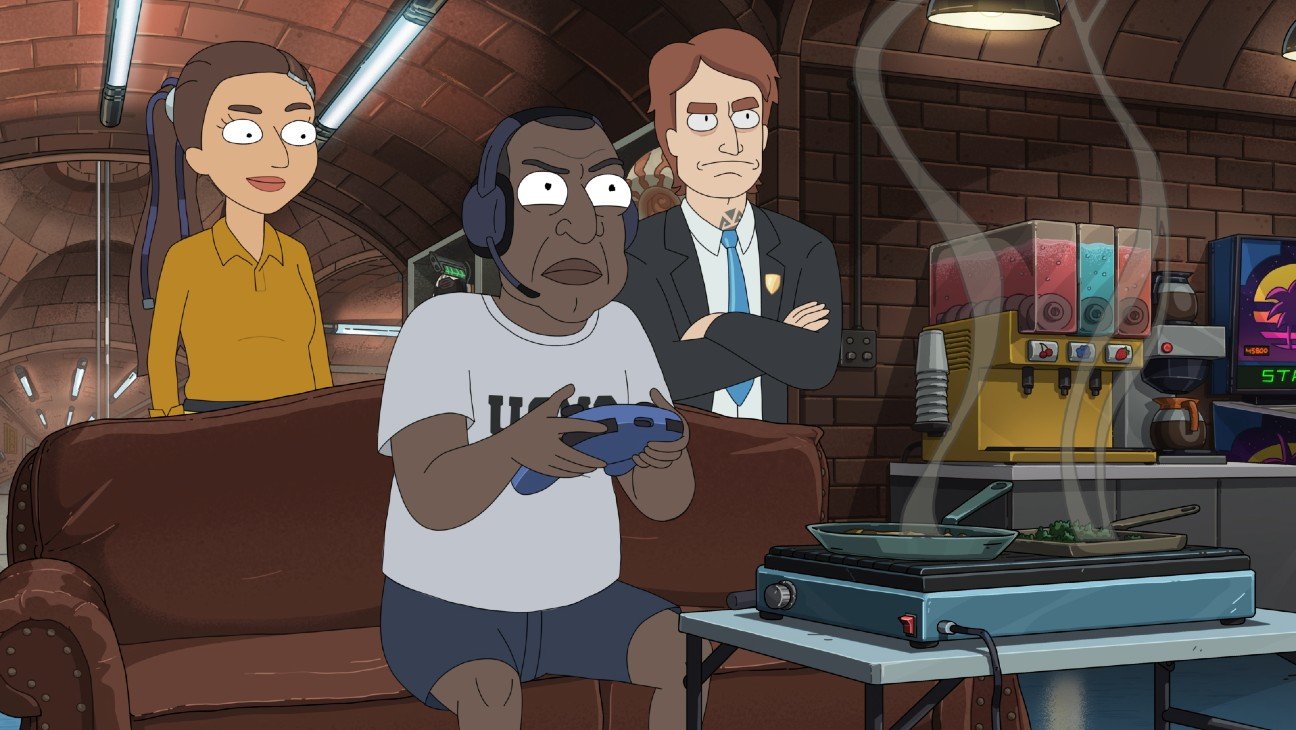
Veteran actor Keith David voices the titular commander in chief on President Curtis, the Rick and Morty spinoff that premiered Sunday on Adult Swim following the season nine finale for the flagship series. Stephanie Beatriz and Jim Rash round out the cast for the new project that centers on the leader of the free world and his quirky staff as they navigate an array of unusual crises.
David originated the role of President Andre Curtis during a season two episode of Rick and Morty back in 2015 and has continued to return periodically throughout the series. President Curtis co-creator James Siciliano recalls talk of a spinoff happening as a natural extension of the Rick and Morty team working on the Thanksgiving episode for season five, with Rick seeking a presidential turkey pardon.
“We started to see a more dialed-in world for Curtis there, with spider-FDR, the French assassin hidden in the Statue of Liberty — the National Treasure element of that stuff,” Siciliano, a longtime member of the Rick and Morty staff, tells The Hollywood Reporter. “We could see more of an X Files world that could be built out and wouldn’t necessarily be redundant with the Rick and Morty universe.”
President Curtis
Courtesy of Adult Swim
Siciliano and fellow President Curtis series creator Dan Harmon recall the writing team initially suggesting qualities that have cemented previous real-life U.S. presidents as particularly memorable. Harmon notes that he personally has been fascinated by Harry S. Truman, while other writers brought up Teddy Roosevelt — and, of course, Donald Trump and Barack Obama.
“The conversations about Obama and Trump were inevitable,” Harmon admits. “Curtis has a naïveté that you could overlap with Trump, who is like, ‘I’m an outsider, and I consider this job simple, and I don’t care about the bureaucracy of it.’ On the Obama side, it’s the charmer and the guy who gets organic joy in being liked — that whole rock star aspect of Obama. But mostly just more legendary aspects of presidents from the past, all Serpentor’d into a test tube baby that then becomes our version of maybe Martin Sheen in West Wing, where it’s our fantasy president, warts and all.”
For fans hoping to catch Rick and Morty popping up on President Curtis (mild spoilers ahead), rest assured that the adventure-seeking duo are indeed part of the pilot, although they will not appear again in the first season. Luckily, there is more President Curtis to come, as the show’s team announced Saturday at San Diego Comic-Con that the spinoff had scored an early renewal for a second season.
Rick and Morty
Everett
“If we didn’t do that, people would be waiting for it,” Siciliano says of writing Rick and Morty into the President Curtis pilot. “In the first season, that’s their only appearance, but that’s not to say that we have anything against them appearing in the future. We really wanted to have this show just be able to get its own identity and breathe a little bit, so that people felt like it was its own show.”
Harmon concurs: “If the show has a life of its own, then we can go Dick Wolf nuts with the crossovers and have Detective Munch all over SVU. But we look forward to earning that.”
The President Curtis launch arrives just weeks after Rick and Morty landed its third Emmy Award nomination for best animated series, having won in 2018 and 2020. This year marks the show’s first such nomination after a turbulent stretch in recent years that saw Justin Roiland (who co-created the series with Harmon) exit following felony domestic abuse charges that have since been dismissed. The titular voice roles were recast in light of Roiland’s firing, with Ian Cardoni replacing him as inventor Rick Sanchez, while Harry Belden took over as teen grandson Morty.
“It is an incredibly important nomination for us because the show has gone through transitions of such peril,” Harmon candidly shares. “To me, it feels like we are an athlete back on a field after a major injury, and so it is an honor to be nominated. It is all I need. I’m happy to go and watch Smiling Friends win or whatever the case, but I’m so grateful for that nomination.”
President Curtis
Courtesy of Adult Swim
President Curtis is not the only potential opportunity for expansion for the Rick and Morty world. THR recently reported that supervising director Jacob Hair was in talks to helm an animated feature version of the series for Warner Bros.
Although the possible film does not yet have a script, Harmon notes that it does have “a technically approved idea that we’re dreaming away on.” He was late to checking out Denis Villeneuve’s Dune films but reveals that they now might serve as inspiration: “I just watched the Dune movies because of messing around with the Rick and Morty movie script. I was like, ‘Oh, my God, I’m so late to Dune.’ It’s so rad.”
As for his hopes with the Rick and Morty film, Harmon adds, “It would be my goal, however self-destructive, to make it the greatest movie ever to exist. That might make it hard to write. It would probably be a sci-fi epic, transcending time and space, but not in a way that was unsatisfying. It would probably blend colors as varied in its palette as Lethal Weapon 2 and Dune 2: Toon, as well as Indiana Jones and everything. One could argue that it’s a concept that would be my undoing and the franchise’s as well, since me having permission to think about stuff is not the recipe for success that people would think. It’s more of a trailhead to hell, traditionally.”
Ready for a bit of Swiss bliss on the big screen? The 79th edition of Switzerland’s Locarno Film Festival is set to be a showcase of adventurous new cinema from around the globe, including homegrown productions from Swiss filmmakers and/or producers.
Various sections of the fest, running Aug. 5-16, will serve up homemade cinematic fare. In addition, the popular “Panorama Suisse” section will put the spotlight on “Swiss films that have enjoyed success at festivals, found an audience in cinemas, or are currently released in the country.” Plus, the Locarno Kids Screenings program also includes two titles with Swiss participation.
For those looking for some Swiss cinematic bliss and trying to avoid having Swiss cheese-sized holes in their Locarno schedules, THR is below highlighting a selection of Swiss treats screening at Locarno79.
The Chilean Director: Sergio Castro-San Martín Piazza Grande International sales: Fandango
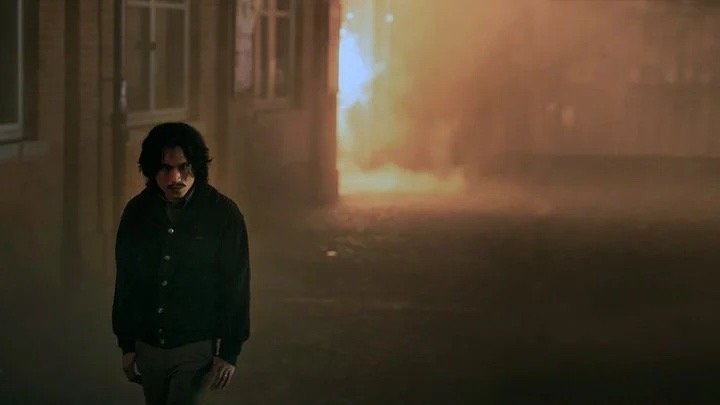
A political thriller telling the story of a fugitive is ready to explode onto Locarno’s screens. The big-screen epic The Chilean is a co-production between Italy, Chile and Switzerland that starts off in 1976 Chile.
Amid mining protests, Aldo, skilled in explosives, is forced into exile, leaving his wife and newborn child behind. He moves to Italy, where he must survive on menial jobs in Torino and where people simply call him Il Cileno, The Chilean. But everything changes when he meets Luciana, a doctor involved with anarchist groups. She offers him the chance to reunite with his family. But in exchange, he must return to his old trade – making bombs for revolutionary groups.
“Reconstructing an era means not only designing its atmosphere, but understanding the personalities that embody it,” the director says about The Chilean. “The exiled Aldo Marín leads us to one of the most pressing issues: immigration, omnipresent in the film.”
Happiness Is So Close! Director: François-Christophe Marzal Out of Competition International sales: Point Productions
Jean-Luc, an actor in his 80s, is set to play Don Quixote in a prestigious theater. It is the big role that he has been waiting for to bid farewell to the stage. But his health problems make rehearsals difficult, so the production team hires an understudy in case he is unable to perform. The result is paranoia. Says a synopsis: “Jean-Luc gradually sinks into an obsessive delusion, convinced that his understudy will take his place until he disappears completely.”
Jean-Luc Bideau, Gilles Privat and Aurore Clément star in the Swiss production, written by the director and Nicolas Frey, who also served as the editor.
Ahead of the Aug. 9 world premiere of Happiness Is So Close!, Bideau will receive a special honorary Leopard at Locarno.
Small Talk Director: Matteo Yberra Filmmakers of the Presence Competition International sales: Urban Sales
‘Small Talk,’ courtesy of Locarno Film Festival
How’s this tease for the hybrid feature that serves up a peek behind the curtain of an elite institution? “Hoping to launch a career in the luxury world, Charlie enrolls at Institut Villa Pierrefeu – the last finishing school still operating in Switzerland. Here, women from all over the world are prepared to move within the circles of the international elite.” Over the course of a summer, their daily life is all about lessons in elegance, protocol and the art of conversation.
Written by the director, the actress, along with Louis Rebetez, Hélène Bares, Milan Alfonsi,, the film features actress Hélène Bares.
Says the director: “By working with an actress within a real educational setting, the film explores the porous boundary between performance and social behavior, questioning how identity is shaped by learned codes and expectations.”
O Jacaré Director: Basil Da Cunha International competition International sales: Thera Production
‘O Jacaré,’ courtesy of Locarno Film Festival
Director Basil Da Cunha has dual Swiss and Portuguese citizenship, which explains this co-production and its elements that don’t sound quintessential Swiss: such as alligators and its setting, namely Reboleira, a suburb of Lisbon.
The haul from a robbery has mysteriously disappeared. Within the area sealed off by the police, rumors spread and speculation runs wild. Among the residents, a whole cast of colorful characters dream of getting their hands on the loot. But who will be first to find it?
For the filmmaker, who also wrote the script for the movie, the production marks a farewell of sorts. “For the past 15 years, I have been filming the Reboleira neighborhood, which is due to be demolished,” he explains. “O Jacaré is like a final dance before its disappearance: a vibrant, light-hearted film, infused with comedy and a sense of freedom.”
The AngelMaker Director: Marina Klauser Out of competition International sales: tellfilm
‘The Angel Maker,’ courtesy of Locarno Film Festival
This four-part documentary series from Switzerland, written and directed by Klauser, is not for the faint of heart, but it will appeal to fans of true-crime and cult stories and audiences beyond that.
After all, the series tells the story of “the Swiss religious community of Methernitha, which still exists today, its founder Paul Baumann — the inventor of a mysterious energy machine — and the young women who brought him down on charges of child abuse,” as a synopsis reads.
Klauser has previously written and directed short films and served as head writer of the writers’ room for the dramedy series How to Be Sad – The Right Way.
Frank & Louis Director: Petra Volpe Piazza Grande International sales: TrustNordisk
Kingsley Ben-Adir (left) and Rob Morgan in ‘Frank and Louis.’
Rob Baker Ashton/Courtesy Sundance
Last but not least, Locarno will showcase a well-established Swiss cinematic voice’s latest movie, but not in a world premiere, which happened at Sundance. But the film will still get a big square screening at the festival.
Swiss-Italian writer-director Petra Volpe followed up her box office and critical successLate Shift with Frank & Louis, her English-language debut, putting a spotlight on another often-overlooked care issue: the care needs of the aging incarcerated. Set within the walls of a U.S. prison, it Frank, portrayed by Kingsley Ben-Adir, who is serving a life sentence and takes on a caretaking role for aging inmates suffering from memory loss. Rob Morgan stars as one of those inmates, Louis.
“The theme of care and caretaking, what that means and how we all need it, is such an important societal issue,” Volpe told THR about her motivation for the film in a previous interview. “We take for granted that there are people who take care of us. It’s also a taboo, because nobody wants to think about being old and sick and needy. And especially in the context of prison, we never really think about it deeply.”