Blog

  • ‘Wonder Man’ Star Yahya Abdul-Mateen II Reacts to Marvel Series Cancellation: “See You at the Emmys”

    ‘Wonder Man’ Star Yahya Abdul-Mateen II Reacts to Marvel Series Cancellation: “See You at the Emmys”

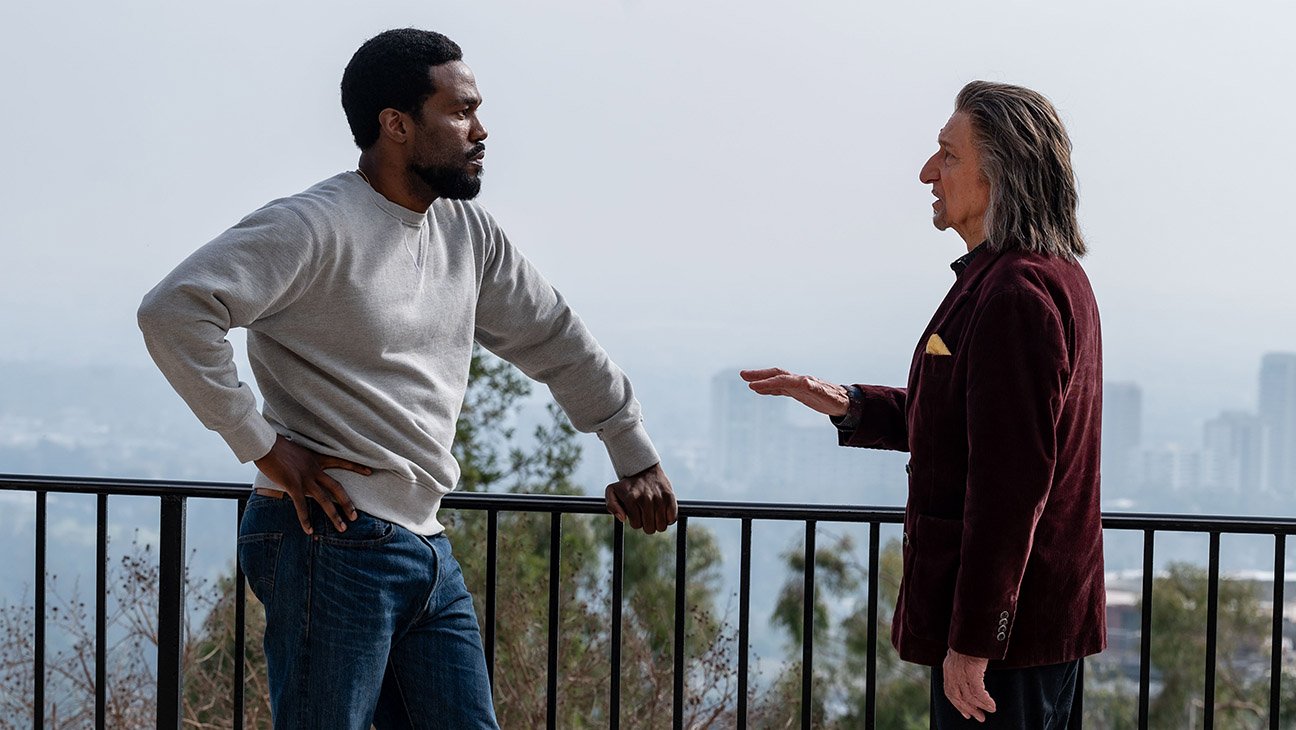
    Marvel‘s Wonder Man star Yahya Abdul-Mateen II is speaking out after the Disney+ series was un-renewed.

    The streamer picked up the series for a second season in March before reversing course and canceling the renewal on Thursday. The decision came as a surprise after Wonder Man had a solid debut on Disney+ in late January, drawing 618 million minutes of viewing time during its premiere week, according to Nielsen’s streaming ratings. While the show fell out of the top 10 original streaming titles after that, it continued to earn positive reviews from critics and audiences. Abdul-Mateen also received an Emmy nomination for his performance of the title character.

    Following the cancellation, Abdul-Mateen took to Instagram to share his reaction.

    “Word just dropped that Wonder Man won’t be coming back,” he wrote in the caption. “That’s life, right? Everything will shake out.”

    The Candyman actor continued, “I wanted to say thank you to everybody who WATCHED the show, ENJOYED the show, and SHARED that they enjoyed the show in some way or other. The show worked. And that’s my favorite thing about it. I could see it on the faces of the Youtube Reactors (because I watched along with y’all this time. Shoutout to y’all) and I can see in the messages I get saying how the show reminded some of you not to give up, and I feel it in the genuine love shared when I bump into some of you all during the day. So, thinking of you all today. I’m glad we got to be a part of something cool.”

    He concluded his post: “Thank you for watching… And uhh… See you at the EMMYS.”

    Abdul-Mateen is nominated for best actor in a comedy series alongside Steve Carell (Rooster), Matthew Rhys (Widow’s Bay), Jason Segel (Shrinking) and Martin Short (Only Murders in the Building).

    Wonder Man co-creators Destin Daniel Cretton (Spider-Man: Brand New Day, Shang-Chi and the Legend of the Ten Rings) and Andrew Guest had also been set to return for a second season. They executive produce alongside Marvel Studios president Kevin Feige, Louis D’Esposito, Jonathan Schwartz and Brad Winderbaum, head of Marvel Television and Marvel Animation. Guest also served as showrunner, while Cretton directed several episodes.

    Ben Kingsley, X Mayo, Demetrius Grosse, Zlatko Burić, Arian Moayed, Olivia Thirlby, Dan Donohue and Kameron J. Meadows rounded out the cast.

  • Digital asset SPAC delays crucial merger vote, leaving a deeply undercapitalized Old Glory Bank waiting on a $50M lifeline

    Digital asset SPAC delays crucial merger vote, leaving a deeply undercapitalized Old Glory Bank waiting on a $50M lifeline

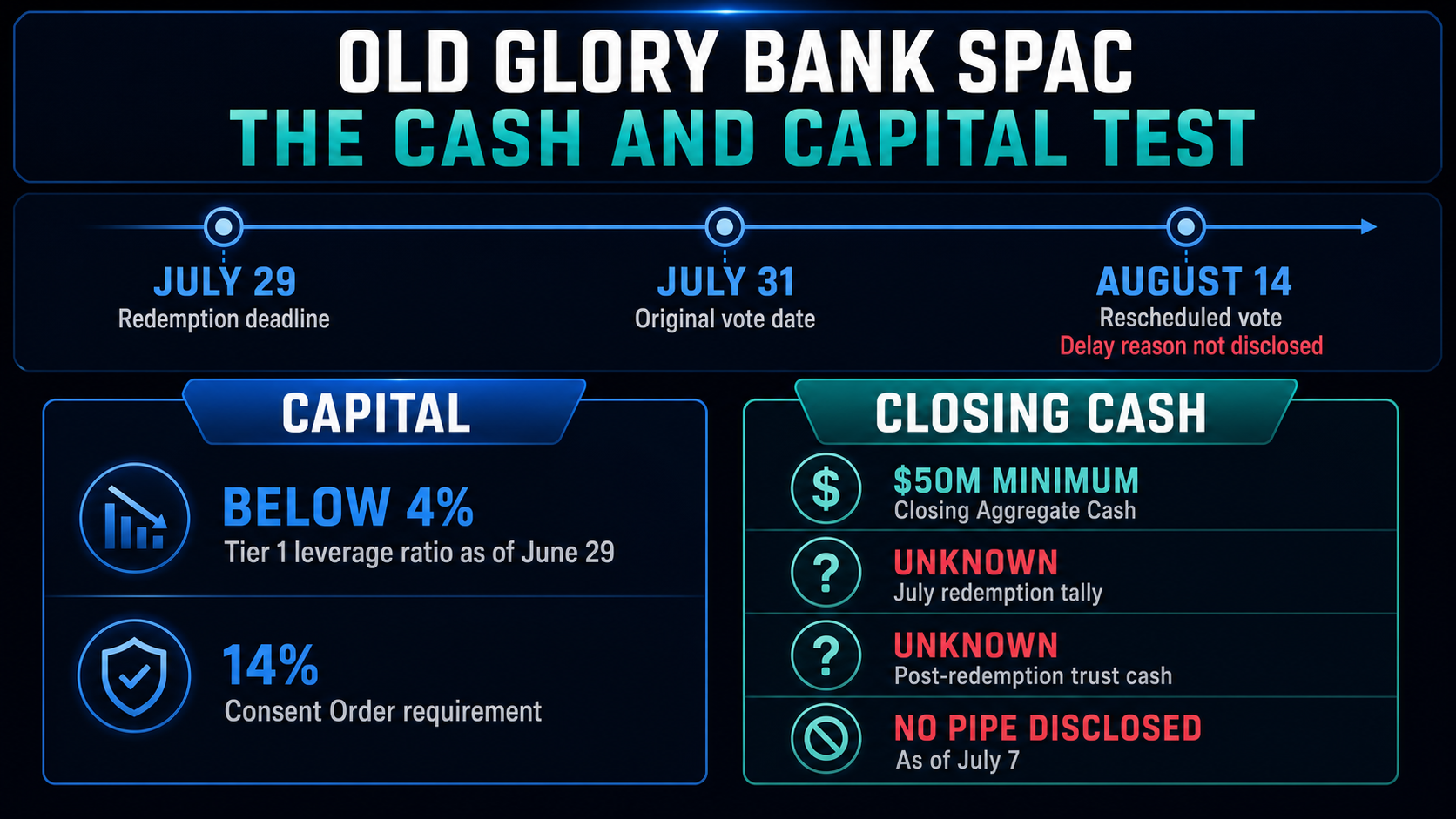
    Digital Asset Acquisition Corp., the SPAC seeking to combine with the parent of regulated bank Old Glory Bank, postponed the shareholder vote on the deal to 10 a.m. Eastern Time on Aug. 14 from July 31.

    The original meeting date fell two days after the stated July 29 redemption deadline. DAAQ said in a July 31 filing that it would continue soliciting proxies but gave no reason for the delay.

    The postponement did not automatically reopen redemptions. DAAQ’s final prospectus says investors could withdraw a redemption request through the deadline and afterward only with the company’s consent before closing. The filing does not say whether DAAQ has approved any post-deadline withdrawals.

    Capital gap meets the cash test

    The parent company at the center of the deal is Old Glory Holding Company. The bank was below two distinct capital thresholds going into the vote window. The final prospectus said its Tier 1 leverage ratio remained below the ordinary 4% adequately capitalized threshold as of June 29, putting Old Glory in technical noncompliance with a merger-agreement covenant. Old Glory considered that noncompliance nonmaterial, according to the filing.

    A May 2024 consent order from the Federal Deposit Insurance Corp. and Oklahoma State Banking Department sets a much higher requirement. It requires a 14% Tier 1 leverage ratio while the order remains in effect, along with regulator-reviewed capital and business plans and prior consent for dividends and bonuses. Separately, prompt-corrective-action rules restrict growth, capital distributions, acquisitions, branches and new business lines while the bank is undercapitalized.

    The holding company’s consolidated financial disclosures say its capital is not expected to cover operating losses and minimum regulatory capital needs over the next 12 months, creating substantial doubt about its ability to continue as a going concern.

    Management identifies cash from the merger as a mitigation, but says closing depends on other parties and market conditions and is not assured. The warning is not a declaration that the bank is insolvent or about to close.

    The merger agreement requires at least $50 million of closing aggregate cash, calculated from trust cash remaining after redemptions, PIPE proceeds actually received, and proceeds to be received from other transaction financing. The party benefiting from the condition can waive it in a signed writing where lawful.

    DAAQ reported $178.58 million of trust securities and 17.25 million redeemable public shares as of March 31. That historical balance does not show what will be available at closing. The postponement filing disclosed neither the July redemption tally nor the remaining trust cash.

    The July 7 prospectus also said no PIPE or other transaction financing had been entered into or obtained. A June filing said DAAQ intended to negotiate non-redemption agreements, but the attached form identified no executed investor or committed share amount.

    Approval timing remains uncertain. As of the final prospectus, a Federal Reserve application was pending, and Nasdaq approval of the combined company’s initial listing remained a closing condition. The July 31 filing announced neither approval, though its silence does not establish their current status.

    DAAQ now has two more weeks to chase votes, while the deal’s cash picture remains murky. Investors need the redemption count and firm funding commitments to see whether it can clear the $50 million closing test, plus a fresh capital ratio to gauge Old Glory Bank’s shortfall.

  • CZ Warns Bitcoin Holders After $70 Million Wallet Exploit: ‘Nothing Is 100%’

    CZ Warns Bitcoin Holders After $70 Million Wallet Exploit: ‘Nothing Is 100%’

    In brief

    • CZ warned on X that even hardware wallets and long-established wallets can have bugs, suggesting holders split their funds across several wallets to mitigate risk while noting no setup is fully foolproof.
    • The warning follows a Coldcard exploit stemming from a March 2021 firmware build error that drew seeds from a software fallback instead of the hardware generator, making private keys far easier to guess.
    • Galaxy Research, mapping the fund flows from a pattern identified by Block engineers, now pegs losses at about 1,082.65 BTC (~$70.2 million) across 1,196 addresses—nearly double the original $38 million estimate.

    Binance founder Changpeng “CZ” Zhao is warning crypto owners not to place blind faith in hardware wallets, following an exploit that drained tens of millions of dollars in Bitcoin from Coldcard devices.

    In a Saturday post on X, Zhao cautioned that even hardware wallets can carry bugs, and that older wallets with long histories are not immune. “Nothing is 100%,” he posted.

    He suggested holders consider spreading their funds across several wallets as one way to reduce exposure, while acknowledging the approach carries its own trade-offs and that no setup is entirely foolproof. CZ closed with his familiar refrain urging users to stay informed and keep their funds safe: “Stay SAFU!”

    His comments followed the discovery of a flaw in Coldcard devices made by manufacturer Coinkite. As Decrypt reported, a build error caused seeds on affected units to be drawn from a software fallback rather than the device’s hardware random-number generator, leaving the private keys far easier to guess than intended. The problem traced back to firmware shipped in March 2021, and updating the firmware does not fix a seed already created on a compromised device.

    The scope of the theft has grown considerably since the first estimates. Early reporting pegged losses at roughly 594 BTC, or about $38 million, drained from around 500 wallets. According to a report from Galaxy Research, which mapped the flow of funds based on a pattern identified by engineers at Jack Dorsey’s Block, the toll is now put at 1,196 addresses drained for about 1,082.65 BTC, or roughly $70.2 million, in a 41-minute window on July 30. That is nearly double the initial figure.

    Galaxy said every sweep paid an identical hardcoded fee and left no change output, a signature it described as consistent with an automated tool spending keys it already held rather than owners moving their own funds. The victims spanned native SegWit and older address types, pointing to multi-path key scanning. The stolen Bitcoin was consolidated within minutes into a handful of addresses and, per Galaxy, has not moved since.

    Coinkite has shipped emergency hotfixes and urged exposed users to migrate to newly generated seeds.

    Daily Debrief Newsletter

    Start every day with the top news stories right now, plus original features, a podcast, videos and more.

  • Michael Saylor Rejects Report of New Strategy Bitcoin Sale Approval

    Michael Saylor Rejects Report of New Strategy Bitcoin Sale Approval

    Saylor Pushes Back on Viral Bitcoin Sale Claim

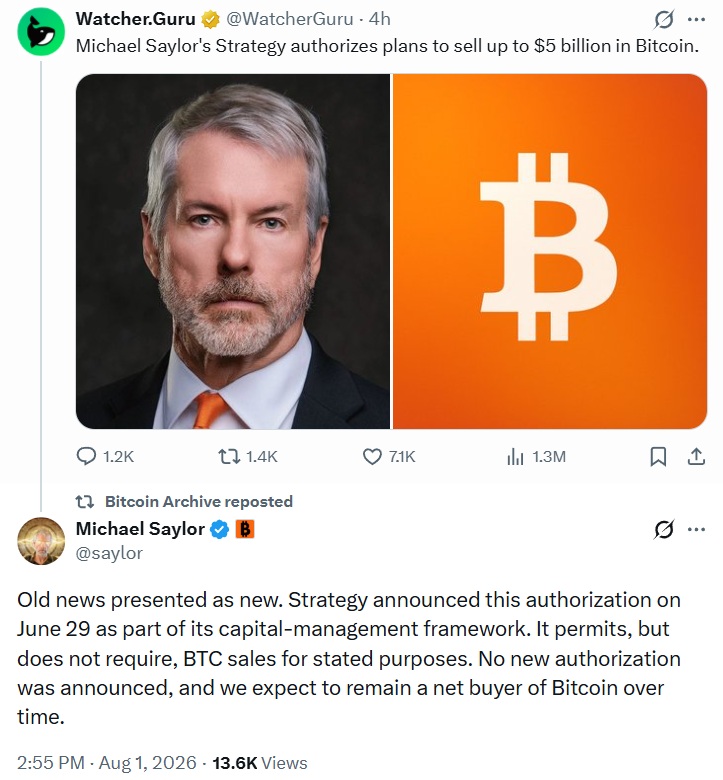
    Strategy Executive Chairman Michael Saylor pushed back Aug. 1 on reports that Strategy Inc. (Nasdaq: MSTR) had newly authorized up to $5 billion in bitcoin sales. His response followed a widely circulated social media post that presented the company’s existing capital-management framework as a fresh decision, prompting concern about potential selling pressure.

    Saylor characterized the claim as recycled information and explained that the authorization was announced June 29 as part of the company’s Digital Credit Capital Framework. He reiterated that the program permits bitcoin sales for defined corporate purposes and that Strategy had announced no additional bitcoin sale authorization.

    Filing Shows How the Program Operates

    A July 6 filing with the U.S. Securities and Exchange Commission (SEC) recorded 3,588 bitcoin sold for $216 million between June 29 and July 5, following Strategy’s first bitcoin sale since 2022 of 32 $BTC to help fund preferred-stock dividend payments. It later issued $263.5 million in common stock without purchasing additional bitcoin, opting instead to increase cash reserves and liquidity. Those actions reflected the company’s broader effort to balance bitcoin holdings with funding requirements tied to its growing portfolio of preferred securities.

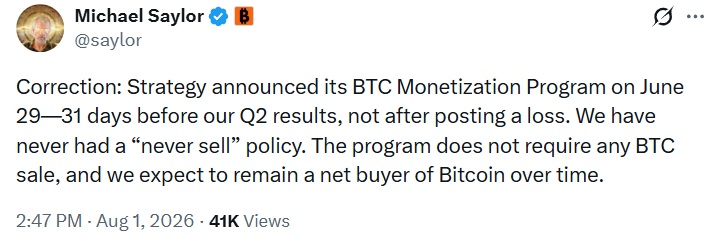
    In another X post on Aug. 1, Saylor clarified that Strategy announced the $BTC Monetization Program on June 29, 31 days before reporting its second-quarter results, rather than after posting a quarterly loss. He added that Strategy has never maintained a “never sell” policy, the program requires no bitcoin sales, and the company expects to remain a net buyer over time.

    Under the framework, management retains $1.25 billion in unused reserve-building capacity and may direct bitcoin sale proceeds toward dividends, interest, repurchases, taxes, fees, and transaction expenses. Analysts have argued that this flexibility could lower the risk of forced sales during periods of financial or market pressure.

    Investors Debate the Framework’s Shareholder Impact

    Market observers remain divided over the structure. Supporters view it as a way to preserve liquidity and meet obligations without relying on hurried bitcoin disposals, while critics warn that supporting STRC near its $100 target could place added costs on common shareholders through higher dividends or further asset sales.

    The June framework remains unchanged and authorizes sales only for specified corporate purposes. It has no fixed expiration date, and management may modify, suspend, or terminate it as market conditions, liquidity requirements, and corporate priorities change.

    Any sale outside the framework’s approved purposes or established limits would require additional authorization from the company’s board.

  • ‘It: Welcome to Derry’ Creator Says Season 2 Will ‘Not’ Shy Away From the ‘Horrible’ Cultural Themes of the 1930s: It’s the ‘Heart of Our Story’

    ‘It: Welcome to Derry’ Creator Says Season 2 Will ‘Not’ Shy Away From the ‘Horrible’ Cultural Themes of the 1930s: It’s the ‘Heart of Our Story’

    As horror fans eagerly await the next chapter in Pennywise’s (Bill Skarsgård) horrifying reign of terror, “It: Welcome to Derry” co-creator Andy Muschietti has shared some details on the current status of Season 2.

    “We’re very excited, we’re in the writers’ room right now,” Muschietti confirms to Variety.

    The new season will take place in 1935, centering around one of the interludes in Stephen King’s “It” novel — the Bradley Gang Massacre. As recalled in the book, a group of outlaws hides out in the town of Derry while fleeing the FBI, robbing and murdering store owners and causing all-around chaos. It takes place 27 years before the first season of “It: Welcome to Derry,” which follows the mystery surrounding a young boy gone missing amidst a Cold War military plot.

    “There’s gonna be a lot of that depression-era hustling in the air in our characters. Everybody’s trying to get by and survive the circumstances. They are gonna do crazy things,” Muschietti says. “And of course, the social, cultural, horrible things that were happening in the era, too. We’re not going to skip those. [They are the] very center and the heart of our story.”

    While “It” fans have become accustomed to the franchise’s focus on the horror that lurks underneath images of suburban comfort and kids riding bicycles, Muschietti says Season 2’s aesthetic will differ: “In this case, on the surface, Derry is a graveyard almost. It’s a carcass of something because people are depleted, poor, tired, jobless, homeless. The kids don’t have a suburban, comforting life. They’re in a very different situation. Some of them are orphans or runaways, and so the environment is pretty bleak. But there’s always the aspect of hope that is always there, burning, and it’s what keeps our new group going.”

    Going back another 27 years gives Muschietti and his creative team, including co-creators Barbara Muschietti and Jason Fuchs, more of a canvas to play with; after all, the ’30s interlude in King’s original novel doesn’t take up much of the overall story. But the family bloodline will help fans connect the different timelines.

    “There will always be the connection, there’s a family tree that appears,” Muschietti explains.

    Muschietti began exploring the world of Derry and Pennywise in the 2017 hit film “It” and its 2019 sequel “It: Chapter Two.” He previously told Variety of his three-season plan for “Welcome to Derry,” exploring the time periods of 1962, 1935 and 1908, respectively, with an interest in King’s interludes: “I realized there was a hidden story there, and that Stephen King was leaving crumbs that could guide us somewhere. It’s a story told backwards.”

    But the horror director and screenwriter still has his eyes set on adapting other King stories.

    “I cannot talk too much about it because some of them are [active] projects. One that I did touch that’s not a current project, but I would love to go back to at some point is ‘The Juant,’ which is a short story that blew my mind when I read it. I was 14 or something,” Muschietti says of the short story in King’s “Skeleton Crew” collection. “It just completely shattered me.”

    “It: Welcome to Derry” Season 1 is currently streaming on HBO Max.

  • All about Hyperliquid’s liquidation cascade threat below $52-zone

    Hyperliquid [$HYPE] is under pressure. At the time of writing, the decentralized exchange (DEX) token was down 9.1% in a week, and almost 20% down over the past 30 days.

    Some whales are now unstaking their $HYPE and depositing the tokens onto centralized exchanges. According to AMBCrypto’s findings, this unstaking behavior may be getting more common among both retail and institutional investors.

    With the price action leaning bearish, a descending channel can be seen on the price charts too.

    On the bright side, the exchange has been expanding its revenue streams. Traders are paying priority fees to improve queue positions. This focus on execution rather than just trading volume can strengthen the long-term business model.

    Even so, the shadow of institutional selling still looms over $HYPE. What will the upcoming price trends look like though?

    The big liquidation warning for Hyperliquid token

    Source: Base Case D on X

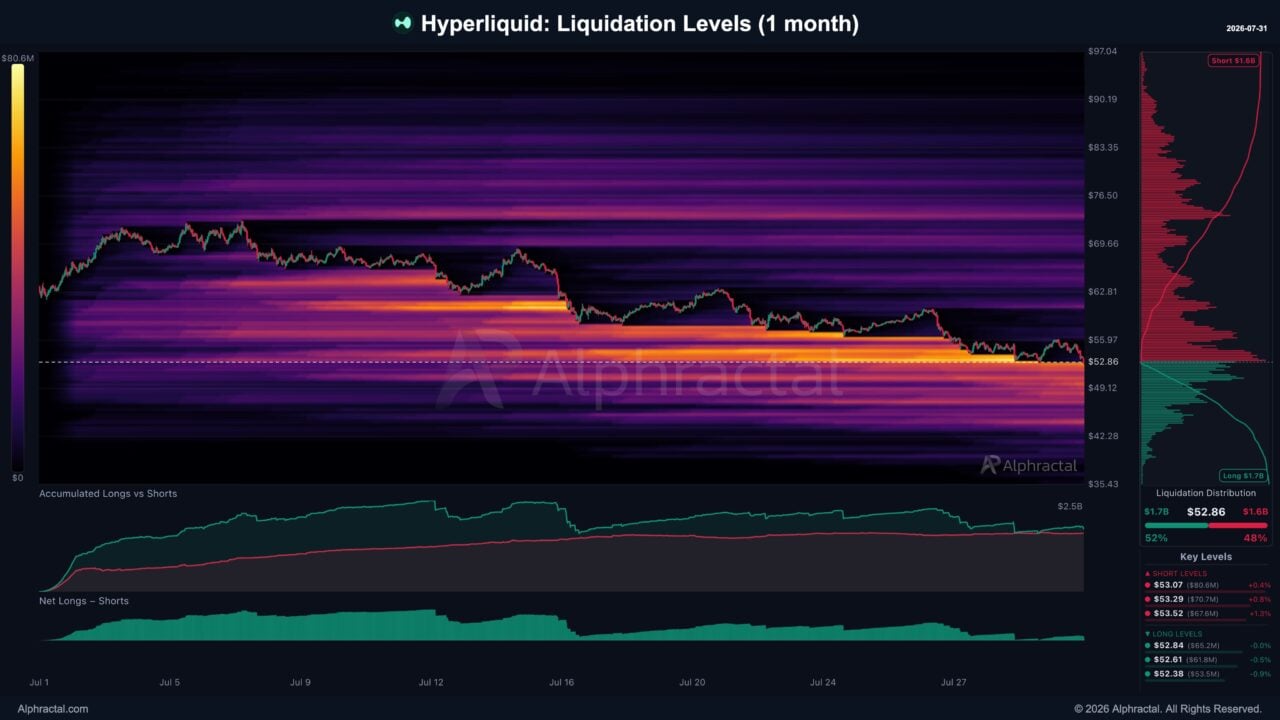
    Using the liquidation data of the past month for $HYPE, analyst Base Case D made the argument that a liquidation cascade might be around the corner.

    A big magnetic zone of long liquidations sat at $52.38. A minor drop could hit these long liquidations, forcing these positions to close, amplifying the sell pressure in the short term and possibly leading to a liquidation cascade.

    This meant that a cautious-to-bearish bias may be warranted in the short-term, the analyst concluded.

    Multi-timeframe analysis makes a long-term bull case for $HYPE

    A sharp flush from liquidations tends to follow the longer-term trend thereafter. And yet, the wider market sentiment, especially for Bitcoin [BTC], has been firmly bearish lately.

    Source: $HYPE/$USDT on TradingView

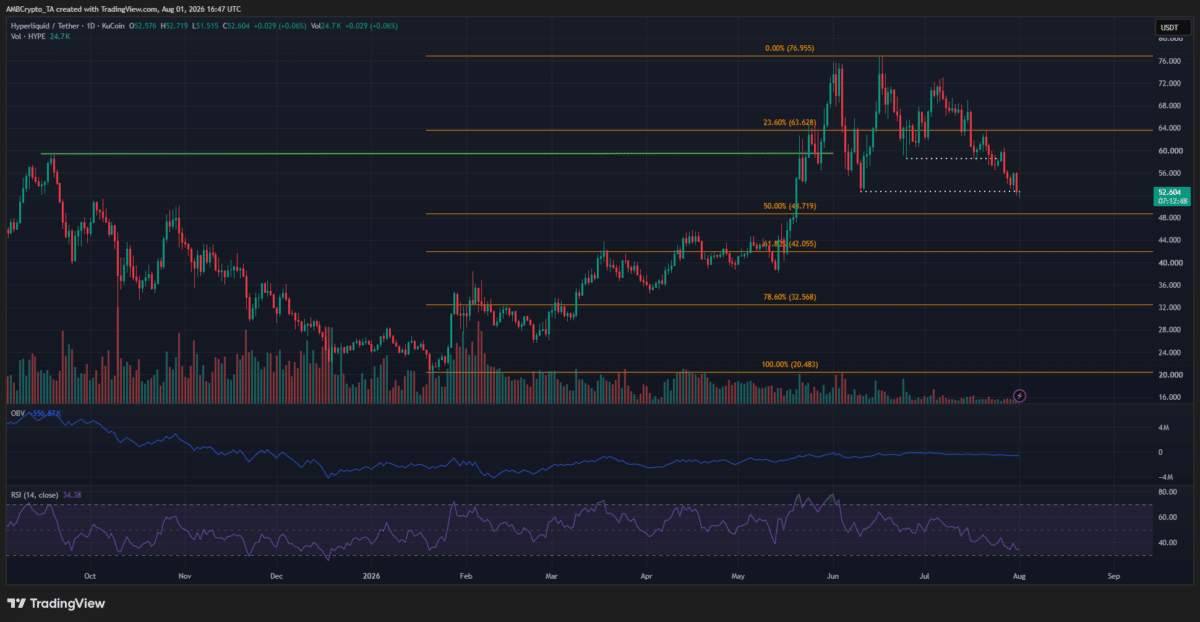
    The upward break above the swing high (green) hinted at a bullish swing structure continuation. The Fibonacci retracement levels plotted the potential bearish targets before the long-term uptrend can commence.

    As things stand, a drop to $32-$42 would not be a surprise.

    This, because the internal structure (dotted white) was beginning to turn bearish at press time.

    Source: $HYPE/$USDT on TradingView

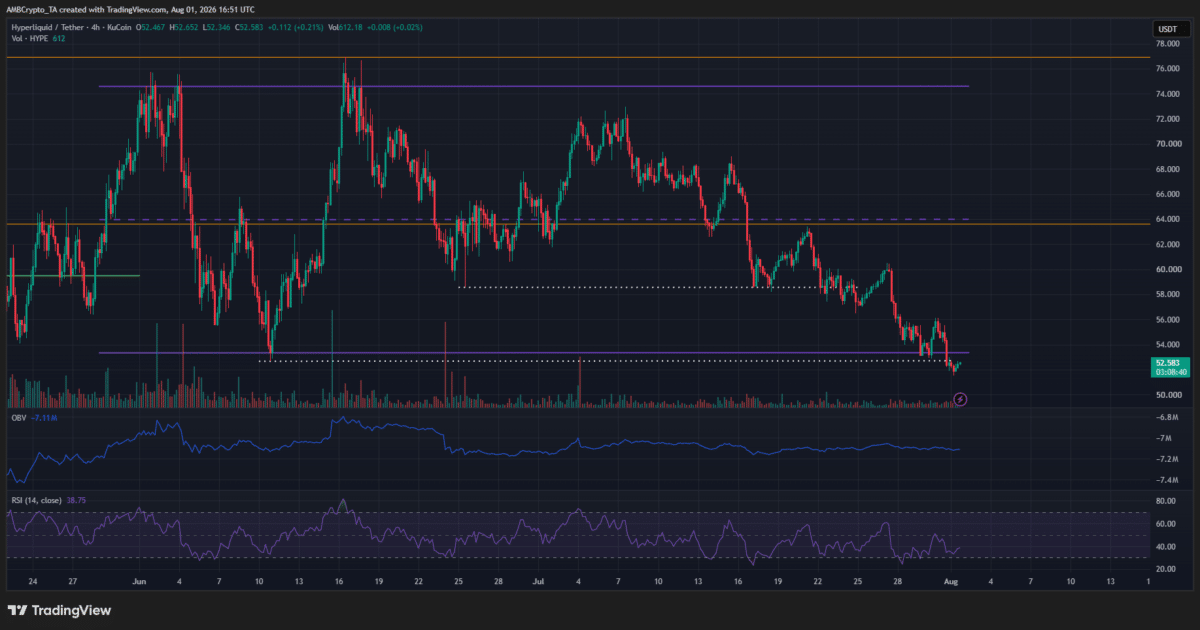
    This shift was more evident on the 4-hour chart. Though the OBV appeared to be flat, the price has been falling lower. A two-month range formation, whose low was at $53.3, has been breached too.

    Hence, a deeper retracement towards $32 cannot be ruled out.

    Final Summary

    • Hyperliquid’s long-term trend was bullish, but a deep retracement may be a possibility in the coming weeks.
    • In the near-term, a price drop below the $52-magnetic zone could trigger a wave of forced selling.
  • Paramount Pitches Judge On November Start Of WBD Merger Antitrust Trial, While State AGs & WGA Propose April

    Paramount Pitches Judge On November Start Of WBD Merger Antitrust Trial, While State AGs & WGA Propose April

    Paramount wants a trial to start in November in the antitrust lawsuit brought by a dozen state attorneys general and the Writers Guild America. Not surprisingly, the state AGs and the guild want an April start to the proceedings.

    The sides outlined their proposals ina joint filing Friday, with the ultimate decision on scheduling left to the federal judge in the case, Araceli Martinez-Olguin.

    “The parties have discussed the trial schedule, but they have not reached agreement,” the parties wrote.

    The trial dates are hugely important for the transaction, and even Paramount’s proposed date likely will cost the company hundreds of millions. After September 30, Paramount will be on the hook for about $7 million for every day that the transaction doesn’t close, under an agreement with WBD that was a sweetener to the deal.

    A Paramount spokesperson said, “Our request for a November trial date is more than sufficient to give both sides the time they need to conduct discovery, gather evidence, and prepare for trial. Plaintiffs’ request to delay proceedings until April is nothing more than a stonewalling tactic that goes well beyond the timelines sought in similar prior proceedings and ignores the substantial evidence plaintiffs have already received in this matter. Delay will also harm the many individuals outside this courtroom who will be denied the expanded content offerings and industry stability that a combined Paramount-WBD promises to bring.”

    California Attorney General Rob Bonta, who is leading 12 states in the lawsuit, said in a statement, “Our challenge to the unlawful Warner Bros./Paramount merger is a clean-cut antitrust challenge through and through: it’s about protecting the vibrancy of an industry, the pockets of consumers, and the quality of films and television programs that take center stage in many of our lives. This challenge deserves careful and thorough review and today my office and attorneys general across the country asked the court for a trial date next spring. We are eager to continue to make our case and look forward to a final determination of the schedule by the court.”

    Last week, Paramount said it would not close the merger until June 1, 2027, or until days after the legal issues are resolved, and indicated it wanted to go directly to trial. Its announcement came just days after the judge granted the state AGs a temporary restraining order that prohibited the transaction from closing for 14 days, an order that was later extended to 28 days.

    The company spokeswoman said a trial “on the merits is the best and most direct way for us to prove what we’ve said from the start — this transaction is lawful, pro-competitive, and raises no antitrust concerns.”

    In the filing Friday, Paramount proposed a 12-day trial starting November 4 that would encompass the cases brought by the states and the WGA.

    Paramount also noted that the later date would give the judge “much less time to decide” the case by June, the outside date it had set for the merger to close, as well as time for the company to appeal.

    Among other things, they noted that the DOJ’s antitrust case seeking to block AT&T’s merger with Time Warner went to trial on March 19, 2018, four months after the federal government brought the case. Makan Delrahim, who is Paramount’s chief legal officer, was then the chief of the DOJ’s antitrust division; on the other side was attorney Daniel Petrocelli, representing Time Warner, and now representing WBD in this case.

    The company also noted that Bonta had last week favored a January trial start, but now was proposing a date four months later.

    “Given the stakes of this case, there is no basis and no time to delay for the sake of delay, particularly when delay significantly prejudices Defendants and the Hollywood ecosystem more broadly,” Paramount’s legal team wrote in the filing.

    The company also argued that Paramount and the WGA will have had sufficient time for discovery.

    Paramount’s legal team wrote, “State Plaintiffs had six-plus months before they filed their complaint to conduct unilateral discovery regarding the proposed transaction. State Plaintiffs also had the benefit of waivers granted by Defendants to enable the U.S. Department of Justice (DOJ) to share with State Plaintiffs all information and materials that Defendants produced to the DOJ. In sum, the discovery that State Plaintiffs received many months ago includes over two million documents from more than 80 of Defendants’ employees.”

    The company’s legal team noted that the later date would require them to refile merger materials with the Justice Department, which has already cleared the transaction, and that it would leave the creative community in a period of uncertainty, as Paramount plans to boost production to 30 films per year.

    The state AGs and WGA proposed a start of April 5, 2027, lasting at least 12-15 days, with each plaintiff presenting their cases sequentially.

    The state plaintiffs wrote that extensive discovery is needed, including of “the definition of the relevant product and geographic markets, the nature and scope of harm in those markets, whether expansion by other firms will prevent harm in those markets, and whether the merger will produce verifiable, merger-specific efficiencies sufficient to outweigh harm in those markets.”

    They pointed specifically to areas like Paramount’s assertion that the merger will generate billions in synergies, “a claim that Plaintiff States are entitled to test in discovery, including discovery of Defendants’ integration plans for their merged company.”

    The states noted that Paramount’s document productions “largely cut off” before the merger agreement was signed in February, leaving the plaintiffs with few internal documents about post-closing plans.

    The state AGs wrote, “Defendants’ pre-complaint productions also do nothing to address the need for discovery from third party customers and competitors. Importantly, no depositions of percipient fact witnesses from Defendants or third parties have occurred.”

    The states also contended that their schedule was “reasonable,” claiming that the 402 days from the signing of the merger agreement on February 27 to the proposed trial date “moves this case to trial more rapidly than virtually every merger case in recent history.” The AT&T-Time Warner trial started 513 days after the merger deal was signed, they noted, as opposed to when the DOJ lawsuit was filed. The state AGs also wrote that an April trial would still leave the judge with time to decide the case by June.

    The state AGs also called Paramount’s proposed schedule “one-sided,” arguing, “Their extraordinarily truncated schedule unfairly favors Defendants because they (1) have information Plaintiff States need to prove their case and (2) do not bear the burden of persuasion.”

  • This Near-Mint Dell Laptop Is Ready for Business and 58% Off

    This Near-Mint Dell Laptop Is Ready for Business and 58% Off

    TL;DR: Get a Grade A, near-mint Dell Latitude 5421 with an 11th Gen Intel Core i5, 16GB RAM, and 256GB SSD for $419.99 (MSRP $999.99).

    A capable business laptop doesn’t have to cost close to $1,000. The Grade A refurbished Dell Latitude 5421 delivers solid everyday performance with an 11th Gen Intel Core i5 processor, 16GB of RAM, and a 256GB PCIe SSD for $419.99.

    Built for professionals, the Latitude is designed to handle demanding workloads, whether you’re working with large spreadsheets, managing multiple browser tabs, attending video meetings, or running productivity software throughout the day. The 14-inch Full HD anti-glare display helps reduce reflections, making it easier to work in different lighting conditions.

    Thunderbolt 4 support makes it easy to connect docks, external storage, and high-resolution displays, while Wi-Fi 6 provides faster, more reliable wireless connectivity. The memory and storage are also upgradeable, giving the system room to grow as your needs change.

    This model is listed as Grade A refurbished, meaning it arrives in near-mint condition with little to no visible wear. It’s a practical option for anyone who wants dependable hardware without paying new-laptop prices.

    Recommended by Our Editors

    Don’t miss grabbing this near-mint Dell Latitude 5421 while stock is still available for just $419.99 (MSRP $999.99).

    Refurbished Dell Latitude 5421 (2021)

    14-inch, i5 2.9GHz 16GB RAM 256GB SSD WIN11P Titan Gray


    $419.99
    at StackSocial

    $999.99
    Save $580.00


    Get Deal

    Prices subject to change. PCMag editors select and review products independently. If you buy through StackSocial affiliate links, we may earn commissions, which help support our testing.

    About Our Expert

  • Lego Just Released Its First ‘The X-Files’ Set, Complete With Mulder and Scully Minifigures

    Lego Just Released Its First ‘The X-Files’ Set, Complete With Mulder and Scully Minifigures

    If you purchase an independently reviewed product or service through a link on our website, The Hollywood Reporter may receive an affiliate commission.

    Lego has unveiled its first-ever The X-Files set, arriving Aug. 1 for Lego Insiders (Lego’s free-to-join membership program) or Aug. 4 for the general public. The collectible recreates Fox Mulder’s basement office alongside an alien arrival scene in the surrounding woods. It also includes eight minifigures: Fox Mulder, Dana Scully, Walter Skinner, Mr. X, Alex Krycek, Carl Busch, the Flukeman and a gray alien.

    Lego

    1,478-Piece set

    Pre-Order

    The X-Files Lego office is packed with references longtime viewers will recognize.

    At 1,478 pieces, the build lands in the upper-mid range for Lego Ideas releases, making it a substantial display model without reaching the size of the company’s largest collector sets. Created by a fan designer, the project won Lego Ideas’ ’90s Nostalgia Challenge after receiving strong community support before being selected for production.

    The set includes case files, investigative equipment and the iconic “I Want to Believe” poster hanging on the wall. A removable desk section allows builders to take a closer look at the interior, while minifigures can be attached to recreate memorable moments from the series.

    Lego minifigures: Fox Mulder, Dana Scully, Walter Skinner, Mr. X, Alex Krycek, Carl Busch, the Flukeman and a gray alien.

    Lego

    Led by David Duchovny and Gillian Anderson, The X-Files became one of television’s defining sci-fi dramas during its original run from 1993 to 2002 before returning for two additional revival seasons in 2016 and 2018. A new Ryan Coogler reboot is currently in development for Hulu.

    Mulder and Scully Lego minifigures in Lego basement office.

    Lego

    The completed Lego display measures more than 12 inches tall and is designed with adult collectors in mind. Builders can also use the Lego Builder app to zoom in, rotate the model in 3D and follow step-by-step digital instructions throughout the building process.

    Lego Insiders members can purchase the set ahead of its wider release through the company’s free-to-join early-access program. While supplies last, qualifying purchases will also include the exclusive Scully’s Lab promotional gift, giving fans an additional mini build inspired by the FBI agent’s forensic workspace.

  • Run Out of Podcasts? Reddit May Soon Allow You to Watch or Listen to Posts

    Run Out of Podcasts? Reddit May Soon Allow You to Watch or Listen to Posts

    By the end of 2026, scrolling on Reddit could mean a bit less reading and a lot more listening and watching. 

    CEO Steve Huffman said the company is working on what it calls “video Reddit” or “spoken Reddit,” in the firm’s latest earnings call, first spotted by TechCrunch. Huffman said the new project will enable users to listen to Reddit posts, as well as to listen to them in the background, presumably while changing tabs or viewing other pages.

    The company didn’t give much detail on what these new features could look like in practice, or whether the company would use an AI tool to read the posts aloud, or allow users to upload their own voice notes and recordings.

    There’s obviously at least some appetite for this type of content. Reddit posts have proved a goldmine for some content creators on platforms like YouTube and TikTok, who will often upload themselves simply reading out Reddit posts. Many channels, some with tens of thousands of subscribers, are entirely dedicated to this kind of content. Huffman dubbed this type of material an “emerging content type” on his call with investors. The CEO said testing of the feature is planned for later this year.

    Reddit has slowly become more video-friendly in recent months, allowing users to include video in responses to posts in June, which the company says is already widely used.

    Huffman said the company is still experimenting with how video will interact with the rest of its feed. “You have got video. You have got text. You have got images. So those flows between from feed to theater mode to the comment page back to the feed are essential,” he told investors on the call.

    Recommended by Our Editors

    Other platforms have pivoted to adding short-form video content this year, putting companies like TikTok in a much more crowded space than ever. Max rolled out TikTok-style short-form video content earlier in July, following ESPN, Disney+, Prime Video, and Netflix over the past year.

    Reddit continues to pick up new users in comparison to some of its rivals. Research from the Pew Center released in November 2025 found that its regular users spiked from 22% to 26% since January 2024, while platforms like X and Snapchat showed dips in regular users.

    About Our Expert