Blog

  • PENGU Notches Double-Digit Gains as Bitcoin Hits $78K Amid $418M Liquidation Spree

    PENGU Notches Double-Digit Gains as Bitcoin Hits $78K Amid $418M Liquidation Spree

    In brief

    • Bitcoin hit $78,000 on Wednesday, triggering $418 million in liquidations over 24 hours, with shorts accounting for $254 million.
    • Altcoins including PENGU and Cosmos have posted gains alongside Bitcoin
    • Sentiment has flipped bullish amid crypto market recovery, with Myriad users assigning a 75% chance that Bitcoin retests $84,000 next.

    Bitcoin has been on a steady uptrend in April, with shallow pullbacks, allowing altcoins to extend their gains.

    Pudgy Penguins meme coin PENGU led altcoin gains, up 12.6% on the day, while Cosmos (ATOM), Aptos and Bitcoin Cash saw gains of over 5% over the past 24 hours.

    The altcoin surge comes as Bitcoin hovers around $78,000, up nearly 2% over the past 24 hours, according to CoinGecko data. If the bullish momentum persists, the leading crypto could revisit $80,000 for the first time in over two and a half months, analysts suggested.

    “What we’re seeing right now is a mix of both early rotation and mechanically driven upside,” Wenny Cai, founder of Anchored Finance, told Decrypt. “There is some genuine capital moving out along the risk curve as Bitcoin consolidates, particularly into higher-beta majors and select narratives. But the velocity of the move suggests that short covering and leverage are amplifying it.”

    As a result, almost $418 million in leveraged positions have been wiped out, with more than $286 million coming from bears or short sellers, suggesting these investors were caught off guard, per CoinGlass data.

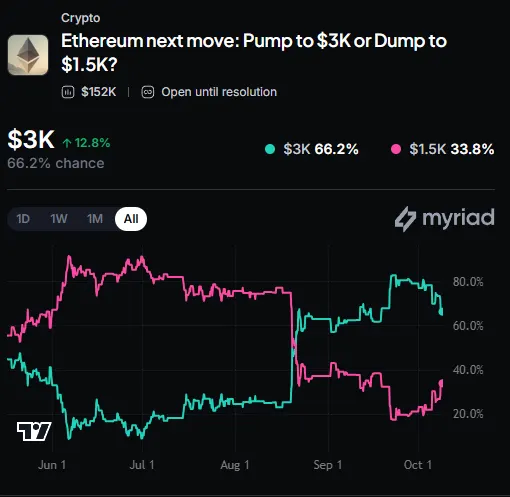
    Investor sentiment has flipped bullish, with users on prediction market Myriad, owned by Decrypt’s parent company Dastan, assigning a 75% chance that Bitcoin’s next push could send it to $84,000. Those odds have increased from roughly 45% on April 1, underscoring increasing investor optimism amid the ongoing uptrend.

    Looking ahead

    Nevertheless, the bullish outlook remains uncertain. From a technical standpoint, a Schwab strategist identified $83,000 as a key resistance level, which is the average cost basis of Bitcoin ETP investors, according to a previous Decrypt report.

    Beyond that is $87,000, which is the 200-day simple moving average, a breakout above which usually signals a shift in the long-term trend, favoring bulls.

    “The $83,000 benchmark matters because it’s where a large cohort of spot ETP buyers are sitting at breakeven, and reclaiming it would be financially and psychologically significant for a huge pool of relatively recent institutional capital,”  Orkun Kılıç, co-founder and CEO of Chainway Labs, told Decrypt.

    However, until these key hurdles are overcome, the outlook remains uncertain. The parallels to the Middle East conflict are telling: just as that situation remains unresolved, so too does Bitcoin’s path above $83,000.

    Altcoins will become “fragile” if the leading crypto fails to overcome the ETP cost basis, Cai said. “Most of this rally is predicated on Bitcoin stability, not necessarily Bitcoin strength.”

    As a result, a rejection here would likely “tighten liquidity conditions across the market, and altcoins—being higher beta—would feel that disproportionately.”

    Investors should watch out for assets whose gains have “run ahead of fundamentals,” Cai explained, adding that these tokens could lead to a fast unwind of leveraged positions.

    While optimism surrounding Bitcoin remains strong, investors remain skeptical about altcoins, with Myriad users seeing just a 22% chance that an “altseason” kicks off before July.

    Daily Debrief Newsletter

    Start every day with the top news stories right now, plus original features, a podcast, videos and more.

  • Magnolia Pictures Acquires Dave Boyle’s Japanese Horror Film ‘Never After Dark’ (EXCLUSIVE)

    Magnolia Pictures Acquires Dave Boyle’s Japanese Horror Film ‘Never After Dark’ (EXCLUSIVE)

    Magnolia Pictures has acquired North American rights to “Never After Dark.”

    The Japanese horror movie, written and directed by Dave Boyle and from XYZ Films, premiered at SXSW and went on to win the Midnighter Audience Award.

    “Never After Dark” stars SAG Award and Critics’ Choice Award Winner Moeka Hoshi (“Shogun”), Kento Kaku (“House of Ninjas”), Kurumi Inagaki (“House of Ninjas”), Mutsuo Yoshioka (“Chime”), Bokuzo Masana (“Toyko Vice”) and Tae Kimura (“All Around Us”). The film also recently won the grand jury prize for feature film at the Overlook Film Festival, and won the Golden Raven at the Brussels International Fantastic Film Festival. Magnolia is planning a fall theatrical release.

    The film follows Airi (Hoshi), a wandering medium who spends her life guiding restless spirits out of the world of the living. Summoned to an isolated country house, she comes face to face with a grotesque apparition with powers that defy Airi’s experience. As she digs deeper into the house’s past, a secret comes to light — and Airi finds herself hunted by a far more unpredictable force. For the first time, her greatest adversary is not the supernatural, but the living.

    “Dave Boyle and crew have delivered an incredibly beautiful and terrifying experience,” said Magnolia Pictures co-CEOs Eamonn Bowles and Dori Begley. “We can’t wait to share this truly exceptional film with audiences.”

    “We are so thrilled that Magnolia Pictures will bring ‘Never After Dark’ to audiences across North America,” said Boyle and Kaku in a joint statement. “Their passion for the film, their commitment to a theatrical release, and their long history as exceptional stewards of great cinema make this partnership a dream come true for our team. We made this film for the big screen, and we’re delighted that audiences in North America will have the chance to experience it that way.”

    The film is produced by Signal 181, the Tokyo-based production company founded by actor-producer Kaku and Boyle following the global success of their Netflix series “House of Ninjas,” which debuted in 2024 and immediately climbed to No. 1 on Netflix’s Global Top 10. The company develops distinctive film and television projects that bridge Japan and the United States — a mission reflected in its name, which combines the countries’ calling codes (+1 and +81). CEO Kosuke Tsutsumi also produces alongside Kaku and Boyle, with Aram Tertzakian of XYZ Films, Todd Brown and United Lounge Tokyo’s Toshiyuki Suzuki serving as executive producers.

    The deal was negotiated by Magnolia’s SVP of acquisitions John Von Thaden, with Peter Van Steemberg and Pip Ngo of XYZ Films on behalf of the filmmakers.

    The film will also be released wide in theaters across Japan on June 5, distributed by Toho Next.

  • Bitcoin breaks out of months-long range on Iran ceasefire extension

    Bitcoin breaks out of months-long range on Iran ceasefire extension

    Bitcoin just did something it hasn’t managed in months: it broke free.

    After spending nearly three months pinned between $65K and $75K, $BTC surged past $79K on Wednesday, riding a wave of geopolitical relief after President Trump extended the US ceasefire with Iran just hours before the two-week deal was set to expire. The timing was, as they say, not subtle.

    What happened

    The ceasefire extension removed what traders had been pricing in as an imminent risk. An expiring deal with Iran, left to lapse, would have injected fresh uncertainty into energy markets and the broader risk landscape. Instead, the renewal acted like a release valve.

    Bitcoin climbed 4.3% in 24 hours and 6.6% over the past week, pushing to levels not seen since early February. Ethereum followed closely, gaining 4.2% to reach $2,400. Solana rose 3.1% to $89, and $XRP held steady near $1.45.

    Traditional markets moved in lockstep. The S&P 500 and Nasdaq both posted gains Wednesday morning, confirming this wasn’t a crypto-specific phenomenon. Risk assets across the board got the green light.

    Here’s the thing: Bitcoin had been stuck in that $65K-$75K range since early February. That’s roughly 10 weeks of sideways price action, the kind of extended consolidation that tends to resolve violently in one direction or the other. This time, it resolved upward.

    The fear is still real

    Despite the breakout, the market’s emotional state tells a more cautious story. The Crypto Fear and Greed Index sits at 32, firmly in “Fear” territory. Last week it was at 23, which registers as “Extreme Fear.”

    In English: traders are less terrified than they were seven days ago, but they’re not exactly popping champagne. A move from “Extreme Fear” to regular “Fear” is improvement in the same way that going from a house fire to a kitchen fire is improvement. Progress, sure. Calm, not quite.

    That gap between price action and sentiment is worth watching. Historically, sustained rallies that begin while fear dominates tend to have legs. The logic is simple: when everyone is scared, fewer people are fully positioned. As the breakout continues, sidelined capital gets pulled in, creating a self-reinforcing move higher.

    Of course, the inverse is also true. If the breakout fails and $BTC slides back into its old range, the already-fearful market could tip into something uglier.

    Why geopolitics moved crypto

    There’s an ongoing debate about whether Bitcoin is a risk asset or a safe haven. Days like Wednesday make the answer pretty clear: it trades like a risk asset, at least on shorter timeframes.

    When the ceasefire extension removed a source of geopolitical tension, Bitcoin rallied alongside equities. It didn’t rally in advance as a hedge against conflict, which is what you’d expect from digital gold. It rallied after the tension dissipated, which is what you’d expect from a high-beta version of the Nasdaq.

    This isn’t a new dynamic, but it’s worth restating because the narrative shifts depending on who’s talking. Bitcoin can serve as a long-term store of value and simultaneously trade like a risk asset in the short term. Those two things aren’t mutually exclusive. They’re just confusing.

    The broader context matters too. Trump’s diplomatic posture toward Iran has been a source of market anxiety for weeks. The original two-week ceasefire was itself a surprise, and the extension doubles down on a de-escalation path that few observers expected. For markets that had been pricing in at least some probability of escalation, the reversal of that risk premium shows up directly in asset prices.

    DeFi, interestingly, hasn’t participated in the rally with the same enthusiasm. The top-performing category over seven days shows essentially flat returns, according to CoinGecko data. That suggests the current move is being driven by macro flows and spot Bitcoin demand rather than a broad-based rotation back into risk across all of crypto.

    What this means for investors

    The breakout above $75K is technically significant. That level served as the ceiling of Bitcoin’s range for weeks. Clearing it and pushing to $79K turns former resistance into potential support.

    Look, breakouts from extended ranges are one of the more reliable patterns in technical analysis. They aren’t guaranteed, but the longer an asset consolidates, the more energy tends to build. Three months of compression followed by a clean move higher is the kind of setup that trend followers pay attention to.

    The risk is that this rally is entirely geopolitically driven. If the Iran situation deteriorates, or if another macro shock emerges, the breakout could reverse quickly. Bitcoin’s correlation with traditional risk assets means it’s vulnerable to the same forces that move equities: interest rate expectations, trade policy, and yes, Middle Eastern diplomacy.

    Ethereum’s move to $2,400 is notable but less dramatic in context. ETH has underperformed $BTC for most of 2025, and a 4.2% daily gain doesn’t change that broader trend. Solana and $XRP gains were similarly modest relative to Bitcoin’s breakout.

    The Fear and Greed Index at 32 suggests there’s room for sentiment to improve, which could fuel further upside. But it also means the market is fragile. Fearful markets can turn on a dime if the catalyst for optimism evaporates.

    Bottom line: A diplomatic extension that almost didn’t happen gave Bitcoin the push it needed to escape a months-long trading range. The breakout to $79K is the most consequential price move since early February, but with fear still dominating sentiment and the rally tied to a geopolitical catalyst that could shift at any moment, this is a market that’s moving on borrowed confidence. The next few days will reveal whether this is the start of a new trend or just a brief vacation from consolidation.

  • Bitcoin breaks $79,000 as Trump says US-Iran talks could resume as early as Friday

    Bitcoin breaks $79,000 as Trump says US-Iran talks could resume as early as Friday

    Bitcoin broke above $79K on Wednesday morning as traders bet that a new round of US-Iran diplomacy could ease the geopolitical tensions that have battered markets for months.

    The move pushed prices to levels not seen since early February, before the Middle East situation spiraled.

    Peace talks over the Iran war are set to restart in Pakistan as soon as Friday, according to the New York Post, citing Donald Trump, who said Steve Witkoff will lead a new round of negotiations in Islamabad alongside Jared Kushner.

    Iran, however, has pushed back, saying it will not participate due to disagreements over US demands and continued military measures.

    The situation in the Strait of Hormuz continues to escalate, with recent US intervention against an Iranian tanker and reported Iranian attacks on ships. While Trump remains optimistic about securing a deal, he has also reiterated threats of military escalation if Iran refuses terms, as a temporary ceasefire nears its expiration.

    The backdrop traces back to February, when US-Iran tensions escalated sharply. Military strikes and the closure of the Strait of Hormuz sent crude prices soaring and risk assets tumbling.

    Bitcoin fell to around $60,000 as investors sought safety. The 32% recovery since those lows has been driven by a gradual thaw in diplomatic relations and the institutional money that follow.

    A ceasefire in early April marked the turning point, with ETF inflows picking up as traditional finance players concluded the worst had passed.

    Bitcoin’s recent rally reflects a bet that diplomacy holds. If talks stall or break down, the same institutional flows that drove prices higher could reverse fast.

    Monetary policy is now an added wildcard, with inflation still running hot and oil prices unsettled after the Hormuz tensions, complicating how markets react to global developments.

  • Virginia man buys 20 tickets for one lottery drawing, wins 20 times

    Virginia man buys 20 tickets for one lottery drawing, wins 20 times

    Odd News // 3 weeks ago

    Virginia man buys 20 tickets for one lottery drawing, wins 20 times

    March 27 (UPI) — A Virginia man bought 20 identical tickets for a single Pick 4 lottery drawing and ended up winning $5,000 for each ticket — a total of $100,000.

  • California scientists among disappearances, deaths under federal investigation

    California scientists among disappearances, deaths under federal investigation

    By Natasha Chen, Alex Stambaugh, Chris Boyette, CNN

    A nuclear physicist and MIT professor fatally shot outside his Massachusetts residence. A retired Air Force general missing from his New Mexico home. An aerospace engineer who disappeared during a hike in Los Angeles.

    These are among at least 10 individuals connected to sensitive US nuclear and aerospace research who have died or disappeared in recent years, prompting concerns whether they are connected and fueling speculation online about the possibility of nefarious activity.

    The FBI now says it “is spearheading the effort to look for connections into the missing and deceased scientists,” adding that it “is working with the Department of Energy, Department of War, and with our state … and local law enforcement partners to find answers.”

    Separately, the Republican-led House Oversight Committee announced Monday it will investigate reports of the deaths and disappearances of the individuals, whom it said had access to sensitive scientific information.

    The reports “raise questions about a possible sinister connection” between the deaths and disappearances, the committee said in its statement, seeking briefings on the matter from the FBI, the Defense Department, the Department of Energy and NASA.

    The Defense Department said only that it would respond to the committee directly, and the Department of Energy referred questions to the White House.

    In a post on X, NASA said it is “coordinating and cooperating with the relevant agencies” in relation to the scientists.

    “At this time, nothing related to NASA indicates a national security threat,” NASA spokesperson Bethany Stevens said.

    The cases vary widely in circumstance. Some involve unsolved homicides, while others are missing persons cases with no signs of foul play. In at least two instances, families have pointed to preexisting medical conditions or personal struggles as explanations. Authorities have not established any links between the cases.

    The White House said last week it is also working with federal agencies to probe any potential links between the deaths and disappearances, with President Donald Trump referring to the matter as “pretty serious stuff.”

    “It’s very unlikely that this is a coincidence,” House Oversight Chair James Comer, a Republican, told Fox News Sunday. “Congress is very concerned about this. Our committee is making this one of our priorities now because we view this as a national security threat.”

    Rep. James Walkinshaw, a Democrat who also serves on the Oversight Committee, agrees an investigation into the disappearances and deaths is warranted, but he said he is not convinced there is a coordinated motive behind the cases.

    “The United States has thousands of nuclear scientists and nuclear experts,” Walkinshaw told CNN’s Erin Burnett on Tuesday. “It’s not the kind of nuclear program that potentially a foreign adversary could significantly impact by targeting 10 individuals.”

    Circumstances vary case by case

    The string of mysterious deaths and disappearances began in 2023, lawmakers say, with the death of Michael David Hicks, a scientist who worked at NASA’s Jet Propulsion Laboratory for nearly 25 years.

    Hicks, 59, died July 30, 2023. During his career at JPL, he specialized in comets and asteroids, according to the American Astronomical Society. His cause of death was not disclosed.

    His daughter, Julia Hicks, told CNN her father had been struggling with known medical issues and that the recent speculation has her “shaken up.”

    “From what I know of my dad, there’s no train of logic to follow that would implicate him in this potential federal investigation,” she said. “I don’t understand the connection between my dad’s death and the other missing scientists.”

    “I can’t help but laugh about it, but at the same time, it’s getting serious,” Hicks said.

    Hicks told CNN no one in elected office or at any federal agency had reached out to her to inquire about her father’s death as of Tuesday afternoon.

    In the years since, several others connected to JPL have also died or disappeared: Frank Maiwald, a specialist in space research, died in Los Angeles in 2024 at 61. Monica Reza, a 60-year-old aerospace engineer, disappeared while hiking in a Los Angeles forest in June 2025. She served as the director of the NASA Lab’s Materials Processing Group, the House Oversight Committee said.

    Also missing is William Neil McCasland, a retired Air Force major general, who hasn’t been seen since he walked out of his Albuquerque, New Mexico, home on February 27, leaving behind his phone, prescription glasses and wearable devices. The FBI is now involved in the search.

    McCasland was at the center of some of the Pentagon’s most advanced aerospace research and once commanded the Air Force Research Laboratory at Wright-Patterson Air Force Base. Months after the 68-year-old went missing, officials still can’t say where he went, why he left or whether someone else was involved.

    His wife, Susan McCasland Wilkerson, disputed at the time speculation that his disappearance was tied to his work at the base — long rumored to house extraterrestrial debris linked to the alleged “Roswell incident,” despite Air Force denials.

    “It is true that Neil had a brief association with the UFO community,” McCasland Wilkerson said in a Facebook post. “This connection is not a reason for someone to abduct Neil. Neil does not have any special knowledge about the ET bodies and debris from the Roswell crash stored at Wright-Patt.”

    “No sightings of a mothership hovering above the Sandia Mountains have been reported,” she added.

    McCasland Wilkerson did not respond this week to CNN’s request for comment on this story.

    Two others missing, Melissa Casias and Anthony Chavez, worked at the Los Alamos National Laboratory, a leading nuclear research facility in New Mexico.

    Casias, 53, was last seen walking on a highway near Talpa, New Mexico, in June 2025, according to New Mexico State Police, leaving her belongings at home and a phone that had been factory-reset, NBC News reported.

    The New Mexico Department of Public Safety told CNN there is an open missing person investigation into Casias’ disappearance but added no foul play is suspected.

    Chavez, a 78-year-old retiree who worked as a foreman supervising construction at the site, also disappeared in May 2025, according to Los Alamos police. A detective told CNN there are no signs of foul play, but exhaustive searches have yielded no signs of activity or indications he was planning to leave.

    His friend, Carl Buckland, told CNN he’s glad authorities are looking into the case: “It’s about time.”

    A string of deaths

    In recent months, the deaths of several acclaimed scientists have also fueled speculation.

    A professor at the Massachusetts Institute of Technology, Nuno F.G. Loureiro, was fatally shot at his home near Boston in December 2025 by a gunman who also opened fire on Brown University’s campus, killing two students. The 47-year-old physicist and fusion scientist had led MIT’s Plasma Science and Fusion Center, where he aimed to advance clean energy technology and other research.

    Carl Grillmair was fatally shot at the age of 67 at his home outside Los Angeles in February. Authorities arrested a suspect whom they don’t believe knew Grillmair, according to KABC. The astrophysicist worked at the California Institute of Technology, collaborated with NASA and was renowned for his studies on the search for water on planets outside our solar system.

    Former US Air Force intelligence officer Matthew James Sullivan, 39, also died in 2024 before he could testify in a federal whistleblower case about UFOs, Rep. Eric Burlison of Missouri said, urging the FBI to investigate. His public obituary did not state how he died. CNN has reached out to his family.

    Burlison, however, told Fox News that Sullivan died by suicide, calling it suspicious.

    “He was scheduled to come in for an interview. Within two weeks, he had suspiciously committed suicide,” Burlison, a Republican, told Fox News.

    In recent days, the 2022 death of Amy Eskridge has gained attention. Eskridge, 34, co-founded the Institute for Exotic Science in Huntsville, Alabama, according to her obituary.

    Eskridge’s family said in a statement to CNN she was a “marvelously intelligent person” and suffered from “chronic pain.”

    “People should realize that scientists die also and not make too much of this,” the family said.

    Federal investigations underway

    Trump said he hopes the disappearances and deaths are just a coincidence.

    “I hope it is random, but we are going to know in the next week and a half,” Trump told reporters Thursday, adding he had a recent meeting on the subject.

    The White House declined to elaborate on the meeting.

    The White House is “actively working with all relevant agencies and the FBI to holistically review all of the cases together and identify any potential commonalities that may exist,” White House Press Secretary Karoline Leavitt said in a statement on X on Friday.

    The investigation is being carried out “in light of the recent and legitimate questions” regarding the recent cases and “no stone will be unturned,” she said.

    “We’re going to look for connections … on whether there are connections to classified access, access to classified information, and or foreign actors,” FBI Director Kash Patel told Fox News on Sunday. “If there’s any connections that lead to nefarious conduct or conspiracy, this FBI will make the appropriate arrest.”

    CNN’s Jason Morris, Annie Grayer and Kit Maher contributed to this report.

    The-CNN-Wire
    ™ & © 2026 Cable News Network, Inc., a Warner Bros. Discovery Company. All rights reserved.

  • Cannes Adds James Gray’s Star-Stacked ‘Paper Tiger’ to Competition Lineup

    Cannes Adds James Gray’s Star-Stacked ‘Paper Tiger’ to Competition Lineup

    James Gray‘s Paper Tiger is heading to Cannes.

    The new crime drama from the director of The Immigrant, Two Lovers and We Own The Night, is a late addition to the competition line-up at the 79th Cannes Film Festival, The Hollywood Reporter has confirmed. Featuring Scarlett Johansson, Adam Driver and Miles Teller, the film will bring some much-needed star power to the event, which runs May 12-23.

    Neon has swooped in to take North American rights to the film ahead of its festival bow. Vincent Maraval and Kim Fox’s The Veterans are representing international sales rights on the movie, with CAA Media Finance handling North American rights. 

    When he unveiled his 2026 lineup on April 8, Cannes artistic director Thierry Frémaux said it wasn’t complete, and there was widespread speculation that Gray’s film would be added to the list. French distributor SND recently boarded the film for local distribution, adding to the speculation it would be Cannes-bound. Gray is a favorite on the Croisette, with five of his previous films, including his last feature, Armageddon Time, screening in competition. He was part of the Cannes jury in 2009.

    His new film is thought to be a return to Gray’s early, more genre-inflected work. Driver and Teller play two brothers whose pursuit of the American Dream gets tied up in a deadly Russian mafia scheme that tests their relationship and gets them entangled in a dangerous Russian mafia scheme that threatens their family and their bond to one another.

    Anne Hathaway and Jeremy Strong were initially cast in the film but dropped out due to other commitments, with Johansson and Teller replacing them. The casting reunites Johansson and Driver after 2019’s Marriage Story, for which they both earned Oscar nominations.

    Paper Tiger was produced by Rodrigo Teixeira for his RT Features banner and Anthony Katagas for AK Productions alongside Raffaella Leone, Gary Farkas, Marco Perego, Carlo Salem and Andrea Bucko. Lee Broda, Jeff Rice, Riccardo Maddalosso and Emily Salveson are executive producers.

    Neon, which has released the past six Palme d’Or winners domestically, has several horses in this year’s race. Alongside Paper Tiger, Tom Quinn’s indie distributor has also secured Cristian Mungiu’s Fjord, Hirokazu Kore-eda’s Sheep in the Box, Arthur Harari’s The Unknown, and Na Hong-jin’s Hope.

  • Mediterrane Film Festival 2026 Returns to Malta With Expanded Program

    Mediterrane Film Festival 2026 Returns to Malta With Expanded Program

    The Mediterrane Film Festival will return for its fourth edition from June 21–28, expanding across Valletta and several of Malta’s landmark locations.

    Organized by the Malta Film Commission, the festival is set to grow in both scale and ambition this year, with an enlarged program of screenings, industry events and cultural offerings aimed at strengthening Malta’s role as an international filmmaking hub. The 2026 edition will introduce five program strands, up from three: the Big Screen Competition, Mediterranean Competition, Mare Nostrum, Best of the World and Malta Focus, each highlighting a different facet of global and regional cinema.

    Screenings will take place at the Embassy Cinema in Valletta, alongside outdoor venues including Upper Barrakka Gardens and Fort Ricasoli Counterguard, with filmmaker Q&As accompanying select titles.

    This year’s theme, “Beyond Together,” underscores the festival’s emphasis on collaboration and cross-cultural exchange, reflecting Malta’s positioning as a connector between creative industries and international talent.

    An industry strand will also return, featuring panels and masterclasses with prominent figures. Previous editions have welcomed speakers including Mike Leigh, Yorgos Mavropsaridis, Nathan Crowley, Rick Carter, Catherine Hardwicke and Margery Simkin.

    The festival will once again culminate in the Golden Bee Awards, with an expanded slate of honors across its competition sections, as well as special awards recognizing emerging and established talent. Jury members and full program details will be announced in May.

    The 2025 festival drew more than 11,400 attendees and generated significant global media reach. All ticket proceeds will be donated to Maltese cancer charity Puttinu Cares.

  • Hilary Duff Felt ‘Quite Sad’ Watching Docs on Britney Spears and Exploited Child Stars: ‘I‘m Grateful I Wasn‘t Put in Too Many Positions That Left Battle Wounds‘

    Hilary Duff Felt ‘Quite Sad’ Watching Docs on Britney Spears and Exploited Child Stars: ‘I‘m Grateful I Wasn‘t Put in Too Many Positions That Left Battle Wounds‘

    Hilary Duff reflected on her child star upbringing at the TIME100 Summit in Manhattan, where Time executive editor Dan Macsai asked if documentaries like “Quiet on Set: The Dark Side of Kids TV” or “Framing Britney Spears” changed her perspective on being a child star in the early 2000s.

    “I think I feel really quite sad when I watch a lot of those documentaries, for obvious reasons,” Duff said. “I feel very grateful that I wasn’t put in too many positions that left battle wounds on me. But I have held a job as an adult since I was nine years old. I have a very different upbringing. I have a lot of missed experiences, but also a lot of amazing [ones].”

    In recent years, a wave of documentaries and longform reporting has exposed the harmful conditions many child stars faced at the turn of the 21st century. The 2024 docuseries “Quiet on Set: The Dark Side of Kids TV” detailed allegations of abuse, sexism, racism and inappropriate dynamics involving children and teen stars tied to former Nickelodeon showrunner Dan Schneider, who later sued the producers for defamation, calling the series a “hit job.” A few years prior, FX’s 2021 documentary “Framing Britney Spears” helped legitimize the #FreeBritney movement by detailing the pop star’s struggles growing up in the spotlight.

    For Duff, she says the less-rosy side of her Disney Channel years came from the pressures of early responsibility.

    “I’m a scrubby kid from Texas,” Duff explained. “Sometimes I’m like, ‘How did I end up here?’ I think it goes to the luck of something, but it doesn’t take away the fact that I’ve worked as an adult since such a young age — and had to be able to hold my own in a room full of adults constantly. I was expected to show up and be professional through exhaustion or sickness or whatever. It’s taught me a lot, and it’s completely formed who I am. And I’m proud of that person.”

    Duff, best known for “Lizzie McGuire,” said she’s “finally taking some ownership” of her life with “Luck… or Something,” her first album in over a decade. Calling the work her “boldest and most self-assured,” the former Disney star seems grateful to be settled in a more adult era of her journey.

    “Coming up as a child actor, it’s hard to get out of that,” Duff said. ”I’m at 38, and I feel like now I’m finally able to take agency in my life and make decisions that I’m really confident in. Although I did before, but there’s just a level now where I’m like, ‘I’m the adult in the room. Finally!’”

    Up next for Duff is “The Lucky Me Tour,” which kicks off in June and runs through February 2027.

  • The Longer Poop Stays in Your Body, the More It Can Affect Your Health

    Unrolled rolls of toilet paper against a pink backgroundShare on Pinterest
    The time it takes for stool to transit through your body can affect your health. Image Credit: AUDSHULE/Stocksy
    • Research suggests that the amount of time stool spends in your body may affect your overall health.
    • This may be due to changes in gut microbiomes associated with how quickly or slowly stool moves through the body.
    • An expert explains long-term health issues associated with slow digestion, chronic constipation, and chronic diarrhea.

    The amount of time it takes for stool to move through your body may impact your health in more ways than you may think.

    A 2023 study showed that there may be distinct differences in gut microbiomes depending on whether your stool is fast or slow.

    This study also looked at previous research on gut transit time. All of the research had the same goal of estimating how long food stays in a person’s colon.

    The longer it stays, the more time bacteria have to ferment the contents, regulate acidity in the gut, and produce metabolites that can influence the body’s health.

    The study found that people with faster gut transit times had drastically different microbiomes than those with slower transit times.

    One approach to estimating the gut transit time was the Bristol Stool Scale. This is a visual tool that classifies stool by consistency. For example, hard, rock-like pellets typically mean a long transit time. Watery, mushy stool often indicates a short transit time.

    Transit time can also influence how your body responds to probiotics, as well as supplements and medications that interact with the gut.

    “The gut is far more than a digestive organ — it is a finely tuned ecosystem whose balance underpins everything from immune function and metabolic health to neurological well-being and cancer risk,” said Ketan Thanki, MD, board certified colorectal surgeon who specializes in benign and malignant disease of the colon, rectum, and anus with the MemorialCare Todd Cancer Institute at Long Beach Medical Center in Long Beach, CA.

    Healthline spoke with Thanki to learn more about how poop transit time can impact health.

    This interview has been lightly edited for length and clarity.

    Thanki: Gut transit time is a major determinant of microbiome composition, diversity, and metabolism.

    Slower colonic transit time is consistently associated with a shift away from beneficial sugar fermentation, which produces health-promoting short-chain fatty acids (SCFAs) and toward protein fermentation that generates potentially harmful byproducts like ammonia and phenols.

    The relationship works both ways: transit time shapes which microbial communities thrive, but microbiota and their metabolites — including SCFAs and secondary bile acids — directly influence gut motility.

    Thanki: When transit slows, fermentable carbohydrates become depleted before stool reaches the distal colon, and bacteria switch from fermenting carbohydrates into healthful short-chain fatty acids to fermenting proteins instead (proteolysis).

    This produces metabolites — ammonia, hydrogen sulfide, phenols, indoles, and branched-chain fatty acids — that are directly toxic to colonocytes, damage colonocyte DNA, cause cancer-causing mutations, and promote a leaky gut lining, thereby promoting systemic inflammation.

    Meanwhile, increased methane production further slows the gut, and increased estrogens in the blood can increase the risk of malignancies like breast cancer and dysregulate levels of other hormones.

    SCFA depletion affects systemic metabolism. SCFAs are not just local (colonocyte) fuel. They also signal to the liver to regulate glucose production, and influence adipose tissue metabolism, insulin sensitivity, and secretion of appetite hormones (GLP-1, PYY).

    When prolonged transit time reduces SCFA production, these regulatory signals are diminished. This is particularly relevant in diabetes and obesity, where gastroparesis and altered transit compound glycemic control problems and energy dysregulation.

    Lastly, gut bacteria convert choline and carnitine from meat and eggs into trimethylamine (TMA), which the liver converts to TMAO, a metabolite linked to cardiovascular disease. The paper notes the transit-TMAO link hasn’t been fully characterized yet, but it’s a plausible pathway to worsened heart disease.

    Thanki: Colorectal cancer is one of the most well-established and serious associations with chronic constipation.

    Slow transit promotes the accumulation of secondary bile acids that are directly genotoxic and cytotoxic to colonocytes.

    Combined with the shift toward proteolytic fermentation generating ammonia, phenols, and hydrogen sulfide — all of which damage the mucosal barrier and colonocyte DNA — and the depletion of protective butyrate (a SCFA), the colonic environment becomes progressively more hostile over time.

    The distal colon, where proteolysis dominates and transit is slowest, is also where most colorectal tumors arise.

    Thanki: Eat lots of fiber (I suggest aiming for 35 g a day), drink lots of water (64 to 80 ounces a day), and minimize red and processed meats (3 portions of red meat a week and only eat processed meats rarely or sparingly).

    Try to get your fiber from varied sources like vegetables, seeds, and whole grains, and don’t hesitate to take a fiber supplement like psyllium husk.

    Probiotic foods like yogurt, kefir, kombucha, and sauerkraut can help restore gut flora, especially sugar-fermenting bacteria.

    Finally, exercise! Even 20 to 30 minutes of walking a day will stimulate your gut motility.

    Thanki: Think beyond your diet — while food and water intake are major contributors, constipation is multifactorial.

    Move your body regularly: Even a daily 20 to 30-minute walk can stimulate bowel activity.

    Don’t hold in your bowel movements: Ignoring the urge to defecate retrains your bowel to live with constipation.

    Try lifestyle modifications to help with stress, poor sleep, and reduce medications that might slow things down. These can all contribute to nervous system and hormonal dysregulation that, in turn, affects gut motility.

    If constipation persists for more than a few weeks despite lifestyle modification, there’s likely something more going on. Listen to your body and get it checked out.

    Thanki: Chronic diarrhea accelerates gut transit to the point where adequate nutrient absorption and microbial fermentation cannot occur, leading to a cascade of long-term systemic consequences, including:

    The persistently compromised gut barrier allows bacterial products to enter systemic circulation, driving low-grade inflammation linked to autoimmune conditions, while the depleted SCFA production starves colonocytes and further destabilizes the mucosal lining.