Blog

  • Uniswap price pops 20% to $4 amid oversold rebound

    Uniswap price pops 20% to $4 amid oversold rebound

    • Uniswap price jumped to above $4 on Wednesday as Bitcoin retested $68,000.
    • The $UNI token could eye $5 amid an oversold bounce across crypto.
    • If bulls fail to rally, key support lies around $3.48 and $3.00.

    Uniswap ($UNI) price has surged nearly 20% in recent trading, climbing to intraday highs above $4.00 as top altcoins retest critical resistance levels.

    This rebound aligns with Bitcoin’s spike in the past 24 hours, which sees BTC trade above $68,000 and altcoins, including Ethereum, XRP, and BNB, target oversold bounces above $2,000, $1.50, and $620, respectively.

    As with these top altcoins, on-chain data shows Uniswap price ticking up from oversold conditions. Morpho was among the coins to see sharp gains on the day.

    Uniswap price pumps to above $4

    The sharp decline on February 5, 2026, saw $UNI price dump to $3.00, and a subsequent attempt to break higher failed as prices hovered in a range capped at around $3.60.

    Overall, weakness in digital assets amid macro headwinds contributed to this outlook.

    However, despite risk assets remaining largely bearish, $UNI’s uptick to $4.00 amid a 62% spike in daily volume reflects fresh optimism.

    Uniswap’s gains in the past 24 hours build on the positive movement that followed BlackRock’s recent strategic purchase of $UNI.

    The global asset management giant plans to use the tokens to facilitate trading of its BUIDL tokenized Treasury fund via Uniswap.

    Data on the market platform Coinglass highlights the improvement in on-chain metrics for $UNI.

    Open interest is picking up, and funding rates are positive. This suggests recent weakness has provided entry opportunities for buyers.

    Bitcoin’s push above $68,000 and Ethereum’s breach of $2,000 may catalyze further gains for small-cap tokens.

    What next for $UNI price?

    Although Uniswap’s price is up by double digits on the day, it remains in the red over the past week, month, and year-to-date.
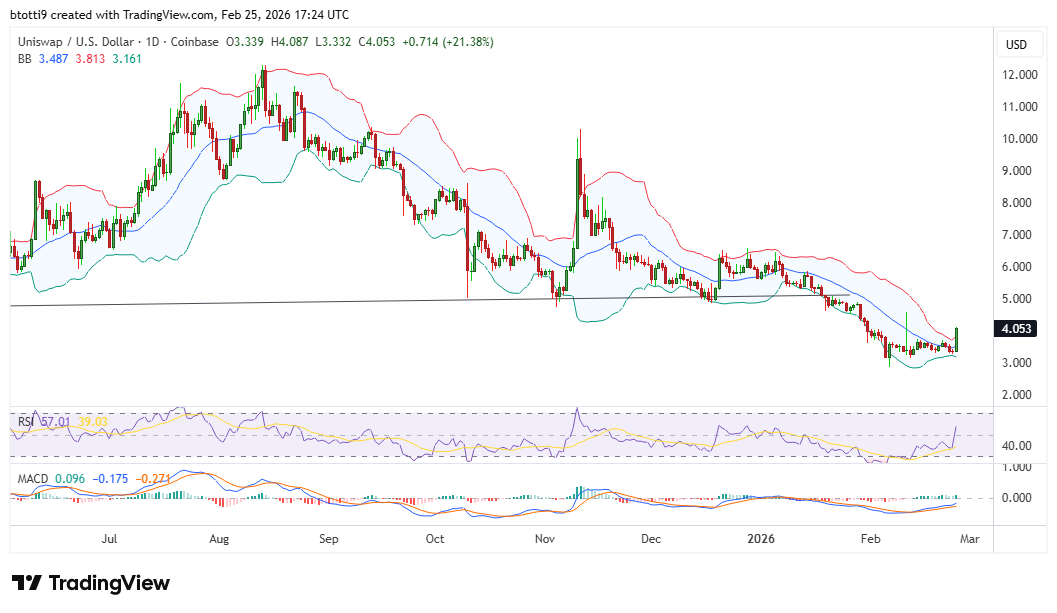
    Uniswap Price Chart

    Uniswap price chart by TradingView

    Technical indicators also suggest that $UNI at $4.00 is below key moving averages, including the 50-day, 100-day, and 200-day SMAs.

    Daily RSI at 56, however, signals an extended bounce from oversold territory, and significantly, has room for another leg up before bulls hit overbought extremes.

    Meanwhile, the MACD histogram hints at fresh bullish momentum with $3.20 having formed a potential bottom.

    Bollinger Bands position $UNI above the upper band, which is currently at $3.81.

    If prices break above the 50-day SMA, bulls will have eyes on the 100 SMA ($5.09).

    This hurdle aligns with a horizontal resistance line that also acted as support in November and December 2025.

    However, near-term bearish targets are alive. The lower Bollinger band at $3.48 offers the first major demand reload zone. Below this, bulls could rely on support at $3.00.
  • Largest BNB treasury crashes 95%, blames CZ family office

    Largest BNB treasury crashes 95%, blames CZ family office

    The world’s largest $BNB treasury company has crashed 95% from its high last year and is blaming the family office of Binance founder Changpeng Zhao (CZ) for a “secret side agreement.”

    On Tuesday, it issued a press release demanding that CZ’s YZi Labs disclose a confidentiality provision between his family office and 10X Capital Asset Management LLC, the lead party in the company’s July 2025 PIPE transaction that coincided with its 52-week and multi-year high of $82.88 per share.

    Shares of CEA Industries, which changed Nasdaq ticker symbols from VAPE to BNC — an attempt to pivot the company’s brand to a $BNB Network Company — now trade at $3.88 after losing 95% of their value over the past seven months.

    Before becoming a $BNB treasury company during the height of the digital asset treasury (DAT) mania in the summer of 2025, CEA Industries was operating Canadian vape retailers.

    That business model, as well as several business models and pivots including a previous ticker change from CEAD to VAPE, failed to reverse a multi-year decline in its common stock from a $873 peak in 2018 to under $8 by the time of its acquisition of 33 Canadian vape locations.

    By July 2025, the company had yet again began looking for a new trend.

    It found a suitor in Cantor Fitzgerald, founded by US Commerce Secretary and Jeffrey Epstein’s former neighbor Howard Lutnick, who acted as the lead financial advisor to 10X Capital and sole placement agent to CEA Industries.

    Read more: Binance demands the Wall Street Journal remove ‘damaging’ article

    Another Cantor Fitzgerald-advised treasury flop

    Cantor Fitzgerald helped raise capital for other DATs like Twenty One, Bitcoin Standard Treasury Company, and Nakamoto.

    In fact, the same 10X Capital that led CEA Industries’ $500 million PIPE also served as financial advisor to Nakamoto, which has declined 99% in value from its May 2025 peak. Twenty One is down 89% since May, and Bitcoin Standard Treasury Company is down 37% since July.

    Despite its financial devastation, CEA Industries’ 95% decline is somewhat unremarkable among DATs.

    10X Capital acted as CEA Industries’ $BNB asset manager “with the support of YZi Labs.” According to CEA Industries, that support is potentially problematic, and it wants to force disclosure of how, exactly, CZ’s family office “supported” 10X Capital’s management of $BNB.

    10X Capital’s Chief Investment Officer (CIO) Russell Read became CIO of CEA Industries shortly after the PIPE closed.

    By September, the company had relegated him to a non-executive position and by the end of the year, he’d resigned entirely.

    Almost everyone lost in $BNB treasury debut

    Some of the biggest crypto funds invested in CEA Industries via the PIPE, including Pantera Capital, GSR, Arrington Capital, Borderless, Blockchain.com, Arche Capital, Hypersphere Capital, Kenetic, and the founders of BitFury.

    There are two sides to every story.

    For its part, YZi Labs has contested CEA Industries’ characterization of the “secret side agreement” as recently as this week.

    YZi Labs wants CEA Industries to retract what it calls false claims about that agreement, and it’s requested directors Hans Thomas and David Namdar recuse themselves from asset management discussions.

    It also wants to solicit stockholder written consents for board changes.

    Amid the infighting, CEA’s common stock has fallen 41% year to date, 67% over the past 12 months, 95% from its 52-week high, and 98% over the past five years.

  • Trump says lawmakers Ilhan Omar, Rashida Tlaib should be removed from US

    US President Donald Trump lashed out at two lawmakers after their protests during his State of the Union address.

    President Donald Trump has said United States Representatives Ilhan Omar and Rashida Tlaib should be sent “back from where they came from” after the two Democratic members of Congress shouted in protest during his State of the Union address.

    During Trump’s address on Tuesday, Tlaib, a Palestinian American, and Omar, a Somali American, criticised Trump as he extolled his ⁠administration’s immigration crackdown and its immigration enforcement actions.

    Recommended Stories

    list of 4 itemsend of list

    Trump wrote on his Truth Social platform late on Wednesday that the two Muslim lawmakers had behaved like “crooked and corrupt politicians” who should be removed from the US.

    “When you watch Low IQ Ilhan Omar and Rashida Tlaib, as they screamed uncontrollably last night at the very elegant State of the Union, such an important and beautiful event, they had the bulging, bloodshot eyes of crazy people, LUNATICS, mentally deranged and sick who, frankly, look like they should be institutionalised,” Trump wrote.

    “When people can behave like that, and knowing that they are Crooked and Corrupt Politicians, so bad for our Country, we should send them back from where they came – as fast as possible,” Trump said.

    “They can only damage the United States of America, they can do nothing to help it,” he added.

    Omar and Tlaib were among a small group of Democratic lawmakers who protested during Trump’s nearly two-hour speech on Tuesday.

    As Trump told legislators during his speech that the US should end “sanctuary cities” – which limit cooperation with federal authorities such as Immigration and Customs Enforcement (ICE), Omar and Tlaib shouted: “You have killed Americans!”

    Omar wrote later on social media: “I said what I said. I had to remind Trump that his administration was responsible for killing two of my constituents”.

    Omar represents Minnesota’s 5th Congressional District, which covers the city of Minneapolis, where Trump launched a sweeping immigration crackdown last year.

    In January, two US citizens were killed by federal officers in Minnesota while protesting against immigration raids by ICE and customs agents.

    Omar is also a member of Minnesota’s Somali American community, which has been repeatedly targeted by Trump for criticism. The president previously said they should also “go back where they came from”.

    Tlaib, who is the first woman of Palestinian descent in the US Congress, wrote later on social media: “Can’t take two Muslimas [Muslim women] talking back and correcting him so now he is crashing out. #PresidentMajnoon.”

    Majnoon is an Arabic word that translates as possessed by an evil spirit, mad or fanatical.

    Trump’s post on Truth Social singled out Tlaib and Omar, but did not mention Democratic Representative Sarah McBride, who US broadcaster NBC said had also shouted in protest during the president’s speech.

    Trump also did not mention Democratic Representative Al Green, who was removed from the floor of the House of Representatives during Trump’s address, for holding a sign that said “Black people aren’t apes” – in reference to a racist video of former President Barack Obama and his wife Michelle Obama that was recently shared by Trump on social media.

  • XRP Price Rally Accelerates, $1.50 Resistance Could Decide Next Move

    XRP Price Rally Accelerates, $1.50 Resistance Could Decide Next Move

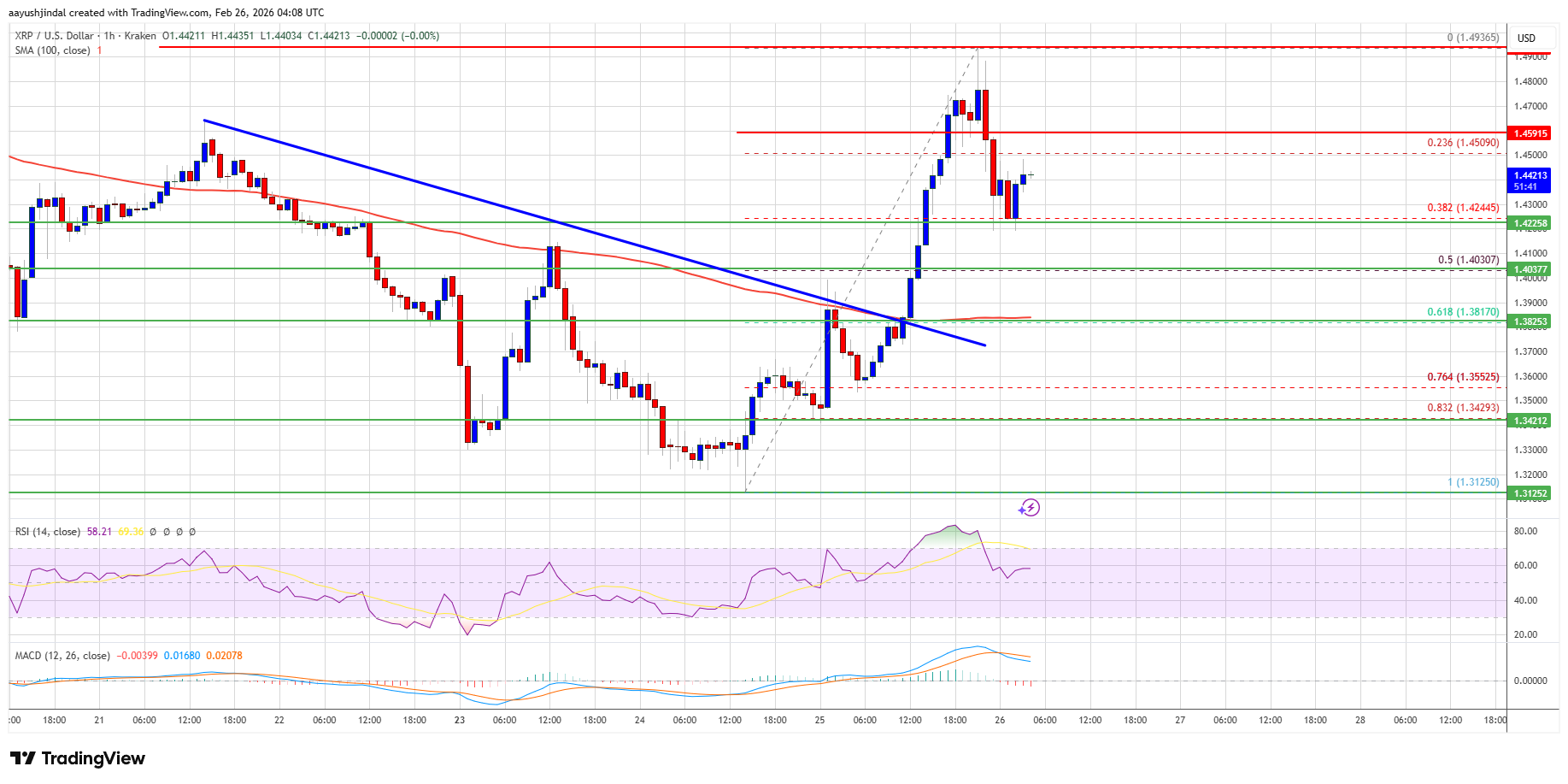
    $XRP price started a decent increase above $1.40. The price is now consolidating gains and might aim for more gains above the $1.50 zone.

    • $XRP price started a decent upward move above the $1.420 zone.
    • The price is now trading above $1.4250 and the 100-hourly Simple Moving Average.
    • There was a break above a key bearish trend line with resistance at $1.3820 on the hourly chart of the $XRP/USD pair (data source from Kraken).
    • The pair could continue to move up if it settles above $1.50.

    $XRP Price Rally Reaches Resistance

    $XRP price started a fresh upward move above $1.40 and $1.420, like Bitcoin and Ethereum. The price gained pace for a clear move above the $1.450 resistance.

    There was a break above a key bearish trend line with resistance at $1.3820 on the hourly chart of the $XRP/USD pair. The bulls even pumped the price toward the $1.50 zone. A high was formed at $1.4936 and the price started a consolidation phase. There was a drop below the 23.6% Fib retracement level of the upward move from the $1.3125 swing low to the $1.4936 high.

    The price is now trading above $1.420 and the 100-hourly Simple Moving Average. If there is a fresh upward move, the price might face resistance near the $1.460 level. The first major resistance is near the $1.50 level, above which the price could rise and test $1.5450. A clear move above the $1.5450 resistance might send the price toward the $1.650 resistance. Any more gains might send the price toward the $1.720 resistance. The next major hurdle for the bulls might be near $1.80.

    Another Decline?

    If $XRP fails to clear the $1.460 resistance zone, it could start a fresh decline. Initial support on the downside is near the $1.420 level. The next major support is near the $1.4030 level or the 50% Fib retracement level of the upward move from the $1.3125 swing low to the $1.4936 high.

    If there is a downside break and a close below the $1.4030 level, the price might continue to decline toward $1.3820. The next major support sits near the $1.3430 zone, below which the price could continue lower toward $1.320.

    Technical Indicators

    Hourly MACD – The MACD for $XRP/USD is now losing pace in the bullish zone.

    Hourly RSI (Relative Strength Index) – The RSI for $XRP/USD is now above the 50 level.

    Major Support Levels – $1.420 and $1.4030.

    Major Resistance Levels – $1.460 and $1.50.

  • Harry Styles Says He Laughed at His Grandmother’s Funeral “Thinking About Inappropriate Cremation Songs”

    Harry Styles Says He Laughed at His Grandmother’s Funeral “Thinking About Inappropriate Cremation Songs”

    Harry Styles has admitted that he laughed at his grandma’s funeral, but he has a specific reason.

    The Grammy-winning singer made a recent appearance on Brittany Broski’s Royal Court, where she brought up Styles’s song “Music for a Sushi Restaurant.” The host then proceeded to ask him what other locations he thinks also deserve to have a song written about them.

    In a surprising response, the singer said the crematorium. “I really like cremation songs,” Styles confessed, as Broski and the room erupted in laughter.

    The former One Direction member went on to explain how his interest in cremation songs first came about. “I remember being at my grandma’s funeral, and as the belt started, it just went ‘the long and winding road’ (referring to The Beatles song), and it made me laugh,” he recalled.

    “It feels so inappropriate because of how abrupt it was,” Styles added. “And then I just started thinking about inappropriate cremation songs. … And then I was off.”

    The “As It Was” artist also took a moment to name some of the specific songs on his mind at the time, including Dan Hartman’s “Relight My Fire,” The Trammps “Disco Inferno” and Johnny Cash’s “Ring of Fire.”

    Styles’s fourth solo studio album, Kiss All The Time. Disco, Occasionally, is set to be released on March 6. Later this year, he’ll also head out on an extensive world tour, including several residencies around the world.

    Elsewhere during his chat with Broski, the “Sign of the Times” singer said, “I had so much fun making this album.”

  • Ethereum Undervalued, Bitcoin & XRP Remain Neutral Amid Recent Bullish Reversal

    Ethereum Undervalued, Bitcoin & XRP Remain Neutral Amid Recent Bullish Reversal

    • MVRV shows $ETH is mildly undervalued, while $BTC, $XRP, and Chainlink remain neutral.

    • The crypto market is now witnessing an upward trend reversal despite recent bearish trends.

    • Buyers show renewed interest in crypto following Nvidia earnings report.

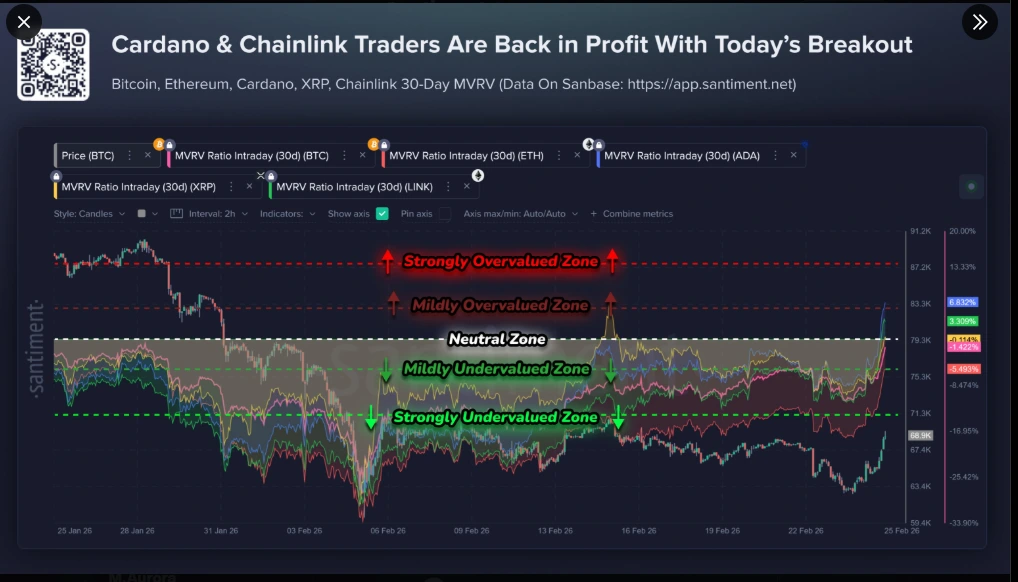
    Based on the 30-day Market Value to Realized Value (MVRV) Ratio, Ethereum ($ETH) is mildly undervalued at -5.5%. Bitcoin ($BTC), $XRP ($XRP), and Chainlink ($LINK) remain neutral at -1.4%, -0.1%, and +3.3%, respectively. By contrast, Cardano (ADA) is mildly overvalued, with an MVRV ratio of +6.8%.

    Source: Santiment

    Bitcoin and the wider crypto market showcase a bullish trend reversal

    The past day has seen an upward trend reversal in the broader cryptocurrency ecosystem, despite recent bearish momentum and sentiment.

    Data shows that the average Moving Average Convergence Divergence (MACD) indicator has slightly surpassed its 9-day average, indicating a weak bullish momentum reversal.

    $BTC was up 7.78% in the past day to trade at $69,050 as $ETH gained 13.31% to reclaim its $2,000 psychological level. Meanwhile, $XRP and $LINK gained +9.37% and 16.07%, respectively. Uniquely, Cardano has experienced a striking 20.07% upsurge to trade at $0.3115.

    Source: CoinMarketCap

    Events leading up to the recent crypto rally

    Tech company Nvidia recently reported record-breaking earnings driven by demand in artificial intelligence (AI). Due to the strong correlation (98%) of crypto with the S&P 500, the news fueled renewed risk appetite in investors of both stocks and crypto.

    Capital rotation from $BTC to altcoins has contributed to their recent rallies as investors seek higher returns from riskier assets. Bitcoin dominance is now at 58-60%, while the Altcoin Season Index reads 34/100, indicating a mixed market for Bitcoin and Altcoins.

    This week, Bitcoin ETFs saw $257.7M in net inflows, effectively ending a five-week outflow streak.

    Near-term market outlook

    At press time, the overall crypto market cap totaled $2.38 trillion, having gained 7.50% in the last 24hours.

    Should the current rally hold, the crypto market could test the $2.59T (50% Fibonacci) level. Falling below $2.35T (78.6% Fib) would indicate a loss in momentum, validating a weak bullish theory.

  • Trump-backed World Liberty plans governance staking overhaul to reward active participation

    Trump-backed World Liberty plans governance staking overhaul to reward active participation

    World Liberty Financial, a DeFi platform backed by the Trump family, has put forward a governance proposal that would require holders of unlocked $WLFI tokens to stake them to vote, while offering staking rewards to those who actively participate in governance.

    Under the plan introduced on February 26, $WLFI holders must lock their tokens for at least 180 days to take part in governance voting.

    Participants who cast at least 2 governance votes during their lock-up period would receive an estimated 2% annual return paid from the project’s treasury.

    Voting power would be measured by both stake size and remaining lock-up duration using a non-linear formula to limit concentration among the largest holders. The system also links staking to deposit incentives on $USD1, World Liberty’s flagship stablecoin.

    The proposal also establishes Node and Super Node tiers for larger stakers, offering additional incentives such as access to licensed market makers for 1:1 $USD1 stablecoin conversions and prioritized partnership engagement.

    To become a “Node,” users must stake at least 10 million $WLFI, valued at roughly $1 million at current prices.

    These participants would gain access to licensed market makers facilitating 1:1 conversions of supported stablecoins such as USDT and USDC into $USD1, as well as $USD1 off-ramps into US dollars.

    The move would redirect arbitrage profits from institutional market makers to committed token holders, while strengthening demand for $USD1 and tying governance power to long-term capital commitments.

    To become a “Super Node,” participants must lock up a minimum of 50 million $WLFI. In return, holders would receive priority access to partnership discussions with the platform’s leadership, though commercial agreements remain subject to separate review.

    The proposal will be put to a seven-day vote and must secure participation from at least one billion eligible tokens to be valid.

    Staking-based governance models have gained traction across decentralized finance projects as developers seek mechanisms to align long-term incentives without relying on centralized oversight.

  • Adult Swim’s ‘Smiling Friends’ to End After Season 3

    Adult Swim’s ‘Smiling Friends’ to End After Season 3

    Adult Swim‘s animated comedy “Smiling Friends” is ending after its third season. Creators and stars Michael Cusack and Zach Hadel revealed the news in a video posted to Adult Swim’s X account.

    “I’m gonna cut right to the chase,” Hadel said at the top of the message. “This is not a bit, this is not a joke. Michael and I are here to announce that ‘Smiling Friends’ will be ending after Season 3 is done.”

    “To be perfectly honest, after we finished Season 3, Zach and I just both had the same feeling where we felt pretty burnt out after putting years and years into this, but also pretty accomplished,” Cusack added. “We just came to this feeling where we were like, ‘I think that could just be it,’ after Season 3.”

    Hadel explained that from the very beginning of the show, he and Cusack wanted to put “110%” into “Smiling Friends” and then “go out on top.” He said it was better to leave the audience “wanting more” than to have fans think, “‘That show is still on the air? Oh god.’”

    “We wouldn’t want to be doing more seasons half-hearted or burnt out or not feeling it,” he added. “That’s not fair to us, and it’s not fair to the audience to give you guys fucking slop. That sucks.”

    Cusack explained that ending “Smiling Friends” was “our decision,” and that Adult Swim has been nothing but “very supportive.”

    More to come…

  • Park Chan-Wook to Preside Over 79th Cannes Film Festival Jury

    Park Chan-Wook to Preside Over 79th Cannes Film Festival Jury

    Park Chan-wook will preside over the jury of the 79th edition of the Cannes Film Festival.

    The celebrated South Korean director, screenwriter and producer will succeed French actor Juliette Binoche, whose jury handed the Palme d’Or to Jafar Panahi’s Iranian drama “It Was Just an Accident.”

    Known for his baroque and subversive work, Park has a long history with Cannes. He presented his feature debut, “Oldboy,” at the 2004 festival, where it won the Grand Prize and later became a cult film. He’s returned to the competition with most of his films since then, including “Thirst,” which picked up the Jury Prize in 2009, “The Handmaiden” in 2016 and “Decision to Leave,” which won best director in 2022.

    “Park Chan-wook’s inventiveness, visual mastery, and penchant for capturing the multiple impulses of women and men with strange destinies have given contemporary cinema some truly memorable moments,” said festival president Iris Knobloch and director Thierry Frémaux in a joint statement. “We are delighted to celebrate his immense talent and, more broadly, the cinema of a country deeply engaged with the questioning of our time.”

    Park will become the first South Korean president of the Cannes Film Festival in its 79-year history. Wong Kar-wai is the only other Asian filmmaker to have headed the jury, 20 years ago.

    Park, whose latest film “No Other Choice” was nominated for three Golden Globes, said, “The theater is dark so that we may see the light of cinema. We confine ourselves within the theater so that our souls may be liberated through the window of film.

    “To be enclosed in a theater to watch films, and enclosed again to engage in debate with the members of the jury, this double, voluntary confinement is something I await with great anticipation,” he continued.

    Alluding to ongoing wars and political tensions, he said, “In this age of mutual hatred and division, I believe that the simple act of gathering in a theater to watch a single film together, our breaths and heartbeats aligning, is itself a moving and universal expression of solidarity.”

    Cannes has long championed South Korean cinema. Back in 2002, the festival awarded Im Kwon-taek with the best director award for “Strokes of Fire.” Bong Joon-ho became the first Korean director to win the Palme d’Or in 2019 for “Parasite” and then made history winning best picture, director, screenplay and international feature at the Oscars.

    Over the years, Cannes also shined a spotlight on a new generation of South Korean directors who presented their films in competition; notably Hong Sang-soo, with “Tale of Cinema” in 2005, Kim Ki-duk with “Breath” in 2007 and Lee Chang-dong with “Poetry,” which won best screenplay in 2010. Others have included Kim Jee-woon with “A Bittersweet Life” in 2005, Yeon Sang-ho in “Train to Busan” in 2016, Byun Sung-hyun with “The Merciless” in 2017 and Lee Won-tae with “The Gangster, the Cop, the Devil” in 2019.

  • Jane Street Speculation Renews Scrutiny of Bitcoin ETF Market Mechanics

    Jane Street Speculation Renews Scrutiny of Bitcoin ETF Market Mechanics

    Bitcoin’s Wednesday rally has reignited debate over the role of Wall Street market makers in spot Bitcoin exchange-traded funds, after online speculation linked the price move to a lawsuit involving quantitative trading firm and liquidity provider Jane Street.

    Posts circulating on X claimed that Bitcoin’s roughly 10% climb over two days coincided with the disappearance of a purported intraday selling pattern, suggesting that legal action against Jane Street had altered market behaviour.

    Analysts and ETF specialists, however, said the focus on a single firm obscures a more complex set of market mechanics underlying how spot Bitcoin ETFs operate.

    Bitcoin ETFs track the asset’s spot price, but the creation and redemption process allows institutional middlemen to meet demand without having to buy or sell Bitcoin on public exchanges.

    Jeff Park, chief investment officer at ProCap and an adviser to ETF issuer Bitwise, said Wednesday the debate reflects a misunderstanding of ETF market structure rather than evidence of manipulation.

    In a screenshot post on X, Park outlined how large trading firms responsible for creating and redeeming ETF shares, known as authorized participants, operate under regulatory exemptions that allow them to meet ETF demand without mechanically forcing immediate spot Bitcoin purchases.

    Park said those exemptions, which apply to all authorized participants, are designed to support orderly ETF market-making, but can create a “grey window” in which ETF share creation, hedging activity, and spot market transactions are not tightly linked in time.

    As a result, ETF inflows do not always translate into immediate buying pressure in the spot Bitcoin market, weakening the assumption that ETF demand directly maps to spot price movements.

    Ryan McMillin, chief investment officer at crypto fund manager Merkle Tree Capital, told Decrypt the structure also creates incentives that favour derivatives over spot markets.

    Because Bitcoin futures frequently trade at a premium to spot prices in a condition known as contango, authorized participants may hedge exposure using futures while earning carry from the basis, he said.

    “ETF assets under management balloons without forcing exchange buys, muting rallies below key levels where hype would otherwise push prices higher in a flywheel,” McMillin said.

    McMillin added that when futures positions are reduced, either due to macro shifts or narrowing spreads, the adjustment can amplify price swings, contributing to sharp pullbacks that appear sudden to retail investors.

    Both analysts stressed that the behaviour is legal and consistent with how ETFs are designed to operate, and does not imply wrongdoing by any individual firm.

    Instead, they said it highlights how Bitcoin’s price discovery is increasingly shaped by institutional trading venues such as futures markets, rather than spot exchanges alone.

    “APs wield hedge-fund-like incentives and tools with less accountability in a volatile, adoption-stage asset,” McMillin said. “The ETF ‘innovation’ risks becoming a yield-skimming machine for Wall St. that prioritises institutional arbitrage over genuine spot support.”