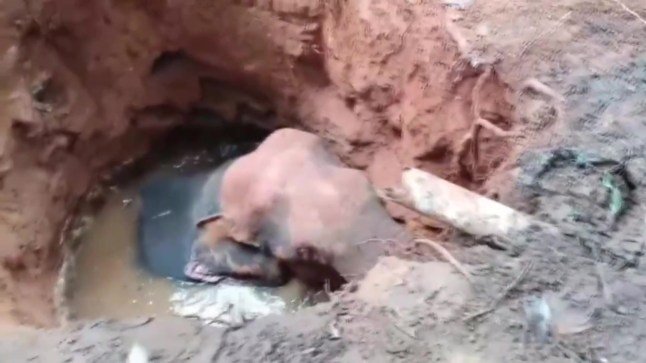
The elephant fell into the unmanned well earlier this week (Picture: Newslions / SWNS)
A 15-year-old elephant was trapped for 10 hours in an abandoned well before it was rescued.
The animal fell into a well in Ernakulam, in the southern Indian state of Kerala, on Tuesday at around 2.00am. According to the reports, the well didn’t have a wall, and was located near the home of doctor Thattayath Aliyar.
Forest officials rescued the elephant using an excavator, creating a mud ramp so it could safely escape.
Witnesses say the elephant struggled at first to climb out from the muddy water, but eventually managed to break free and return to the forest.
Forest department personnel were initially prepared to begin rescue operations in the early morning, but residents protested, demanding that the elephant be permanently relocated away from human habitation.
Villagers had their doubts about the rescue (Picture: Newslions / SWNS)
Sign up for all of the latest stories
Start your day informed with Metro’s News Updates newsletter or get Breaking Newsalerts the moment it happens.
The elephant fell at around 2am (Picture: Newslions / SWNS)
After a meeting, the area’s divisional forest officer, P. Karhik, assured villagers the elephant would be kept under 24-hour surveillance using drones and forest patrol teams upon release and would be captured if it were to stray into human areas again.
Authorities also said they would compensate the homeowner for damages and install an electric fence in the region. Only after these demands were met did the rescue operation begin, around noon.
Forest officials say that the top of the elephant’s trunk was damaged as part of an old wound. The injury restricts the elephant’s ability to forage for food and water, explaining why it frequently wanders into residential areas to find easily accessible sustenance.
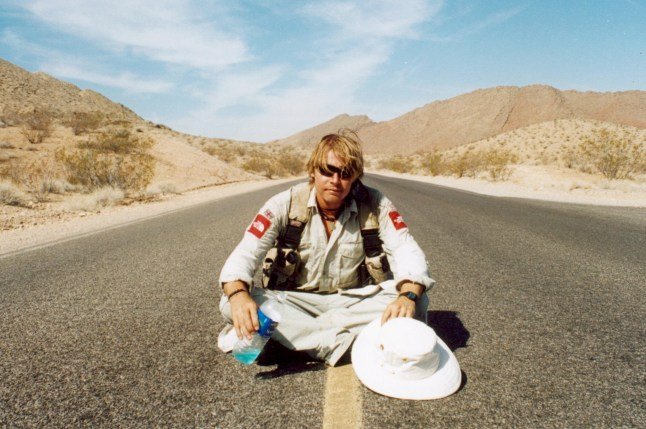
Karl Bushby has been travelling the world on foot for nearly 30 years (Picture: Karl Bushby / SWNS)
A former paratrooper who has spent nearly 30 years walking home to Hull from South America may be prevented for a second time after he was prevented from swimming across the English Channel.
Karl Bushby – who is travelling the world without using cars, trains, buses or planes – may not be able to make the final crossing to the UK from France, as French authorities only allow people to swim in the other direction.
Karl, 57, said: ‘We are talking with the French coastguard.’
Bushby set off from Chile in 1998 and has reached Belgium.
He is now nearing the final stages of his journey back to his hometown.
But crossing the Channel has proven a challenge more than once after Eurotunnel bosses refused his request to walk through it in June.
Sign up for all of the latest stories
Start your day informed with Metro’s News Updates newsletter or get Breaking Newsalerts the moment it happens.
Karl in Chile in 1999, shortly after he started his epic journey (Picture: Karl Bushby / SWNS)
This left him with no option but to swim, in line with the terms of his challenge, which say he cannot use any form of transport to travel.
Bushby still hopes that authorities might let him use the Eurotunnel. In the meantime, he is hoping he can find a way to swim the 21-mile distance in just a few months.
We have secured a support boat for October’, he said. ‘That’s a big thing. I would expect it to take two or three days to swim across to the UK.’
Karl is currently in Mexico, where he takes breaks between stages of his challenge to meet visa regulations and to plan routes. On occasion, he visits the US, where his sponsors are based.
‘I will be back in Belgium in early September,’ he said. ‘Towards the end of that month, I expect to be in France, preparing for the swim.
‘I am not angry it has come to this. I am more disappointed. But things could still change. Walking through the service tunnel is still the preferred option.’
Karl has crossed all terrains and has even been detained along his route (Picture: Karl Bushby / SWNS)
Karl is no stranger to traversing vast bodies of water.
In 2006, he became the first Brit to walk across the Bering Strait, a 58-mile stretch of frozen sea linking North America and Russia.
Then, in 2024, he swam more than 170 miles over 31 days across the Caspian Sea from Kazakhstan to Azerbaijan to avoid conflict zones in Russia and Iran.
Despite this, Karl isn’t a fan of this method of getting around.
‘I’m just not into the swim thing,’ he said previously.
‘I’ve had to do a couple of swims here and there. […] [The English Channel] is a different stretch of water; it’s colder, we’ll see. Hopefully, I’ll never have to think about it.’
Where has Karl been so far?
Karl in Panama in 2001 (Picture: Karl Bushby / SWNS)
Karl began the challenge after sketching a rough path on a map when he was in the army. He showed the plan to fellow soldiers who told him it could not be done.
This made him all the more determined, and he set himself two rules: to never use transport, and to not return to the UK until he had completed the journey.
Karl set off on his 36,000-mile journey from Punta Arenas, Chile, in 1998, thinking it would take him 12 years.
But in the three decades since, he has been met with several setbacks that have lengthened his adventure.
He has had to evade bandits in the notoriously dangerous Darien Gap and has been detained by Russian officials for illegally entering the country.
He also spent 18 days in prison in Panama for entering without a visa before continuing his journey through Mexico and the US, where he overstayed his visa and had to fly back to Colombia to wait for a new one.
In 2003, as he was preparing to cross the border into Canada, his trailer was stolen and he was forced to wait another month for the items in it to be replaced.
Karl crossed the Baring Strait in 2006 (Picture: Karl Bushby / SWNS)
His trailer was stolen on New Year’s Day 2003, a day before he was due to cross into Canada while visiting a bar. Another month passed while he replaced his lost items.
Despite this – and many other issues he encountered along the way – he reached Armenia last June, before travelling through Turkey, Bulgaria, Romania, Hungary, Austria, Slovakia and, after stopping off in Mexico to sort his Schengen visa out, traversed Europe where he is now hoping to find a way to cross his final sea.
Once he is back on UK shores, Karl will walk to Hull, where the journey will end at his childhood home.
The French Maritime Rescue Coordination Centre referenced a 2018 ‘prefectural order’ confirming the restriction on Karl’s swim.
It said it has referred Karl’s support team to the Channel and North Sea Maritime Prefecture.
Developers recently revealed that a four-year-long vulnerability in Orchard may have enabled unlimited counterfeit Zcash [$ZEC] until an emergency patch was issued. However, fresh market data has raised further questions regarding events before the discovery.
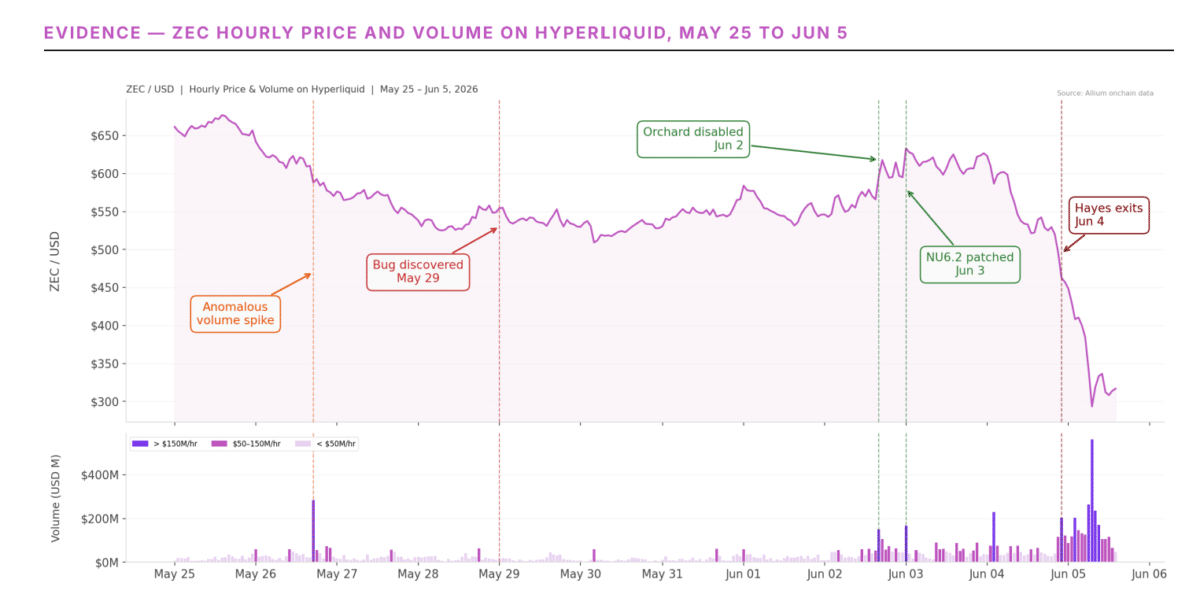
Allium Labs, after reviewing trade history, identified unusual trading activity. On the 26th of May, $ZEC’s trading volume surged 12–13 times above its average. Researchers privately uncovered the defect three days later, on the 29th of May.
Source: Allium Research
While researchers were identifying the defect, $ZEC declined from approximately $660 down to $530, indicating increasing selling pressure. The developers disabled Orchard on the 2nd of June and issued a patch on the 3rd of June, yet confidence continued fading.
By the 5th of June, $ZEC had fallen by 64 percent from $685 to $247 with hourly trading at $560 million.
Early positioning fuels market suspicion
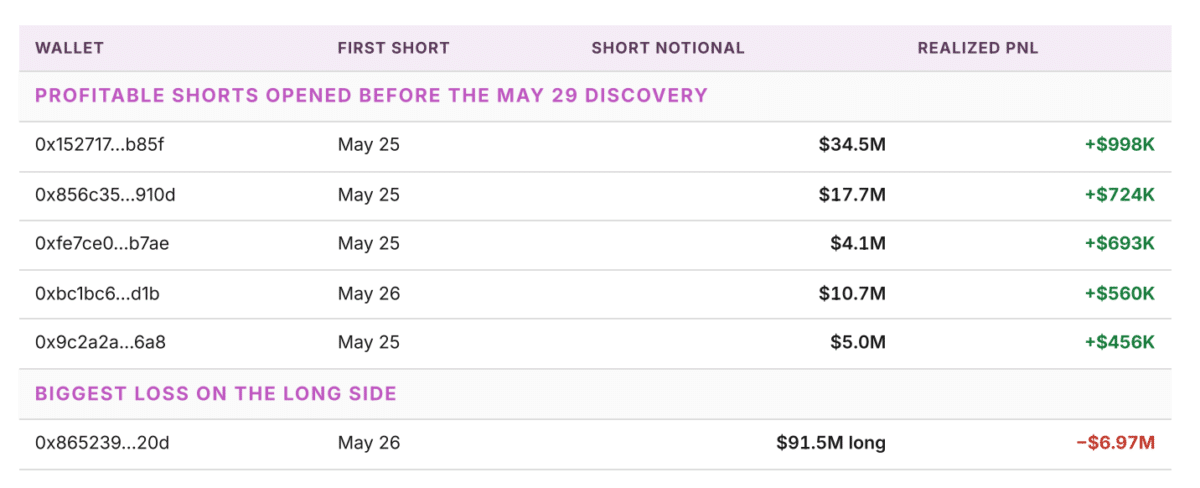
The uncertainty in the aftermath of this issue also led to further review of which parties were actively trading in the market ahead of the issue becoming apparent. Allium found that traders opened the most profitable positions on the 25th and 26th of May.
This occurred days before the private discovery of the Orchard flaw. More importantly, traders opened these large positions before researchers privately disclosed the flaw on the 29th of May. Notably, the largest wallet had a short position worth $34.5 million and, as a result, made approximately $998,000 in profits.
Source: Allium Research
A second short position worth $17.7 million accrued profits of approximately $724,000. These high profits raised questions about whether traders anticipated the sell‑off.
However, the data does not provide sufficient evidence to prove such claims. In futures markets, all shorts are offset by an equal number of longs. Therefore, simply showing profitable positions is insufficient to establish that those positions existed due to prior knowledge.
That balance became evident when the largest $91.5 million long position ultimately lost $6.97 million. Meanwhile, Zcash’s privacy model prevents anyone from verifying whether the flaw was ever exploited. This left markets to price on probabilities instead of certainty and kept confidence fragile despite the completed patch.
Final Summary
Allium Labs flagged unusual $ZEC trading before the Orchard flaw discovery, fueling suspicion of informed positioning.
Profitable shorts raised questions, but lack of evidence and Zcash privacy kept confidence fragile.
Ripple Considered Closing After SEC Lawsuit Put Company at Risk
Ripple CEO Brad Garlinghouse revealed that the company considered shutting down after the U.S. Securities and Exchange Commission (SEC) filed a lawsuit against Ripple and named him and co-founder Chris Larsen in 2020 over $XRP sales. The decision became one of the most difficult moments of his leadership, with the company weighing whether continuing the legal fight was worth the financial and operational risks.
Garlinghouse said during a KU Hustle podcast interview at the University of Kansas School of Business, published on July 8:
“We almost decided to shut down the company when the SEC sued us … The company owns a lot of $XRP … We could have shut it down and … just distribute the $XRP to shareholders on a pro rata basis.
The SEC lawsuit centered on the regulator’s claim that $XRP sales involved unregistered securities. Garlinghouse disputed that position, comparing the crypto token more closely to bitcoin, which he described as a separate digital asset operating on an open network.
Ripple’s Legal Fight Ended After SEC Appeal Withdrawal and Final Judgment
Garlinghouse said Ripple spent $150 million on legal bills during the four-year dispute with the SEC, while its U.S. business remained largely stagnant for about five years after the lawsuit began. He said the case created prolonged uncertainty around Ripple’s ability to operate in the domestic market.
The legal battle began in 2020 when the SEC alleged Ripple sold $1.3 billion of $XRP as an unregistered security. In 2023, U.S. District Judge Analisa Torres issued a mixed ruling, finding that $XRP sales on public exchanges were not securities transactions, while sales to institutional investors were treated differently under securities law.
Ripple was later ordered to pay a $125 million civil penalty and accept an injunction related to securities law compliance. Both Ripple and the SEC filed appeals challenging different aspects of the ruling before agreeing to dismiss those filings. The case formally concluded in August 2025 after the appeals were withdrawn and the court process ended.
The regulatory environment surrounding cryptocurrency also changed after SEC leadership shifted under Chairman Paul Atkins and the Trump administration. The agency moved away from a more aggressive regulation-by-enforcement approach toward deregulation, greater engagement with the crypto industry, and a focus on traditional fraud cases rather than broad corporate penalties.
Garlinghouse said that before the SEC filed its lawsuit, he met with SEC officials four times between 2017 and 2019 to explain how Ripple used blockchain technology and $XRP in its payment system. He said regulators did not indicate during those meetings that $XRP could be considered a security.
Ripple Continued Operations After Weighing Shutdown Option
The Ripple chief executive described how the company could have responded to the SEC lawsuit, outlining a scenario in which Ripple might have exited the dispute by distributing its $XRP holdings and dissolving the company.
“You guys think these are securities. Ripple doesn’t own it anymore. Ripple’s gone now,” he said, describing a hypothetical scenario rather than an action the company took, outlining how Ripple could have responded to the SEC.
He added that such a move would have come at a high cost to employees and the company’s future, stating:
“Hundreds of people would have lost their jobs. I think that was a bad outcome, but in some ways it was the easier outcome.”
After deciding not to shut down, Garlinghouse said the choice to continue operating was not clear at the time. “That was a difficult decision, and obviously I’m glad in retrospect, but that was not obvious at the time,” he stated. Ripple chose to continue operating after weighing the impact on employees and the business.
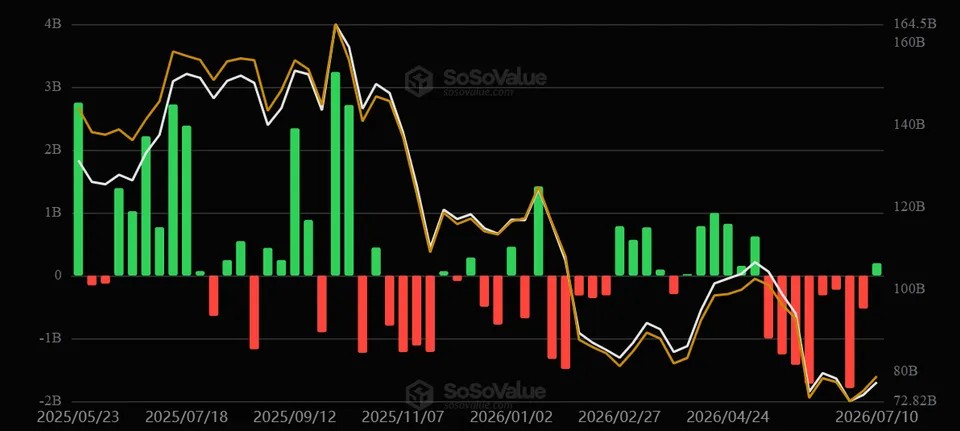
US-listed spot Bitcoin exchange-traded funds recorded a net inflow of $197.4 million in the week ended Friday, snapping an eight-week streak of weekly outflows dating back to May.
Data from Farside Investors shows that most of the week’s gains came from the BlackRock iShares Bitcoin Trust ETF, which recorded $291.9 million in inflows. This was offset by outflows from the Grayscale Bitcoin Trust ETF, the Fidelity Wise Origin Bitcoin Fund and the ARK 21 Shares Bitcoin ETF.
The end of the outflow streak could suggest institutional demand for Bitcoin is recovering after two months of sustained selling pressure. However, one analyst said it’s too early to tell with ETF and stablecoin outflows and seasonality in August and September.
“There’s also been a pattern over the past few months where Bitcoin performs better in the first half of the month, then consolidates in the latter half,” 10x Research founder and CEO Markus Thielen told Cointelegraph.
“Without flows still pronounced and ETF flows yet to meaningfully pick up, even after Bitcoin’s 9%+ jump, the headwinds remain in our view.”
The $197.4 million weekly inflow was modest compared with the $8.26 billion investors withdrew since May 11.
Total spot Bitcoin ETF net inflow. Source: SoSoValue
Last week, Real Vision chief crypto analyst Jamie Coutts told Cointelegraph that Bitcoin could be entering the latter stages of the bear market, based on early technical signs suggesting that selling pressure is easing.
“I think we’re getting through most of the bear market action. It’s still not over, clearly. But you know, I think we’re approaching at least the second half,” Coutts said.
Other analysts say there could be further downsides ahead.
Russell Thompson, chief investment officer at asset manager Hilbert Capital told Cointelegraph last week that he believes Bitcoin remains in a downcycle and could hit a low around October this year.
Ether ETFs also break outflow streak
Meanwhile, US-listed spot Ether ETFs also broke their eight-week losing streak, with $84.42 million in net inflows for the week ended Friday, led by BlackRock and Fidelity’s Ether funds.
The inflows paled in comparison with the $1.2 billion in net outflows since May 11.
The US has launched a new wave of strikes on Iran targeting what it says is Tehran’s ability to threaten shipping in the Strait of Hormuz. US President Donald Trump has declared the waterway open while Iran insists it is closed leading to a further escalation of attacks, as Heidi Zhou Castro reports from Washington DC.
UPDATED:The New York Times filed a counterclaim to a lawsuit brought by the Equal Employment Opportunity Commission, alleging that the Commission’s litigation was a retaliatory effort because of the newspaper’s reporting on the Trump administration.
In a filing in federal court in Manhattan, the Times’ legal team wrote, “The Commission filed this action only eight days after The Times published an article reporting that the EEOC is under pressure to use its scarce resources to pursue flimsy (at best) claims of alleged discrimination that ‘fit the Trump administration’s priorities,’ and a mere two days after The Times reported that it was being investigated by the EEOC.”
In May, the EEOC filed a reverse discrimination lawsuit against the Times, alleging that it violated federal law when it passed up a white male employee for a promotion because of his race or sex.
But in its filing, the Times’ legal team wrote that the person chosen for the role as deputy real estate editor was more qualified than the person who was passed up for the job, Bryant Roussau. The Times’ team wrote that she had extensive experience with service journalism and “articulated a compelling vision for the future of The Times’s real estate coverage that aligned with the Real Estate desk’s goals to focus on service and visually-driven journalism.” The Times also noted that other candidates of color of both sexes had more real estate experience than Rousseau yet were not advanced in the hiring process.
“Despite conducting an eight-month investigation, collecting more than a thousand pages of documents, and interviewing no fewer than nine witnesses, the Commission was unable to identify any evidence that The Times considered the selected candidate’s race or sex in filling the position,” the Times stated in its filing.
The Trump administration has gone after private companies — including Disney — over its diversity, equity and inclusion policies, claiming that they are themselves discriminatory. But in its lawsuit, the Times not only defends its policies but notes that it was grounded in initiatives of the EEOC until Trump came back to office.
The Times contended that the EEOC rested its claim “almost entirely” on a 2021 Call to Action report and subsequent diversity and inclusion reports. The leadership goals laid out in the report, the Times’ legal team stated, “were aspirational in nature and were not established targets or quotas; they were a projection of the expected impact of various legitimate, nondiscriminatory efforts to improve The Times’s culture and strengthen its people practices and were consistent with longstanding EEOC guidance in place at the time.” The real estate deputy editor position was not impacted as it was not a “leadership” position, the Times filing stated.
The counterclaim also identifies numerous instances in which Trump has attacked the Times, noting that he has, among other things, called it “treasonous.”
“The Commission’s retaliatory, bad faith use of its authority to target The Times violates the First and Fifth Amendments and the Administrative Procedure Act (‘APA’) and poses a uniquely insidious threat to a free and independent press, and to our democracy,” according to the filing.
The counterclaim alleges violation of the First Amendment, due process and the Administrative Procedure Act. It seeks dismissal of the EEOC claim and a declaration that the lawsuit was a violation of the First and Fifth Amendment, as well as the APA. It also seeks costs and attorney’s fees.
An EEOC spokesperson said, “The agency does not comment on ongoing litigation.”
UPDATED, with comment from AG: Oregon‘s attorney general has dropped a civil investigative demand for Paramount to turn over records related to its efforts to secure federal approval for its merger with Warner Bros. Discovery.
Oregon Attorney General Dan Rayfield also had asked a state circuit court judge to order Paramount to turn over the materials and to delay Paramount’s closing of its proposed acquisition of Warner Bros. Discovery by 60 days so the documents could be reviewed. A hearing has been scheduled for Monday in Multnomah County Circuit Court.
A Paramount spokesperson said, “We are pleased that the Oregon Attorney General has withdrawn its motion to delay this transaction. It was the right decision and avoids an unwarranted effort to delay a lawful, pro-competitive merger.
“Antitrust authorities around the world have carefully reviewed this transaction, clearing it or concluding that it does not violate any competition laws. That regulatory record underscores what the facts, the law and the economics make clear: this transaction will create a stronger challenger to dominant global streaming and technology platforms, expand consumer choice, increase investment in premium content and theatrical distribution, and create more opportunities for creators and workers. We look forward to completing the transaction and delivering those benefits.”
Jenny Hansson, communications director for Rayfield, said in a statement, “Paramount made it clear that they weren’t going to comply with the investigative demand, and that they think they’re above the law. We’re not going to let them waste Oregonians’ resources on these games. We’ve withdrawn the motion to consider our next steps.”
California Attorney General Rob Bonta and other state attorneys general are said to be considering a legal challenge to the transaction.
Rayfield sought Paramount records of lobbying of federal officials, as well as its role in a statement that the DOJ released in support of the transaction. The attorney general also sought documents “related to the formulation and execution of lobbying strategies aimed at obtaining regulatory approval of the proposed merger, which Respond as internally named ‘Project Warrior.’”
In a court filing, Paramount has objected to the document requests, arguing, among other things, that they impose “burdens and demands which are disproportionate” to the Oregon investigation and are “of such marginal relevance that the value of any materials sought is outweighed by the burden imposed on Paramount in having to provide such information.”
“Lobbying activities and related communications are wholly irrelevant to whether the proposed acquisition ‘violates Oregon’s antitrust laws,’” the company’s legal team wrote.
The Times said that those who received subpoenas included Julian E. Barnes, Eric Lipton, Tyler Pager and Eric Schmitt, who reported this week that there were security concerns about the new Air Force One, as Trump left the NATO summit in Turkey in the old aircraft. That included the lack of antimissile capabilities in the new aircraft, a Boeing 747-8 that was donated by the government of Qatar.
The subpoenas, according to the Times, asked the reporters to testify before a grand jury on Wednesday but do not contain many details, other than that they were being sought “in regard to an alleged violation of federal criminal law.” The subpoenas were issued by Jay Clayton, who is the U.S. attorney in Manhattan, the Times reported.
David McCraw, senior vice president and deputy general counsel at the Times, said in a statement that the “appearance of Federal law enforcement agents on the doorstep of reporters should shock the conscience of any American who believes in the Constitution and the press freedom it protects.”
McCraw added, “Our journalists report the facts and advance the American public’s right to know how their government is operating and their taxpayer dollars are being used. This brazen act should be seen as nothing more than an attempt to prevent the public from knowing what is happening in their country by intimidating journalists from doing their jobs.”
Per the Times, an FBI official asked that the story be held, characterizing it as an issue of national security.
A Justice Department spokesperson did not immediate return a request for comment.
Few days go by when Trump doesn’t lash out at the media, but in his second term, his administration has been more aggressive in using enforcement and regulatory powers against media outlets.
In January, federal agents conducted a search of the home of Washington Post reporter Hannah Natanson, seizing such things as her phones and laptops. The search was part of an investigation of a government contractor, but Natanson had reported extensively on Trump’s war on the civil service and the impact on the federal workforce.
The Times on Friday filed a countersuit against the Equal Employment Opportunity Commission, claiming that a reverse discrimination claim was in fact a retaliatory action because of its news reporting. The Times also has challenged new press restrictions at the Pentagon, and a federal judge has so far found that they violate the First Amendment.