Blog

  • Sharon Stone on Quitting Weed and Stopping a Stroke Medication Despite Doctors’ Orders: ‘It Was Like Going Off of F—ing Heroin’

    Sharon Stone on Quitting Weed and Stopping a Stroke Medication Despite Doctors’ Orders: ‘It Was Like Going Off of F—ing Heroin’

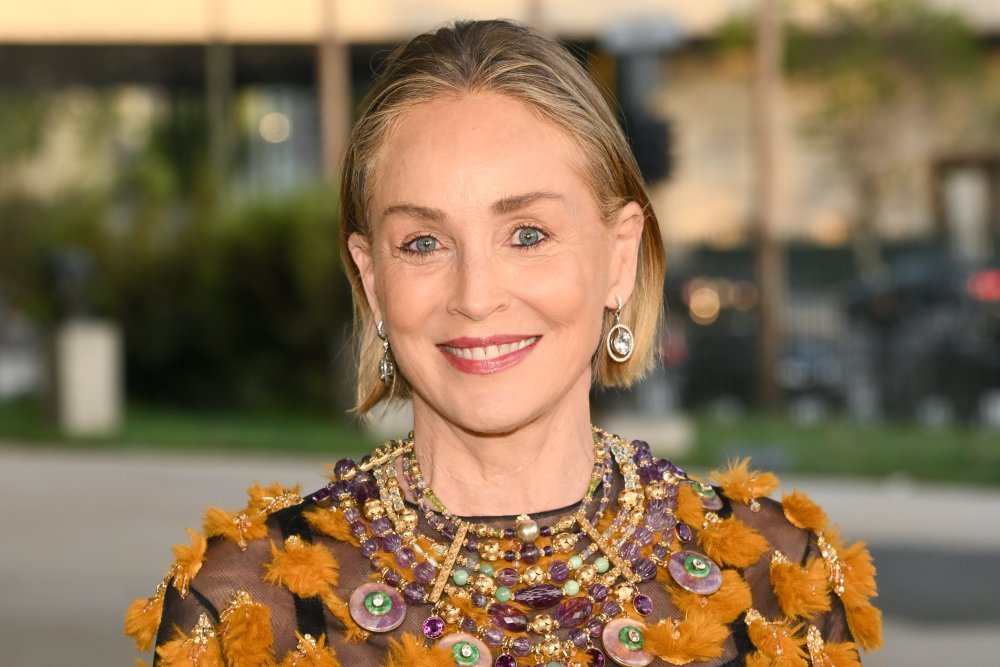
    Sharon Stone is done smoking weed.

    Her journey to cut ties with cannabis began when she was put on several medications after she suffered a near-fatal stroke in 2001.

    “I got off one of my medications that I was on for my stroke last September, and they said I couldn’t go off of it,” Stone tells me. “They said, ‘You can’t go off of it. You can never go off of it.’ I’m like, ‘I’m going off it,’ and it was like going off of fucking heroin. I was sick as a frigging dog for four and a half months. I just thought, ‘I want my life back.’ I had gotten off the majority of the drugs over the years that they had put me on. But I was like, ‘I want a drug-free life.’”

    She continues, “Once I got off that, I decided I’m going to quit smoking pot. And because I think they put so much stuff in it now — they really do — when I stopped smoking pot, I also got sick. It’s not like you’re pulling it out of the ground anymore. It’s not like when we were kids. I got pretty sick for a month. I went to my neurologist, and he said, ‘Sharon, I’ve had people dying in the emergency room from marijuana.’”

    Stone is sitting poolside at her Beverly Hills estate on a Monday afternoon. Just minutes before, I watched her paint on a large canvas in a guest house she’s turned into an art studio. At the same time, photographer Tyler Chick is shooting her for digital magazine Nineteen92. The day is also being chronicled by a group of young people from Social Network Studios, a social media management and branding company founded by her eldest son, Roan, that runs Stone’s social media.

    “I had four or five million followers [on Instagram], but not that much engagement,” Stone says. Roan overhauled her feed. “Now, I have millions in engagement.”

    But that also meant Roan had to modify who she was following. “People wrote me nasty letters. Why am I not following them anymore?” Stone says. “People got outraged that they were not being followed anymore, as if like this was a real relationship. As if I had a personal relationship with someone I was following on Instagram, someone I had never met.”

    While Stone’s painting career has taken off over the last few years, the art form isn’t new to her. The Pennsylvania native studied fine arts in college before she dropped out to pursue a modeling career. “I went to New York with 50 bucks and a suitcase,” she says.

    The creative spark was reignited during the COVID lockdown. What began as a few canvases and some paints in her bedroom turned into a sometimes around-the-clock obsession. Before she knew it, Stone transformed her bedroom into a makeshift art studio. “I moved all the furniture out of my bedroom. Before very long, I gave away my bedroom furniture and gotten a small bed,” Stone recalls. “I was living in like this French artist loft with this bed in front of the fireplace. I had this beautiful bedroom, but I put nails in the wall like I wasn’t living in this gorgeous house. I just put nails in this beautiful wall. Started buying bigger canvases. Brought a big table up there. Threw sheets on the floor. Months went by, months and months.”

    Stone paints in her studio.

    Alexander Moura

    Her sons – Roan and his brothers, Laird and Quinn – became worried and intervened. “They come in and they say to me, ‘Mom, we just think that you should wear a bra.’” Stone says. “I’m like, ‘This is the same conversation my dad had with me in the 70s.’ Didn’t work then. Not going to work now. Thanks for your concern. Have a lovely day.”

    They were able to persuade Stone to move her painting to the guest house. “I’m selling my work in galleries all around the world now,” she says.

    Stone poses for photographer Tyler Chick and creative director Andrew Matarazzo.

    Alexander Moura

    She also returned to modeling in June by walking a runway for the first time in 33 years as the closing model of the Vetements menswear show in Paris. “I really liked meeting the designer [Guram Gvasalia] because he’s very talented, and I think very clever, and he’s doing something which is to me quite punk,” Stone says. “And you know, I was actually around for punk, so I like punk a lot. I truly identify with punk.”

    She also couldn’t help but think of her early days modeling in Europe. “When I was 19, I had a 38-year-old boyfriend who was a designer, a silk designer, and I knew all of the designers because of him,” Stone recalls. “We traveled all over the world together. We dated on and off for 30 years. We’re still best friends.”

    Was marriage ever considered? “He would have married me, but I did not want to live in Europe,” Stone explains. “I knew I was going to be an actress. I knew what my destiny was. I really knew when I was little that this is what was going to happen to me. It wasn’t just all about the acting. I knew that I was going to be super famous, and that I had many things I was meant to do. I just knew it.”

    In the last year or so, Stone’s time in front of the camera includes appearances in “Euphoria,” the action comedy “Nobody 2” and the indie dramedy “In Memoriam.”

    Stone hopes a Broadway debut is in her future. She tells me she tried to secure the rights for a stage production of “All About Eve.” “I could be a good Margo Channing,” she says of the role of the aging Broadway star originated by Bette Davis in the 1950 film. “I mean, in my sleep. Let’s go. Come on. When she goes, ‘I hate men.’”

    An outtake from Stone’s Nineteen92 shoot by Alexander Moura.

    Stone says she’s been offered Broadway roles, but nothing ever felt right. She also revealed to me that she recently pitched an idea to her agent. “I was like, ‘Can we get ‘Mame’ and reset it in the punk era?” she says. “I could work at a department store in New York and get a biracial kid and be Mame in the punk era. The kid could have a mohawk. I would have bleached blonde Blondie hair. I could get Debbie Harry to do the music and Billy Idol.”

    Another idea brewing is a gender swap adaptation of “La Cage Aux Folles,” the Tony-winning musical about a gay couple operating a drag club who try to go back into the closet for just one night when the son of one of the men brings his conservative future in-laws to dinner. “’La Cage’ with two lesbians,” Stone says. “I play the lipstick lesbian and you find a big butch lesbian who has to fem it up.”

    But then she adds laughing, “I tell people these ideas and they just look at me and are like, ‘What the fuck are you taking?’”

    But as we now know, Stone is hardly taking anything these days. In fact, she says, “This has been a period for me in this last year of really reclaiming my life.”


  • Bank of Korea Scales Up CBDC Pilot With Half a Million Users

    Bank of Korea Scales Up CBDC Pilot With Half a Million Users

    In brief

    • The Bank of Korea will launch Phase 2 of its CBDC pilot in September, expanding to nine banks and a cap of 500,000 users for live deposit token testing.
    • Phase 1 (April–June 2025) processed 114,880 transactions across 81,000 wallets.
    • Phase 2 adds biometric payments, person-to-person transfers, and real government subsidy disbursements.

    South Korea’s Bank of Korea ran a central bank digital currency, or CBDC, pilot for three months last year. Eighty-one thousand people opened wallets, but only 42% actually spent anything.

    The next phase of its CBDC push starts in September—with nine banks involved, up to 500,000 users spending the tokens, and real government money on the line this time.

    The central bank announced the expansion of Project Hangang—its CBDC (a government-issued, blockchain-based version of the paper won) initiative—on Monday, per a Yonhap News Agency report. “From the second phase, we will lay the groundwork for commercialization,” a Bank of Korea official told Yonhap.

    Phase 1 ran from April to June 2025 with seven banks and 12,000 merchants producing 114,880 transactions. According to a review by the HRF CBDC tracker, banks had collectively put up around 30–35 billion won building the infrastructure for that result.

    Phase 2 addresses the engagement problem with functionality that resembles actual banking. New features include biometric fingerprint approvals, person-to-person wallet transfers, automatic top-ups (your linked bank account converts funds into deposit tokens automatically when the balance runs low), recurring auto-payments, cash receipt generation, and interest payments.

    For the first time, the pilot will also test government subsidy disbursements using programmable tokens.

    The Bank of Korea issues a wholesale CBDC—a digital currency used only between financial institutions to settle transactions behind the scenes, not something ordinary people hold directly. Commercial banks then create deposit tokens (a blockchain-based version of the money already in your bank account) that consumers and merchants use for actual payments. Kim Dong-seop, head of the bank’s Digital Currency Planning Team, called the design “a middle ground between a CBDC and a stablecoin.”

    For regular users, that architecture could eventually mean receiving government benefits directly into a digital wallet instead of waiting for a voucher or a check. For small businesses and retailers, the test will measure whether deposit token payments can undercut the interchange fees that card networks charge on every transaction—a cost that compounds quickly for high-volume merchants.

    Phase 2 will run programmable deposit tokens with spending rules baked in: funds locked to permitted purposes, vendors, and time windows, replacing the paper trail of manual audits and cutting fraud at the point of disbursement.

    In other words, this implementation gives the Bank of Korea broader control into how citizens spend money given by the government for a specific purpose.

    Joining the original seven banks—KB Kookmin, Shinhan, Hana, Woori, Nonghyup, Industrial Bank of Korea, and BNK Busan—are Gyeongnam Bank and iM Bank. The pilot will run open-ended rather than with a fixed close date.

    South Korea’s new Bank of Korea Governor, Shin Hyun-song, made Project Hangang a centerpiece of his first policy address after taking office in April 2026. Hana Bank, meanwhile, has started designing systems for a won-backed stablecoin—a privately issued digital token pegged 1:1 to the Korean won—ahead of legislation that has been at the center of a stablecoin debate in Seoul since mid-2025. The Ministry of Economy and Finance has also announced plans to update a 76-year-old national asset law to classify cryptocurrencies as national assets.

    CBDCs, however, are not without controversy. The same programmability that makes deposit tokens attractive to regulators is exactly what worries critics. Rules that lock government funds to specific vendors can just as easily be extended beyond subsidies—expiring balances, spending category restrictions, or wallet freezes without a court order. Unlike cash, every CBDC transaction is logged on a ledger the central bank and its partners can read.

    Civil liberties organizations have flagged this as a structural problem with CBDCs as a category, not just South Korea’s version. China’s digital yuan has already been rolled out with expiry dates on certain stimulus payments—Beijing frames it as anti-hoarding policy, critics call it financial coercion. Researchers at Lawfare have warned the e-CNY could set a global precedent for state-controlled financial surveillance. The concern is the same regardless of who’s running the system: programmable money is money with conditions attached, and those conditions can always be expanded.

    Meanwhile, the United States is heading the other direction. The four-year ban on CBDC issuance became law on July 11—the 21st Century ROAD to Housing Act took effect without President Donald Trump’s signature when the constitutional 10-day window expired, after Trump declined to sign it over unrelated demands on voting legislation.

    Daily Debrief Newsletter

    Start every day with the top news stories right now, plus original features, a podcast, videos and more.

  • Sui blockchain hits 4.5 billion cumulative transactions, network activity accelerates

    Sui blockchain hits 4.5 billion cumulative transactions, network activity accelerates

    Sui, the Layer-1 blockchain designed for high-throughput decentralized applications, has surpassed 4.5 billion cumulative transactions, according to data from blockchain analytics platform Chainspect. The milestone reflects sustained network activity and growing adoption since the mainnet launch.

    Network growth and transaction volume

    Reaching 4.5 billion transactions places Sui among the more active blockchain networks in terms of on-chain activity. The figure includes all transactions processed since the network’s genesis, covering transfers, smart contract interactions, and decentralized application usage. Chainspect’s data confirms the tally as of today, marking a steady increase from previous milestones. The network has consistently added hundreds of millions of transactions in recent months, indicating ongoing developer and user engagement.

    Market context and $SUI token performance

    According to CoinMarketCap, $SUI, the native token of the Sui blockchain, was trading at approximately $0.7634 at the time of reporting, reflecting a 1.33% increase over the previous day. The modest price movement comes amid broader market conditions where many cryptocurrencies have seen mixed performance. The transaction milestone may contribute to positive sentiment, though token prices remain influenced by a range of factors including overall market trends, protocol developments, and investor sentiment toward Layer-1 projects.

    Why this matters for the blockchain ecosystem

    Transaction volume is a key metric for evaluating blockchain network usage and health. High cumulative transaction counts suggest that a network is being actively used for real-world applications, not just speculative activity. For Sui, which differentiates itself through parallel execution and object-centric data modeling, reaching 4.5 billion transactions provides evidence that its technical design can support substantial on-chain activity. This milestone also positions Sui as a contender among emerging Layer-1 blockchains competing for developer mindshare and user adoption.

    Broader implications for Layer-1 competition

    The achievement comes at a time when multiple Layer-1 networks are vying for dominance in the smart contract platform space. Sui’s focus on high throughput and low latency has attracted projects in gaming, decentralized finance, and social applications. While transaction count alone does not measure network value or security, it serves as a useful indicator of adoption trends. Continued growth in transaction volume may signal that Sui is gaining traction as a viable alternative to more established platforms.

    Conclusion

    Sui’s surpassing of 4.5 billion cumulative transactions marks a notable milestone in the network’s development. The data underscores sustained usage and technical capability, while the $SUI token’s modest price uptick reflects cautious market optimism. As the blockchain landscape evolves, Sui’s transaction growth will be one of several metrics to watch for assessing its long-term viability and competitive position.

    FAQs

    Q1: What is Sui blockchain?
    Sui is a Layer-1 blockchain platform designed for high throughput and low latency, using a parallel execution model and object-centric architecture to support decentralized applications, particularly in gaming, DeFi, and social media.

    Q2: How does the 4.5 billion transaction milestone compare to other blockchains?
    While 4.5 billion cumulative transactions is significant, it is lower than networks like Ethereum or Solana, which have processed many more transactions over longer periods. However, Sui’s growth rate indicates increasing adoption relative to its launch timeline.

    Q3: Does transaction volume affect the $SUI token price?
    Transaction volume can influence sentiment and perceived network utility, which may indirectly affect token price. However, price is determined by many factors including market conditions, investor demand, and broader macroeconomic trends.

  • Peter Lassally, Legendary Late Night Producer for Johnny Carson, David Letterman and Craig Ferguson, Dies at 93

    Peter Lassally, Legendary Late Night Producer for Johnny Carson, David Letterman and Craig Ferguson, Dies at 93

    Peter Lassally, the dean of late night producers who worked with Johnny Carson on the “Tonight Show,” David Letterman on “Late Show” and Craig Ferguson on “The Late Late Show,” has died. He was 93.

    Lassally was long dubbed the “host whisperer” for helping steer some of the biggest franchises of all time in late night. He worked with Carson until that host retired in 1992; after that, he joined forces with Letterman, who had hoped to take the “Tonight” mantle but was famously passed over for the gig. That’s when Lassally, joining Letterman’s Worldwide Pants shingle, was instrumental in helping Letterman decide to leave NBC and create an entirely new “Late Show” franchise at CBS.

    Under Letterman’s deal with CBS, Worldwide Pants also programmed the 12:37 a.m. slot with “The Late Late Show” — which Lassally executive produced in its first incarnation with Tom Snyder. When it later went to Craig Kilborn, Lassally semi-retired, but when Craig Ferguson took over in 2005, Lassally served as the show’s executive producer.

    “Peter had two loves in his life that lasted more than a half-century, the first with his lovely wife, Alice, and the second with the world of talk television,” said Michael Naidus, who worked with Lassally on Ferguson’s “Late Late Show” as showrunner. “Each of those love affairs was a two-way street.  Quite literally, hundreds of millions of people owe their late-night smiles and laughs to this beautiful soul, whose gift for finding extraordinary talent and honing it is unmatched and unrivaled. 

    “And all the while, Peter took such joy from the moments he helped create, that his grin was as ubiquitous as his daily sliced apple,” he added. “Whatever little I gave to the format is because he was kind and patient enough to teach it to me. It’s traditional to say ‘he will be missed’ in these circumstances, but the truth is Peter was and is irreplaceable.”

    Lassally retired in 2015, as Ferguson departed “The Late Late Show,” overseeing guest hosts before James Corden took over.

    In a 2015 Variety profile, then-CBS Entertainment chairman Nina Tassler referred to Lassally as “the strong, silent type,” with an unerring ability to “diagnose problems with surgical precision” and a nurturing attitude that elicited the best from the big personalities with whom he’s dealt, as well as with the show’s staffs. “He’s kind of ego-less,” Tassler noted. “There’s a comfort he derives from not wanting or needing to be in the spotlight.”

    An NBC spokesperson shared, “When Johnny Carson and David Letterman needed counsel and an honest opinion, they immediately went to Peter Lassally, the professor of late night. His relationship to each of these giants was immeasurable and both of them would undoubtedly say his contribution to their success was so impactful that it would be difficult to put in words. A quiet man whose influence and stature spoke volumes, Peter’s brilliance was in shaping what we watch, how we watch and why late night was, and remains, vitally significant.”

    Lassally was born in Hamburg, Germany, in 1932 to a Jewish family that later had to flee to the Netherlands with the rise of Nazi Germany. While there, Lassally’s sister went to school with Anne Frank, and he, his mother and sister were imprisoned in the Westerbork transit camp and later in the Theresienstadt concentration camp. After surviving the Holocaust, Lassally and his family moved to New York in 1947.

    Lassally was a part of TV from the very beginning, joining the NBC page program at age 19 and serving as a Radio City Music Hall usher alongside his pal Regis Philbin. He worked in radio, then moved to Arthur Godfrey’s popular program.

    He joined “The Tonight Show Starring Johnny Carson” in the 1970s, rising to executive producer until Carson’s retirement. From there, he moved to “Late Night with David Letterman,” and then helped establish “Late Show” with Letterman. (That franchise, which later continued under Stephen Colbert, recently wrapped following CBS’ surprise cancellation.)

    Lassally’s final act in late night was identifying comedian Craig Ferguson (then known mostly for his role on “Drew Carey”) and transforming him into a talk show host — which ultimately, as Ferguson grew into the role, became a critically acclaimed, unique late night outpost.

    Lassally won two Emmy awards over the years, while discovering and nurturing multiple generations of talent.

    He was preceded in death by his wife, Alice Lassally, and is survived by his daughter, Andrea Gibbin (Chris Gibbin); his son, 3 Arts’ Tom Lassally (Romi Lassally); and his four grandchildren, Walker Gibbin, Eloise Gibbin, Annabel Lassally, and Owen Lassally.

  • London Stock Exchange to launch overnight trading venue in 2027 as crypto competition grows: FT

    London Stock Exchange to launch overnight trading venue in 2027 as crypto competition grows: FT

    The London Stock Exchange (LSE), operator of the UK’s flagship equities market, plans to offer an overnight trading platform in the first half of 2027 in a bid to attract global retail investors accustomed to round-the-clock access to crypto exchanges, the Financial Times reported Monday.

    The platform will function as a standalone market alongside the LSE’s main exchange and initially focus on listing exchange-traded products.

    In mid-2024, months after US spot Bitcoin ETFs debuted, the LSE joined the crypto ETP space, launching physically backed Bitcoin and Ethereum ETNs. While access was initially restricted to professional investors, Financial Conduct Authority rule changes have since opened the products to retail buyers.

    The planned overnight trading platform will operate outside the LSE’s normal market hours, running from 5:00 p.m. to 7:50 a.m. with a brief nightly pause, giving international retail investors greater flexibility to trade London-listed products. Exchange executives said the move is intended to capitalize on London’s global position while responding to changing investor expectations shaped by digital asset markets.

    Alongside extended trading hours, the LSE plans to integrate agentic AI functionality into the venue, allowing AI systems to support portfolio evaluation, market analysis and trade execution. The launch follows similar moves by major US exchanges like Nasdaq, NYSE, CME, and Cboe as traditional financial markets adapt to around-the-clock investing.

  • Man arrested after fire outside New York immigration court

    Man arrested after fire outside New York immigration court

    NewsFeed

    A man has been arrested after setting off an incendiary device outside an immigration court building in New York City. The building houses several federal offices, including the FBI and Immigration and Customs Enforcement (ICE).

  • Jito jumps 12% after JIP-38 buyback proposal – Can JTO reach $0.80?

    Jito jumps 12% after JIP-38 buyback proposal – Can JTO reach $0.80?

    Jito [$JTO] climbed 11.59% over the previous 24 hours to $0.6087 as of writing, while its market capitalization reached $304.67 million as investor interest strengthened. Trading activity also accelerated, with daily volume surging 142.17%, indicating that buyers returned aggressively after recent weakness.

    The rally followed growing optimism surrounding JIP-38, a proposal that established Jito as a token-centric network by directing 100% of the Jito DAO’s revenue share from JTX Trade toward programmatic $JTO buybacks and burns for at least one year.

    Positive sentiment surrounding Solana’s [SOL] institutional adoption and capital rotation into Solana ecosystem tokens further supported the move. As a result, market participants increasingly viewed the proposal as a long-term value driver rather than a short-lived catalyst.

    $JTO’s leveraged traders return

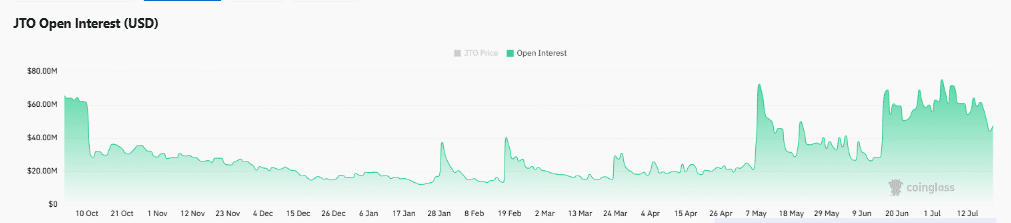
    Derivatives traders also increased their exposure as Open Interest (OI) rose 14.53% to $52.05 million at press time, during the rally. The increase suggested that fresh positions entered the market instead of existing contracts simply closing.

    Rising OI alongside double-digit price gains often reflected stronger market conviction because both spot and futures participants committed additional capital.

    Unlike rallies driven by declining derivatives exposure, $JTO‘s advance attracted broader participation across multiple trading segments. The combination suggested traders expected the bullish narrative surrounding JIP-38 to continue influencing price action.

    However, expanding leveraged exposure also increased the probability of sharper volatility should sentiment reverse or profit-taking accelerate after the recent advance.

    Source: CoinGlass

    Buyers maintained control across spot markets

    Spot market activity also favored buyers throughout the latest recovery.

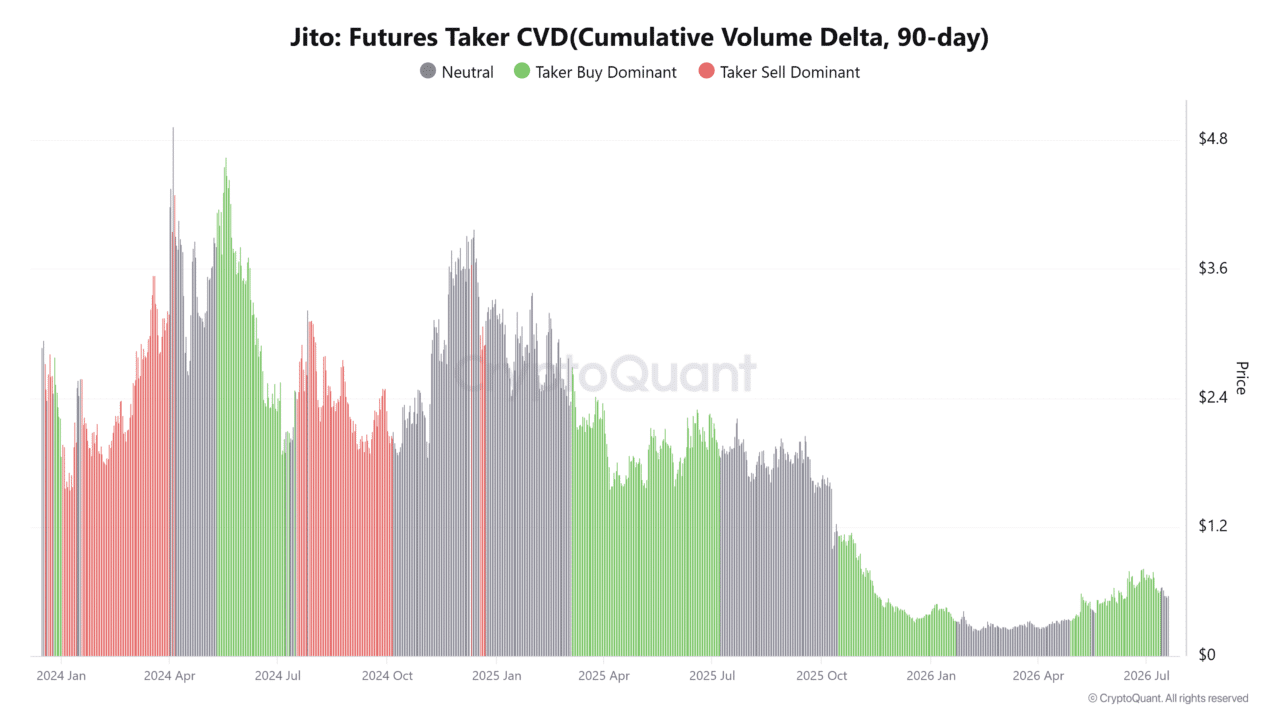
    At the time of writing, the 90-day Futures Taker CVD remained buy dominant, showing that aggressive market buyers consistently absorbed available sell orders. The behavior aligned with the sharp increase in trading volume, which expanded 142.17% over the previous day.

    Stronger buying pressure supported the price recovery instead of allowing sellers to regain control after recent weakness.

    In addition, the sustained demand complemented improving sentiment surrounding Jito’s revised tokenomics and the broader Solana ecosystem. Although buyers held the advantage, continued demand would remain necessary to absorb future profit-taking as speculative participation increased across both spot and derivatives markets.

    Source: CryptoQuant

    Can $JTO reclaim $0.80 next?

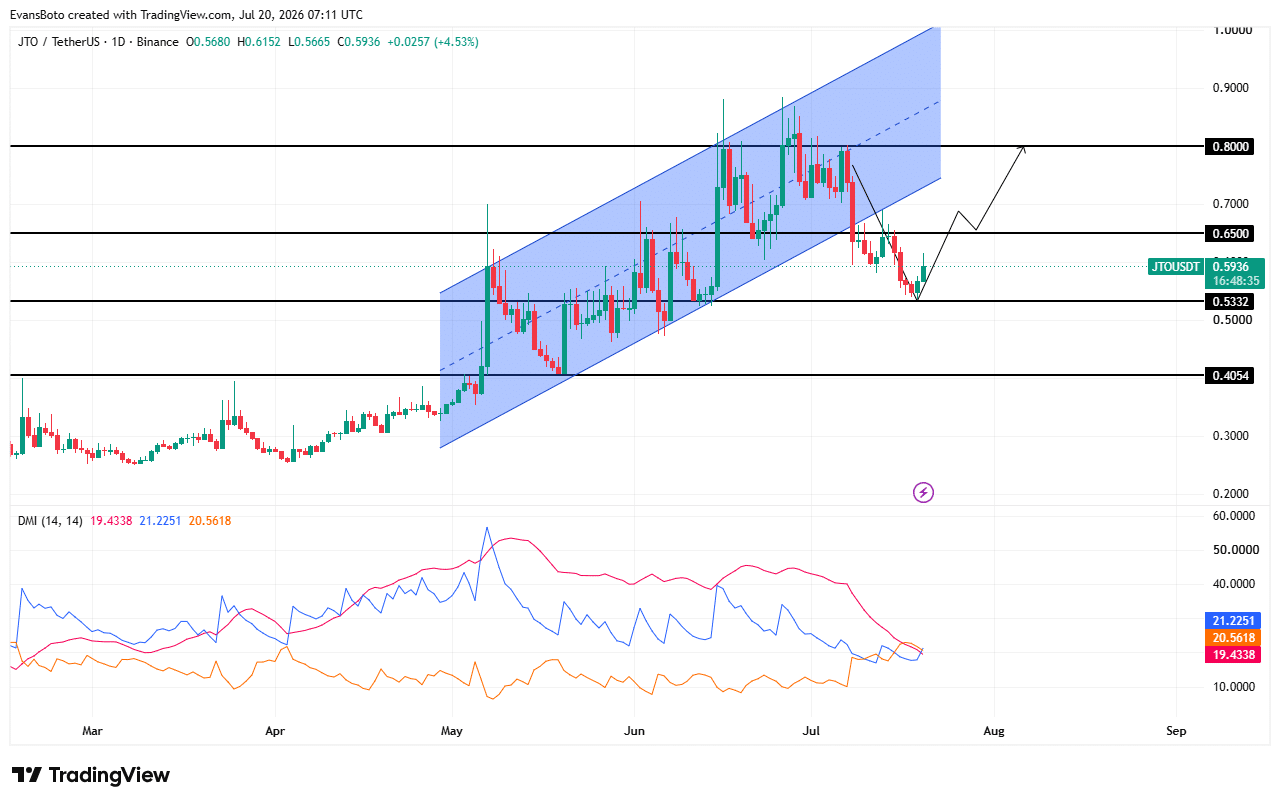
    $JTO rebounded from the $0.5332 support area after breaking below its broader ascending channel earlier.

    Buyers pushed the token back toward $0.6500, which now represented the nearest resistance before a possible move toward $0.8000. The Directional Movement Index (DMI) also reflected improving conditions.

    At press time, the +DI stood at 21.23, remaining above the -DI at 20.56, while the ADX measured 19.43, suggesting bullish strength had started improving but remained below the threshold associated with a strong trend.

    If buyers reclaimed $0.6500, the chart suggested a retest of $0.8000 could follow. However, failure to hold above $0.5332 would likely expose $JTO to another test of the $0.4054 support level.

    Source: TradingView

    Conclusively, $JTO’s rally reflected improving fundamentals, stronger buying pressure, and increasing trader participation rather than a purely speculative bounce.

    If buyers continue defending support and overcome the $0.6500 barrier, the token could challenge $0.8000 in the sessions ahead. However, weakening demand would likely delay that recovery and shift attention back toward the $0.5332 support zone.

    Final Summary

    • $JTO’s rally gained support from stronger buying activity and growing confidence after the JIP-38 proposal.
    • Rising Open Interest and steady spot demand kept bullish pressure intact, though $0.6500 remains the next key hurdle.
  • Judge Grants Temporary Restraining Order To Pause Paramount-Warner Bros Discovery Merger For 14 Days

    Judge Grants Temporary Restraining Order To Pause Paramount-Warner Bros Discovery Merger For 14 Days

    A federal judge has granted a temporary restraining order that will pause Paramount‘s merger with Warner Bros Discovery for 14 days.

    The order, issued Monday, is in response to a lawsuit filed by California Attorney General Rob Bonta and 11 other states, claiming that the proposed merger violates antitrust laws.

    U.S. District Judge Araceli Martinez-Olguin wrote that the state AGs “present compelling evidence that the combined firm resulting from the transaction will possess substantial market share in the wide-release theatrical distribution market.”

    “On this combined firm market share alone, the Court is persuaded that it can presume the proposed merger is likely to violate antitrust laws,” the judge wrote.

    Click here to read the judge’s order pausing the merger.

    The judge’s order bars Paramount and Warner Bros “from closing or consummating the Transaction or taking any steps, directly or indirectly, to integrate or consolidate their operations pursuant to the Transaction.”

    The states claim that the merger creates undue concentration in the markets for wide release films, distribution of anticipated top-grossing theatrical films, and licensing of basic cable channels.

    A TRO is an order to preserve the status quo in the short term as the judge more fully considers the merits of the case. But in her order, Martinez-Olguin wrote that the “balance of equities, combined with the public’s vital interest in antitrust enforcement, therefore tips sharply in favor of the requested injunctive relief.”

    The states had asked that a temporary restraining order was needed because Paramount had not made any guarantee that it would not close the transaction after July 22. The European Union is expected to make its decision on the transaction around that date.

    RELATED: Paramount Submits Concessions To Gain EU Approval For Warner Bros. Discovery Deal

    The judge’s granting of a TRO is not a major surprise, and Paramount had signaled that it would delay a close to the transaction. At a hearing on Friday, Paramount’s lead attorney, Jeffrey Kessler, said that they were prepared to commit to not closing the merger for the next 28 days.

    Bonta said in a statement, “This is a critical first win in our case to ensure this megamerger never sees the light of day.”

    He added, “We have a full tank of gas, the law on our side, and look forward to continuing to make our case.”

    New York Attorney General Letitia James said, “This lawsuit is about a simple fact: when one company controls a massive share of our film and television industries, workers, artists, businesses, and consumers suffer.”

    A Paramount spokesperson said, “We are confident the evidence will demonstrate that the State AGs’ antitrust arguments are without merit as their alleged markets and claims of anticompetitive effects are without any basis in modern market realities.  This merger is lawful, pro-competitive, and will benefit consumers, creators, workers, and the entertainment industry. We will continue to vigorously defend the transaction and will look forward to the hearings on the substance of the State AGs’ action.”

    The timing of the legal proceedings is significant. Paramount faces the prospect of paying a $7 million-per-day “ticking fee” to Warner Bros for each day that the transaction is not closed after September 30. That was a sweetener that Paramount made to win the bidding for WBD.

    The judge set a schedule for the stage AG’s motion for a preliminary injunction, which could halt the merger indefinitely as the legal process plays out. She set a hearing date of August 3, with the motion due by Thursday, the opposition brief from Paramount due by July 27 and the state AGs’ reply by July 30.

    The judge wrote that even though Paramount’s legal team argued that certain market concentration figures are not binding on the courts, they did not present “countervailing evidence” to rebut the data.

    Paramount also argued that the state AGs presented “fundamental misunderstandings and incorrect assumptions regarding the economics of theatrical film distribution in the United States,” pointing to the opinion of a competing expert witness. But the judge wrote that their proof still did not show that the merger would not “substantially lessen competition.”

    She wrote, “At best, Defendants’ proof regarding these robust, dynamic markets creates disputes regarding the facts and legality of the Transaction’s market effects.” She wrote that the state AGs showed that “serious questions going to the merits remain, weighing in favor of preliminary injunctive relief.”

    The judge also signaled that she was not sympathetic to Paramount’s arguments of economic harm if the merger is blocked beyond September 30. She waived the security requirement, typically the posting of a bond, “because Plaintiffs have demonstrated that Plaintiff States bring suit to enforce important public interests.”

    She wrote, “Even if Defendants argued that they would suffer economic harm as a result of delaying the merger, the equities do not weigh in their favor when contrasted with the potential public harms that would result from consummation of the Transaction, including the loss of competition.”

    The transaction looked to be on its way to closing in June, after the Justice Department announced that it was closing its investigation and, in a statement, explained why it believed that the merger was not anticompetitive.

    Paramount contends that the transaction would bolster competition in streaming, as the combination of Paramount and Warner Bros would stand a better chance against stronger rivals like Netflix, Disney+ and Amazon’s Prime Video.

    The states, though, focused on theatrical and cable markets, arguing that consolidation impacts theater owners and cable distributors, with consumers ultimately feeling the impact.

    In a footnote, the judge wrote that she could “not accept” that the transaction would benefit the streaming market, which is a Paramount defense. She wrote that courts “have expressly and repeatedly rejected the defense that a challenged merger will result in economic efficiencies ancillary to competition in the relevant market.”

    Jill Goldsmith contributed to this report.

  • Best Laptop Deal of the Day: Save $600 on a Stunning OmniBook Ultra With This Special Code

    Best Laptop Deal of the Day: Save $600 on a Stunning OmniBook Ultra With This Special Code

    If you spend most of your day staring at a screen, whether it’s for work on a weekday or gaming on a weekend, you want a display that’s worth looking at for hours on end. That means you want a high resolution, a high refresh rate, and, if you don’t already own one, something with built-in eye protection. 

    You shouldn’t buy a laptop just because of the screen, but it should be a very important part of your decision. Dazzling displays can add more than a few dollar signs to your cart if you aren’t careful, but HP just so happens to have the OmniBook Ultra with a particularly pretty configuration on sale for $600 off right now. As long as you use code ULTRA600, you can get this laptop for $1,199.99 instead of $1,799.99!

    HP OmniBook Ultra Laptop

    14-inch 3K OLED display, 100% DCI-P3, 512GB SSD, 16GB RAM, Intel Core Ultra 7 356H


    $1,199.99
    at HP

    $1,799.99
    Save $600.00


    Get Deal

    The OmniBook Ultra laptop sports a stunning 14-inch 3K OLED multitouch display that reaches from edge to edge to slim out any bezel distractions and keep your eyes on the prize (that is, whatever you’re working on in that moment). It’s made of durable Gorilla Glass 3, which makes this computer incredibly scratch-resistant, on top of its already super-sturdy metal chassis. It boasts 100% DCI-P3 color, which means this laptop is spectacular for creative work or streaming, where you want every color of the rainbow (and more) to pop right off the screen. 

    And depending on whether you’re viewing content in SDR or HDR, the display can hit up to 500 nits of brightness or 1100 nits of brightness, respectively—so if you’re doing some light gaming or high-quality streaming, this laptop will kick the brightness up several notches to deliver the best experience possible. Not to mention, the lightning-fast 0.2 ms response rate and silky smooth 120Hz refresh rate are just the cherry on top of the whole experience, whether you’re on this laptop for play or productivity. 

    Now, under the sleek, backlit keyboard, this OmniBook Ultra is powered by an Intel Core Ultra 7 356H processor that can reach speeds up to 4.7GHz. It’s a high-performance processor designed for multitasking, content creation, and demanding productivity sessions, and can even handle software development and video rendering if that’s part of your workflow! 

    But between the dazzling screen and that computing power (not to mention 512GB of SSD storage and 16GB of memory), the OmniBook Ultra stands out as a popular ultraportable for content creators. And at just under three pounds, slim at under half an inch thick, and capable of reaching a 50% charge in just 45 minutes, this laptop is basically begging you to take it on the go. In our review of a slightly different configuration, we thought the OmniBook Ultra might’ve looked a bit bland on the design front, but this particular model’s beautiful screen and performance make up for it once you open it up and get typing.

    More Laptop Deals

    *Deals are selected by our commerce team

    About Our Expert

  • Chloe Fineman Finds Her First Post-‘Saturday Night Live’ Gig

    Chloe Fineman Finds Her First Post-‘Saturday Night Live’ Gig

    Chloe Fineman has lined up her first big series regular credit post-Saturday Night Live.

    The performer, who announced on Thursday that she is leaving the iconic NBC sketch comedy show after seven seasons, has been slated to join the upcoming Netflix show Myron Bolitar as a series regular, the streamer announced on Monday. The upcoming series, an adaptation of a Harlan Coben’s thriller series about an NBA star-turned-sports agent that started with 1995’s Deal Breaker, will be co-showrun, written and executive produced by TV legend David E. Kelley and Kyle Long.

    Fineman is set to play Parker Quinn, a sports reporter for a top publication who’s known as a dogged reporter with a passion for her beat.

    Netflix announced Fineman’s casting on the show alongside that of Jabari Banks (Bel-Air) and Jamie McShane (Task, 1923), who will also be series regulars. Ben McKenzie, the star of The O.C. and Gotham, was also announced as a recurring guest star.

    They’ll be joining a cast including Colin Woodell (The Flight Attendant), who will star as Bolitar himself, KJ Apa (Riverdale) and Diane Guerrero (Doom Patrol). Matthew Tinker is executive producing for David E. Kelley Prods, Coben is executive producing for Final Twist Productions and Rick Muirragui is also executive producing.

    Veteran TV helmer Greg Yaitanes (Lucky, Dutton Ranch) will executive produce as well as direct several episodes.

    In an Instagram post announcing her departure from SNL, Fineman said, “It’s really hard to leave SNL but it does feel like the right time. I’m going to miss it a lot. But the people who work there are my family and that place is my home, and I know I’ll never be too far away.”

    After joining the long-running comedy show in 2019, Fineman has also racked up an acting resumé in other projects, as a character in Freakier Friday, Babylon, Despicable Me 4 and Search Party, among other roles.