Blog

  • Disney Unveils Annual Halloween Shop With Costumes, Decor and Coveted Starbucks Cup

    Disney Unveils Annual Halloween Shop With Costumes, Decor and Coveted Starbucks Cup

    If you purchase an independently reviewed product or service through a link on our website, The Hollywood Reporter may receive an affiliate commission.

    Spooky season has officially commenced — well, sort of.

    As is tradition, Disney Store’s annual online Halloween Shop had its 2026 grand opening during peak summer months — on Monday, July 27, to be exact. But just because it launches early, doesn’t mean it lasts long; this year’s product lineup is full of 2026-exclusive toys and collectibles along with an in-demand assortment of adult and kids’ costumes and clothes.

    And while fresh inventory is expected to roll out in the months leading up to October, Disney Store’s flagship drop, the Mickey Family Halloween Collection, has already made its debut, and product seems to be moving quickly.

    act fast

    Part of the Disney x Starbucks Collection, created especially for Disney Parks.

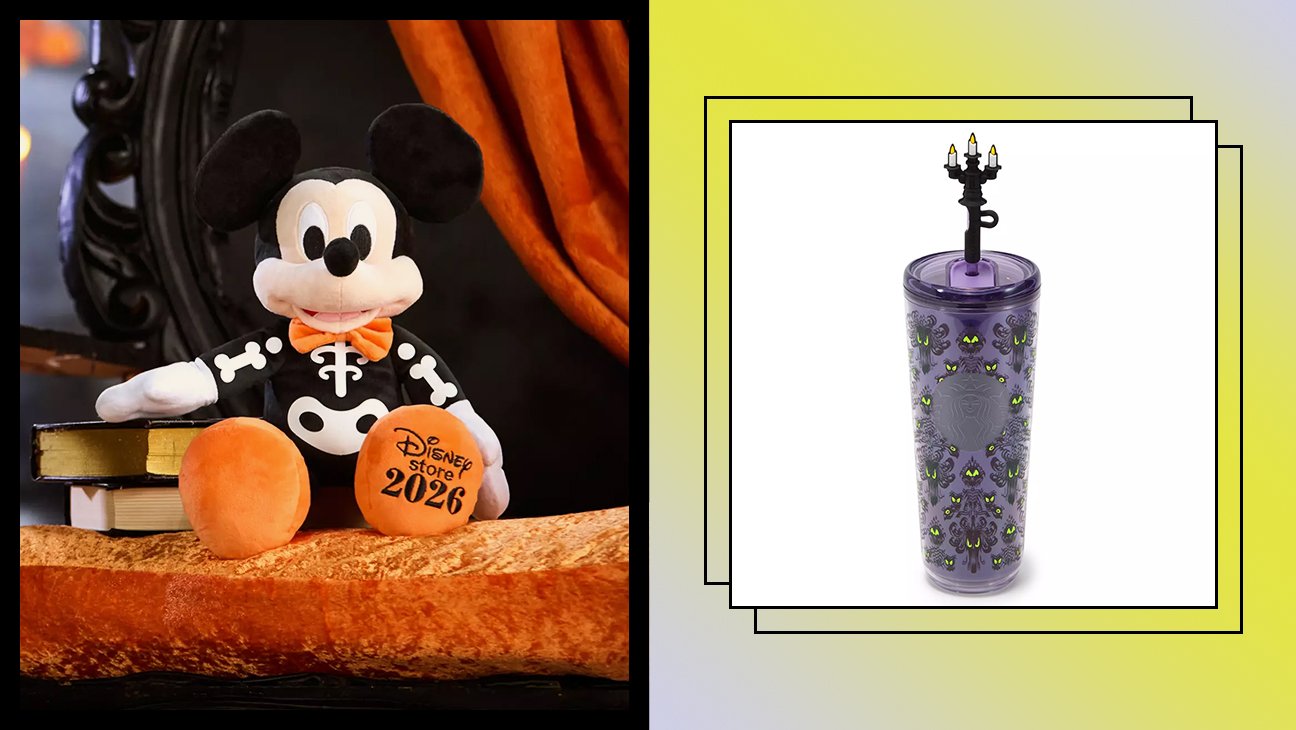
    While baby, toddler, children’s and adult costumes are coming in by the dozens, the real seasonal standouts — and typically, the most sought-after pieces during any of Disney’s limited-edition holiday drops — are in the toys and collectibles categories. For Halloween 2026, these come in the form of Mickey Mouse and Minnie Mouse plushes, each embroidered with “Disney Store 2026” on foot, and, of course, the cult-favorite Disney x Starbucks travel tumbler, which, in this case, is inspired by The Haunted Mansion. And if this collaborative Starbucks cup is anything like past launches, inventory surely won’t last long.

    exclusive

    Measures approx. 14 1/4″ high.

    exclusive

    Measures approx. 14 1/4″ high.

    As for Halloween decorations (which certainly teeter into collectible territory), items span from Mickey Mouse jack-o’-lantern buckets, stoneware bowls and light-up wreaths to their spookier companions in The Nightmare Before Christmas, Disney Villains and The Haunted Mansion collections. Stock up on the full selection of seasonal staples, while supplies last, at DisneyStore.com, and shop a few more 2026 highlights below.

    Select Disney x Crocs Halloween styles also available on Amazon.

    Includes four figures: the Hitchhiking Ghosts (Phineas, Ezra and Gus) and the Hatbox Ghost

    Reveal a new surprise each day from Oct. 19 through 31.

    One size fits most adults.

    Set of two pins.

  • United Airlines Bans Humanoid, Animal-Like Robots From Flights

    United Airlines Bans Humanoid, Animal-Like Robots From Flights

    “Humanoid and animal-like robots” now rank as machina non grata at United Airlines.

    The Chicago-based carrier updated its “dangerous items list” last week to ban passengers from taking those non-human companions on flights, whether they have their own seat or get tucked into the baggage hold.

    That clause of United’s policy defines each category in duck-test phrasing: “A humanoid robot is an artificial intelligence-driven or remote-controlled machine that mimics how a human looks, moves, thinks, and speaks,” while “An ‘animal-like robot’ is an artificial intelligence-driven or remote-controlled machine that looks and behaves like an animal.”

    The change did not get much, if any, public attention at first, but Live and Let’s Fly blogger Matthew Klint flagged it on Monday, citing internal communication from the airline and longstanding flight-safety concerns about the fire risks posed by lithium-ion batteries in robots and many other gadgets. Years ago, that risk assessment led airlines to ban people from checking in “smart” luggage unless they removed the rechargeable batteries from those connected bags. 

    United, an early adopter of AI and other forms of automation, confirmed that this rule is driven by safety considerations. “We no longer allow humanoid and animal-like robots in the cabin or as checked baggage,” spokesman Charles Hobart said in an email. “Yes, these devices often use batteries that we do not accept on board or in checked baggage, and we believe this change will help further ensure the safety of our customers and crews.”

    Smaller robots may still fly; the new policy mentions “small toys and gadgets” if they meet United’s other safety rules. The most important criteria in this context govern batteries: A device’s lithium-ion battery can’t hold more than 100 watt-hours. If it has two, their combined capacity can’t exceed 160 watt-hours, and any device with three or more will have to stay grounded. 

    So, while a full-size version of Star Wars’ C-3PO (or a Tesla Optimus robot, should it ever reach commercial reality) would be right out, you might be able to carry on a smaller R2-D2 if its battery was small enough or wasn’t lithium-based. 

    United is the second major US airline to restrict robots. Southwest Airlines, which has also been more aggressive than its competitors in restricting power banks, added its own ban on “human-like” and “animal-like” robots in May.

    Recommended by Our Editors

    The proximate cause of that appeared to be the owner of a robot-rental studio in Dallas, Aaron Mehdizadeh, bringing a compact humanoid robot nicknamed Stewie on a Southwest flight from Las Vegas to Dallas. Despite what Mehdizadeh described in a post on X as extensive efforts to comply with Southwest’s then-published rules, including equipping Stewie with a battery “just under the legal limit” and then buckling in that bipedal bot like any other passenger, the Dallas-based airline was evidently not amused. 

    While commercial aviation may be cooling on the idea of robots as cargo, self-loading or otherwise, the industry does not appear to harbor any general resentment toward “clankers” or be possessed by the FCC’s recent angst over snooping by imported robots.  

    Tokyo’s Haneda Airport is now testing humanoid baggage-handling robots, some manufacturers of “ground support equipment” like aircraft tugs are developing automated versions of them, and many of United’s airport lounges already feature wheeled robots that glide back and forth to collect plates, utensils, and glasses from guests.

    About Our Expert

  • ‘Star Wars’ On-Set Visual Effects Workers Unionize

    ‘Star Wars’ On-Set Visual Effects Workers Unionize

    IATSE’s visual effects organizing drive has reached the galaxy far, far away.

    A group of on-set VFX professionals working on various Star Wars franchise titles have unionized with IATSE, the crew union announced on Tuesday. A group of workers on titles including the recently released film The Mandalorian and Grogu, the upcoming season of the series Ahsoka and the forthcoming film Starfighter will join IATSE after they demonstrated what the union called “overwhelming” support for joining the labor organization.

    “These workers help bring some of the most ambitious stories in entertainment to life, and they deserve a meaningful voice in shaping their working conditions,” IATSE international president Matt Loeb said in a statement. “We are proud to welcome these visual effects professionals into our proud union.”

    IATSE did not disclose how many workers were included in the bargaining unit or what roles they play on the Star Wars productions. It also wasn’t clear as of press time where the workers were based or whether the union was voluntarily recognized by the employer, as it appears it was.

    The next step for the unionized group will be negotiating a first contract with Lucasfilm. The Disney-owned company did not respond to a request for comment.

    The addition of the on-set Star Wars workers is a major development for IATSE, which began its latest attempt to unionize the visual effects field a few years ago. The campaign began with some splashy wins at Marvel and Disney in 2023, and visual effects workers on Avatar unionized the following year. The union has since notched bargaining units in smaller settings — with workers on Saturday Night Live and on Apple TV+ shows, for example — but the Star Wars union adds more blockbuster work to the mix.

    With its recent attempt to organize the visual effects field, IATSE has largely homed in on workers employed directly by film and television productions, rather than those working for high-profile vendors like Weta FX and Industrial Light & Magic. It’s generally taken aim at crewmembers including data wranglers, coordinators, production supervisors and witness camera operators. 

    “Previous attempts were looking essentially to organize the artists of the vendors who are strategically more precarious,” IATSE organizer Mark Patch previously explained to THR.

  • ‘The Gilded Age’ Star Ben Ahlers and Wesley Taylor Wrap Workplace Satire Short ‘Movin’ On Up’ (EXCLUSIVE)

    ‘The Gilded Age’ Star Ben Ahlers and Wesley Taylor Wrap Workplace Satire Short ‘Movin’ On Up’ (EXCLUSIVE)

    “The Gilded Age” star Ben Ahlers and Wesley Taylor have wrapped production on ‘Movin’ On Up,’ a workplace satire short film directed by Jacob Wahba .

    Taylor (“Only Murders In The Building,” “Smash,” “Spongebob Squarepants: The Musical”) stars as a directionless white-collar worker who is catapulted up the corporate ladder. He lands in an “MGM Musical Meets Silicon Valley world” where employees dance through the halls and the company’s actual purpose is a mystery.

    The cast also features Ainsley Seiger (“Law and Order: Organized Crime”), David Mattar Merten (“Enemy of the People”) and Denise Lute (“The Path,” “Up Here”).

    The aesthetics of the satiric short were “inspired by the intricacy of 1950s MGM musicals—films like ‘Singin’ in the Rain’ and the work of Vincente Minnelli and Busby Berkeley,” Jacob Wahba said Tuesday. The short film is Wahba’s film directorial debut, following work across editorial campaigns, New York City theatrical productions and 20th Century television series.

    “It captures a uniquely 2020s feeling that we all have inside of us – that feeling of ‘I’m not sure what I’m doing, but if I don’t do it fast I might die.’ It’s unsettling in real life, but hilarious on screen,” writer Patrick Daly said.

    Max Johnson, Chloé Ryan and Wahba are producers, with executive producers Frankie Seratch and David Treatman, co-producers Maria Noto and Daly, and associate producers Katherine McGuire and Joseph Hayes. 

    Pierre Marais (“As Apple Pie,” “Ghost Light), recently a leading man in Broadway’s “Sunset Boulevard,” served as editor. Veteran studio gaffer Jason Velez (“The Meyerowitz Stories,” “When They See Us”) is director of photography, while costumes are by Kala La Fortune Reed (“Only Murders in the Building,” “Musica”), production design by Lucas Degirolamo (“Run Amok,” “The Mill”) and choreography by Matthew Steffens (“Once Upon a Mattress,” “Into the Woods”). Joseph Hayes (“The Alto Knights,” “The Bear,” “Masquerade”) served as casting director. Composers are Natalia Karaseva and Christian McGhee and Zachary Schur is music supervisor.

    Ahlers is repped by Gersh and Artists First. Taylor is with Innovative and Anonymous. Seiger is repped by Gersh and Authentic. Merten is with Innovative and CLA Partners and Lute is repped by the Bloc Agency.


  • ‘Jumanji: Open World’ Trailer Takes Dwayne Johnson, Jack Black, Kevin Hart Out of the Console

    ‘Jumanji: Open World’ Trailer Takes Dwayne Johnson, Jack Black, Kevin Hart Out of the Console

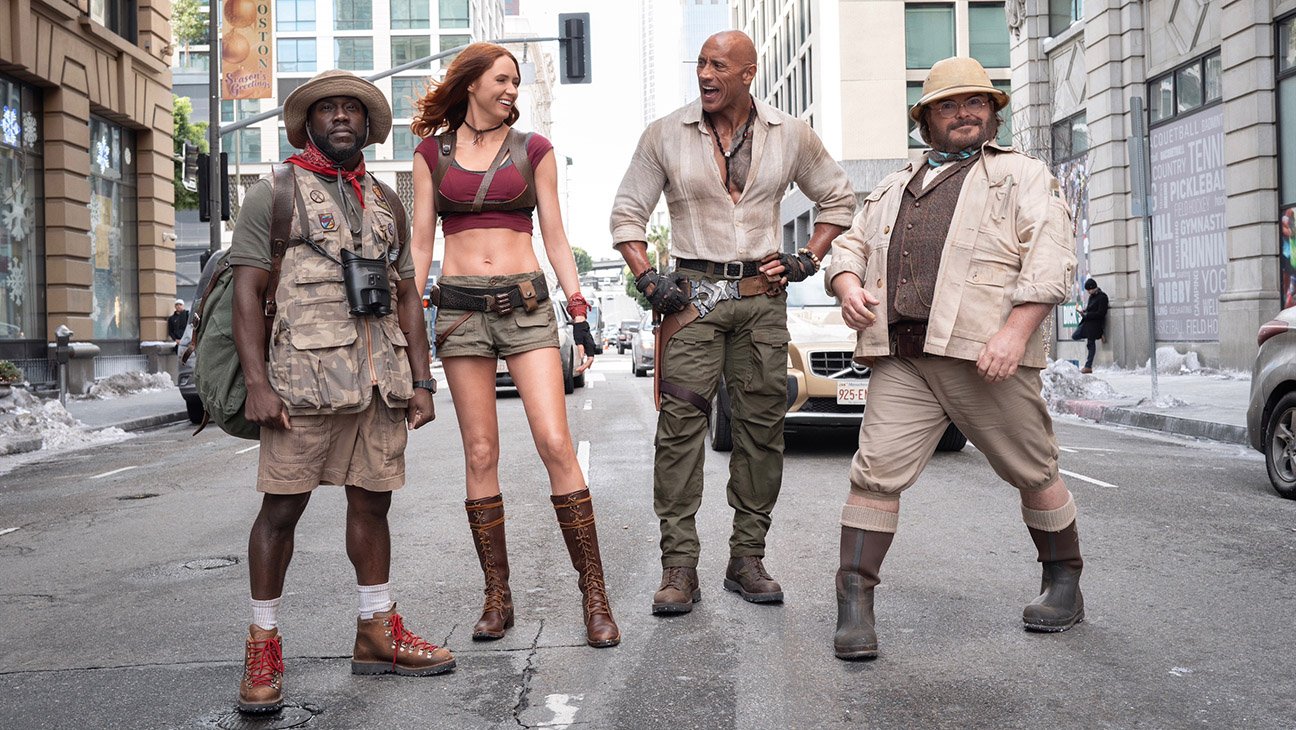
    Dwayne Johnson, Jack Black, Kevin Hart and Karen Gillan are leaving the jungle behind in the first trailer for Jumanji: Open World.

    Sony Pictures is set to release director Jake Kasdan‘s film in theaters on Dec. 25. Nick Jonas, Alex Wolff, Morgan Turner, Ser’Darius Blain, Madison Iseman, Rhys Darby and Danny DeVito round out the cast for the final installment in the trilogy.

    Jumanji: Open World centers on the game’s heroes breaking free of its console and wreaking havoc on our world. The trailer shows Johnson, Black, Hart and Gillan in the real world as stilted versions of the video game avatars they play.

    Wolff’s character explains, “We have a problem. They’re video game characters, but they’re stuck in demo mode.”

    This movie follows 2017’s Jumanji: The Next Level, which rebooted the franchise after Robin Williams starred in a 1995 feature version adapting Chris Van Allsburg’s 1981 children’s book. Kasdan, who directed the 2017 film and its 2019 sequel, returns to helm Open World from a script he co-wrote with Jeff Pinkner and Scott Rosenberg. Kasdan, Johnson, Matt Tolmach, Dany Garcia and Hiram Garcia serve as producers.

    Welcome to the Jungle focused on a group of teenage friends getting trapped inside a video game as a collection of adult avatars. It hit theaters in December 2017 and surpassed $950 million at the global box office. The 2019 sequel, subtitled The Next Level, topped $801 million globally.

    Johnson, Hart and Black took the stage at CinemaCon earlier this year, where they unveiled the new movie’s first footage and revealed the title. Black told the crowd, “I’ve never had more fun working on a movie. This is my favorite so far.”

  • Ethereum Wallet Count Crosses 200 Million: What It Signals for Adoption

    Ethereum Wallet Count Crosses 200 Million: What It Signals for Adoption

    The number of wallets holding Ethereum ($ETH) has surpassed 200 million, according to data reported by Cointelegraph. This milestone reflects a steady increase in user engagement with the Ethereum network, driven by decentralized finance (DeFi), non-fungible tokens (NFTs), and growing institutional interest.

    Network Growth in Context

    Ethereum’s wallet count has more than doubled since early 2021, when it first crossed 100 million wallets. The latest figure of 200 million includes both active and dormant addresses that hold a non-zero balance of $ETH. While not every wallet represents a unique individual — some users control multiple addresses — the metric is widely used as a proxy for overall network adoption.

    The growth comes despite periods of market volatility and shifting regulatory landscapes. Ethereum’s transition to proof-of-stake in September 2022, known as the Merge, improved energy efficiency and laid the groundwork for future scalability upgrades, which may have encouraged new users to enter the ecosystem.

    Implications for the Broader Crypto Market

    A wallet count of 200 million suggests that Ethereum’s user base is expanding beyond early adopters into a more mainstream audience. This is significant because Ethereum serves as the foundation for a large portion of the decentralized application (dApp) ecosystem, including lending protocols, decentralized exchanges, and $NFT marketplaces.

    Analysts note that wallet growth often correlates with increased transaction volume and network activity. However, it does not directly indicate price appreciation, as market sentiment and macroeconomic factors also play substantial roles. The milestone reinforces Ethereum’s position as the leading smart contract platform by user adoption, though competitors like Solana and Avalanche continue to attract users with lower fees and faster transaction times.

    What This Means for Everyday Users

    For retail investors and crypto enthusiasts, a larger wallet base can imply greater network security and liquidity. More participants generally lead to a more decentralized and resilient network. It also suggests that tools and services built on Ethereum — such as wallets, exchanges, and dApps — are becoming more accessible to non-technical users.

    However, users should remain aware of risks, including network congestion during peak usage and fluctuating gas fees. Layer-2 scaling solutions like Arbitrum and Optimism aim to mitigate these issues by processing transactions off the main chain while maintaining security.

    Conclusion

    The crossing of 200 million Ethereum wallets is a notable indicator of the network’s maturation and continued relevance in the cryptocurrency space. While the metric alone does not predict market direction, it underscores a growing base of users who are engaging with Ethereum’s ecosystem. As scalability improvements roll out and regulatory clarity evolves, the trend may accelerate, further cementing Ethereum’s role in the digital economy.

    FAQs

    Q1: Does 200 million wallets mean 200 million people use Ethereum?
    No. Many users control multiple wallets, so the number of unique individuals is likely lower. The figure represents addresses with a non-zero $ETH balance, not necessarily active users.

    Q2: How does this compare to Bitcoin’s wallet count?
    Bitcoin’s wallet count is estimated at around 50–60 million addresses with a non-zero balance. Ethereum’s higher count reflects its broader utility for smart contracts and dApps.

    Q3: Is this milestone bullish for $ETH price?
    Not directly. Wallet growth indicates adoption, but price is influenced by many factors including market sentiment, regulation, and macroeconomic conditions. It is a positive signal for network health, not a price guarantee.

  • Noah Kahan Slams White House for Using Song in Social Media Post: ‘Would Never Approve’

    Noah Kahan Slams White House for Using Song in Social Media Post: ‘Would Never Approve’

    Noah Kahan is the latest among musicians firing back against the White House for using their music on social media, responding to an Instagram post that utilized his song “American Cars.”

    The White House post from Monday featured images of President Donald Trump while visiting General Motors’ flagship test site in Michigan. After many fans tagged Kahan in the comments, he responded on Tuesday afternoon with a message of disapproval: “Would never approve of my music being used in support of you or this administration.”

    “American Cars” was used in White House posts on both Instagram and TikTok. It appears the sound was disabled on Instagram, but is still included on the TikTok post. Noah Levine, who co-wrote “American Cars” with Kahan, also left an Instagram comment that was much more pointed, writing, “You fat fuck this song isn’t for you.”

    Representatives for Kahan and the White House did not immediately respond to Variety‘s request for comment.

    Kahan joins a growing list of artists who have spoken out against the White House for using their music on social media. This past weekend, Katy Perry blasted the administration for using her 2010 hit “Firework” in a TikTok post that included footage of military strikes. “I am deeply appalled and angry to see ‘Firework’ used on the @WhiteHouse TikTok account as a backing track for video footage of military strikes,” she wrote on X. “I did not approve this, I was not asked, and I absolutely do not condone it.”

    In June, Ariana Grande shared similar sentiments after the White House used a version of her 2024 song “Bye” in a TikTok post that depicted ICE agents arresting and handcuffing people. Sabrina Carpenter, Olivia Rodrigo, Celine Dion, Neil Young and the Rolling Stones have also criticized Trump for using their songs.

  • Markets Don’t Buy the US Ceasefire Against Iran Will Last

    Markets Don’t Buy the US Ceasefire Against Iran Will Last

    In brief

    • The United States announced a ceasefire with Iran yesterday, but markets aren’t optimistic it will last.
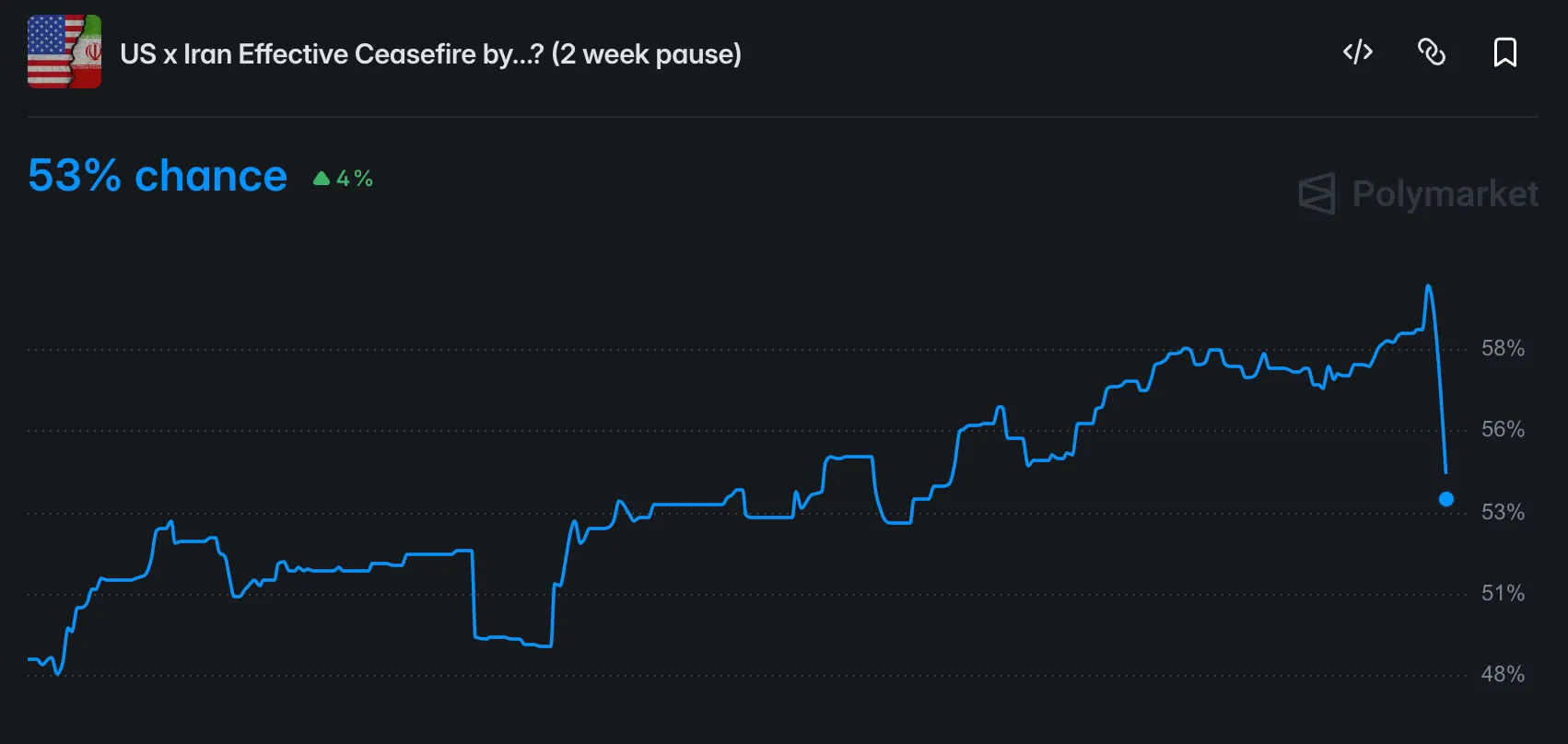
    • The odds that the ceasefire lasts a continuous 14 days dumped by 10% on Polymarket today.
    • The U.S. and Iran had held fire for a third day by Monday, but President Trump warned military action could resume if diplomacy fails.

    The United States seems to have announced a ceasefire yesterday on its offensive actions against Iran. But prediction markets are not too optimistic about how long that peace will last.

    A Polymarket contract requiring a continuous 14-day period without a U.S. airstrike or surface-to-surface missile strike directly hitting Iranian territory dumped from over 60% to around 53% today.

    A ceasefire is a sustained halt in fighting, not simply an announcement that commanders are taking a breather.

    That creates a pretty big gap. Traders are pricing in around 50-50 odds that the U.S. won’t be able to contain its will to shoot for two whole weeks.

    The skepticism is not paranoia. The U.S. and Iran had held fire for a third day by Monday after 13 consecutive nights of U.S. strikes, but President Donald Trump told Axios he was ready to return to “very strong military action” if talks fail.

    Iran, meanwhile, denied that direct negotiations were taking place, saying mediators were carrying messages.

    Myriad, a prediction market developed by Decrypt’s parent company Dastan, separately tracks whether the next formal senior-level round of U.S.-Iran peace talks begins by July 31. Its rules exclude technical meetings, phone calls, and messages exchanged through mediators unless they form part of a formally convened senior-level round.

    Most of the money is put into such conversations being delayed until next month.

    We’ve seen this movie before. An April ceasefire sent Bitcoin and oil markets sharply higher, but analysts called it “fragile breathing room.”

    Days later, prediction markets still doubted that Strait of Hormuz shipping would normalize because ships were still turning back.

    The July 31 Polymarket contract can remain open into mid-August because the required 14-day no-strike period only needs to begin by July 31.

    Daily Debrief Newsletter

    Start every day with the top news stories right now, plus original features, a podcast, videos and more.

  • Vitalik Introduces Diamond iO: A Breakthrough in Crypto Encryption Timescales

    Vitalik Introduces Diamond iO: A Breakthrough in Crypto Encryption Timescales

    Vitalik Buterin has pitched the Diamond indistinguishability obfuscation (iO), a novel cryptographic framework that promises to deliver blockchain privacy and trustless infrastructure in both crypto and Web3.

    Vitalik proposes new blockchain privacy technology

    In his latest blog, the Ethereum co-founder describes Diamond iO as a tool that would enable user interaction with encrypted software, but in such a manner that the program’s underlying logic, code, and keys remain secret. Diamond iO would run on Fully Homomorphic Encryption (FHE) inside a modified Attribute-Based Encryption (ABE) scheme.

    Unlike historical assumptions about iO, Buterin’s proposal could theoretically reduce the time it takes to run hidden program logic from a “universal-level” to a “planet-level” timescale. This would lay the groundwork for several privacy-preserving applications, including:

    1. On-chain voting where the program tallies votes and displays results without the need for a centralized tallying body.
    2. Private key use where applications can deploy private keys without risking their exposure.
    3. Trustless cryptographic infrastructure where developers can build secure software licensing protocols and decentralized, trustless Web3 services.
    4. Privacy-first blockchain and AI systems where artificial intelligence (AI) and smart contracts can process sensitive data with zero leakages.

    Current limitations and competition

    While Diamond iO is a viable proposition, it still requires extensive research and peer review before deployment. It also demands heavy computational input and tight circuit depth limits and will therefore require additional optimization studies.

    Nonetheless, the idea speaks to the ever-growing need for privacy preservation on-chain and beyond, for both individuals and corporate entities.

  • ‘Jumanji: Open World’ Trailer: Dwayne Johnson, Kevin Hart and Jack Black Return for Third and Final Movie

    ‘Jumanji: Open World’ Trailer: Dwayne Johnson, Kevin Hart and Jack Black Return for Third and Final Movie

    Sony has unveiled the trailer for the third entry in the “Jumanji” franchise, titled “Jumanji: Open World.” The teaser offers fans their first glimpse of the returning ensemble cast, including Dwayne Johnson, Kevin Hart, Jack Black and Karen Gillan.

    The third film follows the global success of 2017’s “Jumanji: Welcome to the Jungle” and 2019’s “Jumanji: The Next Level,” which together grossed more than $1.7 billion worldwide. The rebooted franchise reimagines the iconic 1995 original starring the late Robin Williams and a 13-year-old Kirsten Dunst. The reboots transitioned the story from the classic Jumanji board game to a video game, following a group of teenagers whose in-game avatars are played by Johnson, Hart, Black and Gillan.

    The core quartet is back in action, signaling a continuation of the franchise’s mix of action, comedy and body-swap hijinks that defined the previous films. Returning cast members also include Danny DeVito, Nick Jonas, Awkwafina, Marin Hinkle, Bebe Neuwirth, Lamorne Morris and Rhys Darby, with newcomers Dan Hildebrand and Jack Jewkes joining the ensemble.

    Jake Kasdan, who helmed the first two reboot films, returns to direct from a screenplay he co-wrote with Jeff Pinkner and Scott Rosenberg. Producers include Matt Tolmach, Johnson, Dany Garcia, Hiram Garcia and Kasdan.

    The film was originally scheduled for a Dec. 11 release but has been pushed back to Christmas. The new Christmas release positions “Jumanji 3” to arrive in theaters just after the Dec. 18 debuts of “Dune: Part Three” and “Avengers: Doomsday,” a blockbuster showdown that fans have dubbed “Dunesday.”

    Watch the trailer below.