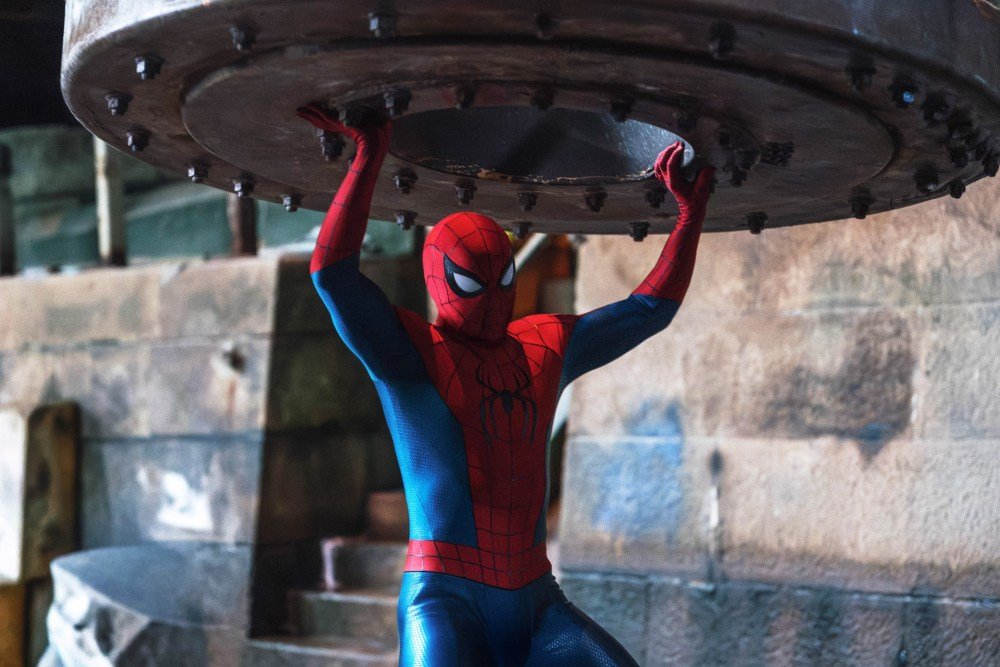
While Marvel fans are expected to turn out in droves to see “Spider-Man: Brand New Day” in theaters this weekend, a high-quality bootleg of the film leaked on X, with millions of people having viewed it.
Posted by an account named Fredrick Bryan at 6:05 a.m. PT, the leaked video reached 5.9 million accounts and counting, with over 143,000 people liking the post and 10,000 people resharing before it was taken down around 3:25 p.m. PT.
Several other X accounts also posted copies, though most didn’t last long on the platform. Studios typically send infringement notices to those posting unauthorized copies, though it can be difficult to keep ahead of the volume of posting for the most popular new films.
Sony had no comment.
“Brand New Day” is far from the first big-budget film to leak online. Last week, Christopher Nolan’s tentpole “The Odyssey” leaked on X with its own high-quality bootleg. It reached 2.1 million views within two and a half hours and was eventually taken down with a notice. The account itself was suspended as well.
Addressing “The Odyssey” leak, Universal issued a statement to Variety on Sunday: “We became aware of the unauthorized posting of the film and immediately initiated takedown protocols. We take copyright infringement seriously and will pursue all appropriate remedies to protect our content and intellectual property rights.”
Regardless of the leak, “Brand New Day” is already doing exceptional business at the box office. It made a record-breaking $72 million in previews, including Tuesday early access screenings — the most of any movie in history. That placed it above “Avengers: Endgame,” which grossed $60 million in Thursday previews.
“Brand New Day” sees the return of Tom Holland as the famous web-slinger, with Emmy-winner Zendaya returning as MJ. The cast also includes Sadie Sink in a mystery role, Jon Bernthal and Jacob Batalon.
U.S Treasury Secretary Scott Bessent has dismissed Senate Democrats for stalling the crypto market structure bill, the CLARITY Act.
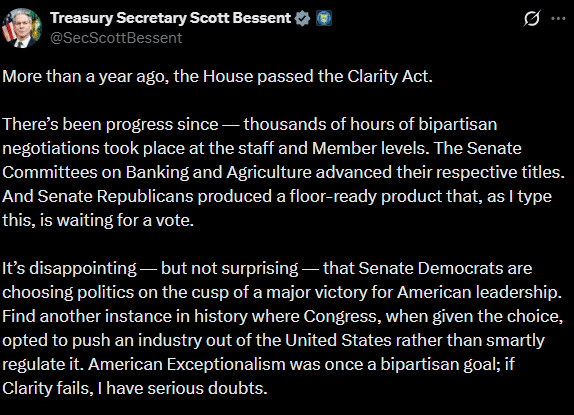
In a statement on Thursday, the 30th of July, Bessent noted that Democrats’ opposition was not surprising but “disappointing.”
It’s disappointing — but not surprising — that Senate Democrats are choosing politics on the cusp of a major victory for American leadership. American Exceptionalism was once a bipartisan goal; if Clarity fails, I have serious doubts.
The Senate Democrats, including pro-crypto ones such as Angela Alsobrooks and Ruben Gallego, withheld support for the bill, citing ethics, developer protections (BRCA) and illicit finance provisions.
For Bessent, some of the raised concerns, like developer protections under the Blockchain Regulatory Certainty Act (BRCA), formalize some historical government policies.
The BRCA does nothing other than codify longstanding Treasury Department policy: non-custodial builders and developers are not, and have never been, subject to registration obligations under the Bank Secrecy Act.
Source: X
Clarity Act: Republican support falters
That said, Sen Thom Tillis (R-NC) and Ruben Gallego (D-AZ) reportedly reached an ethics deal. The draft included the role of state attorneys general (AGs).
This is one of the key demands Democrats had pushed for, arguing that ethics cases and oversight can not be left to the Department of Justice (DoJ) alone.
Whether this will be enough to win over Senate Democrats is unclear. But there is only 1 week before the August recess. Additionally, other bills like the ‘SAVE America’ Act are also being prioritized by President Donald Trump.
At the same time, the CLARITY Act does not have unanimous support amongst Republicans. AMBCrypto had earlier estimated that only about 49 Senate Republicans would support the bill. Now, Josh Hawley (R-MO) is reportedly a holdout, according to pro-crypto Sen. Cynthia Lummis.
She noted,
Republican support is very high. But I don’t think it will be unanimous, as people like Josh Hawley are really resistant. I think we’ll have an overwhelming majority.
In other words, Republicans will need over 11 Democratic votes to pass the bill on the Senate floor.
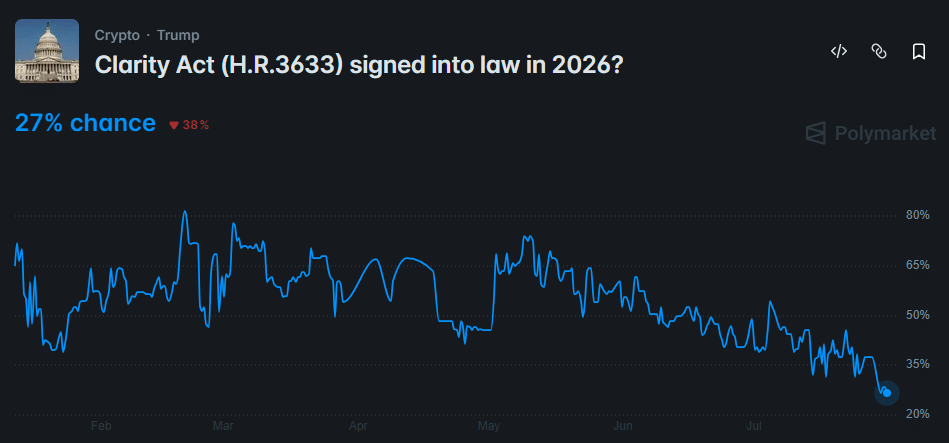
That said, as of writing, early Friday, the market was very pessimistic about CLARITY Act passage this year. The odds dropped to another yearly low of 27%.
Source: Polymarket
Overall, there is movement to resolve the ethics provision stalemate. But White House priority and the incoming August recess have made the market doubt the bill’s potential progress next week.
Final Summary
U.S Treasury Secretary Bessent was “disappointed” with Senate Democrats’ opposition to the CLARITY Act.
Chances of the bill’s passage dropped to a record yearly low of 27% amid a shrinking window
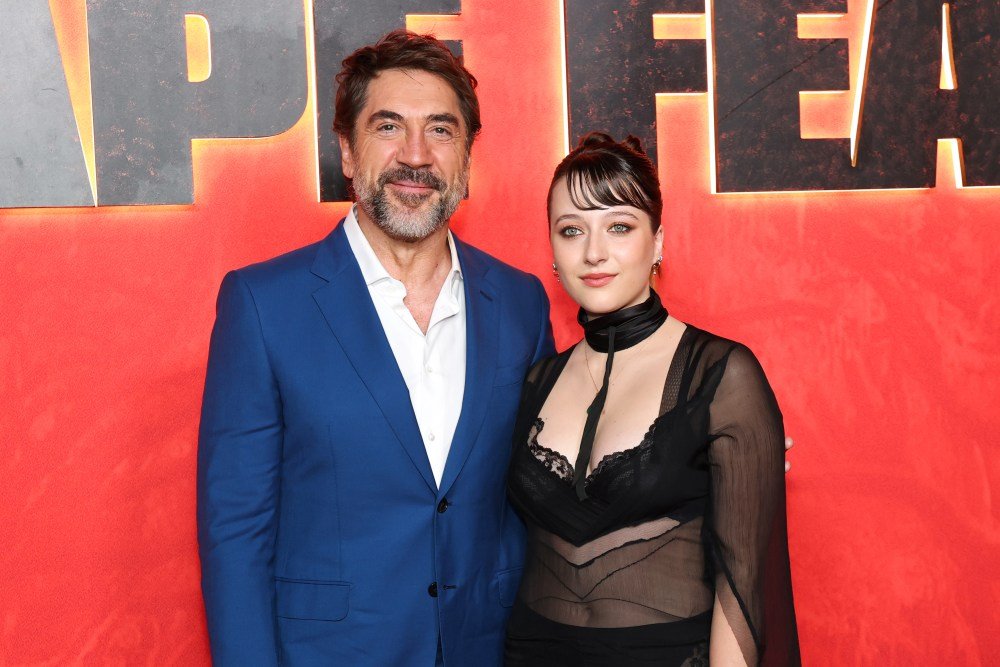
In 2007, Javier Bardem delivered one of the century’s most chilling performances as Anton Chigurh in “No Country for Old Men.” Nearly two decades later, he’s proved once again he could convincingly play a sociopath, reimagining the vengeful murderer Max Cady on Apple TV+’s hit summer series “Cape Fear.”
Cady was previously played by Robert Mitchum in 1962 and Robert De Niro in 1991, but the brilliance of Bardem’s performance lies in the long stretches of perceived stillness, heightening the tension of the cat-and-mouse game he plays with the Bowden family, which star Lily Collias described as “a lot of fun” but “sometimes very jarring.”
“We’re playing cat and mouse, and then the cameras turn off, and I still feel like a mouse,” Collias told Variety at the “Cape Fear” finale screening in New York. “And he still feels like Tom from ‘Tom and Jerry.’”
Collias plays Natalie Bowden, the daughter of Anna (Amy Adams) and Tom (Patrick Wilson), two lawyers who Bardem’s Cady blames for his incarceration. After 10 episodes of buildup, the series finale depicts an epic battle in which Cady invades the Bowden’s home, placing Anna and Tom on “trial” for colluding against him and threatening their children.
“[Episode] 10 felt almost like a play,” Collias said. “It was just the family and him in the house, and we were doing the most insane things and laughing so hard off camera. It felt like such a joy that it was actually a beautiful time.”
Before filming one violent sequence in which Cady grabs Natalie by the hair, Collias says Bardem politely apologized in advance and made sure she felt comfortable with the physicality.
“We would go through such weird circumstances, it’s little things that make me still giggle to this day,” Collias said. “In Episode 10, there’s one point where he has to grab me by my hair, and before the scene, he’s like, ‘I’m so sorry, my love. Is it OK if I just — I’m going to grab you like that?’ I’m like, ‘Yeah, that’s fine.’ Then we start rolling and I see this thing coming up to me and I’m like, ‘What the fuck?! Well, OK, that’s your job!’”
When asked about filming the intense finale scenes, Bardem smirked, explaining how he’s learned to lean into the “play” involved with acting as he’s gotten older.
“For me, it’s more about a game,” Bardem said. “You use your imagination to jump in and step out of it. I respect everybody’s process, as long as those processes respect other people’s processes. For me, the fun part is to really be part of a group of people that imagine things that don’t exist, and they create it together based on the fact that it’s all a big lie.”
Researchers at Galaxy Digital say about $70 million has been stolen due to an exploit in the popular Bitcoin wallet Coldcard.
The attack was enabled by a firmware bug that dramatically reduced the randomness of how the wallet creates its secret recovery phrase.
According to Galaxy, the vast majority of the funds were stolen in less than an hour.
“While new attacks are likely to occur if users do not migrate their funds out of affected Coldcard-generated addresses, the initial attack is identifiable onchain. Note that this analysis may not be complete, but it represents our best-efforts attempt at scoping the initial impact…
The full event spans six blocks and 41 minutes. Three intervening blocks contain no sweep activity at all, suggesting the transactions were broadcast in batches rather than streamed…
The loss profile is dominated by sub-1 $BTC addresses in count, but by 1-50 $BTC addresses in value. This is the shape of individual self-custody, not institutional or exchange holdings.”
Coinkite, the company behind Coldcard, says it takes full accountability for the firmware bug and has apologized to affected users.
The company has released emergency firmware updates for all affected models: version 4.2.0 or later for Mk3, 5.6.0 or later for Mk4 and Mk5, and 1.5.0Q or later for the Coldcard Q.
These updates remove the vulnerable software fallback path and ensure new seeds use the intended hardware true random number generator.
Critically, a firmware update alone does not secure existing seeds. Users must generate an entirely new recovery phrase on the fixed firmware and migrate their $BTC.
Paramount wants a trial to start in November in the antitrust lawsuit brought by a dozen state attorneys general and the Writers Guild America. Not surprisingly, the state AGs and the guild want an April start to the proceedings.
The sides outlined their proposals ina joint filing Friday, with the ultimate decision on scheduling left to the federal judge in the case, Araceli Martinez-Olguin.
“The parties have discussed the trial schedule, but they have not reached agreement,” the parties wrote.
The trial dates are hugely important for the transaction, and even Paramount’s proposed date likely will cost the company hundreds of millions. After September 30, Paramount will be on the hook for about $7 million for every day that the transaction doesn’t close, under an agreement with WBD that was a sweetener to the deal.
A Paramount spokesperson said, “Our request for a November trial date is more than sufficient to give both sides the time they need to conduct discovery, gather evidence, and prepare for trial. Plaintiffs’ request to delay proceedings until April is nothing more than a stonewalling tactic that goes well beyond the timelines sought in similar prior proceedings and ignores the substantial evidence plaintiffs have already received in this matter. Delay will also harm the many individuals outside this courtroom who will be denied the expanded content offerings and industry stability that a combined Paramount-WBD promises to bring.”
California Attorney General Rob Bonta, who is leading 12 states in the lawsuit, said in a statement, “Our challenge to the unlawful Warner Bros./Paramount merger is a clean-cut antitrust challenge through and through: it’s about protecting the vibrancy of an industry, the pockets of consumers, and the quality of films and television programs that take center stage in many of our lives. This challenge deserves careful and thorough review and today my office and attorneys general across the country asked the court for a trial date next spring. We are eager to continue to make our case and look forward to a final determination of the schedule by the court.”
Last week, Paramount said it would not close the merger until June 1, 2027, or until days after the legal issues are resolved, and indicated it wanted to go directly to trial. Its announcement came just days after the judge granted the state AGs a temporary restraining order that prohibited the transaction from closing for 14 days, an order that was later extended to 28 days.
The company spokeswoman said a trial “on the merits is the best and most direct way for us to prove what we’ve said from the start — this transaction is lawful, pro-competitive, and raises no antitrust concerns.”
In the filing Friday, Paramount proposed a 12-day trial starting November 4 that would encompass the cases brought by the states and the WGA.
Paramount also noted that the later date would give the judge “much less time to decide” the case by June, the outside date it had set for the merger to close, as well as time for the company to appeal.
Among other things, they noted that the DOJ’s antitrust case seeking to block AT&T’s merger with Time Warner went to trial on March 19, 2018, four months after the federal government brought the case. Makan Delrahim, who is Paramount’s chief legal officer, was then the chief of the DOJ’s antitrust division; on the other side was attorney Daniel Petrocelli, representing Time Warner, and now representing WBD in this case.
The company also noted that Bonta had last week favored a January trial start, but now was proposing a date four months later.
“Given the stakes of this case, there is no basis and no time to delay for the sake of delay, particularly when delay significantly prejudices Defendants and the Hollywood ecosystem more broadly,” Paramount’s legal team wrote in the filing.
The company also argued that Paramount and the WGA will have had sufficient time for discovery.
Paramount’s legal team wrote, “State Plaintiffs had six-plus months before they filed their complaint to conduct unilateral discovery regarding the proposed transaction. State Plaintiffs also had the benefit of waivers granted by Defendants to enable the U.S. Department of Justice (DOJ) to share with State Plaintiffs all information and materials that Defendants produced to the DOJ. In sum, the discovery that State Plaintiffs received many months ago includes over two million documents from more than 80 of Defendants’ employees.”
The company’s legal team noted that the later date would require them to refile merger materials with the Justice Department, which has already cleared the transaction, and that it would leave the creative community in a period of uncertainty, as Paramount plans to boost production to 30 films per year.
The state AGs and WGA proposed a start of April 5, 2027, lasting at least 12-15 days, with each plaintiff presenting their cases sequentially.
The state plaintiffs wrote that extensive discovery is needed, including of “the definition of the relevant product and geographic markets, the nature and scope of harm in those markets, whether expansion by other firms will prevent harm in those markets, and whether the merger will produce verifiable, merger-specific efficiencies sufficient to outweigh harm in those markets.”
They pointed specifically to areas like Paramount’s assertion that the merger will generate billions in synergies, “a claim that Plaintiff States are entitled to test in discovery, including discovery of Defendants’ integration plans for their merged company.”
The states noted that Paramount’s document productions “largely cut off” before the merger agreement was signed in February, leaving the plaintiffs with few internal documents about post-closing plans.
The state AGs wrote, “Defendants’ pre-complaint productions also do nothing to address the need for discovery from third party customers and competitors. Importantly, no depositions of percipient fact witnesses from Defendants or third parties have occurred.”
The states also contended that their schedule was “reasonable,” claiming that the 402 days from the signing of the merger agreement on February 27 to the proposed trial date “moves this case to trial more rapidly than virtually every merger case in recent history.” The AT&T-Time Warner trial started 513 days after the merger deal was signed, they noted, as opposed to when the DOJ lawsuit was filed. The state AGs also wrote that an April trial would still leave the judge with time to decide the case by June.
The state AGs also called Paramount’s proposed schedule “one-sided,” arguing, “Their extraordinarily truncated schedule unfairly favors Defendants because they (1) have information Plaintiff States need to prove their case and (2) do not bear the burden of persuasion.”
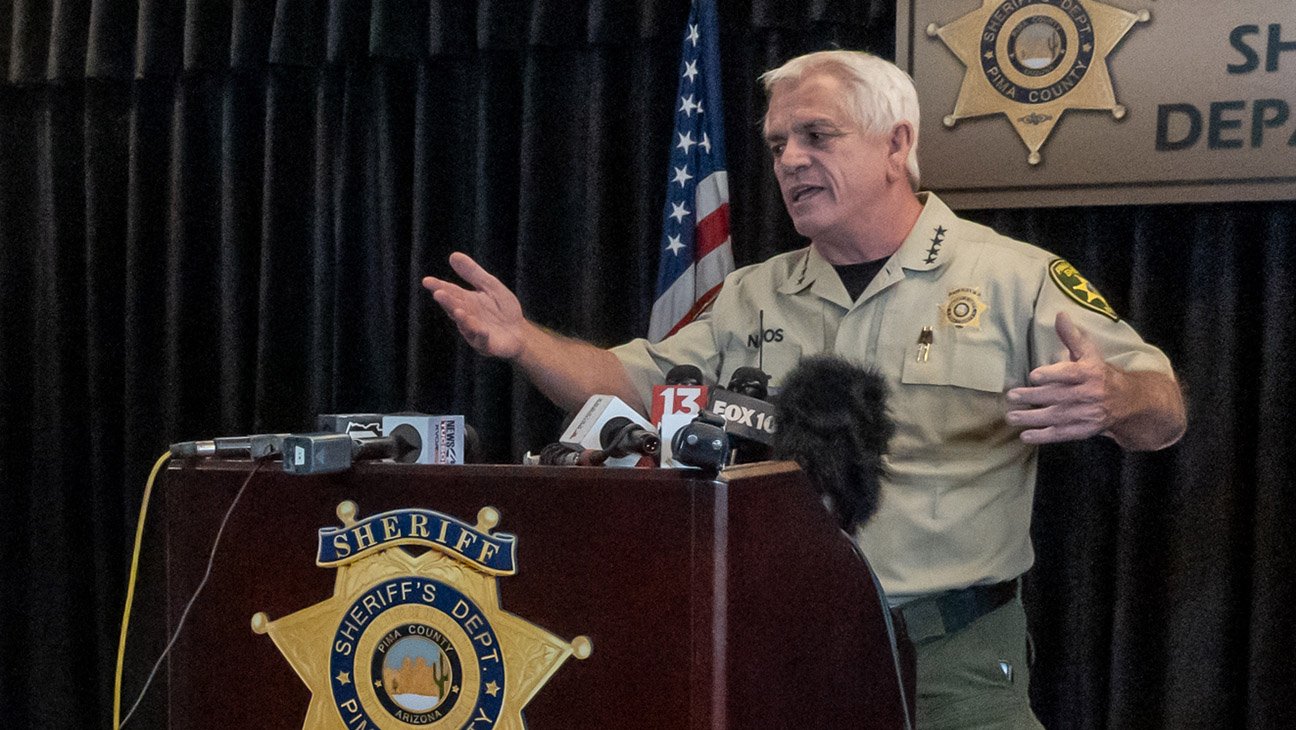
Chris Nanos, the sheriff in the Nancy Guthrie kidnapping case, has released a pair of ransom notes initially sent to the CBS affiliate in her home city of Tucson, Arizona. The second of the two notes states that Nancy has “perished.”
The notes “purport to have been written by kidnappers,” the Pima County Sheriff’s Department wrote in a press release timed to the six-month anniversary of Nancy’s disappearance. The first note was sent to KOLD-TV 13 News on Feb. 2; Nancy was last seen alive on Jan. 31.
Addressed directly to Savannah Guthrie, the first ransom note demands $4 million-$6 million (depending on date of deposit) in Bitcoin for her safe release. It says Nancy is “safe but scared.”
“Her life is in your hands,” the first note states. The note’s final line offers two details as proof of its legitimacy: “She had a white smart watch on the floor of the foot of her bed and the white flood light in the backyard was destroyed.”
Nancy Guthrie is the mother of Today show co-anchor Savannah Guthrie. She was 84 years old at the time of her disappearance.
On Feb. 6, a second email sent to the same news outlet’s Tips line states that Nancy has died and “is buried in nature.” The initial deadline for the ransom deposit ($4 million) was Feb. 5; the second deadline ($6 million) was Feb. 9.
The second note reads, in full: “Guthrie Family, We did not fully grasp the seriousness of her physical condition. We never intended to hurt her, that was not our intention. She perished shortly after she was taken. We believe it was heart related. She is buried in nature now. Nothing you could have done could have changed the outcome. We want your family to know this and hope you can all find peace. We are truly sorry.”
Nancy had a serious heart condition and was without her medication. The ransom notes are posted below.
The first Nancy Guthrie ransom note.
Pima County Sheriff’s Office
The second Nancy Guthrie ransom note.
Pima County Sheriff’s Office
The Pima County Sheriff’s Department says it is sharing the ransom notes now for the first time publicly in hopes that someone in the public recognizes “distinctive patterns of word choice, syntax and phraseology that reflect the writer’s unique linguistic style.”
“They also provide valuable insight into the person’s mindset, motives and the evolution of their tone over time,” the press release continues. “As with the unidentified male depicted in the video, we believe these distinctive linguistic characteristics may be recognizable to someone who knows or has interacted with the notes’ writer. A friend, family member, coworker, classmate or acquaintance may recognize these patterns of expression and possess information that could help identify the individual responsible.”
There are a lot of reasons to celebrate Friday, but one of the most important is that it’s when I compile the five most impressive tech deals for your weekend shopping. These are deep discounts (as much as 50% off!) on some of the best-reviewed laptops, tablets, games, and more that have undergone the rigorous PCMag review process. All of the expertise of the deals department comes through here, so shop with confidence.
Let’s start strong with a massive 50% discount on HP’s versatile, durable, and surprisingly powerful OmniBook X Flip. If you’re doing back-to-school shopping, this is a fantastic pick. Equipped with AMD’s new Ryzen AI 5 430 processor, it’s built to enable on-device Copilot+ AI across every aspect of Windows 11, with integrated Radeon 840M graphics giving a little boost. The display is also a strong point, with full 2K on a crisp OLED touch panel. We have an extensive review of this model, where we put it through its paces and concluded that it had an edge over most other convertibles in its weight class thanks to a sleek all-metal chassis and strong performance. While the battery life could’ve been better, this massive discount makes up for it.
One of the best action games of the current generation is on sale at Amazon for 38% off, so if you haven’t tested your skills against Stellar Blade, now’s the time (especially with a sequel on the way). We gave this game an Editors’ Choice award in our review, with PCMag expert Gabriel Zamora declaring that the developers “nailed the assignment, delivering an outstanding title that easily stands alongside Bayonetta, Devil May Cry, and other action giants.” As Eve, the sole survivor of an Earth battalion fighting the alien Naytiba, you slash, parry, and dodge attacks from gruesome beasts in gorgeous environments. Lots of NPC interaction and other mechanics make it a rich and engrossing experience.
Lenovo’s Android tablets come in a wide range of sizes and price points, but for a little over $200, you’re not going to find a better deal than the Idea Tab Plus. This all-purpose slate isn’t juiced up for high-octane content creation, but if you just need a slim and efficient portable for web browsing, basic productivity, and media streaming, it more than makes the cut. In our full review, we praised its big, bright display, sturdy all-aluminum build, and SD card slot for additional storage. The dual Dolby Atmos-tuned rear speakers are sufficiently loud and clear, and the MediaTek Dimensity 6400 processor delivered solid performance in benchmarking.
More Tablet Deals
*Deals are selected by our commerce team
JBL Live 670NC Wireless On-Ear Headphones Deal
JBL Live 670NC Wireless On-Ear Headphones
USB-C, Stereo 3.5mm, active noise cancellation, 65 hours battery life
This is a very nice price for a solid pair of over-ear headphones with active noise cancellation and lots of fun features. In our full review of the JBL Live 670NCs, we were impressed by the rich, assertive bass they pumped out, as well as the companion app’s robust 10-band equalizer for precise noodling with your audio profile. The ability to listen wired via USB-C or traditional 1/8-inch audio is also cool, along with Bluetooth 5.3, multipoint connectivity using the AAC and SBC codecs. They also give you 65 hours of battery life on a single charge (dropping to 50 hours with active noise cancellation on). Our only kvetch was that the controls take a little getting used to.
This is a wildly low price for a very competent gaming monitor that’ll pair perfectly with a midrange desktop for lightning-fast 180-hertz QHD frames, with a 1ms gray-to-gray response time and AMD FreeSync support. HDR10 color pairs with Samsung’s Black Equalizer technology that gives you precise control over contrast levels, making sure you can see everything in even the most atmospheric horror games. The stand is also a strong point, with easy height, tilt, and angle adjustment as well as a full 90-degree pivot to portrait mode. For $150, you’re not going to find a better monitor from a trusted brand anywhere.
More Gaming Monitor Deals
*Deals are selected by our commerce team
Want even more of the lowest prices on the highest-rated products? Our deals page is where it’s at.
About Our Expert
K. Thor Jensen
Contributing Writer
Experience
K. Thor Jensen is a writer and cartoonist living in the Pacific Northwest. He has contributed to dozens of prestigious outlets, including PCMag, Tested, Clickhole, and Newsweek. His second graphic novel, Cloud Stories, was released in 2017.
Cooper Hoffman had never filmed a sex scene before signing on to Gregg Araki’s erotic thriller “I Want Your Sex.” So when he arrived on set for the first time and found himself surrounded by ball gags, stilettos, whips, chains, dildos and strap-ons, a few first-day jitters were understandable.
“Even if you’re nervous to do it, you’re gonna do it,” Hoffman told Variety at the film’s Los Angeles premiere on Tuesday night. “Because there’s no reason to not do anything in this life just because you’re scared.”
Still, how does an actor prepare to strip naked, slip into a maid’s outfit and get spanked with a leather whip? This is just one of many, many kinky situations Hoffman encounters as Elliot, a meek, wide-eyed college graduate who enters into a sadomasochistic relationship with gallery owner Erika Tracey (Olivia Wilde).
Increasingly, the answer comes in the form of an intimacy coordinator — a role that Araki, long known for embracing provocative themes, employed for the first time on this project. The profession, which officially unionized with SAG-AFTRA in 2024, has become an increasingly standard presence on film and television sets.
Intimacy coordinator Yehuda Duenyas likens the job to that of a choreographer or stunt coordinator. “If someone is going to get their head blown off, people are like, ‘Go grab the goo gun, get the exploding head with the squibs in it, press the button and boom.’ No one really bats an eye about violence,” he says. “But when it comes to intimacy, everyone gets kind of squishy and weird.”
“There are so many things to look after with intimacy scenes that no one really sees,” he continues. “It’s the same way that, with a stunt, you’re not seeing the padding or the fake hits. It just looks real, but you know there’s a lot of movie magic happening behind the scenes.”
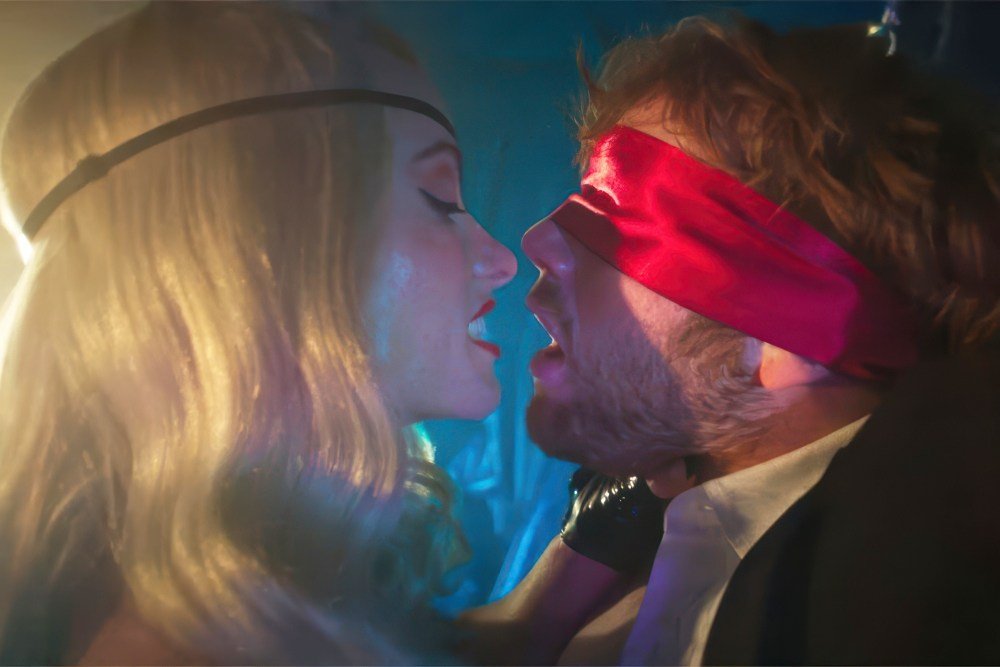
That movie magic is put to work throughout the film, which uses high-intensity montages to establish the pair’s dom-sub dynamic: Elliot crawling across the floor in pink silk lingerie, taking a spanking in a maid’s outfit, standing fully nude as a hot-pink dildo is lubed up overhead and, during a threesome-gone-wrong, getting handcuffed to a St. Andrew’s cross with a towel stuffed in his mouth.
“He might have been terrified, but it wasn’t, ‘I’m terrified, I don’t want to do this.’ It was, ‘I’m terrified, and I do want to do this,’” Duenyas says of Hoffman. “He was more like, ‘Yeah, yeah, it’s the scariest thing I’ve ever done. Let’s do it.’”
Below, Duenyas talks about how he prepared Wilde and Hoffman for their most intense on-screen moments, the most challenging scenes to shoot and the film’s overall messaging on sex and experimentation:
There are multiple high-intensity montages that establish the nature of Olivia and Cooper’s dom-sub sexual relationship. What would surprise people about what goes into shooting scenes like that?
With those montages specifically, we had moments where we would say, “Okay, I’m hitting you this hard. What is that on a scale of one to 10?” Cooper would say, “That’s a zero.” She’d say, “Really?” Then she would go harder, and he’d say, “Okay, that’s a two. That’s a three. That’s a five.”
Olivia realized, “I can hit you really hard, and it’s only registering as a seven or an eight.” We had a bunch of little things like that so they could, number one, have a language for communicating about the physicality and, number two, feel like they could talk about what was happening while also making it look good.
Gregg told Variety that Olivia came onto the set with much more experience doing nude scenes, while Cooper was “terrified.” What was your process for making him more comfortable from the beginning?
If you’ve ever gone skydiving, you might be terrified, but you really want to go skydiving. You’re there to do it. Or, if you’ve ever jumped off a cliff into water or stood on a high diving board, you’re on top of that thing to do it, even though you’re scared. So, yeah, he might have been terrified, but it wasn’t, “I’m terrified, I don’t want to do this.” It was, “I’m terrified, and I do want to do this.”
Is someone terrified because they’re thinking, “This is a no for me. This is a hard boundary, but I’m involved in this thing and I already said yes, so what am I going to do?” Are they biting their nails or is it, “I’m fucking terrified. Let’s do this really well. How are we going to do this?”
That was Cooper’s stance. I wouldn’t say he was terrified. If you’ve ever talked to him, he’s super cool and very together. He was more like, “Yeah, yeah, it’s the scariest thing I’ve ever done. Let’s do it.” It was very matter-of-fact. He approaches almost everything he does by diving headfirst into it in this really beautiful way. He’s an incredible performer.
How did the dom-sub type of sex scenes differ from the more traditional sex scenes you’re used to working on?
Sure, there are differences, but in terms of the way we approach intimacy coordination as a craft, it’s not that different. Olivia had also done a lot of research. Everyone brought what they knew and the type of story they wanted to tell. Gregg obviously did as well.
In this particular film, we’re dealing with these very specific, blurry and complicated power dynamics. That’s the story. The story shows up in their relationship, their work lives and their sexual lives together. What was so fun was finding the character of their intimacy together.
Every intimate scene we work on has a different type of character, and that was the character for this one. Is it different? Yes. BDSM and these kinds of lifestyle scenes, if you want to call them that, are different from something like a “Heated Rivalry” scene. It’s a different type of intimacy, but we approach it the way we would approach anything else.
I’m guessing one of the main differences is how many props are involved. What was the most challenging scene to work on?
The threesome scene, from a blocking and camera-angle perspective, took a minute to figure out. When I say “a minute,” we had a really compressed shooting schedule. We shot all the intimacy within the first five days. We did all of that stuff upfront.
Also from an intensity perspective, that scene required a lot. There was a lot to work out. It wasn’t, “Oh my God, this is so hard.” It was a puzzle to put together in terms of the traffic patterns, the handcuffing and how to get out of the handcuffs quickly. Are we fiddling with keys, or are we just getting out of them? There are a lot of little details. Which details are you going to skip for the sake of the story, and which details are you going to keep in to maintain the flavor and the vibe of the story?
All of the restraint scenes needed a little more care. Getting an actor into restraints on the St. Andrew’s cross wasn’t that complicated of a scene. But when you have to shoot it from three angles in three different ways, and an actor is strapped to a St. Andrew’s cross, can they get out easily if they need to pee?
Gregg recently talked to Variety about Gen Z’s attitude towards sex and what he hoped to accomplish with this film. What are your thoughts on this mission statement?
Gregg wants people to go out and argue. He really wants people to argue about it and say, “Well, I thought it was this,” or, “I thought it was that,” or, “I think that’s bullshit,” or, “I think that’s true.” He wants those conversations.
I love Gregg, and I’ve loved his work over the years. He has contributed so much. I learned about intimacy through watching Gregg Araki films as a young person. I feel like we owe him for his contribution to intimacy in cinema. He has contributed so much to the film canon. Where would we be without those pieces he has made and the work he has put in?
I can’t speak for Gen Z, and I don’t know whether Gen Z is having less or more sex. But I hope people see this film and want to take a chance on love, take a chance on experimentation, take a chance on feeling something and allow themselves to be taken to a place they haven’t been before.
Warner Music Group COO and CFO Armin Zerza is stepping down from his role, the company announced on Friday, noting that the executive has decided to leave for “personal reasons.” Warner Records COO Tom Corson will replace Zerza WMG’s as COO, and the company is starting a search for its next CFO.
Zerza “will remain available to the company through the end of the fiscal year to ensure a seamless transition,” WMG said.
Louis Dickler, WMG’s SVP, Global Controller and Chief Accounting Officer will serve as interim CFO while the company looks for a replacement.
It’s a sudden departure for Zerza given that he joined the record company just over a year ago in April of 2025, and he was given the joint role as COO as well just over two months ago. Zerza’s successor will be WMG’s fourth CEO since 2023. Longtime CFO Eric Levin retired in 2023, succeeded by former ESPN and Disney executive Bryan Castellani before Zerza’s appointment in 2025.
“Armin has been an instrumental leader and member of the executive team during a crucial period of growth and transformation,” WMG CEO Robert Kyncl said in a statement. “We thank Armin for his outstanding business and financial leadership and enduring contributions to WMG, and we wish him all the best.”
Corson, meanwhile, is one of the most respected record executives in the music industry. Before joining Warner, he was the president and COO of RCA Music Group. With Warner Records CEO Aaron Bay-Schuck, the duo led a respected turnaround for the storied label, garnering a reputation in the record business for a strong artist development system with stars like Zach Bryan, Benson Boone and Sombr. With Corson moving to the corporate posting, following the transitional period, Bay-Schuck will helm Warner Records alone.
“It’s an honor to step into this role during such a transformative era for both our company and the industry at large,” Corson said in a statement. “A huge thanks to Robert for the opportunity, as well as to Aaron and the Warner Records team for the unforgettable run. I’m looking forward to building on our momentum, turbocharging operations, and creating even more impactful opportunities for our incredible artists and songwriters worldwide.”
As Kyncl said of Corson’s appointment: Tom is one of the most dynamic, respected, and effective executives in the music business, and a fierce champion of talent. Together with Aaron, he’s helped architect Warner Records’ resurgence, and we’ll leverage his vision, disciplined execution, and deep experience across the entire company as we continue to deliver for our artists and songwriters while achieving our top and bottom line goals.”
Ripple [$XRP] is slightly down by around a percent but still accounts for a sizeable daily trading volume. The altcoin’s daily volume is about $1.06 billion, slightly lower than the high volumes experienced in a bullish market.
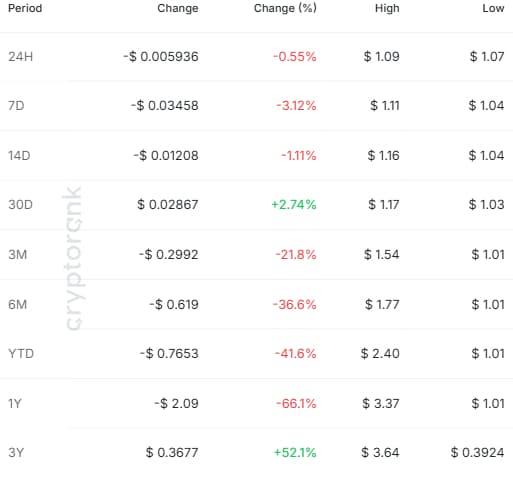
This significant volume results from high network activity growth. Despite that, the price of $XRP is lagging, down about 41% year-to-date (YTD).
Network activity on $XRP Ledger explodes
On-chain data showed immense network growth across multiple divides.
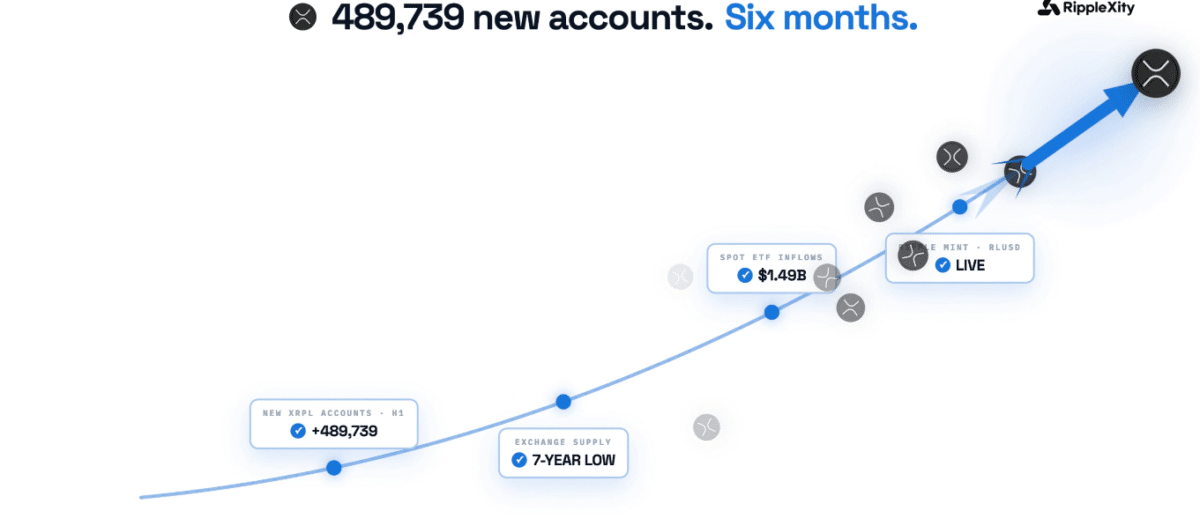
For instance, the $XRP Ledger has added 489,739 new accounts in the first half of 2026. As a result, they have hit a new peak level of 8.403 million in July, up from 7.913 million.
Additionally, exchange supply declined to a new 7-year low of 2.748 billion $XRP tokens. This indicates accumulation is in progress as coins are moving to self-custody, reducing circulating supply.
Moreover, the cumulative spot ETF inflows hit $1.50 billion, accounting for about 1.48% of the market cap. The daily total net flow was $5.98 million, with a total traded value of $8.83 million.
Source: RippleXity
On top of that, Ripple Mint went live for institutional $RLUSD. In fact, $RLUSD’s market cap was growing on both the $XRP Ledger and the Ethereum [ETH] network.
Recently, Ripple minted 15 million $RLUSD on Ethereum and then burned 10 million $RLUSD in their treasury. The circulating supply of $RLUSD on Ethereum has climbed above $712 million, behind the $XRP Ledger with $873 million.
Can this help $XRP price stay above $1?
Meanwhile, the price of the altcoin is around $1.07, a few cents above $1.
Over the past three months, $XRP price is down 21.8% and 36.6% in six months. It is still down by more than 66% since last July.
Source: CryptoRank
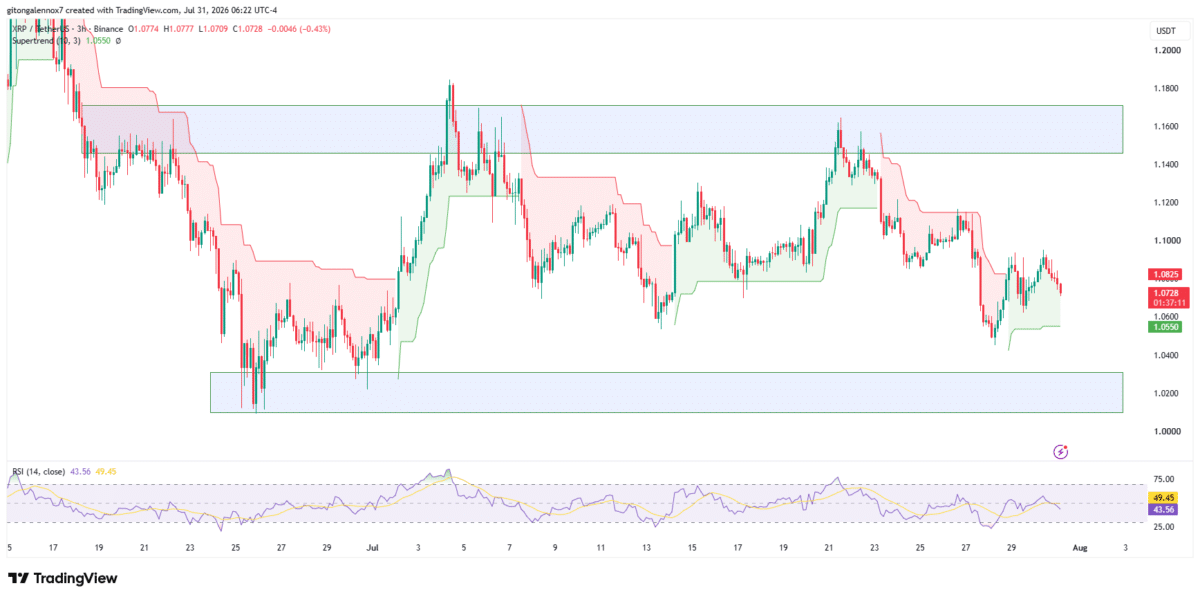
This data confirms the trend is bearish, which risks the altcoin breaking below $1. $XRP is only 6.67% away from trading below $1. However, it was trading above the SuperTrend, which was also above this key support level.
The RSI was at 43, below the neutral level, indicating there was mid-selling activity. However, the selling did not outweigh the buying activity as per the exchange supply balances.
Source: $XRP/USDT on TradingView
Technically, the altcoin is trapped between two dynamic levels at $1 and $1.16. The sideways market reinforces the decline in exchange balance.
Therefore, the growing network activity may help the price hold above the lower support level at $1. If the price breaks down, the bearish market that has persisted for most of 2026 will continue.
Final Summary
$XRP network activity explodes with 489.7K new accounts added, low exchange balance, and $RLUSD market cap growth.
$XRP price was trading above $1, with mid-selling hinting at a test of the demand zone, but can bulls hold it?