Blog

  • Ex-Lunar founders raise €8.2M to crack the €80B AI audit market

    Ex-Lunar founders raise €8.2M to crack the €80B AI audit market

    A trio of former executives from Danish digital bank Lunar has decided that spreadsheets and human-only bookkeeping have run their course. Together with a professional auditor, they’ve raised €8.2 million to build Repodo, a startup betting that artificial intelligence can finally break into the notoriously conservative audit market, starting with small businesses in Denmark rather than the multinational giants that dominate the industry today.

    Key takeaways

    • Repodo raised €8.2 million to launch an AI-powered audit firm, with the round led by Hedosophia and Seed Capital.
    • The company was founded by three former Lunar executives alongside professional auditor Anders Houmann.
    • The global audit market is worth roughly €80 billion, with Europe accounting for about €74 billion of that total.
    • Repodo is targeting small and medium-sized enterprises in Denmark first, with plans to expand across Europe.
    • The Big Four firms have poured billions into AI tools but remain focused on large corporate clients, leaving SMEs largely underserved.

    Launch of Repodo and Its Founders

    Repodo’s arrival answers a simple question: what happens when people who scaled a challenger bank turn their attention to auditing? The company launches with fresh capital and a founding team that blends fintech experience with formal audit credentials, an unusual pairing in a profession built on regulatory caution.

    Funding and Investors

    The €8.2 million funding round was led by Hedosophia and Seed Capital, two firms that also backed Lunar during its earlier fundraising rounds. That continuity matters. Investors who watched Lunar grow from a Danish challenger bank into a company that has raised more than €500 million since 2015, with over one million customers, are now placing a similar wager on the audit sector. It’s a signal that backers see repeatable playbooks between digital banking disruption and reshaping how audits get done.

    Founding Team Composition

    Three of Repodo’s founders previously held executive roles at Lunar. Joining them is Anders Houmann, a professional auditor whose presence addresses a structural reality of the industry: audit is heavily regulated, and no software, however advanced, can substitute for the legal requirement that a qualified human sign off on the final result. Repodo’s pitch rests on dividing labor sensibly, letting machines handle volume while licensed professionals retain accountability.

    Repodo’s AI Approach to Auditing

    Repodo describes itself as “AI-native,” a label meant to draw a sharp line between its technology and the bolt-on chatbots that legacy audit firms have added to existing workflows. The distinction is strategic as much as technical: it positions Repodo as built for automation from day one, rather than retrofitted for it.

    AI Capabilities and Auditor Roles

    The company’s AI is designed to handle the repetitive, time-consuming parts of an audit, data collection, transaction analysis, and pattern matching, tasks that traditionally eat up junior staff hours. Licensed auditors then step in for the parts of the job that genuinely require professional judgment, keeping the human sign-off intact while freeing up time that would otherwise go toward manual review.

    Distinct AI-Native Strategy

    This division of labor is central to why Repodo believes it can compete. Rather than promising to replace auditors outright, an approach that would run headlong into regulatory reality, the company frames AI as a way to compress the grunt work so human expertise can be applied more efficiently. That framing matters for a heavily regulated profession where trust and compliance carry as much weight as speed.

    Market Context and Strategic Focus

    Why does any of this matter beyond one startup’s funding round? Because the numbers behind the global audit market suggest a sizable gap between where big accounting firms have pointed their technology investment and where the actual demand for faster, cheaper audits sits.

    Global and European Audit Market Size

    The global audit market is valued at approximately €80 billion, and Europe alone accounts for around €74 billion of that figure. Those numbers put the European opportunity for SME audit Europe services in sharp relief: it’s a market nearly as large as the global total, concentrated on a continent with dense populations of small and mid-sized businesses that need audit services but often lack the budget or attention of top-tier firms.

    Targeting SMEs and Expansion Plans

    Small and medium-sized enterprises in Denmark represent Repodo’s initial focus, with expansion throughout Europe planned for later phases. That sequencing isn’t accidental. Building for smaller businesses first, then scaling into other markets, mirrors the approach Lunar’s founders used when they started as a Danish challenger bank before pushing into other Nordic markets. It’s the same playbook, applied to a different balance sheet problem.

    Comparison with Big Four Firms’ Market Focus

    The Big Four accounting firms, Deloitte, PwC, EY, and KPMG, have collectively invested billions in AI and automation tools over recent years. Yet their attention tends to skew toward large enterprise clients, the companies with the budgets and complexity that justify heavy technology spending. That focus leaves the SME segment relatively underserved by cutting-edge tools, even though small and mid-sized businesses make up the bulk of Europe’s economic activity.

    This is where Repodo’s bet becomes strategically interesting rather than merely opportunistic. If the Big Four are optimizing for scale and complexity, a startup built around Lunar founders AI expertise and lean automation could carve out a segment that larger competitors have effectively priced themselves out of. Whether that gap stays open long enough for Repodo to establish itself, especially once larger firms notice the opening, is the question that will determine whether this funding round becomes a footnote or the start of a genuine shift in how SMEs get audited.

    FAQ

    Who founded Repodo and what is their background?

    Repodo was founded by three former Lunar executives and professional auditor Anders Houmann.

    What is Repodo’s approach to auditing with AI?

    Repodo’s AI handles data collection, transaction analysis, and pattern matching while licensed auditors perform the expert judgment required for sign-off.

    Which market segment does Repodo initially target?

    Repodo initially targets small and medium-sized enterprises in Denmark, with plans to expand across Europe.

    How does Repodo’s market focus differ from Big Four firms?

    While the Big Four firms focus their AI investment on large enterprise clients, Repodo aims to serve SMEs with AI-driven audits, a segment it argues has been left behind by the industry’s biggest players.

    Article produced with the assistance of artificial intelligence and reviewed by the editorial team.


  • Music Industry Moves: Meghan Trainor Signs With UTA; Guitar Center Foundation Names Valeisha Butterfield CEO & Executive Director

    Music Industry Moves: Meghan Trainor Signs With UTA; Guitar Center Foundation Names Valeisha Butterfield CEO & Executive Director

    Grammy-winning singer-songwriter Meghan Trainor has signed with United Talent Agency for global representation across live touring, filmed entertainment, digital media, theatre, brand partnerships, and more.

    The signing follows Trainor’s on-screen acting debut in Ryan Murphy’s FX series “The Beauty,” and the April release of her seventh studio album “Toy With Me,” although she canceled a North American arena tour slated for earlier this year amid low ticket sales, citing the challenges of balancing work, family and a new baby. She also has appeared as a judge, coach, mentor and advisor on “The Voice,” “The Voice UK,” “The Four” and “Australian Idol.” She also published the motherhood memoir “Dear Future Mama: A TMI Guide to Pregnancy, Birth, and Motherhood from Your Bestie.”

    Trainor is managed by Nikola Barisic for Bond Artist Management and represented by Aaron Rosenberg for Myman Greenspan Fox Rosenberg Mobasser Younger & Light LLP.

    + The Guitar Center Music Foundation has named Valeisha Butterfield as its CEO & Executive Director, effective immediately. She will work closely with GCMF’s Board of Directors to advance the Foundation’s strategic plan, grow fundraising and donor engagement, develop partnerships with schools and community organizations and strengthen the reach and visibility of its programs.

    She was previously co-president of the Recording Academy and VP of global partnerships at Google; she currently serves on the Grammys’ Television Committee and is the founder of Seed Media.

    “Valeisha brings the rare combination of nonprofit leadership, music industry experience and operational expertise that GCMF needs for its next stage of growth,” said board president and chair Curtis Heath. “She has spent her career building organizations, developing partnerships and bringing people together around a shared purpose.”

    + Songwriter Phil Barton has announces a global publishing deal with BMG in partnership with Liz Rose Music, marking the next chapter in a career that has produced more than 900 songs.

    Barton first broke through with Lee Brice’s No. 1 hit “A Woman Like You,” and has had songs recorded by artists including Sara Evans, Gabby Barrett, Dustin Lynch, Eli Young Band, Priscilla Block, Matt Stell, Alison Krauss, Ashley McBryde and others.

    “We couldn’t be happier to welcome Phil to BMG,” says BMG’s Amy Hendon Scott. “I’ve believed in Phil since the beginning, so getting the opportunity to work together again makes this partnership especially meaningful. Phil is the kind of songwriter every publisher hopes to work with. His songs are honest, memorable and beautifully crafted, but just as importantly, he’s someone artists love writing with. He brings curiosity, consistency and an incredible work ethic to every room, and we’re proud to partner with Liz Rose Music as we help champion the next chapter of his remarkable career.”

    + BBR Music Group/BMG Nashville has signed award-winning Canadian country artist Jade Eagleson, whose track record includes four Juno Award nominations, 2025 Canadian Country Music Association’s Male Artist of the Year, 2024 CCMA Album of the Year, and 2023 CCMA Entertainer of the Year and Male Artist of the Year honors.

    In addition to signing with the label, Eagleson also expanded his team signing with Range Music for management, CAA for booking and Spirit Music, in a joint venture with Alliance Music Partners, for publishing.

    “I’m incredibly excited to begin my journey with BBR Music Group/BMG Nashville,” Eagleson said. “I have always had a profound respect for their team and the way they love and elevate their artists. The whole team feels like family and I’m so very proud to call this label my home. Regarding Range, that team has already been such a strong support for me, and we’re only just getting started. In addition, I love my agents at CAA, and I am so grateful that they rolled the dice on me and my obsession with steel and fiddle. For the Spirit Music team, I remember coming to Nashville close to 10 years ago exploring publishing options, and most folks politely turned me away because what I was doing at the time was too country.”

    + Independent distribution and services company Amuse has named Mark Mitchell general manager and Tim Cronin senior VP and head of music.

    Amuse is also announcing a new London office, located in Farringdon, from which Mitchell and Cronin will lead Amuse’s London, New York and Stockholm teams.

    Mitchell joins from Parlophone Records, where he served as Co-President for five years and worked closely with such artists as Coldplay, Iron Maiden, Gorillaz, Pink Pantheress and David Guetta. He most recently spent a year at 0207 Def Jam/Universal Music Group, and prior to Parlophone, served as GM at Atlantic Records UK. Cronin joins from FUGA, where he served as Senior Director of Business Development, leading business development and sales across the UK and Ireland.

    Giorgio D’Ambrosio, CEO of Amuse, said, “We’re seeing growing demand from labels and managements looking for an active, modern partner. Amuse combines a human approach and data with the scale only a distributor can offer. Mark and Tim bring more than 40 years of combined industry experience between them, and will be able to bring Amuse’s unique offering to artists and labels alike.”

  • Binance’s TradFi Perpetuals Show Early Traction as Multi-Asset Strategy Expands

    Binance’s TradFi Perpetuals Show Early Traction as Multi-Asset Strategy Expands

    The boundary between crypto-native trading venues and traditional brokerage desks is becoming harder to locate. Binance has spent months layering traditional finance assets onto a platform built for digital asset derivatives, and the latest read suggests the strategy is producing more than a product announcement cycle.

    According to the original report, Binance’s effort to bring TradFi assets onto its crypto-native platform is showing clear signs of traction. The framing points to a multi-asset strategy, but the update does not provide granular volume figures or a detailed asset-by-asset breakdown. That leaves market participants reading the move through product structure rather than hard data.

    What a TradFi Perpetual Changes for Traders

    Perpetual contracts tied to traditional assets are not a new concept, but the way a major crypto exchange packages them matters. For a trader already using Binance’s perpetual infrastructure, the structural appeal is straightforward: a familiar order book, an established liquidation engine, and the ability to manage exposure without leaving the venue. That is different from opening a separate account with a broker or navigating fragmented TradFi execution.

    The product design question is whether those contracts become genuine alternatives to traditional futures or function as synthetic exposure for crypto-native capital. Binance’s signal suggests it believes the demand is broad enough to support both. If that holds, the venue starts to look less like an exchange for digital assets and more like a cross-asset derivatives destination.

    Liquidity, Collateral, and the Multi-Asset Push

    Multi-asset strategy in derivatives usually means one collateral pool doing more work. That has benefits and complications. On the benefit side, capital efficiency improves when traders can post one type of margin against different exposures. On the risk side, the venue has to prove that its risk systems can handle the interaction between crypto volatility and more conventional asset prices.

    The current push also lands at a moment when real-world asset tokenization is becoming a measurable flow rather than a narrative. As BlockchainReporter covered in its Weekly Tokenization Roundup, on-chain RWA activity has passed $20 billion, and live settlement arrangements are moving from test cases to operational infrastructure. Binance’s TradFi perpetuals are part of the same convergence, even if the contract structure is different from tokenized ownership.

    Institutional demand for alternative exposure is not confined to tokenized Treasuries. Sui’s recent run-up on institutional staking demand showed how quickly product narratives can harden into capital flows, as noted in this Sui institutional staking update. The parallel matters because it indicates that allocators are willing to test non-native yield and exposure when the venue architecture is credible.

    Why the Timing Matters

    Exchange expansion into TradFi products is not happening in a regulatory vacuum. The US legislative picture remains unsettled, and major industry fights are still playing out in Washington. Banks were pressing for last-minute changes to a significant crypto bill just days before a Senate vote, a dynamic covered in this crypto bill update. That uncertainty makes offshore and global product rollouts more sensitive, because the same venue can face very different rules across jurisdictions.

    What remains uncertain is whether the traction Binance reports translates into durable market share in TradFi-facing derivatives or simply reflects early experimentation by crypto-native traders. Without disclosed volumes, open interest, or product-level liquidity, the market cannot separate genuine adoption from promotional momentum. The next data points to watch are whether more traditional counterparties participate, whether margin efficiency improves, and whether the product attracts traders who were not already active in crypto perpetuals.

    For now, the report offers a directional signal: Binance is treating TradFi perpetuals as core infrastructure, not as a side project. Whether that bet reshapes how traditional asset exposure is traded depends on execution details the market has not yet seen.

  • RLUSD vs. PYUSD: Which $2B Stablecoin Is Actually Used More?

    RLUSD vs. PYUSD: Which $2B Stablecoin Is Actually Used More?

    Ripple’s $RLUSD has crossed the $2 billion market-cap milestone this month, which now puts the stablecoin much closer to PayPal USD ($PYUSD), which has a market value of about $2.9 billion.

    But market capitalization alone doesn’t show which stablecoin is used more. On-chain activity suggests $PYUSD still has the larger user base and generates more transfer volume. Meanwhile, $RLUSD shows a different pattern: fewer active addresses but high activity relative to its supply.

    $RLUSD Is Smaller, But Its Supply Is Moving

    As of August 24, RWA.xyz data puts $RLUSD’s market cap at about $2.02 billion, with 84,514 holders. Its monthly transfer volume stands at roughly $11.60 billion, generated through 1.28 million transfers and 7,982 active addresses.

    That means $RLUSD’s monthly transfer volume is roughly 5.7 times its circulating supply. The figure is significant because it shows the $2 billion supply is not simply sitting in wallets.

    $RLUSD also has a relatively high number of transfers per active address. Dividing its 1.28 million monthly transfers by 7,982 active addresses produces roughly 160 transfers per active address.

    That points to a network with a relatively small active user base but frequent activity.

    $PYUSD Has the Bigger User Base and More Volume

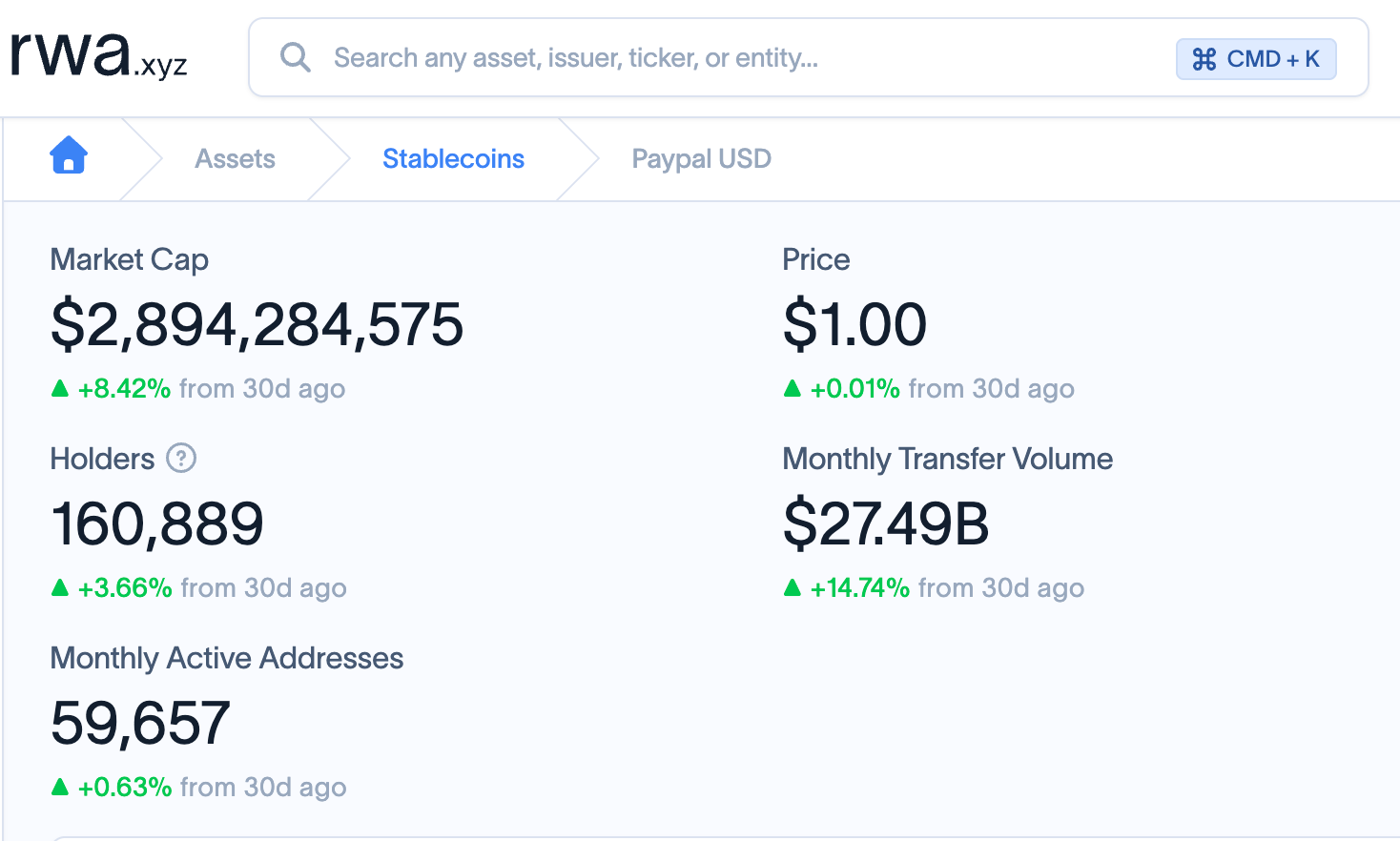
    $PYUSD remains ahead on almost every broad usage metric. RWA.xyz currently puts $PYUSD’s market cap at about $2.89 billion, with 160,889 holders and 59,657 monthly active addresses. Its monthly transfer volume is approximately $27.5 billion across 957,693 transfers.

    Source: RWA.xyz

    On a supply-adjusted basis, $PYUSD moves about 9.7 times its circulating supply each month, considerably higher than $RLUSD’s roughly 5.7x turnover. $PYUSD also has more than seven times as many monthly active addresses as $RLUSD.

    Interestingly, $RLUSD records more monthly transfers despite having far fewer active addresses. That gives $RLUSD a much higher transfer frequency per active address.

    The difference is partly reflected in the average size of recorded transfers. $RLUSD’s monthly volume divided by its transfer count works out to roughly $9,100 per transfer, compared with about $29,300 for $PYUSD.

    Chain Distribution Tells Another Story

    $RLUSD’s supply is concentrated primarily on Ethereum and the $XRP Ledger. RWA.xyz shows approximately $1.03 billion of $RLUSD on Ethereum and about $988 million on XRPL, meaning the two networks account for virtually the entire current supply.

    $PYUSD is more broadly distributed. Current RWA.xyz data shows roughly $1.96 billion on Ethereum, $708 million on Solana, $220 million on Arbitrum, and nearly $8 million on Stellar.

    That wider distribution gives $PYUSD access to more ecosystems, particularly Solana, where cheap transactions have made the token attractive for payments and DeFi applications.

    DeFi Gives $PYUSD a Broader Footprint

    $PYUSD is used across DeFi venues including Aave, Curve, Morpho, and Kamino, with Solana playing an important role in its expansion.

    $RLUSD also has a growing DeFi presence. On Ethereum, for example, Sentora operates an $RLUSD lending vault on Morpho, and FXRP was recently added as collateral, allowing users to borrow $RLUSD against an $XRP-linked asset without selling their $XRP.

    A Curve USDC-$RLUSD pool has also reached tens of millions of dollars in liquidity, showing that $RLUSD is developing a meaningful secondary market inside DeFi.

    Exchange Liquidity Favors Neither on Every Measure

    CoinMarketCap currently shows $RLUSD trading volume at roughly $510 million over 24 hours, while $PYUSD is closer to $42 million. That snapshot suggests $RLUSD can see much heavier exchange activity during periods of increased demand or liquidity shifts.

    Both tokens are also available through major trading venues including Kraken, ByBit, OKX, and Bitget.

    The Real Difference Is the Use Case

    The strongest distinction may not be raw transaction numbers but what each issuer is trying to make the stablecoin do.

    $PYUSD has a natural distribution advantage through PayPal and is designed for payments, transfers, and conversions within the PayPal/Venmo ecosystem. PayPal also allows eligible users to earn rewards on $PYUSD balances.

    Meanwhile, $RLUSD serves institutional settlement, cross-border payments, and financial-market infrastructure, while Ripple’s broader ecosystem includes institutional custody, trading, and lending applications.

    The takeaway is that $PYUSD currently has the broader user and transaction footprint, while $RLUSD is concentrated around high-frequency and higher-value financial activity.

    As both approach the same $2 billion-plus market-cap neighborhood, the more important battle will therefore be over how efficiently each dollar of stablecoin supply is actually put to work, rather than simply which token has the bigger supply.

    Related: How $XRP Holders Can Borrow $RLUSD Without Selling—and the Risks of FXRP Lending

  • How the US sanctions on Iran impact China

    How the US sanctions on Iran impact China

    The US has sanctioned Chinese entities tied to Iran’s shadow networks but stopped short of hitting major banks or China broadly, warning Beijing over Iranian oil as both sides try to preserve trade ties ahead of a Trump–Xi meeting set for September 24.
    Al Jazeera’s Katrina Yu reports from Beijing.

  • ‘Heated Rivalry’ Season 2 Adds Daniel Diemer and Shaheen Jafargholi as Ryan and Fabian

    ‘Heated Rivalry’ Season 2 Adds Daniel Diemer and Shaheen Jafargholi as Ryan and Fabian

    Breakout gay hockey drama Heated Rivalry is continuing to add to its season two cast, with Daniel Diemer set to play Ryan Price, a tough guy enforcer battling anxiety off the ice.

    Diemer is best known as Paul in Netflix’s The Half of It and Tyson in the Disney+ series Percy Jackson and the Olympians. Shaheen Jafargholi will perform the role of aspiring musician Fabian Salah after star-turns in War, The Agency and Lost Boys and Fairies.

    Ryan and Fabian’s love story drives Rachel Reid’s novel Tough Guy, the third installment in her Game Changers series, which Heated Rivalry is based on. Ryan was briefly mentioned during the first season during a conversation between the show’s leading men Shane Hollander, played by Hudson Williams, and Ilya Rozanov, played by Connor Storrie, as the latter spent a season together playing in Boston.

    The news comes after several additions to the season two cast over the past month including Justice Smith, Charlie Gillespie, Emily Hampshire, Edvin Ryding, Robert Naylor, Sabrina Jalees and Priyanka. Hampshire and Priyanka were cast as the characters of Vanessa and Tarek, who also hail from Tough Guy — the pair are Fabian’s best friends.

    Ryan and Fabian’s novel takes place while Ryan is on the Toronto team, alongside fellow season two additions Troy Barrett, portrayed by Gillespie, and Wyatt Hayes, portrayed by Naylor. However, both Troy and Wyatt eventually play alongside Ilya in Ottawa.

    Diemer and Jafargholi join Williams, Storrie, Gillespie and Smith in leading roles for season two.

    “Fabian and Ryan each bring a distinctive energy to the world Rachel Reid has created,” said series executive producers Jacob Tierney and Brendan Brady in a statement. “They are bold, complicated, and deeply compelling characters, and finding actors who could really take on all of those different sides was so important to us. Daniel and Shaheen bring such confidence and emotional honesty to the roles. We can’t wait for audiences to see what they do with Fabian and Ryan and how they make these characters their own.” 

    Heated Rivalry is produced by Accent Aigu Entertainment in association with Bell Media. Season one of the award-winning show was adapted from the second novel in the Game Changers series, Heated Rivalry, which focuses on the ever-complicated situationship between Shane and Ilya, who are generational talents in the world of professional hockey and sworn on-ice rivals. The first novel of Reid’s book series, Game Changers, centered on François Arnaud’s character Scott Hunter and Robbie G.K.’s character Kip Grady and served as secondary material for the first season.

    Season two of Heated Rivalry will be adapted from Reid’s sixth novel in the series, The Long Game, which continues Shane and Ilya’s story. The novel finds the hockey players now in a committed relationship with one another and learning how to build a life together while hiding their true feelings for one another in public. Series creator Jacob Tierney has said that Role Model, which takes place concurrently with The Long Game, will also be source material for the season. Role Model follows Troy’s romance with the Ottawa team’s social media manager Harris Drover, played by Smith.

    The TV series is created by Jacob Tierney, who is also the writer, director and executive producer along with Brady and Jayme Alter Wilson. Lori Fischburg and Liane Cunje are producers, with Reid serving as as consulting producer.

    Mike Goldbach serves as co-writer on season two. Additional second season cast already announced includes Emily Hampshire, Edvin Ryding, Robert Naylor, Sabrina Jalees and Priyanka.

    Diemer is repped by Atlas Artists, Nuance Management and Gersh Agency. Jafargholi is repped by Simon Grant Jones at JAG.

  • Helen Mirren, Seth Rogen, Fan Bingbing to Receive Toronto Fest Tribute Awards

    Helen Mirren, Seth Rogen, Fan Bingbing to Receive Toronto Fest Tribute Awards

    Helen Mirren, Seth Rogen, Fan Bingbing, Adam Pietkiewicz and Bassam Tariq are set to receive TIFF Tribute Awards at the upcoming Toronto Film Festival.

    Oscar winner Mirren will receive the Groundbreaker Award as she brings the thriller A Talent For Murder to Toronto for a world premiere. Rogen, who stars in two films at TIFF — Babies, directed by Lauren Miller Rogen, and Tangles, an animated film which Rogen and Miller Rogen produced — will receive a  Career Achievement Award, and cinematographer Pietkiewicz will receive the Artisan Award as he is honored in Toronto for his work on Angh, the debut film by Theja Rio.

    In addition, director Bassam Tariq will receive the Rising Talent Award as he brings his latest movie, Your Mother Your Mother Your Mother, to Toronto, while a Special Tribute Award will be presented to Bingbing as her new movie, Wayne Wang’s Diary of a Mad Old Man, debuts in Toronto.

    The latest Tribute Award recipients round out the celebrity lineup for the annual TIFF fundraiser that includes the previously announced honorees Penélope Cruz, Lee Chang-dong, Rosalind Eleazar, Siân Heder and Isabelle Huppert.

    Proceeds from the Tribute Awards on Sept. 13 go towards the festival’s year-round talent development programs that encourage diversity, equity and inclusion in filmmaking. The gala dinner fundraiser for the fest’s philanthropic efforts is also an occasional harbinger of Oscar recognition and is held each year at Fairmont Royal York Hotel. 

    TIFF Tribute Award honorees tend to have films in Toronto’s official lineup. The 51st Toronto Film Festival is set to run Sept. 10-20.

  • What to Watch on Netflix in September 2026

    What to Watch on Netflix in September 2026

    Month after month, Netflix proves it’s one of the best values in the streaming world by adding dozens of new shows and movies. September keeps the streak going: We’ve got the second season of Stranger Things spin-off Tales From ’85, along with a documentary on the 2024 Olympic breakdancing sensation, and a super-wacky new reality competition. Here’s our guide to the most interesting series and movies on the streaming service in September.

    Netflix logo


    Untold: Raygun: Breaking Badly (September 1)

    Sometimes your world can change in a single moment. Just ask Australian break dancer Rachael Gunn, whose performance at the 2024 Olympics puzzled viewers the world over. Gunn’s moves were questionable, to say the least, and after she lost 18-0 in all three rounds, it sparked a firestorm of criticism and conspiracy theories. This new documentary sits down with the dancer, the people who know her, and representatives of the global breaking community to understand exactly what happened.

    • Directors: Chapman Way, Maclain Way

    • Stars: Rachael Gunn, Samuel Free

    • Genre: Documentary

    • Rating: TV-MA


    Stranger Things: Tales From ’85 – Season 2 (September 17)

    Now that the original Stranger Things cast has aged out of being able to play kids, Netflix has pivoted to CGI animation for its spin-off series, Tales From ’85. The first season received mixed reviews, as it also softened the horror elements slightly to appeal to a younger audience. I’m curious to see how it develops in its second season, which takes place around Valentine’s Day and features ghosts and creatures we haven’t seen before.


    Wonka’s the Golden Ticket (September 23)

    Netflix loves the overproduced reality competition, and September brings one of the wackiest entries yet. Wonka’s the Golden Ticket replicates the chase to get into the legendary chocolate factory, with a group of 12 finalists entering a custom-built factory, each with a companion of their choosing. Once inside, they’ll navigate sweet challenges, overcome temptation, and the winner will walk away with what the streamer calls a “life-changing prize.” Will the contestants get sucked into a chocolate pipe, Augustus Gloop-style? We can only hope.


    Everything Coming to Netflix in September 2026

    September 1

    17 Again
    About Time
    Alien
    Aliens
    Antz
    Battleship
    Big Daddy
    The Blues Brothers
    The Boy Next Door
    Conan the Barbarian
    Cruel Intentions
    Dragnet
    The Flintstones
    Gothika
    Greta
    Heartland – Season 19
    Jared Fried: The Family Plan
    Jarhead
    Jaws
    Jaws 2
    Jaws 3
    Jaws: The Revenge
    Kick-Ass 2
    Knocked Up
    Liar Liar
    Neighbors
    Phantom Thread
    Ready or Not
    Resident Evil: Afterlife
    Resident Evil: Extinction
    Resident Evil: Retribution
    The Rite
    Scarface
    Shark Tale
    Sleepless in Seattle
    Straight Outta Compton
    T2 Trainspotting
    The Texas Chainsaw Massacre
    Uncle Buck
    Unfriended
    Untold: Raygun: Breaking Badly

    September 2

    Driven – Seasons 1-3
    Lovesick
    Resident Evil: Damnation
    Resident Evil: Death Island
    Resident Evil: Vendetta
    Turning Point: Generation 9/11

    September 3

    Fito Paez: The World Within a Song
    Folktales
    The Gentlemen – Season 2
    Major Crimes – Seasons 1-6
    Smile 2

    September 4

    Earle Meets World
    Teenage Wasteland

    September 5

    Emeril Tailgates – Season 1

    September 8

    Dang!
    Fauda – Season 5
    Stavros Halkias: Uncle Stav
    Untold Mr. T: I Pity the Fool

    September 9

    Prom Night
    Tyler Perry‘s Why Did I Get Married Again?

    September 10

    Call My Agent! The Movie
    Crew Girl
    NFL Melbourne Game
    The Perfect Lie
    We Don’t Live Here Anymore

    September 11

    Go Team!
    Physical 100: Italy
    Stolen Heartbeats
    Tribeca 25

    September 13

    Dog Man

    September 14

    Gabby’s Dollhouse – Season 14
    Hot Ones: Extra Heat – Episode 2
    When Hope Calls – Seasons 1-2

    September 15

    The AI Doc: Or How I Became an Apocaloptimist
    I Survived a Killer – Season 1
    Jo Koy: Blue in the Face

    September 16

    The Doll

    September 17

    The Fixers
    Monster: The Lizzie Borden Story
    Not a Stranger
    Plastic Beauty
    Stranger Things: Tales From ’85 – Season 2

    September 18

    Recommended by Our Editors

    Best of the Best
    Pokemon Horizons – Season 3: Rising Hope Part 4

    September 20

    Stop! That! Train!

    September 22

    Minerva Academy
    Party Down – Seasons 1-3

    September 23

    Habeas Corpus
    Lifehack
    Wonka’s the Golden Ticket: A Competition Series

    September 24

    A Different World
    Delusion
    House at the End of the Street
    My Sad Dead
    Oculus

    September 25

    The Final Problem
    Law & Order – Season 25
    Steel Ball Run: JoJo’s Bizarre Adventure 2nd-3rd Stage
    Unabomber

    September 29

    Lego One Piece
    Mononoke the Movie: Chapter III – The Curse of the Serpent
    Murder in a Small Town – Seasons 1-2

    September 30

    Ancient Aliens – Season 13
    The Arena
    Hoarders – Season 16
    What’s Your Number?
    The Widower: ‘Til Death Do Us Part

    About Our Expert

  • Everest Drama ‘Tenzing’ With Tom Hiddleston, Willem Dafoe to Open Zurich Festival

    Everest Drama ‘Tenzing’ With Tom Hiddleston, Willem Dafoe to Open Zurich Festival

    Tenzing, a period adventure drama starring Tom Hiddleston and Willem Dafoe, about the first ascent of Mount Everest, will open this year’s Zurich International Film Festival (ZFF).

    Directed by Jennifer Peedom (Sherpa, River) for Apple TV, Tenzing follows the true story of Nepalese-Indian Sherpa Tenzing Norgay (played by Genden Phuntsok), a gifted mountaineer who, together with New Zealand alpinist Edmund Hillary (Hiddleston), became the first person to reach the summit of Mount Everest in 1953. Dafoe plays Colonel John Hunt, the leader of the British expedition team. Thinley Lhamo plays Tenzing’s wife Dawa. Caitríona Balfe co-stars as expedition secretary Jill Henderson.

    Tenzing will open the 22nd Zurich Film Festival on Sept. 24 in its European premiere. The film debuts at the Toronto Film Festival on Sept. 15. Hiddleston, Dafoe and Peedom will attend the Zurich opening night gala.

    “This year’s ZFF motto is ‘dream big.’ Our breathtaking opening film Tenzing fits perfectly, because it shows how you can grow beyond yourself when you have a big dream,” said Zurich Festival CEO Christian Jungen. “The film offers powerful emotion and mountain scenery of sublime beauty. But it also carries an important message for our time: The first ascent of Mount Everest only succeeded because the climbers respected the local Sherpa people and the laws of nature.”

    “At its heart, Tenzing is about a man who dared to imagine a life beyond the limits the world had placed on him and the courage, sacrifice and belief it took to reach the highest point on earth,” added Peedom.

    Tenzing will premiere in select theaters on Oct. 9 before bowing on Apple TV Oct. 16.

  • Hulu Cancels Mindy Kaling-Created Comedy ‘Not Suitable for Work’ After One Season (EXCLUSIVE)

    Hulu Cancels Mindy Kaling-Created Comedy ‘Not Suitable for Work’ After One Season (EXCLUSIVE)

    Hulu will not be moving forward on a second season of its recent comedy “Not Suitable for Work,” from creator Mindy Kaling. The series, which Kaling executive produced with showrunner Charlie Grandy and 3 Arts Entertainment’s Howard Klein, launched in June and ran for nine episodes. Warner Bros. TV, which produces the series, plans to shop it to potential new homes.

    Ella Hunt, Avantika, Will Angus, Jack Martin, Nicholas Duvernay and Jay Ellis star in the series, which per the show’s logline, centers on “work-obsessed 20-somethings striving for professional success and, if they have time, personal happiness in Manhattan’s most glamorous neighborhood, Murray Hill.”

    Recurring guest stars on “Not Suitable for Work” include Victor Garber, Greg Germann, Judy Gold, Ego Nwodim, Harry Richardson, Constance Wu, Laura Bell Bundy, May Hong, Bhavesh Patel, Emilia Suárez and Michael Benjamin Washington.

    The series stars Hunt as AJ, an investment banker from Boston, who moves to New York for a new job and begins living with her best friend, aspiring celebrity stylist Abby (played by Avantika). They live across the hall from male best friends Davis (Will Angus), who is AJ’s co-worker and has a crush on her; nepo-baby/young journalist Josh (Jack Martin); and aspiring actor/med school dropout Kel (Nicholas Duvernay).

    “Not Suitable for Work” was produced under Kaling’s Kaling International label in association with Warner Bros. Television, where both Kaling and Grandy hold overall deals.

    “Not Suitable for Work” repped Kaling’s first sole creator credit on a project since “The Mindy Project,” the comedy that began its life on Fox for three seasons before moving over to Hulu, where it ran for an additional three seasons as one of the streamer’s earliest original hits. After “Mindy Project,” Kaling continued a string of successes with Netflix’s “Never Have I Ever,” HBO Max’s “The Sex Lives of College Girls” and Netflix’s ongoing series “Running Point,” which has already been renewed for a Season 3.

    In her review of “Not Suitable for Work,” Variety‘s Alison Herman wasn’t too impressed, but she did see some “glimmers of a more biting, memorable take on young people juggling jobs and love in New York City throughout the nine-episode season.”