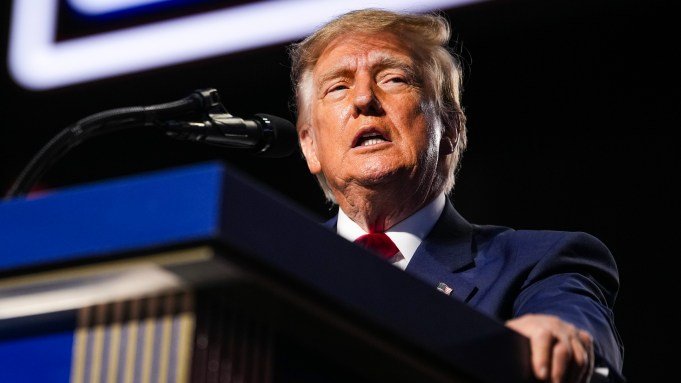
The first night of Donald Trump‘s midterm convention failed to generate a ratings bounce for Fox News, with the audiences comparable or even slightly below regular primetime programming.
Fox News’s coverage of the convention dominated the primetime hours on Wednesday, drawing an average 2.3 million viewers. But that is less than its September, 2025 primetime viewership, when it averaged 2.54 million viewers.
During Donald Trump’s speech from 9 p.m. ET to 11 p.m. ET, Fox News averaged 2.5 million viewers. A year ago, during the month of September, Hannity drew an average of 2.89 million in the 9 p.m. ET hour and Gutfeld! garnered an average of 2.94 million at 10 p.m. ET.
CNN‘s primetime coverage averaged 441,000 viewers, compared to a 543,000 average in September, 2025. MS NOW posted 1.1 million viewers in primetime, an uptick from an average of 810,000 during the month a year ago. In contrast to Fox News and CNN, MS NOW carried little of Trump’s speech and stayed on analysis from Jen Psaki and Lawrence O’Donnell and their guests.
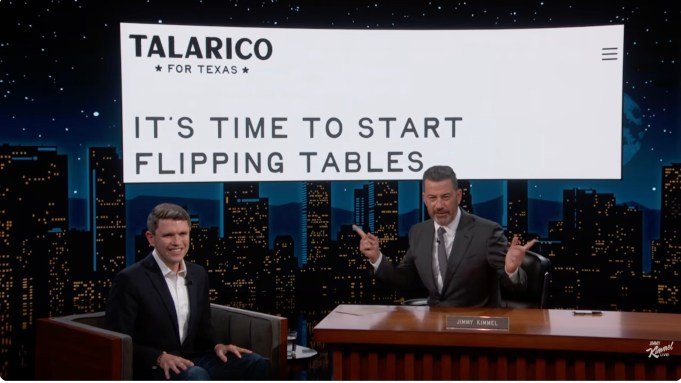
Jimmy Kimmel‘s interview with James Talarico was posted to YouTube on Thursday evening rather than the late-night host’s ABC broadcast amid concerns over an FCC enforcement action.
“Why are they so scared of you?” Kimmel asked Talarico at the outset of the 20 minute interview, noting that Stephen Colbert also posted a sit down with the Texas U.S. Senate candidate in February over concerns it would invoke the the rule.
“They are worried that we’re going to win this race in Texas,” Talarico said. “But we are the underdogs until the last vote is counted.”
For decades, daytime and late night TV talk shows have operated on the assumption that they were exempt from the FCC’s equal time rule, which requires broadcasters who feature candidates to provide comparable time to their rivals, if it is requested.
But in January, the FCC under chairman Brendan Carr, appointed by Donald Trump, issued guidance to broadcasters that TV talk shows may not be exempt, a move that critics saw as a regulatory effort to crackdown on daytime and late-night hosts the president does not like. Weeks later, the FCC started an investigation of The View after it featured Talarico as a guest. The equal time rule includes an exemption for news coverage and news interviews.
ABC has pushed back against the FCC’s actions, releasing a 2002 letter from the FCC affirming that The View was exempt. The network also has argued that the FCC is selectively enforcing the rule, as its January guidance did not address talk radio, where conservative hosts routinely feature political candidates, including Talarico’s Republican opponent, Ken Paxton.
Kimmel opened his interview by noting that, until recently, the FCC has long recognized that late-night talk shows have been exempt, pointing to Donald Trump’s guest spots.
“When he was running, he was on the show two times, but now I guess he doesn’t like me anymore, or the First Amendment, and so the FCC has threatened me or threaten my show, our network, even our local ABC stations, because they want to make our editorial decisions for us, which of course we cannot accept,” Kimmel said. “And so tonight we’re bypassing the public airwaves and hosting this YouTube interview on YouTube, even though our government would clearly prefer that we not do it at all.” The FCC does not regulate streaming platforms.
In a statement earlier on Thursday, a White House spokesman claimed that Kimmel was creating “a false narrative about this administration’s policies.
“Chairman Carr has not threatened him regarding interviewing James Talarico, or any other candidate,” a spokesperson said.
Carr has not commented, but previously said that the TV talk shows are free to feature political candidates, but they may be on the hook to offer time to their competitors. He also suggested that the Colbert interview was a publicity stunt designed to drive up fundraising for Talarico.
In his monologue on the Jimmy Kimmel LiveTV broadcast, Kimmel challenged the White House’s statement. He told the audience that he would be interviewing Talarico but viewers would not see it. He called the threat of FCC action “yet another attack on free speech, something that is all too familiar for the show for us.” Kimmel also said that he would “love” to interview Paxton, but the rule would not just apply to Talarico’s GOP rival. “Our affiliates in Texas would have to give equal time to as many candidates as there are on the ballot. There’s about 10 candidates on the ballot,” Kimmel said. ABC’s legal team has argued that offering all candidates such time is untenable.
The interview was otherwise a pretty standard sitdown for Talarico, giving him the opportunity to repeat some of his campaign themes, including how his life has been shaped by religion and Jesus Christ.
It was also clear that Kimmel was a fan of Talarico, and he even ran a portion of one of his campaign ads.
He said, “I’ve been following you for a long time. I’ve been watching your videos. I think what you’re doing is great. I really do. … You hit on something that used to be on all of the bumper stickers. ‘What would Jesus do?’ I think Jesus has been co-opted by this MAGA enterprise in this way. It makes no sense when you really think about it. Would Jesus be throwing people into vans and separating them from their children? Would Jesus be taking kids off food stamps? … This is not the Jesus that I learned about growing up. And you bring it right back to the Bible, to the real teachings of Jesus, and it is it is very authentic.”
If the past is any guide, the Kimmel interview may ultimately draw more attention that Talarico would have gotten via a standard broadcast. His interview with Colbert has drawn 9.5 million views on YouTube, far more than the show’s average.
Art helped us process 9/11 in so many ways right after the attacks. But for me the breakthrough wouldn’t come for nearly five years, at a midtown Manhattan movie theater.
The Tribeca Film Festival had decided in 2006 to open with a premiere of Paul Greengrass’ United 93, despite puzzling murmurs of “too soon.” (Is there a reverse statute of limitations for when artists can make sense of trauma?) Tribeca organizers — Robert De Niro, producing partner Jane Rosenthal and the rest of the staff of the healing-minded Manhattan film gathering — invited not only Greengrass and the many terrific workaday actors featured in the film but the family members of the victims and heroes of that titular flight’s hijacking.
Covering the event for my employer at the time, I approached the old Ziegfeld Theater with a mix of curiosity and anxiety. I had lived through 9/11 — watched the towers burn from a downtown apartment window, stood in Union Square as people streamed in soot-filled and shell-shocked. Was a movie recalling, let alone reclaiming, that day what I needed?
I couldn’t have been ready for what followed. The answer was a resounding yes, in ways impossible to anticipate.
I felt it immediately, stepping on to the red carpet, as it were, with the family members clearly eager to share with me or anyone who would listen their memories of those who died. I wouldn’t call them happy or even content, but a certain relief seemed to light their eyes as they opened themselves up, for the first time or maybe the 500th time, to talk about the men, women and children who died on that plane as a sidewalk-full of reporters eagerly listened.
The movie of course was dramatically effective, cinema at its urgent finest. Greengrass bringing us along, gently holding our hands from the early moments of Tuesday-morning banality, to the terror upon the realization of what was happening, to the activation that something had forever changed — a metaphor in celluloid for what we all went through in the lead-up to and aftermath of that incogitable day. Sitting through the film I couldn’t believe what the director and his cast had achieved — couldn’t believe that something that lived so abstractly in our minds could so viscerally be created in front of our eyes.
And then, the film’s ending — the plane spins down, the screen goes dark, the sound stops. In any other theater the room would have fallen into a reverent silence. But the room wasn’t silent. It was filled with wailing. Waves and waves of wailing.
I was sitting in the main section of that grand 20th-century palace, the loge right behind me. The family members were mainly sitting in that loge. When the movie ended they let out the most heartfelt, soulful, painful cries, each of them with their own rhythm and cadence, all combining into a tragic cacophony that, if I’m being honest, I still hear in my nightmares. Just the loudest crying and sobbing you’ve ever heard, coming from dozens and dozens of people, cascading like a surging river, unending, unavoidable.
As the cries washed over me and everyone else who didn’t lose people on that day, they bridged a gap, between the victims and the onlookers, bringing all of us in the latter group into their grief in a way that I have never been brought into another’s grief before. It hit me then what Greengrass had done — he hadn’t just re-created a terrible event. He had given victims a chance to see their family members one last time. While we were watching a movie, they were watching their loved ones eat, talk, live, fight and, yes, die. (One compelling moment, in a darkly comic way, arrived in a crowded restroom after the screening when an actor who played a hijacker came face to face with a family member. You could feel the room bubble with tension — it was only a second of silence but it felt like an hour — until the family member put his hand gently on the actor’s shoulder and said “you were very brave.”)
And then it hit me what Tribeca had done too: Invited all of these family members to experience that last-glimpse together. To turn private mourning into public bonding.
The moment stands out as one of defining cultural experiences of my life. And it stands as a defining cultural experience of the Tribeca Film Festival, which like the tragedy that spawned it marks its 25th year in 2026.
A lot of the talk about art “helping us heal” can feel hollow. The only thing that truly makes us heal is time, and maybe therapy. But Tribeca’s stated goal of using art to ease the pain of a city and a nation landed as genuine that springtime day. And, frankly, on many other days.
Founded — as the new Matt Tyrnauer documentary Tribeca 25 dropping on Netflix Friday shows — in the months after the attacks by De Niro, Rosenthal and Rosenthal’s then-husband Craig Hatkoff, the Tribeca Film Festival soon became more than just a one-off benefit. It became, as Graydon Carter says in the film, part of the cultural calendar of the city. (You can watch an exclusive clip of the movie below.)
From the Nelson Mandela and Bill Clinton appearances at the first edition to Nas, George Harrison, Aretha Franklin and other performers taking the stage in later years, Tribeca has turned into a curious kind of mainstay — like downtown itself, always changing, sometimes for the better, sometimes for the less-better, but somehow still here and strong all those planned obituaries later. (After a somewhat odd period owned by James Dolan, Tribeca for the past seven years has been owned by James Murdoch’s investment group.)
No one would accuse Tribeca of hewing closely to a single identity. Over its quarter-century it has sometimes lurched between indie films and studio movies (did a festival really need a Spider-Man 3 premiere?); between feature discoveries (the enduring gem City Island) and features you’ll never hear about again; between worthy docs and foreign films ((Taxi to the Dark Side, early Asghar Farhadi) and too many authorized-celebrity nonfiction boondoggles to count. Not to mention the cool if unruly experiments in VR, multimedia and, this year, AI.
This wasn’t all of the festival’s doing; Sundance and SXSW usually had first looks at the best of the indie film crop, forcing Tribeca to other pastures. But that kind of ecumenism, whether born of ideology or necessity, is exactly what makes Tribeca keep on, the let’s-just-try-it-what-the-hell-ism. Film people sometimes like to shade the gathering, but New Yorkers rarely do, and I find that telling: faced with tragedy, residents of this city simply want to get together and talk about something in front of them, whether that something is joyous or odd or even just re-lives the worst day of their lives. Like the city after that terrible day, simply being together is enough.
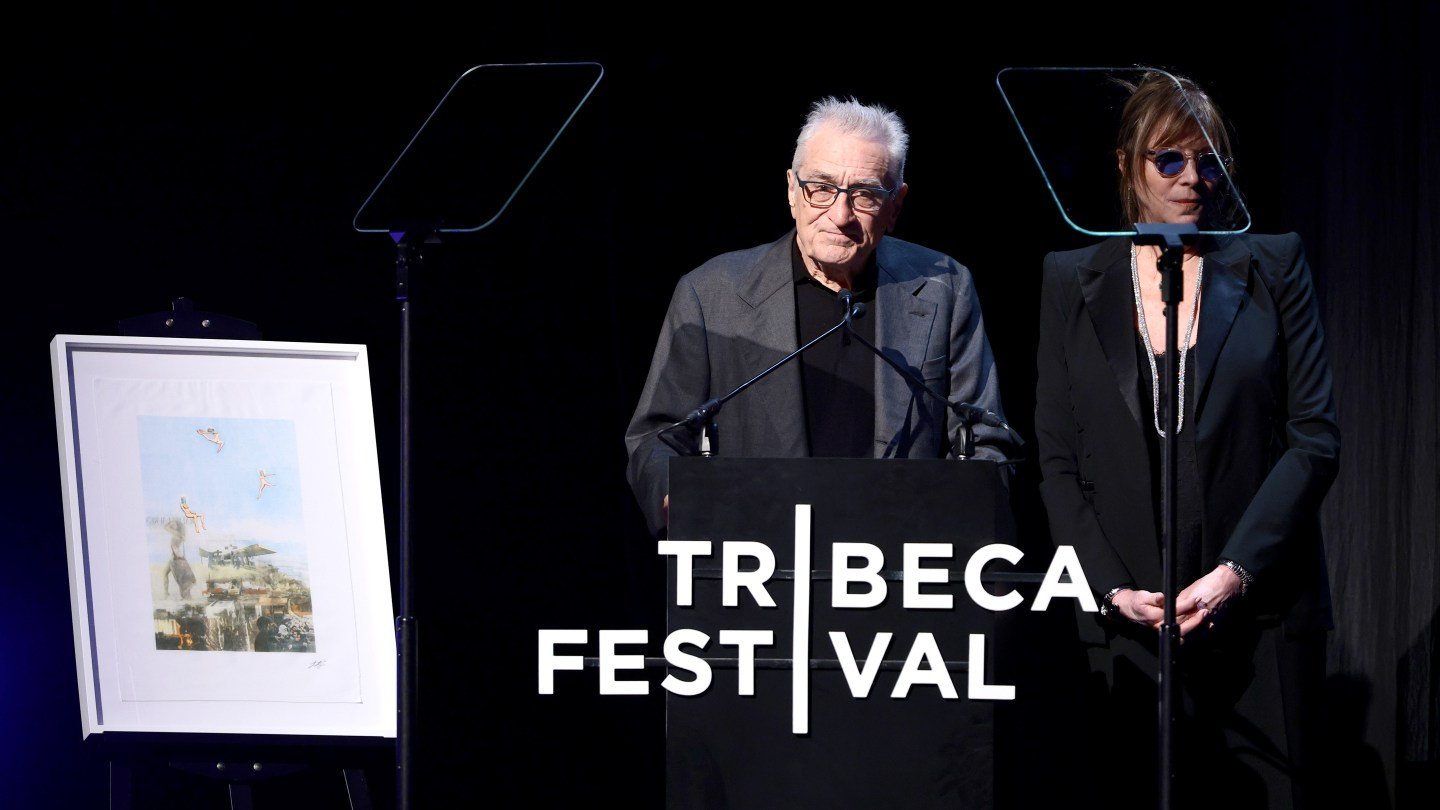
To mark the 25th anniversary of 9/11 and the release of the doc, I sat down this week with De Niro and Rosenthal at CBS News headquarters in midtown Manhattan (fresh off a Gayle King hit) to talk to them about 9/11, the anniversary and the festival’s place in both.
Let’s talk about that night of the United 93 premiere, which was unlike anything I’ve ever felt in a movie theater. How did it play for you guys?
Jane Rosenthal: It was very special and one of the highlights of the past 25 years. You have to remember that the Shanksville [PA] families haven’t already felt like they were included as much as some the others. So we were just trying to give them a community, a place where they can come together and remember.
The tone of it feels so hard to strike — is this a celebration? A commemoration? A memorial? Almost, perhaps, like a microcosm of the festival itself.
JR: We had a lot of questions about how to do it. Like, would we have a red carpet? Who would we invite? It’s really uncharted territory. But I think in the end we got it right and it was one of the most special moments in the history of the festival.
Bob did that moment stand out to you? Or is there another that really embodies Tribeca in your mind?
Robert De Niro: It’s hard to pick one. But I do remember that first year, right when we started, standing on the roof [at Tribeca headquarters and De Niro offices on 375 Greenwich] and looking down and seeing thousands of people coming out and thinking “we really have something.” We had no idea if it would work. And then I’m thinking “downtown can come back.” I don’t know if anything will compare to that feeling.
Jane, creating something out of nothing seems hard for anyone with a film-festival dream, let alone in a place that was the site of a major terrorist attack with nothing but rubble and rescue workers around. What was the scale of the challenge?
JR: It really did seem impossible. I mean, we were walking into movie theaters with hazmat suits because they were telling us it was unsafe. We really didn’t know if anyone would come. And winging it doesn’t really begin to describe it. George Lucas had a new Star Wars movie coming out. Bob walks into my office and says, “George tells me the movie won’t be ready in time.” And I said “maybe we just push the festival back? It’s not like anyone is waiting for it.” So that’s what we did. We had no rules, no business plan. We just knew we needed to do something.
RDN: New York seemed stuck. Downtown seemed dead. The only thing we could do is try to change that.
JR: It’s a feeling about being part of a community. That’s what they were trying to take away with the attacks. So that’s what we tried to bring back.
Bob you talk movingly in the film about your experiences on the day. We all had them but to think that a celebrity was basically feeling what we all were feeling brings a strange kind of comfort.
RDN: It was surreal. I was supposed to go to California later that day. I was coming back from a meeting in Midtown and my son called me in the car and said a plane hit the Twin Towers. Then he called me again and said another plane hit. I get to my office, which is nine blocks north of the Towers. I have a big picture window and saw them burning. Then they just pancaked down.
That’s one of the most striking moments in the movie, where you say that even though you watched it out the window with your own eyes you didn’t believe it. I think a lot of us felt that way.
RDN: I couldn’t believe what I was seeing — I had to watch CNN just to confirm it, as strange as that sounds. Right at the moment it felt like nothing could ever go on as usual. “We are in the middle of an apocalypse,” I kept thinking.
There’s been some stir in recent days here in New York about whether Mayor Zohran Mamdani should attend the memorial, a protest movement led by Rudy Giuliani, George Pataki, former FDNY commissioner Thomas von Essen and a few families, because — as they see it — he’s had associations with people who minimized the tragedy. Do you think he should be there?
RDN: I don’t see why he shouldn’t come. He’s the mayor. I haven’t heard him say or do anything yet that would disqualify him from being there. Maybe I’m naive but you have to give the guy a chance. He’s not a part of what happened.
Do you understand why families of victims would find it problematic or does the logic not track for you?
RDN: [pauses to think] I understand their pain but I still think he should be there.
JR: I think this stems from tension he’s had with the fire department and the comments about defund the police, which I don’t think he really meant.
RDN: Well he did say it. And of course it’s ridiculous. You can’t defund the police. It’s not going to happen. But I still think he should be at the memorial.
JR: He should use it as a baton to unite the city.
RDN: As a bridge.
Speaking of partisan politics, you’ve been outspoken on Trump…
RDN: We have to stop him. It’s insane. We have to send people to voting booths and make sure they can go in. Just watch to keep them safe. It’s crazy we’re here but this is where we are. We have to protect our elections.
As we speak Alex Gibney’s Elon Musk documentary is premiering in Venice. One of the things it’s about is how Musk himself could put his thumb on the scale with the election.
RDN: He’s a monster. I don’t know how else to say it. So many of the tech barons. They were supposed to be helping us and now look at what they’ve done to us. And they’re doing things not to other countries but here, in America, to America, in our own backyard. It’s unbelievable.
You’ve actually had a very interesting relationship with tech and deepfakes as an actor; Marty used it in a groundbreaking way to de-age you in The Irishman. That was more than seven years ago. Do you like where AI has gone?
RDN: I have a lot of concerns about where it’s gone. Where it’s going. I did that thing at CAA — The Vault (a partnership between the agency and YouTube to give performers more agency over their likeness). I have control over my image now. You need my consent. If you do it right and I’m involved I don’t think I’d have a problem with it. But a lot of it is not that. It’s things I’d never say.
JR: I think The Vault is very good but we have a long way to go to get control.
RDN: You know every year Apple asks me to take a picture and then they’ll give me an iPhone if I do. And I’m never doing that; I’m not going to help them sell their technology. I always say no. I’m very polite about it. But they know.
Before we break, I have to ask: what does the future of Tribeca look like — what do you think will be said about it after the next 25 years?
RDN: Well I won’t be here for that. Maybe you will.
You’re saying you don’t think Bryan Johnson can give you immortality and you can be here that way?
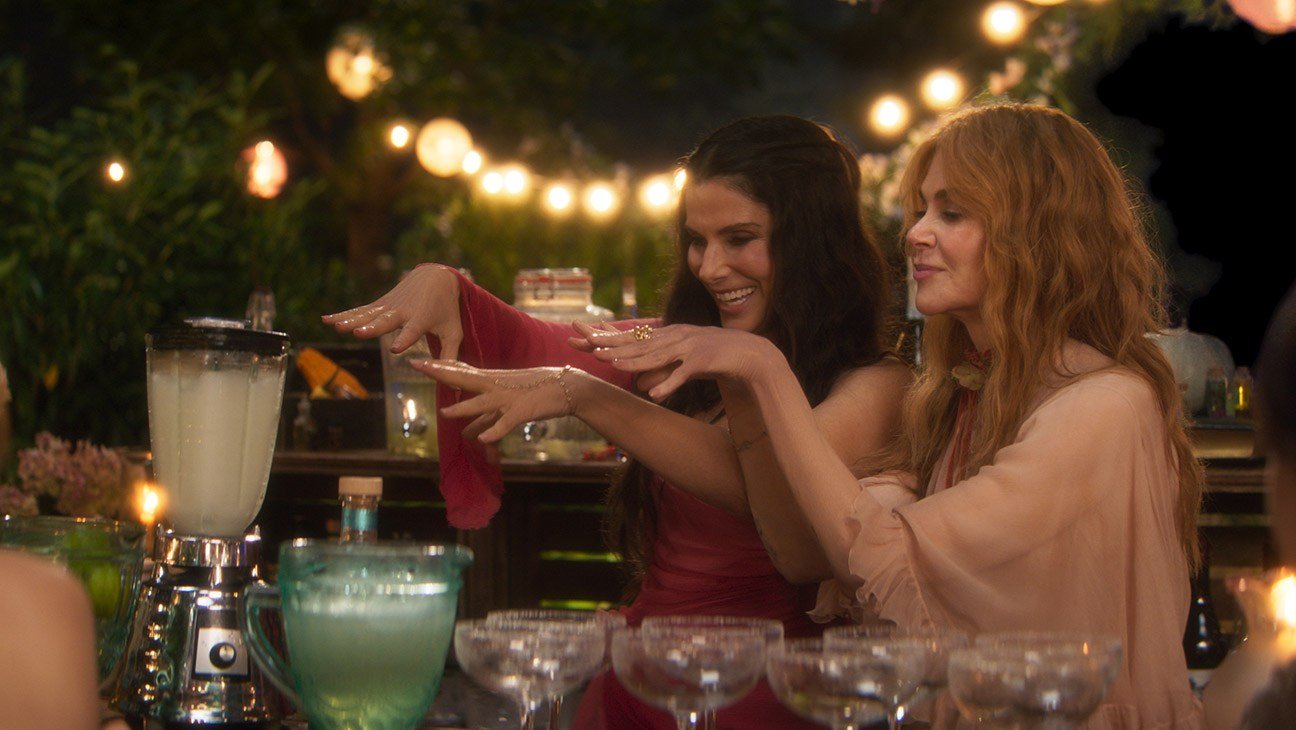
Warner Bros. Pictures‘ Practical Magic 2 debuts in over 4,000 theaters and arrives 28 years after Sandra Bullock and Nicole Kidman originated their roles as the Owens sisters in the first film. The studio projects director Susanne Bier‘s feature to gross between $30 million and $35 million from North America in its opening weekend, with an additional $18 million to $23 million overseas.
The initial movie collected a total of $46 million domestically from its theatrical run that began Oct. 16, 1998, meaning that the sequel has a chance to surpass this in its debut frame. Adapting the work of author Alice Hoffman, Practical Magic 2 centers on witches Sally (Bullock) and Gillian (Kidman), who aim to break the curse that has prevented their family members from finding love. Joey King, Maisie Williams and Lee Pace round out the cast.
Critics have not felt the film’s magic, as the sequel holds a 36 percent approval rating on Rotten Tomatoes. In her review for The Hollywood Reporter, critic Angie Han wrote that the movie “works better the less you look for any sense of logic, and the more you just lean into the transient joys of watching these [two] actresses bounce off each other.”
Sony Pictures’ Spider-Man: Brand New Day has led the domestic box office for six consecutive weeks, but that streak will come to an end this weekend.
Still, the Tom Holland-led film that hails from Marvel Studios continues to make its mark, as the record-setting movie is on its way to becoming the top title on the all-time North American chart. The feature is expected to soon surpass the $936 million domestic total for 2015’s Star Wars: Episode VII — The Force Awakens, which should happen either this weekend or the following one.
Also opening this weekend are Angel’s Runner, starring Alan Ritchson and Owen Wilson; Focus Features’ Andrew Garfield-led The Uprising; and Inaugural’s The Fix, with Liam Neeson and Zachary Levi.
Oscar-winning CODA director Sian Heder argues Being Heumann, her new film about disability rights that opened the 51st Toronto International Film Festival, is timely because “collective action matters.”
“We are living in a time when a lot of groups of people are getting left behind,” Heder told festivalgoers at the Roy Thomson Hall on Thursday night. “The rights that many people fought for in the 1970s are under threat, and it is easy to feel helpless,” she added before a local audience showing a groundswell of patriotism amid Donald Trump’s cross-border trade and tariffs war with Canada.
“I have been out on street with a cardboard sign many times this year, and thought does this even matter, does this protest matter. There’s so many battles on so many battles, it’s hard to know where to fight,” Heder said. She spoke to introduce Being Heumann, her Ruth Madeley-starring drama about protest leader Judy Heumman, who led a historic 1977 campaign that launched the disability-rights revolution in the U.S., which eventually led to the Americans With Disabilities Act.
“This film is what happens when people refused to be invisible,” Heder added before a post-premiere Q&A saw her bring onto the stage her cast of disability actors that played disabled people in her crowd-pleasing movie for Apple Original Films.
Madely said she was inspired by the opportunity to bring Judy Heumann’s ferocity and humor to the big screen.“Thank you for so much for trusting me with something so huge,” Madeley also told Heder after being offered her dream role.
Toronto Mayor Olivia Chow was also in attendance to help open the 2026 edition of TIFF. Chow didn’t name Trump directly, but pointed to the U.S. president recently renaming one of the Great Lakes on the U.S.-Canadian border as “Lake America” amid stalled efforts to negotiate a new cross-border trade deal.
“I am pleased to say our magnificent waterfront will always be Lake Ontario,” Chow said to loud applause. Trump’s trade war with Canada is expected to overshadow TIFF as around two-thirds of Canadian film and TV series exports go to the U.S. market, even as Canadians consume a host of Hollywood film and TV content north of the U.S. border.
Shortly after Turning Point USA CEO Charlie Kirk was fatally shot in September 2025, his wife, Erika Kirk, announced she was pregnant with their third child.
Rating:
Months after Turning Point USA CEO Charlie Kirk was fatally shot on Sept. 10, 2025, a rumor circulated online that his widow, Erika Kirk, had announced she was pregnant shortly after her husband’s death.
The claim about her supposed pregnancy resurfaced (archived) about a year after Kirk’s killing, with many people online noting that the baby should have been born by then.
Some social media users speculated it was an example of the “Mandela Effect” — a phenomenon that occurs when people collectively misremember reality.
“Wait wasn’t erika kirk supposed to be pregnant or is that some kind of mandela effect?” one TikTok user asked in July 2026. The post (archived), which received more than 4.2 million views as of this writing, was captioned: “It’s been well over 9 months.”
Dozens of Snopes readers searched searched the site for answers.
While Erika Kirk has repeatedly talked about the two children she had with Charlie Kirk, there’s no evidence that she announced she was pregnant again after her husband was assassinated. The rumor has persisted since the shooting took place. We first looked into it in September 2025 and found no evidence that it was true.
In November 2025, during an interviewwith conservative commentator Megyn Kelly, Erika Kirk said that she and Charlie Kirk had wanted four children.
“I was praying to God that I was pregnant when he got murdered,” she said. “I was like, oh goodness, that would be the ultimate blessing out of this catastrophe.”
She did not confirm she was pregnant at any point during the interview.
Despite dozens of false claims — often generated using artificial intelligence tools — that Erika Kirk announced she was pregnant after her husband died, Snopes found no evidence in publicly availablesources that she made such an announcement.
Of the sadly many dwindling artforms whose slow (or rapid) declines we’ve been mourning over the years, the original musical is high on my list of sorrows. Broadway struggles to launch successful new works — meaning, ones not based on a movie we’re nostalgic for, or built around the jukebox catalog of a beloved artist — and they’re practically non-existent on film, save for some arthouse stuff like Leos Carax’s Annette or Joshua Oppenheimer’s The End. We’re starved for new stories set to new songs.
Culture has also been doing some fretting about the state of the movie star, as one class ages into their golden years and not terribly many actors seem poised to replace them. In that regard, I’ve long been invested in Jodie Comer, a Brit who burst onto the scene in the television series Killing Eve. Following that show’s success, Comer delivered a series of film performances that, in combination with her boggling stage work in the awards-bedecked Prima Facie, had me boldly considering a possibility reserved for a precious few performers: Could she be the heir apparent to Meryl Streep?
Stuffed
The Bottom Line
A gnarly romance set to even gnarlier songs.
Venue: Toronto International Film Festival (Discovery) Cast: Jodie Comer, Harry Melling Director: Theo Rhys Writers: Theo Rhys, Joss Holden-Rea
1 hour 57 minutes
She’s just so captivating and chameleonic, so different in The Bikeriders from how she is in The Last Duel, finding such distinction between one post-apocalypse movie (The End We Start From) and another (28 Years Later). There’s a determination in her eyes, a fiercely committed fire to her choices, that makes me think of a young and hungry Streep in her wild run in the late 1970s and 1980s. The trouble is, Streep first found her footing in a very different kind of Hollywood, one that, amid a lot of junk, made enough films to showcase her prodigious talent. Comer, on the other hand, has arrived in a much more uncertain time in the industry. Good roles are scarcer, financial success has been tethered to franchise output. She has not gotten the roles she deserves, I don’t think, the ones that could finally, for all to see, confirm her as a next great hope.
With those two concerns in mind — a longing for original musicals and a wary optimism about Comer’s best-of-a-generation prowess — I went into Comer’s new movie-musical Stuffed wanting it to be a smash. Though it is based on a short film, Stuffed is really a new thing altogether, conceived by director Theo Rhys and his co-writer Joss Holden-Rea, who also wrote the music. Maybe the film could serve a noble double purpose, putting Comer on the right career track and giving a jolt of energy to a languishing medium.
Alas, the film is instead a discouraging slog, a mess of cheap shocks and painful lyrics. It seems inspired by some mix of Sweeney Todd and the dreadful true-crime case of the German guys who set up a date so one of them could eat the other. It’s an icky musical, but one that endeavors to find the sweetness — the romance, even — in the muck. To admit to some bias, that particular genre has never really been my cup of tea. But Stuffed serves up an especially acrid brew, plodding along unmelodiously until its foregone conclusion.
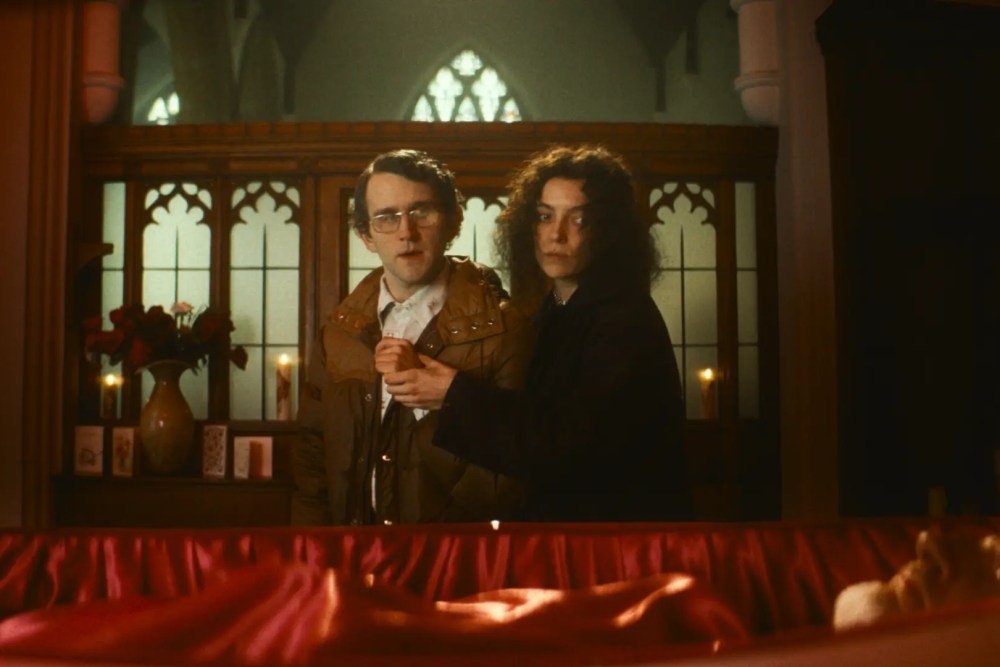
Comer plays Araminta, a bizarre loner who lives in what could be called, by many standards, a house of horrors, full of taxidermied animals and body parts in jars of vinegar. She’s feared and loathed by the locals, who think she ate her mother’s corpse after she died, and is fixated on her dream of turning a human being into one of the stuffed creatures that keep her company. She puts feelers out online, but it’s mostly fetishists and trolls who reach out to her.
Across town, there’s lonely sad-sack Bernie (Harry Melling), a loveless young man who works at a food processing plant and drops in for visits to his dementia-addled mother, with whom he used to be inseparable. He desperately longs to be special, to be remembered, to make an impact on the world somehow. Understandably then (I guess), he’s intrigued by Araminta’s pitch to make him something of a pioneer — the first person to live forever. (In Araminta’s notion of life, anyway.)
And thus the two meet creepy-cute, embarking on preparations for Bernie’s great transition and occasionally singing bland and repetitive songs. While Holden-Rea’s core melodies can be pretty, his lyrics are woefully simplistic, as if they were churned out by a rhyming dictionary bot that traffics in the broadest, most generic of sentiments. It’s one thing to hear a character clunkily sing their motivation once, it’s another to hear it time and time again, with so many of the same rhymes.
The film is also far less risqué than it perhaps thinks it is. Much of the humor relies on the audience chuckling at the discordancy of sweet music scoring talk of death and guts and tissue, amused by the idea these two freaks living in such an ugly and forbidding place could see any of it, or each other, as beautiful. But we’ve been down that juxtaposition road before, in Sweeney Todd, in Tim Burton films, in Urinetown, in Tim Burton’s film version of Sweeney Todd. Disappointingly, Stuffed is not guided by much fresh perspective or narrative ingenuity; a mere oddball premise is not enough on which to hang a whole film. It all wears pretty thin, pretty quickly, and then there’s another hour to go.
On the Comer front, at least, the news is better. She finds a way to distinguish Araminta from myriad other weirdos we’ve seen in similarly-hued films, and keenly locates the actual person under all the mannered characterization of the script. She sings quite well too, working hard (and sometimes successfully!) to elevate the banal lyrics to something like poetry. She’s well matched by Melling, who has a voice like an angel, though were I on his management team I might advise him to seek out some more varied roles going forward. Too often in Stuffed, it feels like we’re watching Melling’s character from Pillion unravel after his breakup with Alexander Skarsgard. (And I wouldn’t blame him one bit.)
The film is to be commended for building itself from the ground up, but the work is dismayingly slapdash. Rhys creates some nice images and certainly knows his way around a sequence; if only he had stronger material to support all that visual panache. He certainly had a tremendous collaborative asset in Comer, though; she carries the carcass of the film — its inert mass of canned provocation — as far as humanly possible. We leave Stuffed hungry only for more of her.
MemeToro has entered Stage 7 as traders search for early memecoin projects during September 2026. The presale has raised $122,810.33 toward a $156,312.74 stage target, with $MT available at $0.00430.
The project displays a $0.05186 launch price, but that target is not a guaranteed market value. A useful MemeToro launch price prediction must examine the required demand, liquidity, product delivery, and selling pressure.
What the MemeToro Launch Price Prediction Means
If $MT moved from its Stage 7 price of $0.00430 to the displayed $0.05186 target, the increase would be about 12 times. A $1,000 purchase at the current stage would receive roughly 232,558 tokens before fees.
At the displayed launch target, those tokens would have a paper value near $12,060. This is only hypothetical math and does not account for network fees, liquidity, price movement, taxes, or the ability to sell at that level.
The project’s stated target should not be confused with a confirmed exchange order. Once public trading begins, buyers and sellers will determine the real price.
Several factors could affect the MemeToro launch price prediction:
The size and depth of the opening liquidity pool.
The number of tokens claimed and sold after launch.
The exchanges or decentralized markets supporting $MT.
Delivery of the planned AI launch system.
Wider demand for $BNB Chain memecoins.
Calling presale participants “top traders” also requires proof. Public fundraising figures show contributions, but they do not reveal whether professional traders or named whales made those purchases.
Fair-Launch Code Adds a Clearer Project Catalyst
MemeToro recently published its first fair-launch smart contract draft. The update added 1,373 lines across 17 files and introduced FairLaunchEscrow.sol, interfaces, test contracts, documentation, and Foundry-based testing.
The contract locks each round’s terms when it is created. It has no owner, admin role, or upgrade path that could let the team rewrite those terms after users contribute.
Its allocation math makes insider tokens impossible within the round. Contributor tokens and liquidity tokens must equal the full supply, while rounding leftovers move into liquidity.
Funds can return to contributors or pass to the planned launch executor for liquidity. There is no coded route from the escrow to a developer or treasury wallet.
These controls may strengthen the project case behind a MemeToro launch price prediction. They do not establish the future value of $MT, and the draft still needs deployment and independent review.
Why $BNB Chain Conditions Could Matter
$BNB Chain has become an active home for memecoin creation because it offers low fees, fast confirmations, established decentralized exchanges, and no-code launch platforms. Four.meme and Flap have helped make token deployment easier for regular users.
The $BNB Chain Foundation has also backed ecosystem growth through a reported $100 million incentive plan. Some decentralized trades can cost around $0.005, reducing friction for users making smaller swaps.
MemeToro aims to add an open-source AI layer to this market. Its AI agent scans trends, publishes supporting evidence, creates proposals, and can reject drafts that break fixed launch rules.
Yet the live contract executor and automatic liquidity step remain unfinished. The project must also connect its manifest to the escrow, deploy on testnet, and obtain a new security review.
The $0.05186 target is therefore an upside project scenario, not a confirmed launch result.
FAQs
What is the current MemeToro presale price?
The latest supplied Stage 7 figure is $0.00430 per $MT, with $122,810.33 raised toward a $156,312.74 target.
Will $MT launch at $0.05186?
The project displays that target, but open-market pricing will depend on liquidity, listings, demand, token claims, and product progress.
What could weaken the launch price?
Thin liquidity, delayed development, contract issues, broad market weakness, or heavy selling by claimable presale holders could push the price below the displayed target.
It’s a somewhat telling coincidence that “Stuffed,” a very peculiar new vehicle for Jodie Comer, is premiering at the same edition of Toronto as “Prima Facie,” the film adaptation of the stage hit that won the Liverpudlian actor a Tony last year, but with Cynthia Erivo taking over her role for the screen. “Prima Facie” could have given Comer a chance to dazzle a wider audience with what we already knew she could do; “Stuffed” will delight and/or bewilder a smaller one with what we definitely didn’t, namely Broadway-level musical emoting in a macabre pop-opera about a romance unfolding through the art of taxidermy. She scores points for risk-taking, then, but she also just scores: A high-wire high-concept piece like this stands or falls by the conviction that the actors bring to it, and Comer plays it from the gut.
So, for that matter, does Harry Melling — an actor who, following last year’s sub-dom romcom of sorts “Pillion,” seems to be making unlikely British indie love stories his niche. Which makes sense, given that he’s a pretty unlikely leading man: His slightly crumpled face, with its resting expression of forlorn, puppyish vulnerability, carries much of the comedy and the tragedy in Theo Rhys‘ endearingly bizarre debut feature, adapted and expanded from his BAFTA-nominated short of the same name. It’s those disarranged features and disconsolate mien that make his character, friendless factory drone Bernie, a figure of fascination for hermetic amateur taxidermist Araminta (Comer); she likes them so much, in fact, that she’d like to fix them in place forever.
In its briefest form, the logline for “Stuffed” promises body horror of the most morbid order: A woman obsessed with the idea of forever preserving a human body advertises for a volunteer to be killed and made into a fleshly artwork; a man who feels invisible while he’s alive steps forward, believing that once he’s stuffed, he’ll finally be seen. David Cronenberg could have done something vividly disturbing and intimately sensual with this idea, but it’s unlikely the result would have landed anywhere in the ballpark of “sweet” — which Rhys’ film, against substantial odds, actually is, even as its atmosphere of fetid physical and psychological decay turns the stomach a little.
If making the whole enterprise a musical sounds like something of a tongue-in-cheek stunt, meanwhile, that’s reckoning without the plaintive lyricism of writer-composer Joss Holden-Rea’s songcraft, which feels heavily indebted to the earnest modern school of Broadway balladry. The score could use a few more hummable tunes, but its sincerity is welcome in a film so rooted in extreme strangeness that it needs to dial down the quirk factor in at least a couple of areas.
Indeed, “Stuffed” takes some time to find a happy medium between the violent eccentricity of its premise and its potential for positively baroque levels of British tweeness. Its opening passages lean in the latter direction, outlining Bernie’s humdrum existence (complete with perfectly banal job in a sandwich factory) with fairytale-style naïveté to match his unworldly outlook, not to mention a hint of Wes Anderson stylization in the superb production design by Beck Rainford (“Ray and Liz,” “Club Zero”), albeit with a thrift-store scruffiness and perennially overcast backdrop to suit the film’s working-class Northern setting. (Rainford also provides ample sight gags for any viewers still tickled by the “bad taxidermy” meme that ruled the web a few years back.)
Once we getting into the more granular details of these people’s lives, however, they start ringing a little more true — and so in turn does the film. A socially awkward introvert devoted to the single mother who, it seems, raised him well into adulthood, Bernie is now returning her care as she slips into dementia — but when she stops recognizing him, it’s as if his sole connection with another human being has been snuffed out. Araminta, it gradually emerges, has a different backstory behind her withdrawal from the world, though her introversion is of a more confidently, creatively aloof variety. When Bernie responds to her ad, he’s astonished that someone so interesting and witchily beautiful should have designs on his body, even if those designs involve formaldehyde: She practically flatters him into a death wish.
Yet the more time they spend together, mapping out their exact plans for his demise and preservation, the more they appear to be peas in one very lonely pod, and mutual intrigue turns to affection. Where does that leave the gruesome project that binds them together? Rhys and Holden-Rea’s script — deftly and quite knottily expanded from the story’s shorter format — takes the central relationship through stages that nod, by turns, to the odd-couple romanticism of Richard Curtis and the knife-twisting adult storytelling of Roald Dahl, with a final dose of Shakespearean fatalism for good measure.
None of which would convince if Comer and Melling weren’t so honestly committed to the bit. Both quite capable singers, they’re alive to the kitsch excesses of the film’s horror, melodrama and musicality, not to mention Holly Rebecca’s suitably mothballed costumes. But they play it just straight enough too: Together, they find a deep, calcified sadness to these oddballs, a desperate need to do something, anything extraordinary, and, finally, a giddy flicker of empathetic self-recognition in each other. It’s that sadness, and that relief, that ultimately dignifies them and their demented mission — and that makes “Stuffed” a more poignant ode to human embalming than anyone might have thought possible.
A crypto analyst has projected that $XRP could eventually reach $60, although the forecast depends on it first clearing a much closer—and difficult—price barrier.
The projection arrived as former Ripple executive David Schwartz said $XRP could one day overtake Bitcoin. But $XRP did not look like it was going towards that prediction as of the time of this writing on Thursday 10 September, falling to around $1.35.
Why is an analyst projecting a $60 $XRP price?
Analyst Ali Martinez believes$XRP could reach $60 if it produces a monthly close above $3.66. His forecast is based on the idea that such a move would end a long period in which $XRP has struggled to make lasting progress beyond its previous highs.
For this to happen, $XRP would need to rise nearly 170% from its current price to even reach $3.66 and would jump almost 4,000% to take it from $1.35 to $60.
There have also been comments from Ripple’s chief technology officer, David Schwartz.
Schwartz was asked, in an X Spaces discussion, if $XRP could take over BTC in total market value, and he said it was possible. He said that for that to happen, $XRP would have to grow faster, not that Bitcoin would lose value.
It wouldn’t happen from Bitcoin shrinking. It would happen from $XRP growing faster than Bitcoin.
Schwartz said that the speed and wider range of functions offered by $XRP Ledger may lead to faster future growth. However, unlike the analyst, he did not give a target of $60 or when it might overtake Bitcoin.
$XRP price faces a more immediate test
During the most recent trading session, $XRP fell 3.24% to about $1.35, pushing $XRP below $1.40, where buyers and sellers have been competing for control.
The price is currently sitting near $1.34 – $1.35, and if this fails, then $1.30 could be the next number buyers look to defend.
Any recovery would first need to take $XRP back above $1.40. It could then face another challenge between $1.45 and $1.50, an area that has repeatedly stopped recent advances.
Source: TradingView
$XRP is also trading with caution in the larger market ahead of fresh US inflation data, which could weigh on the expectations for interest rates and thereby affect the demand for cryptos.
Final Summary
David Schwartz said $XRP could eventually overtake Bitcoin.
The $60 target is only possible if $XRP manages to close above $3.66, but for now, the challenge is holding onto $1.35.