Blog

  • Bitcoin Held at a Loss Reaches Record 11.1 Million BTC

    Bitcoin Held at a Loss Reaches Record 11.1 Million BTC

    BitcoinWorld has reported on a related measurement issue before: analysts have warned that internal transfers can inflate on-chain loss readings, because coins moved between wallets a holder controls can register as realised losses. Darkfost’s framing is narrower: he is describing a snapshot of where the supply sits, not a tally of coins sold.

    The profit side of the ledger, 9 million $BTC, is the number that gives the ratio its weight. When the majority of the supply is underwater at once, the average holder is not sitting on gains, and the analyst’s argument is that this condition has historically preceded better long-term entry points rather than worse ones.

    Why it matters

    For readers trying to place the current market, the headline number is less useful than the ratio. A supply split that leans toward losses means the market’s cost basis sits above the spot price, which shapes how holders behave during drawdowns and recoveries. Darkfost’s own conclusion is explicitly long-term in framing, not a call on the next move.

    Market snapshot

    At the time of writing, 03:36 UTC on November 29, 2026, CoinPaprika data put bitcoin at $59,285, equivalent to ₹5,511,343, down 1.0% over 24 hours and up 0.2% over seven days, with a market cap of $1.19 trillion and 24-hour volume of $8.90 billion.

    What to watch

    The next data point is how the loss-side count moves as the price changes: any sustained recovery would shift coins back into profit, while a further decline would push the figure higher. Darkfost’s post did not set a threshold or a timeframe for either outcome.

    Nothing in the report amounts to a guarantee about future prices. The observation is a historical pattern described by one analyst, and on-chain splits can move quickly in either direction. This is not financial advice; the crypto market is volatile and uncertain.

  • Indonesian Film Admissions Fall 16% in 2026 as Hollywood Imports Rebound

    Indonesian films sold 57.9 million tickets in the first 47 weeks of 2026, down 15.7% on last year, according to analytics platform Cinepoint, while imported titles have clawed back to 2025 levels on the strength of Hollywood’s summer tentpoles.

    Total cinema admissions in Indonesia reached 95.7 million between Jan. 1 and Nov. 22, a 10.3% fall from 106.6 million at the same point in 2025. Cinepoint co-founder Sigit Prabowo presented the figures at the Film & Market Conference at JAFF Market in Yogyakarta on Nov. 29.

    “Are we down this year? Yes, we are,” Prabowo said.

    The overall gap has narrowed since mid-year, when the market was down 16.7%. Imports did the heavy lifting, recovering from a 22.6% deficit at the halfway mark to 37.8 million admissions, just 0.3% short of last year. Local films lost further ground over the same stretch, though they still took 60.5% of all admissions.

    July and August together delivered more than 21.4 million admissions, led by “Spider-Man: Brand New Day” with 6.9 million, Christopher Nolan’s “The Odyssey” with 2.02 million and “Insidious: Out of the Further” with 1.69 million. No Indonesian film released in those two months crossed 1 million. Indian film “Ramayana” has drawn 500,000 admissions, which Prabowo called the biggest result for an Indian title in quite a long time.

    Local films managed 11.7 million admissions across Weeks 27–40, down from 17.4 million in the same stretch of 2025. In Weeks 31–33 they sold roughly 250,000–290,000 tickets a week, compared with 1.2 million–1.7 million a year earlier. They have topped the equivalent 2025 week three times out of four since Week 43.

    The holiday calendar also moved the numbers. Lebaran releases opened on March 18 this year, against March 31 in 2025, and combined March and April admissions dropped 19% to 21.8 million from 26.7 million. May fell 27%, mostly on imports, which slid from 5.8 million to 2.1 million.

    “Jumbo” alone sold 10.2 million tickets in 2025. Strip it out, and the 2026 local slate trails the equivalent 2025 releases by just 1%, at 57.9 million against 58.52 million. Indonesian films set records of 82 million admissions in 2024 and 83 million in 2025.

    “I invite you not to look only at the years of 2024 and 2025 because that’s a very big year, and not every year can have hits like that,” Prabowo said.

    Cinepoint projects local admissions of 62 million–69 million by year-end, 9%–21% above the 2025 five-year moving average of 57 million. Prabowo called that range a very conservative estimate, saying he was looking at 70 million–71 million and “definitely more than 68.” He named newly released “Pulang Kampung,” which Cinepoint projects will post very strong opening weekend numbers, among the stronger titles still to come.

    Hits are also more evenly distributed. At Week 47, 20 local releases had passed 1 million admissions, against 14 at the same point last year, and five had passed 2.4 million. The top five films’ share of all admissions fell from 35.8% to 28.55%, and the top 10’s from 51.9% to 43.7%. Output has climbed faster than hits, however: Indonesian releases rose from 106 in 2023 to 200 in 2025, while the number crossing 1 million slipped from 20 to 16.

    “Danur: The Last Chapter” topped the Lebaran releases with 3.62 million admissions, ahead of “Tunggu Aku Sukses Nanti” with 3.01 million. “Danur” drew the fewest trailer views of that group, at 2.38 million, but converted the most into advance sales, while “Na Willa” logged the most views, 17.39 million, with weak pre-sales before word of mouth carried it.

    Cinepoint’s opening-week audience score, Cinepoint Flash, tracks closely with how far a film runs. Local films rated 8 or above finish at about 2.5 times their opening weekend, against about 1.5 times for those rated below 7. “Na Willa” ranked only 21st among first-half local openings with 156,000 admissions, but went on to finish 10th with 1.40 million, a nine-times multiple. Horror made up 34 of 81 local releases in the first half, or 42%, and averaged a Flash score of 5.6.

    Imports, meanwhile, consist of a few blockbusters and a mass of small releases. Of 283 imports released in the first half, 47% drew fewer than 5,000 admissions, and the median local film outsold the median import 88,800 to 6,450.

    Prabowo argued that films need at least two weeks of relatively stable showtimes to reach every audience segment. Last year’s “Agak Laen: Menyala Pantiku” sold 97% as many tickets in its second week as in its first, on its way to 10.9 million.

    “Even with the current limited infrastructure, my back-of-the-envelope calculation says we can do 95 to 100 million still,” he said of local films, adding that this depends on careful programming and the right content from filmmakers.

    Looking to 2027, Prabowo said he has not yet seen the full slate. “Next year, I have a strong feeling we are going to see at least two or three passing 4 million,” he said, calling 5 million–6 million admissions “a very reachable aspiration.” He also expects imports to rebound with “Avengers: Doomsday,” which he said opens in about three weeks.

    JAFF Market runs alongside the 21st Jogja-Netpac Asian Film Festival, which continues through Dec. 5.

  • ALT5 Sigma Moves 410M WLFI Worth $7.83M in Three Hours

    ALT5 Sigma Moves 410M WLFI Worth $7.83M in Three Hours

    The gap between transfer value and market value

    The $7.83 million figure reflects the price at transfer, not what the tokens are worth now. Panewslab reported a sharp drop in the $WLFI token price on the same day, and the 76 million dollar gap between the $131 million transfer-price estimate for the 2.76 billion tokens and their current roughly $55 million value illustrates how quickly the paper value of a token treasury can move.

    What the transfer does and does not tell readers is worth separating. On-chain data shows tokens leaving a company-linked wallet for a consistent destination. It does not, by itself, show a sale, a custody move, an OTC placement or a swap, and the source report does not state which of these it was. The single address has been receiving ALT5 Sigma tokens for three months, which argues against a one-time liquidation pattern, but the underlying purpose of the flows is not disclosed in the report.

    Market snapshot

    At 17:16 UTC on November 28, 2026, CoinPaprika data showed $WLFI at $0.0169 (₹1.58), down 55.2% over 24 hours and 61.2% over seven days, with a market capitalisation of $536.6 million and $98.0 million in 24-hour volume. ARKM traded at $0.0678 (₹6.30), down 5.9% on the day and 11.6% on the week, with a $38.6 million market cap.

    Why it matters

    Treasury companies holding a single token have concentrated exposure to that token’s price. The pattern has already played out this month in the corporate $ETH stockpile of BitMine, which saw a large weekly paper loss, and in CoinShares’ decision to sell its treasury $ETH and half its SOL holdings — coverage that underscores how quickly on-chain treasury valuations can swing. For $WLFI holders, the practical question is whether repeated transfers to a single address signal a resale of tokens into a falling market or an internal bookkeeping move, because the two have very different implications for supply available to buy.

    What to watch

    Any subsequent on-chain movement out of 0x0dB3 — particularly toward an exchange or liquidity pool — would be the clearest next data point. Whether ALT5 Sigma comments publicly on the transfers is the other thing to track, since Arkham monitoring is descriptive and does not establish the company’s intent.

  • Bitcoin Slips Below $59K as WLFI Plunges to Record Low

    Bitcoin Slips Below $59K as WLFI Plunges to Record Low

    Monday’s climb to $61,000 and a jump to $64,500 tied to news from Nvidia and Jensen Huang did not hold. A high PCE reading on Wednesday sent Bitcoin to $57,100, and although it recovered into Friday and touched $62,000, that level rejected it again. The asset was still fighting to stay above $59,000 at the time of the report, with its market capitalization at $1.180 trillion and dominance at 58.4%.

    Why it matters

    Repeated failures at $62,000 leave the market without a confirmed floor, and the $WLFI move shows how quickly treasury sales by a single project can erode token value. Cryptocurrency losses of the kind seen at BitMine’s Ethereum treasury this month illustrate how large holders’ decisions now feed directly into price action. For ordinary holders, the practical effect is wider drawdowns across majors and smaller tokens alike, with only a handful of names, such as BTW, running counter to the trend.

    What to watch

    The next test is whether Bitcoin can reclaim and hold $60,000, with $62,000 the level that has twice capped rallies. On the $WLFI side, attention turns to whether the project makes further $ETH sales, and to HYPE and Peer, which were among the largest decliners on Friday.

    Market snapshot

    Bitcoin was quoted at $59,435 (₹5,525,281) at the 28 November 2026 18:46 UTC snapshot, down 0.9% over 24 hours and 1.5% over seven days, with market capitalization of $1.20 trillion and 24-hour volume of $10.41 billion, according to CoinPaprika data.

  • Mike Love, Beach Boys Co-Founder and Mainstay for More Than Six Decades, Dies at 85

    Vocalist and songwriter Mike Love, a co-founding member of the Beach Boys and the group’s longest-standing mainstay, died Saturday. He was 85.

    “With great respect, I share that Mike Love died this evening, surrounded by family,” said his press representative, Katie Altman. “An American cultural icon, he will be remembered for his singular talent and inspiration to generations of musicians. We celebrate his remarkable contribution to American music and the joy he felt performing for his beloved fans.”

    No cause or place of death was immediately given by reps. NBC reported that paramedics responded to a medical emergency in Malibu around 5 p.m. that is believed to be related to Love.

    Love’s illness had recently been a source of speculation and concern, as his performances with the band grew weaker this summer, including a three-night stand at the Hollywood Bowl in July for the venue’s annual fireworks spectacular. Months of tour dates were called off a few weeks after the Bowl shows, with the need for Love to “recharge” being cited. He eventually returned for just two concerts, performing seated throughout both evenings. His last show with the Beach Boys was Oct. 10 at Nashville’s Ryman Auditorium.

    Taking to social media before the Nashville finale in October, John Stamos, Love’s friend of many decades and a frequent guest with the band, wrote, “(W)hile I always knew there would eventually come a day when things would change, I never really allowed myself to imagine what that day would feel like. I’m not saying tonight is the end. God, I hope it isn’t. But there’s a part of me that wonders if this could be the last time I get to stand behind Mike, play those songs, watch him work an audience, and feel that indescribable magic that happens when those harmonies fill a room.”

    Little had been heard about Love since that last show, although inside sources shared at the time that it was indeed understood to be his final show with the group. However, in an email to the New York Times published after the Ryman finale, Love wrote that “being onstage this past weekend fed my soul and gave me an incredible lift. … I’m putting my full energy into rehab so I can get back to the music and the best fans in the world.”

    Love’s disinclination to publicly acknowledge that his time fronting the band had ended may have reflected a real desire to keep the door open after all, reflecting his drive to keep his version of the band on the road no matter what, six and a half decades after their first performances. Some associates said he was so dedicated to touring, he might rather go down on the road than retire. Said Jardine, his sometimes estranged former bandmate, in the Times article, describing himself as less motivated to constantly be on the road: “Mike is the epitome of that show business mentality. And I think that’s what keeps Mike up there, no matter what the cost is.”

    Love had been active with public appearances earlier in the year. He stood proudly with two of the group’s other early members, fellow co-founder Al Jardine and Bruce Johnston, in May at a Capitol Records party celebrating the 60th anniversary of “Pet Sounds,” and engaged in interviews with Variety and other publications. He also made a speaking appearance at the Grammy Museum in February (pictured above) to discuss a new boxed set centered on the “Beach Boys Love You” album.

    With cousins Brian, Dennis and Carl Wilson and high school friend Al Jardine, Love formed the Beach Boys in Hawthorne, California, south of Los Angeles in 1962. That year, the group was signed by Capitol Records; the group’s lively, sunny songs about the Golden State’s surf and car culture struck an immediate chord with American listeners.

    Love penned a number of the band’s major early top 10 hits with Brian Wilson, including “Surfin’ Safari,” “Be True to Your School,” “Shut Down,” “California Girls,” “When I Grow Up (To Be a Man),” “Dance, Dance, Dance,” “Fun, Fun, Fun,” “All Summer Long,” “The Warmth of the Sun,” “Wouldn’t It Be Nice” and the chart-topping “I Get Around,”  “Help Me, Ronda” and “Good Vibrations.”

    In a move that typified the internecine, soap-operatic conflict between Love and his band mates, he sued Brian Wilson in 1993 and secured writing credit on more than 30 Beach Boys songs and $2 million in back royalties.

    Over the course of the band’s more than half-century history, as Brian Wilson contended with drug abuse and mental health crises that pushed him off the stage and diminished his writing contributions, Love’s profile in the group rose.

    Love went on to take control of the act and served as its lead singer in later years. He co-wrote and sang the 1988 single “Kokomo,” a song recorded for the soundtrack of the Tom Cruise feature “Cocktail”; it became a million-seller and the Beach Boys first single to hit No. 1 since “Good Vibrations” in 1966.

    In 1998, following the deaths of Dennis and Carl Wilson and with Brian Wilson embarked on a solo career, Love secured exclusive rights to tour under the Beach Boys name from the band’s corporate entity Brother Records; he subsequently filed suit against Jardine to prohibit him from using the group’s name in touring advertising.

    The band largely languished as a live enterprise until 2012, when Love and long-term touring and recording member Bruce Johnston regrouped with Brian Wilson, Jardine and David Marks, who had briefly replaced Jardine in the ‘60s lineup, for a 50th-anniversary album and tour. Inter-band acrimony was swiftly rekindled after Love abruptly re-commenced touring with his lineup of the group immediately following a series of sold-out reunion dates.

    In later years, in the wake of such actions as a successful defamation lawsuit against Brian Wilson after publication of the controversial 1991 autobiography “Wouldn’t It Be Nice,” Love became a lightning rod for vilification among Beach Boys fans. He was often viewed as a conservative force within the band, and the primary motivator for the shelving of the ambitious conceptual work “Smile.”

    Reflecting on his cousin’s reputation as the band’s resident genius in his 2016 autobiography “Good Vibrations,” Love bluntly noted in a much-quoted passage, “For those who believe that Brian walks on water, I will always be the Antichrist.”

    He joined the Rock and Roll Hall of Fame as a member of the Beach Boys in 1988. He stunned the audience at the induction ceremony with a rambling, combative speech that profanely attacked previous inductees Mick Jagger and Paul McCartney. Both Bob Dylan and Elton John sardonically thanked Love from the stage for not mentioning them.

    Love was born March 15, 1941, in the Baldwin Hills neighborhood of Los Angeles; his mother was the sister of Murry Wilson, father of his future Beach Boys band mates. He grew up in Hawthorne, and attended high school there with the Wilsons.

    With Jardine, the Wilsons and Love founded a group – initially known as the Pendletons and ultimately dubbed the Beach Boys – that lyrically exploited the instrumental “surf music” sound that burgeoned in Southern California during the early ‘60s. The neophyte act was influenced by the smooth harmonies of the vocal group the Four Freshmen; Love’s adenoidal voice and tenor saxophone work was a key component of their embryonic style.

    After Brian Wilson’s song “Surfin’” became a regional hit, the Beach Boys pacted with Capitol Records. From 1962-66, they scored 13 top-10 hits – most of them penned by Brian Wilson, or co-written by Wilson and Love – and occupied the top rank of American rock bands.

    By 1966, the dynamic within the band had shifted. Brian, the group’s key composer and producer, had begun to increasingly experiment with drugs, and had ceased touring following a severe panic attack aboard a plane in late 1964; he was ultimately replaced by Bruce Johnston. The group found themselves increasingly supplanted in the studio instrumentally by the “Wrecking Crew,” top Hollywood studio players. And Brian moved away from sun-and-fun songs and towards a more personal, introspective writing style.

    Written and largely produced solo by Brain while the Beach Boys were on the road, the 1966 album “Pet Sounds,” mainly co-written by Wilson and lyricist Tony Asher with contributions from Love on two tracks, marked a definitive break with the band’s early sound. Its making created strife within the band. Love was often described as having protested against its rejection of the act’s bedrock commercial sound, although he denied in interviews over the years that he had anything other than a high opinion of the album.

    “Well, it was simply not true,” Love said to Variety in July, in an interview about “Pet Sounds.” “I never said that. But the funny thing about being in a group is, some people are disparaging of an individual member, when it takes a village, you know? The whole is greater than the sum of its parts. People have said that John Lennon is the Beatles, and, well, what’s up with Sir Paul, I’d like to know? Anyway, there was a tendency by some people to focus on a person and deify them and denigrate the others. And I was a victim of that too, to a small degree for a little bit of time.”

    Love continued, “I came up with the album title. And I went with Brian to Capitol Records to present it to our A&R person. And he simply told us, ‘Hey, this is great, you guys, but can’t you come up with something more like ‘California Girls’ or ‘I Get Around’ or that kind of thing?’ We did come up with ‘Good Vibrations’ a few months later, and that went to No. 1. But it took quite a while for ‘Pet Sounds’ to get the recognition from the public. From the beginning, it was admired by the other recording acts” — including the Beatles, whose admiration for the album was oft-cited by Love. “You know, McCartney has said that “Pet Sounds” is his favorite album — ‘God Only Knows’ is the perfect recording — and Sir Paul knows a thing or two about writing great records, that’s for sure.”

    Despite the failure of “Pet Sounds” in comparison to previous releases, Wilson forged ahead with more daring work. Love supplied the choral hook to the daring, Theremin-laced late-1966 smash “Good Vibrations,” coming up with more simple and commercial lyrics than what had been originally slated. But Brian envisioned the song and the follow-up single “Heroes and Villains” as the cornerstones of a complex thematic work he was writing with prodigious young collaborator Van Dyke Parks.

    Sessions for the album known as “Smile” proceeded arduously, amid a steep decline in Brian Wilson’s mental health, from early 1966 through the spring of 1967. But resistance to the impressionistic, sometimes impenetrable collection grew within the band, and Parks separated himself from the project after an argument with Love over the lyrics to the song “Cabin Essence.”

    In May of that year, release of the still unfinished album was canceled; the “Smile” sessions went unreleased until 2011. Songs from the collection were cannibalized for the subsequent Beach Boys albums “Smiley Smile” (1967) and “Surf’s Up” (1971). But the set’s aborted release and the band’s withdrawal from the Monterey Pop Festival dealt the Beach Boys’ reputation a severe blow, and some observers laid the blame at Love’s feet.

    In the immediate wake of “Smile” and amid Brian’s ongoing dissolution, Love took an enlarged role in writing the band’s music. He co-authored all the songs on the late-1967 LP “Wild Honey,” including the top-20 hit “Darlin’.” He also co-wrote 1968’s “Do It Again,” the band’s last self-penned top-20 single for two decades; on the same year’s album “Friends,” Love celebrated his embrace of the Maharishi Mahesh Yogi’s discipline on the song “Transcendental Meditation.”

    In 1969, following a legal wrangle with Capitol over unpaid royalties, the Beach Boys took their Brother Records imprint to Warner Bros. for distribution. Their debut there, “Sunflower,” was strong artistically, with the Wilson-Love tunes “Add Some Music to Your Day” and “Cool, Cool Water” standing out. But the album was a commercial failure.

    The Beach Boys soldiered on through the ‘70s with Brian’s sporadic participation; the group’s biggest hit of the decade, save the No. 1 hits package “Endless Summer” (1974), was a No. 8 collection of covers, “15 Big Ones” (1976). The 1977 set “The Beach Boys Love You,” hyped as Wilson’s return to form, proved to be his last full collaboration with the band for 25 years. Moving forward, the act became Mike Love’s vehicle.

    The band’s succeeding three studio albums – which included “M.I.U.” (1978), recorded mainly at Maharishi International University in Iowa, at Love’s direction — charted no higher than No. 75. During this period, Love engaged in a side project, Celebration, with saxophonist Charles Lloyd. A single by the band, the movie title song “Almost Summer,” reached No. 28, but two albums failed to chart, as did Love’s lone solo album, “Looking Back With Love” (1981).

    Interpersonal relations between Love, who filed for bankruptcy protection in 1982, and Dennis Wilson, who was grappling with alcoholism and drug abuse, were shredded in the early ‘80s, after the junior Wilson brother fathered a son with Love’s 19-year-old daughter Shawn and then married her. After the couple separated, Dennis drowned accidentally in Marina Del Rey, CA in December 1983.

    The tropically flavored “Kokomo” proved to be the Beach Boys’ last big chart success, though the group issued three albums between 1989-96. Following Carl Wilson’s death from cancer in 1998 and the legal dust-up over the band name with Jardine, Love and Bruce Johnston toured under the Beach Boys handle.

    Brian Wilson’s belated return to health, several warmly-received Wilson tours and solo albums (including his widely acclaimed 2004 re-recording of “Smile”) and a raft of archival Beach Boys releases on Capitol set the stage for the 50th-anniversary reunion of 2012. The album “That’s Why God Made the Radio,” produced by Wilson and featuring three tracks co-written by Wilson and Love, reached No. 3 and became the band’s first top-five collection in 26 years.

    However, the renewed partnership was quickly sundered, with both Love and Wilson pointing at the other as the responsible party. The Love-Johnston edition of the Beach Boys again took to the road, while Wilson toured with Jardine and ‘70s band member Blondie Chaplin. Johnston announced he was retiring from the group earlier this year, leaving Love as the only remaining member from the classic era of the band.

    Love published a memoir, “Good Vibrations: My Life as a Beach Boys,” in 2016. It drew polarized reviews, predictably enough, with some readers siding with Brian Wilson and other members in disputes that were recounted in the book, while others expressed admiration for Love’s candor and his role as the ringleader who kept the band active when most of the members were less motivated or less interested in the business aspects of keeping the Beach Boys going as a unit.

    When Love appeared at the Grammy Museum in February, he reminisced not just about the era covered in the fresh “We Gotta Groove” boxed set but about the group’s earliest days. Upon being brought out near the end, Love launched into a 12-minute stream-of-consciousness monologue that touched on the Brother Studio years of the 1970s, but also events stretching back to him and Brian Wilson bonding over music while attending youth group at Angeles Mesa Presbyterian Church.

    “He’d come over to my house in his Nash Rambler, and we’d get kicked outta my house because my dad had to get up so early to go to work at Love Sheet Metal, where I was an apprentice at one time,” recalled Love. “The Nash Rambler had the feature of the seats going down, so we laid back and listened to all the R&B stations in L.A. and we’d listen to our Everly Brothers. … We loved doo-wop. We loved Chuck Berry. We loved Little Richard. You name it, we loved it. … And so when I wrote this song, ‘Brian’s Back’…” He recited the lyrics. “They say that Brian’s back / Well, I’ve known him for oh so long / Well, they say that Brian’s back / Well, I never knew he that he was gone / But still they say Brian’s back / Well, I know he’s had his ups and downs / Well, they say Brian’s back / But in in my heart, he’s always been around.’”

    In covering the Grammy Museum event, Variety noted that Love’s softer and gentler appearance roused some emotions among attending fans. “Love turns 85 next month, and his soft-spoken manner in his museum soliloquy was touching to many of those in the audience, even some of those not normally inclined to favor his point of view on disputes that have been part of Beach Boys lore over the decades.”

    Said Love at the event: “I mean, there’ve been differences and terrible things that have happened and lifestyle choices that were terrible, ultimately, to many. But it’s always been about love, and with me, about trying to accentuate the positive. This evening, tonight, is ridiculously positive. It’s kind of miraculous, in a way, that there would be an interest in a period of time and a group of songs that never saw the light of day until now… We did all get together and support Brian in whatever ways we could. And I just had nothing but love for Brian, for the other guys, and for the music, and all the people that have worked on our music.”

    Love is survived by his fifth wife Jacqueline and nine children.

  • ‘Jumbo’ Studio Visinema Unveils New Look at Sci-Fi Folklore Animation ‘Kancil’ (EXCLUSIVE)

    Variety has the exclusive first look at a new image from “Kancil,” Visinema Studios’ sci-fi animated take on Indonesian folklore, as the follow-up to hit “Jumbo” moves into animation production.

    The image shows a suited hero in a helmet with a glowing blue visor, crouched mid-landing in a cloud of dust on a neon-lit city street at sunset.

    Visinema presented the project during a session at its booth at JAFF Market 2026 titled “From ‘Jumbo’ to ‘Kancil’: Elevating the Next Generation of Indonesian Animation.” “Jumbo” drew more than 10 million admissions in Indonesia.

    Variety first reported on “Kancil” in 2024, when Visinema presented the project at the Future Project platform of the inaugural JAFF Market. The film has now completed development and pre-production, including visual development, world-building, casting and voice recording.

    The film recasts Kancil, a familiar figure from Indonesian folklore, in a sci-fi action comedy. Here, Kancil is a clever and resourceful young boy who is unexpectedly pulled into a dangerous adventure and becomes an unlikely hero. Alongside the action, humor and sci-fi elements, the story deals with family, belonging and self-discovery.

    “We want to create an up-to-date version of this well-known folklore for a modern audience, while also expanding the lore,” director Adrianto Rudiman told Variety. “We chose sci-fi because we can explore our imagination even further for this film.”

    Visinema began developing “Kancil” while “Jumbo” was still in production, as the studio looks to widen its animation slate beyond a single genre or storytelling formula.

    “We feel like when we developed ‘Jumbo,’ we just barely touched the surface of what Indonesian animation can do,” said Ryan Andriandhy, who directed “Jumbo” and is creative producer on “Kancil.” “We learned what was possible with ‘Jumbo,’ and with ‘Kancil,’ we want to ask what else is possible, and how much we can elevate this project.”

    Linius Gunardi, head of animation at Visinema Studios, said the team is exploring a 2D-look approach to 3D animation on “Kancil,” alongside more dynamic camera movements to support the blend of action and comedy.

    “The process involves various experiments, evaluations and collaborations among different talents to find the most suitable approach,” Gunardi said.

    Visinema Studios is the Visinema subsidiary focused on family-friendly and animated content.

    JAFF Market, which concludes Nov. 30, runs alongside the 21st Jogja-Netpac Asian Film Festival, which continues in Yogyakarta through Dec. 5.

  • Bitcoin Held at a Loss Tops 2022 Bear Market Levels, Analyst Says

    Bitcoin Held at a Loss Tops 2022 Bear Market Levels, Analyst Says

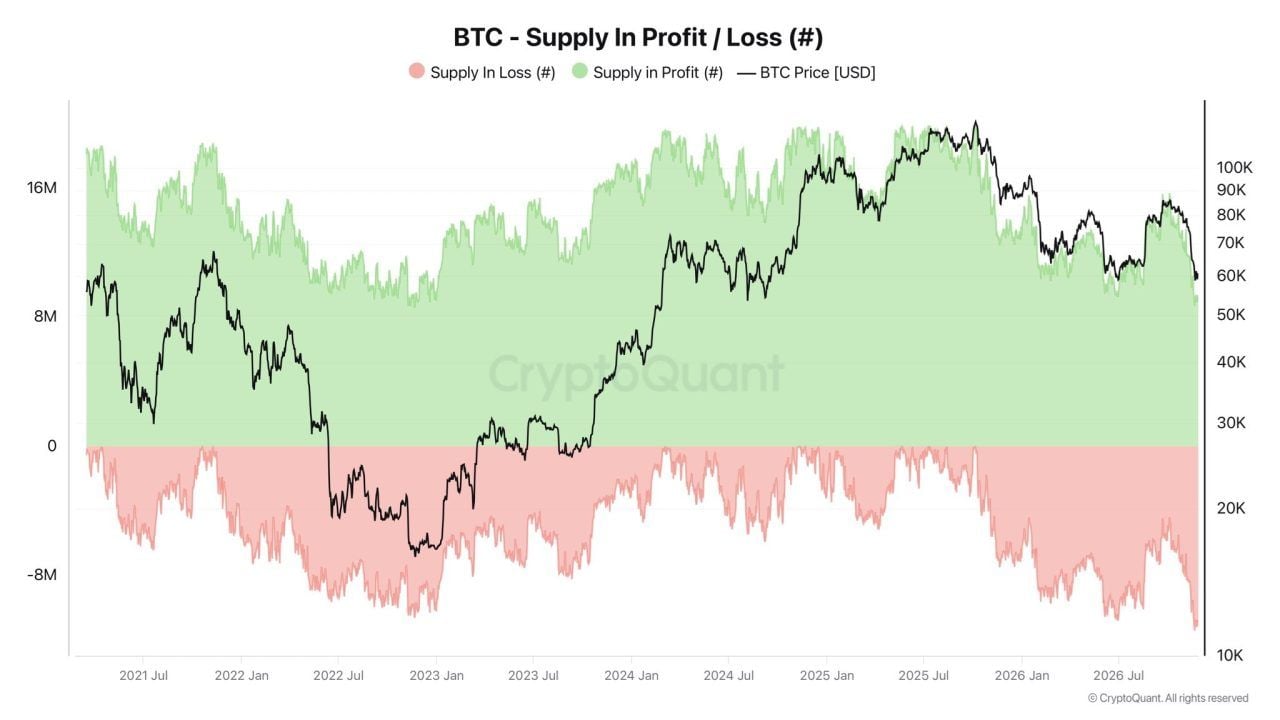
    “Currently, 11.1 million $BTC are held at a loss, versus 9 million in profit,” the analyst further shared. He viewed the imbalance as a potential opportunity for investors looking to build a long-term bitcoin position.

    During a reversal in bitcoin’s Thanksgiving rally on Nov. 27, bitcoin fell from an intraday high of $62,125 to $58,719 as roughly $7 billion in Deribit options expired. By midday, bitcoin had recovered to test $60,000. U.S. spot bitcoin ETF outflows for November had already surpassed $5 billion.

    Bitcoin supply held in profit (green) and at a loss (red), plotted against $BTC’s price. Source: Cryptoquant and Maartunn, shared by Darkfost on X.

    Coinglass Shows a Higher Reading Earlier in November

    Coinglass’s historical figures for bitcoin held at a loss peaked at 11.42 million $BTC on Nov. 20 before easing to 11.10 million on Nov. 27. The series stood at 6.66 million $BTC 30 days before the Nov. 27 reading. The same series counted about 10.60 million $BTC at a loss on Nov. 21, 2022.

    Glassnode’s weekly bitcoin market analysis showed the share of supply in profit fell to 47.3% from 54.2% a week earlier. The Nov. 23 report also found that short-term holders’ net unrealized profit-to-loss reading had fallen to its lowest level since mid-June. Weekly ETF outflows were the heaviest since early July, while futures open interest fell to its lowest level since early March.

    During the June sell-off below $61,000, Glassnode estimated that more than 8 million $BTC were underwater on June 9. Bitcoin briefly fell to $60,718 that day before reclaiming $61,000. It later traded near $61,700, down 2.9% on the day. Its losses over the preceding week reached 8.5%.

    How the Metric Counts Bitcoin at a Loss

    Analysts compare the current market price with the price at which unspent bitcoin transaction outputs last moved. Coins count as underwater when their last-moved price is higher. A transfer between wallets can reset that reference price without a sale even when the same person still owns the coins. A price rebound can return coins to profit while they stay in the same wallets.

    Cryptoquant contributor Cryptozeno estimated that the bitcoin supply profit-to-loss ratio was near 0.8, or about eight coins in profit for every 10 at a loss. The contributor pointed to similar readings near past market lows, including during the 2022 bear market, and said the seven- and 30-day averages needed to recover above 1 to confirm a durable improvement.

    Realized price combines those individual reference prices into a single average for circulating bitcoin. Matt Mena, senior crypto research strategist at 21shares, put bitcoin’s average on-chain cost basis near $53,000 on Nov. 25. He warned that a sustained move below that level could bring $48,500 into play, pointing to the August 2024 sell-off, when bitcoin traded below $49,000.

  • XRP Ledger Lending Activates on Dec. 11 Unless Three Validators Switch Their Votes

    XRP Ledger Lending Activates on Dec. 11 Unless Three Validators Switch Their Votes

    XRPScan’s amendment record for LendingProtocolV1_1 shows 30 yes votes against a threshold of 28, with 35 validations. The parent LendingProtocol entry carries the same count and the same majority timestamp: 14:22:02 UTC on Nov. 27. Both must activate for the feature to work as specified.

    The upgrade path began with xrpld 3.4.0, which shipped the lending amendments in September. A second amendment in the same family is further along. SingleAssetVault, known as XLS-65, reached its own majority at 19:38:51 UTC on Nov. 25 with the same 30 of 35 votes. Its earliest activation is 19:38:51 UTC on Dec. 9, two days before lending.

    Vaults first, then loans

    The sequence follows from the design. XLS-66 requires XLS-65, and a LoanBroker draws its funding from a Single Asset Vault, so the vault type has to exist first. On Dec. 9 the vault becomes available as a ledger object. On Dec. 11, if support holds, the loan objects that draw on it follow.

    The XRPL documentation describes the feature in one sentence: “The Lending Protocol is an $XRP Ledger DeFi primitive that enables on-chain, fixed-term, uncollateralized loans using pooled funds from a Single Asset Vault.” That definition is published on xrpl.org.

    The lifecycle the specification lays out is short. A loan broker creates a vault. Depositors add assets. The broker may deposit first-loss capital. A broker and a borrower then sign a loan in a single transaction using a counterparty signature, the terms are fixed at signing, and the principal moves. Payments are amortized; a missed payment opens a grace period, and once it expires the broker can declare the loan in default.

    What the amendment actually permits

    The design choice that separates this from Aave or Compound is stated plainly in the XLS-0066 standard: “Most DeFi lending protocols (e.g., Aave, Compound) require on-chain collateral and automated liquidation mechanisms. This protocol deliberately omits these in favor of uncollateralized loans with off-chain underwriting.”

    There is no liquidation engine because there is no collateral to liquidate. Credit assessment happens off-chain, before a loan is signed, and the ledger enforces the terms afterward: principal, interest, late interest, a full-payment rate for early repayment, and a set of broker-configurable fees that include a management fee taken as a share of interest, an origination fee, a service fee, a late fee, and an early-payment fee.

    Protection for depositors comes from first-loss capital, which the standard describes this way: “This scheme requires the Loan Broker to deposit a fund that can be partially liquidated to cover losses in the event of a loan default.” The fund sits in a broker pseudo-account, separate from the vault’s assets, and is drawn down when a borrower defaults.

    The same section adds the qualifier that matters most: “The First-Loss Capital mechanism is optional rather than mandatory.”

    The compliance layer is the part issuers will read

    For a bank, a fintech, or a licensed issuer weighing tokenized credit, the collateral question is secondary to control. The standard answers it early: “The Lending Protocol supports the Clawback and Freeze controls of the Vault asset’s Issuer.”

    The consequences are written into the loan objects. If an issuer freezes a borrower’s account, the borrower cannot make payments, but the obligation to repay does not disappear. A deep freeze on the broker’s pseudo-account stops new loans and also prevents existing loans from being paid, while an ordinary freeze on the same account only blocks new lending. An issuer can claw back funds from the first-loss capital pool. In each case the issuer keeps the asset-level control it already had, and the ledger applies that control to the credit position.

    That is an unusual combination: uncollateralized credit, priced off-chain, with on-chain settlement and an issuer kill switch that reaches the loss buffer. It is closer to a permissioned credit rail than to the open liquidity pools most DeFi users know, and it explains why the specification spends a full section on freeze and clawback semantics before it describes the loan terms.

    A two-vote cushion is thin

    Thirty votes against a threshold of 28 leaves room for exactly two defections. At 27 of 35, support is 77.1%, below the 80% line, and the amendment is rejected. The countdown then restarts from the next majority, which pushes the earliest activation date back by another two weeks.

    Validator counts move for operational reasons that have nothing to do with the merits of a feature: a validator goes offline, changes operators, or upgrades to a release that does not yet support the amendment. The LendingProtocolV1_1 entry lists its supporting validators individually on XRPScan, which makes the two-vote margin checkable rather than rhetorical. Anyone can count the names, and anyone can watch them change before Dec. 11.

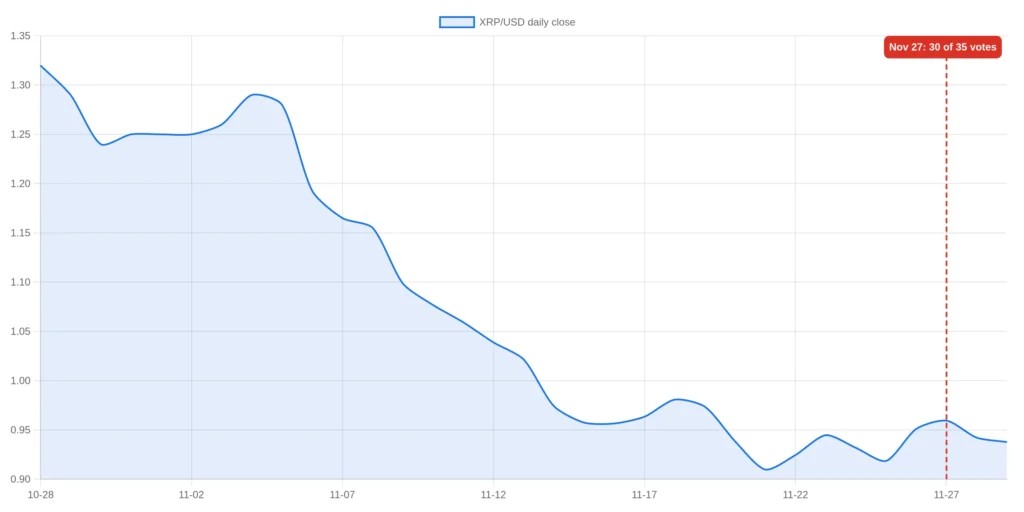
    $XRP is trading 29% below its Oct. 28 close

    $XRP traded at $0.9368 at 00:46 UTC on Nov. 29, continuing a slide that began in early November, down 1.7% in 24 hours, 25.1% over 30 days, and 57.3% over a year, according to CoinPaprika. Its market capitalization was $59.5 billion. Bitcoin, for scale, traded at $59,185 with a $1.19 trillion market cap.

    The token closed at $1.32 on Oct. 28. It bottomed at $0.9098 on Nov. 21 and has recovered 3.0% from that low, which still leaves it 29.0% below the October close. The chart above plots those daily closes and marks Nov. 27, the day the amendment crossed 28 votes.

    $XRP daily close, Oct. 28 to Nov. 29, 2026. Data: CoinPaprika. The red line marks Nov. 27, when the lending amendment reached 30 of 35 votes.

    The market-cap arithmetic is worth doing because it sets the scale of any recovery claim. At a $59.5 billion cap and a $0.9368 price, roughly 63.5 billion $XRP are in the float, so each one-cent move is worth about $635 million in market value. A return to $1.00 requires a 6.8% gain, or about $4.0 billion of added value. A double to $1.87 would add $59.5 billion. A tenfold move to $9.37 would require a $595 billion valuation, about half of bitcoin’s current $1.19 trillion.

    What the chart does not show is causation. $XRP traded near $0.96 on Nov. 27, the day the amendment crossed, but the decline from $1.32 began in early November, before the vote was close. The available evidence does not establish the amendment as a price driver in either direction. It is a protocol event with a fixed date.

    What changes on Dec. 11, and what does not

    What changes: the ledger gains native loan and loan-broker objects, the vault created on Dec. 9 gains a credit use, and issuers gain an enforceable way to apply freeze and clawback to a lending position.

    What does not change: $XRP does not become borrower collateral, because a loan is still unsecured and the vault’s asset only supplies the funding. No smart contract is required to use the feature, and no loan can exist without a broker willing to underwrite it off-chain. A vault created before the amendment records the rules in force at creation through its LEXVersion field, and keeps those rules for its whole life, so early vaults will not automatically inherit later accounting fixes.

    The near dates are now fixed on the ledger’s own calendar. Dec. 9 at 19:38:51 UTC for vaults, Dec. 11 at 14:22:02 UTC for lending, both conditional on 28 of 35 validators staying in place. Between now and then, the only number that matters is the vote count.

    Frequently Asked Questions

    When does lending go live on the $XRP Ledger?

    The earliest activation is 14:22:02 UTC on Dec. 11, 2026, two weeks after the LendingProtocol amendment reached 30 of 35 validator votes on Nov. 27. Support must stay above the 28-vote threshold for the full window.

    What happens if validator support drops before Dec. 11?

    If support falls to 27 of 35, or 77.1%, the amendment is rejected and the 14-day countdown restarts from the next majority, pushing activation back by at least two weeks.

    Does the $XRP Ledger lending protocol need smart contracts?

    No. Loans, brokers, and vaults are native ledger objects and transactions, so the credit terms are enforced by the ledger rather than by a deployed contract.

    Are the loans collateralized?

    No. The protocol is built for uncollateralized, fixed-term loans underwritten off-chain. First-loss capital posted by the loan broker is an optional buffer, not collateral pledged by the borrower.

    What activates before the lending protocol?

    SingleAssetVault, or XLS-65, reached its majority on Nov. 25 and activates no earlier than 19:38:51 UTC on Dec. 9. The lending protocol draws its funds from those vaults.

    Does the Dec. 11 activation mean $XRP will rise?

    There is no established mechanism linking the amendment to the token’s price. $XRP fell 29% from its Oct. 28 close while the vote advanced, and the decline began before support neared the threshold.


    Sources: XRPScan amendment records for LendingProtocolV1_1, LendingProtocol, and SingleAssetVault; XRPL documentation for the Lending Protocol; XLS-0066 specification. Data: CoinPaprika, XRPScan, Coinbase.

    This article is for information only and is not investment advice. Prices and market data are from CoinPaprika and Coinbase as of 00:46 UTC on November 29, 2026, and change continuously.

    The post $XRP Ledger Lending Activates on Dec. 11 Unless Three Validators Switch Their Votes appeared first on Blockchainreporter.

  • Mexico files complaint with US over DEA tip line on alleged drug dealers

    Mexico files complaint with US over DEA tip line on alleged drug dealers

    Tensions rise over DEA tip line, with Mexico emphasising respect for its sovereignty amidst growing bilateral discord.

    Mexico has filed a formal complaint with the ⁠United States over a US Drug Enforcement Administration (DEA) tip line seeking information on suspected drug traffickers and alleged corruption among Mexican officials, President Claudia Sheinbaum has announced, touching on a particularly sensitive issue in bilateral relations.

    Foreign Minister Juan Ramon ⁠de la Fuente contacted the US ambassador to Mexico to lodge the complaint, Sheinbaum said on Friday during her morning news conference, adding that the ambassador said he would look into the issue.

    Recommended Stories

    list of 3 itemsend of list

    Alleged links between elected officials and organised crime have become an increasingly fraught issue for Sheinbaum’s government, which has rejected what it describes as attempts by US authorities to interfere in Mexican ‌affairs.

    “We have made it very clear that our relationship with the United States is one of coordination, not subordination,” Sheinbaum said.

    The complaint comes despite a significant expansion of security cooperation between the two nations under Sheinbaum. Her government has stepped up efforts against organised crime and fentanyl trafficking amid pressure from US President Donald Trump, who has repeatedly threatened unilateral action against Mexican cartels if Mexico did not do more.

    On Thursday, Sheinbaum  in harsh comments Thursday, read excerpts from a new investigation by The Associated Press news agency revealing how the DEA allowed at least 1.4 million counterfeit fentanyl pills to go unseized as it spent eight months tracking a drug trafficking ring flooding the southwestern US with deadly drugs.

    “The DEA has plenty of work to do in its own country. A lot,” Sheinbaum said. “The first thing it should do is investigate corruption in the United States linked to organised crime, or what they call terrorist groups.”

    Recent cooperation has included the capture of drug lord Fausto Isidro Meza Flores, known as “El Chapo Isidro“, in an operation Mexican officials said was carried out by ⁠Mexican troops supported by US intelligence.

    Bilateral security cooperation, however, has been ⁠repeatedly tested. The DEA has long been a source of friction, with Mexican officials accusing the agency of overstepping its authority and infringing on national sovereignty.

    Tensions also flared earlier this year after two US officials who were killed in the northern state of Chihuahua were identified by sources ⁠as CIA personnel, exposing US intelligence activities that Sheinbaum said her government was not aware of.

    The DEA did not immediately respond to a request for comment by the Reuters news agency on the Mexican complaint.

    The ⁠US agency this week announced a tip line seeking information on alleged ⁠members of criminal organisations, corrupt officials and others collaborating with drug traffickers in Sinaloa, the northwestern Mexican state that is the stronghold of the Sinaloa Cartel.

    “Your information matters. Your identity and your safety matter,” DEA  Administrator Terry Cole said in a post on social media, specifying that tips submitted via Signal, WhatsApp and email would be handled confidentially.

    The tip line comes amid broader US pressure on Mexico over suspected links between politicians and cartels.

    Reuters reported in June that the Trump administration ‌had pressed Mexico to investigate politicians suspected of cartel links and extradite them to the US to face criminal charges. Those discussions included allegations involving figures from Sheinbaum’s governing Morena party, according to sources familiar with the talks.

    Among the politicians ‌who ‌have faced US scrutiny is Sinaloa Governor Ruben Rocha Moya, who has repeatedly denied wrongdoing.

    Sheinbaum added on Friday that “the United States should focus on tackling drug consumption and criminal groups operating within its own territory.”