Key House supporters of a federal film & TV incentive are establishing a congressional caucus, as work continues on legislation establishing the nationwide production credit.
The Congressional American Film & TV Production Caucus will “work to revitalize, strengthen, and expand film production across the United States,” per an announcement on Wednesday.
The founding members of the caucus include Rep. Brian Jack (R-GA), Rep. Laura Friedman (D-CA), Rep. Nathaniel Moran (R-TX), Rep. Linda Sánchez (D-CA), Rep. Nicole Malliotakis (R-NY) and Rep. Tom Suozzi (D-NY).
The organizers cited the loss of more than 100,000 film and television production jobs since a 2022 peak, and a fall in production spending by 20% while such output grew in the U.K. and Eastern Europe.
They cited the lure of subsidies offered by foreign countries, and argued that states are unable to compete on their own.
Supporters of an incentive are emphasizing support on both sides of the aisle.
President Donald Trump recently announced his support for a federal incentive, and there are hopes among supporters that will generate momentum for congressional action when Congress returns after the midterms.
Moran, Sánchez, Malliotakis and Suozzi are members of the Ways & Means Committee, which writes tax law. Jack serves on the Rules Committee, essential to getting a bill to the floor.
Friedman, a former film producer, said in a statement, “Film and television work is leaving this country because 65 other nations decided to compete for these hundreds of thousands of good-paying jobs. A national film tax credit is how we bring that work home, and this caucus is a key step to build support for it.”
Moran said, “Every production that sets up here ripples out, supporting the businesses around it and pumping money into local communities. We need to keep that going and keep American storytelling in America.”
Supporters have not given any timeline for introduction of legislation, but it could be in the coming weeks. Friedman and Jack appeared in a press call on Tuesday organized by the Motion Picture Association to outline the urgency for a production credit.
EXCLUSIVE: A group of House lawmakers is launching a new caucus focused on the economic and cultural impact of movies, music, entertainment and sports.
The Movies, Music, Entertainment & Sports (MoMEntS) Caucus is being launched by Rep. Sydney Kamlager-Dove (D-CA), whose district includes Culver City, and she will co-chair it along with Rep. María Elvira Salazar (R-FL) and Troy Carter (D-LA).
Kamlager-Dove said in a statement, “America’s creative and entertainment sectors are economic powerhouses, generating more than $1 trillion each year and supporting over five million good-paying jobs. Yet for far too long, Congress has failed to give these industries and the workers and creators who power them the attention and support they deserve.”
The caucus comes amid an industry push for the establishment of a federal film and TV tax incentive as a way to address the flight of production to other countries.
The caucus will have a broader focus than TV and film, and also include broadcasting; music; sports and live entertainment; fashion and beauty; gaming, esports, and interactive media; streaming and digital platforms; content creators and the influencer economy; literary and publishing; and visual and performing arts, organizers said.
Salazar said in a statement that the caucus “will bring lawmakers and creative industries together to better understand the challenges they face, protect creative rights, and keep American talent and innovation leading on the world stage.”
Carter said the caucus “provides a critical opportunity for us to prioritize America’s creative and entertainment industries, which contribute so much to our nation’s history, economy, and culture.”
The caucus also will focus on innovation, competition, and responsible platform practices, among other aims.
Other members of the caucus include Rep. Joe Wilson (R-SC), Rep. André Carson (D-IN), Rep. Gilbert R. Cisneros, Jr. (D-CA), Rep. Jared Moskowitz (D-FL), and Rep. Ted W. Lieu (D-CA).
Among those praising the formation of the caucus were Recording Academy President Harvey Mason Jr., TKO Group Chief Legal Officer Riché McKnight, TikTok USDS Joint Venture”s head of public policy Nicole Nason and Kathryn Busby, head of orginal programming at Starz.
Congress also has a Creative Rights Caucus, focused on copyrights, First Amendment rights and intellectual property rights. It is co-chaired in the House by Rep. Judy Chu (D-CA) and Rep. Laurel Lee (R-FL), and in the Senate by Sen. Thom Tillis (R-NC) and Sen. Mazie Hirono (D-HI).
Rep. Laura Friedman (D-CA) and Rep. Brian Jack (R-GA) appeared on a press call on Tuesday to call for a federal film incentive, telling reporters that legislation is being drafted. President Donald Trump announced his support for a federal film incentive earlier this month.
As Washington debates how to regulate AI without falling behind China, industry experts say that governance doesn’t have to mean hitting the brakes. Al Jazeera’s ‘This is America’ explores whether rules managing AI’s risks can also give American companies room to innovate.
Key House supporters of a federal film & TV incentive are establishing a congressional caucus, as work continues on legislation establishing the nationwide production credit.
The Congressional American Film & TV Production Caucus will “work to revitalize, strengthen, and expand film production across the United States,” per an announcement on Wednesday.
The founding members of the caucus include Rep. Brian Jack (R-GA), Rep. Laura Friedman (D-CA), Rep. Nathaniel Moran (R-TX), Rep. Linda Sánchez (D-CA), Rep. Nicole Malliotakis (R-NY) and Rep. Tom Suozzi (D-NY).
The organizers cited the loss of more than 100,000 film and television production jobs since a 2022 peak, and a fall in production spending by 20% while such output grew in the U.K. and Eastern Europe.
They cited the lure of subsidies offered by foreign countries, and argued that states are unable to compete on their own.
Supporters of an incentive are emphasizing support on both sides of the aisle.
President Donald Trump recently announced his support for a federal incentive, and there are hopes among supporters that will generate momentum for congressional action when Congress returns after the midterms.
Moran, Sánchez, Malliotakis and Suozzi are members of the Ways & Means Committee, which writes tax law. Jack serves on the Rules Committee, essential to getting a bill to the floor.
Friedman, a former film producer, said in a statement, “Film and television work is leaving this country because 65 other nations decided to compete for these hundreds of thousands of good-paying jobs. A national film tax credit is how we bring that work home, and this caucus is a key step to build support for it.”
Moran said, “Every production that sets up here ripples out, supporting the businesses around it and pumping money into local communities. We need to keep that going and keep American storytelling in America.”
Supporters have not given any timeline for introduction of legislation, but it could be in the coming weeks. Friedman and Jack appeared in a press call on Tuesday organized by the Motion Picture Association to outline the urgency for a production credit.
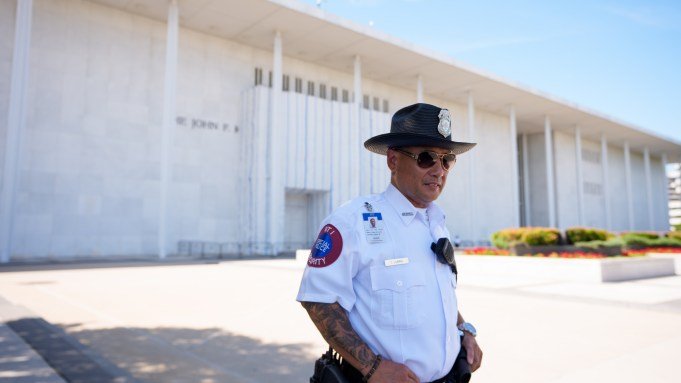
After fencing went up around the Kennedy Center and the main building was closed to the public, a House lawmaker on Thursday called for an emergency hearing, warning that the shutdown violates a judge’s order.
The board, dominated by allies of President Donald Trump, voted Tuesday for a resolution to immediately close the main building of the complex, citing safety issues while the center has been working on plans for a large-scale renovation. The resolution also pointed to a recent incident in which a portion of the ceiling collapsed to the floor following a recent rainstorm.
But attorneys for Rep. Joyce Beatty (D-OH), an ex officio member of the center board who has been challenging the closure plan, noted that U.S. District Judge Christopher Cooper’s order prohibits a shutdown until he lifted a preliminary injunction, something that he has yet to do. The judge has ruled that renovations could proceed, but a closure could come only after the board made a fuller analysis of its impact.
Per a court filing, a staffer at a law firm representing Beatty sought to enter the main building on Wednesday but was advised by security that it was closed to the public.
Cooper has given the center until Thursday morning to respond to Beatty’s motion for an emergency hearing.
The judge on Tuesday prohibited the board’s latest plan to return Trump’s name to the façade of the complex or to designate its grounds for him. Trump, who serves as the center’s chair, posted on Truth Social that they would seek an expedited appeal, but that the renovation would not proceed if courts rule against the naming plan.
Beatty has said that she is not opposed to a renovation, but previous plans were to keep the center open as the rehab was carried out in phases.
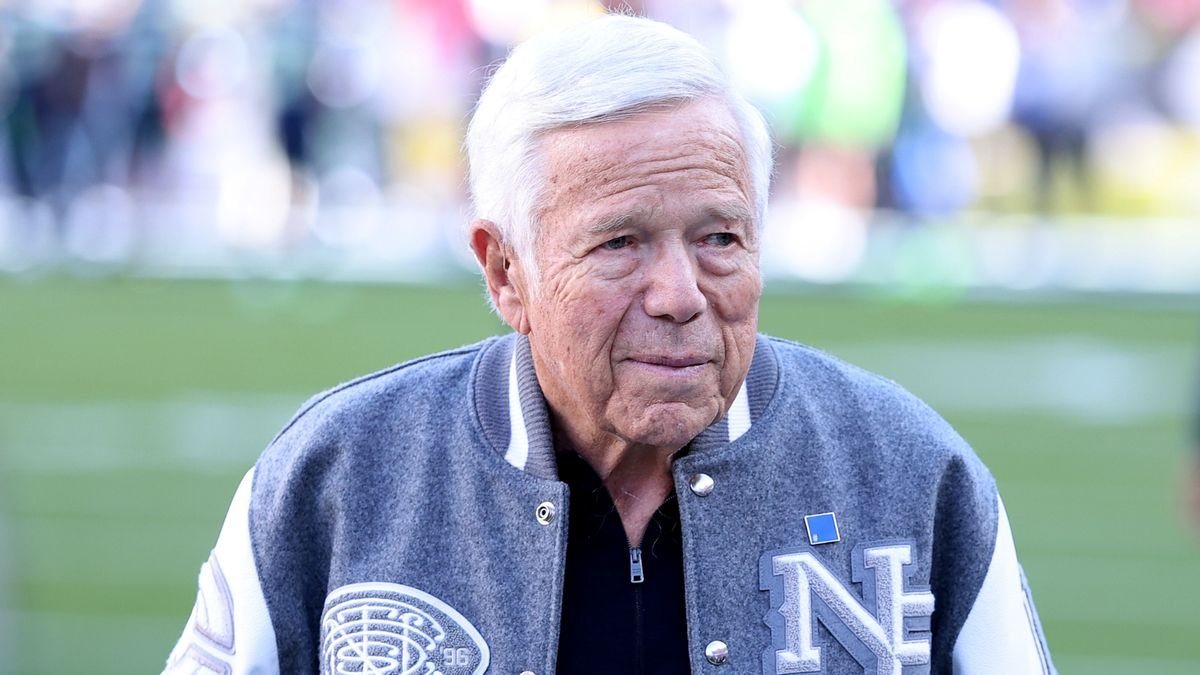
Gillette Stadium owner Robert Kraft, who musician Macklemore said orchestrated his removal as an opening act on Ed Sheeran’s tour, once faced a solicitation charge, and his name appears in the files related to late sex offender Jeffrey Epstein.
Rating:
Context
Kraft faced a charge of solicting prostitution in Florida, but the case was ultimately dropped as it hinged on video that was secretly recorded. Kraft’s name also appears in the Epstein files multiple times, but they do not connect Kraft to Epstein’s crimes and he has not been accused of any involvement in those crimes.
After rapper Macklemore was dropped as an opening act on singer-songwriter Ed Sheeran’s 2026 tour over his pro-Palestine stance, a rumor spread that Gillette Stadium and New England Patriots owner Robert Kraft once faced a solicitation charge and appeared in the federal government’s files related to the late financier and sex offender Jeffrey Epstein.
Macklemore said in an Instagram post that Kraft had orchestrated his removal from Sheeran’s tour after he advocated for Palestinian freedom during a performance. Kraft confirmed in a statement provided to ESPN on Sept. 14, 2026, that he had Macklemore removed as an opening act for shows at Gillette Stadium because the venue has a “longstanding commitment to providing a welcoming environment for all guests and ensuring that events held at our venue do not provide a platform for hate speech.”
The rumor about Kraft spread on X and Facebook. On X, a post (archived) read, “This is who Ed Sheeran sided with: an Epstein-connected billionaire who was charged with soliciting prostitution”:
In short, the claim is true.
Snopes found Kraft faced charges of “soliciting another to commit prostitution,” according to the Palm Beach County, Florida, clerk’s database. (Readers can verify the information directly by search for Kraft’s name, the offense date of Jan. 19, 2019, and the case number 50-2019-MM-002346-AXXX-NB). However, the case was dismissed after a federal court of appeals upheld a lower court’s decision to throw out video evidence.
Further, it is also true that Kraft appears in the Epstein files, largely regarding the solicitation charge he faced. However, the files do not connect Kraft to Epstein’s crimes, and he has not been accused of any involvement in those crimes.
The Palm Beach County database shows that the charges against Kraft were filed on Feb. 25, 2019, and he was arrested the following day on misdemeanor offenses allegedly committed on Jan. 19 and 20, 2019. The case status showed it was closed.
Authorities accused Kraft of paying workers at a massage parlor in Jupiter, Florida, for sex acts. However, his case hinged on a video that was secretly recorded, which Kraft’s attorneys argued was an invasion of his privacy. A federal court of appeals agreed:
Neither the Florida statutes, nor case law authorize covert audio surveillance to investigate prostitution-related offenses. It follows that the more intrusive video surveillance is also prohibited, providing yet another basis for affirmance.
This matches information found through links to news reports we identified among the Epstein files on the U.S. Department of Justice website. A search for Kraft’s name turned up 24 documents, the vast majority of which shared news articles reporting on his solicitation charge.
In one document containing a death announcement, Kraft is one of the email recipients copied on a message. In an email that Epstein sent to Melanie Spinella, then the assistant of former Apollo Management CEO Leon Black, Kraft is named in a link to a story by The Guardian regarding his ownership of an offshore company the paper said could help him avoid taxes in the U.S.
EXCLUSIVE: A group of House lawmakers is launching a new caucus focused on the economic and cultural impact of movies, music, entertainment and sports.
The Movies, Music, Entertainment & Sports (MoMEntS) Caucus is being launched by Rep. Sydney Kamlager-Dove (D-CA), whose district includes Culver City, and she will co-chair it along with Rep. María Elvira Salazar (R-FL) and Troy Carter (D-LA).
Kamlager-Dove said in a statement, “America’s creative and entertainment sectors are economic powerhouses, generating more than $1 trillion each year and supporting over five million good-paying jobs. Yet for far too long, Congress has failed to give these industries and the workers and creators who power them the attention and support they deserve.”
The caucus comes amid an industry push for the establishment of a federal film and TV tax incentive as a way to address the flight of production to other countries.
The caucus will have a broader focus than TV and film, and also include broadcasting; music; sports and live entertainment; fashion and beauty; gaming, esports, and interactive media; streaming and digital platforms; content creators and the influencer economy; literary and publishing; and visual and performing arts, organizers said.
Salazar said in a statement that the caucus “will bring lawmakers and creative industries together to better understand the challenges they face, protect creative rights, and keep American talent and innovation leading on the world stage.”
Carter said the caucus “provides a critical opportunity for us to prioritize America’s creative and entertainment industries, which contribute so much to our nation’s history, economy, and culture.”
The caucus also will focus on innovation, competition, and responsible platform practices, among other aims.
Other members of the caucus include Rep. Joe Wilson (R-SC), Rep. André Carson (D-IN), Rep. Gilbert R. Cisneros, Jr. (D-CA), Rep. Jared Moskowitz (D-FL), and Rep. Ted W. Lieu (D-CA).
Among those praising the formation of the caucus were Recording Academy President Harvey Mason Jr., TKO Group Chief Legal Officer Riché McKnight, TikTok USDS Joint Venture”s head of public policy Nicole Nason and Kathryn Busby, head of orginal programming at Starz.
Congress also has a Creative Rights Caucus, focused on copyrights, First Amendment rights and intellectual property rights. It is co-chaired in the House by Rep. Judy Chu (D-CA) and Rep. Laurel Lee (R-FL), and in the Senate by Sen. Thom Tillis (R-NC) and Sen. Mazie Hirono (D-HI).
Rep. Laura Friedman (D-CA) and Rep. Brian Jack (R-GA) appeared on a press call on Tuesday to call for a federal film incentive, telling reporters that legislation is being drafted. President Donald Trump announced his support for a federal film incentive earlier this month.
The claim that six images circulating online showed Iranian damage to U.S. military bases in the Middle East is still under investigation.
According to CBS News, the outlet that first shared the images, they came from active service members who shared them on condition of anonymity “because of rigid media restrictions within the military.”
Snopes does not rely on anonymous sources. We could not independently verify the authenticity of the photographs because we could not speak to the people who took them and verify their metadata (information about where and when a photo is taken). As such, we leave claims about the authenticity of the images unrated.
At least one of the images showed another angle of damage to a sentry aircraft that otheroutlets previously verified. Others corroborated reports of damage at U.S. bases.
Snopes will update this report if, or when, additional information surfaces. We contacted the CBS journalist who published the pictures to ask how he verified their authenticity and CENTCOM for further comment and await replies to our queries.
In September 2026, a series of images circulated online that social media users claimed (archived) showed Iranian damage to U.S. military bases in the Middle East.
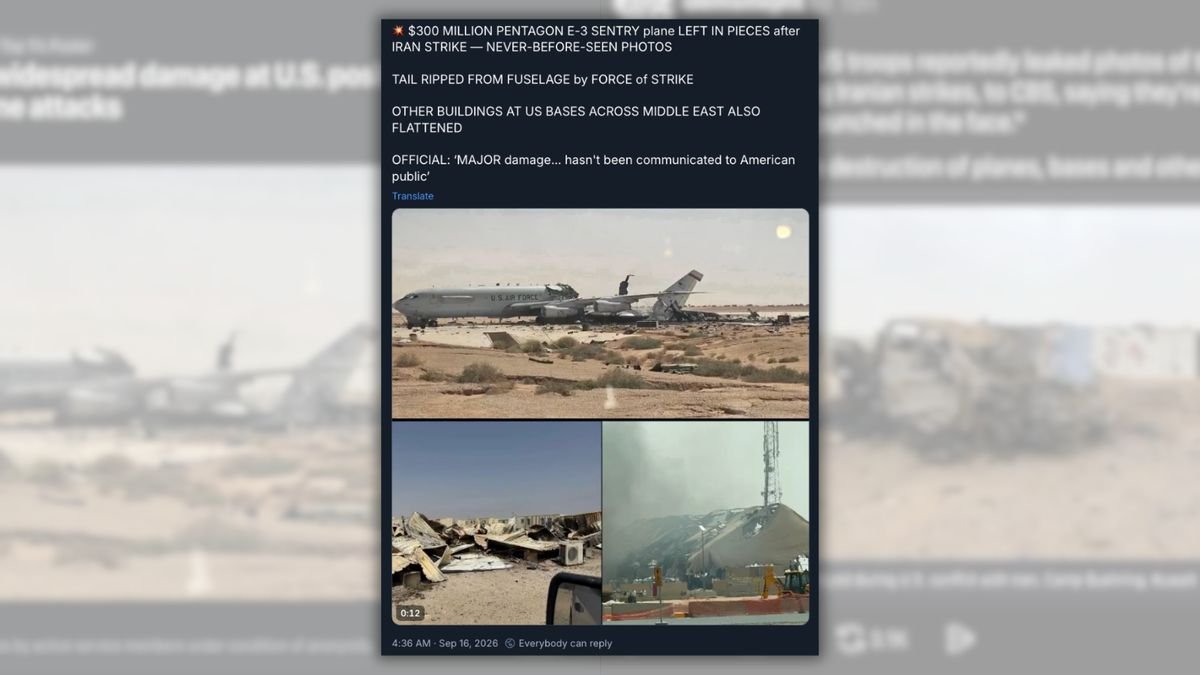
For example, one X user shared a video consisting of six photographs that appeared to show a damaged aircraft, vehicle and structures, and wrote:
BREAKING: Troops leaked photos of their wrecked bases to CBS, saying they’re “standing there with our eyes closed getting punched in the face”
Active service members sent the images anonymously.
The images came from an exclusive CBS News report that said its reporter Jonah Kaplan had received the photos from “active service members on condition of anonymity because of rigid media restrictions within the military.”
It wasn’t possible for Snopes to independently verify the authenticity of the images. We don’t rely on anonymous sources. Therefore, in order to independently verify them, we would need to speak to the people who took the images and verify their metadata (information about where and when a photo was taken). This did not appear possible given the sources told CBS News they didn’t want their names published alongside the images. Therefore, we leave claims about the authenticity of the images unrated.
We contacted Kaplan to ask how he verified the authenticity of the photos. We also contacted U.S. Central Command, which directs U.S. security operations across the Middle East, to ask about the authenticity of the images. We await replies to our queries.
What we know about images
The CBS News report included six photos. The first claimed to show a damaged plane at the Prince Sultan Air Base in Saudi Arabia. The image resembled photos verified by the BBC in March 2026 after Reuters and The Wall Street Journal reported that Iranian strikes damaged an E-3 sentry aircraft and injured 12 troops at the base.
Snopes could not verify the exact location of the plane at the base, though CBS News’ image did show a sign reading “35L S2.” 35L is the name of one of the runways at the Prince Sultan Air Base, suggesting the damaged plane was parked on or near that runway when Iranian strikes hit. The image showed what appeared to be a drain or tunnel under the runway. Google Earth imagery showed identical structures along the 35L runway.
A report about Operation Epic Fury (the U.S. government’s name for the war in Iran) that the lead inspector general submitted to Congress in September 2026 found one E-3 aircraft had been “damaged on the ground in Saudi Arabia by Iranian strikes” during the conflict (Table 5).
The next two images in the CBS News article claimed to show damage to a large tent structure and several trailers at Camp Buehring in Kuwait. According to the Institute for the Study of War, a public policy research organization that analyzes military and foreign affairs, Iran has claimed to have struck Camp Buehring at least five times since the start of the war.
One of the images, which showed a burned-out vehicle, also showed a mural that included a hand grasping three lightning bolts. This was the same imagery used by the 136th Expeditionary Signal Battalion. That battalion has previously been deployed to Camp Buehring. The unit was deployed to Central Command’s area of operation, which includes the Middle East, around April 2026.
Another image appeared to show damage to the Unaccompanied Officers Quarters at Camp Arifjan, Kuwait. The ISW reported that Iranian forces had struck Camp Arifjan at the start of March 2026. CNN reported on March 3 that six U.S. service members had been killed in strikes on the Port of Shuaiba, which is around 18 miles north of Camp Arifjan, suggesting the Iranian military had targeted the area.
The sixth image claimed to show damage to a large tent structure at Prince Sultan Air Base in Saudi Arabia. Snopes could not independently confirm the location or date of that image.
Foreign base damage difficult to confirm
Verifying damage to U.S. bases or equipment overseas is difficult because U.S. authorities generally do not publicly confirm such strikes so as not give away equipment locations or military capabilities. For example, in April 2026, the Pentagon declined to comment on reported damage to U.S. bases in Qatar, the United Arab Emirates, Bahrain, Jordan, Kuwait, Iraq and Saudi Arabia for operational security reasons.
The September 2026 report to Congress about Operation Epic Fury included damage estimates only for diplomatic facilities such as embassies and consulates (Page 19), not military bases.
U.S. Secretary of Defense Pete Hegseth said (at 32:57) on March 3, 2026, that the six people killed near Camp Arifjan in early March 2026 died because a “squirter” passed through U.S. air defenses and hit a “tactical operation center.”
Hegseth said such incidents happened “every once in a while.”
Speaking to CBS News about the September 2026 images, a service member reportedly refuted that characterization of the alleged damage caused to U.S. bases in the Middle East, instead saying, “We’re not defending these bases. We’re just watching them get destroyed.”
For further reading, Snopes has investigated a number of claims related to the war in Iran.
Sources
136th Expeditionary Signal Battalion Casing Ceremony. 6 Apr. 2026, https://www.europeafrica.army.mil/VideoPlayer/videoid/1002181/.
Britzky, Haley. ‘No Warning, No Siren: Six US Service Members Killed in Iranian Strike That Hit Makeshift Operations Center in Kuwait’. CNN, 3 Mar. 2026, https://edition.cnn.com/2026/03/02/politics/six-soldiers-killed-in-iranian-strike-kuwait.
‘Camp Arifjan’. Institute for the Study of War, https://understandingwar.org/site-search/. Accessed 16 Sept. 2026.
‘Camp Buehring’. Institute for the Study of War, https://understandingwar.org/site-search/. Accessed 16 Sept. 2026.
Department of War. ‘LIVE: Secretary of War and CJCS, Air Force Gen. Dan Caine, Hold a Press Briefing at the Pentagon.’ YouTube, 2 Mar. 2026, https://www.youtube.com/live/Y5LgpOGxTmE?t=1977s.
‘Enhancing Quality of Life at Camp Arifjan: USACE Cuts the Ribbon on the Unaccompanied Officers Quarters’. DVIDS, https://www.dvidshub.net/image/8359568/enhancing-quality-life-camp-arifjan-usace-cuts-ribbon-unaccompanied-officers-quarters. Accessed 16 Sept. 2026.
Holliday, Shelby, and Summer Said. Crucial E-3 Sentry Aircraft Damaged in Saudi Base Attack. 26 Mar. 2026, https://www.wsj.com/livecoverage/iran-war-middle-east-news-updates/card/crucial-e-3-sentry-aircraft-damaged-in-saudi-base-attack-8LibxBawXturwMIFOwTx?gaa_at=eafs&gaa_n=AWEtsqdSLCnZttiSrXyedw07NYZytLrlx0bHVoOigdxFA1fZXptP4N-3aPjveVH7A0Y%3D&gaa_ts=69c88775&gaa_sig=65vHgSOGboOLSbqmi4NYJJdQcPkdE5vgGDNgaXoPRHeYGw4kmWJfvr7o-OILcq7unGtdpeRFnbZpLRorVJISeg%3D%3D.
‘Iran Caused More Extensive Damage to U.S. Military Bases than Publicly Known’. NBC News, 25 Apr. 2026, https://www.nbcnews.com/world/iran/iran-caused-extensive-damage-us-military-bases-publicly-known-rcna331853.
Lead Inspector General . ‘OPERATION EPIC FURY’. 14 Sept. 2026, https://media.defense.gov/2026/Sep/09/2003993626/-1/-1/1/OEF_Q3_JUN2026_FINAL_508%20SECURE.PDF.
New Photos Show Widespread Damage at U.S. Positions Caused by Iranian Missile, Drone Attacks – CBS News. 15 Sept. 2026, https://www.cbsnews.com/news/new-photos-damage-u-s-kuwait-saudi-arabia-iran-drone-missile-attacks/.
‘Photos Show Heavily Damaged US Radar Jet at Saudi Base’. BBC News, 29 Mar. 2026, https://www.bbc.co.uk/news/articles/cwyd07m7e1xo.
‘Twelve US Troops Wounded in Iran Strike on Base in Saudi Arabia, US Official Says’. Reuters, 27 Mar. 2026, https://www.reuters.com/world/middle-east/twelve-us-troops-wounded-iran-strike-base-saudi-arabia-us-official-says-2026-03-27/.
In an August 2026 meeting between U.S. President Donald Trump and Joesley Batista, the owner of Brazilian multinational meat-processing company JBS, Batista asked Trump to lower tariffs on Brazilian beef, then Trump decided to allow 660 million pounds of tariff-free imported beef, that Europe had banned, into the United States, with JBS buying it all, suggesting the beef would come from Brazil.
Rating:
What’s True
In August 2026, Trump expanded a U.S. beef import quota by roughly 660 million pounds. The European Union did also adopt restrictions on Brazilian beef in summer 2026.
What’s False
The quota expansion of roughly 660 million pounds was not specifically for Brazilian or JBS beef, according to a presidential proclamation. It was not possible to rule out the prospect that, despite not being mentioned in the proclamation, JBS or Brazilian beef could be the main or sole beneficiaries of the expansion. It is also imprecise to say the imported beef would be tariff-free.
What’s Undetermined
The Wall Street Journal reported that JBS controlling shareholder Joesley Batista asked Trump to lower tariffs on Brazilian beef. It was not possible for Snopes to independently verify this report.
In September 2026, a rumor circulated online that during an August meeting between U.S. President Donald Trump and Joesley Batista, the owner of Brazilian multinational meat-processing company JBS, Batista asked Trump to lower tariffs on Brazilian beef. Trump then allegedly decided to allow 660 million pounds of tariff-free imported beef into the United States that Europe had banned, with JBS buying it all.
The suggestion appeared to be that the imported products would come from Brazil despite the European restrictions on Brazilian beef, and that JBS would benefit from the reduced tariffs.
One Instagram post (archived) featuring the rumor describes JBS as the “primary beef supplier” for McDonald’s, Burger King, Sysco, Walmart’s Great Value brand and Kroger private-label products. Its caption reads, in part:
The owner of JBS met privately with Trump in the Oval Office, and discussed lowering the import tax on Brazilian beef.
The next day, Trump opened the border to 660 million pounds of tariff-free imported beef. JBS is the world’s largest meat processing company. Their headquarters are in Brazil.
The EU banned Brazilian beef after Brazil couldn’t prove their cattle met antibiotic safety rules. China rejected beef from Argentina after it was lab tested to contain a drug linked to cancer.
Versions of the rumor also spread on TikTok, Facebook and Threads, and readers contacted us to ask whether the elements of the claim were true.
In short, the claim contains a mixture of accurate, false and unconfirmed information.
In August 2026, Trump did expand a U.S. beef import quota by roughly 660 million pounds, and the European Union did adopt restrictions on Brazilian beef. However, that expansion was not specifically for Brazilian or JBS beef, according to a proclamation Trump signed in August 2026, and it is imprecise to say the imported beef would be tariff-free. The Wall Street Journal also reported that Batista, JBS’ controlling shareholder, asked Trump to lower tariffs on Brazilian beef, but it was not possible for Snopes to independently verify that report.
Trump expanded beef imports in August 2026
On Aug. 26, 2026, Trump signed a proclamation temporarily increasing the amount of lean beef trimmings that could enter the U.S. under an existing tariff-rate quota by 300,000 metric tons. That increase equals roughly 660 million pounds.
Describing the imports as “tariff-free,” however, is imprecise. Under a tariff-rate quota, a set amount of a product can enter at a lower tariff, while imports above that amount face a higher tariff. The White House said Trump’s measure increased the amount of beef eligible for the lower tariff rate rather than eliminating duties for beef altogether.
Moreover, the proclamation did not explicitly say the beef would come from Brazil. It allocated the additional quota to “other countries or areas” and directed U.S. Customs and Border Protection to ensure that “all eligible countries have full access” on a first-come, first-served basis. JBS is also not mentioned in the proclamation.
However, it was not possible to rule out the prospect that, despite not being mentioned in the proclamation, JBS or Brazilian beef could be among the main or sole beneficiaries of the expansion.
Did JBS co-owner meet Trump?
Batista and his brother, Wesley Batista, are JBS’ “ultimate controlling shareholders,” according to the company’s filings with the U.S. Securities and Exchange Commission. As of March 18, 2026, the brothers held about 86% of the company’s voting power.
Citing anonymous sources, The Wall Street Journal reported (archived) on Aug. 31 that Joesley Batista met Trump at the White House on Aug. 20 and argued that additional beef imports from Brazil could help lower U.S. prices if tariffs were reduced. Trump announced plans to increase beef imports the following day.
However, the policy was not implemented immediately. Trump formally expanded the quota on Aug. 26, and the first tranche opened on Sept. 1.
Reuters later reported the Journal’s account but said it could not independently verify it. Snopes also was unable to independently verify the report, given it was based on anonymous sources.
We contacted JBS via email to confirm whether Batista met with Trump and, if so, what was discussed. We will update this story if we receive a response.
Snopes also reached out to the White House with similar questions and to ask how much beef would come from JBS or Brazil. Replying via email, a spokesperson said the tariff-rate quota expansion was not the result of a single conversation (emphasis ours):
President Trump’s action to address a short-term supply crunch in the beef market was the result of a long policy planning and coordination process involving domestic stakeholders; this action was not done as the result of any one conversation. At the same time, the Trump Administration continues to work with American farmers and ranchers to grow America’s cattle herd, which is currently at a multi-decade low.
JBS has ties to some named companies
JBS does have documented relationships with several companies named in the social media posts, but it was not possible to confirm that it is the primary beef supplier for all of them, as of September 2026.
For instance, a 2017 JBS report (Page 87) says its Seara division supplied 75% of McDonald’s hamburger requirements in Brazil at the time and listed McDonald’s and Burger King among its global customers. A 2020 JBS sustainability report (Page 76) also says Friboi, a JBS beef brand, received Burger King’s Best Supplier Award that year.
There is also evidence of relationships with Sysco and Kroger. Sysco named JBS Swift Beef among its beef suppliers in a 2016 supplier awards announcement, while Department of Agriculture records show JBS produced ground beef products sold under the Kroger and Private Selection brands. A JBS job posting also described (archived) Kroger as a “key case ready customer.”
But those sources do not show that, as of September 2026, JBS was the primary beef supplier for all the companies listed in the social media posts. McDonald’s, for example, lists OSI, Lopez Foods and National Beef among the U.S. suppliers behind its beef burgers.
Walmart also disputed the post’s description of JBS as a supplier of its ground beef. Annie Walker, director of Walmart U.S. communications for food and U.S. manufacturing, said via email, “We do not source ground beef from JBS.”
Snopes contacted JBS, McDonald’s, Burger King, Sysco and Kroger to clarify their current supplier relationships. We will update this article if we receive responses.
EU did restrict Brazilian beef
The posts were also broadly correct that the EU restricted Brazilian beef. On June 4, 2026, the European Commission adopted a regulation changing the list of countries authorized to send certain animal products to the EU under rules concerning the use of antimicrobial medicines. The changes took effect Sept. 3, 2026.
The regulation says Brazil was previously authorized for bovine products, among other categories, but that the commission did not receive information guaranteeing Brazil had implemented the measures needed to comply with the antimicrobial requirements by Sept. 3. Brazil’s authorization for bovine products was therefore removed.
Importantly, the regulation does not say Brazilian beef tested positive for unsafe antibiotic residues. Rather, it says Brazil did not provide enough information to show it met the EU requirements laid out above, which a European Commission spokesperson confirmed via email. The spokesperson said Brazilian exports could resume once the country meets those requirements.
Brazil’s government also said the restrictions concerned new rules governing the use of antimicrobial medicines, adding that Brazilian authorities are continuing engagement with European officials.
Snopes contacted Brazil’s Ministry of Agriculture for additional context on the restrictions and will update this story if we receive a response.
China case unrelated to Brazil
Chinese authorities did suspend (Page 1921) the export authorization of one Argentine beef plant, ArreBeef, after detecting the antibiotic chloramphenicol in a shipment in March 2026, as Snopes previously reported. However, Argentina’s government said the country’s broader beef market with China remained open and operational (Page 1921). The U.S. Food and Drug Administration prohibits chloramphenicol in food-producing animals and says residues of the drug can pose health risks.
As we previously reported, that incident was separate from Trump’s August import plan. The president’s Aug. 26 proclamation does not assign the additional 300,000 metric tons to Argentina, Brazil or any other individual country.