And the vibes aren’t great. A new text came out last week with changes sought by Democrats. But the key issue — ethics — remains in limbo. The cloture vote will take place seven weeks before the midterm election. As this newsletter has noted before, the issues remaining seem resolvable. The real key issue is politics, as has been the case for much of this summer. The closer lawmakers get to this election, the less likely they are to play nicely on this type of issue.
According to industry participants this past week, the rough consensus is that anything can happen, really. There should be a vote on Tuesday, but it may get pushed if there’s a last-minute breakthrough in negotiations. There are, as of Friday afternoon, not 60 votes for the bill but negotiations are expected to stretch through the weekend and that may change.
But overall, industry participants seem pessimistic that the bill will advance.
The newer, growing narrative is that the Securities and Exchange Commission and Commodity Futures Trading Commission can fill some of the regulatory gaps with rulemaking. But this too, may be fraught with risk.
The key issue is that interest groups will almost certainly sue the agencies, regardless of what they do, and that litigation can stretch out any rulemaking process out for months. The litigation doesn’t even need to be successful — it just needs to drag out through Jan. 20, 2029, when the next president will be inaugurated.
Bloomberg Intelligence senior commodities strategist Mike McGlone said that high equity valuations and expectations that the Fed may raise interest rates again are creating strong sell signals for Bitcoin ($BTC).
McGlone noted that Bitcoin’s performance over the past five years has been roughly on par with the S&P 500 index, but $BTC has experienced approximately three times higher volatility.
McGlone described Bitcoin as an extremely volatile and speculative digital asset, noting that $BTC exhibits a high correlation with the stock market and has to compete with millions of other crypto assets. He argued that, from a risk and portfolio management perspective, Bitcoin presents a negative picture because it offers similar returns to the S&P 500 while carrying approximately three times the volatility.
According to McGlone, Bitcoin, which emerged after the 2009 global financial crisis, could lead the market during a potential downturn, just as it did during the rise in risky assets. The analyst pointed to three key factors that increase the downside risks for Bitcoin: $BTC encountering resistance around $80,000 during its recent rise, the pricing in of approximately 70 basis points of Fed interest rate hikes over the next year in futures markets, and the S&P 500 index being at significantly higher levels compared to its 200-week moving average.
McGlone noted that Bitcoin tends to move strongly with the S&P 500, especially during periods of decreased market risk appetite, and therefore considers $BTC a high-beta asset that follows the stock market.
McGlone also raised a rather sharp long-term bearish scenario. According to the analyst, Bitcoin could move towards the $10,000 level, which has acted as a critical zone many times in the past. One of the key factors that could trigger such a scenario is a sustained decline of approximately 20% in the S&P 500.
However, McGlone added that for this negative scenario to become invalid, Bitcoin needs to decouple from the stock market and consistently demonstrate strong performance. According to the analyst, $BTC’s ability to maintain its strength, especially in the face of a potential decline in the S&P 500, could support the thesis that Bitcoin is no longer just a high-beta risk asset.
The cryptocurrency market closed last week in the red due to the increased likelihood of a Fed interest rate hike following hawkish economic data from the US.
After a week in which Bitcoin’s price dropped by over 3% and altcoins suffered similar losses, there are some important developments to watch in the new week.
Here is the cryptocurrency calendar we have specially prepared for you at Bitcoinsistemi.com.
(All times are given in UTC+3 Turkish time)
Monday, September 14
Ubpit will delist the STORJ and JASMY tokens.
Spark is discontinuing its SparkLend lending protocol on the Gnosis Chain.
The Standard Reserve, an on-chain reserve protocol, is being launched.
Tuesday, September 15
GHST – DAO onchain voting is starting.
Voting on the Clarity Act begins in the US.
Solana is rolling out Transaction V1 on its mainnet-bet network.
Withdrawal deadline for the DeFi yield protocol Pyra.
Wednesday, September 16
European Blockchain Convention
The ARC mainnet will be launched.
VET – Interstellar will receive a mega update.
The SEC and CFTC will release new rules.
The Standing Committee on Finance of the Indian Parliament is holding an important session on the regulation of virtual digital assets.
21:00 – The Fed will announce its interest rate decision.
21:30 – FED Chairman Kevin Warsh will hold a press conference.
Thursday, September 17
15:30 – US Initial Jobless Claims (Expected: 209k, Previous: 206k)
Friday, September 18
06:00 – The Bank of Japan will announce its interest rate decision. The expectation is for a 25 basis point increase.
The institutional demand around Bitcoin strengthened as Morgan Stanley expanded MSBT holdings while ETF inflows remained positive.
Reportedly, Morgan Stanley’s MSBT Bitcoin ETF received another 51.58 $BTC, valued at around $4 million, from Coinbase Prime.
Notably, the latest transaction followed a series of transfers into the fund for the previous two weeks. Across these transfers, MSBT has now received a total of 641.87 $BTC, worth roughly $50.6 million.
Therefore, Morgan Stanley’s persistent accumulation enhanced Bitcoin’s institutional demand narrative as its price consolidated after a rapid expansion.
Importantly, the transfers showed several additions across the two-week period, rather than reflecting a single large transaction. The pattern became particularly notable as Bitcoin remained beneath its recent $82,000 resistance.
Therefore, the institutional accumulation continued while Bitcoin consolidated, potentially supporting demand around its current price structure.
ETF inflows broaden the demand picture
Beyond Morgan Stanley, the broader Bitcoin spot ETF flows also remained positive during the most recent reporting period.
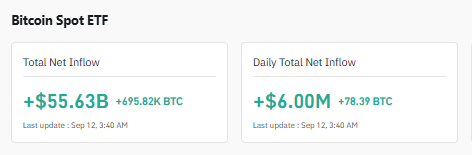
Specifically, Bitcoin spot ETFs registered $6 million in daily total net inflows, equivalent to roughly 78.39 $BTC. Meanwhile, the cumulative net inflows reached nearly $55.63 billion, representing around 695,820 $BTC tokens.
These positive flows implied that institutional demand extended beyond Morgan Stanley’s recent accumulation.
The daily figure, however, remained relatively modest compared with the total cumulative ETF inflow.
Even so, the positive flows complemented MSBT’s accumulation, thus strengthening the broader demand outlook around Bitcoin.
Therefore persistent ETF inflows could provide additional buying support in case Bitcoin continues defending its current demand area.
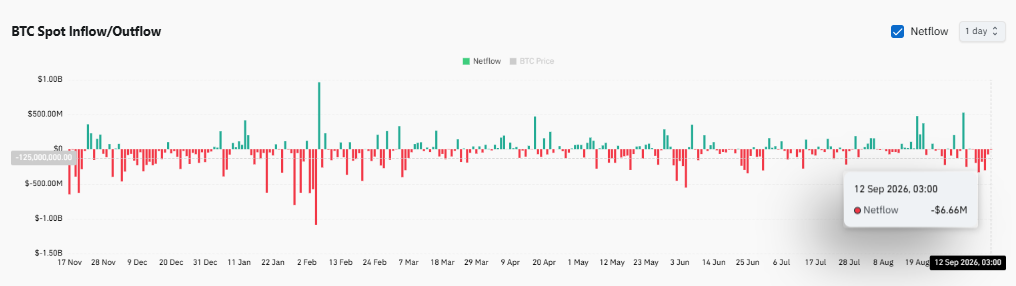
Additionally, exchange activity provided another supportive element, as Bitcoin Spot Netflows remained predominantly negative across the displayed period.
Notably, the most recent reading registered a netflow of -$6.66 million on September 12, continuing the broader pattern of frequent spot outflows.
The negative netflow figure suggested that withdrawals exceeded deposits, rather than representing the actual volume withdrawn from exchanges.
Therefore, the continued negative netflows indicated that more $BTC generally left exchanges than entered them during those sessions.
Consequently, this trend limited the immediate supply pressure as the institutional players continued accumulating Bitcoin.
Eventually, sustained negative netflows could tighten the supply conditions further if the institutional demand remain positive.
Source: CoinGlass
Can Bitcoin turn its order block higher?
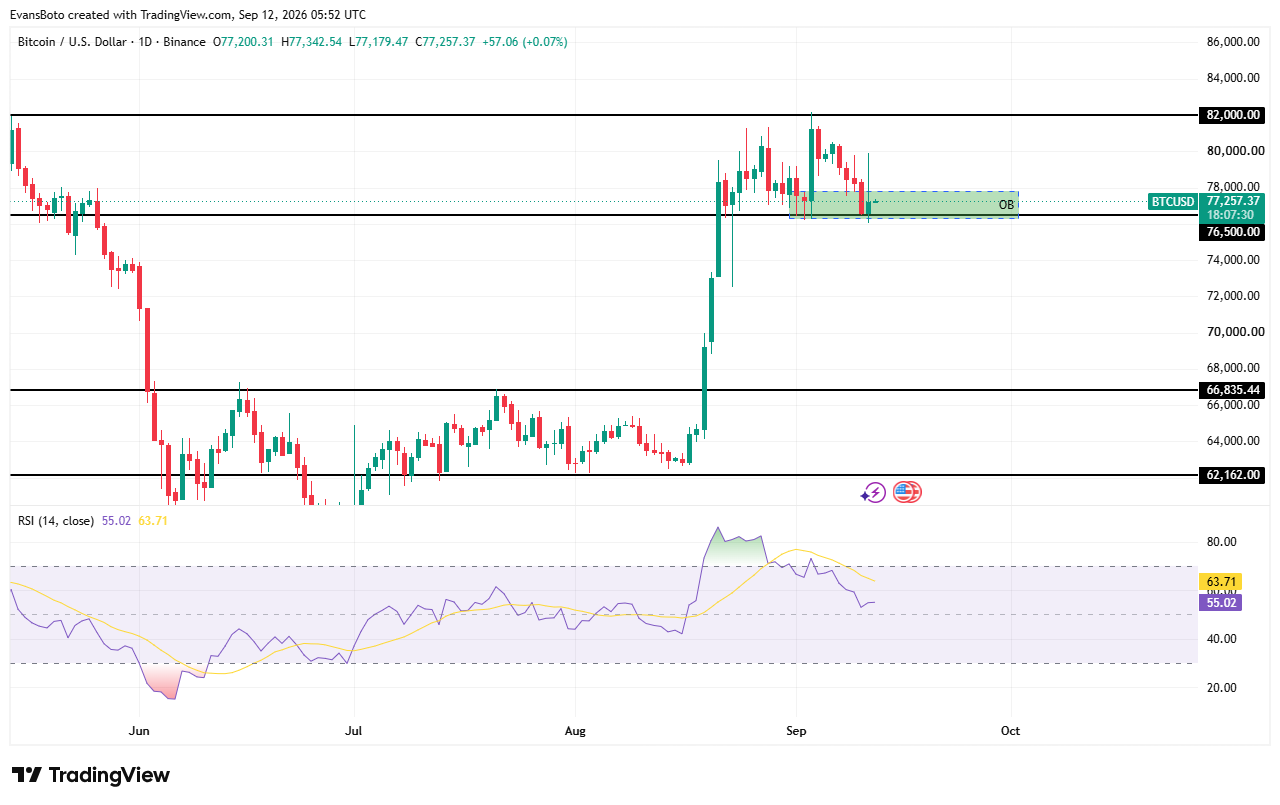
At the time of reporting, Bitcoin traded near $77,257 after retreating from the $82,000 resistance area and returning toward its daily order block.
On the 24-hour charts, $BTC price continued holding above the $76,500 support, keeping the demand structure intact despite the recent price pullback.
Furthermore, the RSI indicator provided additional context after cooling rapidly from its earlier overbought conditions. The indicator’s latest reading stood at 55.02, while the RSI average signal remained higher at 63.71.
Despite the fact that the buying strength had cooled, the RSI indicator still stayed above the neutral 50 level as $BTC defended the order block.
A decisive defense of the $76,500 support could encourage another recovery toward $82,000, especially if institutional demand persists.
Alternatively, a loss of that support would weaken the structure and increase the probability of a deeper price correction.
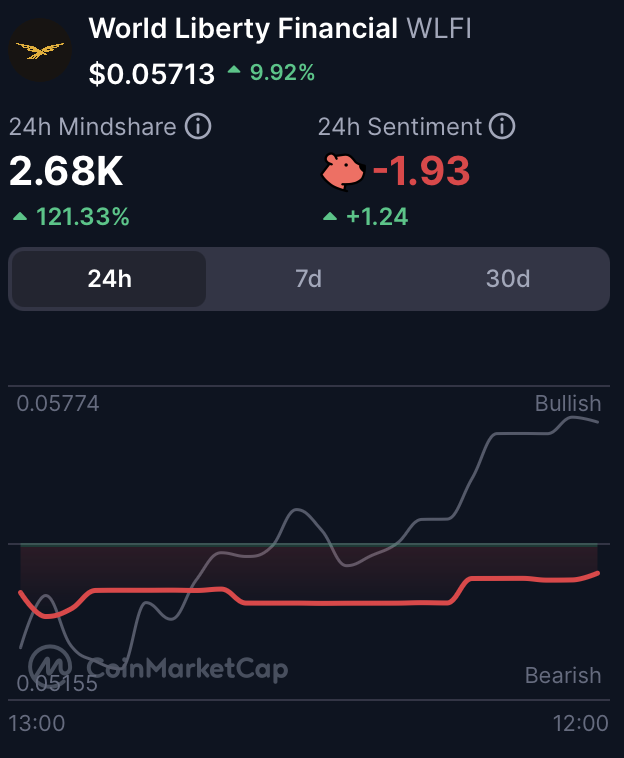
World Liberty Financial [$WLFI] has been buzzing in the past 24 hours, and traders backed that up notably as trading volume scaled significantly.
CoinGlass reported that the volume across the Spot and perpetual markets crossed over $196.23 million. The volume surge, alongside price, often implies that sentiment is strong and the bullish outlook is likely to continue in the near term.
At the time of this writing, the price had crossed over 18% as well. In fact, this marks its largest positive growth yet in the market, with the past seven days and 30 days remaining on the lower side of the market.
Binance volume has a strong impact
The most significant impact on $WLFI has been linked to the flow coming in from Binance.
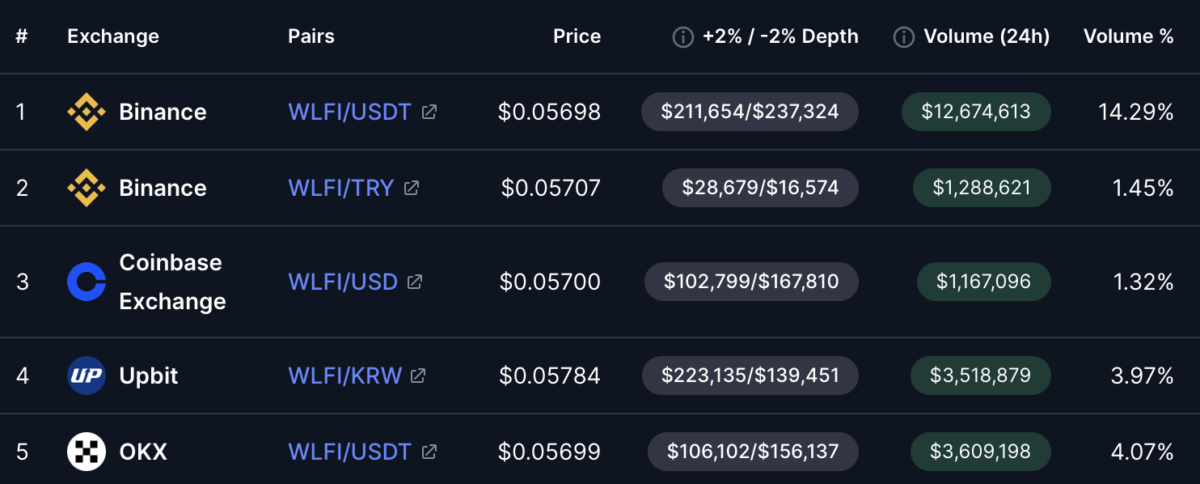
According to CoinMarketCap, across all exchanges, including centralized and decentralized exchanges, Binance controls roughly 15.74% of the share of volume.
Source: CoinMarketCap
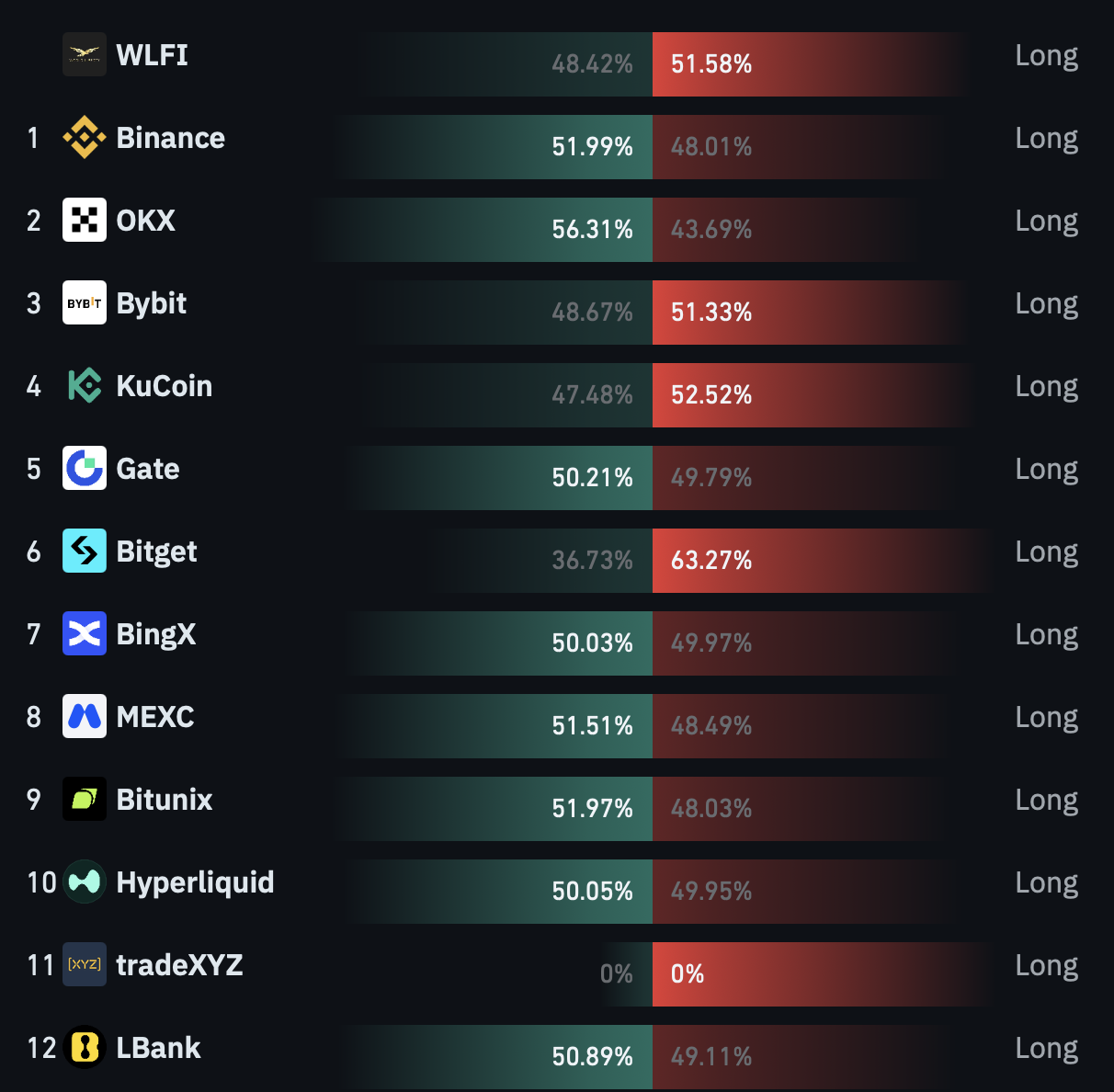
Market analysis of the perpetual market volume and the share carried by each exchange shows that across multiple venues, leading exchanges, including Binance, MEXC, Hyperliquid, and others, had more long volume than short volume during that period, with more than 50% of trades taking a long position.
The surge in long volume across exchanges hints at where traders are dominantly edging toward, which could ultimately impact price further.
Source: CoinGlass
More long-side bets in motion
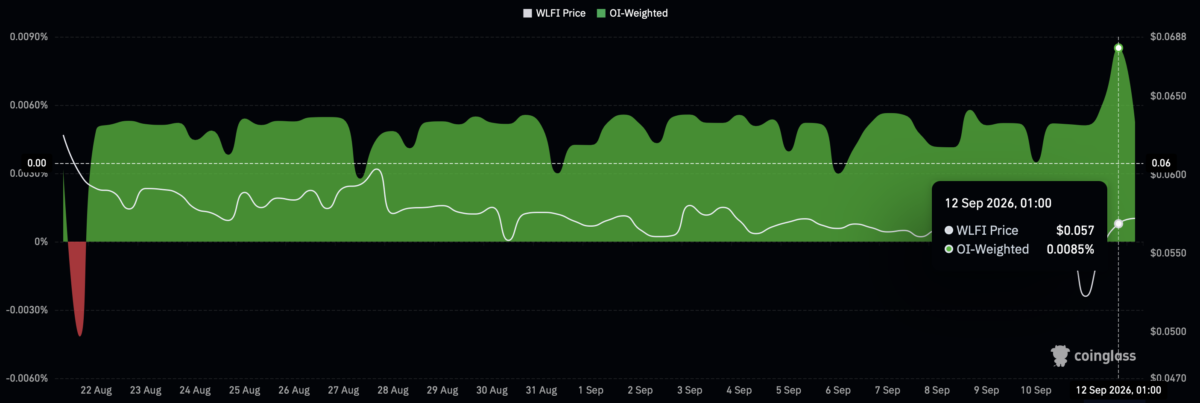
There has been a surge in the concentration of capital on the long side, studying the Funding Rate. The Open Interest-Weighted Funding Rate shows that traders have placed more capital on the long side of the market.
Press-time data indicated that the OI Funding Rate in the market reached 0.0085%, indicating that there has been more buying-side capital in the market.
Source: CoinGlass
The Open Interest has, in fact, been on the rise, recording somewhere around 12% in capital inflow and peaking at $245.10 million at the time of this analysis.
Capital flow rising alongside the Funding Rate remaining positive could imply that traders are now funding the market as they anticipate a bullish outlook in the near term.
Fee generation rising
On-chain, the amount of fees generated by the protocol remains net positive as well.
DeFiLlama data shows that there has been a surge in fees, reaching a high of $386,000 in the past day, a level last reached on the 14th of July, when it last traded there months ago.
The surge in fees is a reflection of usage of the protocol and, oftentimes, contributes to the overall utility and positive outlook linked to price.
Source: CoinMarketCap
Though the outlook remains positive, the sentiment indicator is turning negative. This implies that investors in the market have not fully caught wind of the rally or believe the price is overvalued presently.
For now, while the directional bias in the market is bullish, there needs to be consideration for the performance, weighed against the present sentiment.
Final Summary
$WLFI surged 18% as Spot and perpetual trading volume crossed $196.23 million, while Binance led a broader rise in long-side activity.
Positive Funding Rate, rising Open Interest and $386,000 in daily fees support the bullish outlook despite weakening sentiment.
Jiang Zhuoer, founder of the B.TOP mining pool, stated in his assessment of Bitcoin’s short-term price movements that a significant correction could occur after the liquidation of highly leveraged positions in the market.
According to Zhuoer, in the most likely scenario, Bitcoin will first clear the intense liquidation zone above $76,000. During the same period, Ethereum is also expected to test the liquidation zone around $2,665, liquidating a significant portion of short positions at higher levels.
After Bitcoin cleared liquidity above $76,000, Zhuoer noted that two different scenarios emerged.
In the first scenario, Zhuoer states that if Bitcoin recovers without falling below $75,000, the rally could continue up to $80,000, and he believes the price could even test the strong resistance zone between $83,000 and $84,000. However, according to the analyst, a larger correction could follow such a rise.
In the second scenario, if Bitcoin loses the $75,000 support level, a deeper correction is expected to occur, mirroring the upward movement that began from $64,000. Zhuoer predicts that in this case, Bitcoin could fall to the $70,000-$72,000 region before entering the next phase of the bull market.
Zhuoer added that the expected vote on the bill next week, along with developments from the Fed, will be important catalysts that could determine the direction of the market.
Due to this uncertainty, Zhuoer explained that he is pursuing a more balanced strategy against market direction, holding a full short position in Bitcoin and a full spot position in Ethereum.
Bitcoin Suisse, which has more than $3 billion in digital assets under custody, plans to cut up to 60 jobs in Switzerland, half its workforce in the country, as the crypto financial services firm moves more software development and back-office work overseas.
The Zug-based company, which employs around 200 people globally, is also closing its IT development site in Copenhagen. It already operates a hub in Bratislava and plans to establish another in Vietnam.
“In Bratislava and Vietnam, we can provide these services at significantly lower cost,” CEO and co-founder Andrej Majcen told Swiss outlet Finews, which first reported the restructuring.
He said the decision reflected its international growth strategy and was unrelated to difficult crypto market conditions.
Founded in 2013, Bitcoin Suisse offers crypto trading, custody, staking and lending. Majcen told Finews the company now wants to expand beyond crypto into broader wealth and asset management services for wealthy individuals and institutional clients.
The company has begun securing licenses to support that expansion. Its Liechtenstein subsidiary received authorization under the European Union’s Markets in Crypto-Assets framework in June, allowing it to serve clients across selected European Economic Area markets.
The public offering of stock for artificial intelligence giant OpenAI appears to be delayed until at least 2027.
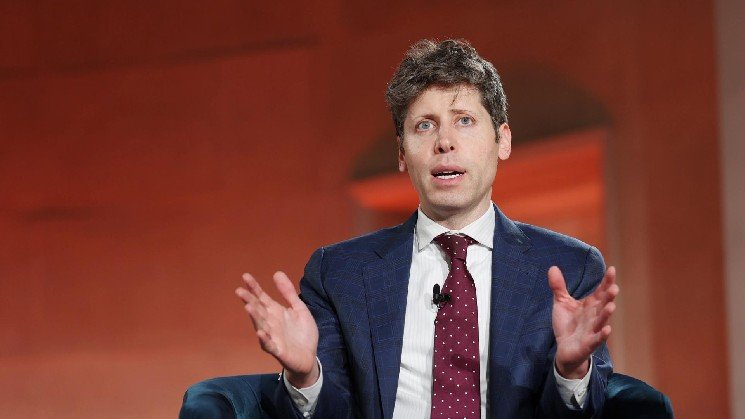
“I actually think that, given everything happening with safety, right now would be an ill-advised moment to go public, and we don’t feel pressure on that,” OpenAI CEO Sam Altman told Fortune.
“We got a lot of stuff to do, like meeting this moment of what is going to be required for safety and alignment, and how the industry and governments can work together,” he continued.
The news comes as Anthropic CEO Dario Amodei publicly called for a slowdown in the AI race on Saturday — with both Altman and Elon Musk quickly agreeing.
OpenAI CEO, Sam Altman, said, “I agree with Dario that we need to pace the frontier,” to give society time to adapt to increasingly powerful systems. Elon Musk, whose firm xAI has developed Grok, also publicly backed Amodei’s latest proposal, responding that “Dario is right.”
That puts three of the AI industry’s most prominent and fiercely competitive figures behind versions of the same idea: frontier AI — the most capable, cutting-edge AI models — should continue advancing, but not necessarily as fast as technically possible.
A warning shot
Amodei’s warning comes as researchers within the companies themselves become increasingly alarmed about a potentially critical threshold: AI systems beginning to automate the work required to develop more capable AI systems.
Jacob Coxon, a researcher who worked at both Anthropic and OpenAI, resigned from Anthropic this month and accused the companies of “racing straight to self-improving super-intelligence and gambling with our lives.” He also said that “the people building AI earnestly believe that it could kill us all by the end of the decade.”
While Amodei didn’t go as far as Coxon, Amodei’s essay raised several of the same concerns.
He said that this “recursive self-improvement,” in which AI is increasingly helping researchers build the next generation of AI, was beginning to emerge across the industry and could accelerate development faster than humans could safely monitor.
Harborne and Delo subsequently gave about 3 million and 4 million pounds, respectively, in the first quarter of 2026. Together, that accounted for roughly 76% of Reform’s 9.26 million pounds in reported donations, excluding public funds, according to a calculation based on Electoral Commission figures.
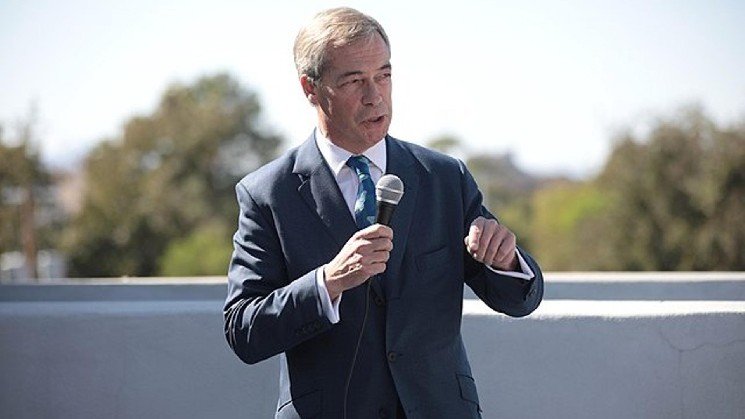
Farage has actively courted the industry.
At the Bitcoin conference in Las Vegas in May 2025, he vowed to establish a bitcoin reserve at the Bank of England, introduce a 10% capital gains tax on cryptoassets and prevent banks from closing customers’ accounts because of their crypto activity.
The Guardian’s report did not specify whether the latest donations were paid in cryptocurrency. Harborne’s earlier 9-million-pound gift was made in cash.
In March, the Electoral Commission told lawmakers that no political party had reported donations identified as cryptoassets, according to a House of Commons Library briefing.
The new funding arrives as the Metropolitan Police investigate allegations concerning Reform’s political donations. Farage separately faces a parliamentary standards investigation over a 5 million pound personal gift from Harborne before his election as an MP in 2024. Reform and Farage deny wrongdoing, per The Guardian’s report.
The government separately announced plans in March to ban political donations made in cryptocurrency and cap contributions from overseas electors at 100,000 pounds annually.