In contrast, perpetual swaps never expire. Instead, they use a funding rate mechanism to anchor the contract price to the spot index, theoretically offering investors the closest possible proxy to trading the actual VIX spot price.
“Traders don’t have to worry about expiries and decay and just focus on the direction of where they think the underlying is heading. The VIX is one of many more indexes, assets and metrics that will be perpified. We expect to see a strong wave of perp-ification to occur in the coming months,” Martin Lee, market insights lead at DWF Labs, told CoinDesk.
Some crypto exchanges like Gate already offer VIX/USDT perps, but the market is highly illiquid with little noticeable volume. Recently Hyperliquid listed futures tied to bitcoin’s VIX – Volmex’s bitcoin implied volatility index.
A potential launch of VIX futures could bring more traders to volatility markets. More buyers and sellers and more hedging by market makers across VIX futures and other S&P 500 derivatives could pull the various VIX products into closer agreement.
However, costs still exist in the form of funding payments. Also the index is really just mathematical calculation and doesn’t exist like bitcoin, which creates a channelge for market makers, who cannot easily buy and sell the “spot” to hedge their risks, just as $BTC market makers do.
“For us, the interesting question is how funding would anchor an index that cannot be bought as a cash asset. Removing expiry does not remove hedge costs or basis risk. Until contract terms exist, this is a potential new volatility market, not a cheaper substitute for options convexity,” analysts at Marex Solutions said in an email.
For now, Cboe’s plan shows just how fast traditional and crypto market structures are converging to support advanced volatility products. Stay alert!
Read more: For analysis of today’s activity in altcoins and derivatives, see Crypto Markets Today . For a comprehensive list of events this week, see CoinDesk’s Crypto Week Ahead.
“It’s coming home,” Tether CEO Paolo Ardoino proclaimed on X last week, referring to the return of his company’s stablecoin, $USDT, to the Bitcoin network.
Tether’s $USDT, the world’s largest stablecoin with a market cap of nearly $190 billion, began life on Bitcoin in 2014 on its Omi protocol, before Ethereum and later Tron became its primary venues.
$USDT is now set to return to the world’s oldest blockchain through Tether-backed infrastructure project Utexo, which is expected to begin issuing the world’s largest stablecoin on the Bitcoin network this month.
Utexo, which was founded in 2025 and raised $7.5 million in funding earlier this year, has been granted the commercial license to issue $USDT on Bitcoin, using the stablecoin’s trademark to bring it to exchanges, wallets and payment providers, Utexo co-founder Viktor Ihnatiuk told CoinDesk in a Telegram message.
“Tether has always been a Bitcoin company,” Ihnatiuk told CoinDesk in a recent interview. “Bitcoin for them is a stability haven, along with gold. That’s why Tether kept buying $BTC and supporting the Bitcoin community.”
Tether holds around 100,000 $BTC ($8.4 billion) as of mid-August this year, according to Bitcoin Treasuries.
Bitcoin derivatives activity is picking up ahead of Friday’s U.S. jobs report, with traders adding positions as the price climbs above $86,000.
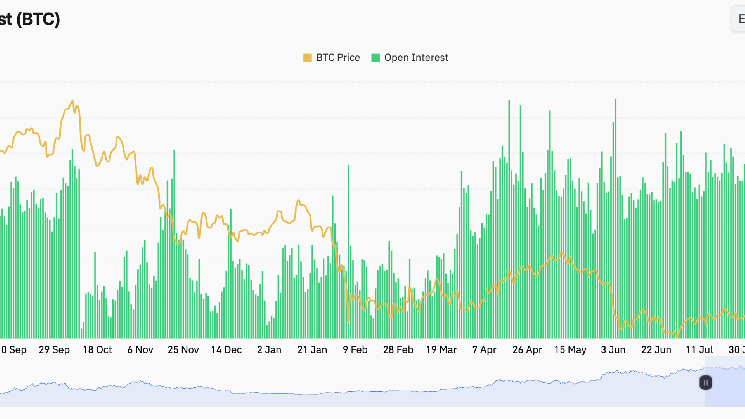
Open interest has risen to approximately 653,000 $BTC ($56.2 billion) from 626,000 $BTC on Sept. 30, according to CoinGlass data, an increase of 27,000 $BTC ($2.3 billion), or roughly 4.3%. Open interest measures the total value of outstanding futures and perpetual contracts that have yet to be closed or settled. Rising open interest indicates that traders are adding exposure, although it does not reveal whether they are betting on prices rising or falling.
Bitcoin has climbed from around $83,500 to $86,500 over the same period. A price increase coinciding with rising open interest suggests new positions are helping support the rally.
Meanwhile, the perpetual funding rate has risen from around 3% to 10% in the same time frame. Funding is a periodic payment exchanged between traders holding long and short positions, designed to keep perpetual futures prices close to the spot price. When funding is positive, traders betting on higher prices pay those betting on lower prices.
According to Circle, this regulation exposes stablecoin reserves to greater credit and counterparty risks in the banking sector. The company cites the 2023 Silicon Valley Bank collapse, where approximately $3.3 billion in $USDC reserves remained with the bank, causing the token to briefly lose its $1 peg, as an example of these risks.
Circle is advocating for the consideration of a liquidity requirement that allows a certain portion of reserves to be cashed out within one to five business days, rather than a strict minimum deposit requirement for bank deposits. The European Central Bank and some national central banks also support a similar approach.
The company also objected to the rule limiting reserve exposure to a single country’s government bonds to 35 percent. Circle argues that this limit makes it difficult for a dollar-based stablecoin to hold a significant portion of its reserves in US Treasury bonds.
As part of the same review, the Hyperliquid Policy Center also requested that perpetual futures contracts on the chain be evaluated under the existing MiFID II derivatives rules instead of MiCA.
These are requests submitted by industry organizations. This does not mean that the European Commission has accepted the proposals or amended the MiCA rules. A formal assessment and potential legislative process will need to be completed before a final decision is made.
However, industry participants and Ethereum core developers indicated that a broader discussion was needed regarding the proposal’s potential impact on security, economic incentives, and solo validators. How the burning curve would be calculated, the impact of liquid staking protocols, and the structure of the validator set were among the main points of contention.
The withdrawal of the proposal does not mean that the idea of reducing or burning staking rewards on Ethereum has been completely abandoned. The authors of the EIP plan to conduct a review process for $ETH supply policy independent of the network update.
According to the new schedule, one of the first comprehensive meetings will be held at the Devcon event in November. A new forum is being considered for January at the cryptoeconomics workshop at Columbia University. Technical workshops are planned for February and March, and a more concrete proposal will be worked on with developers at the EthCC event in April.
Therefore, EIP-8363 is not expected to be implemented in the Hegota update. However, the discussion about Ethereum’s long-term supply and staking incentives will continue in a separate process.
The largest portion of the daily outflows came from Fidelity’s FBTC fund, with approximately $125.6 million withdrawn. Bitwise’s BITB fund saw a net outflow of $13.6 million. BlackRock’s IBIT fund also completed its nine-day inflow streak with a $9.5 million outflow. Other spot Bitcoin ETFs did not see any significant net movement.
The single-day outflow of $148.7 million does not indicate a mass exodus of investors from spot Bitcoin ETFs. The funds have generated cumulative net inflows of over $57 billion since their inception in January 2024. Net inflows calculated from the beginning of 2026, despite the recent outflow, remain at approximately $970 million.
The total assets managed by the funds are reportedly over $100 billion. However, cumulative flows remain approximately $5 billion below the peak reached on October 10, 2025.
On the same day, approximately $59.6 million also flowed out of Ethereum ETFs. This extended the outflow from Ethereum funds to two days, following a net inflow of approximately $850 million over the previous seven days.
While ETF flows are an important indicator of institutional demand, they alone do not determine the future direction of Bitcoin’s price. Futures contracts, interest rate expectations, and overall risk appetite can also influence the market.
Under OKX’s contract specifications, traders can use leverage ranging from 0.01x to 50x on the new $QNT perpetual market. The contract uses the QUANT/$USDT index as its underlying price reference and carries a face value of 0.01 $QNT.
OKX states that funding fees normally settle every four hours. If funding reaches the contract’s upper or lower limit when a payment is due, the interval can automatically shorten to one hour.
#NewPerpsListing: $QUANT@quantnetwork builds the infrastructure of programmable money, using Overledger and QuantNet to connect banks, blockchains, tokenised deposits, and traditional payment rails.
QUANTUSDT global Perpetual Futures trading is now available on OKX.
— OKX (@okx) October 2, 2026
Perpetual futures let traders take leveraged long or short positions without a fixed expiry date. Higher leverage can magnify both profits and losses, while liquidation risk rises when price moves quickly against a position.
The listing therefore arrives during an unusually volatile period for $QNT. CoinGecko’s latest data show a 24-hour range between roughly $242 and $305, with trading volume around $451 million. Volume has fallen around 41% from the previous day even as activity remains far above levels recorded before the September rally.
OKX did not say $QNT’s recent price performance prompted the listing, and the exchange did not make a price forecast for the token.
$QNT price cools after its huge September rally
$QNT’s latest drop follows one of the crypto market’s sharpest rallies of September. CoinGecko historical data show the token around $90 on Sept. 24 before it accelerated above $150, $230 and eventually $300 over the following sessions.
At the current price near $249, $QNT has surrendered part of the gains made around the end of September. Its market capitalization remains around $3.62 billion, placing the token 34th among cryptocurrencies tracked by CoinGecko. Roughly 15 million $QNT are in circulation.
The pullback follows an earlier move above $300 covered in $QNT’s push toward the $343 resistance area. At the time, $QNT had reached $329 intraday as traders watched $312.50 and $343.75 as nearby technical levels.
Earlier in the rally, $QNT surged more than 300% from its late-September lows, driven alongside heavy trading activity by a new U.S. banking infrastructure deal.
The current retreat does not erase the weekly advance. $QNT remains roughly 178% higher over seven days, compared with a gain of less than 1% for the overall crypto market during the same period, according to CoinGecko.
Quant’s U.S. banking deal remains the main catalyst
The price rally began accelerating after The Clearing House selected Quant to provide technology for its On-Chain Money Initiative.
The Clearing House announced on Sept. 24 that Quant will provide the interoperability, orchestration and transaction-management layer for a new network designed to clear and settle tokenized commercial bank deposits.
Quant’s technology will connect the planned network with existing payment infrastructure including RTP and CHIPS. The Clearing House says its current U.S. payment networks clear and settle more than $2 trillion each day.
The project is intended for financial institutions, with potential uses including corporate treasury operations, liquidity management, cross-border payments and digital-asset settlement. Participating banks are expected to gain access during the first half of 2027, though specific launch participants have not yet been disclosed.
The deal provided the main fundamental backdrop for $QNT becoming one of the crypto market’s strongest weekly performers before its rally accelerated further.
Quant CEO Gilbert Verdian described the U.S. project as a step toward programmable commercial-bank money. His statements about its future reach remain company expectations, while The Clearing House has confirmed Quant’s role and the planned 2027 availability window.
UK banks have already used Quant infrastructure
Quant’s U.S. deal followed live work with banks in the United Kingdom. UK Finance confirmed on Sept. 24 that seven major banks had completed live customer transactions using tokenized sterling deposits.
Barclays, HSBC UK, Lloyds Banking Group, Monzo, Nationwide, NatWest and Santander participated in the Great British Tokenised Deposit project. Quant built the shared platform, EY handled project management and Linklaters developed the legal rulebooks.
The transactions included person-to-person payments and remortgage use cases. Tokenized deposits in the project remain commercial bank money and retain the legal and regulatory characteristics attached to conventional deposits, according to UK Finance.
Quant has continued presenting the system to financial institutions through Sibos in Miami, where its sessions this week covered tokenized deposits, programmable settlement and connections between distributed ledgers and existing banking systems.
The Clearing House expects its Quant-powered U.S. network to become available to participating institutions in the first half of 2027 and said further details on participants and use cases will be released as development progresses.
The connection offers investigators a starting point. It does not establish who controlled the wallets or how the private keys were exposed.
Source: Bitquery
The Bot Stopped but the Theft Continued
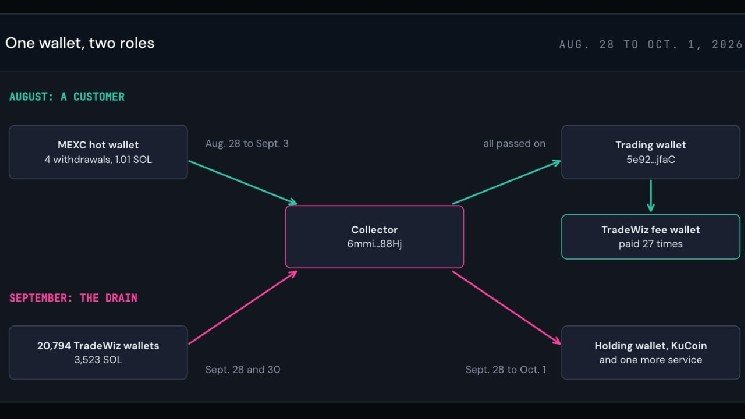
Bitquery found that trading activity through the bot stopped 41 minutes into the main drain. About 73% of the $SOL swept in that operation was taken afterward.
Tradewiz’s September 30 security notice on X attributed the incident to private-key exposure involving its $SOL PVP export feature. It instructed customers to stop using existing $SOL PVP wallet addresses.
“We will fully compensate users for losses caused by this incident,” the company wrote.
A later X update said the first refunds had been sent and that each claim required verification. Tradewiz also announced a precautionary pause in EVM services while it conducted security checks.
Those statements leave customers with two separate questions: when their losses will be reimbursed, and what failed in the system protecting their wallets.
A Security Promise Meets a Private-Key Leak
Tradewiz’s own documentation makes the incident particularly uncomfortable.
Its FAQ allows users to import and export wallet keys, but recommends against exporting them. It states: “By not exporting your private keys, we can ensure 100% security of your assets.”
The company’s subsequent disclosure puts that assurance under scrutiny. Users need an explanation of which wallets were exposed, how the export feature was compromised, and what changed before services resumed.
The public statements issued so far by Tradewiz describe security upgrades and compensation commitments without resolving those questions.
The Trail Reaches Exchange Accounts
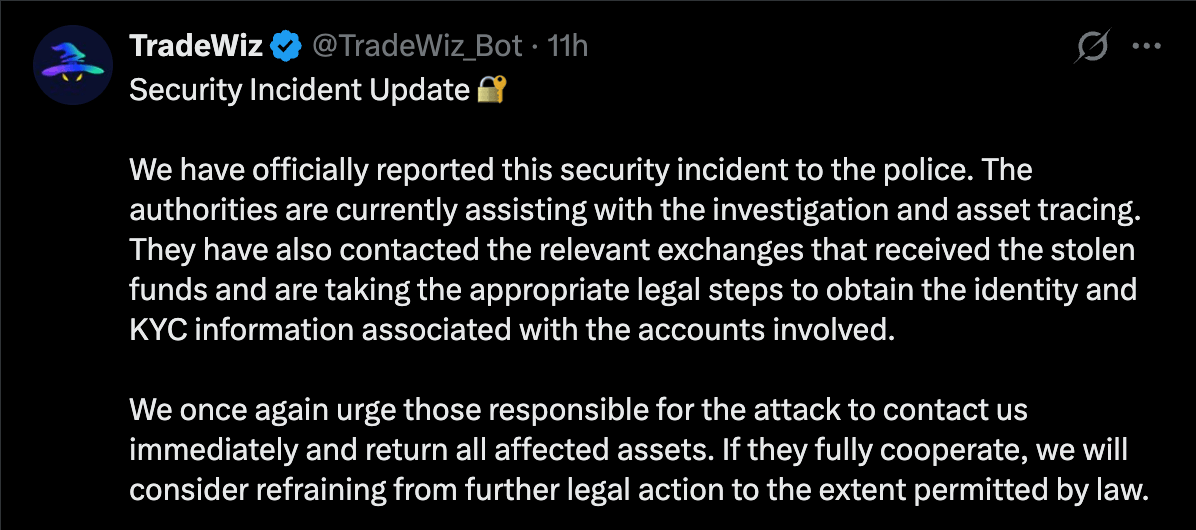
On October 1, Tradewiz said on X that police were assisting with asset tracing and had contacted exchanges to seek identity and account-verification information.
The company also offered to consider foregoing further legal action, where legally permitted, if those responsible cooperated and returned the assets.
Source: Tradewiz on X
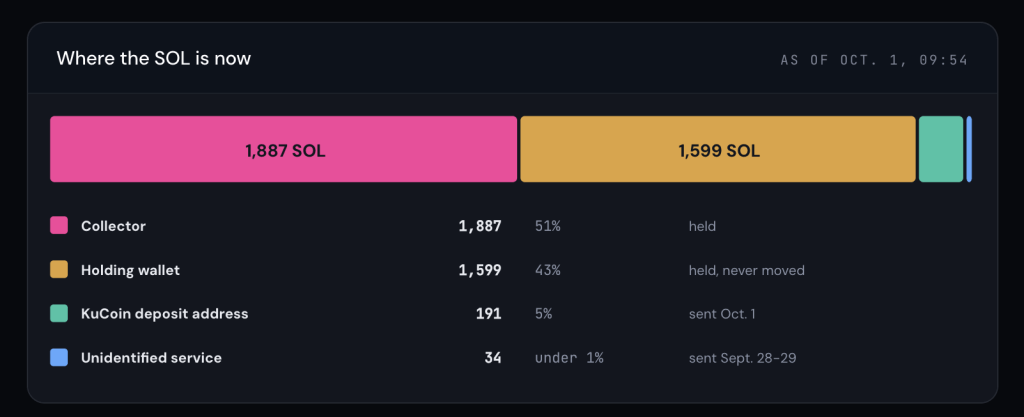
Bitquery traced earlier funding to MEXC withdrawals and later transfers toward a Kucoin deposit address. Those connections do not implicate either exchange in the theft. However, they identify potential records for investigators to pursue.
For affected traders, the next meaningful evidence will be completed reimbursements and a technical account of the breach. For investigators, the earlier customer activity may prove more useful than the theft itself.
A Vault customer invites a beneficiary directly from the dashboard, and that person is notified and guided to set up an Uphold account to receive the assets later. The beneficiary gets no access while the owner is alive, and the designation can be changed at any time. After the owner passes, Uphold’s compliance team verifies the legal documentation before transferring control into the beneficiary’s Uphold wallet. The company says the beneficiary needs no prior crypto knowledge. Uphold Vault itself launched in December 2023, pairing self-custody with built-in key replacement and instant access to trading.
Pricing and the estate-planning gap
Vault Inheritance costs $19.99 a month. Existing Vault customers will see the new plan reflected after December 31, 2026, while U.S. users get a free 30-day trial. “Crypto has become a real part of how people build their financial future, but unlike traditional assets, there are few ways to pass it on securely — especially for $XRP holders,” said Nancy Beaton, Uphold’s president of consumer.
A growing self-custody trend
The launch lands months after Kresus introduced its own crypto inheritance service for self-custody users in July, a sign that wallet providers are moving to close the estate-planning hole as crypto matures into a long-term holding. Analysts have long warned that billions of dollars in crypto could vanish into dead wallets, and inheritance features are one of the first product-level answers to that risk.