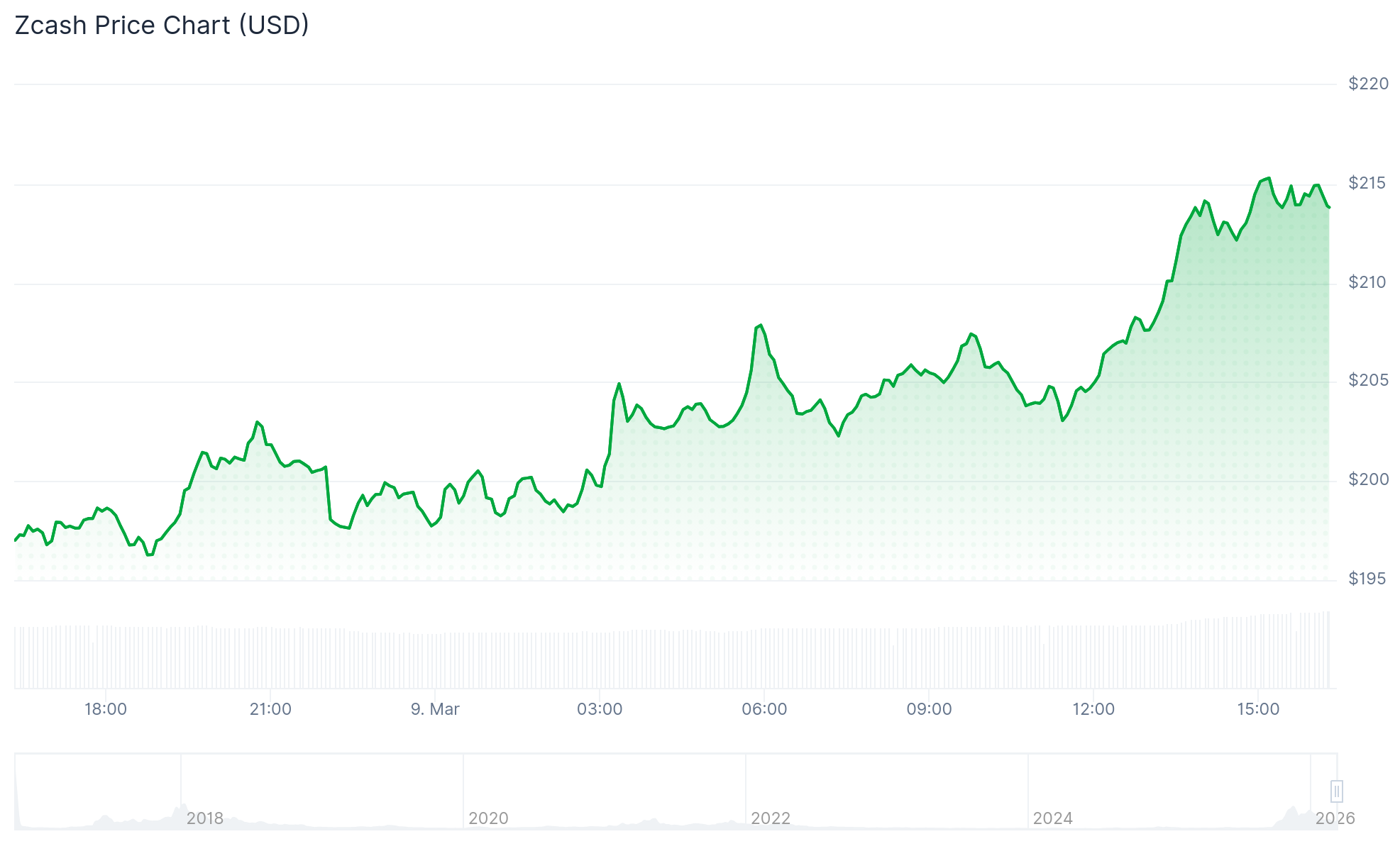
Cryptocurrencies linked to artificial intelligence, such as Bittensor’s $TAO, $NEAR Protocol, Internet Computer, and others rallied after Wired reported that Nvidia is preparing a new open-source platform for autonomous AI agents, a concept similar to the OpenClaw framework, ahead of its annual developer conference.
The broader artificial intelligence token category rose about 4.8% to roughly $14.17 billion in market value, outperforming the wider crypto market, where the CoinDesk 20 index was up 2.86%. Among the majors, Bittensor’s $TAO led the move, with $NEAR Protocol and Internet Computer also advancing.
Nvidia’s new platform, according to Wired, will be called NemoClaw. The system would allow enterprise software companies to deploy AI agents that can perform multi-step tasks for employees, and Nvidia has reportedly approached firms including Salesforce, Cisco, Google, Adobe, and CrowdStrike about potential partnerships ahead of its developer conference next week.
Wired says NemoClaw is expected to include security and privacy tools for enterprise use and is part of Nvidia’s broader strategy to expand its software ecosystem while maintaining its dominance in AI infrastructure.
Nvidia’s GTC developer conference begins March 17.
Last week’s apparent triangle breakout closed as a massive bullish wick — a classic false breakout signal.
On Myriad, prediction market traders are split among bulls and bears, with no clear consensus on which way the squeeze resolves.
Traditional markets are acting spooked as geopolitical tensions rise. The VIX—Wall Street’s “fear gauge” measuring expected volatility in the S&P 500—surged above 35, its highest level in nearly a year, as oil prices briefly spiked toward $120 per barrel following U.S. and Israeli strikes on Iran. Stocks fell. Gold fell. Pretty much everything that was supposed to be a safe haven wasn’t.
Bitcoin, true to form, decided to go a different direction. Almost every coin in the top 10 by market capitalization opened in the green today—Tron being the lone holdout. Bitcoin is currently trading above $69,000, up nearly 4.3% today, which would sound great for holders if the longer term charts didn’t have some awkward things to say about it.
On Myriad, a prediction market run by Decrypt‘s parent company Dastan, traders are essentially split between Bitcoin pumping to $84K or dumping to $55K, with odds slightly bearish. Traders are currently pricing in odds at 57% on the downside; not exactly a ringing endorsement of this bounce.
The broader macro question of which bubble bursts first, crypto or equities, is very much alive, especially with the VIX spiking and oil markets in chaos. Bitcoin’s own volatility index, the BVIV, already peaked above 96 in early February when BTC touched $60,000, and the Crypto Fear and Greed Index has been in the fear zone for most of 2026 so far.
What happens in traditional markets this week will matter, especially considering Bitcoin is trading in a compression zone. If equities continue selling off and the VIX keeps climbing, risk assets face real pressure regardless of any intraday bounce. Traders will want to watch equity futures—they’ll act as a ceiling or floor for how far this move actually goes.
Bitcoin (BTC) price: The breakout that wasn’t
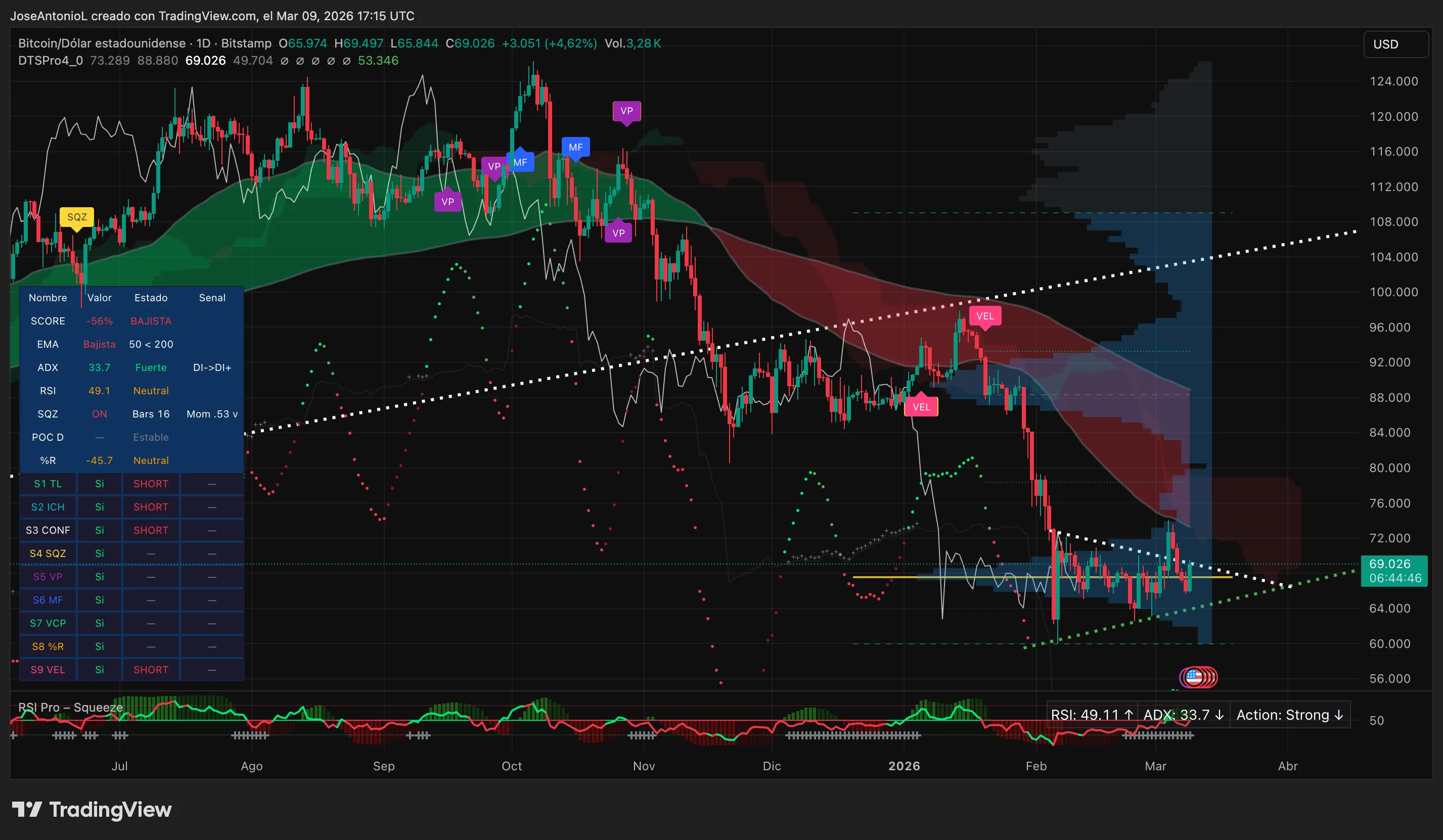
Bitcoin opened today’s session at $65,974 and is currently trading at $69,128—a 4.78% jump with an intraday high of $69,497. On the surface, that reads like bullish news, but looking at the broader picture makes this assumption more complicated.
Bitcoin (BTC) price data. Image: Tradingview
Last week, Bitcoin printed what looked like a clean breakout above the descending triangle that’s been compressing its price since February. But the week closed with the price of Bitcoin back inside the triangle. What appeared to be a breakout was mostly a wick in the weekly charts—technically closer to an inverted doji (a candlestick with no body and big wicks), a signal that sellers absorbed all the buying pressure and rejected the move hard. The triangle swallowed the breakout whole. Today traders are trying again.
The Average Directional Index, or ADX, sits at 33.7. ADX measures trend strength on a scale from 0 to 100, with readings above 25 confirming a genuine trend is in play—and 33.7 puts Bitcoin squarely in “strong trend” territory. But the ADX during this bear run has been stronger and is receding. That’s not a confirmation that bulls have taken over, but it can be interpreted as a sign that the tug-of-war is tightening even though things don’t look good for long-term bulls at the moment.
Until Bitcoin actually escapes the triangle and holds above it, the ADX shift is a yellow light, not a green one.
The Relative Strength Index, or RSI, reads 49.3. RSI is a momentum oscillator running from 0 to 100—below 30 signals oversold conditions, above 70 signals overbought, and 50 is the neutral midpoint. At 49.3, Bitcoin is flat on the fence. It hasn’t exhausted buyers, but hasn’t attracted enough conviction to push into bullish momentum territory either. Traders typically want to see RSI clear and hold above 50 before calling a meaningful momentum shift. Right now it’s just parked there, noncommittal.
The Exponential Moving Averages, or EMAs, tell the clearest story. The 50-day EMA—which tracks average prices over the last 50 sessions to reflect medium-term momentum—is sitting below the 200-day EMA. That’s a major bearish setup considering the gap is getting wider. EMAs show trend direction by weighting recent prices more heavily, and when the short-term average is below the long-term one, it means recent price action is weaker than the broader trend.
For bears to genuinely lose their grip, Bitcoin needs more than a session spike to $69K. What bulls actually need is a series of daily closes above the descending trendline—currently running near $73,000–$75,000, close to where the 50-day EMA sits at $73,293. Bullish traders would want to see rising ADX confirming that the move has real trend strength behind it, not just a VIX-driven risk-on blip. Anything short of that, and this remains a probe of resistance inside a compression zone.
Today’s 4.78% pop gives intraday traders something to work with, but swing traders and holders are still inside a bearish structure until Bitcoin posts convincing closes above $73,000–$75,000 on volume. Lose the $65,000–$66,000 volume shelf below—the price level where most of the recent trading has concentrated—and the path toward $60,000 opens up fast.
Disclaimer
The views and opinions expressed by the author are for informational purposes only and do not constitute financial, investment, or other advice.
Daily Debrief Newsletter
Start every day with the top news stories right now, plus original features, a podcast, videos and more.
Anthropic sued federal agencies after being labeled a national security “supply chain risk.”
The dispute stems from the company’s refusal to allow unrestricted military use of its AI.
The designation bars Pentagon contractors from doing business with the firm.
Anthropic has turned to the federal courts to fight a sweeping blacklist by the Donald Trump administration, claiming the government branded the AI startup a national security threat in retaliation for its refusal to relax safety protocols.
The lawsuit, filed Monday in the United States District Court of Northern California, challenges actions taken after President Trump directed federal agencies in February to stop using Anthropic’s technology. This followed public comments from Anthropic CEO Dario Amodei, who said the company would not comply with the Pentagon’s request for unrestricted access to Claude. The complaint names multiple federal agencies and senior officials as defendants, including Defense Secretary Pete Hegseth, Treasury Secretary Scott Bessent, and Secretary of State Marco Rubio.
“The Constitution does not allow the government to wield its enormous power to punish a company for its protected speech,” attorneys for Anthropic said in the lawsuit. “No federal statute authorizes the actions taken here. Anthropic turns to the judiciary as a last resort to vindicate its rights and halt the Executive’s unlawful campaign of retaliation.”
At the direction of @POTUS, the @USTreasury is terminating all use of Anthropic products, including the use of its Claude platform, within our department.
The American people deserve confidence that every tool in government serves the public interest, and under President Trump… https://t.co/R7rF0ci5CY
— Treasury Secretary Scott Bessent (@SecScottBessent) March 2, 2026
The dispute began in January when Pentagon officials demanded AI contractors allow their systems to be used for “any lawful use,” including military applications. While Anthropic had by then already entered into a $200 million contract with the Department of Defense, it refused to remove two safeguards prohibiting the use of Claude for mass domestic surveillance of Americans or for fully autonomous lethal weapons systems.
“The Challenged Actions inflict immediate and irreparable harm on Anthropic; on others whose speech will be chilled; on those benefiting from the economic value the company can continue to create; and on a global public that deserves robust dialogue and debate on what AI means for warfare and surveillance,” attorneys for Anthropic stated in the lawsuit.
For AI developers, including SingularityNET CEO Ben Goertzel, the designation is an odd choice and doesn’t fit with the typical meaning of a supply chain threat, something usually reserved for software from adversaries that could contain hidden malware, viruses, or spyware.
“Anthropic not being willing to have their software used for autonomous killing or mass surveillance doesn’t seem to pose a risk of that nature,” Goertzel told Decrypt. “That just means if you want to use software for autonomous killing or mass surveillance, then buy somebody else’s software. So the logic of making it a supply chain risk eludes me.”
Goertzel said differences among leading AI models may limit the practical impact of the decision.
“In the end, Claude, ChatGPT, and Gemini are not that far off from each other,” he said. “As long as one of these top systems is being used by the U.S. government, it’s all about the same thing. And the intelligence agencies, under the cloak of top secret clearance, would use the software however they wanted.”
Anthropic is asking the court to declare the government’s actions unlawful and block enforcement of the “supply chain risk” designation that prevents federal agencies and Pentagon contractors from doing business with the company.
“There is no valid justification for the Challenged Actions,” the lawsuit said. “The Court should declare them unlawful and enjoin Defendants from taking any steps to implement them.”
Anthropic did not immediately respond to requests for comment by Decrypt.
Even after designating Anthropic a risk to national security, Claude has been used in ongoing military operations, including by U.S. Central Command to help analyze intelligence and identify targets during strikes on Iran.
Jennifer Huddleston, a senior fellow in technology policy at the Cato Institute, said in a statement shared with Decrypt that the case raises concerns about constitutional protections when national security claims are used to justify government action.
“While the courts have been hesitant in the past to question the government’s claims of national security concerns, the circumstances of this case certainly highlight the real risk to the First Amendment rights of Americans if the underlying considerations of such claims are not thoroughly scrutinized,” she said.
Daily Debrief Newsletter
Start every day with the top news stories right now, plus original features, a podcast, videos and more.
The Bitcoin price faces an intact overhead supply at $74,000 resistance, signaling the continuation of its ongoing correction.
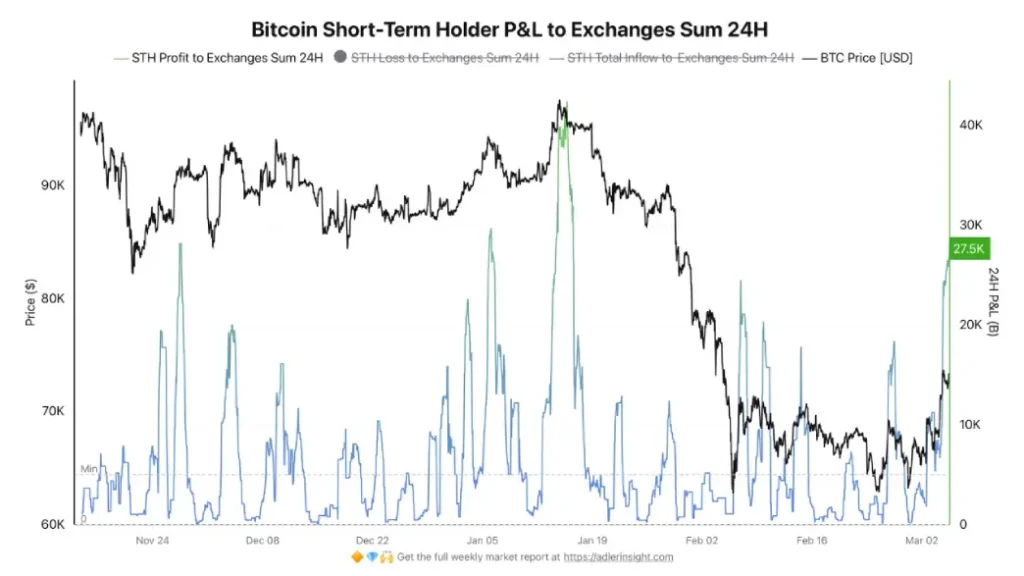
Blockchain data shows over 27,000 $BTC moved to exchanges in profit within the past 24 hours.
The crypto fear and greed index at 18% suggest that the broader market sentiment remains strongly bearish.
The pioneer cryptocurrency, Bitcoin, is down 3.5% during Friday’s trading market hours to trade at $68,302. The downtick coincides with U.S. market correction following a triple threat of weak labor data, surging oil prices, and escalating geopolitical tensions, including Iran. However, the Bitcoin price faces additional pressure as short-term holders rushed to book profit when the coin briefly surged above the $70,000 mark earlier this week. Is the $60,000 breakdown close?
$BTC Faces Selling Pressure as $1.8B Profit-Taking Hits Exchanges
On March 6th, the cryptocurrency market experienced a significant outflow, which pushed its market cap to 2.41% down to hit $2.33 Trillion. The primary catalyst fueling this sell-off includes surging oil in the broader market amid geopolitical tension in the middle east, which also raised risk-off sentiment among investors.
The bearish momentum further accelerated as the February 2026 US nonfarm payrolls shows an unexpected loss of 92,000 jobs against the market forecast of a 50,000 gain, with unemployment steady at 4.4%.
However, the weak job number may raise odds of Federal Reserve rate cuts, which historically triggered a recovery in Bitcoin.
That said, the potential uptick would still struggle to sustain higher ground as STHs (Short Term Holders) are preferring to take early profits.
On-chain metrics indicate that more than 27,000 $BTC, worth about $1.8-1.9 billion at prevailing exchange rates, have been sent to trading platforms in gains over the last 24 hours. This represents one of the more significant single-day profit outflows in recent months.
Participants who obtained positions about one week to one month earlier are still the primary group in positive territory, with their average cost basis being around $68,000. Short-term holders, who are sometimes defined as those who are more sensitive to price action and outside sentiment, seem to prefer quick exits rather than long exposure.
Broader market conditions, such as cautious macroeconomic forecasts and continued geopolitical developments in the Middle East, have created an environment in which near-term caution is the order of the day. Bitcoin traded in the range of $68,000 – $69,000 in the early hours of March 2026, moving back from the recent peak on the back of high volatility and renewed selling interest from this cohort.
Bitcoin Price Reverts After Dead Cat Bounce
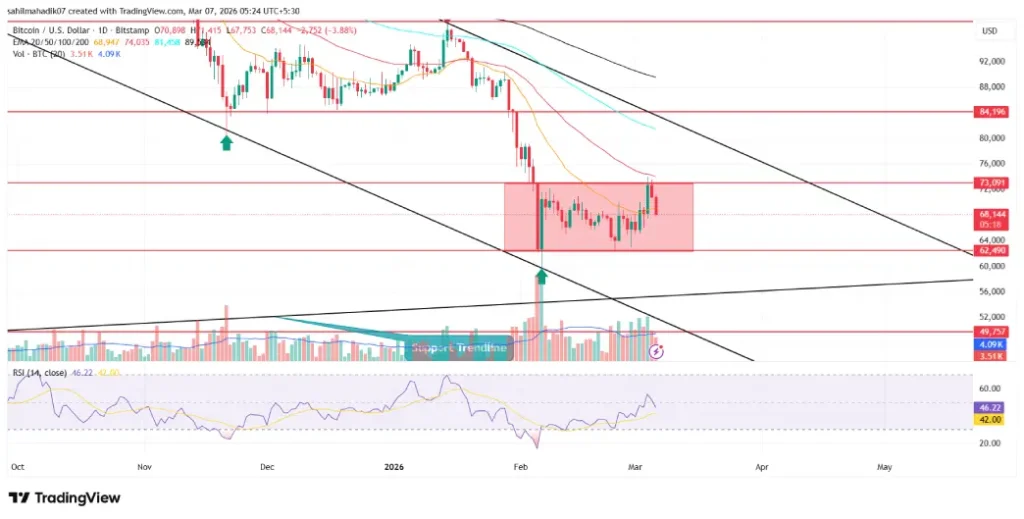
In the 48-hours, the Bitcoin price is down from $73,573 to $67,753, registering a 7.9% loss. This pullback signals intact overhead supply around $74,000 and a potential bearish reversal in the daily chart.
With sustained selling, $BTC could lose another 8% and retest the immediate support at $62,600. Since early February, the coin price has been resonating within a narrow range from $72,600 and $74,000.
Amid this consolidation, If the sellers manage to replenish its prevailing bearish momentum, the coin price could breach the bottom support, and extend its current downtrend to $56,000.
$BTC/USDT -1d Chart
On the contrary, if the coin flips the overhead resistance of $74,000 into potential support, the buyers could strengthen their grip over this asset for a higher rally to $85,000 mark.
Coinbase rolled out futures trading across 26 EU countries for the first time.
Products include perpetual futures, dated contracts, and Mag7 + Crypto Equity Index Futures.
Kraken and Crypto.com already launched similar offerings in May 2025.
Coinbase launched futures contracts for traders across Europe, marking the first time the exchange has offered regulated crypto derivatives directly to users in the region.
The products are being progressively rolled out through Coinbase Advanced in 26 European countries, including Germany, France, and the Netherlands, offered through its MiFID II.
A license through Markets in Financial Instruments Directive, or MiFID, grants firms permission to offer traditional financial products like stocks, bonds, derivatives, and similar products to EU customers. Although Coinbase is a crypto exchange and offering crypto-based derivatives, those contracts still fall under MiFID.
Coinbase said in its blog post that the offering will give European traders a regulated alternative to the offshore platforms many have historically relied on for crypto derivatives.
The new product suite includes perpetual-style futures and dated contracts with monthly or quarterly expirations. The perpetual-style contracts carry five-year expiries, while the lineup also features an equity-index product called the Mag7 + Crypto Equity Index Futures, which combines exposure to the Magnificent Seven tech stocks with crypto-linked equities and BlackRock iShares ETFs tied to Bitcoin and Ethereum.
Leverage of up to 10 times is available on selected contracts such as Bitcoin and Ethereum, with fees as low as 0.02% per contract. Accounts can be funded in euros or USDC.
Coinbase will have some crypto-native company in the European derivatives space. Both Crypto.com and Kraken rolled out their own offering sin May 2025.
Just last month, Coinbase repoorted at Q4 earnings miss with a $667 million loss while the price of Bitcoin slid late last year.
Coinbase said the loss stemmed from a $718 million decrease in the value of its investment portfolio, which was largely unrealized. At the same time, strategic investments, including in Circle, lost $395 million in value.
Daily Debrief Newsletter
Start every day with the top news stories right now, plus original features, a podcast, videos and more.
Sharplink disclosed a full-year loss of $734 million, driven by a decrease in the value of its Ethereum holdings in the second half of the year.
The company generated $28 million in revenue for the fiscal year ended in December, mostly from staking.
CEO Joseph Chalom argued that the company has been built in a way to weather market cycles.
Sharplink reported a full-year loss of $734 million on Monday, indicating that its business came under pressure as Ethereum’s price tumbled last year.
In 2024, the firm notched $10.1 million in profits, before pivoting away from sports gambling marketing to become Ethereum’s second-largest corporate holder.
The Miami-based firm currently owns 867,000 Ethereum. That sum was valued around $1.75 billion on Monday, with Ethereum changing hands around $2,000, according to CoinGecko. The company’s holdings are only second to BitMine Immersion Technologies’ $9 billion stockpile, overseen by Fundstrat’s Tom Lee.
Sharplink attributed the performance to a decrease in the value of its holdings, which fell $616 million throughout the year. The loss was bolstered by a $140 million impairment charge on tokens representing staked Ethereum. That was partially offset by a $55 million net gain on conversions between the company’s holdings and such tokens.
Although Sharplink’s treasury took a hit, the company signaled that revenue from staking jumped 50% quarter-over-quarter to $15.3 million from $10.3 million. So far, the company has generated 14,500 Ethereum worth $9.4 million from staking.
“2025 was a defining year for Sharplink,” CEO Joseph Chalom said in a shareholder letter, noting that the company raised around $3.2 billion amid its pivot.
The former BlackRock executive said “short-term market volatility” can impact the company’s results, but he argued that the firm is built in a way to weather crypto’s market cycles, including Ethereum’s swoon from nearly $5,000 in August.
“We have built a platform that can perform in both strong and challenging markets,” he added. “Our strategy is consistent and designed to endure.”
At the end of last year, the company held $30.4 million in cash and stablecoins.
Sharplink shares were little changed on Monday at $7.41, according to Yahoo Finance. Over the past six months, the company’s stock price has dropped 55%, slightly outpacing Ethereum’s 53% fall over the same period of time.
Sharplink seeks revenue by participating in the process of validating transactions on Ethereum’s network, also known as staking. Beyond that, the firm has also deployed capital in decentralized finance protocols in search of higher yields.
The company currently holds 4 ETH per share. Sharplink has signaled boosting that metric further serves as its primary objective, among others like expanding partnerships within Ethereum’s ecosystem.
Consensys CEO and Ethereum co-founder Joe Lubin, who serves as Sharplink’s Chairman, underscored the importance of Ethereum’s ecosystem amid the institutional adoption of stablecoins and tokenized assets.(Disclosure: Consensys is one of 22 investors in an editorially independent Decrypt.)
“The institutional adoption supercycle […] accelerated in 2025,” he said. “Sharplink intends to remain uniquely positioned to serve as a bridge between traditional public markets and the Ethereum opportunity.”
Daily Debrief Newsletter
Start every day with the top news stories right now, plus original features, a podcast, videos and more.
Atlas has launched AI agents that build 3D and other assets for game studios.
The platform has moved from closed beta to global availability on Google Cloud Marketplace.
CEO Ben James said AI should automate technical tasks rather than replace artists.
Vienna-based startup Atlas announced on Monday the launch of a new AI tool to automate the game development process, as game developers increasingly turn to the technology.
The new Atlas AI Studio uses multiple AI agents to automate tasks such as generation, texturing, optimization, and engine integration, allowing artists to describe tasks in natural language. At the same time, the system builds the assets using different AI models.
“What we’ve built now, and what we are releasing, is an agentic kind of workflow builder,” Atlas founder and CEO Ben James told Decrypt. “What it does is you’re able to describe what you’re looking to build. It will go ahead and assemble a combination of different AI models to make that.”
Atlas AI Studio is now moving from closed beta to global availability through Google Cloud Marketplace. Studios including Square Enix, PARALLEL, and Ego have used the system during the beta, Atlas said.
The launch comes as developers continue to experiment with AI across game production, while players continue to push back against its use. James argues that despite the negative view of gamers towards AI, its benefits are often overlooked.
“I think oftentimes what’s not appreciated is AI can do a lot of the non-creative aspects of game development,” James said. “Think of generating different levels of detail for an object that’s created by a human artist, but for a game to run effectively, it still needs different levels of detail, or optimizing material builds for different objects, or setting up collisions and pivot points. There’s a lot of work that AI can do in this space.”
In 2023, Cyan Worlds faced criticism after players discovered its adventure game, Firmament, used AI-assisted content, while voice actors protested the use of AI-generated voices in the shooter The Finals.
The debate has prompted some companies to publicly reject the use of AI. In January, Warhammer 40K maker Games Workshop said it would not use generative AI in its creative design process.
James said much of the criticism centers on visible AI-generated art rather than the technical work required to prepare assets for games.
“I don’t think a gamer would have that sort of visceral reaction to knowing AI was used so that this game could run in a more performant way, or that these assets could be used in a more optimized setting,” James said.
Copyright concerns remain central to the debate over AI in the gaming industry. James said responsibility lies with the developers using the technology.
“The onus still, to some extent, when you’re creating with AI, does fall on the creator,” James said. “So, you shouldn’t introduce IP into the system that you don’t have ownership or authority to introduce into the system.”
Daily Debrief Newsletter
Start every day with the top news stories right now, plus original features, a podcast, videos and more.
Nasdaq is partnering with Kraken parent company Payward to develop tokenized equities, built atop its xStocks framework.
The initiative aims to “modernize processes” including corporate actions, shareholder engagement and proxy voting.
The move comes amid a wider push towards tokenized stocks in the TradFi world from players such as the NYSE.
Nasdaq is partnering with Payward, the parent firm of crypto exchange Kraken, to develop tokenized equities that will enable “programmable investor engagement,” the exchange announced Monday.
Set to launch in the first half of 2027, the initiative aims to “modernize processes” including corporate actions, shareholder engagement, and proxy voting, Nasdaq stated in a press release. Tokenized shares would afford the holder “full legal and regulatory equivalence,” with a transfer of the token representing a transfer of the underlying security, it said.
The exchange added that the plan builds on its tokenization proposal filed with the SEC last year, which aimed to give customers the option to trade securities via traditional digital representation of ownership, with or without blockchain backing.
In a separate release, Payward explained that it would develop an “equities transformation gateway” with Nasdaq built atop its xStocks framework, enabling customers “in jurisdictions around the world where xStocks are available” to trade tokenized versions of public company shares.
“This issuer‑sponsored approach for tokenized equity securities is designed to empower public companies and enhance global accessibility to U.S. equity markets, ”said Nasdaq President Tal Cohen, adding that tokenization “has the potential to unlock the benefits of an always-on financial ecosystem—enhancing how investors access markets, how issuers engage with shareholders.”
Arjun Sethi, Co-CEO of Payward and Kraken, added that the initiative “expands access to public markets where traditional distribution has been limited” for international customers, while U.S. customers will benefit from “greater collateral efficiency and capital mobility across trading and financing workflows.”
Nasdaq’s move comes amid a wider push towards tokenized stocks in the TradFi world. In January, the New York Stock Exchange announced that it is developing a blockchain-based platform for trading tokenized equities, while just last week its parent company Intercontinental Exchange invested in crypto exchange OKX at a $25 billion valuation, enabling OKX users to trade tokenized stocks and derivatives listed on the NYSE from later this year.
Daily Debrief Newsletter
Start every day with the top news stories right now, plus original features, a podcast, videos and more.
The largest digital asset treasury (DAT) companies for Bitcoin ($BTC) and Ethereum ($ETH) added more crypto than usual to their stockpiles last week.
Michael Saylor’s Strategy announced on Monday, March 9, that its latest weekly Bitcoin purchase totaled 17,994 $BTC at an average price of about $70,946 per coin. Last week’s buy is nearly 6x larger than the previous week’s buy of 3,015 $BTC — which itself marked a notable uptick in accumulation after weekly buys shrank since late January.
The latest purchase bring’s Strategy’s stockpile to 738,731 $BTC as of March 8, or about $50.65 billion at current prices. The publicly traded firm remains the largest Bitcoin DAT by holdings, followed by MARA Holdings with 53,822 $BTC.
Meanwhile, the second largest DAT company and the largest Ethereum DAT, Tom Lee’s Bitmine Immersion Technologies, announced in a press release today its most recent purchase of 60,976 $ETH, bringing its total Ethereum holdings to 4,534,563 $ETH as of March 8.
Per the release, last week’s purchase is well above the firm’s recent weekly purchase average of 45,000-50,000 $ETH. The previous week, Bitmine bought 51,000 $ETH. Bitmine is currently staking 3,040,483 $ETH, or about 67% of the 4.5 million $ETH that it holds in its treasury.
Also today, the second-largest Ethereum DAT, Sharplink, released its 2025 financial report. Per a press release from the firm, it recorded a $734.6 million net losses last year, a solid chunk of which — $616.2 million — were unrealized losses on its $ETH holdings.
Sharplink announced its rebrand to an Ethereum DAT in May of last year — with Consensys CEO and Ethereum co-founder Joseph Lubin as chairman of its board. The firm has accumulated 864,840 $ETH to date, at an average cost of $3,588 per $ETH, per CoinGecko data.
But, the spot price of $ETH had a volatile year in 2025. $ETH reached a new all-time high near $5,000 in August, only to end the year struggling near $3,000. $ETH is currently trading just over $2,000 at publishing time.